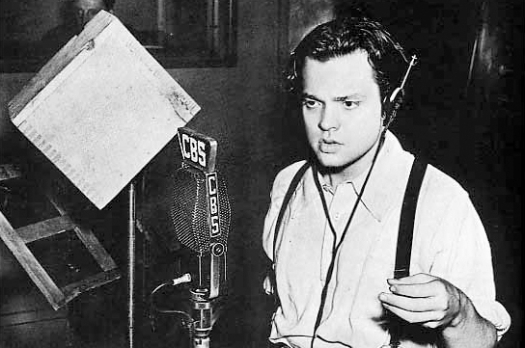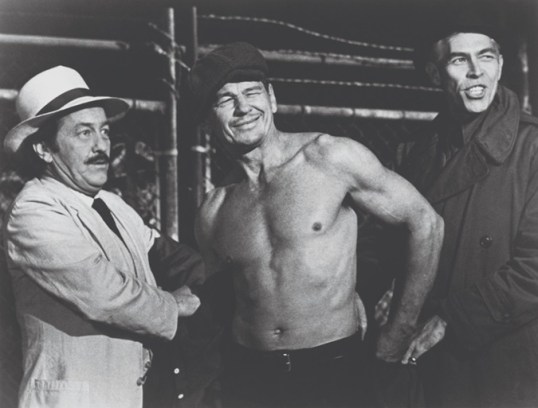
Filmed in 1957 for a television program called Westinghouse Studio One, The Night America Trembled is a dramatization of the night that Orson Welles terrified America with his radio adaptation of War of The Worlds.
For legal reasons, Orson Welles is not portrayed nor is his name mentioned. Instead, the focus is mostly on the people listening to the broadcast and getting the wrong idea. That may sound like a comedy but The Night America Trembled takes itself fairly seriously. Even pompous old Edward R. Murrow shows up to narrate the film, in between taking drags off a cigarette.
Clocking in at a brisk 60 minutes, The Night America Trembled is an interesting recreation of that October 30th. Among the people panicking: a group of people in a bar who, before hearing the broadcast, were debating whether or not Hitler was as crazy as people said he was, a babysitter who goes absolutely crazy with fear, and a group of poker-playing college students. If, like me, you’re a frequent viewer of TCM, you may recognize some of the faces in the large cast: Ed Asner, James Coburn, John Astin, Warren Oates, and Warren Beatty all make early appearances.
It’s an interesting little historical document and you can watch it below!
What’s an Insomnia File? You know how some times you just can’t get any sleep and, at about three in the morning, you’ll find yourself watching whatever you can find on cable or streaming? This feature is all about those insomnia-inspired discoveries!
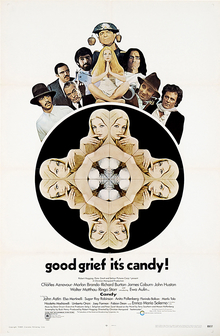
If you find yourself having trouble getting to sleep tonight, you can always pass the time by watching the 1968 film, Candy. It’s currently on Tubi.
Based on a satirical novel by Terry Southern and Mason Hoffenberg, Candy follows Candy Christian (Ewa Aulin), a naive teenager from middle America as she has a number of increasingly surreal adventures, the majority of which end with her getting sexually assaulted by one of the film’s special guest stars. It’s very much a film of the 60s, in that it’s anti-establishment without actually seeming to know who the establishment is. It opens with a lengthy sequence that appears to be taking place in outer space. It ends with an extended sequence of Candy walking amongst the film’s cast and a bunch of random hippies. Director Christian Marquand appears as himself, directing the film. Yep, this is one of those films where the director and the film crew show up and you’re supposed to be say, “Far out, I didn’t realize I was watching a movie, man.”
The whole thing is a bit of a misfire. The novel was meant to be smut that satirized smut. The film isn’t really clever enough to work on any sort of real satirical level. As was the case with a lot of studio-made “psychedelic” films in the 60s, everything is a bit too obvious and overdone. Casting the Swedish Ewa Aulin as a character who was meant to represent middle America was just one of the film’s missteps. Based on The Graduate, Mike Nichols probably could have made a clever film out of Candy. The French Christian Marquand, a protegee of Roger Vadim’s, can not because he refuses to get out of the film’s way. It’s all jump cuts, flashy cinematography, and attempts to poke fun at American culture by someone who obviously knew nothing about America beyond the jokes told in Paris.
That said, the main reason that anyone would watch this film would be for the collection of guest stars who all show up and try to take advantage of Candy. Richard Burton plays an alcoholic poet named MacPhisto and his appearance goes on for far too long. (Burton, not surprisingly, appears to actually be drunk for the majority of his scenes.) Ringo Star — yes, Ringo Starr — plays a Mexican gardener who assaults Candy after getting turned on by the sight of MacPhisto humping a mannequin. When Emmanuel’s sisters try to attack Candy, she and her parents escape on a military plane that is commanded by Walter Matthau. Landing in New York, Candy’s brain-damaged father (John Astin) is operated on by a brilliant doctor (James Coburn) who later seduces Candy after she faints at a cocktail party. Candy’s uncle (John Astin, again) also tries to seduce Candy, leading to Candy getting lost in New York, meeting a hunchback (Charles Aznavour), and then eventually ending up with a guru (Marlon Brando). Candy’s adventures climax with a particularly sick joke that requires a bit more skill to pull off than this film can afford.
If you’re wondering how all of these famous people ended up in this movie, you have Brando to thank (or blame). Christian Marquand was Brando’s best friend and Marlon even named his son after him. After Brando agreed to appear in the film, the rest of the actors followed. Brando, Burton, and Coburn received a share of the film’s profits and Coburn later said that his entire post-1968 lifestyle was pretty much paid for by Candy. That seems appropriate as, out of all the guest stars, Coburn i the only one who actually gives an interesting performance. Burton is too drunk, Matthau is too embarrassed, Starr is too amateurish, and Brando is too self-amused to really be interesting in the film. Coburn, however, seems to be having a blast, playing his doctor as being a medical cult leader.
Candy is very much a film of 1968. It has some value as a cultural relic. Ultimately, it’s main interest is as an example of how the studios tried (and failed) to latch onto the counterculture zeitgeist.
The unique character actor, Strother Martin, is established as one of the most quoted people to ever grace the silver screen. His line from COOL HAND LUKE (1967), “What we’ve got here is… failure to communicate” ranks as number 11 on the American Film Institute’s list of the 100 greatest movie quotes of all time! He’s an incredibly talented man, and every time I see him pop up on an old TV show or movie, I smile.
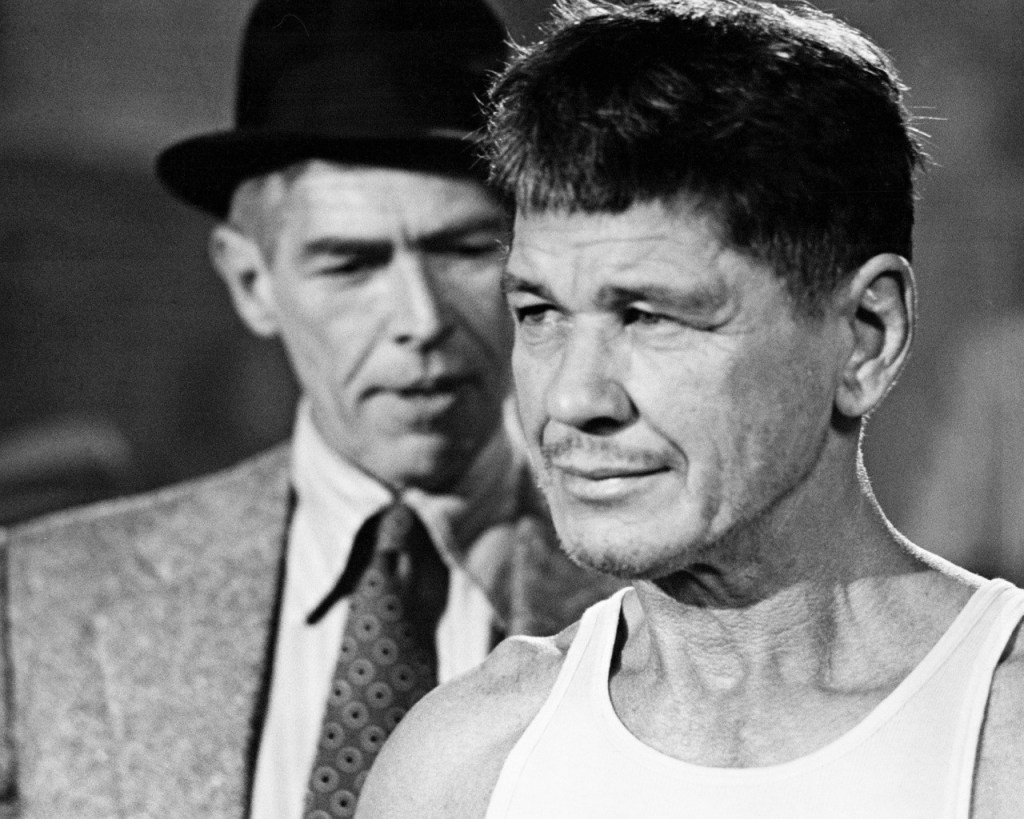
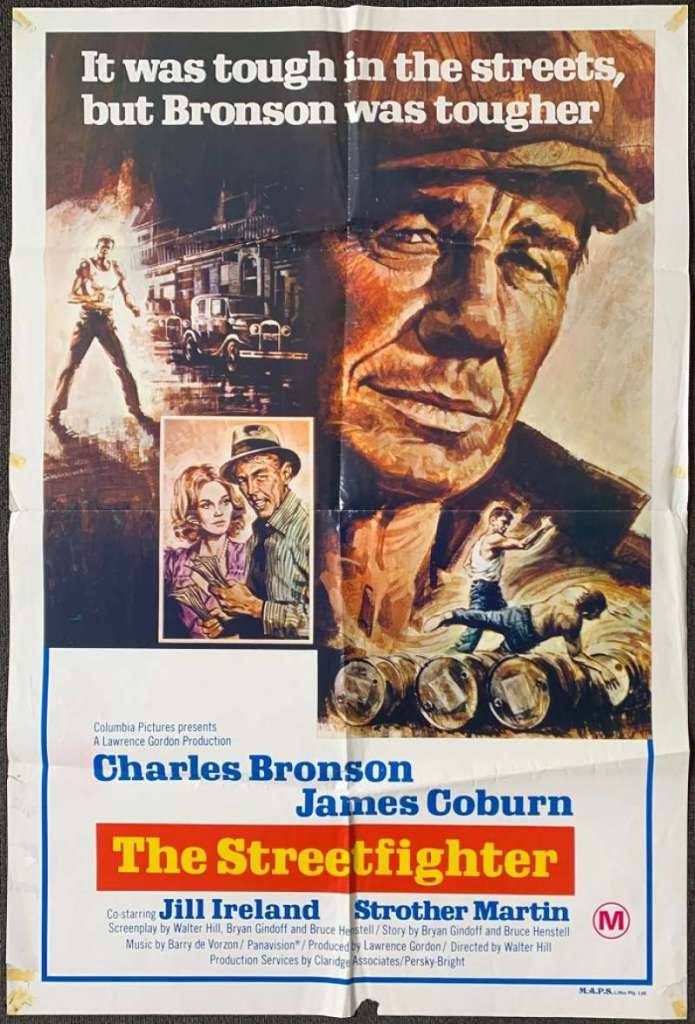
My personal favorite film of all time is HARD TIMES (1975) starring Charles Bronson, James Coburn, Jill Ireland, and yes, Strother Martin. He is so good as Poe, Charles Bronson’s cut man, who also happens to be a recovering drug addict. HARD TIMES is Walter Hill’s debut film, and Hill couldn’t have picked a better cast to introduce himself to the world. It’s my opinion that Martin’s unique talents are a perfect compliment to Bronson’s strong, silent persona, and James Coburn’s motormouth, business man. I think it’s one of his best performances.
My favorite scene with Bronson and Strother Martin in HARD TIMES is the scene where they first meet. Unfortunately, I couldn’t find it on YouTube so I’m sharing this scene where Bronson collects their earnings from a guy who cheated them earlier in the day. Martin’s character isn’t featured in this scene, but he’s always right there with Bronson as a loyal friend. On what would have been Martin’s 106th birthday, I just wanted to take a moment to remember and appreciate him for his great work.
My personal favorite Charles Bronson movie is HARD TIMES, and this is one of my favorite scenes.
As an appreciation gift for helping him all summer with his many projects, my dad took me to Wal-Mart sometime back in the 80’s and told me I could pick out a movie. Wal-Mart just happened to have a big stack of HARD TIMES videocassettes. I was about 13 years old at the time, and I was already obsessed with Bronson, but I had never seen this movie before. So, dad bought the movie for me and did something he didn’t often do, he sat down and watched it with me when we got back home. This one-punch knockout scene takes place at the very beginning of the movie, and I vividly remember my dad having a nice laugh when the scene occurred. That made me happy, as I was always wanting my family members to watch and enjoy my movies with me. It’s a special memory for me of a great time with my dad and of the very first time I saw HARD TIMES!
Walter Hill celebrates his 83rd birthday on January 10th, 2025. He has made so many great films in his career, but the one that stands out the most to me is his directorial debut from 1975, HARD TIMES, with Charles Bronson, James Coburn, Jill Ireland, and Strother Martin. The film was known as THE STREETFIGHTER in some parts of the world, like England, but due to Sonny Chiba’s “Street Fighter” movie from around the same time, the producers decided to go with HARD TIMES in America.
Here are a few more interesting facts about Hill’s directorial debut:
Chaney (Bronson) was originally supposed to be a much younger man, with Jan-Michael Vincent being considered for the role.
Charles Bronson was 52 years old when he made HARD TIMES. According to Hill, Bronson “was in remarkable physical condition for a guy his age…. He had excellent coordination, and a splendid build. His one problem was that he was a smoker, so he didn’t have a lot of stamina. I mean, he probably could have kicked anybody’s ass on that movie, but he couldn’t fight much longer than 30 or 40 seconds.”
According to Hill, Charles Bronson was easier to work with than James Coburn. Hill would say “Bronson was a very angry guy who didn’t get along with a lot of people. The only reason I can tell you he and I got along well was he respected that I wrote the script. He liked the script. I didn’t try to get close to him. Kept it very business-like. I think he liked that. James Coburn, who everybody liked and got along well with, he and I did not get along well. I think he was not in a good mood about being in a movie with Charlie, it was second banana. He had been up there more, and his career was coming back a bit. I don’t think he was wild about being second banana. But Charlie was a big star… and when things had seemed to not be working well, or there was some impasse, Charlie would come down hard on my side. That was a tipping point”.
Walter Hill thought the project could become more “up market” if he made it more like a Western and set it in the past. Hill incorporated elements of an earlier Western he had written, “Lloyd Williams and his Brother”. He wrote it in a style inspired by Alex Jacobs–“extremely spare, almost Haiku style. Both stage directions and dialogue.”
The settings for the Capcom arcade game Street Fighter are taken right from HARD TIMES. This film is titled “The Street Fighter” in Japan, and the game designer was instructed to take inspiration from this film. He did just that and copied many of them directly.
I’m so thankful for Walter Hill and HARD TIMES. In fact, it’s my all-time favorite film, as well as the first review I ever published for The Shattered Lens.
So, if you like movies like HARD TIMES, THE DRIVER, THE WARRIORS, THE LONG RIDERS, SOUTHERN COMFORT, 48 HRS., EXTREME PREJUDICE, and RED HEAT, join us in celebrating the great director Walter Hill on his 83rd birthday. He has brought me countless hours of joy over the years!
Here’s a trailer from the Masters of Cinema for HARD TIMES…
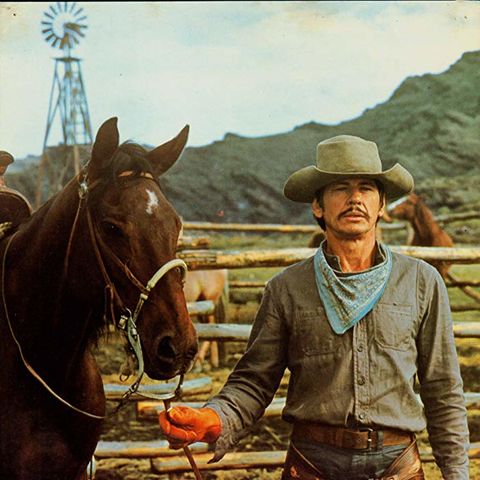
Director John Sturges was born on January 3rd, 1910. He directed some of my favorite movies, and many of them starred my movie hero, Charles Bronson. The picture above is from 1973’s CHINO!
Charles Bronson’s second role in a film was in Sturges’ THE PEOPLE AGAINST O’HARA from 1951, starring Spencer Tracy. The picture below isn’t a very good picture as Bronson was only in one scene. Can you spot Bronson??
In 1959, Sturges would direct Charles Bronson in NEVER SO FEW, which co-starred Frank Sinatra and Steve McQueen.
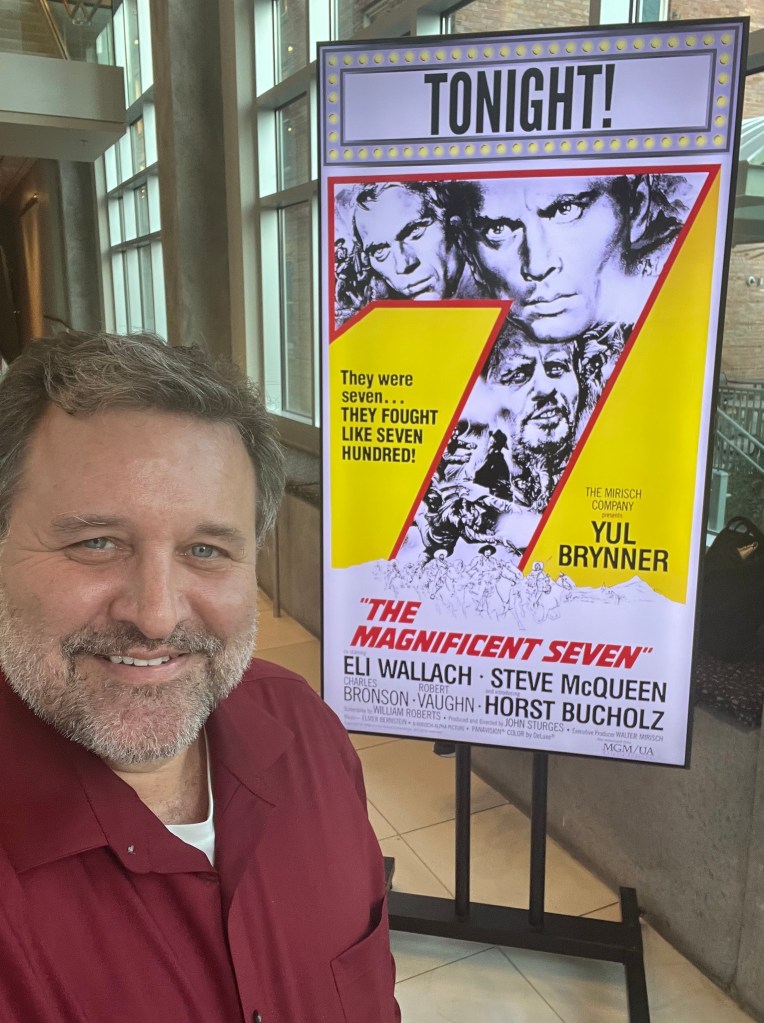
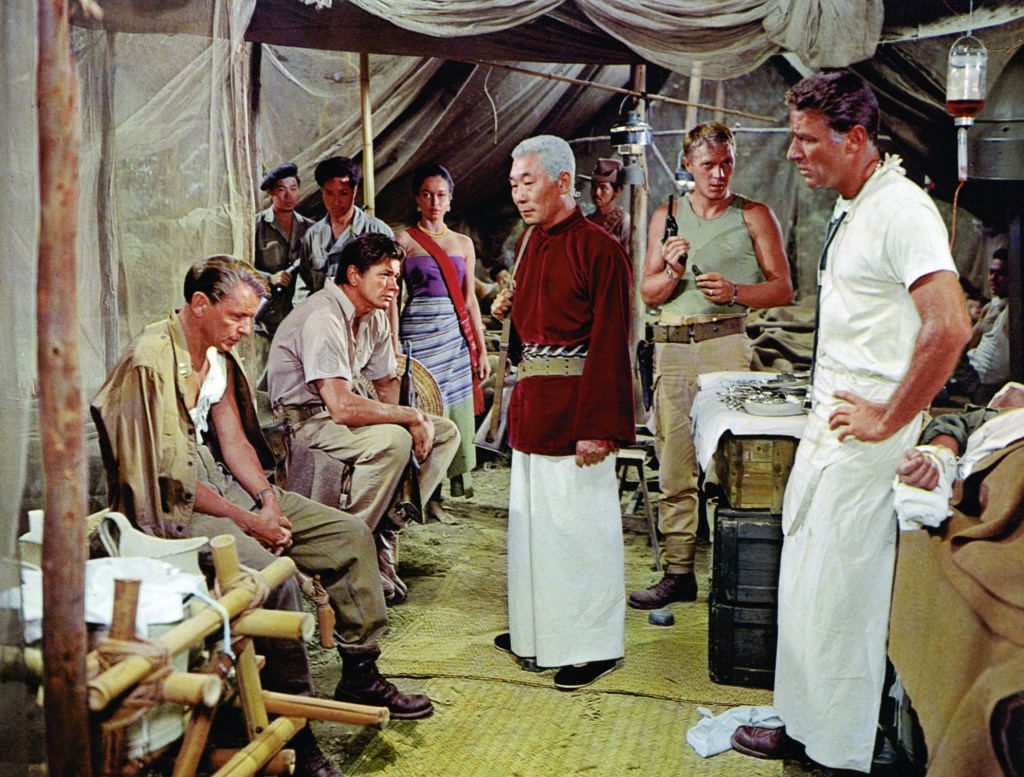
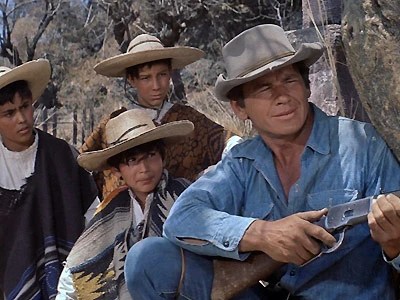
Just a year later in 1960, Sturges would direct Bronson and an all star cast that included Yul Brynner, Steve McQueen, James Coburn and Robert Vaughn in THE MAGNIFICENT SEVEN, a remade of the Akira Kurosawa classic THE SEVEN SAMURAI. Bronson’s role as Bernardo O’Reilly is one of the best in the entire film.
John Sturges would direct Charles Bronson again in 1963 in the classic film THE GREAT ESCAPE, which also starred Richard Attenborough, Steve McQueen, James Garner, James Coburn and Donald Pleasence. Charles Bronson drew on his experience in the coal mines of Pennsylvania when he played “The Tunnel King” in the classic World War II film. Charles Bronson is one of the characters who actually escapes, which made me very happy!
John Sturges would direct Charles Bronson one more time in the underrated western from 1973, CHINO (pictured at the top). Sturges was a phenomenal director, and Charles Bronson was in some of his very best work! As Charles Bronson’s biggest fan, Sturges will always be one of my favorite directors!!
HARD TIMES is probably the best movie that features Charles Bronson in the lead, and it’s my personal favorite movie of all time as of the date of this review. I reserve the right to change this opinion at any time!
Charles Bronson is Chaney, a drifter who’s riding the rails in the south during the great depression. Soon after getting off the train in some unnamed southern town, Chaney comes across an underground “fight” where we first meet Speed, played by the great James Coburn. It seems Speed is the money man for this big lug of a fighter who gets his butt kicked in front of God, the local underground fighting world, a man with horrible teeth, and Chaney. After witnessing this fiasco, Chaney follows Speed to a local restaurant where he apparently waits in the shadows until Speed goes up to the counter to get a refill of oysters and a couple of lemons. I say this because when Speed turns from the counter with his newly filled tray, Chaney is sitting at Speed’s table. I’m surprised that Speed even talks to him because the first thing Chaney does is help himself to an oyster, WITHOUT EVEN ASKING! Even with this breach of etiquette, Speed discusses the fight from earlier in the evening with Chaney, who offers his fighting services to Speed since the “big lug” is clearly not a good investment into the future and who is probably in a hospital overnight dealing with a concussion. Speed is hesitant to accept this offer since Chaney appears to be fairly old (Bronson was 53 when he made the film), but he changes his mind when Chaney offers his last $6 bucks to Speed to bet on him. Cut to Chaney getting his chance to fight. This is a fun scene because his opponent is the same fighter from earlier who kicked the big lug’s butt. The guy even taunts Chaney for being too old. The fight starts and it consists of two hits, Chaney hits the smartass, the smartass hits the ground. Somewhat amazed, Speed takes Chaney to New Orleans, and the two embark on an odyssey together to win fights and make thick wads of cash. The remainder of the film documents that odyssey, although it does take time out for a few “in-betweens.”
HARD TIMES is one of Bronson’s best films, and one of the main reasons why is that it provides a boatload of audience satisfaction. There are many examples of this. First is the scene mentioned above where Chaney takes out the smirking, dismissive fighter who sees our hero as too old. Too old my ass! In another scene, a bunch of unrefined Cajuns out in the boondocks refuse to pay up after Chaney kicks their fighter’s butt. Rather than pay up, the slimy Cajuns pull out a gun and dare Speed and Chaney to come take the money. Our heroes leave at that time, but Chaney convinces them to hang around out in the country for awhile so they can surprise the Cajuns under the cover of darkness at the local honkytonk, which happens to be owned by the head slimy Cajun. Chaney takes the gun, takes the money, and then shoots up the place with the gun, grinning as he saves the last bullet to shoot a mirror he’s looking directly into. It’s a fun scene that ends with Chaney, Speed and the gang speeding off into the night laughing like hyenas! In another scene, Chaney takes on the big, bald-headed, unbeatable fighter Jim Henry (Robert Tessier) in an awesome cage match. Let’s just say Jim Henry thought he was unbeatable and leave it at that. And finally, a competing New Orleans money man (Jim Henry’s guy) just can’t stand that he no longer has the top fighter in town, so he brings in a fighter from Chicago to take on Chaney. I won’t tell you what happens, but it’s some really fun stuff!
The cast of HARD TIMES also elevates the film to top tier status. I’ve already discussed Bronson and Coburn, but Strother Martin and Jill Ireland also add to the joy. Martin plays Poe, Chaney’s drug addict cut man, who dresses up like he could grow up to be Colonel Sanders in his older age. It’s a fun performance that adds a lot to the film. Jill Ireland plays Chaney’s love interest. She’s quite beautiful, but she seems to always be giving Chaney a hard time about what he does for a living. His response is usually to simply leave when she starts that BS. I thinks that’s kind of fun too.
And finally, this was the directorial debut of Walter Hill, the man behind THE WARRIORS, THE DRIVER, THE LONG RIDERS, SOUTHERN COMFORT, 48 HOURS, and RED HEAT. His movie is lean and mean, without a wasted moment that isn’t moving the film along. Hill has crafted a fun movie, filled with great performances. I think it’s one of the most underrated films of the 1970’s!
Filmed in 1957 for a television program called Westinghouse Studio One, The Night America Trembled is a dramatization of the night that Orson Welles terrified America with his radio adaptation of War of The Worlds.
For legal reasons, Orson Welles is not portrayed nor is his name mentioned. Instead, the focus is mostly on the people listening to the broadcast and getting the wrong idea. That may sound like a comedy but The Night America Trembled takes itself fairly seriously. Even pompous old Edward R. Murrow shows up to narrate the film, in between taking drags off a cigarette.
Clocking in at a brisk 60 minutes, The Night America Trembled is an interesting recreation of that October 30th. Among the people panicking: a group of people in a bar who, before hearing the broadcast, were debating whether or not Hitler was as crazy as people said he was, a babysitter who goes absolutely crazy with fear, and a group of poker-playing college students. If, like me, you’re a frequent viewer of TCM, you may recognize some of the faces in the large cast: Ed Asner, James Coburn, John Astin, Warren Oates, and Warren Beatty all make early appearances.
It’s an interesting little historical document and you can watch it below!
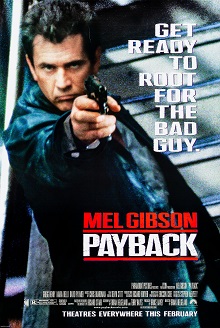
The 1999 film, Payback, opens with Porter (Mel Gibson) lying on a kitchen table while a grubby-looking doctor digs two bullets out of his back. The scene takes place in almost nauseating close-up, with the emphasis being put on the amount of pain that Porter endures to get rid of those bullets. Immediately, we know that Porter is not someone who can safely go to a regular hospital. Porter is someone who exists in the shadows of mainstream society.
He’s also someone who spends a lot of time getting beaten up. Even back when he was still a big star, Mel Gibson always seemed to spend a good deal of his films getting beaten up and tortured in various ways and that’s certainly the case with Payback. Porter gets punched. Porter gets shot. Porter has a encounter with an over-the-top dominatrix (played by Lucy Liu). At one point, Porter allows two of his toes to be smashed by a hammer, just so he can trick the his enemies into doing something dumb. As played by Gibson, Porter stumbles through the film and often looks like he’s coming down from a week-long bender. It’s interesting to think that Payback is a remake of 1967’s Point Blank, which starred Lee Marvin as Walker, an unflappable career criminal who never showed a hint of emotion or weakness. Porter, on the other hand, is visibly unstable and spends the entire film on the verge of a complete mental collapse. A lot of people try to kill Porter and Porter kills almost all of them without a moment’s hesitation.
(Of course, both Porter and Point Blank‘s Walker are versions of Parker, a career criminal who was at the center of several crime novels written by Donald “Richard Stark” Westlake.)
After helping to pull off a $140,000 heist from a Chinese triad, Porter was betrayed and left for dead by his former friend Val Resnick (Gregg Henry) and his wife, Lynn (Deborah Kara Unger). Porter, who just wants the $70,000 cut that he was promised, starts his quest for the money by tracking down Val and Lynn, and then continues it by going after the three bosses (played by William Devane, James Coburn, and Kris Kristofferson) of “The Outfit,” a shadowy organization that Val had gotten involved with. Along the way, Porter deals with a motely crew of corrupt cops, violent criminals, and sleazy middlemen. (David Paymer has a memorable bit as a low-level functionary with atrocious taste in suits.) Porter also hooks up with a prostitute named Rosie (Maria Bello), who might be the only person that he can actually trust.
I have mixed feelings about Payback. (So did director Brian Hegeland, who was reportedly fired towards the end of shooting and later released a far different director’s cut.) Though the film does a good job of capturing the visual style of a good neo-noir, the story itself is so violent and grim that it actually gets a little bit boring. The film’s advertising encouraged audiences to “Get ready to root for the bad guy,” but there’s really no reason to root for Porter. He’s an inarticulate and ruthless killer with no sense of humor. If anything, the people that he kills seem to be far more reasonable and likable than he does. In Point Blank, Lee Marvin may have been a bastard but he was good at what he did and you at least got the feeling that he wouldn’t go after any innocent bystanders. In Payback, Porter is such a mess that his continued survival is largely due to dumb luck. It’s hard to root for an idiot.
That said, the film does do a good job of capturing the feeling of people living on the fringes of society. The Outfit is not a typical Mafia family but instead, a collection of businessmen who work out of nice offices and, in the case of William Devane’s Carter, come across as being more of a senior executive than a crime boss. (James Coburn and Kris Kristofferson, meanwhile, come across as being two former hippies who made it rich on Wall Street. They’re elderly versions of Abbie Hoffman and Jerry Rubin.) The film does a good job of creating a world where no one trusts anyone and everyone is being watched by someone. In one memorable scene, the three men sent to watch for Porter discover that he’s been watching them the entire time. Never forget to look over your shoulder to see who might be following.
Flaws and all, this 1999 film does a good job of capturing the atmosphere of paranoia that, for many, would come to define the early part of the 21st Century.
Filmed in 1957 for a television program called Westinghouse Studio One, The Night America Trembled is a dramatization of the night in 1938 when Orson Welles’s adaptation of H.G. Wells’s The War of the Worlds reportedly caused a panic amongst listeners.
For legal reasons, Orson Welles is not portrayed nor is his name mentioned. Instead, the focus is mostly on the people listening to the broadcast and getting the wrong idea. That may sound like a comedy but The Night America Trembled takes itself fairly seriously, complete with Edward R. Murrow narrating and taking drags off of a cigarette.
Clocking in at a brisk 60 minutes, The Night America Trembled is an interesting recreation of that October 30th. Among the people panicking are a large collection of future stars and character actors. Ed Asner, James Coburn, John Astin, Warren Oates, and Warren Beatty all make early appearances.
It’s an interesting historical document and you can watch it below!