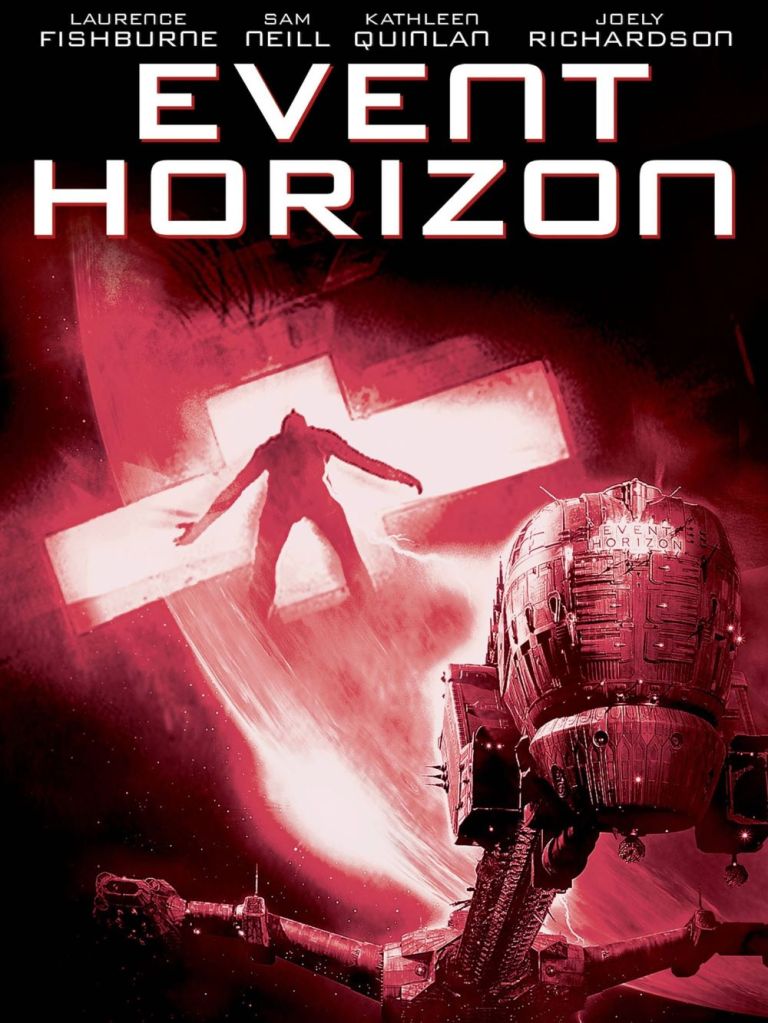
“You know nothing. Hell is only a word. The reality is much, much worse.” — Dr. Weir
Paul W.S. Anderson’s 1997 film Event Horizon stands out as a memorable mix of science fiction and horror, remembered for its gripping atmosphere and disturbing visuals. The story is set in 2047: a rescue crew aboard the Lewis and Clark is sent out to recover the long-missing spaceship Event Horizon, a vessel built to test a new kind of faster-than-light travel. Onboard with them is Dr. William Weir, the Event Horizon’s creator, who explains that the ship vanished after first activating its “gravity drive,” which can fold space to allow for instant travel across vast cosmic distances.
Soon after reaching the drifting Event Horizon, the crew discovers signs of mass violence and horror. They recover a disturbing audio message and realize something traumatic happened to the original crew. As they search for survivors, they experience intense and personal hallucinations—memories and fears brought to life by the ship. It becomes clear that the Event Horizon didn’t just jump through space; it traveled to a place outside reality, a nightmarish interdimensional realm resembling hell.
What makes Event Horizon particularly unique is its concept of hell as an alternate dimension that can infect and corrupt whatever or whoever crosses into it. The ship’s gravity drive doesn’t simply facilitate faster travel—it accidentally opens a gateway to this chaotic, malevolent place. This portrayal of hell as a dangerous interdimensional reality that preys on minds and bodies echoes the idea found in the massive gaming property Warhammer 40K, where hell is depicted as the Warp, a dimension of chaos that corrupts and drives people insane. Like the Warp, the film’s hell is an unpredictable, hostile realm where sanity and physical form break down, infecting and warping everything that comes into contact.
Visually, the film relies on claustrophobic corridors, flickering lights, and unsettling sounds to keep the audience off-balance. The design of the ship itself—part gothic cathedral, part industrial nightmare—adds to the sense of unease and dread throughout. The use of practical effects and detailed sets grounds the sci-fi terror in something tangible, making it all feel more immediate and believable.
Event Horizon also hints at bigger philosophical questions: how far should science go, and what happens when the drive for knowledge is unchecked by ethics or humility? The gravity drive is a technological wonder, but it’s treated with little caution by its inventor, and the catastrophic results suggest that some discoveries may be better left unexplored. The ship becomes both a literal and figurative vehicle for exploring the limits of human ambition and the dangers of pushing beyond them.
As the movie builds toward its climax, the rescue crew faces increasingly desperate odds. The possessed Dr. Weir, now an outright villain, sees the hellish dimension the gravity drive visited as the next step for humanity—a place of chaos and suffering. Multiple characters die in gruesome ways, and the survivors have to fight their own fears and the haunted ship itself. The ending is chilling and ambiguous, leaving open the possibility that the ship’s evil has not been fully contained.
At release, Event Horizon divided critics and audiences. Some found the violence and nightmare imagery too intense or the story too messy to follow. Others praised its ambition and the way it blends psychological horror with cosmic sci-fi. Over the years, the film has developed a cult reputation, frequently cited as one of the more effective and original space horror movies. Its legacy can be seen in later media, especially in video games that tackle similar haunted spaceship scenarios.
However, the film is not without flaws. Many viewers and critics point out uneven pacing, especially in the second half where tension sometimes drains away. The characters often act inconsistently or make choices that feel unrealistic for trained astronauts, which undermines the suspense. The script’s tonal shifts—from serious psychological drama to moments that unintentionally verge on camp—can jolt the viewer out of the experience. The use of jump scares is sometimes predictable, and the film’s heavy reliance on loud, chaotic sequences instead of quiet suspense can feel overwhelming. Some CGI effects haven’t aged well, contrasting with the otherwise impressive practical effects and set design. Acting performances are mixed too; while Sam Neill and Laurence Fishburne are strong, some supporting cast members lack conviction, making emotional engagement uneven.
Importantly, Event Horizon represents Paul W.S. Anderson at his most subtle and effective in directing. Compared to many of his later films, where his style often becomes frenetic and unchecked—possibly due to a lack of producer control—Event Horizon is more controlled, atmospheric, and haunting. This balance between style and substance makes it one of Anderson’s better directorial works, if not his best to date. The film showcases his interest in spatial geography, the use of negative space, and claustrophobic production design, all elements he would expand on in his later work but never as effectively deployed as here. The haunting visual touches, combined with his ability to direct actors and maintain tension, set Event Horizon apart from his more bombastic, less focused later entries.
Despite its flaws, Event Horizon remains gripping and memorable. Its strengths lie in combining deeply personal psychological horror with the vast, terrifying unknown of space and alternate realities. The film explores not just external threats, but also how guilt, fear, and trauma can be weaponized by forces beyond human understanding. For viewers seeking more than a standard haunted spaceship story, Event Horizon offers a disturbing, thought-provoking glimpse into the dark frontier of science, faith, and madness. It stands as a cult classic of sci-fi horror that continues to inspire discussion about the dangers of pushing too far into the unknown.
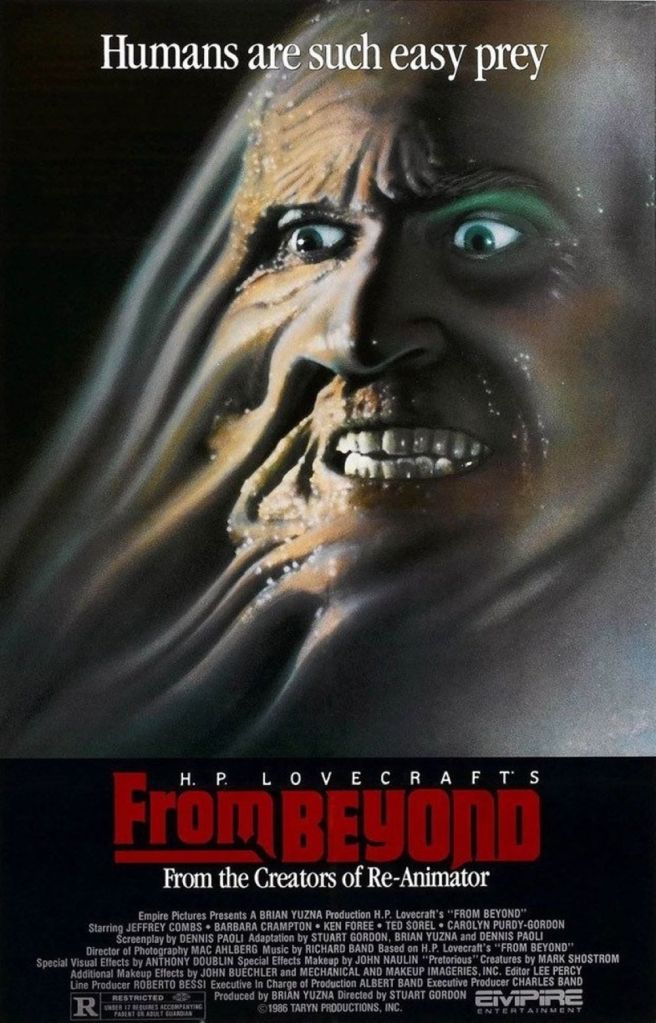
“You’re diving deeper than any sane man ever should.” — Dr. Katherine McMichaels
Stuart Gordon’s From Beyond (1986) stands as a darker, moodier follow-up to his breakout Lovecraft adaptation, Re-Animator (1985). At its core is the Resonator, a bizarre scientific contraption designed to stimulate the pineal gland—allowing its users to glimpse eerie creatures and dimensions normally invisible to the naked eye. When Dr. Crawford Tillinghast (Jeffrey Combs) activates the device, it unleashes horrors not just upon the world but also within the minds and bodies of those involved, blurring the line between reality and nightmare in a way both terrifying and hypnotic.
Just like with Re-Animator, Gordon used H.P. Lovecraft’s short story From Beyond as a foundation but expanded the narrative significantly by injecting his own creative vision and filling in what Lovecraft left unexplored. Lovecraft’s original story is a brief, eerie vignette about stimulating the pineal gland to perceive alternate dimensions and terrifying alien creatures—minimalistic and atmospheric, leaving much to the imagination. Gordon reimagines this premise into a fully fleshed-out narrative, adding complex characters like the obsessive Dr. Edward Pretorius and the rational yet vulnerable Dr. Katherine McMichaels. He enriches the story with body horror, psychological torment, and a deeper thematic exploration of sexuality, obsession, and the fragility of the mind. This creative expansion transforms the story into something far more personal and tangible, blending cosmic horror with primal human fears and desires.
This tonal shift stands in stark contrast to Re-Animator, which thrives on anarchic gore, slapstick comedy, and a playful mad-scientist energy. From Beyond trades much of the humor for a somber, unsettling atmosphere drenched in slime, grotesque transformations, and claustrophobic dread. The characters are more grounded in psychological trauma, and the film’s pacing emphasizes creeping unease rather than chaotic spectacle. Gordon’s use of stark, hallucinatory lighting and saturated colors enhances this otherworldly feeling, while practical effects bring a tactile horror to life that heightens the visceral and emotional impact. The horror isn’t just external—it’s internal, a fracture of reality and self.
One of the most notable ways From Beyond separates itself from Gordon’s earlier work is in its overt intertwining of sexuality and horror. The Resonator doesn’t just expose alien creatures; it unlocks primal lust and repressed desires in its users. Scenes imbued with uneasy erotic tension, especially involving Barbara Crampton’s character, make sexuality a core source of vulnerability and terror. This blend of eroticism and nightmare adds depth and psychological complexity, exploring how intimate human experiences can be distorted into something terrifying. It’s a thematic boldness that would become highly influential beyond Western cinema.
Indeed, the film’s fusion of sexual subtext, body horror, and psychological unease foreshadowed themes embraced by late 1980s and early 1990s Japanese horror hentai anime. Works such as Angel of Darkness (Injū Kyōshi) combined explicit eroticism, grotesque body transformations, and supernatural horror in ways reminiscent of From Beyond’s style and tone. This synergy helped define a subgenre of adult horror anime where the boundaries between pleasure and terror, desire and monstrosity, are constantly blurred—cementing From Beyond not only as a cult classic in horror but also as an inspirational bridge to pioneering adult animation in Japan.
Visually and atmospherically, the film is a masterpiece of practical effects and immersive storytelling. The slime-drenched creatures, anatomically warped bodies, and constant visual flow between nightmare and distorted reality create a hallucinatory experience. The climax offers a frenetic, visceral battle that embodies the film’s core themes of madness, transformation, and cosmic terror, leaving viewers with a lingering sense of unease and wonder.
Stuart Gordon’s direction also employs incredibly effective subjective perspectives, with many scenes shot from the characters’ points of view. This technique immerses viewers in the unfolding madness and heightens the sensory overload that defines the film’s experience. There is a famously unsettling point-of-view shot from the mutated Crawford as he perceives a brain inside a doctor’s head and gruesomely attacks. Such moments amplify the film’s exploration of altered perception and the treacherous expansion of human senses.
Despite these strengths, the film is not without flaws. Ken Foree’s character, Bubba Brownlee, while providing moments of grounded streetwise humor, sometimes comes off as a caricature that leans into stereotypical portrayals of Black men as taboo or outlier figures in horror cinema. This portrayal feels somewhat jarring against the film’s otherwise nuanced tone and may evoke discomfort.
Additionally, From Beyond can feel comparatively stiff and sluggish next to Re-Animator, lacking some of the earlier film’s darkly comic energy. The story often relies on a series of increasingly grotesque set pieces that feel more like shock showcases than a cohesive narrative arc. Some performances, including Jeffrey Combs’ lead, occasionally seem overly intense without sufficient emotional variation, and the film sometimes slips into melodrama that undercuts its impact. Furthermore, although ambitious in visualizing Lovecraftian horrors, budgetary constraints are occasionally evident, diminishing some of the awe those moments seek to inspire.
Ultimately, Gordon’s From Beyond is a significant Lovecraft adaptation that showcases the power of expanding upon source material with bold creativity. Moving beyond Lovecraft’s sparse prose, Gordon infuses the story with rich characters, psychological depth, explicit body horror, and mature explorations of sexuality. This results in a haunting, distinctly unsettling film that not only stands as a high point in Gordon’s career but also resonates far beyond its American horror roots, shaping international horror aesthetics and inspiring future genres. It is a disturbing, thrilling journey to the dark spaces just beyond human perception—a cinematic experience that lingers in the mind long after the screen fades to black.
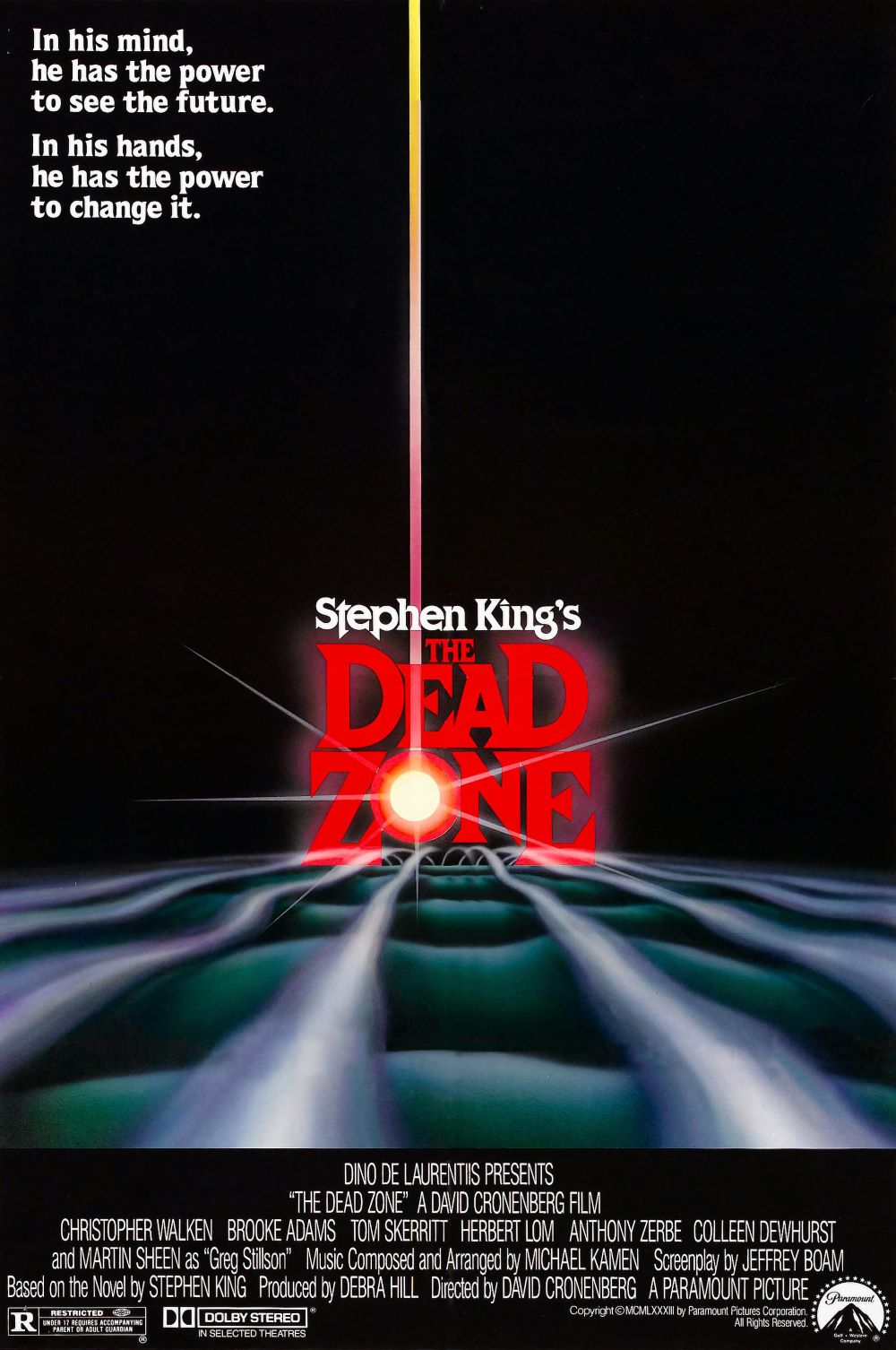
“Bless me, Father, for I have sinned. I had the power… and I tried to prevent what I saw.” — Johnny Smith
In 1983, David Cronenberg adapted Stephen King’s The Dead Zone with a distinctive emphasis on mood, morality, and psychological depth rather than traditional horror spectacle. The film follows Johnny Smith (Christopher Walken), a small-town schoolteacher whose life transforms irrevocably after a traumatic car accident leaves him in a five-year coma. Upon awakening, Johnny discovers he possesses psychic abilities that allow him to see the past and future by touch. Rather than a gift, this power becomes a heavy burden, isolating him and forcing him into wrenching moral choices.
Cronenberg’s direction is meticulous and deliberately restrained. The film’s muted color palette and stark winter landscapes visually echo Johnny’s emotional isolation and the fragility of human existence. His careful, often gliding camera movements create a mounting sense of quiet dread, while minimalistic sound design underscores moments of revelation with haunting subtlety. This subdued style elevates the film’s psychological impact, transforming it into a thoughtful and melancholy meditation on the cost of harrowing knowledge.
Significantly, The Dead Zone marks a departure from Cronenberg’s signature body horror. Instead of the grotesque physical transformations and visceral mutations that characterize much of his other work, here Cronenberg turns inward. The real horror lies in the malleability of the mind and the elusive nature of perception—how reality, memory, and the future are unstable constructs that can shift and fracture under psychic strain. This thematic focus on the impermanence and distortion of mental reality touches on some of Cronenberg’s deepest artistic fascinations.
The restrained treatment of body horror in The Dead Zone previews the director’s later, more psychologically driven films such as A History of Violence, Eastern Promises, and A Dangerous Method, where character studies and narrative depth take precedence over startling visuals. In this early pivot, Cronenberg demonstrates that his mastery lies not only in visual spectacle but in probing the profound emotional and moral dilemmas faced by his characters. The vision-focused horror here is cerebral and grounded, rooting supernatural phenomena in human frailty and ethical complexity.
Christopher Walken’s nuanced portrayal is the emotional heart of the film. He captures Johnny’s vulnerability, weariness, and profound solitude, portraying a man burdened by a cursed knowledge that isolates him from the world. Martin Sheen plays Greg Stillson, the ambitious and morally bankrupt politician whose rise Johnny must foretell and who embodies the film’s central threat. The supporting cast, including Brooke Adams as Johnny’s lost love Sarah and Tom Skerritt as Sheriff Bannerman, delivers compelling and authentic performances that humanize the film’s intimate, small-town environment.
Several changes from King’s novel sharpen the film’s thematic focus. The novel’s sprawling plot, including a serial killer subplot and a brain tumor storyline symbolizing Johnny’s mortality, is pared down or omitted. Despite this trimming, the serial killer element retained in the film remains chilling and effective. It highlights the darker repercussions of Johnny’s psychic gift and injects a tangible sense of dread, reinforcing the psychological weight Johnny carries. This subplot grounds the supernatural within a disturbing reality, illustrating the violent and tragic circumstances Johnny must grapple with as part of his burden.
The concept of the “dead zone” itself shifts in meaning. Originally, the term referred to parts of Johnny’s brain damaged by the accident, blocking certain visions. Cronenberg reinterprets it as a metaphor for the unknown and unknowable parts of the future—the gaps in psychic clarity that allow for free will and change. This subtle shift reshapes the narrative toward a more ambiguous, hopeful meditation on destiny and human agency.
Compared to King’s novel, Cronenberg’s Johnny is more grounded and isolated. The novel frames Johnny’s struggle within a broader spiritual and fatalistic context, highlighted by the looming presence of a brain tumor and a nuanced exploration of hope versus resignation. The film, by contrast, focuses on the emotional and moral fatigue induced by Johnny’s psychic gift, emphasizing his loneliness and reluctant responsibility rather than supernatural destiny.
Walken’s restrained, haunting performance strips away mythic grandeur to reveal a deeply human character. The film’s narrowed narrative tightens focus on Johnny’s internal anguish and his difficult ethical choices, making his plight intimate and richly relatable.
On a thematic level, The Dead Zone contemplates fate, free will, and sacrifice. Johnny’s psychic abilities act as a draining, almost chthonic force, transforming him into a reluctant prophet who is tasked with intervening in grim futures at great personal cost. The film’s bleak winter setting visually reflects Johnny’s alienation, while its deliberate pacing highlights the exhaustion and heartbreak that comes with such knowledge.
Ultimately, Cronenberg’s The Dead Zone goes beyond supernatural thriller conventions. It is a profound meditation on empathy, sacrifice, and the human condition—where the greatest horrors are internal, and the cost of knowledge is both psychic and emotional. Johnny Smith emerges as a tragic, flawed figure wrestling with unbearable burdens.
Cronenberg’s direction and the impeccable performances make The Dead Zone a standout in King adaptations. The film’s enduring impact lies in its rich thematic texture, its moral ambiguity, and its unflinching exploration of human frailty, all conveyed through a director shifting skillfully from physical body horror to psychological and existential terror. The film remains as haunting and resonant now as it was upon release, a testament to the synergy of Cronenberg and King’s extraordinary talents.
Unflinching, subversive, and dripping in corrosive dark humor, Sion Sono’s Cold Fish (2010) doesn’t just showcase Japan’s taste for genre-bending horror—it rips open the underbelly of polite society and exposes what writhes beneath. If I Saw the Devil was a descent into the abyss of revenge, Cold Fish is a fever-dream trek through manipulation, depravity, and the most repressed corners of the psyche. Built around the crucible of violence and sex, Sono’s film dares viewers to question not only the shape of evil, but whether the forces that awaken it could be lurking in anyone.
Before Cold Fish, Sono had already established himself as a subversive force in horror with his earlier film Suicide Club (2001), which helped him gain a loyal cult following and introduced him to the genre scene at large as an innovative and provocative filmmaker unafraid to challenge conventions. With Cold Fish, Sono refined his style, offering a tighter, more psychologically driven narrative that accelerates the intensity while probing deep societal anxieties.
Inspired by the real-life Saitama serial murders of the 1990s, committed by dog breeder Gen Sekine and his common-law wife Hiroko Kazama, Cold Fish draws chilling authenticity from these events. Sekine and Kazama ran a pet shop and poisoned several customers before dismembering their bodies to conceal the murders. Sono reimagines this disturbing history by transforming the pet shop into a tropical fish store and fictionalizing details while preserving the core themes of manipulation, complicity, and violence.
The story opens with Nobuyuki Syamoto, the definition of a beaten-down everyman: a tropical fish shop owner whose daughter openly hates her stepmother, whose marriage is half-drowned in silent resentment, and who drifts through life as little more than a shadow. From the outset, Syamoto’s passivity sets a tremulous undertone—terrible things are happening, but he isn’t doing much to stop them. That changes the moment his daughter Mitsuko is caught stealing and rescued by the charismatic Yukio Murata, proprietor of a flashier fish store. Murata’s manners and generosity are overwhelming, almost caricatured, yet there’s an edge of anticipation: something is amiss, and Sono lets the feeling gradually curdle beneath his gentle facade.
Murata’s initial charm morphs into coercive control as he manipulates the Syamoto family into his orbit. When Syamoto is coerced to become Murata’s “business partner,” the narrative takes its first graphic, kinetic turn: a sales pitch for a rare tropical fish goes lethally wrong. Murata poisons a buyer in cold blood, then erupts into violence, forcing Syamoto and his wife into complicity by helping dispose of the body. The shift is immediate and nightmarish—the performance by Denden (Murata) snaps from quirky salesman to a near-mythical monster, as terrifying for his unpredictability as for his casual approach to killing.
From here, Cold Fish dives into a spiral of murder, sexual domination, and psychological torture. Murata and his partner Aiko have murdered dozens, perfecting the art of erasing their victims. As the body count rises, Sono’s camera remains hauntingly restrained: eschewing frantic cuts for long takes, keeping his characters center-frame, locking viewers in Syamoto’s dread-soaked POV. We are forced to witness every mechanical step in the pair’s routine—the body disposal, the literal scattering of ashes, the casual cruelty.
What makes Cold Fish such a disturbing experience is not merely the gore (though the final act is blood-soaked chaos), but the way deviance is normalized, even made bureaucratic. Murata’s operation feels part nightmare, part dull corporate job. This banality breeds horror. At times, Sono punctuates scenes with black comedy: surf rock tunes play in the background as mutilated bodies are processed in Murata’s shop, and his wife’s participation has a twisted, deadpan humor that makes the violence doubly unsettling.
Syamoto’s trajectory is the film’s secret weapon. By trapping us in his perspective, Sono draws out the uncomfortable reality of learned helplessness, craven compromise, and the latent violence beneath a repressive facade. Syamoto isn’t a hero or anti-hero, but a study in desperation and dissolution. His initial submission slowly ferments into rage, and when he finally snaps, the violence is primal and cathartic—a vengeance that feels less like triumph and more like an act of obliteration. Instead of a neat moral arc, Sono’s script is obsessed with the ambiguity of retribution: what festers beneath apathy, what trauma does when left unaddressed, and what the need to act breeds when suppressed for too long.
This thematic preoccupation connects Cold Fish to the likes of I Saw the Devil: both movies use revenge not as justice, but as a mirror for corruption—how far can the ordinary man go before he becomes indistinguishable from the monsters tormenting him? Sono’s film is ultimately more nihilistic, using social commentary as a subtle undertow, with critiques of Japanese conformity, sexuality, and family decaying beneath the surface. The result is a film that is both emotionally exhausting and intellectually provocative.
Technically, Cold Fish offers Sono at his most focused. The cinematography is subtle but relentless, with natural camera movement amplifying character reactions rather than indulging in spectacle. The use of Mount Fuji as a backdrop for scenes of violence is striking and effective. Costume, color palette, and setting all speak of an ordinary world slowly overtaken by surreal terror. The score plays off these moments, with music choices ranging from nervy tension to surf-rock irony.
The performances are uniformly superb. Denden is magnetic as Murata—making each mood shift obvious, unpredictable, and horrifying. Mitsuru Fukikoshi’s portrayal of Syamoto is raw, fragile, and ultimately explosive. The supporting cast amplifies the film’s extremes without ever feeling cartoonish. Sono pushes them to the edge, finding both tragedy and queasy humor in their unraveling. The sound design, especially in scenes of dismemberment and violence, is overwhelming and intense—forcing the audience into a sensory trap that mirrors Syamoto’s psychological implosion.
Yet Cold Fish isn’t just an exercise in gore or cruelty—it’s an autopsy of repression, cowardice, and compulsion, watched through the lens of a culture known for its traditions of obedience. The film asks what drives people to murder, what keeps them silent, and what happens when those limits are breached. It never gives viewers easy sympathies or clean answers, and the ending is deliberately unnerving—Syamoto’s transformation is complete, but it isn’t heroic, nor is it redemptive.
For some, the film’s length and relentless tone will be too much. Others have pointed out its over-the-top final act, and some feel the excessive violence is hard to justify. However, these very qualities are what cement Cold Fish as a significant work in contemporary Japanese horror—it’s the sort of movie that claws at you for days, sticking in the brain with its grim humor and powerful sense of unease. Like I Saw the Devil, it’s less about catharsis than about exposing the permanent scars left by evil and revenge, and the horrifying possibility that what lurks under the surface of normality is just waiting for an invitation to come out.
Ultimately, Sion Sono’s Cold Fish is an important piece of modern horror—not simply for its brutality, but for its relentless psychological excavation and perverse humor. By channeling the real Saitama serial murders into a study of psychological torment and complicity, Sono creates a film that is designed to provoke, to disturb, and to make audiences ask where the boundaries of morality might finally break. For genre fans, it’s a bracing, unforgettable experience; for those who approach with caution, it’s both a warning and an invitation to glimpse the heart of darkness just beneath the surface.
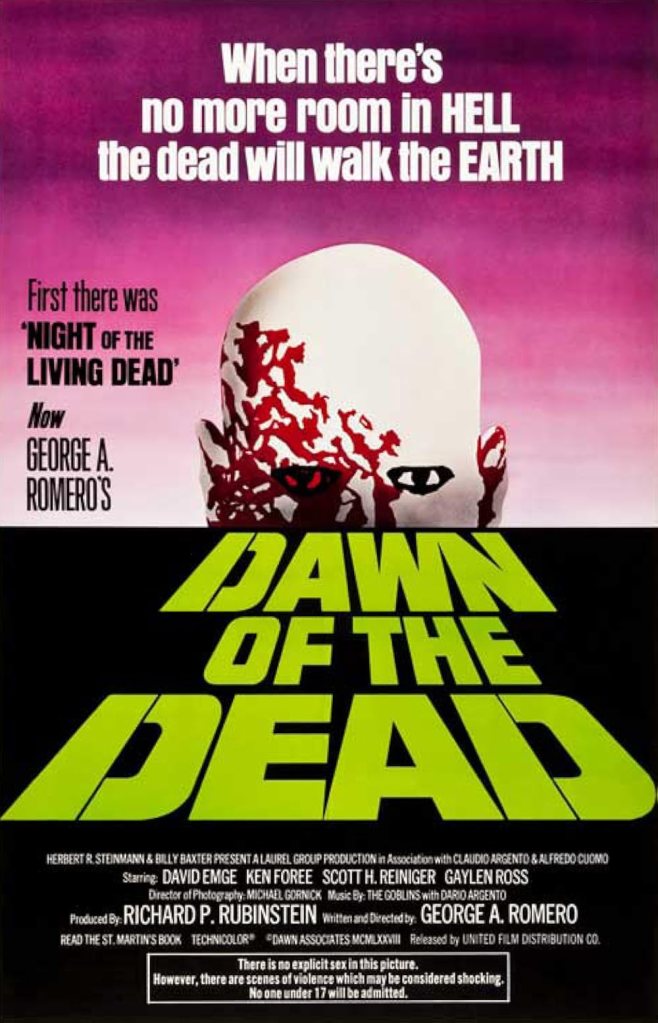
“When the dead walk, señores, we must stop the killing… or lose the war.”
In 1968, horror cinema was irrevocably changed by the emergence of George A. Romero’s vision, signaling the beginning of a transformative era for the genre. Romero, who had spent much of his early career making industrial and educational films, shifted gears dramatically by crafting Night of the Living Dead, an independent film that did more than just scare audiences—it shattered the conventions of horror. This was a film that rejected the glossy, Gothic monsters of studios like Universal and Hammer, replacing them with raw, unvarnished depictions of human decay and social collapse. The fear Romero invoked was no longer supernatural; it was born from human frailty and social upheaval.
Night of the Living Dead introduced audiences to an entirely new kind of monster: the zombie, not as a mystical or alien infection, but as the reanimated corpse of an ordinary person. This change was more than cosmetic. It shifted the source of horror from “the other” to a reflection of ourselves. Death itself had become weaponized, turning friend into foe in the most visceral way imaginable. The infection was no longer a far-off fantasy but an internal threat. Although the word “zombie” was scarcely spoken in Romero’s first three Dead films, the concept solidified into the cultural lexicon, haunting audiences with the idea that anyone—even the people closest to us—could become the enemy.
Despite the landmark impact of Night of the Living Dead, it would take a decade before Romero was able to produce its sequel. The first film’s shocking violence and disturbing social commentary made Hollywood studios wary of financing a continuation. However, a breakthrough came when Italian horror maestro Dario Argento learned of Romero’s plans and offered to co-finance Dawn of the Dead under the condition that he would receive European distribution rights and be allowed to edit a version for his audience. This international collaboration proved pivotal, allowing Romero to create what many consider not just a sequel but a towering masterpiece of horror cinema.
Released in 1978, Dawn of the Dead solidified Romero’s reputation as a visionary filmmaker willing to confront uncomfortable truths. The Motion Picture Association of America refused the film an R-rating due to its graphic content, and Romero opted to release it unrated to avoid association with the X-rating, which was then primarily linked to pornography. While this restricted the number of theaters willing to show the film, it did not hinder its success. The movie drew large audiences hungry for a horror story that dared to depict society’s unraveling with brutal honesty.
From its opening, Dawn of the Dead confronts viewers with the chaos midst societal collapse rather than building toward it. Traditional authority figures—news anchors, government officials, police—are portrayed as overwhelmed, often ineffective, and sometimes themselves sources of danger. The film’s opening sequence, set inside a frenzied television newsroom, captures this chaos vividly; reporters and producers struggle to maintain composure while the world outside falls apart. This scene encapsulates one of Romero’s central themes: the erosion of trust in institutions during extreme crisis. As media credibility falters, survivors are left in an informational vacuum, further imperiling their ability to cooperate or find sanctuary. This mistrust resonates strongly today, echoing recent real-world crises where institutional failure has worsened public panic and political division.
A critical early sequence—the tenement raid—brilliantly illustrates the film’s social complexity. The conflict here stems not only from the undead but from a clash of cultures: the low-income inhabitants hold tightly to their traditions, especially the respect and mourning of their dead, while the government, scientists, and law enforcement—detached “outsiders”—seek to destroy the infected bodies coldly as threats. This refusal to recognize the residents’ humanity and cultural practices sparks a brutal firefight, symbolizing the broader breakdown of social cohesion. Romero uses this conflict to show that the apocalypse is fueled as much by misunderstandings and institutional coldness as by the undead threat itself.
Within this crumbling world, the film centers on four survivors who become our guides through Romero’s apocalyptic landscape: Roger (Scott Reiniger) and Peter (Ken Foree), two disillusioned Philadelphia SWAT officers who desert after that violent raid; Stephen (David Emge), a helicopter pilot; and Fran (Gaylen Ross), a television producer. These characters represent the fractured remnants of a society that once clung to institutions but is now adrift. Their escape from Philadelphia aboard a stolen news helicopter is less a triumphant flight than a retreat into uncertainty.
Their destination is a suburban shopping mall near Monroeville, Pennsylvania. The mall, abandoned but intact, quickly becomes their fortress. Clearing out the zombies inside and barricading the doors seems like a triumph—an oasis amid apocalypse. The survivors revel in a surreal form of luxury that stands in stark contrast to the danger outside. For a time, they indulge in consumer comforts previously unattainable: fine clothes, gourmet food, and even jewelry. This phase is both a coping mechanism and a critique. Romero uses the mall setting as a dark mirror to American consumer culture. The shoppers turned zombies wander these halls as if drawn by habit, herding toward the very symbols of consumption that once defined the pre-apocalyptic world.
Romero’s critique extends beyond consumerism run amok; he exposes consumerism itself as a new religion for America. In the 1970s, as economic and social uncertainties shook the nation, megamalls emerged as the new temples of worship where consumer habits became ritualistic acts of devotion. The film’s setting drives home this analogy—the mall is not simply a marketplace but a sacred space where the rituals of buying and consuming provide meaning and identity. The zombies’ relentless, automatic wandering through the mall’s stores reflects a zombified devotion to these rituals, implying that consumerism has replaced spiritual and community values, offering hollow salvation in its place.
This portrayal is not accidental but deliberately satirical. The mall is a gilded cage, symbolizing consumerism’s dominance over American identity. Even in the apocalypse, the survivors replicate the rituals of capitalism, clinging to items of superficial value and meaning. The zombies’ mindless shuffling through stores like Woolworth’s and the food court underscores this grotesque cycle. Romero’s message is sharp: consumerism is a kind of death, a trance that distracts from and perhaps accelerates societal decay. The film implies that in America, the line between life and death blurs within the walls of the shopping mall because it is there that life’s priorities have long been warped.
While consumerism forms a visible backdrop, Dawn of the Dead probes deeper, exposing a darker undercurrent: humanity’s inherent violent nature as the real engine of destruction. The undead are monstrous and fearful, but they lack the complexity and self-destructiveness of the living. Throughout the film, Romero presents violence not as a rare failing but as a baseline condition of human behavior. The survivors themselves struggle to suppress impulses of aggression, paranoia, and selfishness that grow more toxic over time.
Roger’s reckless bravado during their clearing of the mall leads to a fatal bite from a zombie, making his death a metaphor for the cost of unchecked aggression. The living kill as readily as the dead, but with purpose and calculation that is often more destructive. The raiding biker gang that ultimately invades the mall appears as a harsh symbol of this self-inflicted violence. Unlike the zombies, whose threat is instinctive, the bikers wield cruelty consciously, plundering and destroying the survivors’ fragile sanctuary. Their incursion shatters any illusion of security and exposes the futility of individualistic survival strategies when cooperation is absent.
The unraveling of the survivors’ cohesion over the course of the film underscores one of Romero’s most bleak insights: humanity’s greatest enemy is itself. Even small groups that depend on trust and unity quickly fragment amid fear and scarcity. Despite the severity of their predicament, the four protagonists are often consumed by petty grievances, distrust, and self-preservation. Romero suggests that unless cooperation becomes a collective imperative, survival is impossible. The dead multiply endlessly, but it is the living who ensure society’s demise by turning against each other first.
Romero’s Dawn of the Dead also marks the cinematic arrival of Tom Savini, whose pioneering make-up effects would forever transform horror filmmaking. Savini and members of his team not only crafted many of the film’s grisly effects but also played some of the biker gang antagonists, blending artistry and performance. While the gore in Dawn can appear somewhat garish or cartoony on film, largely due to lighting effects and the practical limits of makeup technology at the time, Savini’s work set the standard for modern horror effects. His techniques and vision became the bedrock of the gore genre, influencing decades of horror cinema thereafter. His legacy continued as he later directed the 1990 remake of Night of the Living Dead, bringing Romero’s seminal vision to a new generation with his signature effects sensibility.
Ken Foree’s portrayal of Peter anchors the film emotionally; his performance balances toughness with vulnerability, capturing a man grappling with the collapse of law and societal norms while striving to retain his humanity. Scott Reiniger’s Roger provides a volatile contrast—impulsive, reckless, and ultimately tragic—as his aggression leads directly to his downfall. David Emge’s Stephen and Gaylen Ross’ Fran round out the core survivors, expressing pragmatism, grief, and the desperate need for connection as their world crumbles. Their dynamic interactions highlight Romero’s warning: human connection in times of extremity is fragile and fraught, undermined by fear and mistrust.
Romero’s expert use of sound and music further elevates the film. The eerie muzak playing through the mall’s PA system contrasts sharply with the groans of the undead and sudden bursts of violence, creating a haunting dissonance between normalcy and chaos. This effective sound design emphasizes the thematic conflict between consumerist detachment and encroaching apocalypse.
Beyond its horror, Dawn of the Dead serves as a time capsule of late-1970s American socio-political anxieties. America was reeling from the disillusionment of Vietnam, shaken by the Watergate scandal, and grappling with urban decay and economic malaise. The film vividly captures this zeitgeist: a society where institutions are distrusted, violence is normalized, and consumerism both numbs and destroys. Romero’s criticism extends to Cold War paranoia, reflected in his depiction of apocalypse not as a sudden cataclysmic event but a slow, grinding decline fueled by human self-destruction.
Romero’s directing style—unpolished at times but unflinching—adds authenticity to the film’s grim message. His use of long takes, handheld camera work, and naturalistic performances grounds the supernatural in the everyday, making the horror tangible. The bleak humor sprinkled throughout, such as the zombies’ fascination with the mall’s siren and muzak, darkens the tragedy with satirical bite.
Dawn of the Dead does not offer easy hope. Its ending—marked by betrayal, destruction, and resignation—echoes Romero’s worldview: humanity’s baser instincts, left unchecked, will always undermine salvation. Yet, in this stark vision lies an ironic beauty: survival is not only about killing or hiding but the recognition of our shared flaws and the possibility, however slim, of striving beyond them.
In conclusion, Dawn of the Dead remains a masterpiece of horror, combining groundbreaking practical effects, compelling performances, and incisive social commentary to create a film that is as relevant today as it was nearly fifty years ago. Romero’s work challenges viewers to confront the monsters within us all and questions whether human nature’s violent and consumerist impulses might prove more lethal than any undead army. Its enduring legacy lies not just in its scares but in its profound understanding of societal collapse and the fragile bonds that sustain civilization.
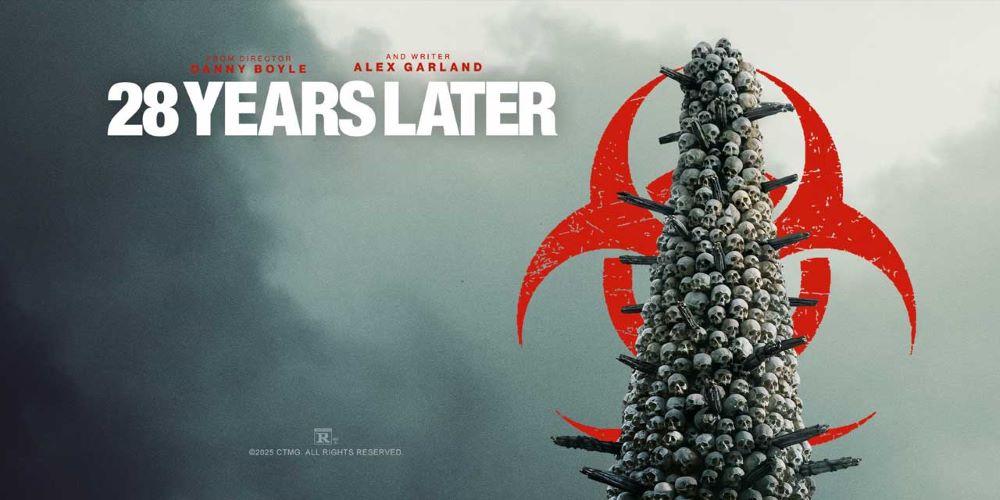
Danny Boyle waited nearly two decades to return to the world he helped redefine with his groundbreaking 2002 film 28 Days Later, which reshaped the zombie subgenre by replacing the traditional, slow-moving undead with fast, feral infected that embody contagion, panic, and societal collapse. While purists continue to debate whether the creatures are technically zombies or infected, Boyle’s vision fundamentally changed how audiences engage with themes of epidemic, survival, and the breakdown of order on screen. The 2007 follow-up, 28 Weeks Later, directed by Juan Carlos Fresnadillo, expanded the Rage virus mythology and landscape but lacked the original’s haunting intimacy and innovation, leaving the franchise in a state of uncertainty until Boyle and writer Alex Garland reunited for 28 Years Later, a film that feels less like a conventional sequel and more like an elegy for a deeply changed world.
The film opens with a short, brutal prologue: young Jimmy Crystal’s family is consumed by the Rage virus while watching Teletubbies, and the boy flees to find safety only to discover his minister father welcoming the infected as a sign of apocalyptic judgment. This early scene deftly establishes the film’s unease, blending visceral horror with spiritual inquiry and foreshadowing a narrative caught between faith, grief, and chaos. Boyle reasserts his command of visceral set pieces while signaling that this film is more concerned with memory and ritual than with relentless terror.
Decades later, the British Isles have been sealed off; NATO forces enforce a quarantine and blockade, isolating the mainland as a toxic exclusion zone. On the tidal island of Lindisfarne, a small community clings to a fragile existence, protected by a causeway that floods at high tide—a detail that metaphorically underscores themes of isolation and dangerous connection. It is here that the emotional core emerges in Jamie and his son Spike, played by Aaron Taylor-Johnson and the remarkable newcomer Alfie Williams. Their spare, heartfelt relationship grounds what otherwise wanders into meditative and often surreal territory.
Alfie Williams emerges as one of the year’s most impressive new talents. His portrayal of Spike avoids the usual survivor archetype; instead, he presents a boy deeply shaped by inherited trauma and cautious curiosity. Boyle’s camera lingers on Williams’ face, capturing silent shifts of fear, wonder, and resilience, making his quiet moments as powerful as the film’s larger set pieces. Williams shines particularly in a sequence where Spike and his mother, portrayed with subtle grace by Jodie Comer, navigate a moss-covered village reclaimed by nature; Williams embodies awe and terror with a single glance. His encounters with the evolved infected—some sedentary and tree-like, others organized into predator packs—are charged with terrifying authenticity and emotional depth. Early reviews label Williams a breakout star, praising his ability to hold the screen alongside veteran actors.
Visually, Boyle and cinematographer Anthony Dod Mantle experiment with a striking mix of techniques, blending the use of iPhone 15 Pro Max cameras and drones with traditional film methods to create a language that oscillates between intimate human moments and sweeping, documentary-style landscapes. The Britain depicted is no longer a lifeless wasteland but an ecologically regrown terrain—lush, eerie, and indifferent. This verdant backdrop reflects the Rage virus’s own evolution. The infected have adapted in ways both terrifying and fascinating: some feed off the earth and fungus, becoming near-plantlike and sedentary, while others form packs ruled by alpha mutants, suggesting emergent social structures even after humanity’s collapse. This biological and ecological evolution amplifies the film’s central theme: survival transcending humanity.
Anchoring the film’s philosophical inquiry is Ralph Fiennes’s performance as Dr. Ian Kelson, a former general practitioner who has exiled himself to live among the infected. Fiennes crafts Kelson with haunting solemnity and layered ambiguity—part caregiver, part fanatic, part recluse—who has created the eponymous “Bone Temple,” a shrine assembled from bones and memories to honor the dead and the changed world they inhabit. The role requires quiet intensity, and Fiennes delivers; his interactions with Spike are charged with both menace and melancholy. Kelson’s reverence for the infected and his willingness to coexist with them challenge traditional survivalist narratives, injecting the film with a solemn meditation on loss, acceptance, and the possibility of new forms of life.
28 Years Later opts for a deliberately slower, more contemplative pace than its predecessors. Boyle and Garland invest their energy in exploring grief, adaptation, and collective memory. The infected become symbolic forces of transformation rather than mere antagonists, while survivors seek meaning through ritual and remembrance as a bulwark against despair. This approach has divided fans: some lament the absence of the unrelenting terror and pace that characterized the earlier films, while others welcome the franchise’s intellectual maturity and thematic depth.
Certain scenes—such as the stranded NATO patrol subplot and glimpses of emerging cult-like human factions—hint at a larger, more complex world but never overshadow the film’s intimate father‑son narrative. Jodie Comer complements Williams with a nuanced portrayal of Spike’s mother, and Taylor‑Johnson brings grounded emotional weight to Jamie, embodying a parent wrestling with how to protect the next generation in a broken world and dealing with his own inner demons.
The interplay between Williams and Fiennes forms the film’s core dynamic, uniting youthful vulnerability with somber reflection. Kelson’s philosophical acceptance of the apocalypse contrasts with Spike’s struggle for identity and belonging, producing compelling, often unsettling exchanges that elevate the narrative’s moral complexity.
Toward the film’s conclusion, a jarring tonal shift occurs with the sudden arrival of a grown-up Jimmy Crystal, whose unsettling presence and cult leadership drastically change the mood. The moment is so discordant that viewers are left questioning whether it is literal or a fevered hallucination—an ambiguity that effectively sets the stage for the sequel.
The upcoming follow-up, 28 Years Later: The Bone Temple, is set for release in January 2026 and will be directed by Nia DaCosta, with Alex Garland returning as screenwriter. This sequel is expected to explore the role of Kelson’s Bone Temple more deeply and develop the cult gathering led by Jack O’Connell’s Jimmy Crystal, expanding on the fractured post-apocalyptic world and the characters introduced in the current film.
Ultimately, 28 Years Later is a film about evolution—of species, storytelling, and filmmaking itself. It balances raw dread with haunting visuals and somber themes, anchored by Alfie Williams’s quietly compelling Spike and Ralph Fiennes’s enigmatic Dr. Ian Kelson. Boyle has not merely revived the franchise; he has transformed it into an unsettling, elegiac meditation on rage, loss, and the fragile hope that survives beyond apocalypse.
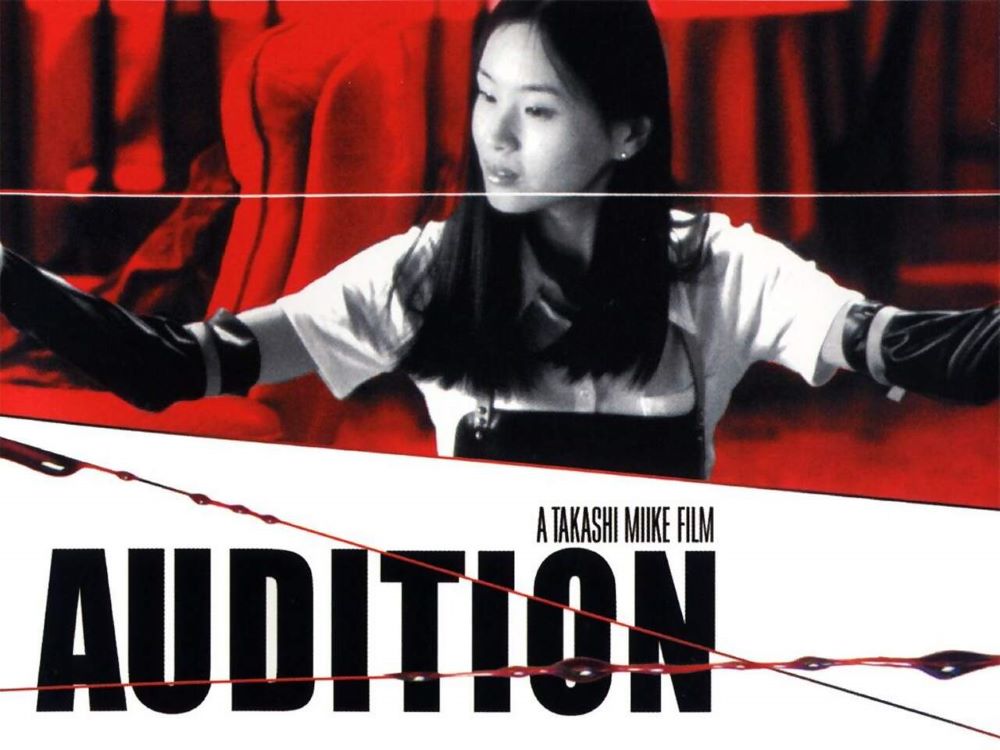
Takashi Miike’s Audition premiered in 1999 at various international film festivals before receiving a limited theatrical release in Japan in 2000. Before this film, Miike was largely known in Japan as a director of gritty, often hyper-violent yakuza cinema, with films like the Black Society Trilogy defining his reputation. However, Audition introduced him to the world stage in a way that shocked and captivated audiences beyond Asia. It was a major step in bringing Japanese horror, or J-horror, into the international spotlight, specifically to Western viewers who had limited exposure to this distinct style of horror. While filmmakers and cinephiles such as Quentin Tarantino and Eli Roth had been fans of Miike’s earlier works, Audition was a revelation that displayed a more complex, restrained, and deeply unsettling side of Japanese horror cinema that was largely unknown to general audiences in the West.
At first glance, Audition presents itself as a simple, quiet domestic drama. The film opens with Shigeharu Aoyama, played with a gentle dignity by Ryo Ishibashi, visiting his terminally ill wife in the hospital. This opening scene is tender and somber, establishing the emotional core of the film: a man grappling with loss. The narrative then leaps seven years forward, showing Aoyama as a widower still mired in grief, living a lonely life with his teenage son, Shigehiko. Shigehiko, sensing his father’s emotional paralysis, urges him to begin moving on with his life, encouraging him to date again and escape the depression that has enveloped him since his wife’s death.
The inciting moment comes when Aoyama’s friend Yasuhisa Yoshikawa, a film producer played by Jun Kunimura, proposes a peculiar solution: to hold an audition for a fictional TV drama, the real purpose being to discreetly find a woman who could be compatible with Aoyama as a partner. The auditions, while framed as a casting call, are frankly a thinly veiled matchmaking scheme. Although initially awkward and even comical in its premise, the auditions soon reveal a darker subtext—the women are not treated as individuals with their own hopes and desires, but rather as pieces in a man’s recovery process. This treatment subtly exposes lingering misogyny entrenched within the social fabric, where the women’s autonomy is overlooked and they are reduced to roles to be performed and judged purely on superficial criteria.
Among the candidates, one young woman stands out: Asami Yamazaki, portrayed with chilling serenity by Eihi Shiina. Asami, with her soft-spoken voice and seemingly delicate demeanor, instantly captures Aoyama’s attention. She shares a tragic backstory about her abandoned dreams of becoming a ballerina, cut short by a debilitating injury. This combination of fragility and mystery pulls Aoyama in, despite the warnings from Yoshikawa, who finds suspicious gaps in her background and troubling connections to violent incidents. What makes Asami particularly intriguing is the way Miike shapes her character with a complex duality. Outwardly, she embodies calmness and grace, which is visually reinforced through her wardrobe choices. She is often dressed in white—a color traditionally associated with purity and innocence—but she also frequently dons black latex over her white clothing. This contrast of white and black on her outfit manifests her dual nature: the peaceful façade masking a darker, far more dangerous interior.
This juxtaposition of colors is a subtle yet powerful artistic choice. It visually hints at her character’s concealed capacity for violence and control beneath a serene exterior. The black latex signals strength, mystery, and something potentially sinister, while the white suggests vulnerability and fragility. Asami doesn’t scream threat or menace; instead, she radiates an almost hypnotic calm that belies the storm hidden underneath. This visual storytelling complements the slow-building tension of the film, where the audience is continuously reminded to question appearances and expect unsettling surprises beneath the surface.
For much of the film’s first hour, Audition presents itself as a slow-burning romance between two emotionally damaged people. The pacing is unhurried, and the tone is understated and reserved, encouraging viewers to settle into the seemingly bittersweet story of a man tentatively trying to open his heart again. Yet throughout, subtle details apply pressure on this comfortable façade: Asami’s unblinking stares, her quiet stillness, and the unsettling sight of the large burlap sack sitting ominously in her sparsely furnished apartment speak volumes in silence. Miike shows a masterful ability to create an overwhelming sense of horror and dread from this sparse setting—just Asami, a burlap sack, and a phone lying on the floor become enough to chill the viewer deeply by their sheer mysteriousness and the ominous possibilities they evoke. The emptiness of the room forces attention on the few elements present, making the audience fill in unseen horrors with imagination, intensifying the tension without a single loud noise or burst of action.
The horror emerges gradually, not as a sudden rupture but as an inevitable revelation. As the film progresses, Asami’s cracks in the façade deepen, and the audience is led to an increasingly dark place where it becomes clear that almost nothing is as it seems. When the violence finally explodes, the tone shifts entirely. Miike keeps the camera steady and calm while the terror unfolds with surgical precision—a terrifying contrast to most horror films’ usual frantic editing in moments of violence. The infamous climactic scene is a masterclass in controlled horror: every movement, every sound, every visual detail is deliberate. It unfolds with a quiet, ritualistic menace that makes it impossible to look away, yet deeply uncomfortable to watch.
Asami’s violent acts are disturbing not only for their nature but for the serenity with which she carries them out. Her cold, calm demeanor during these moments reinforces her duality. The woman who once seemed so fragile now becomes merciless, completely in control, almost as if performing a deeply personal ritual. Her chilling voice remains soft, almost tender, as she methodically inflicts unimaginable pain on Aoyama, turning the hunting of the predator into a careful orchestration of revenge and self-assertion.
This transformation invites apt comparison to Annie Wilkes from Rob Reiner’s film adaptation of Stephen King’s Misery. Both characters are women whose broken pasts have twisted them into forces of violent control. Annie Wilkes, played iconically by Kathy Bates, is a former nurse whose love turns obsessive and horrifying when she imprisons her favorite author. Like Asami, Annie’s violence is not born from random cruelty but from deep emotional scars and isolation that have warped her understanding of love and power. Both women are trapped by their traumas and express that trauma through calculated violence—a grim reclaiming of agency in worlds that had silenced or harmed them. While Asami channels her rage through a cold, almost ritualistic cruelty hidden beneath an outer calm, Annie’s madness is an explosive, volatile cyclone of passion and psychosis. Both, however, show how a woman shaped by pain and repression might lash back in terrifying ways.
What made Audition stand out at the time—and still does today—is its slow-building dread and emotional complexity. Western horror in the late 1990s was dominated by slasher flicks, supernatural hauntings, and a new generation of self-referential genre films that played with tropes for laughs and jumpscares. Audition offered something completely different: a quiet, emotionally resonant story where the horror grows from the cracks in human relationships and societal expectations. Aoyama’s loneliness, his idealization of women, and his emotional blindness all play into the film’s horrifying climax, making the violence feel almost inevitable—a dark extension of the story’s psychological and social subtext.
However, Audition has often been unfairly associated by Western critics and media with the so-called “torture porn” wave of horror films that emerged in the early 2000s. This grouping overlooks the important distinction that the brutal, graphic, and extended depictions of physical and sexual torture characteristic of torture porn owe much more to the French New Extremity movement. Filmmakers like Alexandre Aja, Pascal Laugier, Xavier Gens, and Alexandre Bustillo pushed horror into territories of relentless physical torment, prolonged scenes of sexual violence—including rape—and vivid, lingering gore with films such as High Tension (2003), Martyrs (2008), and Inside (2007). These films are marked by their explicit, often shocking depiction of suffering and are designed to push the audience’s limits through sustained, graphic realism.
In contrast, Audition relies heavily on psychological tension, careful pacing, and emotional weight rather than overt gore or relentless brutality. Its moments of violence, while shocking, are part of a carefully constructed narrative about loneliness, denial, and control, creating horror through gradual revelation rather than relentless spectacle. Miike’s film helped broaden the landscape of horror by introducing a more atmospheric, character-driven terror that challenged viewers to engage deeply with the emotional and social undercurrents of fear.
When Audition reached Western film festivals and arthouse theaters, it caused a stir. Many audiences were unprepared for its unsettling mix of quiet domestic drama and savage horror. Accounts of fainting and walkouts spread quickly, but beyond the shock factor, the film earned critical praise for its artistry and unique voice. Directors like Quentin Tarantino championed Miike’s work, drawing attention not only to him but to the broader wave of Japanese horror arriving on the global stage. Audition helped open the door for landmark films like Ringu (1998) and Ju-on: The Grudge (2002), sparking widespread interest in J-horror’s more subtle, psychological approach to fear.
At its core, Audition is about appearances and the dangerous fictions people build around longing and loss. Asami embodies this perfectly—her serene outward demeanor conceals a deeply disturbed interior. The interplay of light and shadow in her wardrobe, the gentle cadence of her speech compared with her violent deeds, all speak to the duality of her character. She is both victim and predator, delicate and deadly, calm and terrifying.
In this way, Miike invites viewers not just to witness horror but to feel it as an inevitable expression of human vulnerability and social repression. Violence here is less an escape than a dark reflection of isolation and a desperate reclaiming of power when all other avenues are closed.
Looking back, Audition stands as the film that propelled Takashi Miike beyond obscurity and established him as a singular voice in global cinema. It was one of the earliest J-horror films to find a meaningful audience in the West, breaking new ground in how horror could be crafted—fear born from loneliness and cultural repression, told with unsettling subtlety. It remains a haunting, unforgettable film that changed horror’s shape and opened many eyes to the frightening potential lurking beneath calm surfaces.
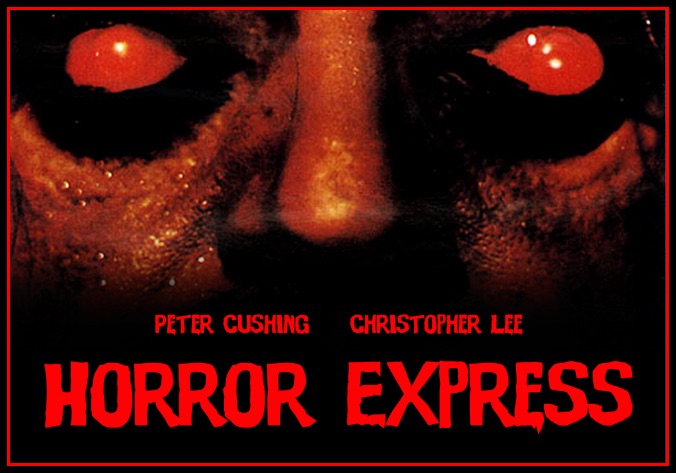
There was one film I saw when I was very young that absolutely terrified me, and even now, decades later, it still has the power to unsettle me and rob me of sleep. That film is Horror Express, a 1972 Spanish-British horror/science fiction hybrid directed by Eugenio Martín. It brought together two titans of gothic horror cinema, Christopher Lee and Peter Cushing—icons of the Hammer Films era—while also featuring Telly Savalas in a sadistic, scene-stealing turn as a volatile Cossack captain.
When Horror Express was released, the horror genre was at a fascinating crossroads. The gothic traditions popularized by Hammer Studios throughout the 1960s were beginning to fade, overtaken by the grittier, bloodier styles of filmmakers like Herschell Gordon Lewis and George A. Romero. By 1968, Romero’s Night of the Living Dead had already shifted the genre toward a darker, more nihilistic tone, paving the way for the grislier excesses that would dominate the 1970s. Martín’s film stood out precisely because it clung to the elegance and atmosphere of Hammer’s gothic aesthetic while incorporating moments of shocking violence and morbid detail. It occupied an unusual in-between space: refined in look and tone yet unnerving in its thematic brutality. Its blend of period atmosphere, science fiction paranoia, and restrained gore made it a fascinating transitional work in horror history.
The premise is simple but chilling. Aboard the Trans-Siberian Express, a British anthropologist (Christopher Lee’s Professor Saxton) transports a recently unearthed specimen—an ape-like, fossilized creature. His colleague, Peter Cushing’s Dr. Wells, becomes reluctantly entangled in the unfolding mystery. Predictably, the specimen is not what it seems; it revives and begins unleashing a series of violent attacks on the passengers. Soon it is revealed to harbor a far more terrifying, alien intelligence capable of killing and inhabiting its victims. This leads to one of the film’s most haunting sequences: the white-eyed, zombie-like corpses, drained of memories and humanity, shambling through the train corridors under the entity’s control. At eight years old, these images struck me as some of the most horrifying I had ever seen, and even today their uncanny blend of gothic atmosphere and science fiction body horror still lingers.
Viewed in retrospect, Horror Express bears a striking resemblance to John W. Campbell’s novella Who Goes There?—the basis for Howard Hawks’ The Thing from Another World and John Carpenter’s The Thing in 1982. Like those stories, it is steeped in paranoia, playing with the idea of an alien intelligence that can absorb knowledge and animate the dead. While it never attains the precision of Carpenter’s later masterpiece, it foreshadows that same blend of claustrophobia, distrust, and escalating dread.
What makes Horror Express unforgettable is its restraint. Rather than leaning on gore, it generates fear through suggestion, atmosphere, and disturbing imagery. The snowy isolation of the Trans-Siberian route reinforces the cold sterility of its alien invader, while the confined train cars become a claustrophobic prison of escalating terror. Over time, the film has slipped into the public domain, making it widely available on streaming platforms and budget DVDs. Though often overlooked in surveys of 1970s horror, it deserves recognition as one of the last great gothic horror films before the torch passed to Craven, Carpenter, and Hooper.
For me, Horror Express remains not just a childhood scare but a cinematic touchstone: a rare piece of science fiction horror bridging two eras, one that manages to terrify without relying on excess gore. It disturbed me at age eight, and even now, watching the blank-eyed corpses lurch through the dim train cars still triggers that same visceral shiver.
Zombie and infection films have long been a proving ground for aspiring horror filmmakers. The subgenre is relatively inexpensive to produce, often relying on claustrophobic settings, survival scenarios, and plentiful blood-and-makeup effects. Because of this, it’s become an enticing entry point for directors looking to make their mark. But while horror can be a forgiving sandbox for experimentation, creating a film that is not just watchable but truly memorable is another matter entirely.
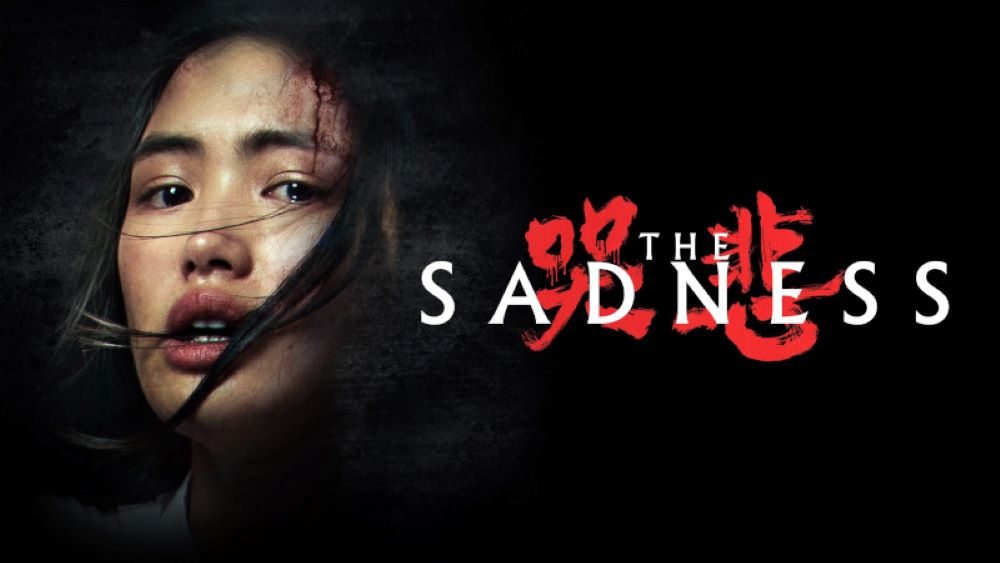
That’s why Rob Jabbaz’s 2021 debut feature The Sadness feels like both a breath of fresh air and a brutal gut-punch. In a cinematic landscape oversaturated with lifeless zombie rehashes, The Sadness stands out as one of the rare gems in the rough: an uncompromising, unfiltered vision that twists infection horror into grotesque new extremes.
The film’s timing alone heightens its impact. Premiering in 2021 as the world was still reeling from COVID-19, The Sadness unfolded against a backdrop of real-world uncertainty and fear. Set in Taipei, it follows a young couple, Jim (Berant Zhu) and Kat (Regina Lei), as they struggle to reunite while a viral outbreak ravages the city. But this isn’t a traditional zombie plague. Those infected don’t stumble through streets in mindless hunger—instead, they shed every shred of empathy and morality, indulging instead in the darkest, most depraved impulses imaginable.
What makes this outbreak particularly disturbing is not the survivalist violence we expect from zombie cinema, but the sadistic cruelty with which the infected embrace their new instincts. They don’t just kill. They torment, torture, and mutilate with gleeful abandon. And yet, in one of the film’s most haunting touches, many of the infected appear to be crying as they carry out these atrocities. Buried deep in the recesses of their corrupted minds is an awareness of the horror of their actions, a recognition that what they are doing is monstrous and wrong. But the virus strips them of the ability to stop themselves, forcing them to participate in their own cruelty even as they mourn it. This paradox of weeping while committing acts of unthinkable violence underlines the film’s title: The Sadness is not simply about gore or shock, but about the profound tragedy of human beings imprisoned within impulses they are horrified to enact.
On its surface, the film invites comparisons to Danny Boyle’s 28 Days Later—especially in its depiction of a city descending into viral chaos. But where Boyle’s rage virus unleashed primal anger, Jabbaz’s strain of infection is even more terrifying: it revels in cruelty, poisoning not just the body but the soul. The Sadness also recalls Garth Ennis’ infamous Crossed comic series—widely deemed unfilmable due to its extremes. That connection is impossible to ignore, both in subject matter and in its deliberate transgressiveness.
As writer, editor, and director, Jabbaz approaches the material with unnerving precision. The first act foreshadows the viral threat in subtle ways—background chatter on TV screens, fleeting moments of sudden aggression—before Taipei collapses into anarchy almost overnight. The narrative remains lean and purposeful, stripping away filler in favor of pacing that escalates terror with brutal efficiency.
Shot in just 28 days, the film nevertheless carries an impressive polish. Cinematographer Jie-Li Bai and production designer Liu Chin-Fu infuse the movie with a grounded sense of place: crowded subways, sterile hospitals, bustling street corners. Each environment feels authentically lived-in before they transform, piece by piece, into blood-soaked arenas of carnage. Practical gore effects are prioritized over CGI, and the result is viscerally effective—sickening yet strangely mesmerizing, almost operatic in their execution. Like the best extreme horror, it locates a twisted beauty in its spectacle of destruction.
The Sadness is more than just gore for gore’s sake. Released during the height of a global pandemic, the film functions as a thematic mirror, reflecting society’s fractures under pressure—our denial of crisis, government missteps, selfish impulses, and the darkness that emerges when rules and trust collapse. Whether or not Jabbaz meant the film as a direct allegory is almost irrelevant; in its execution, it feels pandemic-era, uncannily timely, and raw.
Unsurprisingly, the horror community quickly drew parallels to Ennis’ Crossed. The comparison resonated so strongly that Jabbaz himself has since been attached to direct a live-action Crossed adaptation. If The Sadness is any indication, he may be the rare filmmaker with both the vision and the audacity to bring such an “unfilmable” work to life.
From its deceptively calm beginning to its bleak and nihilistic finale, The Sadness never loosens its grip. It is not a film for everyone—many will find it too transgressive, too nihilistic, or simply too traumatic to endure. But for horror fans who crave extremity, who embrace the genre as a place where boundaries should be tested, The Sadness is more than another zombie flick. It is a tragedy as much as it is a nightmare, and the sight of its infected monsters weeping as they commit atrocities lingers long after the credits roll. That image embodies the very essence of the title: a work that confronts not only our capacity for violence, but the unbearable sorrow of being aware of it, powerless, and consumed.
It is a defining statement in 21st-century horror: brutal, relentless, grotesque, and timely. Rob Jabbaz’s debut doesn’t just enter the infection canon—it tears through it, leaving behind a benchmark of modern extreme cinema.
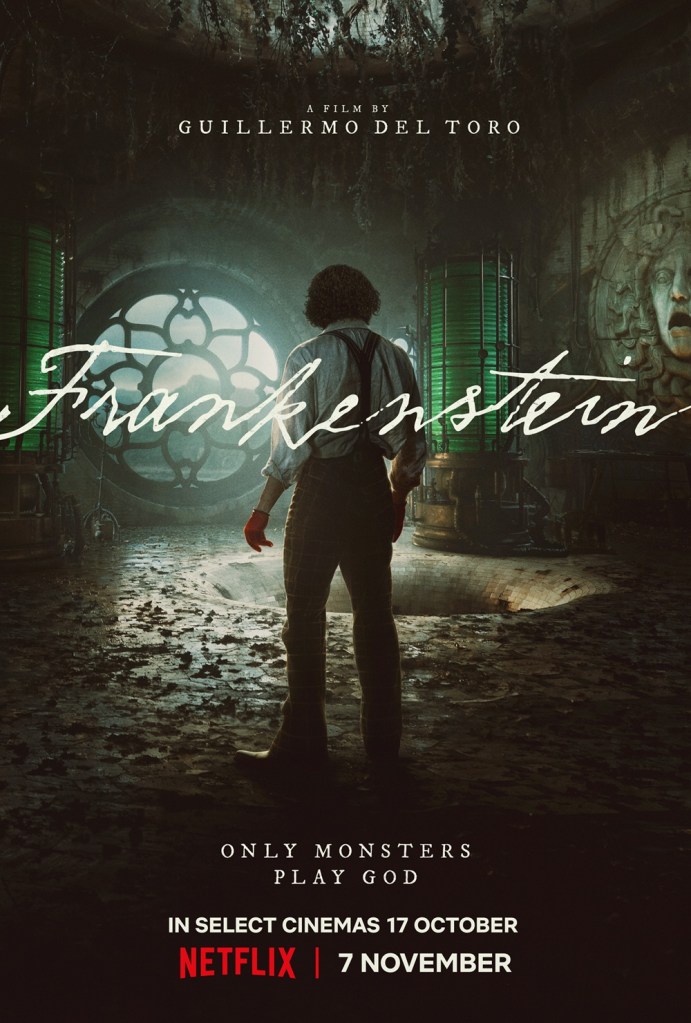
The official trailer for Guillermo Del Toro’s take on the Mary Shelley’s classic gothic horror Frankenstein has finally been released.
An earlier teaser was sent out months ago, but that was mostly played off like sizzle reel of what Del Toro had been up to with this latest adaptation. This official trailer gives us a much more closer look at the type of adaptation Del Toro decided to take with Shelley’s novel of the tortured scientist and his creation.
Even though it will be show up on Netflix on November 7, 2025, I do believe that this film needs to be seen on the big screen when a select cities get them on October 17, 2025.

 Through the Shattered Lens