Lisa Reviews an Oscar Nominee: Roman Holiday (dir by William Wyler)


roman_holiday

The 1953 film Roman Holiday is one that I’ve watched quite a few times.  If you know anything about the film and/or me, you won’t be surprised by that.  I love Audrey Hepburn.  I love Rome.  I love romance.  And I love bittersweet endings.  And Roman Holiday has all four of those!

Speaking of Audrey Hepburn, I’ve shared this picture before but I’m going to share it again:
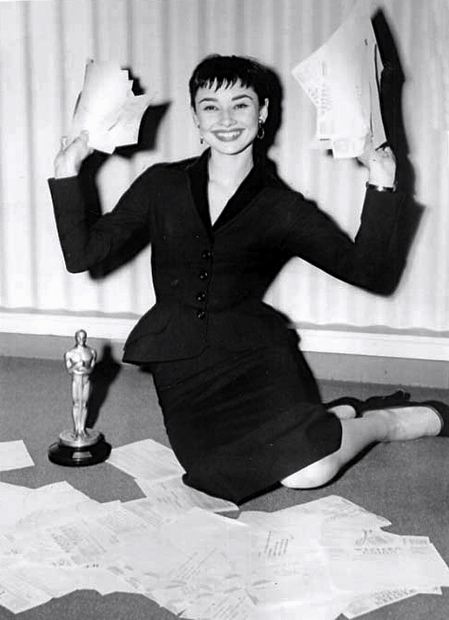
Audrey Hepburn 1954 Roman HolidayThat is Audrey Hepburn, the morning after she won the Best Actress Oscar for Roman Holiday.  Roman Holiday was Audrey Hepburn’s motion picture debut and it continues to hold up as one of the greatest film debuts of all time.  Watching how easily she controls and dominates the screen in Roman Holiday, you would think that she had made over a 100 films previously.

The film tells a simple story, really.  Audrey plays Ann, the crown princess of an unnamed country.  Princess Ann is touring the world.  The press is following her every move.  Her royal handlers are carefully choreographing every event.  Her ever-present bodyguards are always present to make sure that no one gets too close to her.  In public, Ann is the epitome of royal discretion, smiling politely and always being careful to say exactly the right thing.  But, in private, Ann is restless.  Ann knows that she has never been allowed to see the real world and yearns to escape, if just for one night, and live a normal life.  So far, her handlers have managed to keep her under control but then she arrives in Rome and…

…well, who can resist Rome?

Despite having been given a sedative earlier, Ann stays awake long enough to sneak out of her hotel room and see the enchanting Rome night life.  Of course, the sedative does eventually kick in and she ends up falling asleep on a bench.  It’s there that she’s discovered by an American, a cynical reporter named Joe Bradley (Gregory Peck).  Not realizing who she is and, instead, assuming she’s just a tourist who has been overwhelmed by Rome, Joe allows her to spend the night at his apartment.

The next morning, Joe finds out who Ann actually is.  Realizing that getting an exclusive interview with Ann could be his ticket to the big time, Joe and his photographer, Irving (Eddie Albert), rush back to Joe’s apartment.  Joe doesn’t tell her that he’s a reporter.  He just offers to take her on a tour of Rome.  Ann, however, wants to experience Rome on her own.

What follows is a wonderful and romantic travelogue of the glory of Rome.  Though Ann does explore on her own for a while, she eventually does meet back up with Joe and Irving.  Whenever I watch Roman Holiday, I always try to put myself in the shoes of someone in 1953, sitting in the audience during the film’s first week of release.  For many of them, this film may have been their first chance to ever see Rome.  (The opening credits of Roman Holiday proudly announce that the entire film was shot on location, properly acknowledging the Rome is as much a star of this film as Hepburn, Peck, and Albert.)  If you’re not already in love with Rome (and I fell in love with the city — and really, the entire country of Italy — the summer after I graduated high school), you will be after watching Roman Holiday.

(If you truly want to have a wonderful double feature, follow-up Roman Holiday with La Dolce Vita.)

The film’s most famous scene occurs at the Mouth of Truth and… well, just watch…

This scene was improvised, on the spot, by Gregory Peck.  Audrey Hepburn’s scream was very much real as Peck didn’t tell her what he was planning on doing.  As great as this scene is, it’s even better after you’ve actually been to Rome and put your own hand in the Mouth of Truth.

It’s a very sweet movie, one that stands as both a tribute to romance but also proof of what pure movie star charisma can accomplish.  It’s not just that Audrey Hepburn gives a great performance as Princess Ann.  It’s that Gregory Peck gives one of his most natural and surprisingly playful performance as well.  It’s that Peck and Hepburn have an amazing chemistry.  By the end of the film, you know that they deserve Rome and Rome deserves them.

And then there’s that ending, that bittersweet ending that always brings tears my mismatched eyes.  It’s a sad (though not depressing) little ending but somehow, it’s also the only ending that would work.

Roman Holiday was nominated for best picture but it lost to From Here To Eternity.

That’s right — Roman Holiday and From Here To Eternity were released one after another.

1953 was a very good year.

roman_holiday-1

gac_romanholiday

Cleaning Out The DVR #10: The Yearling (dir by Clarence Brown)


Original_movie_poster_for_the_film_The_Yearling

After I finished Abduction: The Jocelyn Shaker Story, I decided to watch a film that was shown on TCM as a part of the 31 Days Of Oscars.  When I started the 1946 film, The Yearling, I thought it was going to be a sweet and heartwarming little movie about a country boy raising a deer.  Instead, it turned out to be a rather dark movie about how much it sucks to grow up in the country.  I can only imagine how many childen, back in 1946, were scarred for life by this movie.

The movie is actually about two yearlings.  The main one is Jody (Claude Jarman, Jr.), who lives in the bayous of 1878 Florida.  His family is a farming and hunting family.  They live in a small shack and struggle to make ends meet.  His father, Penny Baxter (Gregory Peck) is … well, he’s Gregory Peck.  He’s stern but warm and speaks with that deep voice that lets you know that you better pay attention to everything he says.  While Penny is generally laid back and enjoys a good laugh, his wife, Ora (Jane Wyman), is far more serious and severe.  Ora has lost three children and, as a result, she is both overprotective and emotionally distant from Jody.

Jody desperately wants a pet but Ora says that they can’t afford to feed any animals.  However, one day, Penny is bitten by a snake.  Apparently, the organs of a deer can be used to draw out snake venom.  (Seriously, until I watched The Yearling, I had no idea this was the case.  I once nearly stepped on a rattlesnake in New Mexico and it totally freaked me out.  It’s good to know that if I ever do get attacked by a snake, all I have to do is kill a deer.)  Penny shoots a doe and has Jody cut out its heart and liver.  After doing so, Jody notices that the doe had a fawn.  He begs to be allowed to adopt it and, overruling Ora, Penny says that he can.

After getting his deer, Jody goes to visit his best friend, Fodderwing (Donn Gift) and ask him what he thinks a good name would be.  However, Fodderwing’s father informs Jody that his friend has just died.  And really, that scene pretty much epitomizes what The Yearling is about.  Because it’s told almost entirely from Jody’s point of view, the film may occasionally look like an old school Disney film.  But death and hardship are very real in the world of The Yearling.  People die, even children.  Having a pet may make the reality easier to take but it doesn’t change the reality.

Jody names the deer Flag.  As the film progresses, both Jody and Flag grow up.  Unfortunately, as Flag gets older and bigger, he causes more and more trouble for both his family and the neighbors.  He eats crops and he destroys fences.  After Penny is injured, Jody is the one who ends up replanting the corn and fixing all the damage.  But, even after all of Jody’s hard work, Flag still knocks down another fence.  That’s when Jody is told that he must shoot his beloved pet…

And that’s why I went, “Agck!  What type of movie is this!?”

Well, it’s a coming-of-age movie and, unfortunately, Jody is living at a time when growing up means giving up childish things.  (That’s always been my least favorite verse in the Bible, by the way.)  The Yearling itself is a pretty good film, though I do have one major problem with it.  The film looks great and both Jane Wyman and Gregory Peck are expertly cast.  If you keep an eye out, you’ll even spot Henry Travers — Clarence the Angel from It’s A Wonderful Life — in a small role.

That said, my main objection to The Yearling — the thing that keeps it from being quite as good as it could be — is the performance of Claude Jarman, Jr.  In the role of Jody, Jarman goes so totally over-the-top with his line readings and his facial expressions that it immediately takes the viewer out of the film’s reality.  Whenever anything happens — whether its Penny getting attack by a snake or his mother throwing a plate at his deer or Flag knocking over a fence — Jarman responds by standing there with his eyes and mouth wide open.  His lines are delivered with a rushed enthusiasm that can’t hide the complete lack of authentic emotion in his performance.  Claude Jarman tries really hard but it’s not surprising to discover that, after The Yearling, he only appeared in a few more films before joining the Navy and then subsequently moving behind the camera as a producer.

Then again, the Academy thought highly enough of Jarman’s performance to give him an honorary Oscar.  The Yearling itself was nominated for best picture but it lost to another sad film about giving up childish things, The Best Years of Our Lives.

Shattered Politics #19: To Kill A Mockingbird (dir by Robert Mulligan)


To_Kill_a_Mockingbird_poster

So, I guess I should explain why I’m including the classic 1962 film (and best picture nominee), To Kill A Mockingbird, in this series of reviews of films about politicians.  After all, while To Kill A Mockingbird dealt with the issue of racism in Alabama in a surprisingly honest manner, it doesn’t feature any elected officials.  Nobody shows up playing Gov. Benjamin J. Miller or President Franklin Roosevelt.  Instead, this film is about a wise lawyer named Atticus (Gregory Peck), an innocent man named Tom (Brock Peters), a girl named Scout (Mary Badham) and her older brother Jem (Philip Alford), and a mysterious recluse named Boo (Robert Duvall).

However, if you’ve read Harper Lee’s wonderful novel, then you know that Atticus is not just the smartest man in Maycomb, Alabama.  He’s also a member of the Alabama state legislature and his political career is a fairly important subplot in the book, with him occasionally having to leave home so he can go down to Montgomery and help to write the budget.  (Incidentally, Harper Lee’s father actually was a member of the Alabama House of Representatives.)

In the film, no mention of Atticus being a member of the state legislature is made but I still choose to believe that he was.  Because, as played by Gregory Peck, Atticus Finch is exactly the type of man who you would want to think of as serving in government.  He’s wise, compassionate, and firm.  For much of To Kill A Mockingbird, he is literally the only sane adult in Maycomb.  He’s the only attorney willing to defend Tom Robinson when Tom is accused of raping a white girl.  When a mob shows up to lynch Tom, Atticus is the only adult willing to stand up to them.  (Fortunately, Jem also runs up and shames the mob by reminding them that she goes to school with their children.)  And, in court, it is Atticus who proves that Tom is innocent.

When Tom is still convicted, what makes it all the more devastating is that wise and compassionate Atticus doesn’t seem to be surprised as all.  If even Atticus feels that there is no hope for a black man to get a fair trial from an all-white jury, the film seems to be saying, then there truly is no hope.

Of course, the film is not just about Atticus.  It’s about Scout and Jem and their friend Dill (John Megna) and how the three of them grow up and learn the truth about their world.  Watching them from behind the closed doors of his house is the mysterious and reclusive Boo Radley.  When Boo shows up towards the end of the film, I always find tears in my mismatched eyes.  Boo is played, in his film debut, by Robert Duvall.  Duvall doesn’t say a word but he still makes an incredible impression as the shy and withdrawn Boo.

So, I may be cheating a lot by including To Kill A Mockingbird in this series of reviews.  Oh well.  Who am I to turn down a chance to rewatch it?  To Kill A Mockingbird is just a great film.


Horror Film Review: The Omen (dir by Richard Donner)


The Omen

A few days ago, Arleigh shared the theme song from 1976’s The Omen as Monday’s horror song of the day.  As I sat there and listened to Jerry Goldsmith’s award-winning hymn to Satan, it occurred to me that I happen to have all five of the Omen films sitting in my movie collection.  Seeing as how this is Halloween and how the world seems to be getting closer to ending with each passing day, I decided that this would be the perfect time to rewatch the entire franchise and consider whether or not The Omen films are truly as scary as a lot of people seem to think.

So, that’s what I did.

How did things turn out?

Well, in the long history of sequels and remakes, The Omen franchise is one of the more uneven collections.  This is one of those franchises where things tend to get less impressive with each subsequent entry.  However, 38 years after its initial release, the first Omen remains effective and, in its way, genuinely scary.

If you’re a horror fan, you probably know the general plot of The Omen regardless of whether you’ve actually watched it or not.  It’s one of those films that has been so frequently imitated that it’s almost possible to watch it by osmosis.

The film opens in Rome with diplomat Robert Thorn (Gregory Peck) being rushed to the hospital where his wife, Kathy (Lee Remick), has just given birth.  A priest (Martin Benson) tells him that his son died shortly after being born but that he can always just go home with an orphaned newborn that he just happens to have handy.  Robert agrees and decides not to tell his wife the truth about the child.  Robert and Kathy raise the boy and they name him Damien.  Four years later, the politically ambitious Robert is named as Ambassador to the Court of St. James.

The Thorns move to London and soon, odd things start to happen.  Damien (now played by Harvey Spencer Stephens) is a quiet boy with a piercing stare who throws a fit whenever he’s taken inside of a church.  When Kathy takes Damien to the zoo, they’re attacked by angry baboons.  A large Rottweiler mysteriously appears on the grounds of the Ambassador’s estate.  A mysterious and sinister nanny (Billie Whitelaw) shows up and explains that she’s been sent by an “agency.”  A crazed priest (Patrick Troughton) starts to stalk the Ambassador, demanding a chance to speak with him and insisting that Damien’s mother was actually a jackal.

Even more mysteriously, people start dying in the strangest of ways.  A young woman (Holly Palance) smiles as she shouts, “Damien, it’s all for you!” and then hangs herself, thoroughly ruining Damien’s fifth birthday party.  A freak lightning storm leads to a man being impaled by a weather vane.  Another person who suspects that there might be something wrong with Damien ends up losing his head in a graphic sequence that — even in this age of Hostel and Saw — is difficult to watch.

The Ambassador is contact by Keith Jennings (David Warner), a nervous photographer who fears that Damien may be planning on killing him.  Soon, Thorn and Jennings are flying to Italy and to the Middle East and discovering evidence that five year-old Damien might very well be the Antichrist.  Speaking of Damien, he and that nanny have been left alone with poor, victimized Kathy.

(“Oh, leave her alone,” I muttered as Damien attempted to kill Kathy for the hundredth time…)

As I watched The Omen, I tried to figure out why this film has held up so well.  It certainly wasn’t due to the performance of Gregory Peck who, quite frankly, seemed to mostly be going through the motions.  David Warner, on the other hand, gave such a good performance that it was almost difficult to watch.  (Don’t get attached to any character who appears in an Omen film.)   Some of the film’s effectiveness was undoubtedly due to Jerry Goldsmith’s intense score.  Anything’s scary when you’ve got a hundred voice shouting “Ave Satani” at you.

But, ultimately, I think the reason why The Omen still works is because the film generates such a palpable sense of doom.  This is one of those films that leaves you convinced that anyone can die at any minute and, considering that happens to be true in both this movie and in real life, that makes the horror of The Omen feel very real.  By the time the film ends, you’re left with little doubt that nobody in the film had the least bit of power or control over his or her own destiny.  Instead, they were all just pawns in a game that they had no hope of ever winning or understanding.  Is there anything scarier than feeling powerless?

All I know is that, having rewatched The Omen, I will never look at a plane of glass the same way again.