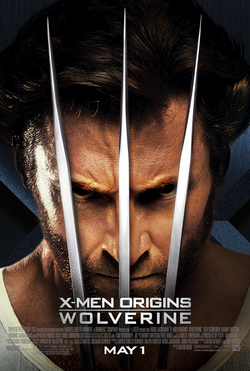
X-Men Origins: Wolverine (2009, directed by Gavin Hood)


Decades before he joins the X-Men, James “Logan” Howlett (Hugh Jackman) is just another mutant with retractable claws and a super-healing ability that essentially makes him immortal. With his half-brother Victor Creed (Liev Schreiber), Logan fights in wars throughout the centuries. When both Logan and Creed (who share Logan’s healing abilities) survive being executed by a firing squad, they are recruited by William Stryker (Danny Huston) to serve as members of Team X. Eventually, Logan tires of being an assassin and goes off on his own. However, both Stryker and Creed have plans for him and all the other mutants that they’ve captured or killed over the years. Several familiar characters appear—Scott Summers (Tim Pocock), Gambit (Taylor Kitsch), and the Blob (Kevin Durand) amongst others—but none of them have much of the personality that made them popular to comic book readers. (Just imagine including Gambit in an X-Men film but not Rogue.) Those who made it to the end of the film were given a Patrick Stewart cameo, albeit one that used CGI to de-age Stewart and make him look like an automaton.

With the majority of the X-Men either dead or cured at the end of X-Men: The Last Stand, it only made sense to spin Hugh Jackman’s Wolverine off into his own series of films. Unfortunately, 20th Century Fox didn’t understand that the thing that made Wolverine so interesting as a character was that his past was shrouded in mystery. Their first Wolverine film revealed his origin and it turned out to be not that interesting. X2 had been filled with so many hints about Wolverine’s past that the origin story didn’t feel as if it was telling us anything that we hadn’t already figured out. Even the many fight scenes between Sabretooth and Wolverine felt dull because it was established that both of them were essentially immortal and impervious to pain.

Today, this movie is mostly remembered for featuring the first appearance of Wade Wilson, the mercenary who will eventually become Deadpool. There’s very little of Deadpool to be found in this film’s version of Wilson. He tells a few jokes before getting his lips sewn shut. Imagine introducing a character who is affectionately known as “the merc with a mouth” and then rendering him silent for the majority of the movie. In Deadpool 2, there’s a scene where Deadpool goes back in time and kills this earlier version of Wade Wilson (or Weapon XI as he’s called here). The audience I saw the film with cheered.

Scenes I Love: The Lord of the Rings: The Return of the King


“Arise, arise Riders of Théoden (Riders of Rohan)! Fell deeds awake: fire and slaughter! Spear shall be shaken, shield be splintered, a sword-day, a red day, ere the sun rises! Ride now, ride now! Ride for ruin… and the world’s ending! Death! Death! Forth Eorlingas!” – Theoden, King of Rohan

This marks the final “Scenes I Love” series from Peter Jackson’s fantasy epic, The Lord of the Rings. The last couple days have seen a favorite scene picked from the first two film. Today’s pick was a tie between two scenes. One a third of the way into The Return of the King with the second being two-thirds in and a logical consequence of the first scene picked. I could’ve easily picked one over the other, but I’ve always seen the two as connected in some way. I also didn’t want to pick one over the other so we have two scenes instead of one. I say that’s a bonus for everyone.

The first scene was (continues to be one of my most favorite scenes ever put on film) the lighting of the beacons which signals Gondor’s call for aid to it’s far neighboring kingdom of Rohan. This scene just builds and builds until the rousing “Gondor theme” reaches it’s peak and shows each beacon lighting up one right after the other until it reaches the mountain peaks outside Rohan. No matter how often I see this scene (especially now on blu-ray) I can’t help but still feel a sense of awe at what Peter Jackson and his crew pulled off. One buys into the scene and just marvels at the sequence. A film which, up until the lighting of the beacons, had such a hopeless tone to it suddenly had hope appear.

The second scene finally sees the culmination of the lighting of the beacons. Rohan has responded in force as every able-bodied man and his horse have gathered on a rise above Pelennor Fields. With Theoden knowing the forces of Sauron arrayed and besieging Mina Tirith dwarfs even his own cavalry force he nonetheless orders his men to charge the Mordor lines to help break the siege. His speech in this scene trumps even Aragorn’s own rousing speech later on in the film which is saying much. The charge of the Rohirrim down into the Mordor lines gets a nice assist from Howard Shore’s score which begins with the “Rohan theme” signalling the arrival of the Rohirrim to the battle then transitioning to the “Nature theme” which is heard for the first time in full orchestral mode before returning to the “Rohan theme” as the Rohirrim charge finally crashes into the Mordor lines.

The charge itself looked great when I saw it on the big-screen and still the best way to see it. Barring not seeing it on the big-screen the best option would be to see it on blu-ray and on a large HDTV screen. The wide, overhead shot of the massed cavalry gradually gaining speed with Theoden at the elongating tip in the middle makes for great, epic filmmaking. The scene sells itself as Jackson used hundreds of extras in real armor and on charging horses (with CGI copies expanding their numbers into the thousands) to show true weight to the scene. I recommend to those who want to revisit this scene to watch it again but using their surround sound system on high and feel the thundering hooves of the charging Rohirrim until they crash into the Mordor lines. It’s the only way to see and experience the scene.