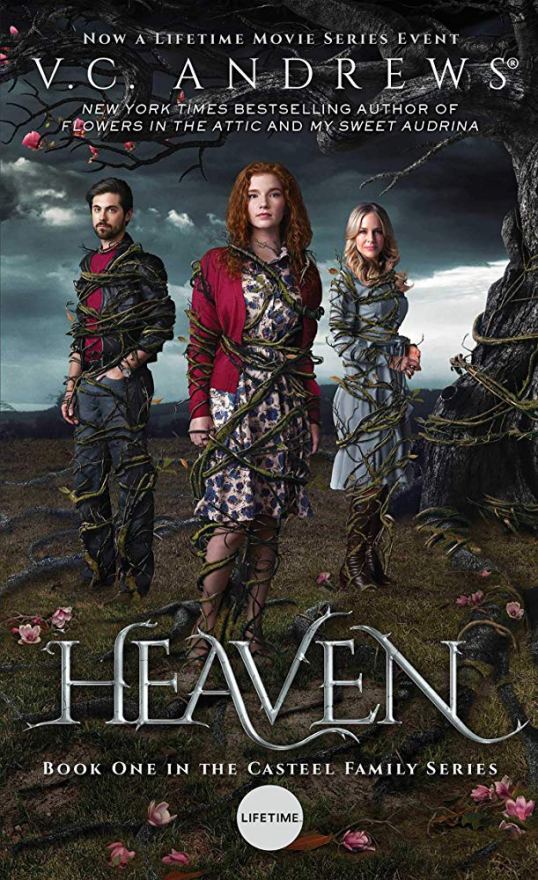
Lifetime Film Review: V.C. Andrews’ Heaven (dir by Paul Shapiro)


So, let’s say that you’re an alcoholic, backwoods hillbilly living in West Virginia.  Everyone in town hates you and your family because, years ago, your father sold a bad batch of moonshine to the mayor’s son.  You’ve got more children than you know what to do with and your wife has just run out on you because she’s blames you for losing her latest baby.  You ain’t got no money and you don’t understand that ain’t no word used by proper folks.  What do you do to make ends meet?

Well, if you’re Luke Casteel (Chris William Martin), you sell your children.  You sell the twins to a couple who can’t have children.  You sell your son to a farmer in Virginia.  You sell one of your daughters to the pervy local priest.  And you keep your oldest daughter, Heaven (Annalise Basso), so that she can clean the house and do the laundry.

Of course, Heaven’s not very happy about this arrangement.  She’s way smarter than the average Casteel and she’s got a crush on a boy at school named Logan Stonewall (James Rittinger).  Everyone keeps telling Logan to stay away from the Casteels and it’s certainly not going to help the family’s reputation once it gets out that Luke’s been selling off his children.

Luke has always resented Heaven, mostly because she’s the daughter of Angel, the only woman that Luke ever truly loved.  Angel was from a rich family in Boston but they disowned her when she married Luke.  Unfortunately, Angel then died giving birth to Heaven.  If that’s not bad enough, Heaven has now grown up to look exactly like her mother which leads to Luke getting drunk and trying to climb into bed with her….

AGCK!

Realizing that Heaven won’t be safe as long as she’s living with him, Luke decides to quit drinking and get his shit together.  JUST KIDDING!  Instead, he decides to sell her too.  He sells her to Kitty (Julie Benz) and Cal (Chris McNally).  Kitty is emotionally unpredictable and alternates between being extremely supportive and extremely cruel.  (She’s also obsessed with keeping her house spotless and really who can blame her?  A house should be clean because you never know who might come by.)  Cal is a sexually frustrated writer who smiles every time that he’s alone with Heaven.

Can you guess what happens?

Heaven is based on a book by V.C. Andrews, the first part of the five-volume Casteel Saga.  A few years ago, Lifetime had a lot of success when they adapted Flowers In the Attic and its sequels so it only makes sense that they would eventually bring the Casteel Saga to screen.  Heaven has everything that you would expect from both V.C. Andrews and Lifetime — melodrama, over the top dialogue, sex, dysfunctional families, and one victimized girl searching for her destiny.

At first, when I started watching Heaven, the film itself seemed to a bit silly.  I mean, I took one look at Casteels mountain shack and I started laughing because it was seriously the nicest shack that I’ve ever seen in my life.  (On Lifetime, even poor hillbillies live in a big house.)  It was also hard not to be amused about how, every few minutes, some primly-dressed townsperson would pop up and say something like, “Logan Stonewall!  You get away from those Casteels!”  As the film went on, though, it became obvious that the film itself had a very self-aware sensibility.  It understood that it was an over-the-top, frequently ludicrous melodrama so, instead of trying to trick us into believing it to be anything else, it instead embraced the melodramatic label and everything that it implied.  This is not a film that’s mean to be taken seriously.  Instead, for the first hour or so, it’s a bit of a self-aware parody.  It’s like Winter’s Bone directed by Paul Feig.

The second half of the film, which finds Heaven living with Kitty and Cal, has a bit more of an edge to it, largely due to Julie Benz’s wonderfully unhinged performance as Kitty.  Benz brings a jolt of real menace to both the role and the film itself.  That’s a good thing because winking at the audience and letting them know that you’re in on the joke can only take you so far.  Julie Benz shows up and basically announces, “Yes, this may be an overheated adaptation of a V.C. Andrews novel but don’t even think about letting your guard down!”

All in all, it makes for an entertaining Lifetime film.  While it may not be a powerful as Flowers in the Attic, it still holds your attention and Annalise Basso gives a good and sympathetic performance as Heaven.  Myself, I related to Heaven because we both have red hair.  Seriously, it’s not always being a redhead.

Heaven was followed by Dark Angel, which I’ll be reviewing later today.
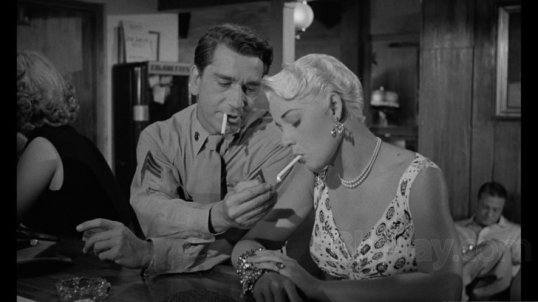
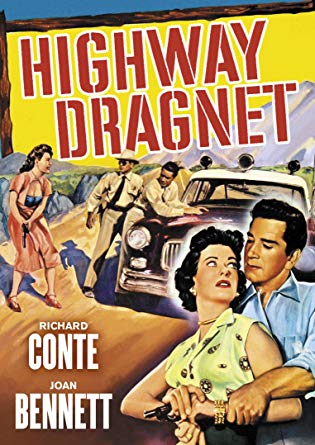
Film Noir Review: Highway Dragnet (dir by Nathan Juran)


Nifty is not really a word that I ever use, mostly because I’m not 80 years old and I’m not totally sure what the word means.  I’ve always assumed that nifty is way of saying that something is good without being too good and, if that’s true, then I have to say that the low-budget 1954 film noir, Highway Dragnet, certainly is a nifty film.

Highway Dragnet opens with Jim Henry (Richard Conte, who decades later would play the evil Barzini in The Godfather) in Las Vegas.  Jim’s just gotten out of the army and he’s visiting his friend, Paul (Frank Jenks).  Paul is a secret agent who is often unexpectedly called away.  Unfortunately, this means that Paul is not around when Jim is accused of murdering another man.  Since Jim was previously seen hitting on the dead man’s girlfriend, the police naturally assume that Jim’s the murderer.  When Jim says that Paul can provide an alibi whenever he gets back from doing his super secret spy stuff, the cops assume that Paul doesn’t actually exist.

Under the direction of the stern Lt. White Eagle (Reed Hadley), the cops are doing a lot of assuming!  Now, if Jim was smart, he would say, “Hey, White Eagle, you know what?  When you assume, you make an ass out of u and me!”  But Jim’s not smart so he decides to fire a gun at the cops and then go on the run!

Hey, Jim …. none of that makes you look innocent!

Anyway, while making his way across the desert, Jim comes across two women who are having car trouble.  Mrs. Cummings (Joan Bennett, who went from nearly getting cast as Scarlett O’Hara in Gone With The Wind to becoming a low-budget noir mainstay) is a fashion photographer and Susan Willis (Wanda Hendrix) is her model.  Jim fixes their car and then asks them for a ride.  They agree, little knowing that they’re heading straight into a …. HIGHWAY DRAGNET!

Of course, it turns out that Jim’s new friends have a connection to the crime of which he’s been accused.  The plot of Highway Dragnet hinges on a totally implausible coincidence.  This is perhaps not surprising when you consider that the script for Highway Dragnet was written by the legendary Roger Corman.  In fact, it was the first script that he ever sold and, though the film was directed by Nathan Juran, Highway Dragnet feels very much like a Corman quickie.  The plot is whatever it needs to be to get the story from the beginning to the end in 71 minutes.  Whether it all makes sense or not doesn’t appear to be all that much of a concern.

So, here’s what does work about Highway Dragnet.  First off, director Nathan Juran (who was also an award-winning art designer) manages to capture some memorable images of the Nevada desert and the film ends with a wonderfully over-the-top and atmospheric confrontation in a flooded house.  Secondly, Joan Bennett is as passive-aggressively menacing in Highway Dragnet as she would later be in Dario Argento’s Suspiria.  I also liked the performance of Reed Hadley, playing the unstoppable and incorruptible Lt. White Eagle.

Last Saturday, I watched Highway Dragnet with my friends in the Late Night Movie Gang and we enjoyed it.  It’s undoubtedly a minor film noir but it’s still entertaining when taken on its own terms.  If nothing else, the box office success of this low-budget production (which was shot over ten days) reportedly inspired Roger Corman to get serious about pursuing his own career in the film industry and, for that, movie lovers will always be thankful.

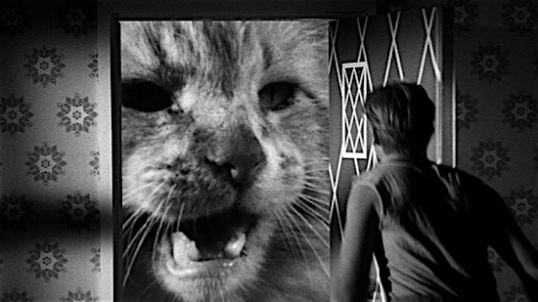
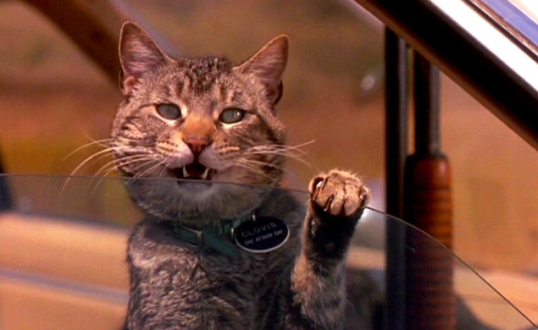
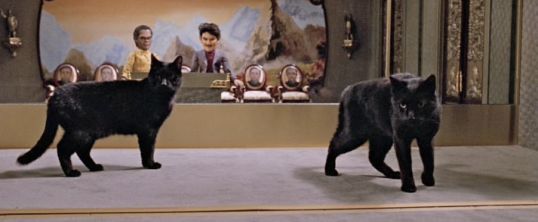
4 Shots From 4 Films: The Incredible Shrinking Man, Sleepwalkers, Team America: World Police, Captain Marvel


4 Shots From 4 Films is just what it says it is, 4 shots from 4 of our favorite films. As opposed to the reviews and recaps we usually post, 4 Shots From 4 Films lets the visuals do the talking.

Happy International Cat Day!

4 Shots From 4 Films

The Incredible Shrinking Man (1957, dir by Jack Arnold)

Sleepwalkers (1992, dir by Mick Garris)

Team America: World Police (2004, dir by Trey Parker)

Captain Marvel (2019, dir by Anna Bolden and Ryan Fleck)


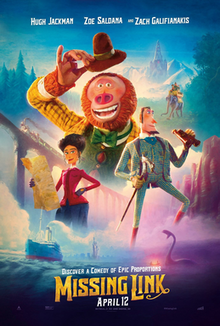
Film Review: Missing Link (dir by Chris Butler)


The year is 1886 and Sir Lionel Frost (Hugh Jackman) is the world’s greatest adventurer.

Or, at least, that’s what he says.  Actually, Sir Lionel may have made a name for himself and gained some popularity as a result of his many adventures but his fellow explorers and adventurers don’t take him seriously.  They view Sir Lionel as being little more than a self-promoter and they’re largely unimpressed with the all the time that he’s devoted to searching for mythical beasts like The Loch Ness Monster and lost lands like El Dorado.  Sir Lionel desperately wants to join the London-based Society of Great Men but the snobbish Lord Piggot-Dunceby (Stephen Fry) refuses to accept his application.

When Sir Lionel receives a letter from someone in America who claims to have tracked down the legendary Sasquatch, Sir Lionel and Lord Piggot-Duncey make a bet.  If Sir Lionel can prove that the Sasquatch exists, he will be allowed to join the Society.  Sir Lionel heads off to America while Lord Piggot-Dunceby promptly hires an evil bounty hunter named Willard Stenk (Timothy Olyphant) to prevent him from accomplishing his mission.  As Lord Piggot-Dunceby explains to his assistant, Mr. Collick (Matt Lucas), the world is changing too quickly.  If Sir Lionel isn’t stopped, people might start to believe in things like evolution or women’s rights.

When Sir Lionel arrives in America, he promptly starts searching for the Sasquatch and, amazingly enough, it doesn’t take him very long to find him.  It turns out that the Sasquatch — who Sir Lionel names Mr. Link — not only speaks remarkably good English but he’s also the one who wrote to Sir Lionel in the first place.  As played by Zach Galifianakis, Mr. Link is a rather laid back and good-natured Sasquatch.  In some ways, Mr. Link is surprisingly worldly and, in other ways, he’s rather naive.  He takes everything that he hears literally, which poses a problem since Sir Lionel has a tendency towards sarcasm.  It also turns out that Mr. Link is lonely but he thinks that he might be related to the Himalayan Yetis.  And Mr. Link thinks that Sir Lionel is just the man to help him get from America to Asia!

Sir Lionel reluctantly agrees.  Accompanying them on their journey is Sir Lionel’s former girlfriend, Adelina Fortnight (Zoe Saldana).  And pursuing them, every step of the way, is Lord Piggot-Dunceby and Willard Stenk.

Missing Link is an enjoyable and undeniably cute stop-motion animated film.  It was produced by Laika, the same animation outfit that previously gave us Kubo and The Two Strings.  While Missing Link is never as memorable or emotionally resonant as Kubo, it’s still a good-hearted film and entertaining enough that an adult can watch it without wanting to tear their hair out.  Blessed with impressively detailed animation and the comedic vocal talents of Hugh Jackman, Stephen Fry, Timothy Olyphant, and Zach Galifianikis, Missing Link has enough funny moments and clever lines that most audiences should be able to overlook the fact that the story itself sometimes feels a bit haphazard in its construction.  Much like the Sasquatch at the center of its story, Missing Link is a rather laid back film.  If Kubo was a carefully-constructed work of art, Missing Link feels like it was almost thrown together at random.  The film is at its best once it reaches the Himalayas, where the humor becomes very barbed and Emma Thompson steals the show in a sharp-witted cameo.

I enjoyed Missing Link.  It’s just too sweet-nartured not to like.

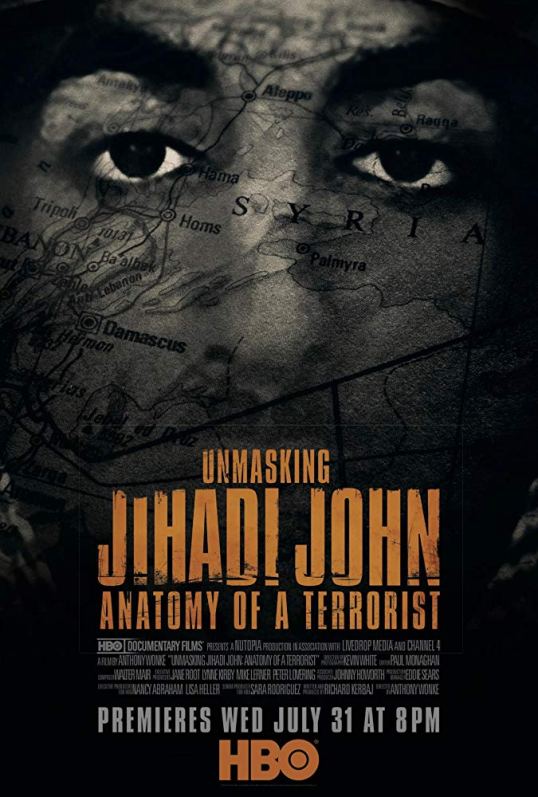
Documentary Review: Unmasking Jihadi John: Anatomy of a Terrorist (dir by Anthony Wonke)


Who was Jihadi John?

He was the black-clad terrorist who haunted the news in 2014 and 2015.  He was the faceless man with the London accent who was frequently filmed standing in the desert, taunting Barack Obama and David Cameron before then beheading a hostage.  In total, Jihadi John was filmed either beheading or directing others to behead 29 hostages.  Among his victims were American journalist James Foley and British aid worker David Haines.

Up until he was apparently blown up by a drone strike in 2015, Jihadi John was, for many of us in the West, the best-known member of ISIS.  When we heard the word “ISIS,” he was the one we pictured.  Because his face was always covered, his identity was unknown.  All we knew about him was that he spoke perfect English with a British accent.  He was like a creature sprung from a nightmare, a monster who materialized out of nowhere and taunted us for our inability to defeat him.  There was much speculation about who Jihadi John was.  Even after we found out that he was probably a Kuwait-born British citizen named Mohammed Emwazi, we still wondered how this man came to be standing in the desert, being filmed as he committed terrible crimes.

The new HBO documentary, Unmasking Jihadi John, is an investigation into the origins of terrorism.  The film attempts to reconstruct Emwazi’s early life as an outsider in the UK.  His teachers describe him as being quiet and somewhat forgettable.  Video from that period shows a skinny and awkward-looking teenager, one who covered his mouth whenever he spoke because he had once been taunted for having bad breath.  When he was ten, he wrote that he wanted to be a soccer player.  A few years later, he was caught on video, smiling while sitting in a computer lab.  And then, just a few years after that, he was in Syria, committing horrific acts of evil.  And make no mistake about it — the Emwazi who we see waving a knife while condemning the West is evil.  Evil comes in many disguises and will often try to justify itself by hijacking a religion or an ideology.  But in the end, evil is evil.

Because Emwazi was vaporized in 2015, he’s not around to explain just what exactly led him to join ISIS.  The film speculates that Emwazi initially joined because he was looking for both a surrogate family and a place where he actually belonged.  The documentary contains clips from several ISIS propaganda videos and what’s interesting is that the images that ISIS used — children playing in the streets, men working together to rebuild a city, and friends hugging each other — are many of the same images that one would expect to find in western advertising.  They’re seductive images, ones that offer up a promise of a better life as long as you follow orders and don’t question authority.  They were exactly the type of images designed to appeal to someone like Emwazi (and countless others), who had a need to feel as if they belonged to something bigger than themselves.

If the first half of the documentary focuses on Emwazi and the founding of ISIS, the second half deals with the aftermath of Emwazi’s actions.  Interviews, with the hostages who survived and the families of those who did not, drive home the pain that was caused by the actions of ISIS as a whole and Emwazi in specific.  It’s in those interviews that we are reminded that Emwazi’s evil cannot be excused by a turbulent childhood or misplaced idealism.  Towards the end of the documentary, the man who controlled the drone that fired the missile that ended Emwazi’s life is interviewed.  When we watch the grainy and coldly impersonal footage of Emwazi’s car blowing up, we feel no sympathy for the man who was called Jihadi John.   As to whether or not there’s joy to be found there, well, that’s up to the viewer to decide for themselves.

It’s a compelling documentary but it’s also frustrating, if just because it poses a question that may be impossible to answer.  Why does evil exist?  How can one go from being a normal, if awkward, teenager to being a savage murderer?  Like the rest of us, the documentary can only wonder why.

Film Review: Cold Pursuit (dir by Hans Petter Moland)


Released back in February (just in time for Valentine’s Day!), Cold Pursuit was this year’s Liam Neeson revenge flick.

This time, Neeson played Nels Coxman, a snow plow driver who speaks in a raspy tone of voice and tends to walk around with a thousand-yard stare on his face.  After his son is killed by gangsters, Nels sets out for revenge.  It turns out that Nels’s father was some sort of mob enforcer so both Nels and his brother (William Forsythe) have apparently inherited the “instinctively know how to kill” gene  So, while Nels’s wife (Laura Dern) stays at home and has a nervous breakdown, Nels heads out and starts killing folks.  Since the gangsters are led by an idiot named Viking (Tom Bateman), they all assume that they’re being targeted by a rival drug gang, one which is led by a Ute named White Bull (Tom Jackson).  So, while the two drug gangs are killing each other off, Nels is busy killing any stragglers that he comes across.  It all adds up to a lot of killing.

Cold Pursuit is different from other Liam Neeson revenge films by the fact that it’s an out-and-out parody of the genre.  So, while Neeson walks through the film with his usual glum expression and commits all the usual mayhem that we’ve come to expect from a vengeance-driven Neeson, everyone else plays their role as broadly as possible.  Tom Bateman leaves not a single piece of scenery unchewed in the role of Viking while Tom Jackson is stoic to the point of insanity in the role of White Bull.  Whenever a gangster gets killed, a title card appears, listing his name, his nickname, and his religion.  Meanwhile, two cops (Emmy Rossum and John Doman) prove to be comically ineffective.

And I will admit that I did laugh a few times while watching Cold Pursuit.  The scene where Neeson asks his brother to explain why everyone has a nickname made me smile.  Some of the murders are clever and the action scenes are frequently so over-the-top that you can’t help but be amused by them.

That said, Cold Pursuit didn’t really work for me.  I think the problem is that the filmmakers spent so much time trying to parody Neeson’s films that they didn’t consider that the majority of those films are themselves already parodies.  I mean, just watch The Commuter and tell me that film isn’t cheerfully winking at the audience.  Since Neeson’s screen persona hasn’t really been a serious one for close to ten years now, parodying it isn’t quite the subversive act that Cold Pursuit seems to think it is.  The difference between Neeson’s other films and Cold Pursuit is the difference between merely winking at an audience or pulling a gun on an audience while demanding, “LAUGH, DAMN YOU!”  Sometimes, the funniest jokes are the ones that you pretend you’re not making.

On the plus side, the film looks gorgeous.  It takes place in the Colorado mountains and makes great use of the frozen landscape.  And George Fenton’s score is nicely evocative and well-used in the film.  Finally, Liam Neeson is always fun to watch, even when it’s in a somewhat flawed film like this one.


Film Review: The Upside (dir by Neil Burger)


There’s a lot of opera in The Upside.

That, in itself, is not a surprise.  The Upside is about a wealthy, emotionally repressed white man and, if there’s anything we’ve learned from the movies, it’s that wealthy, repressed white people always love opera.

Another things that we’ve learned from the movies is that wealthy, emotionally repressed white people always hire a streetwise person of color to help them learn to appreciate life.  This person  of color will inevitably not care for all of the opera and will then introduce the wealthy, emotionally repressed white person to their own type of music.  If the movie’s a comedy, that music will be rap.  If it’s a drama, that music will be jazz.  The Upside is a dramedy so the music of emotional liberation is Aretha Franklin.

There’s not a single cliche that goes unused in The Upside.  Actually, I take that back.  As opposed to so many other films of this short, Phillip (Bryan Cranston) does not start the film as a politically incorrect bigot, which means that we’re spared of any cringey scenes of Philip trying to bait Dell (Kevin Hart) by being casually racist.  Otherwise, every cliche imaginable is present in The Upside and it all gets to be a bit much after a while.  I’m sure that the film means well and there’s a part of me that felt a little bit guilty about not liking it but seriously, this is one of those movie’s that just keeps coming at you.

Phillip is a paraplegic who wants to die, though not before listening to a lot of opera.  Dell is an ex-con who needs to find a job so his parole doesn’t get revoked.  Yvonne (Nicole Kidman) is Phillip’s personal assistant.  She’s obviously in love with Phillip, though for some reason this fact is never acknowledged until the end of the film.

Together …. they solve crimes!

No, actually, they all become friends and learn the importance of celebrating life.  It’s a good lesson to learn, make no mistake.  But it’s just all so predictable that it’s hard not to resent just how thoroughly and blatantly the film insists on trying to manipulate you.  You get the feeling that the filmmakers didn’t have any faith in their audience’s capability to feel empathy.  Director Neil Burger did such a great job with Limitless but, with this film, he seems to have lost his sense of pacing.  The movie drags from one heartwarming cliche to another, without any hints of the type of quirky self-awareness that would help to make those cliches easier to digest.

Bryan Cranston’s a great actor but, perhaps realizing that he’s merely playing a more a benign version of Walter White, he seems a bit bored here while Nicole Kidman is sabotaged by a script that doesn’t allow her to do much other than reproachfully shake her head.  Kevin Hart, however, actually gives a pretty good performance, one that suggests that he actually has a lot of potential as a dramatic actor.  The character may be a stereotype but Hart at least brings a bit of energy to the film.

The Upside came out this January and it was actually a modest box office hit.  I imagine that a lot of people loved this film for the exact reason that I disliked it.  The film’s just too predictable for me to embrace The Upside.

Here’s The Trailer for 1917!


Sometimes, you hear about a film and you just know that it’s either going to be brilliant or it’s going to be disaster.

Take 1917, for instance.  The film is World War I epic and right now, a lot of people are predicting that it’s destined for Oscar glory.  I’m one of those people and I’ve said that despite not having seen the film.  What we do know about the film sounds intriguing.  Apparently, much like Hitchcock’s Rope and Birdman, the film is being put together to appear as if it’s just one, long continuous shot, without any breaks, with the idea being that 1917 is going to an immersive film about the horrors of war.  While the film’s two leads are played by unknowns, supporting roles have been taken by Colin Firth, Mark Strong, and Benedict Cumberbatch.

Sounds pretty good, right?

Here’s my concern.  The film is being directed by Sam Mendes, who is one of the most pretentious filmmakers of all time.  Mendes did brilliant work with Skyfall but have you tried to sit through American Beauty or Away We Go recently?

Anyway, I hope that 1917 lives up to the promise of its premise and that we get the Mendes of Skyfall as opposed to the Mendes of SPECTRE.  The trailer looks good and here it is:

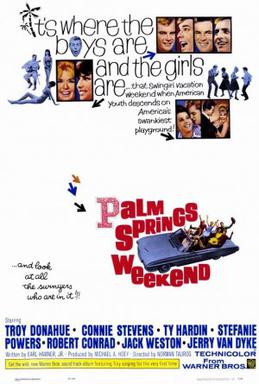
Film Review: Palm Springs Weekend (dir by Norman Taurog)


The 1963 film Palm Springs Weekend asks the question, “When is a beach film not a beach film?”

When it takes place in the freaking desert!

That’s right, Palm Springs Weekend takes place in the middle of the California desert.  There’s no ocean in sight nor are there any beaches on which to frolic.  Instead, there’s just a cheap motel and a swimming pool.  That said, Palm Springs Weekend pretty much follows the same formula as all of the beach films that were released in the early 60s.  A group of college students hop on a bus and head off for the weekend.  One student is wacky.  One student is rich, wild, and dangerous to know.  And, of course, one student is clean-cut, responsible, boring, asexual, and studious and all about doing the right thing.

Troy Donahue, the blandest teen idol of all time, plays the clean-cut student.  His name is Jim and he’s a college basketball star.  Even when he’s on the bus traveling to Palm Springs, he’s still got a book to study.  Jim’s the type who wears a suit and a tie to the pool.  He ends up falling in love with Bunny Dixon (Stefanie Powers) and the two of them spend a lot of time talking about sex in the most chaste way possible.  Bunny’s father (played by Andrew Duggan) is the chief of police and he doesn’t want any crazy college kids causing trouble in his town!  Well, it’s a pretty good thing that all he has to worry about is Troy Donaue asking his daughter if she wants to take a moonlight stroll in the middle of the desert.

(Trust me.  I’ve spent enough time in the desert to know that the last thing you want to do when you live near rattlesnakes is take a moonlight stroll.)

Jim’s best friend is Biff (Jerry Van Dyke).  Biff is the wacky college student, which means that he plays the ukulele and he gets all the comedic moments.  In this film, that amounts to getting babysitting an annoying boy and, at one point, falling into an extremely sudsy pool.  Luckily, Jim’s there to deliver CPR, which leads to soap bubbles floating out of Biff’s mouth and …. you know what?  I’m tired of writing about Biff.

Anyway, Biff and Jim really aren’t that important.  The entire film pretty much belongs to Robert Conrad and Connie Stevens, largely because they’re the only two actors who are allowed to break out of the trap of always either being bumbling and innocent or dramatic and self-righteous.  Robert Conrad plays Eric Dean, who is a spoiled rich kid who owns an expensive and fast car and who is basically a fun-loving sociopath.  Meanwhile, Connie Stevens plays Gail, who is a high senior and who is pretending to be a college student.  And while the film insists that we should somehow be disappointed in Gail because she’s acting wild and breaking curfew and doing more than just talking about whether or not it’s appropriate to kiss on the first date, she’s actually the most compelling character in the film because, at the very least, she’s actually setting her own rules and making her own decisions.  Since Palm Springs Weekend was made in 1963, it ultimately feels the need to try to punish Gail for thinking for herself but that doesn’t change the fact that she’s still a far more interesting character than the blandly innocent Bunny.  Gail’s a rebel.  Gail’s the future.  All hail Gail!

Anyway, Palm Springs Weekend is pretty forgettable and it’s never as much fun as any of AIP’s old Beach Party films.  That said, I’d still recommend it if you’re a history nerd like me.  It’s definitely a film of its time, a time capsule of an era.

Here’s The Trailer For The Lighthouse!


So, I just finished watching the trailer for The Lighthouse and I am now officially excited!

Robert Eggers previously directed one of the best horror films in recent memory, The Witch.  Well, he’s back now with The Lighthouse, a black-and-white film about two men (Willem DaFoe and Robert Pattinson), one lighthouse, and one secret.  The trailer is wonderfully creepy and the black-and-white cinematography is gorgeous.  I can’t wait to see this film!

Here’s the trailer: