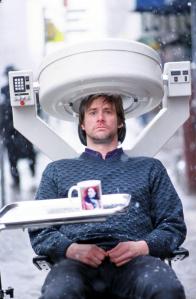
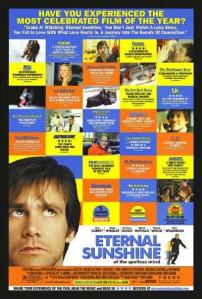
The plot plays out like something from a Philip K. Dick story. I don’t want to reveal too much because I don’t want to ruin the film for anyone who hasn’t seen this film. Eternal Sunshine is one of those rare films that carries with it the joy of discovery. Depressed Joel (played by Jim Carrey) discovers that his ex-girlfriend Clementine (Kate Winslet) has hired Lacuna Inc. to totally erase all memories of him from her mind. Embittered, Joel decides to go through the same process. The Lacuna technicians (Elijah Wood and Mark Ruffalo) comes to Joel’s apartment in the middle of the night and start the process of erasing his memories of Clementine. However, as Joel is losing his past, he realizes that he doesn’t want to lose his time with Clementine. Hence, Joel finds himself running through his rapidly fading memories of Clementine, trying to save at least some scrap of her memory from being erased. Meanwhile, as Joel fights to save his identity, Ruffalo entertains himself by inviting his girlfriend (Kirsten Dunst) over to Joel’s apartment while Elijah Wood sneaks off so he can meet his new girlfriend — who is none other than Clementine.
The genius of this Charlie Kaufman’s screenplay is that it takes an idea that seems very much “out there” and uses it to explore emotions that we’ve all felt. Who doesn’t have someone that they wish they could wipe from their mind? Me, I wish I could forget the exchange student from Keele University who broke up with me via e-mail. I’d love to obliterate all memory of the frat boy who told me I was “white trash” or the former love of my life who managed to break my nose and my heart with just one movement of his hand. We all have those people in our lives and what we forget is that by wiping out all the bad memories, we lose all the good ones as well. Yes, Paul Walsh may have made me cry with his e-mail but, for two months before that, he held me while I cried and I can’t remember what I was crying about but I do remember feeling like I had never been held like that before. And Dane may have hurt me terribly but now, every time I doubt myself, I simply remember that I’ve already survived the worst that could happen. As for that frat boy who called me “white trash” — well, fuck him. Yeah, there’s really no downside to erasing him from my mind. In fact, I’ve already started because, to be honest, I can’t remember his name for the life of me.
Ironically enough considering the title, there’s very little sunshine to be found in this film. Not only is every scene drenched in melancholy but, quite literally, director Michel Gondry appears to have exclusively filmed on overcast days. For such a deliriously romantic film — one that celebrates the idea of enduring love — Eternal Sunshine of the Spotless Mind is almost totally told in tones of gray and darkness. In fact, as I watched the film last night, I was struck by the fact that often times, the only color in the film was provided by the Clementine’s ever-changing hair. (Interestingly enough, Joel mentions Clementine’s hair as one of the things that he especially wants to forget about her.) That the film works as both a dark comedy and a love story despite the grim images is a testament to the talents of both screenwriter Charlie Kaufman and director Michel Gondry. (On the basis of the director’s later films — the latest being the enjoyable but shallow Green Hornet — I kind of suspect that Kaufman perhaps deserves a little bit more credit that Gondry.)
I think it’s also a testament to the talents of the film’s cast, all of whom gel into a perfect ensemble and allow the audience to believe in the film no matter how odd the film’s events may seem. As I watched them last night, I found myself thinking about how much I truly love to watch good acting. As long as a film has one or two good performance, it can be out-of-focus, choppily edited, and an hour or two too long. By the same token, I find nothing more offensive than a million-dollar film full of expensive technology and boring performances. (Hello, Avatar. How are you, Battle L.A?) When I find a film, like Eternal Sunshine, that is actually both well-made and well-acted, I’m pretty much in love.
As the two lovers, Jim Carrey and Kate Winslet have a very surprising and very real chemistry together. Watching them, you believed in their love and then you just as strongly believed in their hate. This is one of those odd love stories where you not only believed that the two of them would actually get together but you also completely understood how and why Joel eventually drove Clementine away. Carrey makes Joel’s depression believable without allowing it to get tedious or repetitive while Kate Winslet — well, where to begin? Kate Winslet is probably one of the best actresses ever and this is one of her best performances. I’ve always had a bit of a girlcrush on Winslet — there’s an honesty to her performances that few other actresses can match. When she’s onscreen, the audience is with her. She never puts up the whole “film star” barrier and, as a result, she inhabits her characters completely and brings them to life with both their strengths and their flaws. And Clementine has got her share of flaws. (I remember that when my mom saw this movie, she absolutely hated Clementine and the ever-changing color of her hair.) Winslet doesn’t shy away from making Clementine human and, as a result, I think she elevated everyone else in the film as well.
As good as Carrey and Winslet are, the supporting roles are well-played as well and, as in all great movies, they give the impression of a world that existed before the movie started and one that will continue after the end credits. I especially loved the performances of the Lacuna Staff, from Tom Wilkinson’s bland yet intimidating doctor to the creepy geekiness of Elijah Wood. Mark Ruffalo and Kisten Dunst have a few great scenes where they’re partying the night away in Joel’s apartment while Joel’s memory is slowly erased. The sight of a very hairy Ruffalo and a very giggly Dunst dancing in their matching panties pretty much epitomizes “geek love” for me. I know that some people have complained that the scenes with Ruffalo and Dunst seemed out-of-place when compared to the ones between Carrey and Winslet but actually, I love the chemistry between Ruffalo and Dunst. Even playing one of the nerdiest characters ever, Mark Ruffalo is still hot. As for Dunst, she’s basically playing the same character that she always plays. (As my friend Jeff recently put it, “Kirsten Dunst In Her Underwear” is as much of a film genre as drama, comedy, and science fiction.) But I’ve always thought that she’s a likable enough actress (plus, by going red for Spiderman, she also indirectly helped this redhead’s social life) and she actually provides a nice (if surprising) moral center for Eternal Sunshine.
(Also, I’ll admit right now that if my boyfriend had a job that allowed him to hang out into a different stranger’s apartment every night, I’d probably sneak over and dance around in my underwear as well.)
It took me a while and a handful of viewings to really appreciate Eternal Sunshine of the Spotless Mind. When I first saw it, I thought it was a strange film. I liked it but I never expected that it would become one of my favorite movies. However, with each viewing, I find myself relating to and loving this film just a little bit more. So, thank you to everyone who voted in my poll and who gave me a chance to fall in love with this film all over again.
Last Friday, I went and saw Zack Snyder’s new film Sucker Punch with my sister Erin and a group of our friends. Sucker Punch was a film that I had been looking forward to seeing for a while and not even all of the scathingly negative reviews that I read before leaving for the theater could dampen my enthusiasm. Somehow, I knew I would love this film (despite the fact that Zack Snyder is, usually, one of my least favorite directors). And you know what? I did love it.
The plot has been criticized for being both overly complicated and not being complicated enough and I actually think that a case can be made for either one of those complaints. The film opens in the 1950s. Teenage Babydoll (Emily Browning) is sent to a mental asylum by her evil father. Her father has made a deal with an orderly named Blue (Oscar Isaac) to have Babydoll lobotomized. (By the way, this was actually a pretty common thing back in the 50s. I shudder to think what would have been done to me if I had been born five decades earlier.) As Babydoll waits for her lobotomy (scheduled to occur at the end of her first week as a patient), she is subjected to the therapy of Dr. Gorski (Carla Gugino) who plays music and encourages her (all female) patients to find peace by controlling their fantasies.
Suddenly, we’re in a fantasy (just who exactly is having the fantasy is one of the film’s mysteries that’s never really explained but is actually kinda fun to debate). In the fantasy, the insane asylum is actually a brothel/dance hall that is owned by Blue. Gorski is a choreographer. The patients are now all lingerie-clad dancers/prostitutes. Babydoll is the latest girl to be put into service in the brothel and she is being held over for “the High Roller” who is expected to show up in five days.
(The fact that the movie explicitly compares forced lobotomy to rape is one of the many interesting facts that the majority of negative reviews have chosen to ignore.)
Babydoll soon discovers that 1) she’s such a good dancer that when she does dance, men can only watch in stunned silence and 2) whenever she does dance, she finds herself transported into a fantasy world where, along with getting advice from the Wise Old Man (Scott Glenn), she also battles (and defeats) everything from giant Samurai to dead Nazis who have been reanimated by “steam power” to a dragon. These battle scenes, as odd as they are, are actually pretty exciting. Say what you will, Snyder knows how to direct a battle scene and Browning and the rest of the almost entirely female cast all seem to be having a blast getting to do the type of things that usually, only boys are allowed to do.
Anyway, as a result of her fantasies, Babydoll comes up with a plan to escape the brothel. She quickly recruits four other girls into her plan — Amber (Jamie Chung), Blondie (Vanessa Hudgens), the free-spirited (and really, really cool) Rocket (Jena Malone) and finally Rocket’s older sister, the world-weary Sweatpea (Abbie Cornish). In order to escape, they need to steal four different items. While Babydoll distracts their captors by dancing (and therefore going into one of her battle fantasies), the others steal whatever is needed. And everything works out just fine. Until it doesn’t….
Sucker Punch is a glorious mess of a movie and, perhaps because I’m a glorious mess myself, I loved it. In fact, it’s probably my favorite film of 2011 so far. In this regard, I know I’m going against the majority but so what? Throughout history, if one thing has always been consistent, it is that the majority sucks. Yes, Sucker Punch is a deeply flawed film that runs on for at least half-an-hour too long. And yes, I think it can be argued quite convincingly that this film is ultimately a happy accident, a film that’s strength comes not from directorial design but instead as the result of a few random elements that resonate in the subconscious. But no matter — happy accident or not, I loved Sucker Punch and I’m not ashamed to admit it.
Hmmm…that’s a familiar pose.
Let’s start with a few obvious points. As even those who hate this film seem to be admitting, it’s visually stunning. The battle scenes are kinetic and exciting, the film’s over-the-top production design (a mix of German Expressionism, 50s film noir, Bob Fosse choreography and old Zack Snyder films) is always a blast to look at, and the soundtrack kicks ass. Like other films in the so-called “Girls with Guns” genre, Sucker Punch allows its actresses to be something other than just scenery or helpless damsels.
Interestingly enough, for a film that takes place mostly in the world of fantasy, there’s no attempt to really make this film’s version of “reality” come across as anything other than an elaborate fantasy as well. The film’s opening scenes are played out in slow-motion and the film’s asylum (which, like most movie asylums, appears to have been borrowed from The Cabinet of Dr. Caligari) is so gray that the film might as well be in black-and-white. Blue and Babydoll’s father hold a melodramatic conference while standing directly behind Babydoll, their three heads filling the screen like flashes of manic paranoia. As such, the film — at times — becomes a fantasy taking place in a fantasy taking place in a fantasy. It takes a while for the viewer to get used to this and, at times, it can seem like there’s really nothing to give the film any sort of grounding. However, for me, the opening sequences are not meant to be “real” as much as they serve as a reflection for the way that the real world can imprison anyone but women in particular. As women, we know what its like to look up and suddenly realize that our entire world has somehow become gray and cold without our knowledge. Throughout history, when everything else has been taken away from us, fantasy has been our escape and salvation, our imagination being the one of those precious things that our fathers, our husbands, and our bosses would never be able to deny us.
One problem I did have with the film is that, for all the talk about how Babydoll’s dancing is essential to the escape plan, we never actually see her dance. Instead, we see Browning start to sway a little, her eyes cast down and then suddenly, we’re transported into a fantasy involving zombie Nazis or giant samurai. Once this fantasy mission has been completed, we’re suddenly back in the brothel where we see Babydoll ending her dance while her audience applauds.
To a large extent, I actually agree with Snyder’s approach here because I know, for me much as with the characters in this film, dance always presented an escape from the grayness of being. When I was dancing, I was literally living a fantasy and this seems to be the case with Babydoll as well. However, from simply a cinematic point of view, the constant talk of the importance of Babydoll’s dance leads the audience to naturally expect that they’ll get to see at least a little bit of the dance in question. When you don’t, it’s hard not to feel as if you’ve been teased. (I have to admit, as well, that all this dance talk got my competitive streak going as well. As I whispered to Erin, “They should see me dance.” “It’s a movie, Lisa Marie, not a challenge.” Erin replied.) Snyder, as a director, certainly probably has a strong enough visual sense that he could have found a way to make any dance that Emily Browning came up with look impressive and other worldly.
Oscar Isaac
As Arleigh has pointed out on both twitter and this site, Zack Snyder is a director who concentrates almost all of his effort on producing memorable visuals. That’s how he tells his stories and gets the whatever response he wants from his audience. Characters and dialogue are often kept simple so that they don’t get in the way of his visuals. Typically, I hate films like this and I’m hardly a fan of Snyder’s previous work. However, it didn’t bother me so much here, perhaps because I could relate to the overall theme of feeling trapped and needing an escape. (More on that later.) As with previous Snyder films, the performances here are mostly in service of the visuals. The actors don’t so much perform as much as they just pose against the stunning backdrops. As such, Emily Browning, Vanessa Hudgens, and Jamie Chung don’t really get much of a chance to make an individual impression. Playing sisters, Abbie Cornish and Jena Malone don’t have a lot to work with but they both are strong enough personalities that they manage to bring some life to their characters beyond simply serving as figures on a landscape.
(I should also mention — and Arleigh had the same reaction — that Cornish and Malone and their character’s relationship reminded me a lot of my relationship with my older sister, Erin — especially all the times that Rocket attempted to keep things fun and interesting just to be told, by Sweetpea, that she wasn’t being boring enough. I definitely related to that. Erin, for her part, says that she related to all the scenes where Sweatpea nearly got killed “because her bratty, little sister did something stupid that made absolutely no sense.”)
Abbie Cornish and Jena Malone (or Erin and Lisa) In Sucker Punch
I also have to mention Oscar Isaac and Carla Gugino, both of whom seem to understand just how far they can go with their characters without descending to the level of camp. Gugino — after this film, Sin City , and Watchmen — has got to be the Queen of digital filmmaking. She’s also the closest thing that American film has to an old school femme fatale right now. As well, as I told Erin as we watched the film, I can only hope that my tits look that good when I’m 60 years old. And speaking of looking good, Oscar Isaac certainly does look good here. Even when he has dark circles under his eyes and sports a glowering scowl, I would still throw Isaac on the ground and lick his face. Plus, he and Gugino contribute a great performance of Love Is The Drug which plays over the end credits.
Finally, Scott Glenn — looking a lot like the late David Carradine — plays the “Wise Old Man” who pops up as a father figure of sorts in Babydoll’s fantasies. Glenn does okay with his role though I wish his character had been a bit more clear. To be honest, simply from the point of view of empowerment, I kinda wish his character had been known as the “Wise Woman” and had been played by Cate Blanchett.
One huge issue that seems to be coming up a lot when people talk about Sucker Punch is the issue of “empowerment.” Does this film, which indulges in a massive schoolgirl fetish even while portraying girls kicking ass, empower or degrade women? Well, first off, I would suggest that the question itself is an inappropriate one because to argue that a film is either “empowering” or “degrading” and nothing else is basically the same as arguing that all women are going to have the exact same response to what they see regardless of their own life experiences or personal outlook. Quite frankly, because of some of my own personal experiences, I find the infamous, much-maligned 1970s rape/revenge film I Spit On Your Grave to be very empowering and I’m not alone in that regard. At the same time, I also know many very intelligent, very strong women who would consider that film to be anything other than empowering. It’s simply a matter of perspective.
I think the same can be said about Sucker Punch. To me, Sucker Punch was a very empowering film and, honestly, that’s the main reason that I loved it even with its flaws. First off, I think that any film in which women are allowed to do something other than stand around and panic until they’re rescued by a man, is going to be empowering because, far too often, we are taught that waiting for the right man to arrive is the only option available to us. As well, the main theme of Sucker Punch was the theme of escape, whether that escape was physical or mental. While I won’t presume to speak for all women, I can say that for many of us, escape is the usually the root of all fantasy and, at least to some extent, the ultimate goal. As I watched Sucker Punch on Friday night, it seemed to me that, for far too many of us, life is a series of prisons and asylums in which the walls are constructed out of the harsh judgments of patriarchal society. We allow ourselves to become trapped by the need to be a mother or a wife or a nurturer or a seductress or a whatever it is that society says a good woman has to be on any given day. The women in Sucker Punch are imprisoned because they’ve gone against the expectations of society and now, whether being lobotomized or sacrificing their bodies in the fantasy brothel, they are allowing their role and personality to be defined by men. Therefore, when Babydoll and her crew fight for their freedom, we can relate to them because that’s what we have to do every day of our lives.
My Dream Is Yours
But, the argument goes, how this be considered to be empowering when all the female images in the film are so hyper-sexualized? And it’s true that even when the film is supposed to be portraying reality, the camera does linger over the bodies of the actresses. In the brothel sequences, the film often looks like an outtake for some anime-inspired Victoria’s Secret fashion show. (Seriously, this film has a major lingerie fetish but you know what? So do I. Lingerie is fashion poetry and when I’m wearing something pretty, I feel like a poem.) Finally, there’s the image of Babydoll fighting her enemies and dodging explosions while flashing her underwear to the viewer. Many have argued that this is a degrading image, that it encourages male viewers to leer and to ogle.
Well, the fact of the matter is that this film was directed by a man and often times it is obvious that we’re watching the action through a male gaze. But, so what? Just as I believe that women should not be ashamed of their sexuality, I don’t see why men should be expected not to look. (Looking is not the problem. It’s the assumption that the right to look also gives one the right to judge.) And ultimately, I would argue, that being sexy is empowering because society, with its fucked up view of human sexuality in general, is so quick to tell us that the ideal woman is unaware of her sexuality or, at the very least, she should either hide it behind a facade of demure humility or else flaunt it to such an extent as to suggest that it’s all actually a sign of some deeper neurosis. What is rarely given as an option is the idea that we might want to show off a little just as a matter of pride. Men are applauded for showing off their muscles yet we are still expected to blush if we show a little cleavage. Being sexy is not degrading. What’s degrading are the conditions that society has attempted to impose on the right to be sexy. To me, it’s very empowering to see strong, independent women standing up for themselves and looking good while doing it.
Sexual Empowerment
And therefore, for me, Sucker Punch was a very empowering film. It’s entirely possible that this empowerment could be the result of a happy accident and that Snyder had no idea he was actually making a film that celebrated third wave feminism. In fact, I’m sure that’s probably the case.
Even with as much as I enjoyed Sucker Punch, I’m still not really sold on Zack Snyder as a director When his films work, they almost work despite his directorial flourishes than because of them. The slow-mo action thingee was kinda fun at first but now, everyone’s doing it and it’s hard to see why it was so exciting in the first place. Add to that, whenever I hear his name mentioned, I think about the Zach was on both seasons of Paradise Hotel and who, at one point, did this priceless drunken monologue about how he was apparently descended from lawyers. Seriously, he was such a tool. Well, why take my word for it? Here’s a clip of Zach that I found on YouTube…
But anyway, what about Zack Snyder? As I’ve mentioned earlier, there’s a lot of people right now who are gleefully hating on Sucker Punch in general and Zack Snyder in specific. What’s really odd is, to judge from twitter, a lot of these haters are people who previously loved Snyder’s more male-centric films. Which just goes to show what I’ve always said — men suck. Well, that and nothing breeds contempt quicker than success. The fact of the matter is that it was time, in the eyes many, for Snyder to take a fall. Personally, I think Zack Snyder could be a truly noteworthy director but his style — the slow-mo action and all that — is running the risk of becoming less a storytelling tool and more of a nervous tic.
In many ways, Sucker Punch is a happy accident, a film that works despite itself. I think that’s probably why so many male filmgoers are having such a negative reaction to it — in order to surrender to a happy accident, one has to surrender the illusion of control and men aren’t exactly good at that. (Of course, neither are most women but seriously, at least we’ll admit to being lost. I mean, goddamn, guys — if you don’t know where you are, you’re lost. Just deal with it.) I expect to have a lot of people disagree with me concerning my opinion of this film and I expect those same people will probably use Sucker Punch as some sort of code word for a “bad” or “disappointing” film from now until whenever David Fincher releases his Girl with The Dragon Tattoo remake. But I think, as time goes on, Sucker Punch will probably be one of the few Zack Snyder films to truly become a cult film. 300 will be forgotten but Sucker Punch will remain.
The results are in and the people have spoken and the movie I will be watching in about 90 minutes and then reviewing tomorrow is — Eternal Sunshine of the Spotless Mind! Thank you to everyone who voted.
As I mentioned in the comments section of the original post, I am also going to go ahead and review Mandingo (the 2nd place finisher) at some point during this upcoming week.
Hi! It’s time for another edition of Lisa Marie’s Favorite Exploitation and Grindhouse Trailers. Today’s theme — well, as explained at the end of this post, I nearly dedicated this post to my menses but then I changed my mind. There really isn’t a theme beyond the fact that these trailers entertained me and hopefully, they’ll entertain you as well. Well, that and the trailers are all about wild sex and wild nature.
I love this trailer! It’s for a film directed by Radley Metzger and personally, I think it’s wonderfully erotic in its old school, sordid way. The use of still frames gives it a real La Jetee feel.
From director Serigo “Not Leone or Corbucci” Martino, this film features Stacy Keach, Ursula Andress, and perhaps the most oddly inappropriate orgy scene in the history of Italian cannibal films. If this film seems to be a lot like Cannibal Ferox, it’s because they both ended up using a lot of the same stock footage.
What are the Lepus you may ask? Well, in case you haven’t heard of this movie or come across it on late night television, I’ll tell you after the trailer.
The Lepus are giant killer bunny rabbits. They hop in slow motion and kill a lot of people. Seriously.
At the same time the southwest was being ravaged by killer bunny rabbits, the real south was being attacked by killer frogs. Mother Earth was on angry bitch in the 70s and to her, I say, “You go, girl!”
Mother Nature was still angry in the ’80s apparently. By this point, I think you start to say, “Someone needs to get off the drama train, girl.”
6) Confessions Of A Summer Camp Counselor (1978)
But why was Mother Nature so ticked off? I think the answer might be found in this trailer. Apparently, in the 70s, there was an actor named Robin Askwith who had the sex appeal of a groundhog. And he apparently starred in a series of British films that all had titles like Confessions of a Window Washer, Confessions of an Altar Boy, and, in the case of this trailer, Confessions of a Summer Camp Counselor. Apparently, Robin played a character named Timothy Lea and he spent these films getting laid. By all accounts, both they and Mr. Askwith were quite popular in Britain which just goes to prove, once again, that the Irish were right. Anyway, I assume that some film producer is currently in pre-production on Confessions of a Registered Sex Offender.
One final note:
Originally, I was going to gross out (and taunt) my male friends by calling this post 6 Trailers For A Bloody Period. And, I’ll warn you right now — I still like that title and if I can find 6 exploitation trailers that center around menstruation, I’m going to resurrect it sometime in the future.
As part of my efforts to watch every film ever nominated for best picture, I recently watched 1931’s The Front Page (which lost to Cimarron, the first western to ever win best picture).
The Front Page, which is based on a broadway play by Ben Hecht and Charles MacArthur, is the story of Chicago newspaper editor Walter Burns (Adolphe Menjou) and his favorite reporter, Hildy Johnson (Pat O’Brien). Hildy is planning on retiring from the newspaper business so he can get married and take a job in advertising. Walter is determined to keep his star reporter. Walter’s attempts to keep Hildy from quitting are played out against a larger background of civil corruption, cynical reporters, and an escaped death row inmate who ends up hiding out at the newspaper.
It’s odd to watch a film like The Front Page today. It’s not just the fact that the movie is technically primitive but that the film is such a product of its time and a lot has changed since 1931. This is one of those old films where African-Americans are continually referred to as being “colored” and the modern-day audience cringes in discomfort and tries to figure out the correct way to react. As a reviewer, I guess I’m supposed to explain how you should react but I really can’t say. Personally, I look at a film like this as a reflection of its time and the casual, unthinking racism that was a part of the culture back then. Then again, I’m not the one being called “a pickaninny.” This is also another one of those old films where women are presented as distractions and the only work that’s worth doing is man’s work. Oddly enough, the sexism didn’t surprise me as much as the racism. Then again, sexism is still socially acceptable while our modern, patriarchal society now insists that people, at the very least, pretend not to be racist.
Still, as dated as many of the film’s attitudes may be, the movie’s cynicism and it’s portrayal of journalists as essentially being a bunch of biased, blood-sucking leeches does give the film a slightly more contemporary feel than most films from the 30s. As Hildy and Walter, Pat O’Brien and Adolphe Menjou are both well cast and the rest of the film’s characters are played by a strong collection of character actors. A surprisingly large amount of the cynical one-liners still work and, once you get used to the film’s pre-CGI style of filmmaking, it occasionally show some genuine visual flair.
Personally, I think that The Front Page makes a lot more sense once you acknowledge the unstated fact that Walter and Hildy are former lovers. Hollywood realized the same thing because The Front Page was later remade as His Girl Friday with Rosalind Russell taking over the Hildy Johnson role.
When I’m not writing about movies or reality television, I work for a lawyer. Some people would describe me as being a receptionist but personally, I prefer the term office administrator. (Actually, what I’d really prefer would be to have people refer to me as “Dr. Bowman,” but that’s in the future.) As a result of my job, I’ve become jaded as far as “legal thrillers” are concerned. The fact of the matter is that most lawyers aren’t slick, most trials aren’t exciting, and most surprise witnesses will probably have their testimony ruled inadmissable. (Assuming, of course, that the testimony is allowed in the first place. It won’t be.) Add to that, attorney-client privilege is always presented as being some sort of grave and somber power like the one ring to unite them all.*
All of the usual legal thriller elements show up in Brad Furman’s new film, The Lincoln Lawyer. Slick attorneys, melodramatic courtroom theatrics, and a lot of discussion about attorney-client privilege, The Lincoln Lawyer has them all but, fortunately, director Furman presents these cliches with so much energy and such a fine attention to detail that you don’t really mind the fact that you’ve seen this movie a hundred times in the past.
In the Lincoln Lawyer, Matthew McConaughey plays a lawyer who operates from the backseat of his car and who finds himself hired to defend a spoiled rich kid (Ryan Phillippe) who has been accused of raping a prostitute. After McConaughey takes the case, it quickly becomes apparent to both him and his lead investigator (a nicely eccentric turn from William H. Macy) that not only is Phillippe guilty but he’s a serial murderer as well. Phillippe, however, quickly reveals that he doesn’t care if McConaughey knows that he’s guilty. After all, since McConaughey is Phillippe’s lawyer now, McConaughey can’t go to the police.
Ryan Phillippe makes for an imposing villain and Margarita Leviera (she played Lisa P. in Adventureland) also gives a sympathetic performance as his latest victim. However, the film is really a showcase for Matthew McConaughey who is at his full McConaugheyness here. Not only do you believe him as the type of lawyer who would operate out of the backseat of a car but you also totally buy it when he has to deliver potentially awkward lines like, “I’m trying to set things right!” This is probably his best performance to date, one in which all the bad acting habits of the past are totally appropriate for the character. If nothing else, The Lincoln Lawyer is worth seeing if just for Matthew McConaughey.
——
*Seriously, if you call up your lawyer and tell him that you’re planning on trying to blow up California in three weeks, attorney-client privilege isn’t going to protect you. So, don’t do it.
I was at work this afternoon when my boss — who had just gotten to the office after spending the day in court — approached my desk and said, “Lisa, you like old movies, don’t you?”
“Kinda sorta,” I replied and I tried to say that with just a hint of a coy little smile to let him know that I absolutely love movies — new and old — but I’m not sure if he noticed.
“Did you know Elizabeth Taylor died today?” he asked. I guess I didn’t answer quickly enough because he then added, “She was a movie star, might have been a little bit before your time.”
Well, just for the record, I do know who Elizabeth Taylor was. And even though she pretty much retired from acting before I was even born, she was hardly before my time because — whether it was by appearing in classic films like A Place in the Sun and Giant or films like Cleopatra and Reflections in a Golden Eye that were so bad that they somehow became good — she became one of those timeless icons.
I think there’s probably a tendency to be dismissive of Elizabeth Taylor as an actress because her private life, in so many ways, seemed to epitomize every cliché of old school Hollywood scandal and glamorous excess. However, you only have to watch her films from the 50s to see that Elizabeth Taylor actually was a very talented actress who, even more importantly, had the type of charisma that could dominate the screen.
I think that’s why it was so strange to hear that Elizabeth Taylor had died. It was a reminder that, as opposed to just being an image stored on DVDs that can be viewed as often or as little as one might choose, she was actually a human being just like the rest of us.
This review is a little late. I saw Limitless last Friday and I was hoping to write up this review on Sunday. Unfortunately, I ended up 1) not sleeping at all between Saturday night and Sunday morning and 2) having a massive, life-threatening asthma attack between Sunday night and Monday morning. Anyway, this all led to the usual Emergency Room hijinks (I’m on a first name basis with a lot of the nurses now and it was nice to get all caught up with them once I finished nearly dying) and then I came home a few hours later, intent on writing up my review but then I was ordered to rest and anyway, it all boils down to this: the review is late.
In Limitless, Bradley Cooper plays Eddie. Eddie is a writer who is suffering from a terrible case of writer’s block. He’s divorced, he drinks too much, and his tiny apartment is seriously so filthy that I would never step foot in it, even if it was owned by Bradley Cooper. In short, Eddie’s a loser.
However, one day, Eddie runs into Vernon (Johnny Whitworth). Vernon is Eddie’s former brother-in-law but even more importantly, he’s a drug dealer. After hearing about Eddie’s troubles, Vernon gives Eddie a pill which is designed to allow Eddie to use 100% of his brain as opposed to just 20% of it. (Wisely, the film doesn’t spend too much time trying to explain how exactly the drug works but essentially, it’s the strongest ADD medication ever.) Reluctantly, Eddie takes the pill and, half-a-minute later, he’s the smartest man on the planet.
(Actually, the film’s advertising is deceptive. The pill doesn’t make Eddie smarter as much as it just allows him to focus his mind and remember all of the thousands of little lessons that we learn everyday and lose track of almost immediately. Director Neil Burger does something very clever here, making use of flashbacks to illustrate the difference between Eddie’s mind on drugs and his mind while sober. Most importantly, the film doesn’t make Eddie the smartest man on the planet, just the most focused.)
After one day on the drug, Eddie wakes up to discover that he’s a dullard again. He goes to Vernon to try to get more of the drugs but, during the visit, Vernon is murdered by persons unknown. Eddie manages to escape with Vernon’s stash and quickly finds himself both addicted and succesful. He finishes his book in a matter of days. He makes a fortune on the stock market. Eventually, he is hired as a financial advisor by a ruthless business tycoon (Robert De Niro) and he transforms himself into the center of the universe.
At the same time, Eddie grows more and more dependent upon the drug and, with Vernon dead, he has no way to replenish his own dwindling supply. As he tries to find someone else with a supply, he discovers that everyone else who has tried it has ended up dying as soon as their supply ran out. He also discovers that someone knows about his supply and they’re determined to take it away from him. As well, he soon starts to suffer from black outs as time and space apparently skips around him. One morning, he discovers that a woman he vaguely realizes was murdered during one of his blackouts. Is he the murderer? Or is there a greater conspiracy at work?
As a film, Limitless is definitely uneven. It meanders a bit in the middle, Robert De Niro is wasted in a role that seems more appropriated for an actor like Frank Langella, and there’s a lot of plot points that just seem to vanish after they’re introduced.
However, flaws and all, Limitless is still an enjoyable little thriller that on a few very rare occasions manages to suggest something deeper going on beneath the surface. The premise is intriguing and, though I could have done without some of Cooper’s heavy-handed, off-screen narration, the film is intelligently written and even has a few moments of genuine wit. Director Neil Burger does a good job contrasting the drabness of Cooper’s life as a sober loser with the vibrancy of his existence as a victorious addict. Burger also does a good job of visualizing those moments when Cooper’s mind starts to skip through time and space. Speaking as someone who has had similar experiences while taking dexedrine (which I take for ADD, it’s all legal), these scenes ring surprisingly true.
Much like Inception, Limitless is fortunate to have an excellent cast. Everyone in the film seems to be taking his or her role seriously and works to keep things compelling and relatable no matter how outlandish the plot might occasionally get. Abbie Cornish (who starred in one of my favorite films of all time, Bright Star) doesn’t get to do much in the role of Cooper’s girlfriend but she does get one great scene where she has to take a pill in order to escape a pursuer. (And after seeing that scene, I’ll never watch ice skating the same way again.) Johnny Whitworth oozes a potent combination of sleaze and charisma while Anna Friel has a poignant cameo as Cooper’s ex-wife. Playing a Russian mobster, Andrew Howard is both funny and scary (which is saying something since the sarcastic Russian mobster is such a familiar character archetype that I now roll my eyes whenever I hear a Russian accent in a film because I know exactly what’s coming up).
However, the film truly belongs to Bradley Cooper and he probably gives his best performance to date here. I have to admit that I love Bradley Cooper. I’ve loved ever since I saw the Hangover. Don’t get me wrong. I don’t love him because he was the guy making snarky comments in Vegas or encouraging his friends to be irresponsible. Quite frankly, those scenes could have been acted by an actor with a cute smile. No, I fell in love with Bradley Cooper at the end of the film when I saw his character at his friend’s wedding, holding his film son in his lap. There was something surprisingly genuine about Cooper’s performance in those scenes that it forced me to reconsider everything that had happened in the film up to that point. Those scenes offered a hint that Cooper is the type of talented movie star that Limitless proves him to be.
A new horror film called Insidious is due to open on the 1st of April and, as a result, I’ve been inundated with the trailer lately.
This trailer leaves me curious. I have a feeling that the movie’s going to be a big disappointment (for one thing, it’s rated PG-13 which is usually not a good sign when it comes to horror films) but the trailer has its moments. So, unless Insidious is just an elaborate April Fool’s joke, I’ll be there to see it when it opens.
Last year, I gave up control to the reader of the site and you know what? I kinda liked it in a sneaky, dirty little way. So I figured, why not do it again?
Here’s how it works. Earlier today, I put on a blindfold and then I randomly groped through my DVD collection until I had managed to pull out ten movies. I then promptly stubbed my big toe on the coffee table, fell down to the floor, and spent about 15 minutes cursing and crying. Because, seriously, it hurt! Anyway, I then took off the blindfold and looked over the 10 movies I had randomly selected. Two of them — Dracula A.D. 1972 and A Blade in the Dark — were movies that I had already reviewed on this site. So I put them back and I replaced them with two movies of my own choosing — in this case, Eternal Sunshine of the Spotless Mind and The Unbearable Lightness of Being.
Between now and next Sunday (March 27th), people will hopefully vote in this poll. On Sunday, I will watch and review whichever movie has received the most votes. Even if that movie turns out to be Incubus. *shudder* (Have I mentioned how much I love Eternal Sunshine of the Spotless Mind?)
Now, of course, there’s always the possibility that no one will vote in this poll and I’ll end up looking silly. Those are the risks you take when you set up an online poll. However, I have a backup plan. If nobody votes, I will just spend every day next week shopping for purses at Northpark Mall and then blogging about it. And by that, I mean blogging every single little detail. So, it’s a win-win for me.
Anyway, here’s the list of the 10 films:
1) Barbarella— From 1968, Jane Fonda plays Barbarella who flies around space while getting molested by …. well, everyone. Directed by Roger Vadim.
2) Barry Lyndon — From 1975, this best picture nominee is director Stanley Kubrick’s legendary recreation of 18th-century Europe and the rogues who live there.
3) Caligula — Yes, that Caligula. From 1979, it’s time for decadence, blood, and nudity in the Roman Empire. Starring Malcolm McDowell, Helen Mirren, Peter O’Toole, John Gielgud, John Steiner, and Theresa Ann Savoy.
4) Eternal Sunshine of the Spotless Mind — Oh my God, I love this movie. Jim Carrey breaks up with Kate Winslet and deals with the pain by getting his mind erased by Tom Wilkinson, Mark Ruffalo, Kirsten Dunst, and an amazingly creepy Elijah Wood.
5) Incubus — From 1969, this low-budget supernatural thriller not only stars a young William Shatner but it also features the entire cast speaking in Esperanto. For. The. Entire. Movie.
6) Inland Empire — If you want to give Lisa nightmares, you can vote for David Lynch’s disturbing 3-hour film about lost identity, sexual repression, human trafficking, and talking rabbits.
7) Kiss Me Deadly — From 1955, this Robert Aldrich-directed cult classic features hard-boiled P.I. Mike Hammer and a host of others chasing after a mysterious glowing box and accidentally destroying the world in the process.
8 ) Mandingo — From 1975, this infamous little film is a look at slavery, incest, and rheumatism in the pre-Civil War South. Starring James Mason, Ken Norton, Perry King, and Susan George. Supposedly a really offensive movie, one I haven’t sat down and watched yet.
9) Sunset Boulevard — From 1950, hack screenwriter William Holden ends up the kept man of psychotic former screen goddess Gloria Swanson. Directed by Billy Wilder.
10) The Unbearable Lightness of Being — From 1988, Philip L. Kaufman’s adaptation of Milan Kundera’s classic novel (one of my favorite books, by the way) features Daniel Day-Lewis, Juliette Binoche, and Lena Olin having sex and dealing with ennui. After I first saw this movie, I insisted on wearing a hat just like Lena Olin did.
Everyone, except for me, is eligible to vote. Vote as often as you want. The poll is now open until Sunday, March 27th.
(Edit: Voting is now closed but check below for the results! — Lisa)