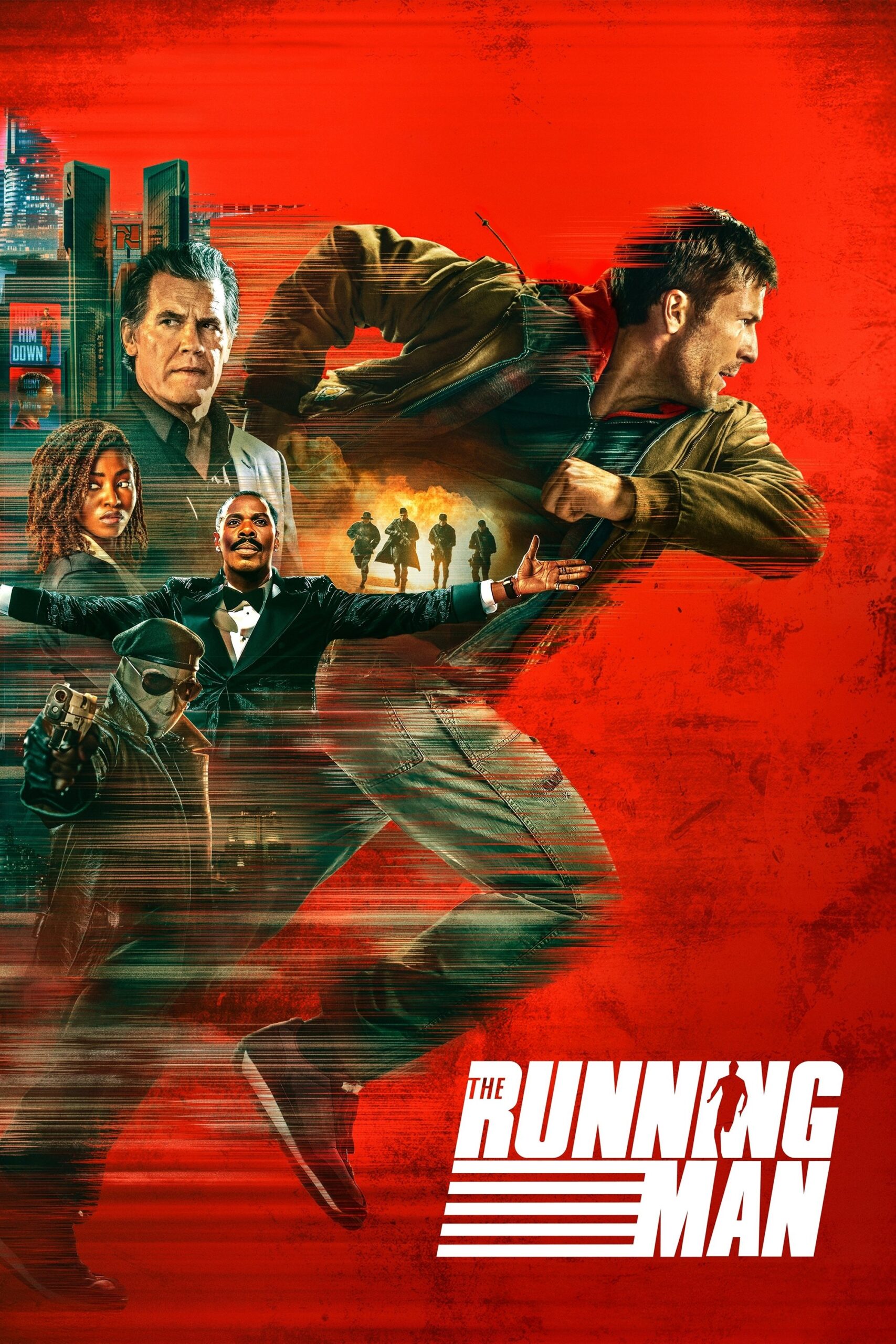
Review: The Running Man (dir. by Edgar Wright)


“Bloodlust is our birthright!” — Bobby Thompson

Edgar Wright’s 2025 take on The Running Man is an adrenaline shot to the chest and a sly riff on our era’s obsession with dystopian game shows, all filtered through his own eye for spectacle and pacing. Unlike many of his earlier works, such as Shaun of the Dead and Scott Pilgrim vs. The World, which bristle with meta-commentary, the film is a sleeker and more bruising affair. At its core, this is a survival thriller decked out in neon, driven by a director who wants to both honor and outpace what’s come before.

Wright’s version ditches the muscle-bound caricature of the 1987 Schwarzenegger adaptation, recentering on a more grounded protagonist. Glen Powell’s Ben Richards isn’t a quip-dispensing tank; he’s a desperate father, pressed to extremes, haunted more by anxiety than rage. We meet him in a world where reality TV devours everything, and nothing is too cruel if it wins the ratings war. Richards is cast as the sacrificial everyman, volunteering for the deadly Running Man show only because his family’s survival is at stake, not his ego. This lends the film a more human—and frankly, more believable—edge than either of its predecessors.

Visually, The Running Man is vintage Wright: kinetic and muscular, with chase scenes propelled by propulsive synths and punchy editing, each set piece designed as much to thrill as to disorient. Gone, however, is much of the director’s comedic ribbing; what remains is a tense visual feast, saturated in electric colors and relentless motion. The camera rarely settles. The television show itself is depicted as both garish and sinister, a spectacle that feels plausible because it’s only five minutes into our own future.

The film takes sharp aim at the machinery of television and the spectacle it creates, exposing how entertainment can thrive on cruelty and manipulation. It highlights a world where reality is heavily curated and shaped to serve ratings and control, with the audience complicit in consuming and encouraging the degradation of genuine human experience. The media in the film mirrors warnings that have circulated in recent years—that it has become a tool designed to appease the masses, even going so far as to use deepfakes to manipulate narratives in favor of particular agendas. While this focus on broadcast media delivers potent social commentary, Wright does drop the ball a bit by concentrating too much on traditional TV media at a time when entertainment consumption is largely online and more fragmented. This narrower scope misses an opportunity to deeply engage with the digital age’s sprawling and insidious impact on public attention and truth.

Glen Powell’s performance is pivotal to the film’s success. He anchors the story, selling both the exhaustion and the resolve required for the role. This Ben Richards is no superhero—his fear feels palpable, and his reactions are messy, urgent, and often impulsive. Opposite him, Josh Brolin steps in as Dan Killian, the show’s orchestrator. Brolin’s performance, smooth and menacing, turns every negotiation and threat into a master class in corporate evil. The stalkers, the show’s gladiatorial killers, are less cartoon than their 1987 counterparts, but all the more chilling for their believability—branding themselves like influencers, they embody a world where violence and popularity are inseparable.

On the surface, Wright’s Running Man leans heavily into social satire. It lobs grenades at infotainment, the exploitation inherent in reality TV, and the way audiences are silently implicated in all the carnage they consume. Reality is a construct, truth is whatever the network decides to show, and every moment of suffering is a data point in an endless quest for engagement. The critique is loud, though not always nuanced. Where Wright has previously reveled in self-aware storytelling, here he pulls back, focusing on the mechanics and cost of spectacle more than its digital afterlife.

Action is where the film hits hardest. Wright brings his expected flair for movement and tension, with chase sequences escalating to wild, blood-smeared crescendos, and hand-to-hand fights that feel tactile rather than stylized. The film borrows more heavily from the structure of King’s novel, raising stakes with each new adversary and refusing to let viewers catch their breath. Despite the non-stop pace, the movie runs a little too long—some sequences feel indulgent, and the final act’s rhythm stutters as it builds toward its conclusion. Still, even in its bloat, there’s always something energetic or visually inventive happening onscreen.

The movie’s climax and resolution avoid over-explaining or revealing too much, instead choosing to leave room for interpretation and suspense about the outcomes for the characters and the world they inhabit. This restraint preserves the tension and leaves viewers with something to chew on beyond the final credits.

For fans of Edgar Wright, there’s a sense of something both familiar and altered here. The visual wit, the muscular editing, the stylish sound cues—they’re all present. Yet the film feels less like a playground for Wright’s usual whimsy and more like a taut, collaborative blockbuster. It’s playfully brutal and thoroughly engaging, but does not, in the end, subvert the genre quite as gleefully as some might hope. For every moment of subtext or clever visual flourish, there is another in which the movie simply barrels forward, content to dazzle and provoke in equal measure.

The Running Man (2025) is a film with a target audience—those who want action, smart but accessible social commentary, and just enough character work to feel the stakes. It will delight viewers drawn to a flashier, meaner take on dystopian spectacle, and Powell’s central performance is likely to win over skeptics and fans alike. If you’re hoping for a thesis on algorithmic age or a meditation on surveillance capitalism, you may need to look elsewhere. But if you want a turbo-charged chase movie that occasionally stops to wag a finger at the world that spawned it, you’re likely to have a great time.

Ultimately, Edgar Wright’s Running Man is a sharp, glossy refit of a classic dystopian story, packed with high-octane action and grounded by its central performance. It won’t please everyone and doesn’t attempt to, but it never forgets that, above all, good television keeps us running. In the era of spectacle, that might be all you need.

Lisa Reviews An Oscar Winner: CODA (dir by Sian Heder)


Remember CODA?

I ask that because this 2021 film often seems to be forgotten about when people discuss the films that have won the Oscar for Best Picture. Indeed, when the Oscar nominations were first announced for that year, many commentators treated the film’s nomination as an afterthought.  It was pointed out that CODA only had a total of three nominations, for Picture, Adapted Screenplay, and Best Supporting Actor.  It was expected that Troy Kostur would win Best Supporting Actor but it was also felt that Best Picture would be won by one of the big nominees, like The Power of the Dog, Belfast, or West Side Story.

But, interestingly enough, the momentum began to shift shortly after the nominations were announced.  The nomination brought the film to an entirely new audience, all of whom could stream the movie on Apple TV+.  The members of the Academy who hadn’t seen the film before the nominations were announced watched the film and many reportedly fell in love with the simple but touching story of a teenage girl who must decide whether to go to music school or to stay at home with her deaf parents and older brother.  By the time the Academy Awards were held, CODA had become the new front runner.

How did this happen?  A lot of it had to do with the fact that CODA was an unabashedly emotional story, one that was specifically made to bring tears to the eyes of the audience.  CODA was more humanistic than the remote and cold Power of the Dog.  Whereas both West Side Story and Belfast were obviously made with Oscar glory in mind, the low-budget CODA felt as if it simply wanted to tell a good story.  Unlike Dune, CODA was not made to launch a franchise and, unlike King Richard, it was about more than just one performance.  Its straight-forward approach provided quite a contrast to the stylized flourishes of Nightmare Alley and Licorice Pizza.  (Incidentally, Nightmare Alley and Licorice Pizza were my two favorite films of the year.)  It should also be remembered that CODA, like the previous year’s Nomadland, was watched while many people were still hiding their faces behind masks, terrified of catching COVID.  It was a time when many people were yearning for something that would just make them feel good.

And whatever else one might say about CODA, it’s definitely a feel good movie.  From the wonderful moments when Ruby (Emilia Jones) discovers her love for singing to the slyly humorous and emotionally honest performances of Troy Kostur, Marlee Matlin, and Daniel Durant as Ruby’s parents and brother, CODA is a film that will make you smile and think about the people who you consider to be your family.  It’s a sweet movie, one that reminds us that it’s okay to get emotional and that it’s okay to tell people that you love them and that, as an artform, film can be used for something other than just comic book adaptations.

That’s not say it’s a perfect film, of course.  Those who complained that CODA had the flat look of a made-for-TV movie were not incorrect and the fact that most people ended up watching the movie on TV (or, in my case, on a laptop) did not help with the issue.  As Ruby’s music teacher, Eugenio Derbez gives a rather broad performance that often fells at odd with the more realistic work of the rest of the cast.  The film had its flaws but it also made me smile and the end brought real tears to my mismatched eyes and there’s something to be said for that.  During a year when many people were still afraid to get close to anyone else, CODA was a film that celebrated love, family, and community.

Did CODA deserve to win Best Picture?  Like I said, I would have given the Oscar to either Nightmare Alley or Licorice Pizza but I liked CODA and, looking back, I certainly prefer its positive vibes to the well-made emptiness of Power of the Dog.  The low-key CODA is probably destined to join The Artist and Argo as one of the best picture winners that people tend to forget but no matter.  It’s a film that holds up well and, in 2021, it was exactly the film that a lot of people needed.

Here Are the 2021 Nominations of the Washington D.C. Area Film Critics!


The Washington D.C. Area Film Critics have announced their nominees for the best of 2021!  The winners will be announced tomorrow so that means you have exactly one day to see all the nominees.  GET TO IT!

Best Film
Belfast
The Green Knight
The Power of the Dog
tick, tick…BOOM!
West Side Story

Best Director
Kenneth Branagh – Belfast
Jane Campion – The Power of the Dog
David Lowery – The Green Knight
Steven Spielberg – West Side Story
Denis Villeneuve – Dune

Best Actor
Nicolas Cage – Pig
Benedict Cumberbatch – The Power of the Dog
Andrew Garfield – tick, tick…BOOM!
Will Smith – King Richard
Denzel Washington – The Tragedy of Macbeth

Best Actress
Olivia Colman – The Lost Daughter
Nicole Kidman – Being the Ricardos
Lady Gaga – House of Gucci
Kristen Stewart – Spencer
Tessa Thompson – Passing

Best Supporting Actor
Jamie Dornan – Belfast
Ciarán Hinds – Belfast
Troy Kotsur – CODA
Jesse Plemons – The Power of the Dog
Kodi Smit-McPhee – The Power of the Dog

Best Supporting Actress
Caitríona Balfe – Belfast
Ariana DeBose – West Side Story
Ann Dowd – Mass
Kirsten Dunst – The Power of the Dog
Aunjanue Ellis – King Richard

Best Acting Ensemble
Belfast
The French Dispatch
The Harder They Fall
Mass
The Power of the Dog

Best Youth Performance
Jude Hill – Belfast
Emilia Jones – CODA
Woody Norman – C’mon, C’mon
Saniyya Sidney – King Richard
Rachel Zegler – West Side Story

Best Voice Performance
Awkwafina – Raya and the Last Dragon
Stephanie Beatriz – Encanto
Abbi Jacobson – The Mitchells vs. the Machines
Kelly Marie Tran – Raya and the Last Dragon
Jacob Tremblay – Luca

Best Original Screenplay
Kenneth Branagh – Belfast
Mike Mills – C’mon, C’mon
Zach Baylin – King Richard
Paul Thomas Anderson – Licorice Pizza
Fran Kranz – Mass

Best Adapted Screenplay
Siân Heder – CODA
Jon Spaihts and Denis Villeneuve and Eric Roth – Dune
Jane Campion – The Power of the Dog
Steven Levenson – tick, tick…BOOM!
Tony Kushner – West Side Story

Best Animated Feature
Encanto
Flee
Luca
The Mitchells vs. the Machines
Raya and the Last Dragon

Best Documentary
The First Wave
Flee
The Rescue
Summer of Soul (…Or, When the Revolution Could Not Be Televised)
Val

Best International/Foreign Language Film
Drive My Car
A Hero
Lamb
Titane
The Worst Person in the World

Best Production Design
Jim Clay, Production Designer; Claire Nia Richards, Set Decorator – Belfast
Patrice Vermette, Production Designer; Richard Roberts and Zsuzsanna Sipos, Set Decorators – Dune
Adam Stockhausen, Production Designer; Rena DeAngelo, Set Decorator – The French Dispatch
Tamara Deverell, Production Designer; Shane Vieau, Set Decorator – Nightmare Alley
Adam Stockhausen, Production Designer; Rena DeAngelo, Set Decorator – West Side Story

Best Cinematography
Haris Zambarloukos – Belfast
Greig Fraser – Dune
Andrew Droz Palermo – The Green Knight
Ari Wegner – The Power of the Dog
Bruno Delbonnel – The Tragedy of Macbeth

Best Editing
Úna Ní Dhonghaíle – Belfast
Joe Walker – Dune
Andrew Weisblum – The French Dispatch
Peter Sciberras – The Power of the Dog
Myron Kerstein & Andrew Weisblum – tick, tick…BOOM!

Best Original Score
Bryce Dessner & Aaron Dessner – Cyrano
Hans Zimmer – Dune
Alexandre Desplat – The French Dispatch
Jonny Greenwood – The Power of the Dog
Jonny Greenwood – Spencer

Here Are The Nominations From The Detroit Film Critics Society


The Detroit Film Critics Society announced their nominations for the best of 2021 earlier today.  It’s an interesting group of nomination, though I would point out that Detroit is usually one of the quirkier of the critics groups.  Every awards season, they nominate something or someone unexpected, there’s a brief flurry of excitement, and then everyone moves on.

I guess that’s one reason why I love them.

Anyway, here’s their nominations:

BEST PICTURE
Belfast
CODA
Cyrano
Don’t Look Up
King Richard

BEST DIRECTOR
Sean Baker – Red Rocket
Kenneth Branagh – Belfast
David Lowery – The Green Knight
Adam McKay – Don’t Look Up
Lan-Manuel Miranda – Tick, Tick…Boom!

BEST ACTOR
Nicolas Cage – Pig
Peter Dinklage – Cyrano
Andrew Garfield – Tick, Tick…Boom!
Oscar Isaac – The Card Counter
Will Smith – King Richard

BEST ACTRESS
Jessica Chastain – The Eyes Of Tammy Faye
Alana Haim – Licorice Pizza
Jennifer Hudson – Respect
Nicole Kidman – Being The Ricardos
​Kristen Stewart – Spencer

BEST SUPPORTING ACTOR
Jon Bernthal – King Richard
Troy Kotsur – CODA
Jared Leto – House Of Gucci
Ray Liotta – The Many Saints Of Newark
Kodi Smit-McPhee – The Power Of The Dog

BEST SUPPORTING ACTRESS
Ariana DeBose – West Side Story
Kirsten Dunst – The Power Of The Dog
Aunjanue Ellis – King Richard
Rita Moreno – West Side Story
Diana Rigg – Last Night In Soho

BEST ENSEMBLE
CODA
Don’t Look Up
The French Dispatch
The Harder They Fall
House Of Gucci

BREAKTHROUGH
Alana Haim – Actress – Licorice Pizza
Emilia Jones – Actress – CODA
Woody Norman – Actor – C’mon C’mon
Agathe Rousselle – Actress – Titane
Emma Seligman – Writer/Director – Shiva Baby

BEST USE OF MUSIC/SOUND
Cyrano
In The Heights
Last Night In Soho
Tick, Tick…Boom!
West Side Story

BEST ORIGINAL SCREENPLAY
Don’t Look Up
The French Dispatch
The Harder They Fall
Licorice Pizza
Parallel Mothers

BEST ADAPTED SCREENPLAY
CODA
The Green Knight
In The Heights
The Power Of The Dog
Tick, Tick…Boom!

BEST ANIMATED FEATURE
Belle
Cryptozoo
Encanto
Flee
Luca
The Mitchells vs. The Machines

BEST DOCUMENTARY
Flee
Roadrunner: A Film About Anthony Bourdain
The Sparks Brothers
Street Gang: How We Got To Sesame Street
Summer Of Soul