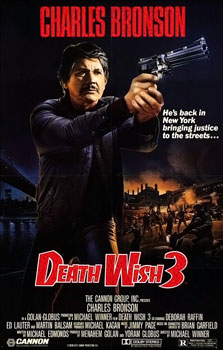
Bronson’s Old: Death Wish 3 (1985, directed by Michael Winner)


To quote Roger Murtaugh, “I’m too old for this shit.”

It has been ten years since Paul Kersey (Charles Bronson) left New York City and the place has gone to Hell.  It’s no longer just muggers that you have look out for.  Now, there are roving street gangs of directionless teenagers, terrorizing the elderly and forcing them to live like prisoners in their own apartment building.

One street corner now looks like a war zone, controlled by spiky-haired, face-painting punks who look like something from a Mad Max movie.  Manny Fraker (Gavan O’Herlihy) rules this street corner, supported by a gang that worships him as if he was some sort of god.  Manny thinks that he is immortal but he’s just targeted the wrong person.  The gang may think that Charley (Francis Drake) is just a defenseless old man but what they don’t know is that, when Charley served in Korea, his best friend was Paul Kersey.

The past few years have been busy for Paul.  He’s killed muggers and rapists in Los Angeles, Chicago, and Kansas City and now he’s returned to New York City, to visit his old friend Charley.  Paul arrives at Charley’s apartment just in time to witness Fraker’s gang murdering him.  The gang flees and when the police arrive, they take Paul into custody.

While public defender Kathryn Davis (Deborah Raffin) tries to figure out why Paul is being held in jail, Paul has a conversation with Lt. Shriker (Ed Lauter).  Shriker remembers Paul as being the New York vigilante and he has a proposition for him.  Paul can kill as many members of Fraker’s gang as he wants, as long as he allows the police to take the credit and reports everything that he discovers to Shriker.  Paul agrees.

In the neighborhood, Paul starts to put Fraker and his gang (one of whom is played by pre-Bill and Ted Alex Winter) in their place.  In a scene borrowed from Brian Garfield’s original Death Wish novel, he uses a used car as bait to gun down two aspiring car thieves.  When Paul gets a new gun, he tests it out on a depraved mugger known as the Giggler.  Though some might call him a serial killer, Paul is soon a hero to the entire neighborhood.  Though Charley may be gone, Paul befriends the other residents of the apartment.  He shows the elderly Kaprovs how to catch anyone trying to climb through their window.  He protects Maria Rodriguez (Marina Sirtis) from the gang.  Best of all, he befriend Bennett Miller (Martin Balsam), a World War II vet who still remembers how to load a machine gun.

(Balsam and Bronson previously co-starred in The Stone Killer, though in that one Bronson was a cop and Balsam was on the other side of the law.)

He also finds time to pursue a relationship with Kathryn Davis.  This is one recurring element in the Death Wish franchise that has never made sense to me.  Paul always has a new girlfriend, despite the fact that almost every woman that he ever gets involved with ends up getting killed.  Paul also only seems to go out with women who would be upset to discover that they were dating a notorious vigilante.  In Death Wish II, he went out with a crusading journalist who was against the death penalty.  In Death Wish 3, he falls for a public defender whose job is to provide legal counsel to the very people that Paul is trying to kill.  After Death Wish 3, Paul would date yet another crusading journalist and, finally, the ex-wife of a notorious mobster.  Maybe Paul should just give up and concentrate on mourning his wife.

Michael Winner returned to direct Death Wish 3 and, this time around, he imagines New York City as being a post-apocalyptic wasteland, full of abandoned buildings and murderous scavengers.  Imagine A Clockwork Orange if Charles Bronson suddenly showed up to shoot Alex and the Droogs.  As played by Gavan O’Herlihy, Manny Fraker is the type of seemingly indestructible bad guy who can actually give Paul Kersey a challenge, something that was missing from the previous films.

The other thing that distinguishes Death Wish 3 is that it was one the only film in the franchise to directly confront an obvious truth.  Charles Bronson was 53 when the first Death Wish was released.  By the time he made Death Wish 3, he was 64 and decades older than the typical action star.  (As way of comparison, Clint Eastwood was 55 when Death Wish 3 was released and was already experimenting with less action-orientated roles.)  By partnering him with Martin Balsam and the other elderly residents of the neighborhood, Death Wish 3 not only acknowledged Bronson’s advanced age but also took advantage of it.  Death Wish 3 is a film where the old folks finally get to teach the young punks a thing or two.  If the other Death Wish films were about one man fighting a lonely war, Death Wish 3 is about a community refusing to be silenced.  The chance to put those kids in their place even seems to perk up Charles Bronson, who gives one of his best performances in Death Wish 3.

Death Wish 3 may have been roundly despised by the critics but it’s the best of the Death Wish sequels.  It made a fortune at the box office so naturally, another sequel would follow.

Tomorrow: Death Wish 4: The Crackdown!

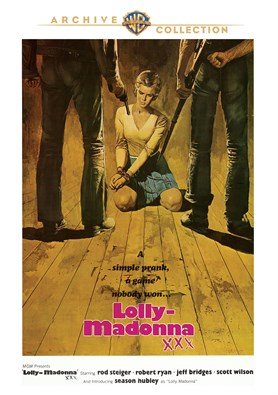
A Movie A Day #354: Lolly-Madonna XXX (1973, directed by Richard C. Sarafian)


In the backwoods of Hicksville, USA, two families are feuding.  Laban Feather (Rod Steiger, bellowing even more than usual) and Pap Gutshall (Robert Ryan) were once friends but now they are committed rivals.  They claim that the fight started when Pap bought land that once belonged to Laban but it actually goes back farther than that.  Laban and Pap both have a handful of children, all of whom have names like Thrush and Zeb and Ludie and who are all as obsessed with the feud as their parents.  When the Gutshall boys decide to pull a prank on the Feather boys, it leads to the Feathers kidnapping the innocent Roonie (Season Hubley) from a bus stop.  They believe that Roonie is Lolly Madonna, the fictional fiancée of Ludie Gutshall (Kiel Martin).  Zack Feather (Jeff Bridges), who comes the closest of any Feather to actually having common sense, is ordered to watch her while the two families prepare for all-out war.  Zack and Roonie fall in love, though they do not know that another Feather brother has also fallen in love with Gutshall daughter.  It all leads to death, destruction, and freeze frames.
Lolly-Madonna XXX is a strange film.  It starts out as a typical hicksploitation flick before briefly becoming a backwoods Romeo and Juliet and finally ending up as a heavy-handed metaphor for both the Vietnam War and the social upheaval at home.  Along with all the backwoods drama, there is a fantasy sequence where Hawk Feather (Ed Lauter) briefly imagines himself as an Elvis-style performer.  (Hawk also dresses up in Roonie’s underwear.)  Probably the most interesting thing about Lolly-Madonna XXX is the collection of actors who show up playing Feathers and Gutshalls.  Along with Steiger, Ryan, Martin, Bridges, and Lauter, everyone from Randy Quaid to Paul Koslo to Scott Wilson to Gary Busey has a role to play in the feud.  Lolly-Madonna XXX is too uneven and disjointed to really be considered a good movie but I can say that I have never seen anything else like it.

One final note: Lolly-Madonna XXX was directed by Richard Sarafian, who is best known for another early 70s cult classic, Vanishing Point.

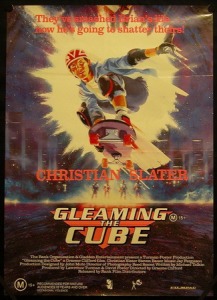
A Movie A Day #257: Gleaming the Cube (1989, directed by Graeme Clifford)


Brian Kelly (Christian Slater) is a California skater with a rebellious attitude and an adopted Vietnamese brother named Vinh (Art Chudabala).  When the movie starts, all Brian cares about is not selling out and finding empty pools to skate.  He even hires an airplane to fly him and his friends over Orange County so they can get a bird’s-eye view of the layout.  Vinh is more worried about his job with the Vietnamese Anti-Community Relief Fund.  The fund has been set up to send medical supplies to Vietnam but, when Vinh comes across a discrepancy in the shipping records, he realizes that something else is going on.  When Vinh turns up dead in a hotel room, everyone else may believe that it is suicide but Brian knows that his brother was murdered.  With the help of his fellow skaters and a sympathetic cop (Steven Bauer), Brian sets out to bring his brother’s killers to justice.

I was surprised when I watched Gleaming the Cube because it turned out to be much better than I was expecting.  The movie is justifiably best known for its skating sequences, which were shot by Stacy Peralta and which featured pro-skaters Mike McGill, Rodney Mullen, and Gator Rogowski doubling for Slater in some of the film’s more spectacular stunts.  (Tony Hawk plays one of Slater’s friends.)  Slater, himself, learned how to skate for the movie and looks far more comfortable and natural on his board than Josh Brolin did in Thrashin’.  Beyond the spectacular skating, Gleaming the Cube is energetically directed and surprisingly well-acted.  A pre-stardom Christian Slater gives one of his best and most natural performances as Brian, playing the role without any of the tics or affectations that later came to define his career.  Of its type, Gleaming the Cube is a classic.

A Movie A Day #152: Bad Company (1972, directed by Robert Benton)


Missouri during the Civil War.  All young men are being forcibly constricted into the Union army, leaving those who want to avoid service with only two options: they can either disguise themselves as a woman and hope that the soldiers are fooled or they can head out west.  Drew Dixon (Barry Brown) opts for the latter solution but his plans hit a snag when he’s robbed and pistol-whipped by Jake Rumsey (Jeff Bridges).  When Drew coincidentally meets Jake for a second time, he immediately attacks him.  Jake is so impressed that he insists that Drew join his gang of thieves.

Jake’s gang, which include two brothers (one of whom is played by John Savage) and a ten year-old boy, is hardly the wild bunch.  They spend most of their time robbing children and are, themselves, regularly robbed by other gangs, including the one run by Big Joe (David Huddleston).  Their attempt to rob a stagecoach goes hilariously wrong.  Less hilarious is what happens when they try to steal a pie from a window sill.

Bad Company was the directorial debut of Robert Benton and it has the same combination of comedy and fatalism that distinguished both his script for Bonnie and Clyde and several of the other revisionist westerns of the 1970s.  While the interplay between Drew and Jake may remind some of Butch Cassidy and the Sundance Kid, the film’s sudden bursts of violence feel like pure Peckinpah.  Fortunately, the combination of Robert Benton’s low-key direction and the excellent performances of Jeff Bridges and Barry Brown allows Bad Company to stand on its own.  Brown and Bridges make for an excellent team, with Bridges giving a charismatic, devil-may-care performance and the late Barry Brown holding his own as the more grounded Drew.  (Sadly, Brown, who appears to have had the talent to be a huge star, committed suicide six years after the release of Bad Company.)  This unjustly forgotten western is one of the best films of the 1970s.

A Movie A Day #141: Breakheart Pass (1975, directed by Tom Gries)


California.  The 1870s.  Sheriff Pearce (Ben Johnson) boards a train with his prisoner, an alleged outlaw named John Deakin (Charles Bronson).  The train is mostly full of soldiers, under the command of Major Claremont (Ed Lauter), who are on their way to Fort Humboldt.  The fort has suffered a diphtheria epidemic and the soldiers are supposedly transporting medical supplies.

However, it’s not just soldiers on the train.  There’s also Gov. Fairchild (Richard Crenna) of Nevada, his fiancée (Jill Ireland), the Reverend Peabody (Bill McKinney), and a conductor named O’Brien (Charles Durning).  As the train continues on its journey, it becomes obvious that all is not as it seems.  People start to disappear.  A man is thrown from the train.  Two cars full of soldiers are separated from the train and plunge over a cliff.  There is also more to Deakin than anyone first realized and soon, he is the only person who can bring the murderers to justice.

In both real life and the movies, Charles Bronson was the epitome of a tough guy, so it’s always interesting to see him playing a more cerebral character than usual.  There are some exciting and surprisingly brutal action scenes, including a scene where Bronson fights a cook (played by former professional boxer Archie Moore) on top of the speeding train, but Breakheart Pass is more of a murder mystery than a typical action film.  If Louis L’Amour and Agatha Christie had collaborated on a story, the end result would be much like Breakheart Pass.  Bronson spends as much time investigating as he does swinging his fists or shooting a gun.  It’s not a typical Bronson role but he does a good job, showing that he could think as convincingly as he could kill.  Acting opposite some of the best character actors around in the 70s, Bronson more than holds his own.

Apparently, back in 1975, audiences were not interesting in watching Bronson think so Breakheart Pass was a disappointment at the box office and it is still not as well known as Bronson’s other films.  However, even if you’re not already a fan of the great Bronson, Breakheart Pass is worth discovering.

A Movie A Day #56: The White Buffalo (1977, directed by J. Lee Thompson)


whitebuffalo1977The year is 1874 and James Otis (Charles Bronson) is traveling through the Dakota Territory.  Everywhere that James Otis goes, someone tries to shoot him.  This is because James Otis is actually the infamous Wild Bill Hickcock and everyone this side of Deadwood has a reason to want him dead.  Hickcock has returned to the territory because he is losing his eyesight and he fears that he may be dying.  Hickcock has been having nightmares about a giant albino buffalo and believes that it is his destiny to either kill it or be killed himself.

Meanwhile, a young indian chief (Will Sampson) is also seeking the White Buffalo.  The buffalo previously attacked his village and killed his son.  The chief must now get revenge or lose his power in the tribe.  He is now known as Worm.  Before the buffalo attack, his name was Crazy Horse.

Crazy Horse eventually teams up with Hickcock and a one-eyed hunter named Charlie Zane (Jack Warden).  They work out an uneasy alliance but who, of the three, will finally get the chance to kill the buffalo?

When Dino De Laurentiis produced The White Buffalo, he was hoping to combine the popularity of Jaws with the star power of Charles Bronson.  It should have been a hit but instead, The White Buffalo was one of the many flops that temporarily killed the western as a commercial genre.  (Before there was Heaven’s Gate, there was The White Buffalo.)  The reason why is obvious: while audiences loved to watch Bronson shoot muggers in New York, they were less willing to sit through a pseudo-intellectual western version of Moby Dick that featured more conversation than gunplay.  The obviously fake buffalo did not help matters.

I still like The White Buffalo, though.  Because of the movie’s cheap sets, fake snow, and some inconsistent rear projection work, The White Buffalo is sometimes so surreal that it could pass for a Spaghetti Western.  (When I saw Bronson, Sampson, and Warden huddled in a cardboard cave while it fake snowed outside, I immediately thought of Sergio Corbucci’s The Great Silence.)  Charles Bronson, always an underrated actor, gave one of his best performances as the haunted Hickcock.  The White Buffalo was, up until his small role in Sean Penn’s The Indian Runner, the last time that Bronson would allow himself to appear as anyone other than Charles Bronson on-screen.

When watching The White Buffalo, keep an eye out for several Hollywood veterans in minor roles.  Kim Novak plays a prostitute.  Stuart Whitman is a thief.  Slim Pickens drives a stagecoach.  Clint Walker’s an outlaw and Ed Lauter plays the younger brother of Gen. Custer.  The town’s undertaker is John Carradine.  The cameos don’t add up too much but it’s still good to see everyone.

A Movie A Day #10: The Longest Yard (1974, directed by Robert Aldrich)


longest-yard-burt-reynolds

Once, Paul “Wrecking” Crewe (Burt Reynolds) was a superstar NFL quarterback.  That was until he was caught up in a point-shaving scandal and kicked out of the league.  When a drunk Crewe steals his girlfriend’s car, gets into a high-speed police chase, and throws a punch at a cop, he ends up sentenced to 18 months at Citrus State Prison.

The warden of the prison, Rudolph Hazen (Eddie Albert), is a football fanatic who, at first, is excited to have Crewe as an inmate.  The prison guards have a semi-pro football game and Hazen wants Crewe to coach the team and help them win a national championship.  Though initially reluctant and just wanting to do his time, Crewe relents after witnessing and experiencing the cruelty of the prison system.  Crewe forms The Mean Machine, a team made up of prisoners, and agrees to play an exhibition game against the guards.

At first, the members of the Mean Machine are just looking for an excuse to hit the guards without being punished but soon, they realize that they have a chance to win both the game and their dignity.  But Hazen is not above blackmailing Crewe to throw the game.

When it comes to understanding the Tao of Burt, The Longest Yard is the place to start.  Starting with a car chase and ending with near martyrdom, The Longest Yard is the ultimate Burt Reynolds film.  Paul Crewe ranks alongside Deliverance’s Lewis Medlock and Boogie Night‘s Jack Horner as Reynolds’s best performance.  Before injuries ended his athletic career, Reynolds was a college football star and, on the prison’s playing field, he holds his own with the large group of former professional football players who were cast to play the guards and the prisoners.  The Longest Yard’s climatic football game takes up over an hour of screen time and reportedly, the action was largely improvised during shooting.  Unlike most movie football games, the one in The Longest Yard looks and feels like a real game.

The Longest Yard was directed by Robert Aldrich, who specialized in making movies about anti-authoritarians fighting the system.  The scenes of Crewe recruiting and training The Mean Machine are very reminiscent of Aldrich’s best-known movie, The Dirty Dozen.  With its combination of dark humor, graphic violence, rebellious spirit, and Southern-friend melodrama, The Longest Yard is a movie that could only have worked in the 1970s.  The Adam Sandler remake may have made a lot of money at the box office but it still comes nowhere close to matching the original.

For tomorrow’s movie a day, it’s the best film of 2016, which also happens to be about a football player in prison.

thelongestyard

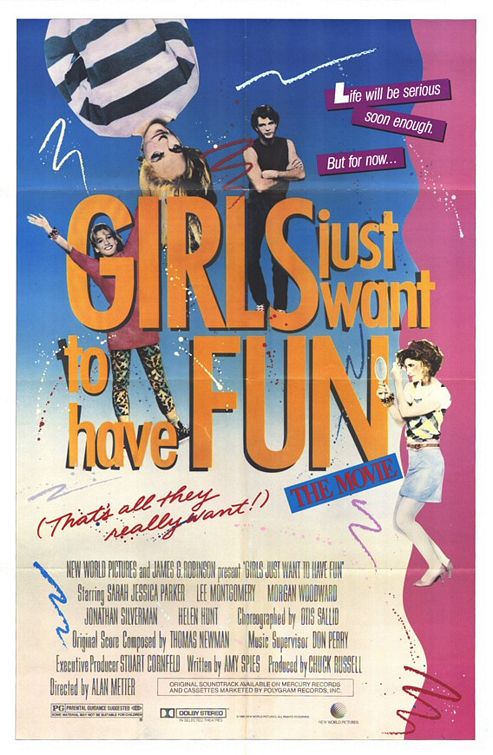
Back to School Part II #19: Girls Just Want To Have Fun (dir by Alan Metter)


Girls_just_want_to_have_fun

For our next film in this series of Back to School reviews, we take a look at 1985’s Girls Just Want To Have Fun!

And you know what?

It’s true — we do just want to have fun!

The fun in Girls Just Want To Have Fun is pretty much defined by dancing, which is okay with me because I love to dance.  However, Girls Just Want To Have Fun had the misfortune to be made in the mid-80s.  I have lost track of many 80s films that I’ve watched but I’m still always shocked at how undanceable most 80s music truly was.  This film, of course, does contain a cover version of the famous song by Cyndi Lauper and that’s actually a pretty good 80s song.  However, the rest of the music (and, by that, I mean the music that everyone in the movie is actually dancing to) is incredibly bland in the way that only music from the decade of We Built This City could be.

As for the film itself, it takes place in Chicago.  Janey Glenn (Sarah Jessica Parker) is the newest student at the local Catholic girls school.  Janey’s overprotective father (Ed Lauter) is in the army and Janey has lived all over the world.  Despite that, Janey is not at all worldly.  In fact, when she tries to introduce herself to her classmates, all she can get out is that she’s a gymnast and she loves to dance. (When we actually see Janey dancing or doing any sort of gymnastics, Sarah Jessica Parker’s hair always seems to fall in her face, which is certainly one way to hide a stunt double.)

Janey makes one friend at the school.  Lynn (Helen Hunt, looking like a teenager but already sounding like a hung over 40 year-old) is about as wild as a girl can be in 1980s PG-rated film.  That’s to say, she wears a leather skirt when she’s not in school and, when she babysits, she orders pizza and then allows the baby to sit on it.  (Ewwwwwww!  There’s a reason why babies wear diapers….)  Lynne and Janey are automatically BFFs because they both love Dance TV!

That’s right — it’s DTV!  I wonder what that’s supposed to be based on…

It turns out that DTV is having a contest to pick two new dancers!  Disobeying her strict father, Janey sneaks out of the house and joins Lynn in auditioning!  Lynn’s partner turns out to be so spastic that Lynn doesn’t make the semi-finals.  Later, Lynn discovers that her partner was bribed by rich bitch Natalie Sands (Holly Gagnier).  I’m not sure why Natalie felt the need to do that since Lynn wasn’t that impressive to begin with.  She’s about as good a dancer as you would expect Helen Hunt to be.

However, Janey does make it to the semi-finals, where she’s partnered with Jeff.  Jeff is tough and blue-collar and, at first, it doesn’t seem like he and Janey will get along.  So, of course, they end up falling in love and, of course, Natalie’s father tries to force Jeff out of the contest by threatening to put his father out of work.  Jeff, incidentally, is played by Lee Montgomery.  Years before appearing in Girls Just Want To Have Fun, Montgomery played the little kid who gets crushed by a chimney at the end of Burnt Offerings.  Burnt Offerings is a really crappy film but I watch it every time that it comes on TCM just so I can see that chimney crush Lee Montgomery.  That said, Montgomery actually does a pretty good job of Jeff.  You never quite buy him as a rebel without a cause but he still seems like an authentic and likable teenager.  Jeff and Janey are a cute couple and that’s all that really matters.

Just as Janey has a best friend, Jeff also has a best friend.  Drew Boreman (Jonathan Silverman) talks too much, tries to sell t-shirts from the trunk of his car, and there’s also a scene were he grabs a random girl’s breasts and makes a comment about using her nipples to tune a radio.  Drew is annoying and, once you get over the fact that she’s being played by a young Helen Hunt, so is Lynn.  Watching the movie, you kind of want to tell both of them to just calm down for a few minutes.

But you know who is not annoying?  Jeff’s younger sister, Maggie, who is played by none other than a very young Shannen Doherty.  Maggie was my favorite character because she alone seemed to understand how stupid everyone else in the film was.  And she was willing to call them out on it.

ANYWAY — Girls Just Want To Have Fun is one of those movies where next to nothing actually happens.  There is an extended sequence where our heroes destroy Natalie’s snooty party with the help of a bunch of punks and female body builders but otherwise, it’s remarkable how little actually happens.  That said, some of the dancing is good (even if most of the music is totally bland in the way that only 80s music can be) and it’s interesting to see Sarah Jessica Parker and Helen Hunt when they were young.  Sarah Jessica Parker actually gives a surprisingly likable performance here, even if it is often way too obvious that a body double is doing the majority of her dancing.  That said, you really can’t get any further away from Carrie Bradshaw than Janey Glenn.

Girls Just Want To Have Fun is a time capsule of the decade in which it was made and that is definitely the main reason to watch it.  Until time machines are a reality and we can experience the past firsthand, we’ll just have to keep getting our information from movies like this one.

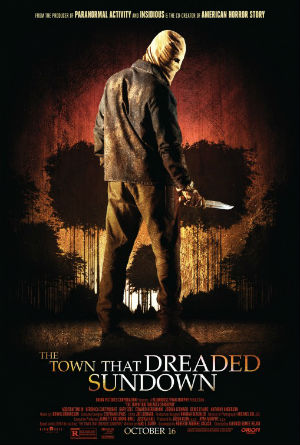
Film Review: The Town That Dreaded Sundown (dir by Alfonso Gomez-Rejon)


The_Town_That_Dreaded_Sundown_(2014_film)_poster

The Town That Dreaded Sundown is the latest classic horror remake.  In this case, it’s a remake of a 1976 docudrama about a real-life serial killer who, shortly after World War II, haunted the streets of my former hometown of Texarkana, Texas.  (You can read my review here.)  The original was a low-budget but effectively creepy little film that was shot on the streets of Texarkana and was full of authentic Texas atmosphere.  (It helped that it was directed by Charles B. Pierce, a Texarkana native, as opposed to some jerk from up north.)  What made the film all the more haunting was the fact that — in both the movie and in real life — the Phantom Killer was never captured.

So, how does the remake compare?

*Sigh*

(For the record, I’m not only signing but I’m also massively rolling my mismatched,  heterochromatic eyes.)

Listen, I will give this film credit for attempting to be something more than just your usual horror remake.  It actually does have a fairly clever premise.  Instead of retelling the original story, the remake of The Town That Dreaded Sundown begins with a bunch of people in present-day Texarkana sitting around and watching the original film.  There’s even an eccentric character named Charles B. Pierce, Jr. (Denis O’Hare) who we are told is the son of the original director.  It’s a clever idea, one that wisely acknowledges the effectiveness of the original film while also commenting on the continuing mystery surrounding both the identity and the fate of the Phantom Killer.

And, when someone dressed like the original Phantom Killer starts to murder young couples in Texarkana, we — just like the characters — are left to wonder whether it’s the spirit of the Phantom or if it’s someone imitating the murders from the original film or whether it’s something else altogether.

That’s certainly the question faced by Jami (Addison Timlin), who survives being attacked by this new Phantom but then grows obsessed with trying to discover who he is.  Addison Timlin gives a really good performance here.  She’s likable and sympathetic, the perfect “final girl.”

In fact, the entire film is well-cast.  Anthony Anderson is a lot of fun as a cocky Texas Ranger while Gary Cole and Joshua Leonard do good work as members of local law enforcement.  Denis O’Hare, who I will always think of as being Russell on True Blood, brings a certain dissipated nobility to his role.  The victims are all sympathetic and the killer is creepy.

But, with all that in mind, I was disappointed with the remake of The Town That Dreaded Sundown.  The reason the original film worked is because it was made by a member of the Texarkana community.  Charles B. Pierce knew the town and he understood why the Phantom Killer continued to haunt the citizens.  What his movie lacked in technical polish, it made up for in authenticity.

Though the remake features a narrator and duplicates the original’s obsession with letting us know whether each scene is taking place on the Texas-side or the Arkansas-side of the town, there’s still absolutely nothing authentic about it.  Whereas the original was filmed entirely on location, the remake was mostly filmed in Shreveport with only three days devoted to getting some location footage of downtown Texarkana.  As someone who has lived in both Shreveport and Texarkana, allow me to assure you that you can totally tell the difference.

The remake was produced by Ryan Murphy (of Glee and American Horror Story fame) and the film really does feel like a lesser season of American Horror Story.  It’s a film that has so little use for subtlety (just check out Edward Herrmann going totally overboard as a hypocritical preacher) that its creepy moments are totally smothered by all the heavy-handed cartoonishness that surrounds them.

Ultimately, the remake fails because it has no feel for or understanding for my homestate.  It was made by people who obviously know nothing about Texas or Arkansas beyond what they’ve seen in other movies produced, directed, and written by other northerners.

The 1976 Town That Dreaded Sundown worked because it was authentic.  Despite a few good ideas, the remake is just too generic to do justice to the original.


Back to School #47: School Ties (dir by Robert Mandel)


School Ties

For the past two and a half weeks, we’ve been reviewing 80 of the best, worst, most memorable, and most forgettable high school films ever made.    We’ve been going in chronological order, starting with two films from 1946 and then working our way through the years that followed.  After 46 reviews, we are now ready to enter the 1990s.

And what better way to kick off the 90s than by taking a look at a film from 1992 that very few people seem to have ever heard of?

School Ties takes place in the 1950s, which of course means that everyone dresses like either James Dean in Rebel Without A Cause or Troy Donaue in A Summer Place.  It also means that the soundtrack is full of the same songs that tend to turn up in every film about the 1950s.  David Greene (Brendan Fraser) is a working-class teen from Pennsylvania* who wins a football scholarship to attend an exclusive prep school in Massachusetts.  At first, David struggles to fit in.  Not only are all of his classmates rich but they’re also extremely anti-Semitic.  However, David wins them over by playing hard on the football field and hiding the fact that he’s Jewish.  However, when the jealous Charlie Dillon (Matt Damon) discovers that David is a Jew, he reveals his secret and David is forced to confront his prejudiced classmates.

School Ties is one of those extremely well-intentioned films that’s never quite as good as you might hope.  With the exception of David and Charlie, the characters are all pretty thinly drawn and there’s more than a few subplots that really don’t really work.  For instance, Zeljko Ivanek shows up playing a sadistic French teacher who harasses one of Fraser’s friends (played by Andrew Lowery) and, as I watched Ivanek drive Lowery to the point of a nervous breakdown over proper verb conjugation, it occurred to me that I knew Ivanek was evil as soon as he showed up wearing his little bow tie and his beret.  (It’s also interesting how French teachers are always evil in films like this.)

That said, the message of School Ties is still a timely one.  On the surface, the message of “Don’t be an intolerant, prejudiced prick,” might seem pretty simplistic and self-explanatory.  However, every day we’re confronted with evidence that there are still people out there who don’t understand this simple concept.  As such, it’s a message that can stand being repeated a few times.

(Seriously, don’t be an intolerant, prejudiced prick.)

When seen today, School Ties is mostly interesting for who appears in it.  For instance, Matt Damon, Ben Affleck, and Cole Hauser all show up here, 5 years before they would all co-star in Good Will Hunting.  One of the anti-Semitic students is played by Anthony Rapp who, a year later, would appear with Affleck and Hauser in Dazed and Confused.  Fraser’s sympathetic roommate is played by Chris O’Donnell.  As for Brendan Fraser himself, it’s a bit odd to see him playing such a dramatic role but he’s convincing and believable as a football player. It’s a good-looking cast and yes, you better believe that there’s a fight scene that takes place in a shower.  If you’ve ever wanted to see Brendan Fraser and Matt Damon wrestling each other while naked — well, this is the film to see.

school_ties—-

* Interestingly enough, David’s family lives in Scranton, Pennsylvania so I guess David could very well have gone to elementary school with Joe Biden and he may have family working at Dunder-Mifflin.