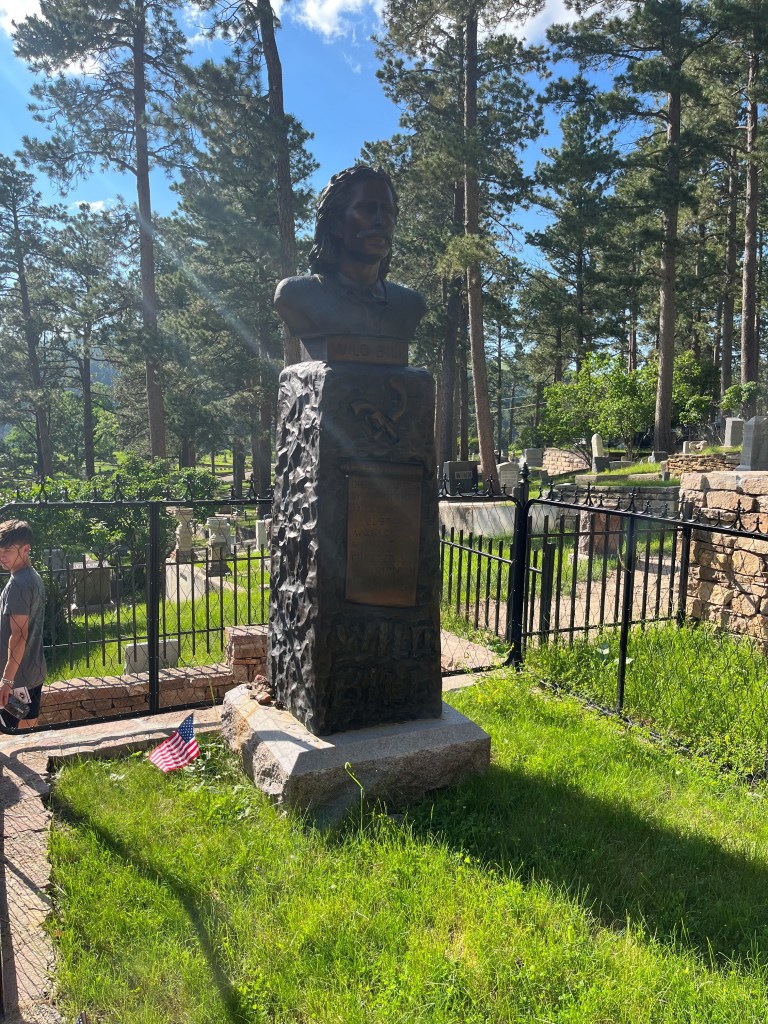
Back in 2023, my family visited the Black Hills of South Dakota. The first thing we did was visit Mount Rushmore. The second thing we did was visit the Mount Moriah Cemetery and the final resting place of Wild Bill Hickok. Situated on the top of a hill overlooking the city of Deadwood, it’s a beautiful place that also includes the graves of Calamity Jane and Sheriff Seth Bullock. I insisted that we see the location for possibly the most superficial reason possible… because Charles Bronson played Hickok in THE WHITE BUFFALO.
Based on a novel by Richard Sale, the story opens with Hickok having a recurring nightmare of a snowy showdown with a giant white “spike.” And if he has pistols handy, he wakes up firing them uncontrollably and you’d better not be nearby. Determined to face his fear, he heads out into the hills with his friend Charlie Zane (Jack Warden), hoping to find the albino buffalo, so he can put him down and end the nightmares. Around the same time, the great beast has stampeded the camp of Crazy Horse (Will Sampson) killing his child in the process. Convinced that the child cannot have peace in the afterlife, Crazy Horse sets out to kill the buffalo so he can wrap his child in its white “robe” and free her spirit. With Hickok a prolific killer of Indians, and Crazy Horse a brave Lakota Oglala warrior, the two men seem to be on a deadly collision course in those snowy hills.
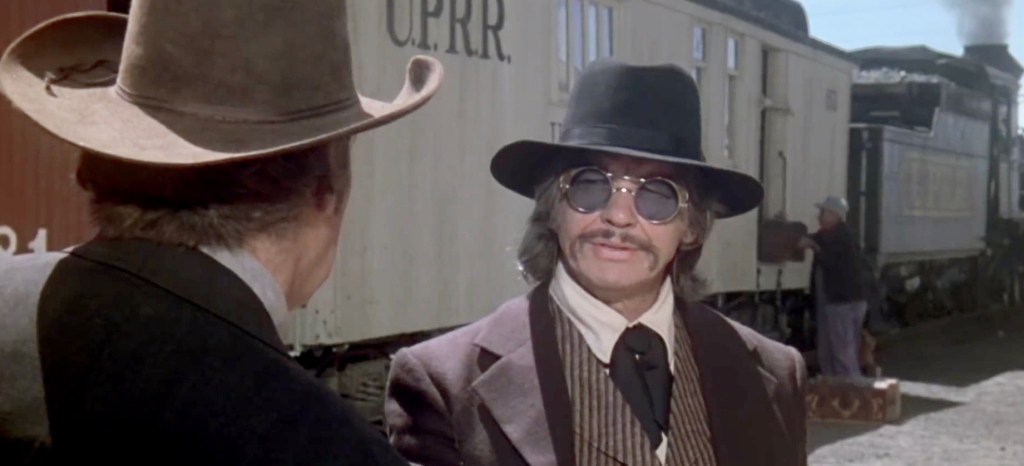
Charles Bronson’s final western, THE WHITE BUFFALO has a lot of the scenes you’d expect. With Bronson playing a famous gunman, we get to see several gunfights as he makes his way through various Wyoming towns, featuring well-known actors like Clint Walker and Ed Lauter. We also get to see him visit various saloons, as well as the widow Schermerhorn, played by Kim Novak. When he really “knew” her, she was a prostitute named Poker Jenny. Along with those I’ve already mentioned, it’s an all-star affair as we see such familiar faces as Stuart Whitman, John Carradine, Slim Pickens, and even a young Martin Kove sprinkled throughout the film. And of course, we get to see Bronson take on the gigantic white buffalo of the title, first in his dreams, and then later in reality! Directed by veteran filmmaker J. Lee Thompson, these scenes are staged and executed well, with Hickok’s nightmares given an especially eerie quality.
While the movie has the expected scenes, it’s the unexpected character moments that sets THE WHITE BUFFALO apart as a uniquely strong entry in Bronson’s filmography. Hickok may be a man haunted by dreams of a monstrous white buffalo, but Bronson plays him in such a way that we can feel his exhaustion and literal sickness from too many years of a dangerous and difficult life. The buffalo is more than just an animal… it’s a symbol of guilt, fear and the coming of death itself. Bronson could always underplay a role better than just about anyone else, but here he’s reflective and haunted in way that I’ve not seen before, and he’s really good.
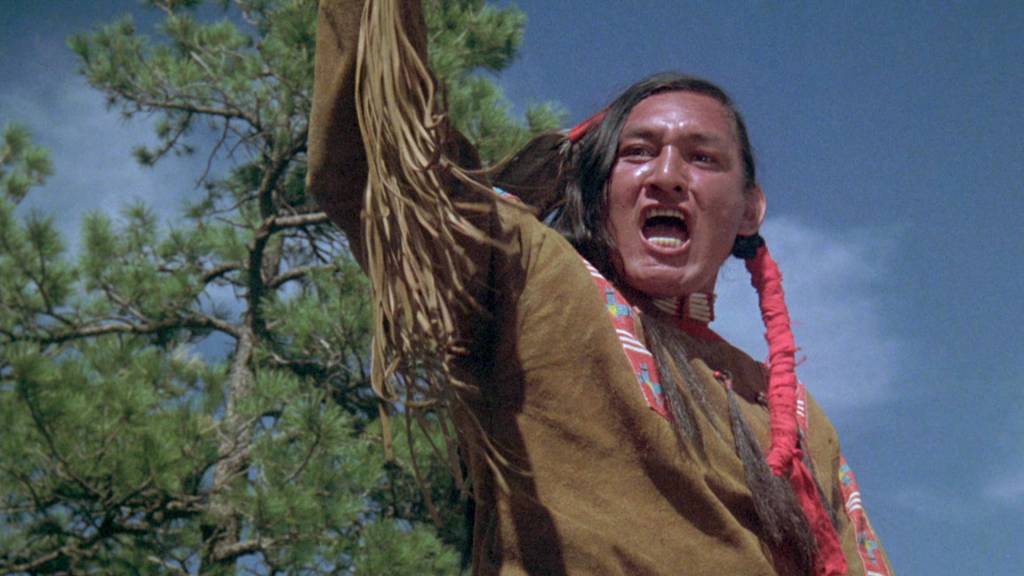
I also think the movie gets better every time Bronson shares a scene with Will Sampson. Sampson brings dignity and intelligence to Crazy Horse. His mission is more noble than Hickok’s, and an unexpected friendship develops between the two men, despite their vast differences. Ultimately, it’s this relationship that provides the film an emotional weight that sneaks up on you by the end, even if it’s not meant to last.
THE WHITE BUFFALO is not a perfect film. The animatronic buffalo may look a little hokey, and the film may seem a little slow at times for those expecting an action-packed western or monster movie. However, Bronson and Sampson are so good in their myth-making performances that the film eventually becomes something more. It’s the idea of watching two aging warriors, bound together through the bravery of confronting death, that I found to be more interesting and compelling than anything else on display.
THE WHITE BUFFALO is currently streaming on Amazon Prime, Tubi, PlutoTV, and The Roku Channel.
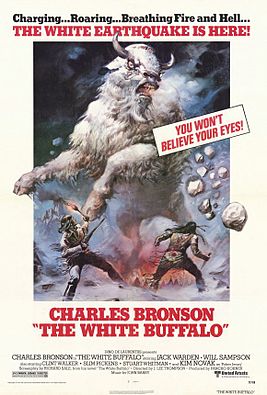 The year is 1874 and James Otis (Charles Bronson) is traveling through the Dakota Territory. Everywhere that James Otis goes, someone tries to shoot him. This is because James Otis is actually the infamous Wild Bill Hickcock and everyone this side of Deadwood has a reason to want him dead. Hickcock has returned to the territory because he is losing his eyesight and he fears that he may be dying. Hickcock has been having nightmares about a giant albino buffalo and believes that it is his destiny to either kill it or be killed himself.
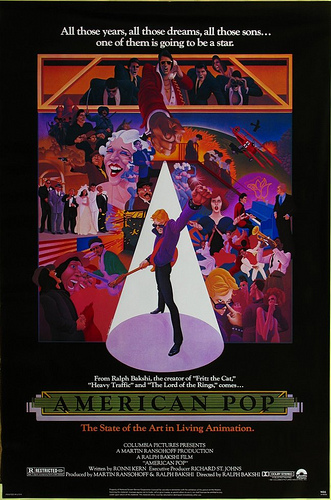 Long before South Park, The Simpsons, and Pixar, there was Ralph Bakshi. At a time when animation was considered to only be good for children, Bakshi shocked audiences and critics with animated films that dealt with mature themes and were definitely meant for adults. His first two films, Fritz the Cat (1972) and Heavy Traffic (1973), was the also the first two animated films to receive an X-rating. Bakshi satirized racism in the controversial Coonskin (1975) and Bakshi’s adaptation of The Lord Of Rings (1978) beat Peter Jackson’s by 23 years. It was after the critical and commercial disappointment of the heavily flawed but interesting Lord of the Rings that Bakshi decided it was time to make a film that would be more personal to him. The end result was American Pop.