I’ve always enjoyed this confrontation from 1990’s Die Hard 2.
I think it accurately reflects how most cops and security people would react to having John McClane in their town (trouble does tend to follow him!) and both Bruce Willis and Dennis Franz seem to be having fun trying to irritate each other.
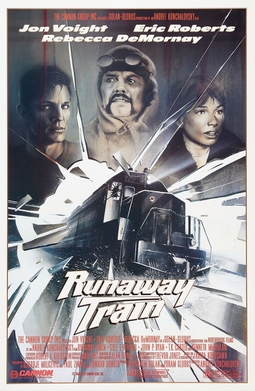
In 1985’s Runaway Train, Eric Roberts plays Buck McGeehy, a prisoner at Stonehaven Maximum Security Prison in Alaska.
Like the majority of the prisoners, Buck looks up to Manny (Jon Voight), a bank robber who has just been released from spending three years in solitary confinement. Manny is a tough guy who refuses to allow the prison system to beat him down. Warden Ranken (John P. Ryan) views Manny as being a threat to his authority and he’s especially angry that it was the courts that ordered that Manny finally be released from solitary. When Ranken tries to arrange for Manny to be assassinated at a prison boxing match, it’s Buck who saves Manny’s life. When Manny later manages to escape from the prison, Buck tags along.
Manny and Buck are a study in contrasts. Manny is as cold as the Alaskan landscape. He’s ruthless and doesn’t allow himself to get too close to anyone but, at the same time, he does live by a definite code. Buck is simple-minded, an earnest guy who talks too much and who probably wouldn’t have survived a day in prison if it wasn’t for his skill as a boxer. Buck and Manny manage to make their way across the frozen wilderness but, when they hop on a train, they soon find themselves trapped on the out-of-control locomotive, along with a railroad engineer named Sara (Rebecca De Mornay). The three of them have to find a way to either escape from or stop the train. At the same time, the obsessed Warden Ranken is determined to recapture Manny and, if that means flying a helicopter over the train so that Ranken can lower himself onto it, so be it.
Runway Train, which was based on a script by Akira Kurosawa, was one of the few Cannon films to find success with not just critics but also audiences and the industry. The Golden Globes nominated it for Best Film. The Academy didn’t go quite that far but they did nominate the film for Best Editing, along with also nominating Jon Voight for Best Actor and Eric Roberts for Best Supporting Actor. While Voight is a multiple-Oscar nominee (and one-time winner for Coming Home), Runaway Train is, so far, the only film for which Eric Roberts has been nominated. (He should have been nominated for Star 80 but his character in that film was a bit too realistically sleazy for the Academy to honor.) Roberts has described Runaway Train as being one of his favorite films and he even used the title for his autobiography. It was on this film that he met Danny Trejo, who not only trained Roberts for the boxing scenes but also helped Roberts kick his addiction to cocaine.
And Roberts has every reason to be proud. Runaway Train is a fast-moving, visually stunning thrill ride, a masterpiece of the pulp imagination. Yes, the symbolism of the runaway train is a bit obvious. Yes, the philosophical edge of the film’s dialogue can sometimes feel a bit out-of-place. Who cares? John Voight and Eric Roberts sell their characters with such skill that you don’t care that they’re both criminals who have done terrible things. From the minute we see that frozen jail and the prisoners tossing burning pieces of paper at the guards, we know why both Manny and Buck have to escape. John P. Ryan turns the warden into everyone’s worst nightmare of a small, pretty man with power, an authoritarian who uses the system to control the lives of others and who resents anyone who does not bow down before him. Even though her role is largely limited to reacting to what everyone else does around her, Rebecca de Mornay still turns Sara into a compelling character and never allows her to become merely a damsel in distress. Runaway Train is a heart-pounding action film and one that still holds up today.
Previous Eric Roberts Films That We Have Reviewed:
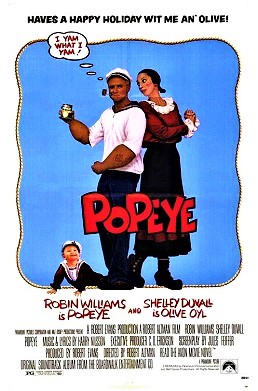
Sometimes, I feel like I’m the only one. Popeye got such bad reviews and was considered to be such a box office disappointment that director Robert Altman didn’t make another major film for a decade. Producer Robert Evans, who was inspired to make Popeye after he lost a bidding war for the film rights to Annie, lost his once-sterling reputation for being able to find hits. This was Robin Williams’s first starring role in a big screen production and his career didn’t really recover until he did Good Morning Vietnam seven years later. Never again would anyone attempt to build a film around songs written by Harry Nilsson. Screenwriter Jules Fieffer distanced himself from the film, saying that his original script had been ruined by both Robert Evans and Robert Altman. Along with Spielberg’s 1941 and Michael Cimino’s Heaven’s Gate, Popeye was one of the box office failures that signaled the end of the era in which directors were given a ton of money and allowed to do whatever they wanted to with it.
I don’t care. I like Popeye. I agree with the critics about Nilsson’s score but otherwise, I think the film does a great job of capturing the feeling of a comic strip come to life. Altman was criticized for spending a lot of money to construct, from scratch, the seaside village that Popeye, Olive Oyl (Shelley Duvall), Bluto (Paul L. Smith), Wimpy (Paul Dooley), and everyone else called home but it does pay off in the movie. Watching Popeye, you really are transported to the world that these eccentric characters inhabit. If the film were made today, the majority of it would be CGI and it wouldn’t be anywhere near as interesting. Featuring one of Altman’s trademark ensemble casts, Popeye create a world that feels real and lived in.
Mumbling the majority of his lines and keeping one eye closed, Robin Williams is a surprisingly believable Popeye, even before he’s force fed spinach at the end of the movie. Paul L. Smith was an actor who was born to play the bullying Bluto and there’s something very satisfying about seeing him (literally) turn yellow. As for Shelley Duvall, she is the perfect Olive Oyl. Not only does she have the right look for Olive Oyl but she’s so energetic and charmingly eccentric in the role that it is easy to see what both Popeye and Bluto would fall in love with her. Though the humor is broad, both Williams and Duvall bring a lot of heart to their roles, especially in the scenes where they take care of their adopted infant, Swee’Pea. Popeye may be a sailor but he’s a father first.
Popeye deserves a better reputation than it has. It may not have been appreciated when it was originally released but Popeye has a robust spirit that continues to distinguish it from the soulless comic book and cartoon adaptations of today.
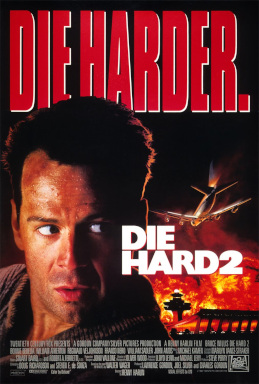
During 1990’s Die Hard 2, John McClane (Bruce Willis) asks himself, “How can the same shit happen to the same person twice?” and he does have a point.
I mean, consider the situation. In 1988, McClane spent his Christmas sneaking around a skyscraper and saving his wife from a group of sadistic mercenaries. Two years later, John McClane spends his Christmas sneaking around an airport and saving his wife from a group of sadistic mercenaries.
There are a few differences of course. In 1988, the mercenaries were only interested in stealing as much money as they could and each mercenary had his own properly ghoulish personality. In 1990, the mercenaries are really more of a cult, led by the fanatical Col. Stuart (William Sadler). And, along with trying to make some money, they are also trying to free General Ramon Esperanza (Franco Nero), a Central American drug lord and former CIA asset. Despite the fact that the mercenaries are played by familiar actors (like Robert Patrick, John Leguizamo, Tony Ganois, and Vondie Curtis-Hall), none of them are quite as memorable as the henchmen that Alan Rickman commanded in the first film. And while Sadler has charisma and makes a big impression during his first scene, his character is nowhere near as interesting or entertaining as Hans Gruber. Franco Nero, it must be said, is as dashing as ever. He really seems to be having fun in this movie.
A lot more people die in Die Hard 2 than died in the first Die Hard and the majority of them are innocent bystanders. This isn’t like the first film, where Harry Ellis died because his coke-addled mind led him to believe that he could outsmart Gruber. The victims in Die Hard 2 include a friendly church caretaker and over 200 passengers of an airplane that Stuart tricks into crashing on an airport runway. The scene where the plane crashes remains disturbing no matter how many times that you see it and it truly makes you hate Colonel Stuart. When the plane crashes, despite McClane’s futile efforts to warn the pilots, McClane sobs and it’s a powerful scene because it’s the first scene in which McClane has not had a quip or a one-liner ready to go. In this scene, McClane fails to save the day and, for a few minutes, he’s helpless. I usually end up crying with McClane. Today, those tears are also a reminder of what a good actor Bruce Willis truly could be whenever he let down his defenses and allowed himself to be vulnerable on screen.
Die Hard 2 is usually dismissed as not being as good as the first movie and …. well, that’s correct. It’s not as good but then again, few actions films are. There’s a reason why Die Hard continues to be held in such high regard. That said, Die Hard 2 is not bad. The stakes are a bit higher and the action scenes a bit more elaborate, as you would expect from a film directed by Renny Harlin. Bruce Willis plays McClane with the blue collar swagger that made his such an awesome hero in the first film. Bonnie Bedelia and William Atherton also return from the first film and Atherton once again gets his comeuppance in a crowd-pleasing moment. The cast is full of character actors, all of whom get a chance to make an impression. Dennis Franz is the profane head of security who eventually turns out to be not such a bad guy. John Amos is the major who eventually turns out to be not such a good guy. Colm Meaney has a few heart-breaking moments as the pilot of the doomed airplane. My favorite supporting performance is given by Fred Thompson, bringing his quiet authority to the role of tough but fair-minded Air Traffic Control director. Watching Die Hard 2, it does feel as if the viewer has been dropped in the middle of these people’s lives. Everyone seems real. No one seems like a mere plot device.
Is Die Hard a Christmas movie? You bet it is! But so is Die Hard 2 and it’s not a bad one.
After bombing several Mormon centers in Utah, religious extremist and polygamist Adam Swapp (Kyle Secord) has barricaded himself inside of a farm house with his wives and supporters. The FBI, led by Bob Bryant (Dennis Franz), have the house surrounded and are trying to convince Swapp to peacefully surrender. Swapp, however, has no intention of going down without a fight.
In the 1990s, NBC did a whole series of made-for-TV miniseries about real-life law enforcement operations that inevitably led to the death of at least one of the officers involved. They made so many of them and they churned them out so quickly that NBC even aired a movie about the Branch Davidian stand-off while it was still going on. Siege at Marion, the fourth of the In The Line of Duty films, feels like a precursor to what was eventually happen in Waco. Just as happened in Waco and with the attempts to arrest Randy Weaver at Ruby Ridge, critics claimed that the government came on too strong while the government claimed that they were merely enforcing the law.
Siege at Marion is the least interesting of all of the In The Line of Duty movies, mostly because the Marion siege was neither as mismanaged as what happened in Waco or as egregiously heavy-handed and disturbing as what happened in Ruby Ridge. Though based on a true story, Siege at Marion is a standard stand-off film with the only suspense coming from the film’s distasteful attempts to build up suspense as to whether it’ll be Dennis Franz, William H. Macy, or Ed Begley, Jr. who is killed in the line of duty. Since only one of them is given a backstory and a family, it’s easy to guess which one it will be.
The best thing about Siege of Marion is the cast. Dennis Franz was born to play cops and it’s interesting to see a pre-Fargo William H. Macy playing a non-nervous character. Kyle Secor is convincingly fanatical and unhinged as the messianic Adam Swapp. Secor would go on to star as Tim Bayliss on the much-missed Baltimore-set cop show, Homicide: Life on the Street. Speaking of classic cop shows, Siege at Marion was also directed by Charles Haid, who played Andy Renko on Hill Street Blues. As for the In The Line of Duty films, the last one was made in 1994 but they all live on in syndication.
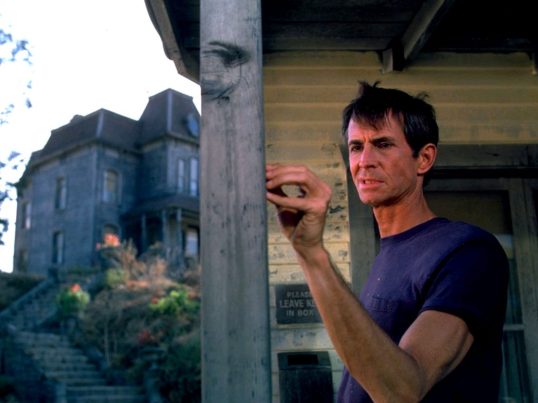
No, I don’t mean Freddie Highmore from Bates Motel or Vince Vaughn from the odd Psycho remake that I keep seeing on Showtime. No, I’m talking about the original Norman Bates, Anthony Perkins!
First released in 1983, Psycho II is a direct sequel to the classic shocker from Alfred Hitchcock. The film opens with a replay of the original film’s famous shower scene and then immediately jumps forward 22 years. Having been found not guilty by reason of insanity, Norman Bates has been in a mental institution ever since he was arrested for the murders of Marion Crane and Milton Arborgast. However, Norman’s psychiatrist, Dr. Raymond (Robert Loggia, who was considered for the role of Sam Loomis in the original film), now feels that Norman has been cured and is no longer a danger to himself or others. A judge agrees. Marion Crane’s sister, Lila Loomis (Vera Miles, reprising her role from the original) does not. She presents the judge with a petition demanding that Norman not be released. When the judge ignores her, Lila yells that Norman will murder again!
Now free, Norman returns to the Bates Motel and discovers that it’s now being run by the sleazy Warren Toomey (Dennis Franz). When Norman finds various party favors in the motel rooms and asks Warren what they are, Warren laughs and says, “They’re drugs, Norman.” Norman’s not too happy about that. As Dr. Raymond tells him, the world has changed considerably over the past two decades.
However, Norman has other issues to deal with. For the most part, most of the people in town are not happy that their most famous resident has returned. Emma Spool (Claudia Bryar) gets Norman a job at a local diner because, in her words, she believes in forgiveness and second chances. Norman gets to know the new waitress, Mary Samuels (Meg Tilly) and, when Mary tells him that she’s had a fight with her boyfriend, he invites her to stay at the hotel until she can get things together.
From the minute that he returns home, Norman is struggling to keep it together. When he first reenters his former house, he hears his mother’s voice but he tells himself that she’s not really there. But if his mother isn’t there, then who keeps calling him on the phone and yelling at him about the state of the motel? Who keeps taunting him about his awkward (yet rather sweet) relationship with Mary? And when two teenagers are attacked after breaking into the house, who else could it possibly be but Norman’s mother?
I was really surprised by Psycho II, which turned out to be a really entertaining little movie, an effective thriller with a healthy dash of dark humor. It’s a very plot-heavy film, with almost every scene introducing a new twist to the story. With the exception of the sleazy Warren Toomey, no one in this film turns out to be who you initially expected them to be, including Norman. Meg Tilly does a good job in the somewhat oddly written role of Mary Samuels and even manages to make an awkward line like “Norman, you’re as mad as a hatter” sound natural. Not surprisingly, the film is dominated by Perkins’s performance as Norman Bates and what a great performance it is. The best moments are the ones where Norman awkwardly tries to fit back in with society, nervously laughing at his own jokes and struggling to maintain eye contact with whoever he’s talking to. You really can’t help but feel sorry for him, especially as the film progresses.
Wisely, Psycho II set out to establish it own identity as a film, as opposed to just trying to duplicate the shocks of Psycho. (There is a shower scene that’s filmed similarly to the one from the first scene, with a key difference that I won’t spoil.) It’s what a sequel should be, not a remake but a continuation of the original’s story. This is definitely a film that’s far better than you may expect.
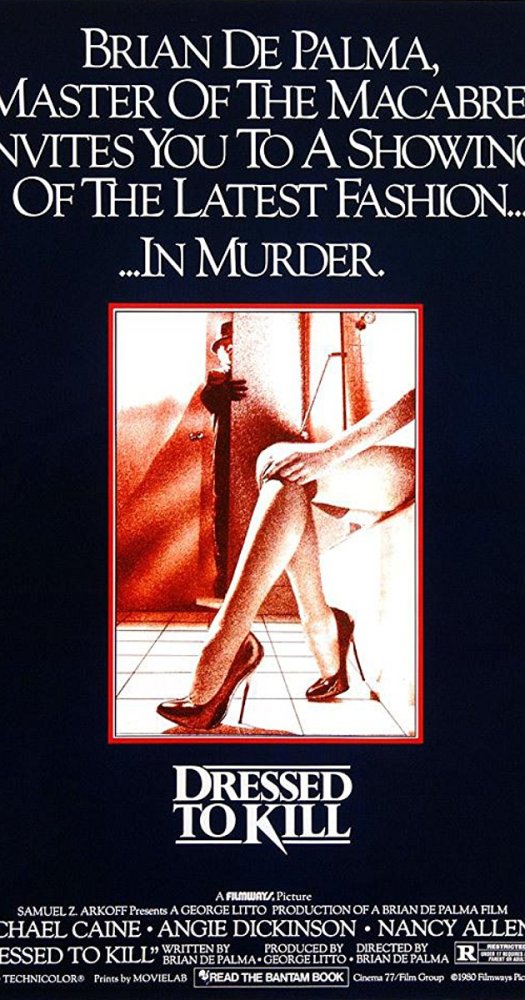
Brian De Palma was a big deal back in the 70’s and 80’s, and his films like CARRIE, SCARFACE, and THE UNTOUCHABLES are still discussed. Yet works such as SISTERS, PHANTOM OF THE PARADISE, OBSESSION, BLOW OUT, and BODY DOUBLE seem unjustly neglected today, and some critics deride him for his over the top sex and violence. DRESSED TO KILL finds De Palma in full Hitchcock mode, an homage to PSYCHO that The Master of Suspense himself cited as more like a “fromage”, but one I find still entertaining.
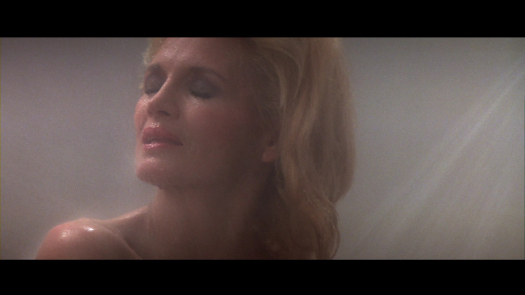
The film begins with a sizzling hot shower scene with Angie Dickinson as Kate Miller, remarried mother of science nerd Peter (Keith Gordon, CHRISTINE ). Kate has problems in her marriage and with her own mom, not to mention being a nymphomaniac! She’s seeing psychiatrist Dr. Robert Elliott (Michael Caine ), but seemingly getting nowhere. We follow her to New York’s…
Produced by Martin Bregman, directed by Brian De Palma, written by Oliver Stone, and starring Al Pacino, the 1983 remake of Scarface is one of the best-known, most iconic gangster films ever made. It opened to mixed reviews but it’s gone on to be recognized as a classic. Everyone can quote the script: “Say hello to my little friend!” “In this country, you gotta make the money first. Then when you get the money, you get the power. Then when you get the power, then you get the women.” “Say goodnight to the bad guy!”
Scarface starts with one of my favorite opening scenes of all time. Powered by Giorgio Moroder’s score, the opening credits of Scarface play out over footage of the real-life Mariel boatlift. Combined with footage of Fidel Castro ranting that Cuba does not need the Marielitos, this opening gives real-world credibility to everything that follows. We then segue from the actual boatlift to Al Pacino as Tony Montana, answering questions with that shit-eating grin on his face.
Listen to the interrogation scene carefully and you’ll hear both Charles Durning and Dennis Franz, dubbing the lines of the actors who played the immigration agents.
What’s an Insomnia File? You know how some times you just can’t get any sleep and, at about three in the morning, you’ll find yourself watching whatever you can find on cable? This feature is all about those insomnia-inspired discoveries!
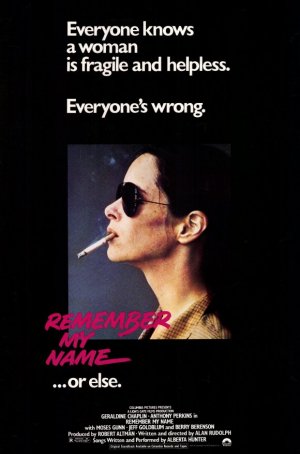
If you were having trouble sleeping last Tuesday, around one in the morning, you could have turned over to TCM and watched Remember My Name, an odd and sometimes frustrating little thriller from 1978.
Remember My Name opens with Emily (Geraldine Chaplin) showing up in a small town in California. From the minute we first see and hear Emily, something seems to be off about her. She views the world through suspicious eyes. Whenever anyone talks to her, you’re never quite sure whether she’s going be friendly or if she’s going to lash out. When she speaks, there’s something weird about her vocal inflection, as if she’s always struggling to figure out what she’s supposed to say. She seems to be separated from the world, almost as if she’s walking through a living dream and only talking to figments of her imagination. There’s nothing about her that feels at all authentic.
She moves into a small apartment and enters into a relationship with her handyman (Moses Gunn), a relationship that seems to be largely defined by her refusal to open up about herself. She gets a job at a grocery story that’s managed by a Mr. Nudd (Jeff Goldblum). Mr. Nudd mentions something about Emily knowing his mother. Apparently, they met in prison.
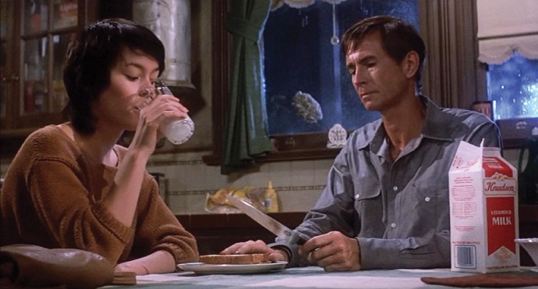
Soon, Emily is stalking a construction worker named Neil Curry (Anthony Perkins). When Neil spots her, he calls out her name and Emily runs away. And yet, Neil doesn’t bother to tell his wife, Barbara (Berry Berenson), about Emily. Soon, Emily is even breaking into the Curry home, silently shadowing Barbara as she walks through the house.
I described Remember My Name as being a thriller and I guess that, technically it is. There are a few moments of tension, especially when Emily is stalking Barbara. However, the film itself is directed in a detached manner by Alan Rudolph. Rudolph was a protegé of director Robert Altman (who also produced Remember My Name) and Rudolph’s approach is very Altmanesque, often to the detriment of the film. (Chaplin and Jeff Goldblum had both appeared in several Altman films, most famously in Nashville.) Though the film is dominated by Chaplin and Perkins, it’s still very much an ensemble film and the action plays out in a deceptively casual, almost random manner. It tries so hard to be Altmanesque that Remember My Name gets a bit frustrating, to be honest. Chaplin gives such a good and memorable performance and she works very hard to make Emily a character who is both frightening and, at times, surprisingly sympathetic but, for the most part, Rudolph’s technique makes it difficult to get emotionally involved in any of the action unfolding on-screen. Rudolph observes the action but refuses to comment on it. As a result, Remember My Name is occasionally intriguing but, just as often, it’s rather boring. Just like real life, I suppose. And, just like real life, it’s not for everyone.
That said, it was interesting to see Anthony Perkins playing a role other than a knife-wielding inn manager. Without resorting to any of the familiar tics or the neurotic speech patterns that typecast him forever as Norman Bates, Perkins plays Neil as just being a regular, blue collar guy and he actually does a pretty good job. Watching the film, I got the feeling that this was perhaps Perkins’s attempt to change his image. (Whenever Neil appears shirtless, both the film and Perkins seem to be saying, Check out this physique! Would someone only capable of playing a psycho have abs like this?) Neil’s wife, Barbara, was played Perkins’s wife, Berry Berenson. Neither one of them is with us any longer. Perkins died of AIDS in 1990 while Berry Berenson was on one of the planes that flew into the World Trade Center on 9-11. They both did good work in this film, as did Chaplin and Goldblum and, really, the entire cast. It’s just a pity that the film itself isn’t as good as the performances.
Today’s horror on the lens is a made-for-TV movie from 1985!
In Deadly Messages, Kathleen Beller plays a woman named Laura who witnesses a murder and then becomes convinced that the murderer is after her. She also finds a Ouija board that continually sends her the same message: “I am going to kill you.” The police are skeptical of Laura. Even worse, her boyfriend (Michael Brandon) is skeptical! And, needless to say, Laura may have some secrets of her own…
Deadly Messages is a lot of fun. Thank you to frequent TSL commenter Trevor Wells for suggesting this movie!



 Through the Shattered Lens