Retro Television Review: Alexander The Great (dir by Phil Karlson)


Welcome to Retro Television Reviews, a feature where we review some of our favorite and least favorite shows of the past!  This Thursdays, I will be reviewing Alexander The Great, which was filmed in 1963 but didn’t air on CBS until 1968.  The show can be found on YouTube!
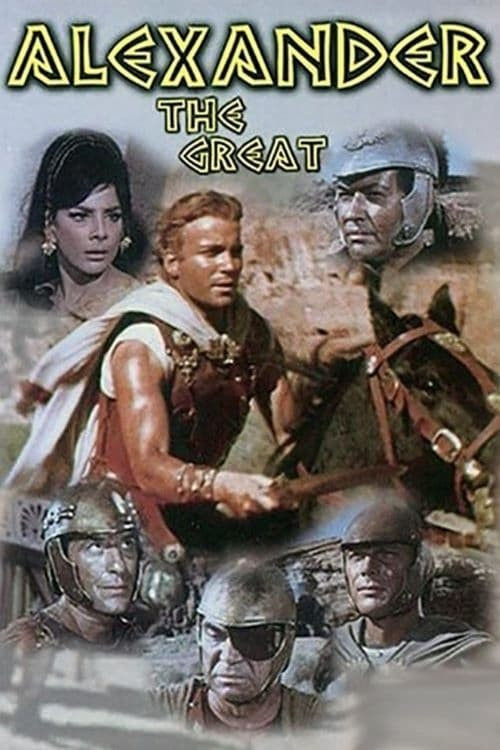
This week, we take a look at William Shatner and Adam West in Alexander The Great, a pilot that never became a series.

Episode 1.1 “Alexander The Great”

(Dir by Phil Karlson, originally aired on January 26th, 1968)

Greek leader Alexander the Great (a very blonde William Shatner) is determined to defeat the forces of King Darius and conquer all of Persia.  But, before he can fight his latest battle, he has to rescue his kidnapped best friend Cleander (Adam West), calm the nerves of his mentor Antigonus (Joseph Cotten), and deal with two insubordinate generals (John Cassavetes and Simon Oakland).  Only then will Alexander be ready to defeat the fearsome, beheading-obsessed Persian general, Memmon (Cliff Osmond, wearing a truly horrifying wig and fake beard).

This hour-long episode features a lot of talking, a lot of scheming, and one good battle scene.  Unfortunately, that good battle scenes becomes a lot less impressive once you discover that it was lifted from the 1959 film, The Giant of Marathon.  As for the scheming, it’s not really a surprise when the generals plays by Cassavetes and Oakland reveal that they’re planning on assassinating Alexander during the battle.  Both characters are so obviously villainous that their very presence amongst the ranks will lead most viewers to doubt whether Alexander is truly the tactical genius that everyone seems to think he is.

For most viewers, the main appeal of Alexander the Great will be the chance to see William Shatner and Adam West playing best friends.  This pilot was made before Shatner was cast as Captain Kirk and West as Batman.  While West gives a relatively sober performance as Cleander, Shatner shows that he had all of his famous acting tics long before he boarded the Enterprise.  Shatner delivers every line as if he’s expecting to be handed an Emmy at any moment.  The halting cadence is present.  The overly dramatic punctuation is present.  The habit of telegraphing every line and emotion by moving his head is present.  This is the type of performance that feels more like William Shatner imitating himself than actually trying to play a character.  Today, we’re all used to William Shatner poking fun at his reputation so it’s always a bit jarring to watch something like Alexander the Great and see just how seriously Shatner used to take himself.

Alexander the Great ends with Alexander achieving victory over both Memmon and his own duplicitous generals.  He buries Antigonous, who was earlier murdered by the mutineers.  And then, with a big smile on his face, Alexander hopes on his horse and rides off with Cleander and his surviving generals.  Watching Shatner riding his horse, it becomes obvious that, had this pilot become a show, it would have been a western that just happened to take place in ancient Greece and which featured togas and mini-skirts instead of chaps and hats.

This pilot was shot in 1963 but it was rejected by the network and shelved.  In 1968, when West was Batman and Shatner was Kirk, the pilot was taken out of storage and aired as an episode of an anthology show.  Needless to say, it didn’t lead to a series.  Adam West later poked fun at the pilot in his autobiography, saying that it was the greatest waste of an hour ever made.  I think West was a bit too hard on the pilot.  It’s not terrible as much as it’s just bland.  No production featuring not only Shatner and West but also Joseph Cotten, Simon Oakland, and John Cassavetes has a right to be this mild.

One does wonder how, if the pilot had become a series, it would have deal with Alexander eventually drinking himself to death.  Imagine what Shatner and West could have done with that!

Horror On The Lens: Incubus (dir by Leslie Stevens)


Remember Esperanto?

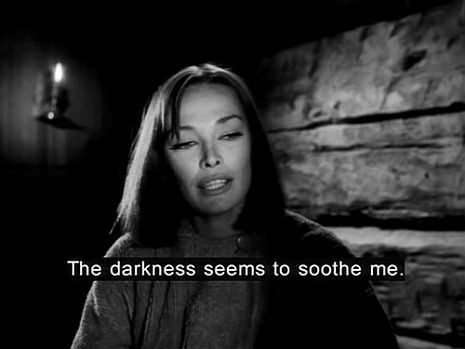
Esperanto was an international language that was briefly promoted by one-world government weirdos but which never really caught on.  Four movie have been made in Esperanto but only one is still remembered.  1966’s Incubus features William Shatner, giving a very Shatnerish performance, as a solider who is tempted by a mysterious woman.  The cinematography of the legendary Conrad Hall gives this one a very dream-like feel, even before everyone starts to talk.

Yes, this movie has subtitles.  But, so what?  Who hasn’t wanted to see William Shatner speak Esperanto?

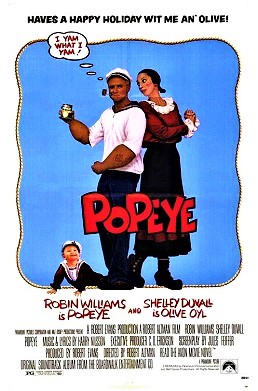
Popeye (1980, directed by Robert Altman)


I like Popeye.

Sometimes, I feel like I’m the only one.  Popeye got such bad reviews and was considered to be such a box office disappointment that director Robert Altman didn’t make another major film for a decade.  Producer Robert Evans, who was inspired to make Popeye after he lost a bidding war for the film rights to Annie, lost his once-sterling reputation for being able to find hits.  This was Robin Williams’s first starring role in a big screen production and his career didn’t really recover until he did Good Morning Vietnam seven years later.  Never again would anyone attempt to build a film around songs written by Harry Nilsson.  Screenwriter Jules Fieffer distanced himself from the film, saying that his original script had been ruined by both Robert Evans and Robert Altman.  Along with Spielberg’s 1941 and Michael Cimino’s Heaven’s Gate, Popeye was one of the box office failures that signaled the end of the era in which directors were given a ton of money and allowed to do whatever they wanted to with it.

I don’t care.  I like Popeye.  I agree with the critics about Nilsson’s score but otherwise, I think the film does a great job of capturing the feeling of a comic strip come to life.  Altman was criticized for spending a lot of money to construct, from scratch, the seaside village that Popeye, Olive Oyl (Shelley Duvall), Bluto (Paul L. Smith), Wimpy (Paul Dooley), and everyone else called home but it does pay off in the movie.  Watching Popeye, you really are transported to the world that these eccentric characters inhabit.  If the film were made today, the majority of it would be CGI and it wouldn’t be anywhere near as interesting.  Featuring one of Altman’s trademark ensemble casts, Popeye create a world that feels real and lived in.

Mumbling the majority of his lines and keeping one eye closed, Robin Williams is a surprisingly believable Popeye, even before he’s force fed spinach at the end of the movie.  Paul L. Smith was an actor who was born to play the bullying Bluto and there’s something very satisfying about seeing him (literally) turn yellow.  As for Shelley Duvall, she is the perfect Olive Oyl.  Not only does she have the right look for Olive Oyl but she’s so energetic and charmingly eccentric in the role that it is easy to see what both Popeye and Bluto would fall in love with her.  Though the humor is broad, both Williams and Duvall bring a lot of heart to their roles, especially in the scenes where they take care of their adopted infant, Swee’Pea.  Popeye may be a sailor but he’s a father first.

Popeye deserves a better reputation than it has.  It may not have been appreciated when it was originally released but Popeye has a robust spirit that continues to distinguish it from the soulless comic book and cartoon adaptations of today.

International Horror Film Review: Incubus (dir by Leslie Stevens)


The 1966 film Incubus is unique for being one of the few films to have been made in the international language.

What?

No, not love!  WE’RE TALKING ABOUT ESPERANTO!

Esperanto is a language that was invented in 1887 by a Polish idealist who wrote under the name — I kid you not — Dr. Esperanto.  The idea behind Esperanto was that it was a simple language that anyone could learn and, if the whole world learned to speak this one language, there would be far less misunderstandings, conflicts, and wars.  There’s probably some truth to that idea and the language has gone through the occasional period of popularity.  (If Lincoln Chafee runs for President again, I’m sure he’ll probably make learning Esperanto a part of his platform.)  Still, Esperanto never really caught on.  I imagine that most people were like, “But what if I go through the trouble to learn a new language but no one else does?  Then I’d look stupid!”  That’s what kept me from learning trigonometry.

Still, when director Leslie Stevens and producer Anthony Taylor was trying to decide what gimmick they could use to set Incubus apart from other low-budget horror films, they decided that the entire film would be in Esperanto.  Since the film was about a succubus trying to steal soul of a “pure man,” the feeling was that Esperanto would give the film an otherworldly feel.  The idea of having the demons all speaking Esperanto actually worked out well because, seriously, why wouldn’t otherworldly denizens have their own language?  But of course, then William Shatner shows up as the pure man and he’s speaking Esperanto too.  It gets a bit confusing.

The film takes place in the village of Nomen Tuum, where there’s a well that can both heal the sick and make the ugly look reasonably more appealing.  As a result, the village has become a popular spot for not only those who are dying but also those who are incredibly vain.  Kia (Alyson Ames) is one of the many succubi who hang out around the village, leading arrogant and foolish men into the ocean where their souls are claimed by the Incubus (played by Milos Milos).  Kia, however, has grown bored with only tempting the morally corrupt.  She wants a challenge!  She wants to tempt someone pure of heart!  All the other succubi tell her to be careful because dealing with the pure of heart might make it difficult for her to retain her demonic nature, which would upset the Incubus.  Kia shrugs them off and heads out to seduce a clergyman….

Unfortunately, all the available clergymen turn out to be just as vain, greedy, and corrupt as the people drinking from the well!  Whatever is a succubus to do!?  Kia is on the verge of giving up when she spies a wounded soldier named Marc (William Shatner) and his sister, Arndis (Ann Atmar).  They’ve come to the village to heal Marc of his wounds.  And yes, they are “pure of heart.”

It would be easy (and, let’s be honest, a bit tempting) to glibly dismiss Incubus as being the film that proves that, in the 60s, William Shatner could overact even in Esperanto.  And William Shatner does give a very Shatneresque performance.  But Incubus is actually a surprisingly effective film.  The film’s black-and-white cinematography was by Conrad Hall (with the uncredited assistance of William A. Fraker) and the film is full of wonderfully atmospheric images.  When Marc dreams, he sees haunting images of dead men floating in the ocean.  When the Incubus abducts Arndis, they travel through a shadowy landscape before finally arriving at a house that that appears to be on fire with demonic evil.  As the film progresses, the imagery becomes more and more surreal, as if we’ve entered into a dream, a filmed nightmare of sorts.  And, long before The Witch, Incubus features a character wrestling with a Satanic goat.

Incubus was filmed with the actors learning their lines phonetically and with no one on set to correct their pronunciations.  When the film was previewed for 60 people who spoke Esperanto, the audience laughed at how the actors butchered their precious little international language.  After that, Milos Milos — the actor who played the Incubus — was found dead with his girlfriend in what was assumed to be a murder/suicide, though many continue to claim that it was a murder/murder.  (Milos’s girlfriend was also Mickey Rooney’s wife and both were discovered dead at Mickey’s house and, well …. I don’t like where this is heading.  Sorry, Mick!)  As a result of all of the scandal, no reputable U.S. distributor would handle Incubus.  (This was 1966, after all.)  So, the film was only released in France.  Though I have no evidence to say for sure, I choose to believe that the French got it.

The film was long believed to be lost until the last remaining print was discovered in the collection of the Cinematheque Francaise in Paris.  From that badly damaged print, Incubus was restored and, as a result, history’s first Esperanto horror film can once again be appreciated by audiences everywhere!

Mi amas feliĉan finon!

Horror On the Lens: Incubus (dir by Leslie Stevens)


For today’s Horror on the Lens, we present Incubus, an odd little film from 1966.  William Shatner plays a soldier who, along with his sister, visits a mysterious village that has magical, healing water.  (Shatner has been wounded in battle and wants to be healed.)  However, the village is also home to a succubus who wants to seduce Shatner and lead him to Hell.

Incubus is memorable for three reasons.  First off, you’ve got William Shatner giving a very Shatnerish performance.  Secondly, legendary cinematographer Conrad Hall gave this film a very dream-like feel.  And third, this is one of the four movies to have been filmed in Esperanto, a so-called international language that has never really caught on.

That’s right!  This movie has subtitles!  But, so what?  Who hasn’t wanted to see William Shatner act in Esperanto?