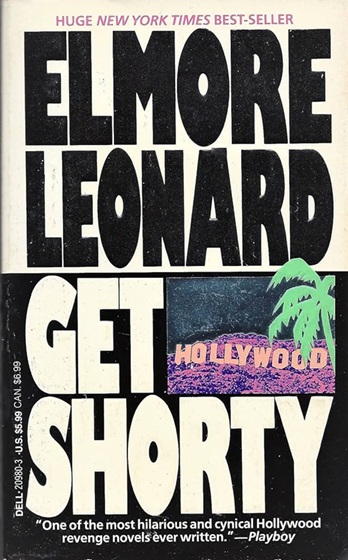
In 1995’s Get Shorty, John Travolta stars as Chili Palmer.
Chili is a loan shark for the mob, an effortlessly cool guy who lives in Miami and who loves to watch old movies. Chili may work for the Mafia and he may make his living by intimidating people but he doesn’t seem like such a bad guy, especially when compared to someone like Ray “Bones” Barboni (Dennis Farina). Bones is an uncouth and rather stupid gangster who steals Chili’s leather jacket from a restaurant. Chili reacts by breaking Bones’s nose with just one punch. Bones reacts by trying to shoot Chili but instead, he gets shot by Chili himself. (The bullet only grazes his forehead.) Chili can do all this because he’s protected by Momo (Ron Karasbatsos) but, after Momo drops dead after having to walk up several flights of stairs just to then be given a surprise birthday party, Chili suddenly finds himself working for Bones. (This all happens in the first few minutes of this perfectly paced film.)
Bones, eager to humiliate Chili, sends him to Vegas to collect on a debt owed by a dry cleaner named Leo (David Paymer). Leo is thought to be dead but Bones wants to collect the money from Leo’s widow. It’s not the sort of thing that Chili likes to do so instead, he ends up going to Hollywood to collect a debt from B-movie director Harry Zimm (Gene Hackman). Chili happens to like Harry’s movies. He also likes Harry’s current girlfriend and frequent co-star, actress Karen Flores (Rene Russo).
Chili ends up in Hollywood, a town where everyone has some sort of hustle going. Chili finds himself dealing with drug dealers (Delroy Lindo), egocentric film stars (Danny DeVito), stuntmen-turned-criminals (James Gandolfini), and the widow (Bette Midler) of a screenwriter. Chili also finds himself looking to escape from the debt collection business by becoming a film producer. Harry has a script that he wants to make. Chili proposes a film based on the story of Leo the dry cleaner. Danny DeVito’s Martin Weir wants to be a “shylock” in a movie just so he can show off his intimidating stare. (“Is this where I do the look?” he asks while listening to the pitch.) Get Shorty is a whip-smart satire of Hollywood, one in which the gangsters want to be film people and all of the film people want to be gangsters. It features wonderful performances from the entire cast, with Travolta epitomizing cool confidence as Chili Palmer. Hackman, Russo, DeVito, Gandolfini, and Lindo are all excellent in their supporting roles but I have to admit my favorite performance in the film is probably given by Dennis Farina, who turns Bones Barnobi into a very believable (and a believably dangerous) buffoon.
GetShorty is based on a book by Elmore Leonard. First published in 1990, the book is a quick and entertaining read, one that reminds us that Leonard was one of the best “genre” writers of his time. When I read that book, I was surprised to see how closely the movie stuck to the book’s plot. Much of the film’s dialogue is right there in the book. It’s a book that practically shouts, “Turn me into a movie!” and fortunately, director Barry Sonnenfeld did just that.
In No Holds Barred, Hulk Hogan plays a professional wrestler who is best-known for his mustache, his thinning blonde hair, and for ripping his shirt in half when he climbs in the ring. Hulk Hogan is playing himself except that everyone in the movie calls him Rip Thomas. Why is Hogan renamed Rip Thomas? It seems strange because NoHolds Barred features “Mean Gene” Okerlund and Jesse “The Body” Ventura as themselves and there’s nothing about Rip that’s any different from Hulk Hogan’s own wrestling persona.
Rip is the World Wrestling Federation Champion and is loved by fans across the globe. Rip may be fierce in the ring but outside of the ring, he loves children and is devoted to looking after his younger brother, Randy (Mark Pellegrino). Tom Brell (Kurt Fuller), the evil owner of World Television Network, wants to harness the star power of Rip but, when Rip refuses to sign with WTN, Brell goes his own way and hires ex-convict Zeus (Tiny Lister) to star in The Battle Of The Tough Guys.
Rip still wants nothing to do with Brell, not even when Brell sends Samantha Moore (Joan Severance) to seduce him. In fact, Rip is such a beacon of goodness that he brings Samantha over to his side. But when Zeus puts Randy in the hospital, Rip has no choice but to seek revenge in the ring.
No Holds Barred is a movie with an identity crisis. It’s a pro wrestling movie that was made to capitalize on Hulkamania and a lot of the humor was meant to appeal to the kids who were a huge part of Hogan’s fanbase but it’s also a movie in which people die, Samantha is nearly raped, and Randy is crippled by Zeus. The movie lacks the sense of fun that has made professional wrestling a worldwide phenomena. The most surprising thing about No Holds Barred is that Hulk Hogan has very little screen presence. I don’t think anyone would expect him to be a great actor but he also shows little of the charisma that made him a phenomena back in the day. Especially when compared to the ferocious Tiny Lister, Hogan is just boring. Maybe that’s the difference between Rip Thomas and Hulk Hogan.
David Paymer has a small role in No Holds Barred, playing a nervous television executive. Out of the cast, Paymer was the only one who later went on to be nominated for an Oscar and Jesse Ventura was the only one to later be elected governor of a state, at least so far. Hulk Hogan’s only 71. He’s still got time.
It isn’t the past. It isn’t the present. It’s the future.
The moon has been colonized and, on Earth, the Mayflower II is preparing for its first international flight. It will be carrying passengers from Houston to the lunar station. Test pilot Ted Striker (Robert Hays) claims that the Mayflower II is not ready to make the trip but he’s been in the Ronald Reagan Hospital For The Mentally Ill ever since he had a nervous breakdown after losing his squadron during “the war.”
Aboard the Mayflower II is Ted’s ex-wife, Elaine (Julie Haggerty), and her new boyfriend, Simon (Chad Everett). Simon says the Mayflower II is in perfect shape but he also turns into jelly whenever things get too rough. Piloting the Mayflower II is Captain Clarence Oveur (Peter Graves) and waiting on the Moon is Commander Buck Murdock (William Shatner). The crew of the Mayflower II is going to have a tough flight ahead of them. Not only is the shipboard computer making plans of its own but one of the passengers (Sonny Bono) has a bomb in his briefcase. Also, Ted has broken out of the hospital and is on the flight, boring people with his long stories.
Every successful film gets a sequel and when Airplane! was a surprise hit in 1980, it was inevitable that there would be an Airplane II. Robert Hays, Julie Haggerty, Lloyd Bridges, Peter Graves, and Stephen Stucker all returned. Unfortunately, Jim Abrahams, the Zucker brothers, Robert Stack, Kareem Abdul-Jabbar, and Leslie Nielsen did not. (The directors and Nielsen were all working on Police Squad and their absence is strong felt.) Airplane II recreates many of the same jokes as the first Airplane! but without the first film’s good nature or genuine affection for the disaster genre. Airplane! was made for the love of comedy. Airplane II was made for the love of money and, while there are more than a few amusing moments, the difference is obvious and there for all to see.
Not surprisingly, Airplane II is at its funniest whenever William Shatner is on screen. In the role of Bud Murdock, Shatner pokes fun at his own image and shows himself to be a good sport. He’s still not as funny as Leslie Nielsen or Robert Stack in the first film but that’s because, unlike Stack and Nielsen in their pre-Airplane! days, there had always been a hint of self-parody to Shatner, even in his most dramatic roles. If Stack and Nielsen shocked people by showing that they could do deadpan comedy, Shatner’s performance just confirmed what most suspected, that he had always been in on the joke. Still, he’s the funniest thing in Airplane II and, whenever I rewatch this movie, I am happy he was there.
Airplane II was a box office failure, which is why the world never got an Airplane III. Fortunately, the world did get Hot Shots and The Naked Gun.
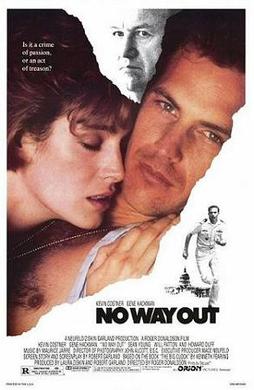
Trust no one in Washington would seem to be the message of this 1987 thriller.
Kevin Costner plays Lt. Commander Tom Farrell, a Naval Intelligence officer who is hailed as a hero after saving a shipmate who falls overboard. In Washington, Tom is recruited by a friend from college, Scott Pritchard (Will Patton), to work for Secretary of Defense Brice (Gene Hackman). Brice doesn’t trust the head of the CIA (played by future senator, Fred Dalton Thompson) and he wants Tom to serve as his mole within the service. What Brice doesn’t know is that Tom is sleeping with Brice’s mistress, Susan Atwell (Sean Young).
Still, Brice does suspect that the woman with whom he is cheating is also cheating on him. When he confronts her about it, their argument leads to him accidentally pushing Susan over an upstairs railing. Pritchard, who is implied to be in love with Brice, takes charge of the cover-up and decides to push the story that Susan was killed by a possibly mythical Russian agent who is known only by the name “Yuri.”
Tom assists with the investigation of her death, both because he wants to know who killed Susan and also because he knows that there’s evidence in Susan’s apartment that could be manipulated to make him look guilty of the crime. For instance, Susan took a picture of Tom shortly before her death. The picture failed to develop but, through the use of what was undoubtedly cutting edge technology in 1987, Naval Intelligence is slowly unscrambling the picture. For Tom, it’s a race against time to find the actual killer before the picture develops and he’s accused of both killing Susan and being Yuri.
Everyone has an agenda in No Way Out, from the ambitious Brice to the fanatical Scott Pritchard to the head of the CIA, who wants Brice to approve funding for a costly submarine. Even the film’s nominal hero has an agenda, which has less to do with finding justice for Susan and everything to do with protecting himself and his future. In fact, as is revealed in the film’s enjoyable if slightly implausible twist ending, some people in Washington have multiple agendas. The film portrays Washington as being a place where, behind the stately facade, everyone is a liar and everyone is ultimately a pawn in someone else’s game. If you have the right connections, you can even get away with murder. Loyalty is rewarded until you’re no longer needed.
It’s an enjoyably twisty thriller, one that makes good use of the contrast between Kevin Costner’s All-American good looks and his somewhat shady screen presence. The film introduces Costner as being a character who, at first glance, seems almost too good to be true and then spend the majority of its running time suggesting that is indeed the case. Gene Hackman is well-cast as the weaselly cabinet secretary, as is Sean Young as the woman who links them all together. In the end, though, the film is stolen by Will Patton, who plays Scott Pritchard as being someone who has unknowingly given his loyalty to a man who is incapable of returning it. As played by Patton, Scott is an outsider who desperately wants to be an insider and who is willing to do just about anything to accomplish that goal. He’s a version of Iago who never turned against Othello but instead devoted all of his devious tricks to trying to cover up the murder of Desdemona.
Even with an over-the-top final twist, No Way Out holds up well as a portrait of how the lust for power both drives and corrupts our political system.
The 1999 film, Payback, opens with Porter (Mel Gibson) lying on a kitchen table while a grubby-looking doctor digs two bullets out of his back. The scene takes place in almost nauseating close-up, with the emphasis being put on the amount of pain that Porter endures to get rid of those bullets. Immediately, we know that Porter is not someone who can safely go to a regular hospital. Porter is someone who exists in the shadows of mainstream society.
He’s also someone who spends a lot of time getting beaten up. Even back when he was still a big star, Mel Gibson always seemed to spend a good deal of his films getting beaten up and tortured in various ways and that’s certainly the case with Payback. Porter gets punched. Porter gets shot. Porter has a encounter with an over-the-top dominatrix (played by Lucy Liu). At one point, Porter allows two of his toes to be smashed by a hammer, just so he can trick the his enemies into doing something dumb. As played by Gibson, Porter stumbles through the film and often looks like he’s coming down from a week-long bender. It’s interesting to think that Payback is a remake of 1967’s Point Blank, which starred Lee Marvin as Walker, an unflappable career criminal who never showed a hint of emotion or weakness. Porter, on the other hand, is visibly unstable and spends the entire film on the verge of a complete mental collapse. A lot of people try to kill Porter and Porter kills almost all of them without a moment’s hesitation.
(Of course, both Porter and Point Blank‘s Walker are versions of Parker, a career criminal who was at the center of several crime novels written by Donald “Richard Stark” Westlake.)
After helping to pull off a $140,000 heist from a Chinese triad, Porter was betrayed and left for dead by his former friend Val Resnick (Gregg Henry) and his wife, Lynn (Deborah Kara Unger). Porter, who just wants the $70,000 cut that he was promised, starts his quest for the money by tracking down Val and Lynn, and then continues it by going after the three bosses (played by William Devane, James Coburn, and Kris Kristofferson) of “The Outfit,” a shadowy organization that Val had gotten involved with. Along the way, Porter deals with a motely crew of corrupt cops, violent criminals, and sleazy middlemen. (David Paymer has a memorable bit as a low-level functionary with atrocious taste in suits.) Porter also hooks up with a prostitute named Rosie (Maria Bello), who might be the only person that he can actually trust.
I have mixed feelings about Payback. (So did director Brian Hegeland, who was reportedly fired towards the end of shooting and later released a far different director’s cut.) Though the film does a good job of capturing the visual style of a good neo-noir, the story itself is so violent and grim that it actually gets a little bit boring. The film’s advertising encouraged audiences to “Get ready to root for the bad guy,” but there’s really no reason to root for Porter. He’s an inarticulate and ruthless killer with no sense of humor. If anything, the people that he kills seem to be far more reasonable and likable than he does. In Point Blank, Lee Marvin may have been a bastard but he was good at what he did and you at least got the feeling that he wouldn’t go after any innocent bystanders. In Payback, Porter is such a mess that his continued survival is largely due to dumb luck. It’s hard to root for an idiot.
That said, the film does do a good job of capturing the feeling of people living on the fringes of society. The Outfit is not a typical Mafia family but instead, a collection of businessmen who work out of nice offices and, in the case of William Devane’s Carter, come across as being more of a senior executive than a crime boss. (James Coburn and Kris Kristofferson, meanwhile, come across as being two former hippies who made it rich on Wall Street. They’re elderly versions of Abbie Hoffman and Jerry Rubin.) The film does a good job of creating a world where no one trusts anyone and everyone is being watched by someone. In one memorable scene, the three men sent to watch for Porter discover that he’s been watching them the entire time. Never forget to look over your shoulder to see who might be following.
Flaws and all, this 1999 film does a good job of capturing the atmosphere of paranoia that, for many, would come to define the early part of the 21st Century.
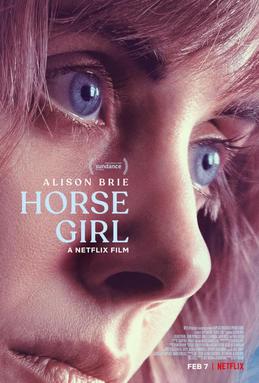
Horse Girl tells the story of a lost woman named Sarah (played, in a bravely committed performance, by Alison Brie).
Sarah is an introvert who works in a craft store, where she can tell the customers exactly the right type of paint to buy and where she’s watched over by her friendly co-worker, Joan (Molly Shannon). During the day, she occasionally visits the grave of her mother, who committed suicide. Sometimes, she might have a conversation with her wealthy stepfather (Paul Reiser). She enjoys going out to the stables and watching a horse named Willow. When she was a little girl, she rode Willow and she still thinks of him as being her horse. The owners of the stable, however, are never particularly enthused to see Sarah hanging around. In one scene, Sarah attempts to give advice to the girl who was just riding Willow, despite the fact that the girl obviously has no idea who Sarah is. Despite her good intentions, Sarah tends to be so awkward in her attempts to socialize that she just leaves people feeling uncomfortable.
When she’s not at work or at the stables or trying to fit in with the other students at her zumba class, Sarah lives in an apartment with her roommate, Nikki (Debby Ryan). While Nikki has a boyfriend, Sarah spends most of her nights in her living room, watching a cheesy sci-fi adventure show called Purgatory. She knows every detail about the show and is always shocked when no one else is as interested in it as she is.
In short, Sarah is a misft but she’s a familiar misfit. We all probably know someone like Sarah. At the very least, we all follow someone on twitter who is like Sarah, someone who always seems to be trying to make a connection but who can never quite get comfortable enough to just relax and be herself.
Strange things start to happen to Sarah. She hears voices in the apartment. She has dreams in which she’s lying on the floor of what appears to be a spaceship. Sarah starts to sleepwalk and is soon waking up to find herself in random locations. When she sees a picture of her grandmother, she wonders if it’s possible that she’s a clone. Strange scratches start to appear on the walls of her apartment. Did Sarah put them there or are they result of something coming after her?
Horse Girl is a surprisingly effective film, one that keeps you guessing as to whether or not what we’re seeing is really happening or if it’s all just occurring in Sarah’s head. Horse Girl was produced by Duplass Brothers Productions and it really does feel like a mumblecore version of Repulsion, with Alison Brie stepping into Catherine Deneuve’s role of the repressed young woman who finds herself a prisoner of her own fears. Whereas Repulsion featured arms growing out of the walls, Horse Girl features alien abductions and clones.
It’s a film that is sometimes heart-breaking and occasionally darkly funny. As much as we care and worry about Sarah, the people around her are interesting as well. The world that Horse Girl creates feels very real and very familiar and even the actors in the smallest roles create an indelible impression. This is one of those rare movies where it actually seems like the characters in the film all have a life even when they’re not in a scene. Every performance and every character feels real and authentic. I particularly liked the performance of Molly Shannon, who brings a very natural and sincere kindness to the role of Sarah’s co-worker. Playing Sarah’s father and Sarah’s gently humorous doctor, Paul Reiser and David Paymer shine in small roles.
That said, the film works best as a showcase for Alison Brie, who is both sympathetic and, eventually, more than a little frightening in the role of Sarah. Brie gives such an emotionally vulnerable performance as Sarah that there are times when you really wish that you could step into the film yourself and assure her that everything’s going to be okay. It’s also a rather brave performance, one that wins our sympathy while also showing why the increasingly manic Sarah might be too much for some people to take.
I have to admit that I wasn’t necessarily expecting much when I started watching a film called Horse Girl but it turned out to be one of my favorite films of 2020 so far.
You have to give the makers of the 1996 film, Unforgettable, some credit. It takes a certain amount of courage to give your movie a title like Unforgettable. You’re practically asking some snarky critic to comment on the fact that she can’t remember your movie.
Well, I’ll resist the temptation because I can remember enough about this movie to review it. I saw it a few days ago on This TV and, at first, I was excited because it was a Ray Liotta movie. Ray Liotta is an entertaining and likable actor who, nowadays, only seems to get cast in small, tough guy roles. Nowadays, a typical Liotta role seems to be something like the character he played in Killing Me Softly. He showed up. He was tough. He got killed for no good reason. So, whenever you come across a film in which Liotta gets to do something more than just get shot, you kind of have an obligation to watch.
In Unforgettable, Liotta plays Dr. David Krane, who is haunted by the unsolved murder of his wife. Fortunately (or perhaps, unfortunately), Dr. Martha Briggs (Linda Fiorentino) has developed a formula that can be used to transfer memories from one person to another. All you have to do is extract some spinal fluid! Or something like that. It doesn’t make any sense to me and I have to admit that I kinda suspect that the science might not actually check out.
Anyway, Dr. Krane is all like, “I want to inject myself with my dead wife’s spinal fluid so I can experience her final moments!”
And Dr. Briggs is all like, “But this could kill you because there’s all these vaguely defined side effects!”
But Dr. Krane does it anyway and he discovers that his wife was murdered by a lowlife criminal named Eddie Dutton (Kim Coates)! So, Dr. Krane chases Eddie all ocer the city and it’s interesting to see that a doctor can apparently keep up with a career criminal. I mean, you would think that Eddie’s experience with being chased and Krane’s inexperience with chasing would give Eddie an advantage. Anyway, regardless, it doesn’t matter because Eddie is eventually gunned down by the police and Dr. Krane is fired from his job.
Hmmm … well, that was quick. I guess the movie’s over…
No, not quite! It turns out that someone hired Eddie to kill Dr. Krane’s wife! And it turns out that person was a cop! But which cop!? Well, there’s only two cops in the film who actually have any lines so it has to be one of them. And one of the cops is so unlikable that it’s obvious from the start that he’s a red herring. So, I guess that means the actual murderer is the one that you’ll suspect from the first moment he shows up.
(For the record, the two cops are played by Christopher McDonald and Peter Coyote. I won’t reveal which one is unlikable and which one is a murderer but seriously, you’ve already guessed, haven’t you?)
Anyway, it’s all pretty stupid and a waste of everyone involved. Ray Liotta is likable and sympathetic but the film gets bogged down with trying to convince us that crimes can be solved through spinal fluid. It’s a dumb premise that the movie takes way too seriously and it never quite works.
Still, I hope that someone will give Ray Liotta another good role at some point in the future. He deserves better than supporting roles and Chantix commercials.
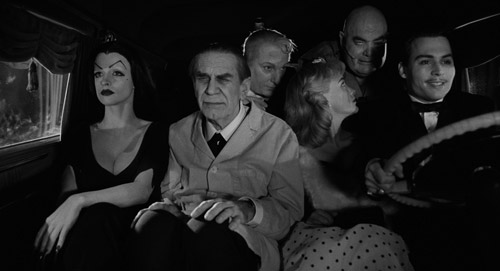
From start to end, the 1994 film Ed Wood is a nearly perfect film.
Consider the opening sequence. In glorious black-and-white, we are presented with a house sitting in the middle of a storm. As Howard Shore’s melodramatic and spooky score plays in the background, the camera zooms towards the house. A window flies open to reveal a coffin sitting in the middle of a dark room. A man dressed in a tuxedo (played to snarky and eccentric perfection by Jeffrey Jones) sits up in the coffin. Later, we learn that the man is an infamously inaccurate psychic named Criswell. Criswell greets us and says that we are interested in the unknown. “Can your heart handle the shocking facts of the true story of Edward D. Wood, Jr!?”
As streaks of lightning flash across the sky, the opening credits appear and disappear on the screen. The camera zooms by tombstones featuring the names of the cast. Cheap-looking flying saucers, dangling on string, fly through the night sky. The camera even goes underwater, revealing a giant octopus…
It’s a brilliant opening, especially if you’re already a fan of Ed Wood’s. If you’re familiar with Wood’sfilms, you know that Criswell’s appearance in the coffin is a reference to Orgy of the Dead and that his opening monologue was a tribute to his opening lines fromPlan 9 From Outer Space. If you’re already a fan of Ed Wood then you’ll immediately recognize the flying saucers. You’ll look at that octopus and you’ll say, “Bride of the Monster!”
And if you’re not an Ed Wood fan, fear not. The opening credits will pull you in, even if you don’t know the difference between Plan 9 and Plan 10. Between the music and the gorgeous black-and-white, Ed Wood is irresistible from the start.
Those opening credits also announce that we’re about to see an extremely stylized biopic. In the real world, Ed Wood was a screenwriter and director who spent most of his life on the fringes of Hollywood, occasionally working with reputable or, at the very least, well-known actors like Lyle Talbot and Bela Lugosi. He directed a few TV shows. He wrote several scripts and directed a handful of low-budget exploitation films. He also wrote a lot of paperbacks, some of which were semi-pornographic. Most famously, he was a cross-dresser, who served in the army in World War II and was wearing a bra under his uniform when he charged the beaches of Normandy. Apparently, the stories of his love for angora were not exaggerated. Sadly, Wood was also an alcoholic who drank himself to death at the age of 54.
Every fan of Ed Wood has seen this picture of him, taken when he first arrived in Hollywood and looked like he had the potential to be a dashing leading man:
What people are less familiar with is how Ed looked after spending two decades on the fringes of the film business:
My point is that the true story of Ed Wood was not necessarily a happy one. However, one wouldn’t know that from watching the film based on his life. As directed by Tim Burton, Johnny Depp plays Ed Wood as being endlessly positive and enthusiastic. When it comes to determination, nothing can stop the film’s Ed Wood. It doesn’t matter what problems may arise during the shooting of any of his films, Wood finds a way to make it work.
A major star dies and leaves behind only a few minutes of usable footage? Just bring in a stand-in. The stand-in looks nothing like the star? Just hide the guy’s face.
Wrestler Tor Johnson (played by wrestler George “The Animal” Steele), accidentally walks into a wall while trying to squeeze through a door? Shrug it off by saying that it adds to the scene. Point out that the character that Tor is playing would probably run into that wall on a regular basis.
Your fake octopus doesn’t work? Just have the actors roll around in the water.
The establishment won’t take you seriously? Then work outside the establishment, with a cast and crew of fellow outcasts.
You’re struggling to raise money for your film? Ask the local Baptist church. Ask a rich poultry rancher. Promise a big star. Promise to include a nuclear explosion. Promise anything just to get the film made.
You’re struggling to maintain your artistic vision? Just go down to a nearby bar and wait for Orson Welles (Vincent D’Onofrio) to show up.
Personally, I’m of the opinion that Ed Wood is Tim Burton’s best film. It’s certainly one of the few Burton films that actually holds up after repeat viewings. Watching the film, it’s obvious that Wood and Burton shared a passionate love for the movies and that Burton related to Wood and his crew of misfits. It’s an unabashedly affectionate film, with none of the condescension that can sometimes be found in Burton’s other film. Burton celebrates not just the hopes and dreams of Ed Wood, Bela Lugosi, Tor Johnson and Criswell but also of all the other members of the Wood stock company, from Vampira (Lisa Marie) to Bunny Breckenridge (Bill Murray), all the way down to Paul Marco (Max Casella) and Loretta King (Juliet Landau). Though Ed Wood may center around the character of Wood and the actor who plays him, it’s a true ensemble piece. Landau won the Oscar but really, the entire cast is brilliant. Along with those already mentioned, Ed Wood features memorable performances from Sarah Jessica Parker and Patricia Arquette (one playing Wood’s girlfriend and the other playing his future wife), G. D. Spradlin (as a minister who ends up producing one of Wood’s films), and Mike Starr (playing a producer who is definitely not a minister).
For me, Ed Wood is defined by a moment very early on in the film. Wood watches some stock footage and talks about how he could make an entire movie out of it. It would start with aliens arriving and “upsetting the buffaloes.” The army is called in. Deep delivers the line with such enthusiasm and with so much positive energy that it’s impossible not get caught up in Wood’s vision. For a few seconds, you think to yourself, “Maybe that could be a good movie…” Of course, you know it wouldn’t be. But you want it to be because Ed wants it to be and Ed is just do damn likable.
As I said before, Ed Wood is a highly stylized film. It focuses on the good parts of the Ed Wood story, like his friendship with Bela Lugosi and his refusal to hide the fact that he’s a cross-dresser who loves angora. The bad parts of his story are left out and I’m glad that they were. Ed Wood is a film that celebrates dreamers and it gives Wood the happy ending that he deserved. The scenes of Plan 9 From Outer Space getting a raptorous reception may not have happened but can you prove that they didn’t?
I suppose now would be the time that most reviewers would reflect on the irony of one of the worst directors of all time being the subject of one of the best films ever made about the movies. However, I’ll save that angle for whenever I get a chance to review The Disaster Artist. Of course, I personally don’t think that Ed Wood was the worst director of all time. He made low-budget movies but he did what he could with what he had available. If anything, Ed Wood the film is quite correct to celebrate Ed Wood the director’s determination. Glen or Glenda has moments of audacious surrealism. Lugosi is surprisingly good in Bride of the Monster. As for Plan 9 From Outer Space, what other film has a plot as unapologetically bizarre as the plot of Plan 9? For a few thousand dollars, Wood made a sci-fi epic that it still watched today. Does that sound like something the worst director of all time could do?
Needless to say, Ed Wood is not a horror film but it’s definitely an October film. Much as how Christmas is the perfect time for It’s A Wonderful Life, Halloween is the perfect time for Ed Wood.
Interestingly enough, New York City may be the center of wealth and politics in the United States but being Mayor of New York rarely leads to any sort of greater office. Though the Americans Elect people tried to unsuccessfully recruit Michael Bloomberg in 2012 and there’s a few deluded souls who seem to think that Bill de Blasio could run and win in 2016, only three NYC mayors have taken the plunge and actually run for President. Of the three of them, DeWitt Clinton was the most successful. He not only won the Federalist nomination but he came close to beating James Madison in the election of 1812. However, both John V. Lindsay and Rudy Giuliani were forced to end their campaigns when their electoral success in New York failed to translate into votes outside of the Northeast.
And that’s the thing really. Everyone in America knows that New York is an important city, perhaps the most important city in the United States. And they resent the Hell out of it. It’s kinda like how the rest of country hates my home state of Texas because they need our oil more than we need … well, whatever the Hell it is that the rest of the country brings to the table.
I mean, let’s face it. There’s a lot of resentment out there. And that resentment will probably keep anyone from going from Gracie Mansion to the White House.
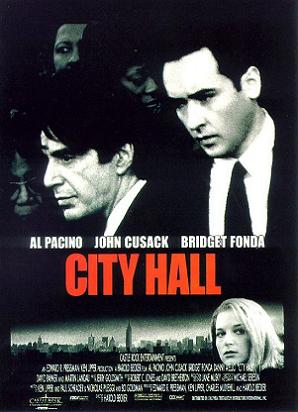
That’s one of the problems that I had with the 1996 film City Hall. In order for City Hall to work, you have to believe that Mayor John Pappas has a legitimate chance to not only be nominated for President but to win the election as well. At the start of the film, we’re informed by Deputy Mayor Kevin Calhoun (John Cusack, speaking in one of the worst attempts at a Louisiana accent that I’ve ever heard) that Pappas is the greatest mayor that New York City has ever had. I guess that might be true, even though we really don’t see any evidence of that fact. (Pappas does get to deliver a few monologues about how much he loves New York but if love is all it took, I’d be a really kick ass Prime Minister of Canada.) However, it’s because Mayor Pappas is such a product of New York City that he’d probably never be able to actually win a primary in Vermont and capture Iowa’s electoral votes. That’s one reason why it’s difficult to buy Mayor Pappas as a future President.
The other reason is that Mayor Pappas is played by Al Pacino. And we’re not talking about Godfatheror Dog Day Afternoon Al Pacino here. Instead, we’re talking about raspy voiced, constantly bellowing, thousand-yard state Al Pacino. As played by Al Pancino, it takes only one look at Mayor Pappas to imagine thousands a middle American voters running in terror away from the voting booths.
(One gets the feeling that if a large group of police officers ever turned their back on Mayor Pappas, he would immediately start jumping up and down while yelling, “YOU ARE TURNIN’ YOUR BACKS ON DA MAYOR HERE! WHAT DA FUCK IS GOIN’ ON WITH THIS SHIT HERE!?”)
That said, there’s another reason why Mayor Pappas may never be President. There’s been a shooting. An undercover cop and a drug dealer shot each other. A little boy was hit by a stray bullet. The little boy is black but, oddly enough, nobody in the film ever suggests that there was any sort of racial element involved. Instead, Mayor Pappas goes to the boy’s funeral and is enthusiastically applauded by the entirely African-American congregation.
It turns out that the drug dealer is the nephew of a mafia don. He should have been in prison at the time of the shooting but instead, he was given an early release by a seemingly incompetent judge (Martin Landau). As Calhoun and a lawyer named Marybeth Cogan (Bridget Fonda, giving a good performance in a generically written role) investigate how the dealer came to be released, they discover that local politician Frank Anselmo (Danny Aiello) may have had something to do with it. Calhoun also discovers that his idol, Mayor Pappas, may know more than he’s saying as well…
If you do happen to watch City Hall, be sure to compare Danny Aiello’s performance with Al Pacino’s. Both Aiello and Pacino are playing larger-than-life characters. And both Aiello and Pacino have a tendency to bellow and to play big. But, whereas Pacino’s performance feels forced and oddly empty, Aiello’s performance feels totally natural. You actually believe that Aiello could be elected to a citywide office whereas Pacino — or at least the version of Al Pacino that shows up for City Hall — seems like he’d have a hard time getting elected to a student council, much less Mayor of America’s largest city.
Anyway, City Hall is currently making the rounds on cable, which is how I saw it. It had the potential to be an interesting look at urban politics but, ultimately, it just doesn’t work. To a certain extent, I hate to be negative about any film that, like City Hall, has its heart in the right place but the movie just doesn’t work.
Way back in October, around the same time that I first decided that I would do a series of reviews of political films and that I would call it Lisa Gets Preachy (subsequently changed to Shattered Politics), I noticed that the 1995 film The American President was scheduled to be shown on TVLand.
“Hey,” I said, “I’ve definitely got to watch and review that!”
So, I set the DVR and I recorded The American President.
And then, I just left it there.
You have to understand that it’s rare that I ever leave anything unwatched on my DVR. Usually, within an hour of recording a program, I’ll be watching it. I have even been known to go so far as to make out very long lists of everything that I have on the DVR, just so I can make check them off after I’ve watched. As a general rule, I am way too obsessive compulsive to just leave anything sitting around.
But, for whatever reason, I could never work up any enthusiasm for the prospect of actually watching The American President. I knew that, eventually, I would have to watch it so that I could review it. Unlike those folks criticizing American Sniper on the basis of the film’s trailer, I never criticize or praise a film unless I’ve actually watched it. But I just couldn’t get excited about The American President.
Can you guess why? I’ll give you a hint. It’s two words. The first starts with A. The second starts with S.
If you guessed Aaron Sorkin, then you are correct! Yes, I do know that Sorkin has a lot of admirers. And, even more importantly, I know that it’s dangerous to cross some of those admirers. (I can still remember Ryan Adams and Sasha Stone insanely blocking anyone who dared to criticize the underwritten female characters in Sorkin’s script for The Social Network.)
But what can I say? As a writer, Aaron Sorkin bothers me. And since Sorkin is such an overpraised and powerful voice, he’s that rare scriptwriter who can actually claim auteur status. The Social Network, for instance, was not a David Fincher film. It was an Aaron Sorkin film, through and through.
And, after having to deal with three seasons of the Newroom and countless Aaron Sorkin-penned op-eds about why nobody should be allowed to criticize Aaron Sorkin, I’ve reached the point where dealing with all of Aaron Sorkin’s signature quirks is a bit like listening to the drill while strapped into a dentist’s chair. I am weary of pompous and egotistical male heroes who answer every question with a sermon. I am tired to endless scenes of male bonding. I have had enough with the quippy, quickly-delivered dialogue, all recited as characters walk down an endless hallways. I have no more sympathy for Sorkin’s nostalgic idealism or his condescending, rich, white dude version of liberalism.
Most of all, I’m sick of people making excuses for an acclaimed, award-winning, highly-paid screenwriter who is apparently incapable of writing strong female characters. I’m tired of pretending that it doesn’t matter that Aaron Sorkin is apparently incapable of viewing female characters as being anything other than potential love interests or silly distractions who need to be told to go stand in a corner while the menfolk solve all the problems of the world.
Fortunately, as a result of The Newsroom, quite a few critics are finally starting to admit what they always knew to be the truth. Aaron Sorkin is not the messiah. Instead, he’s a somewhat talented writer who doesn’t understand (or, in my opinion, particularly like) women. At his best, he’s occasionally entertaining. At his worst, he’s pompous, didactic, and preachy.
And, of course, Aaron Sorkin is the man who wrote The American President.
So, The American President just sat there until a few days ago when I sighed to myself and said, “Okay, let’s watch this thing.” As I watched it, I promised myself that I would try to see past the fact that it was an Aaron Sorkin-penned film and just try to judge the film on its merits.
But here’s the thing. It’s nearly impossible to separate one’s opinion of Sorkin from The American President. If you didn’t know that Sorkin had written The American President, you’d guess it after hearing the first few lines of dialogue. The film, itself, was directed by Rob Reiner but it’s not as if Reiner is the most interesting of directors. (What’s odd is that Reiner’s first films — This Is Spinal Tap, The Princess Bride, Stand By Me — are all so quirky and interesting and are still so watchable decades after first being released that you have to wonder how Reiner eventually became the man who directed The Bucket List.) In short, The American President is totally an Aaron Sorkin film.
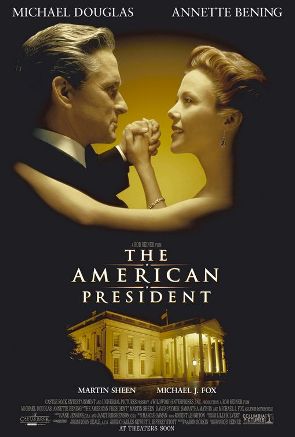
President Andrew Shepherd (Michael Douglas) is a liberal Democrat who, as he prepares to run for a second term, has a 63% approval rating. However, when Shepherd decides to push through a gun control bill, he finds that approval rating threatened. And then, when he listens to environmental lobbyist Sydney Wade (Annette Bening) and tries to push through legislation to reduce carbon emissions, his approval rating is again threatened. And then, to top it all off, he starts dating Sydney. It turns out that Sydney has protested American policy in the past. And, since this is an Aaron Sorkin film, everyone outside of the Northeast is scandalized that President Shepherd is having premarital sex in the White House.
And, to top it all off, there’s an evil Republican named Bob Rumson (Richard Dreyfuss) who wants to be President and is willing to use the President’s relationship with Sydney to further his own evil Republican ambitions.
But, ultimately, it’s not just those evil Republicans who make it difficult for Sydney and the President to have a relationship. It’s also the fact that the President agrees to a watered down crime bill and that he does not hold up his end of the bargain when it comes to reducing carbon emissions.
“You’ve lost my vote!” Sydney tells him.
But — fear not! There’s still time for President Shepherd to give a speech that will be so good and so brilliant that it will, within a matter of minutes, totally change every aspect of American culture and save the day. How do we know it’s a great speech? Because it was written by Aaron Sorkin!
Actually, I’m being too hard on the film and I’ll be the first admit that it’s because I’m personally not a huge fan of Aaron Sorkin’s. But, to be honest, The American President is Aaron Sorkin-lite. This film was written before the West Wing, before the Social Network, before that Studio Whatever show, and before The Newsroom. In short, it was written before he became THE Aaron Sorkin and, as such, it’s actually a lot less preachy than some of his other work. It’s true that, much like The Newsroom, The American President is definitely Sorkin’s fantasy of how things should work but at least you don’t have to deal with Jeff Daniels throwing stuff or Emily Mortimer not knowing how to properly forward an email.
Instead, it’s a film that will probably be enjoyed by those who share its politics. (And, make no mistake, The American President is more interested in politics than it is in the love story between Andrew and Sydney.) Michael Douglas does well in the role of the President. Meanwhile, Annette Bening is so likable and natural as Sydney that it almost make up for the fact that she’s yet another Sorkin woman whose existence is largely defined by looking up to her man while inspiring him to do the right thing and forgiving him when he doesn’t. Personally, I would have been happy if the film had ended with Sydney telling the President, “Thanks for finally doing the right thing but I have a life of my own to lead.”





 Through the Shattered Lens