What Lisa Watched Last Night: Doing Time On Maple Drive (dir. by Ken Olin)


Early Friday morning, I found myself watching an old school made-for-TV movie, Doing Time On Maple Drive, on the Lifetime Movie Network.  If you’ve heard of this film, it’s probably because it features a kinda young Jim Carrey in a supporting role.

Why Was I Watching It?

Because when it’s 3 a.m. and you’re getting hit by the old insomnia curse, what’s a girl to do put turn on the TV and change the channel to the Lifetime Movie Network?

What’s It About?

The Carters appear to be the perfect American family.  They’ve got a beautiful house in the suburbs (on Maple Drive, no less), the children are all handsome and intelligent, the dad is a succesful businessman, the mom a perfect homemaker, and blah blah blah.  You know how this is going to turn out already, don’t you?  Dad is actually an overly competitive jerk, mom is in denial, the daughter is a neurotic mess, the youngest son is a closeted homosexual, and the oldest child is Jim Carrey.  He’s also an alcoholic and he claims that his name is actually Tim but that doesn’t change the fact that he’s still Jim Carrey.

What Worked?

Tolstoy once said that all happy families are the same but that each unhappy family is unique.  The family in this film is unique because — well, oh my God, how dysfunctional can you be?  Not only do you have the judgmental parents and the alcoholic son but you’ve got the frigid daughter and the self-loathing gay son.  Just using one of these stock characters would have made the film’s storyline seem familiar and predictable.  However, tossing all of them into the mix and you’ve got an old school camp classic, complete with dramatic monologues, scary silences, and all the rest.  Though this was originally made and shown by Fox, Doing Time On Maple Drive really does take the beloved Lifetime Family Drama formula to its most logical extreme.

The film is also pretty well-acted and features some familiar faces for those of us who love horror and exploitation films.  For instance, the gay son is played by William McNamara who, if you’re an Argento fan, you may remember his extremely graphic death scene in Opera.

Making the film even more odd, McNamara’s character is engaged to Alison, who is played by Lori Loughlin, the mom from 90210.  How often do you get to see a mix of Argento, 90210, and Jim Carrey on screen?

What Didn’t Work?

Jim Carrey!  Don’t get me wrong, Jim did a good enough job playing his role but the whole time you’re watching the film, you keep thinking “that’s not Tim the alcoholic, that’s Jim Carrey.”

What’s ironic about that, of course, is that Jim Carrey is probably the only reason why anyone ever chooses to watch Doing Time On Maple Drive.  Well, Jim Carrey and insomnia.

(As a sidenote, Jim Carrey had to deliver the line, “I’ve done my time on Maple Drive,” which, of course, meant I had to yell, “We have a title!”)

“Oh My God!  Just Like Me!” Moments

During one dramatic moment, Alison tells her boyfriend, “What’s funny is a part of me always suspected you might be gay…”  This line made me cringe just because I said the exact same thing to one of my ex-boyfriends once.  He started crying.  It was just kinda awkward.

Lessons Learned

If you ever meet the “perfect” family, run away.

6 Trailers For The End of 2010


I’ve been under the weather since the day after Christmas (and you probably don’t want the details though they can be found on twitter because my twitter account is my place to be all TMI) so I fear that I’ve been running behind when it comes to posting on this site.  Not only have I not written my review of True Grit and Rabbit Hole, but I haven’t written anything about that video of the beaver opening up the box of tampons yet. 

So, wyle ah work on gittin mah purty lil self all caught up here (and attempt to phonetically recreate my natural country girl accent), here’s the final 2010 edition of Lisa Marie’s Grindhouse and Exploitation Trailers. 

1) Made in Sweden

I love how all the imported, soft-core films of the early 70s were always advertised as being sensitive, coming-of-age stories.  Christina Lindberg later starred as the iconic One-Eye in Thriller, A Cruel Picture (a.k.a. They Call Her One-Eye.)

2) Blindman

Yes, the trailer’s in German and no, I don’t speak German.  I speak French which I guess means I’d have to surrender if this trailer ever tried to enter me.  BUT ANYWAY, this is actually an Italian film.  Tony Anthony plays a blind gunslinger who is hired by a bunch of mail order brides to free them from a sadistic bandit played by Ringo Starr.  Yes, that Ringo Starr.

3) Tattoo

If, like my friend Elly, you live in Australia, you can watch this movie on DVD.  Unfortunately, outside of “region 4,” this movie is unavailable.  I’ve never seen it though I read about it in Bruce Dern’s quite frankly weird autobiography.  (I say weird with affection because, seriously — how can you not love Bruce Dern?)  Anyway, Dern says that in the sex scenes in this movie, he and Adams were actually doing it.  Apparently, the film itself is a take-off on The Collector — Dern kidnaps Adams, covers her body in tattoos, and then has sex with her.  It actually sounds like kind of a disgusting movie, to be honest and the prospect I might see it is making me reconsider my plans to eventually relocate to Australia (sorry, Elly).  

As for the trailer,  I just think it’s really nicely atmospheric, especially in the slow-motion sequence at the beginning.

4) Hell Night

This is the old school slasher film that I always wish I had been around to be cast in.  Why?  Because of all the costumes, of course!  If you’re going to be a victim in one of these movies, you might as well get to play dress up beforehand.

5) Invasion of the Bee Girls

There are two trailers for this movie.  This is the mainstream version and it is a heavily cut — and I mean HEAVILY CUT — version of the one that played in the grindhouses.  You can find the uncut version on Stephen Romano’s Shock Festival.  Anyway, this is one of those wonderfully satirical 70s films that was marketed as a standard grindhouse film.  William Smith plays an FBI agent who is sent to Peckham, California to discover why the town’s men are being fucked to death.  Actually, just looking at the men of Peckham, California — they should probably be happy with what they can get.

6) Deep Red

What better way to end 2010 than with the one and only Dario Argento?  This is the trailer for his first worldwide hit, the classic giallo Deep Red.  This is also the film where he first met and romanced Daria Nicolodi.  Plus, this movie probably features the best performance ever from the late and underrated David Hemmings (who would end his career playing a small role in Gangs of New York, a film which also features Giovanni Lombardo Radice.)

As a sidenote, I’ve really enjoyed sharing these trailers through 2010 and I look forward to sharing more in 2011.  Je te donne tout mon amour, mon lecteur.

Quickie Review: The Church aka La Chiesa (dir. by Michele Soavi)


The Italian horror cinema scene has always been dominated by such names as Mario Bava, Dario Argento and Lucio Fulci. Their films became Italy’s contribution to horror cinema and one cannot find a fan of the genre who don’t hold these three gentlemen in high regard. Other names of the Italian horror scene were not as well-known beyond the most hardcore horror fans and some just don’t deserve to be in the same company as the previously mentioned trio. One filmmaker who should be part of their company is one Michele Soavi. He rose through the ranks as an actor at first before moving on to becoming assistant directors for mentors such as Joe D’Amato and Dario Argento. The latter would become a major influence in Soavi’s work and would help produce some of his films. One of those Argento would end up producing for Soavi is the 1989 supernatural horror film, The Church (known in Italy as La Chiesa).

The Church wasn’t one of Soavi’s best films, but it was still one of the better horror films to come out of Italy during the waning years of the 80’s when Italian horror began a slow decline. Starring a very young Asia Argento (hard to believe that a career which began with reports of nepotism would turn out to be a successful one in and out of Italy) and an Italian-American actor named Tomas Arana (people would know him best as the ambitious Quintus in Ridley Scott’s Gladiator), the film starts off with a cohort of Teutonic Knights who destroy and kill a town suspected of witchcraft. The bodies of all killed soon get dumped into a mass grave and sealed with a huge metal cross and prayers to keep the evil that was done from ever coming out.

The beginning does have a somewhat ambiguous tone to it as we the audience don’t know if the villagers were indeed evil. Soavi definitely leaves that up in the air until the final third of the film kicks in and most of the horror scenes appear to satisfy gore fans. The knights destroying the village was well-staged and executed with some cool kill-scenes and effects.

It’s the middle reel where the film slowed down to the point that could lose the more casual horror fan. We get the usual non-believer researcer (Arana) who stumbles upon the ancient cross sealing the mass grave beneath the church that had been built over it down the centuries. Even this researcher and another knows that they should leave it alone, but being the scientists one of them proceeds to unseal the find with the reasoning that pursuit of knowledge should triumph over supersitition. Thus, the church becomes the scene of demonic possessions of various individuals. First, the initial researcher who opens unseals the cross then the parents of Asia Argento’s character before moving on to churchgoers who become trapped in the church after some demonic force seals all exits.

The rest of the film once that church seals itself is one person either getting killed by those possessed by the demons escaping from the sealed grave or someone getting possessed. This third act actually has a touch of Fulci’s nightmarish-style and less of Argento’s more dream-like quality. There’s a beautiful scene of Tomas Aranas’ character made-up to be some verdigrised-bronze angel statue, wings and all, embracing a very naked young woman that looked straight out of a Luis Royo painting. Another scene where regular Soavi actor Barbara Cupisti was shown in sexual congress with a demonic being that should give more than a few people nightmares despite being framed and shot in a beautiful manner.

The final nightmare scene of beauty which pushes The Church over into Fulci territory is when a mass of naked, muddied bodies of all those possessed entwine and writhe to form the likeness of a demon’s head. This sequence alone was worth watching through the much slower middle section of this film and Soavi’s eye for staging and lighting the scene made it look like something out of the pages of Dante Alighieri’s Divine Comedy.

One could say that The Church just didn’t live up to the usual quality one expected out of a Michele Soavi film after a he made the excellent giallo-slasher film Stage Fright just two years prior. This second full-lenght feature by Soavi showed him still honing his talent as a filmmaker which would finally culminate five years later in one of the best Italian horror films and one of the best films in the zombie subgenre with his Dellamorte Dellamore. Plus, even when he’s not on top of his craft like with The Church it is still worth a watch and better than the stuff released by his contemporaries like Bruno Mattei.

Song of the Day: L’alba Dei Morti Viventi (by Goblin)


Halloween is less than a week away and for the next few days there’ll be more song of the day choices and this time around it will all be centered on horror. To start things off I chose the theme from George A. Romero’s Dawn of the Dead which was composed by the Italian prog-rock band Goblin.

The theme’s titled “L’alba Dei Morti Viventi” and it definitely creates a dissonant tone which just creeps along and makes one feel more than just a bit uncomfortable. Goblin used a lot of their electronic music background to make this such a signature and iconic horror theme. Anyone who has seen the original Dawn of the Dead will automatically recognize this theme and the feeling it brings up. A feeling of dread and of creeping horror which perfectly describes the zombies from Romero’s grand opus.

Horror fans everywhere have Italian horror maestro Dario Argento for having gotten Goblin to create the score for Romero’s film (Argento was one of the key producers for the film and even re-cut it for the European market). Goblin had already worked with Argento on previous films with their best early work with the filmmaker being the score for Profondo Rosso (known as Deep Red in the US and English market). But no matter how many other Italian horror scores the band has made since Dawn of the Dead (and the ones after have been great in their own right) it will be their score for that film which will indelibly link the band in film music history.

PS: as an added bonus below is the band’s theme for Argento’s Profondo Rosso.

Scenes I Love: Tenebrae


While the goth ballerina side of me will always have a special place in my heart for Suspiria and its two sequels, I think that 1982’s Tenebrae may very well be director Dario Argento’s best film.  Certainly, it was (to date) his last truly great film before he entered the current, frustratingly uneven stage of his career.

Tenebrae was a return to Argento’s giallo roots after the supernatural-themed horror of Suspiria, Zombi, and Inferno.  It was also the work of an audaciously confident director.  That confidence is fully on display in the scene below in which the film’s killer menaces a journalist and her lover.  Featuring a truly impressive tracking shot in which the camera appears to literally swoop in, out, and over a journalists house without a single cut, the scene ends with one of Argento’s more memorable murders.

The music, by the way, is from Goblin.

Scenes I Love: A Face In The Crowd


Located below is the famous Vitajex advertising montage from Elia Kazan’s 1957 film, A Face In The Crowd.  Everytime I see this, I wonder if maybe American audiences in the 50s were smarter than we give them credit for. 

Then again, A Face in The Crowd was a notorious financial and critical failure when it was first released.  It’s actually one of the best and most influential movies ever made.  Certainly, it’s one of the few Kazan films that still seems artistically relevent today.  It should also be noted that A Face in the Crowd features Anthony Franciosa years before his starring turn in Dario Argento’s Tenebrae, Andy Griffith playing a villain, the film debut of Lee Remick, Walter Matthau as a tv writer, and Patricia Neal having a nervous breakdown.  Supposedly, a very young Rip Torn is somewhere in this film as well but I’ve never been able to spot him.

Scenes I Love: Inferno


Inferno is Dario Argento’s 1980 sequel to Suspiria.  Inferno seems to bring out the extreme reactions in Argentonians — it’s either loved or hated.  I happen to love it.

Below is one of the film’s best known sequences, the one where Irene Miracle ends up taking a surreal swim through a basement.  To me, this sequence is almost Fulciesque in it’s dream-like approach (punctuated, of course, by one sudden grotesque shock at the end).  Lucio Fulci’s The Beyond, which is often compared to Inferno, featured a similarly flooded basement. 

Words of warning: This scene lasts 6 and a half minutes.  Also, the first few minutes are nearly ruined by Keith Emerson’s bombastic score.  Fortunately, once Miracle takes her fateful dive, Mr. Emerson is silenced.

10 Films I Must See Before I Die


I love movies.  I love watching movies, reading about movies, and talking about movies.  Perhaps most of all, I love the hunt.  I love discovering movies or finding movies that had previously, for me, only existed in reviews or as a collection of screen captures.  To me, there is no greater experience the watching a movie for the first time.  (Even if, as often happens, that first time turns out to be the only time.)  Listed below are ten movies that I have yet to see but desperately hope to at some point in my life. 

1)  Giallo a Venzia (1979) — This is supposedly one of the most graphically depraved Italian horror films ever made.  If that’s not a recommendation, I don’t know what is.  Actually, I haven’t heard a single good thing about this movie but it has still become something of a Holy Grail in my quest to see as much Italian horror as possible.  This is largely because the movie is nearly impossible to find.  When it was first released, it was banned in the UK as part of the so-called “video nasties” scare.  (Trust the English to not only ban a movie but to come up with an annoying name for doing so in the process.)   This led to it never really getting much of a release in the English-speaking world and, now years later, it’s only available on bootleg DVDs.  As such, I imagine that if I ever do see it, it’ll be because I made a deal in a back alley with some bald guy who speaks with a Russian accent.  Much as with drug prohibition, the fact that its “forbidden” has made this movie rather attractive.

The few people who have seen this always mention that towards the end of the movie, Mariangela Giordano’s legs are graphically sawed off.  This makes sense as Giordano was always meeting grotesque ends in Italian horror movies.  In Patrick Lives Again, she is impaled (through her vagina no less) by a fireplace poker while in Burial Ground, she makes the mistake of breast feeding her zombie son.  In many ways, Giordano was like a female Giovanni Lombardo Radice.  However, its odd to consider that while the sight of Giordano’s legs getting sawed off was enough to get the film banned, the sight of poker being graphically driven into her crotch was apparently totally acceptable.  Censorship is a strange thing, no?

One last reason I want to see this movie — its filmed in Venice.  When I was in Italy, I fell in love with Venice.  (I also fell in love with a tour guide named Luigi but that’s another story.)

2) An uncut version of Nightmares in a Damaged Brain (1981) — This is another banned Italian movie.  When Nightmares was originally released, Tom Savini was credited as being behind the special effects.  Savini, however, has long claimed to have had little to nothing to do with the movie.  As Savini, to his credit, has never been embarrassed to claim ownership for his effects (regardless of the movie they appear in), I’m inclined to believe him.

In many ways, Nightmares reminds me of a film that Savini actually did work on, Maniac.  Not so much as far as the plot is concerned but just in the same bleak worldview and almost palpable sleaze that seems to ooze from every scene.  The version that is most widely available on DVD (and the one that I own) appears to be the cut version that was eventually okayed for release in the UK and even cut, this is a film that remains oddly compelling in just how much its willing to immerse itself in sleaze.  The uncut version remains elusive but someday, I will find it.

3) The Day The Clown Cried (1972) — You knew this one was coming, didn’t you?  I think everyone wants to see Jerry Lewis’s never released Holocaust comedy.  Supposedly, Lewis keeps the movie in a locked vault which I just find to be oddly hilarious.  My hope is that, if nothing else, some enterprising filmmaker will make a movie about a crack team of thieves who break into Jerry Lewis’s estate just to steal the only copy of The Day The Clown Cried and sell it to the people at Anchor Bay.  Jerry could play himself.  I also think this film will see the light of day sooner or later.  At some point, either Jerry Lewis or his estate is going to need the money.

4) The Other Side of the Wind — Orson Welles apparently spent the last few decades of his life making this movie.  At the time of his death, the movie was reportedly 95% film but only 40% edited.  Apparently, because of a whole lot of complicated legal things, the movie has spent the last 30 years under lock and key in Iran.  Even if somebody could rescue it, the remaining footage still needs a strong hand to put it together.  While I’m sure that many directors would be happy to volunteer to provide that hand, the two names most frequently mentioned — Peter Bogdonavich and Henry Jaglom — do not fill me with confidence.  I’d rather see the final film put together by Jess Franco, who was assistant director on Chimes at Midnight.

5) The Fantastic Four (1994) — This is not the dull movie that came out in 2005.  This apparently an even duller version of the same film that was made 11 years earlier for legal reasons.  Apparently, Roger Corman would have lost the movie rights to the comic book if he didn’t start production on a film by a certain date.  So, this film was made on the cheap and then promptly shelved.  My main desire to see it comes from the same morbid desire that makes me look at crime scene photos.  How bad can it be?

6) Le Cinque Giornate (1973) — This Italian film is apparently many things.  It’s a comedy.  It’s a historical epic.  It’s a satire of then contemporary Italian politics.  And most of all, it’s also apparently the only non-horror film directed by Dario Argento.  This was Argento’s fourth  film, coming after his celebrated animal trilogy and it was apparently an attempt, on Argento’s part, to break away from the giallo genre that he has since come to symbolize.  Though the film apparently did well enough in Italy, it failed to establish Argento as a director of comedy and that’s probably for the best as Argento’s fifth film would be the classic Deep Red.  Still, it’s hard not to play the “What If?” game, especially when it involves an iconic a figure as Dario Argento.  It’s also interesting to compare Argento’s attempts to go from horror to comedy with the career of Lucio Fulci, who went from comedy to horror.

7) Cocksucker Blues (1972) — Robert Frank’s documentary of the Rolling Stone touring America was officially unreleased because of its title.  While that title certainly played a role, it also appears that the film was unreleased because of just how much hedonism Frank managed to capture backstage.  The Stones apparently went to the court to block the film’s release.  Somehow, this resulted in a ruling that the movie can only be shown if Robert Frank is physically present.  Mr. Frank, if you’re alive and reading this, you have an open invitation to come down to Texas and stay with me anytime you want.  Seriously.

8 ) The Profit (2001) — The Profit is a satiric film about a cult.  The film’s cult is known as The Church of Scientific Spiritualism and is led by a recluse named L. Conrad Powers.  Sound familiar?  The film’s release was (and continues to be) prevented by a lawsuit brought by the Church of Scientology.  Say what you will about the Vatican, at least you can attack them in a movie without having to worry about getting sued or blown up.

9) Superstar: The Karen Carpenter Story (1987) — Probably one of the most famous film that most of us will never see, Superstar tells the story of Karen Carpenter through the use of Barbie dolls.  Director Todd Haynes supposedly failed to get the rights to the music he used in the film and, obviously enough, nobody in the Carpenter camp was all the eager to give him permission. 

9) Can Hieronymous Merkin Ever Forget Mercy Humppe And Find True Happiness (1969) — God, don’t you hate that title?  And, honestly, are you surprised that a film with that title is apparently history’s 1st X-rated musical?  Anyway, this is a movie I’ve come across in various film reference books where it’s either described as a masterpiece or (more often) one of the worst movies ever made.  Myself, I love musicals and if the musical numbers are mixed in with explicit sex — well, why not?  But that title — that title just gives me a bad feeling.  Another thing that gives me a bad feeling is that the movie was apparently the brainchild of Anthony Newley.  I don’t know much about Mr. Newley but what I do know seems to indicate that he personified everything that most people hate about musicals.  The film is apparently autobiographical and its about a really talented composer who treats the women in his life terribly but has a lot of reasons (or excuses) that we learn about in elaborate flashbacks and — wait, I’ve seen this movie.  Oh wait, that was Nine.  Anyway, Merkin was a huge flop and it has never been released on any type of video format.  Yet, it has not been forgotten which can only mean that it must have really traumatized the critics who saw it.  In other words, this is another one of my “how-bad-can-it-be” crime scene movies.

10) The uncut, original, 9-hour version of Erich Von Stroheim’s Greed (1924) — A girl can dream, can’t she?

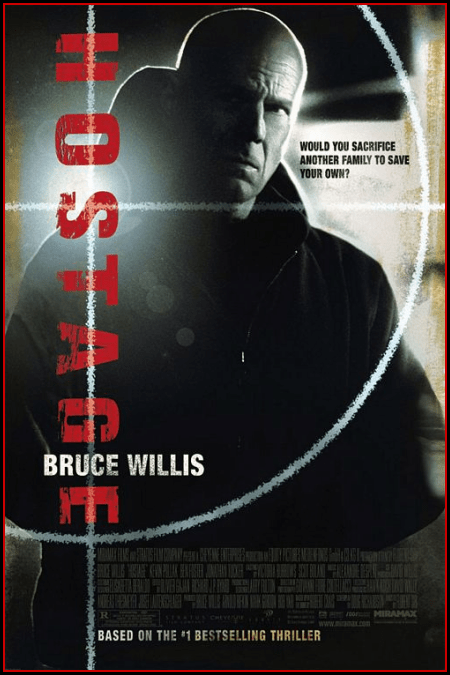
Review: Hostage (dir. by Florent Siri)


The five years or so has seen the rise of several new directors from France who’ve made quite a splash with their Hollywood debuts. There’s Alejandro Aja with Haute Tension (or Switchblade Romance/High Tension) who brought back the late 70’s early 80’s sensibilities of what constitutes a good slasher, exploitation film. Then there’s Jean-Francois Richet whose 2005 remake of John Carpenter’s early classic, Assault on Precinct 13 surprised quite a bit in the industry. Neither film made too much in terms of box-office, but they did show that a new wave of genre directors may not be coming out of the US but from France of all places. Another name to add to this list is Florent Siri and his first major Hollywood project Hostage shows that he has the style and skills to make it in Hollywood.

Hostage
is another Bruce Willis vehicle that was adapted by Doug Richardson (wrote the screenplay for Die Hard 2) from Robert Crais’ novel. Hostage is a very good thriller with a unique twist to the hostage-theme. Willis’ character is a burn-out ex-L.A. SWAT prime hostage negotiator whose last major case quickly ended up in the death of suspect and hostages. We next see him as chief of police of a small, Northern California community where low-crime is the norm. We soon find out that his peace of mind and guilt from his last case may have eased since taking this new job, but his family life has suffered as a consequence. All of the peace and tranquility is quickly shattered as a trio of local teen hoodlums break into the opulent home of one Walter Smith (played by Kevin Pollak). What is originally an attempt to steal one of the Smith’s expensive rides turn into a hostage situation as mistakes after mistakes are made by the teens.

From this moment on Hostage would’ve turned into a by-the-numbers hostage thriller, but Richardson’s screenplay ratchets things up by forcing Willis’ character back into the negotiator’s role as shadowy character who remain hooded and faceless throughout the film kidnap his wife and daughter. It would seem that these individuals want something from the Smith’s home and would kill Willis’ character’s family to achieve their goals. The situation does get a bit convoluted at times and the final reel of the film ends just too nicely after what everyone goes through the first two-third’s of the film.

The character development in the film were done well enough to give each individual a specific motivation and enough backstory to explain why they ended up in the situation they’ve gotten themselves into. Willis’ performance in Hostage was actually one of better ones in the last couple years. The weariness he gives off during the film was more due to his character’s state of mind rather than Willis phoning in his performance. I would dare say that his role as Chief of Police Jeff Talley was his best in the last five years or so. The other performance that stands out has to be Ben Foster as the teen sociopath Mars. Foster’s performance straddles the line between being comedic and over-the-top and could’ve landed on either side. What we get instead is one creepy individual who almost becomes the boogeyman of the film. In fact, the last twenty minutes of Hostage makes Mars into a slasher-film type character who can’t seem to die.

The real star of the film has to be Florent Siri’s direction and sense of style. From the very first frame all the way to the last, Siri gives Hostage the classic 70’s and 80’s Italian giallo look and feel. Siri’s use of bright primary colors in conjuction with the earthy, desaturated look of the film reminds me of some of the best work of Argento, Bava and Fulci. In particular, Siri’s film owes alot of its look to films such as Tenebrae, The Bird with the Crystal Plumage, and The Psychic. Certain scenes, especially the penultimate climax in the Smith home, take on an almost dreamlike quality. Siri’s homage to the classic gialli even gives Hostage some sequences that would comfortably fit in a 70’s slasher film.

Florent Siri’s Hostage is not a perfect film and at times its increasing tension without any form of release can be unbearable to some people, but it succeeds well enough as a thriller. It also shows that Siri knows his craft well and instead of mimicking and cloning scenes from the gialli he’s fond of, he emulates and adds his own brushstrokes. The film is not for everyone and some people may find the story convoluted if not dull at times, but for me the film works well overall. Siri is one director that people should keep an eye on.

My Top Ten Books About The Movies


I love movies and I love books so I guess it would stand to reason that I love books about movies the most of all.  (I also love movies about books but there are far fewer of those, unfortunately.)  Below are my personal favorites.  I’m not necessarily saying that these are the ten greatest film books ever written.  I’m just saying that they’re the ones that I’m always happy to know are waiting for me at home.

10) Soon To Be A Major Motion Picture by Theodore Gershuny — This is one of the great finds of mine my life.  I found this in a used bookstore and I bought it mostly because it only cost a dollar. Only later did I discover that I had found one of the greatest nonfiction books about the shooting of a movie ever written!  Gershuny was present during the filming of a movie called Rosebud in the early 70s.   I’ve never seen Rosebud but, as Gershuny admits, it was a critical disaster that managed to lose a ton of money.  The book provides a fascinating wealth of backstage gossip as well as memorable portraits of director Otto Preminger and actors Robert Mitchum (who was originally cast in the lead role), Peter O’Toole (who took over after Mitchum walked off the set), and Isabelle Huppert.   If nothing else, this book should be read for the scene where O’Toole beats up critic Kenneth Tynan.

9) Suspects by David Thomson — A study of American cinema noir   disguised as a novel, Suspects imagines what would happen if George Bailey from It’s a Wonderful Life fell in love with Laura from the movie of the same name.  Well, apparently it would lead to Sunset Boulevard’s Norma Desmond having an affair with Chinatown’s Noah Cross and to one of George’s sons, sensitive little Travis, getting a job in New York City as a Taxi Driver.  And that’s just a small sampling of what happens in this glorious mindfuck of a novel.

8 ) Profondo Argento by Alan Jones — Long-time fan Alan Jones examines each of Dario Argento’s films (even Argento’s obscure historical comedy The Five Days of Milan) and proceeds to celebrate and (in many cases) defend Argento’s career.  Jones also interviews and profiles several of Argento’s most frequent collaborators — Daria Nicolodi, Asia and Fiore Argento, Simon Boswell, Claudio Simonetti, Keith Emerson, George Romero, Lamberto Bava, Michele Soavi, and many others.  Jones’ sympathetic yet humorous profile of Luigi Cozzi is priceless.

7)  Spaghetti Nightmares by Luca Palmerini — Spaghetti Nightmares is a collection of interviews conducted with such Italian filmmakers as Dario Argento, Ruggero Deodato, Umberto Lenzi, Lucio Fulci, and others.  Among the non-Italians interviewed are Tom Savini (who, as always, comes across as appealingly  unhinged) and David Warbeck.  (Sadly, both Warbeck and Fulci would die shortly after being interviewed.)  What makes this interesting is that, for once, Argento, Fulci, et al. are actually being interviewed by a fellow countryman as opposed to an American accompanied by a translator.  As such, the subsequent interviews turn out to be some of the most revealing on record.

6) Sleazoid Express by Bill Landis and Michelle Clifford — Landis and Clifford’s book is both a history and a defense of the old grindhouse theaters of New York City.  Along with describing, in loving and memorable detail, some of New York’s most infamous grindhouses, they also write about some of the more popular movies to play at each theater.  Along the way, they also offer up revealing profiles of such legendary figures as David Hess and Mike and Roberta Findley.  Reading this book truly made me mourn the fact that if I ever did find myself in New York City, I won’t be able to hit the old grindhouse circuit.

5) Beyond Terror: The Films of Lucio Fulci by Stephen Thrower — Fulci has always been a terribly underrated director and, indeed, it’s easy to understand because, in many ways, he made movies with the specific aim of alienating and outraging his audience.  It requires a brave soul to take Fulci on his own terms and fortunately, Stephen Thrower appears to be one.  Along with the expected chapters on Fulci’s Beyond Trilogy and on Zombi 2, Thrower also devotes a lot of space to Fulci’s lesser known works.  Did you know, for instance, that before he became the godfather of gore, Fulci specialized in making comedies?  Or that he also directed two very popular adaptations of White Fang?  Thrower also examines Fulci’s often forgotten westerns as well as his postapocalyptic sci-fi films.  And, best of all, Thrower offers up a defense of the infamous New York Ripper that, when I read it, actually forced me to consider that oft-maligned film in a new light.  That said, Thrower does admit to being as confused by Manhattan Baby as everyone else.

4) Immoral Tales by Cathal Tohill and Pete Toombs — Tohill and Toombs offer an overview of European “shock” cinema and some of the genre’s better known masters.  The book contains perhaps the best critical examination of the work of Jean Rollin ever written.  The authors also examine the work of Jesus Franco and several others.  This is a great book that reminds us that the Italians aren’t the only ones who can make a great exploitation film.

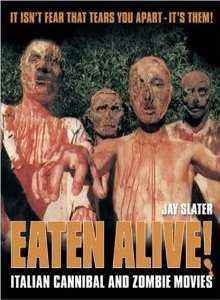
3) Eaten Alive by Jay Slater — This book offers an overview of the Italian film industry’s legendary cannibal and zombie boom.  Along with reviewing every Italian movie to feature even the slightest hint of cannibalism or the living dead (this is one of the few books on Italian cinema that discusses both Pasolini and Lucio Fulci as equals), Eaten Alive also features some very revealing interviews with such iconic figures as Catriona MacColl, Ian McCullough, and especially Giovanni Lombardo Radice.  Radice, in fact, also contributes a memorable “guest” review of one of the movies featured in the book.  (“What a piece of shit!” the review begins.)  Memorable reviews are also contributed by Troma film founder Lloyd Kaufman who brilliantly (and correctly) argues that Cannibal Holocaust is one of the greatest films ever made and Ramsey Campbell who hilariously destroys Umberto Lenzi’s infamous Nightmare City.

2) The Book of the Dead by Jamie Russell — If, like all good people, you love zombies then you simply must do whatever it takes to own a copy of this book.  Starting with such early masterpieces as White Zombie and I Walked With A Zombie, Russell proceeds to cover every subsequent zombie film up through George Romero’s Land of the Dead.  Russell offers up some of the best commentaries ever written on Romero’s Dead films, Fuci’s Beyond Trilogy, Rollin’s Living Dead Girl, and Spain’s Blind Dead films.   The pièce de résistance, however, is an appendix where Russell describes and reviews literally ever zombie film ever made.

1)  All The Colors Of the Dark by Tim Lucas  — This is it.  This is the Holy Grail of All Film Books.  If you’ve ever asked yourself if any book is worth paying close to 300 dollars, now you have your answer.  This one is.  Tim Lucas offers up the most complete biography of director Mario Bava ever written.  In fact, this may be the most complete biography of any director ever written!  Lucas examines not only Bava’s life but also every single movie that Bava was ever in any way connected to, whether as a director or as a cameraman or as the guy in charge of the special effects.  This is 1,128 pages all devoted to nothing but the movies.  This is the type of book that makes me thankful to be alive and I owe a huge debt of gratitude to Tim Lucas for writing it.