Back to School #54: Rushmore (dir by Wes Anderson)


rushmore-play

It’s an understatement to say that Wes Anderson’s films tend to divide viewers.  It seems like critics either love his excessively stylized and quirky vision or else they dismiss him as being a pretentious, overrated, and overly concerned with the problems of the rich and the suburban.  Even among the writers here at the Shattered Lens, there are conflicting opinions.  Leon the Duke gave Moonrise Kingdom a rave review.  On the other hand, I know that Ryan The Trashfilm Guru is not particularly a fan of Anderson’s films.

Myself, I always find it usually takes me a while to warm up to an Anderson film.  With the exception of The Fantastic Mr. Fox, I always seem to find myself somehow both impressed and slightly disappointed after seeing an Anderson film for the first time.  Perhaps it’s because Anderson is such a highly praised director with such a recognizable style that I always tend to go into his film with my expectations set way too high.  And so, I often times end up watching the latest Anderson film and thinking about how much I loved the film’s production design and some of the performances but often times feeling that, narratively, there was something missing.  On first viewing, Anderson’s trademark quirkiness can be overwhelming.  Usually it’s not until a second or third viewing that I really start to appreciate an Anderson film for something more than just the way it looks.  Eventually, I came to love Moonrise Kingdom and The Grand Budapest Hotel but it took me a while.

However, there is an exception to every rule.  And, as far as my reaction to Wes Anderson’s films are concerned, 1998’s Rushmore is that exception.  Rushmore is a film that I have unquestionably loved since the very first time I saw it.  Maybe it’s because, while Rushmore is undeniably quirky, that quirkiness doesn’t overwhelm the human aspect of the film’s story.  Maybe it’s because Rushmore — along with Bottle Rocket — is the most identifiably Texan of all of Anderson’s films.  Or maybe it’s just because Bill Murray gives such a great performance.

Seriously, Bill Murray makes any movie better.
02-rushmore-max-and-mr-blume

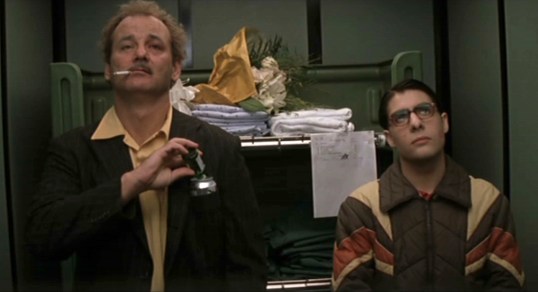
Rushmore is named after Rushmore Academy, a private school in Houston.  (Rushmore is quite obviously based on St. Mark’s, which is perhaps the most exclusive private school down here in Dallas.  Owen Wilson, who collaborated on Rushmore‘s script with Anderson, was expelled from St. Mark’s in the 10th Grade.)  15 year-old Max Fischer (Jason Schwartzman, who gives a sympathetic performance as a potentially off-putting character) loves attending Rushmore.  He’s involved in a countless number of extracurricular activities and has written and directed several plays, the majority of which are based on films from the 70s.  (We see his stage version of Serpico and it’s hilarious.)

tumblr_mcasy9Qj4S1r5l2jyo1_400

Unfortunately, Max has a few problems.  For one thing, unlike most of his peers, he’s not rich.  He tells everyone that his father (Seymour Cassel) is a neurosurgeon but actually, he’s a barber.  Even more seriously, Max spends so much of his time starting clubs and writing plays that he doesn’t ever bother to study.  Max is on the verge of flunking out and, despite numerous warnings from Dr. Guggenheim (Brian Cox), he refuses to do anything to improve his grades.

Instead, Max is more interested in pursuing a crush he has on an older teacher, the widowed Rosemary Cross (Olivia Williams).  What Max doesn’t realize is that his mentor, industrialist Herman Blume (Bill Murray), also has a crush on Ms. Cross.

rushmore02

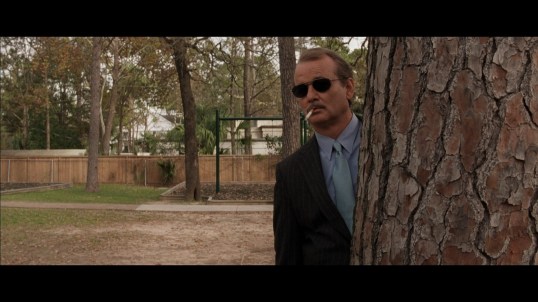
While Max may be the film’s main character, Herman Blume is, without a doubt, the film’s heart.  Blume is a Viet Nam vet (“You were in the shit?” Max asks.  “Yes, I was in the shit,” Blume replies) who has literally gone from rags to riches.  And now that he is rich, he finds himself living an empty life with a wife who doesn’t respect him and two sons who are total idiots.  When Blume starts to mentor Max and pursue Ms. Cross, he starts to care about living once again.
rm61

Meanwhile, Max attempts to impress Ms. Cross by building an aquarium on the school’s baseball field.  This leads to Max getting expelled and having to enroll in a public school.  (Max continues to wear a suit and tie, even after being expelled.)  However, Max then discovers that Blume has been seeing Ms. Cross and soon, the mentor and the student become rivals…

And a lot of other stuff happens but you know what?  I’m not going to tell you what because if you haven’t seen Rushmore, you need to see it and discover all of this for yourself.  You won’t be sorry!

It may be named after the school but Rushmore is ultimately about how love and our dreams make life worth living.  For Max, Rushmore is his fantasy ideal, a world that he loves because it provides him a sanctuary from the harshness of the real world.  When Mr. Blume says, about Ms. Cross, “She’s my Rushmore,” we understand exactly what he means.  But, and this is what distinguishes Rushmore from so many other films about quirky love triangles, is that Ms. Cross is just as independent and important a character as Max and Mr. Blume.  Blessed with excellent performances from Seymour Cassel, Brian Cox, Jason Schwartzman, Olivia Williams, and especially Bill Murray, Rushmore is one of Wes Anderson’s best films.

rushmore-1999-movie-poster1

Horror On TV: Hammer House of Horror Episode 7 “The Silent Scream”


Today’s episode of televised horror is The Silent Scream, the seventh episode of Hammer House of Horror.  It was originally broadcast in the UK on October 25th, 1980.

This episode features an odd pet shop, a youngish Brian Cox playing an ex-con, and — best of all — the iconic Hammer horror star Peter Cushing!

Seriously, how can you do a horror month without featuring at least one appearance from Peter Cushing?

Review: Rise of the Planet of the Apes (dir. by Rupert Wyatt)


In 2001, Tim Burton released his highly-anticipated remake of the classic 1968 film adaptation of Pierre Boulle’s sci-fi novel which would ultimately be called, Planet of the Apes. Fans of the series were excited to see what idiosyncrasies Burton would add to the series which had petered out decades before. What people were hoping for and what they ended up getting were polar opposites. The film in of itself wasn’t an awful film, but it wasn’t a good one and many saw it as average at best and bad at it’s worst. Any plans to sequelize this remake fell by the wayside. It took almost a decade until a decision was made to continue the series in a different direction.

British filmmaker and writer Rupert Wyatt would be given the task to rejuvenate for a second time the Planet of the Apes franchise. He would be working with a screenplay written by Rick Jaffa and Amanda Silver which would take the 4th film in the series, Conquest of the Planet of the Apes, and rework it for a much more current setting. The film was to be called Rise of the Apes and would star James Franco, John Lithgow and Frieda Pinto. As time went by the film would be renamed Rise of the Planet of the Apes. Despite having such an awkward sounding titles the film would end up to be one of the best films of the summer of 2011, if not one of the best of the year.

The film begins with a harrowing sequence in the jungles of Central Africa as poachers capture several chimpanzees to be sold as medical test subjects. Some of these chimps end up at a genetics research lab outside of San Francisco where one Will Rodman (James Franco) is working to find a cure to Alzheimer. He sees the encouraging result in one chimp he has named “Bright Eyes” (due to the side-effect to the test subject’s eyes taking on green flecks to their irises) and pushes for the next step and that’s human testing. The ensuing pitch to the company’s board of directors doesn’t go as planned as Bright Eyes goes on a violent rampage leading to her being put down and the project shelved. Her reaction they soon find out has less to do with the breakthrough treatment and more of a maternal instinct to protect her baby she secretly gave birth to. Will takes the baby chimp home in secret temporarily, but soon becomes attached to it as does his Alzheimer stricken father (John Lithgow) who names it Caesar.

The first third of the film sees Caesar showing an inherited hyper-intelligence from his genetically-treated mother. Caesar becomes an integral part of the Rodman household even to the point that Will has taught Caesar to call him father. It’s a family dynamic which would help mold Caesar into something more than just a wild animal. He begins to show signs of humanity which would become bedrock of his decision later in the film to turn become the revolutionary that the film has been leading up to the moment Caesar gets sent to a primate sanctuary after a violent encounter with a boorish neighbor to end the first reel of the film.

It’s during the second reel which sees Caesar realize that while he may as smart (maybe even smarter) than the humans he would never be a part of that world. In the sanctuary he learns that his very uniqueness has set him apart from the other primates. He sees the abuse inflicted on his fellow primates and longing to be back to his “home” with Will turns to a focus need to free himself and his people. He does this in the only fashion he knows would succeed. With the help from a couple canisters containing the aerosol-based treatment which increased his mother’s intelligence, Caesar frees everyone from the sanctuary and takes the fight to the humans as they make for the wilds of the Muir Redwood Forest north of San Francisco.

Rise of the Planet of the Apes might look to be an action-packed film from how the trailers and tv spots has been pushing the film, but it actually only has three major action sequences and they’re integral to each third of the film in helping advance the story. These were not action for the sake of having action on the screen. Writers Jaffa and Silver do a great job in figuring out that the real strength of the film would be Caesar’s journey from precocious ape child, rebellious teen and then his final unveiling as the leader of a people who have shaken off the shackles of medical research and their forced sacrifice for the greater good.

The film was never about the humans played by Franco, Pinto and Lithgow. It was always about Caesar and the film hinged on the audience believing Caesar as a character. In that regard, the work by WETA Digital should be commended as should Andy Serkis’ performance as Caesar. Serkis’ motion capture performance goes beyond just mimicking the movement of an ape. His own acting as Caesar comes through in even in the digital form of Caesar. In fact, the film never had a real ape used during filming. From Caesar right up to the scarred ape Koba every ape in the film was the work of WETA Digital’s furthering the motion capture work they had done in Peter Jackson’s Lord of the Rings trilogy and James Cameron’s Avatar. Never once during the two hour running time of the film did I ever not believe I was watching apes on the screen. Every emotion Caesar goes through during the film was able to show through facial expressions and body language.

It’s the strength of Serkis’ mo-cap work and the overall execution of Caesar’s character by WETA which also highlighted the one major weakness of the film through it’s underdeveloped human characters. Whether it was Franco’s benevolent Dr. Frankenstein-like Will Rodman right up to his greedy, amoral boss in the company (played by David Oyelowo), all the human’s in the film were very one-note and mostly served to propel Caesar’s story forward. At times, Franco actually seemed to be just as he was during his hosting gig during the Academy Awards earlier in the year. These were not bad performances by the actors involved. They were just there and part of it was due to how underwritten their characters were.

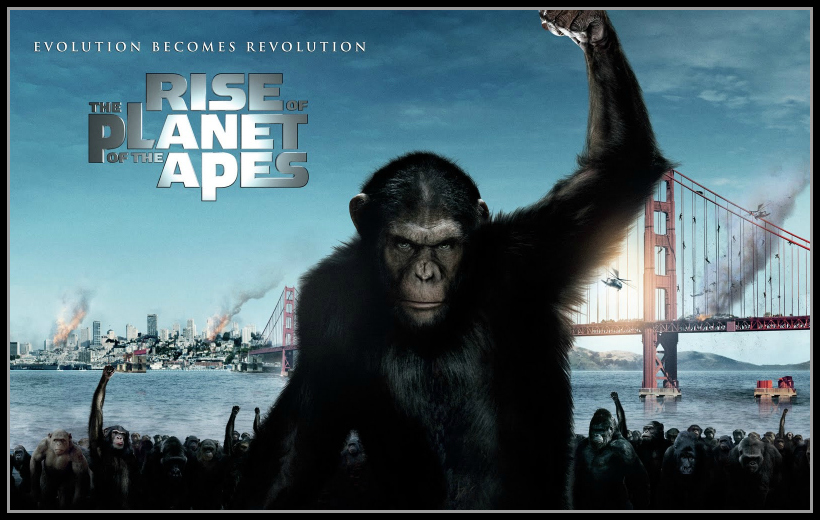
To help balance out this flaw in the film’s non-ape character would be the beautiful work by the film’s cinematographer in Andrew Lesnie. He has always been well-known for beautiful, majestic panoramic shot of the world as he had demonstrated in Jackson’s Lord of the Rings trilogy. He does the same for this film as we see some beautiful shots of the Muir Redwood forest, of San Francisco’s skyline and in the climactic battle on the Golden Gate Bridge. The city of San Francisco and it’s iconic red-hued bridge and the surrounding area has never been shot as gorgeous as Lesnie has done with his DP work on this film.

Even with some of the characters in the film being underwritten the film succeeds through Rupert Wyatt’s direction which keeps the film moving efficiently, but also bringing out the emotional content of the film’s script in an organic way. Film has always been about manipulating the audience’s  emotions. It’s when a director does so and make it seem normal is when such manipulation doesn’t come through for those watching to feel. Then add to this Serkis’ exceptional work as Caesar with some major digital artistry from the folks over at WETA Digital and Rise of the Planet of the Apes does rise above it’s B-movie foundation into something that should live beyond the summer and for years to come.

Rise of the Planet of the Apes does a great job and a long way towards wiping off the bad taste left behind by Tim Burton’s failed attempt to remake the franchise. We didn’t need something exotic and idiosyncratic to give the franchise a fresh breath of life. It seems all it needed was a very good story, some exceptional work from Andy Serkis and WETA Digital and a filmmaker knowing how to tell the story in a natural fashion and not fall into the temptation to go into shock and awe to tell it. Rise of the Planet of the Apes is a film that could stand-alone, but it does something that many trying to create film franchises never seem to do right: it makes people want to see what happens next in the lives of Caesar and his apes.

Rise of the Planet of the Apes: Trailer


The franchise which seemed to have been left for dead by Tim Burton’s attempt to reboot it in 2001 looks to try and make another go at it again ten years later. Tim Burton will not be anywhere near this reboot and instead will be in the hands of British newcomer Rupert Wyatt.

Rise of the Planet of the Apes (originally called Rise of the Apes which I actually prefer) looks to reboot the franchise by taking the origjnal Conquest of the Planet of the Apes ffrom 1972 and using that as the foundation for this reboot’s plot. It will star his Highness himself, James Franco, with Peter Jackson-regular Andy Serkis playing the role of ape leader, Caesar.

This film seems to have the full backing of Jackson’s WETA Digital to create all the apes in the film digitally. There won’t be any prosthetics and make-up work with this film unlike the previous ones. While some may think this is a bad idea I actually think WETA Digital’s work in creating total CG-characters in the past pretty much heads above other FX-shops (and I include Industrial Light & Magic). From the trailer the apes look quite realistic and even Caesar himself look very real.

Time and the film’s release will tell if this reboot will have a better reception than Tim Burton’s film. I, myself, am looking forward to it since of all the Apes film of the past it was always Conquest that remained my favorite of all of them.

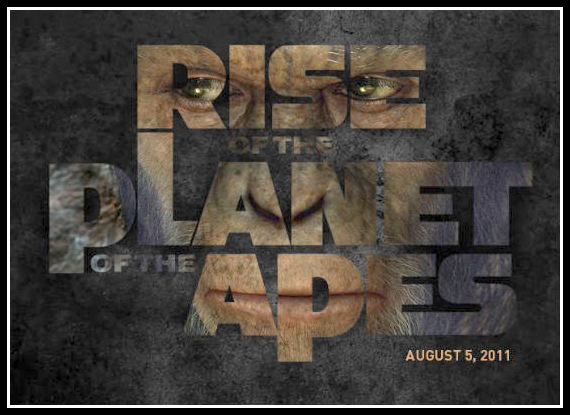
Rise of the Planet of the Apes is set for an August 5, 2011 release.