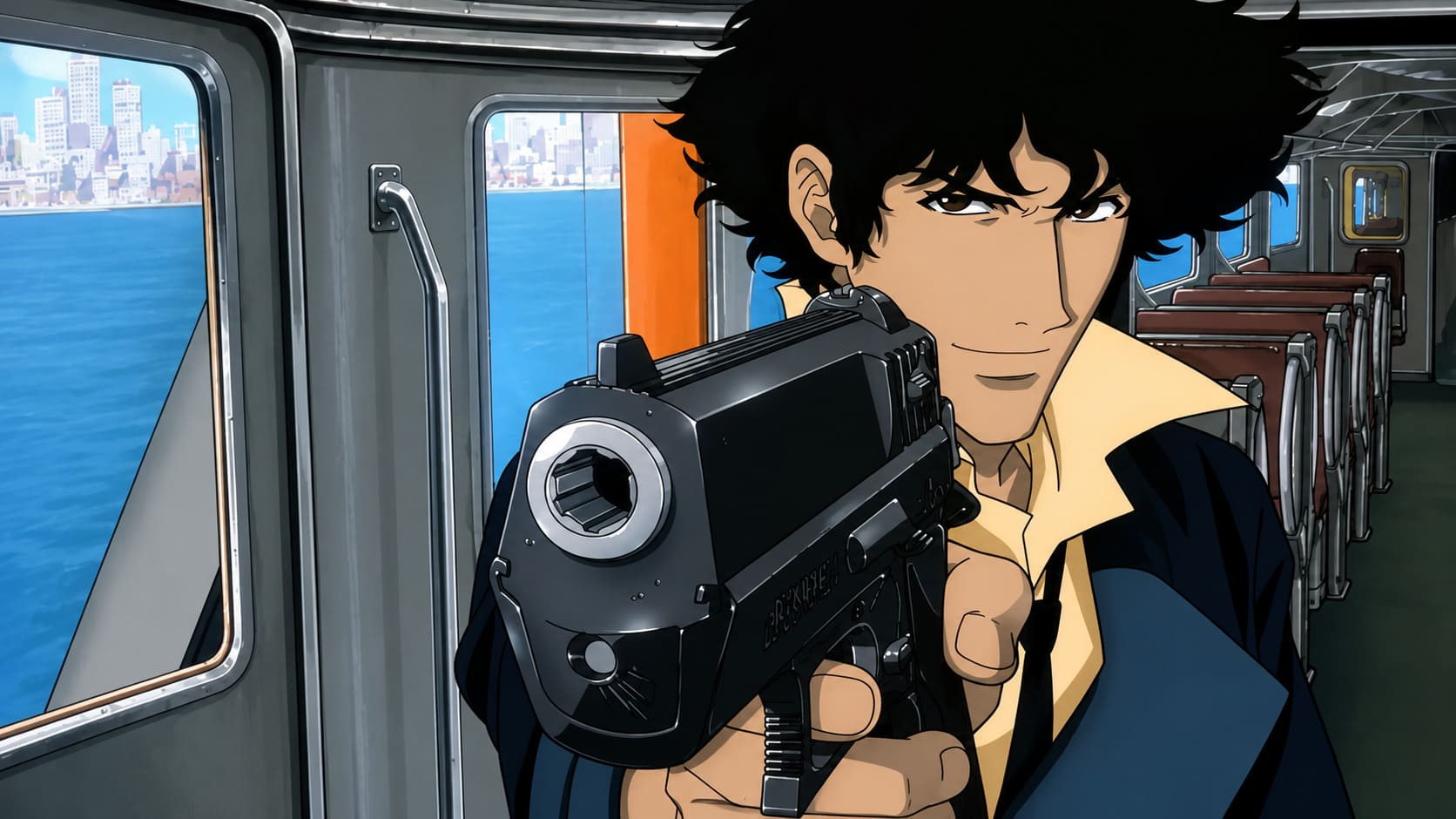
“I’m not going there to die. I’m going to find out if I’m really alive.” — Spike Spiegel
Few characters in anime history have cemented their legacy as indelibly as Spike Spiegel, the slacker protagonist of the neo-noir masterpiece Cowboy Bebop. At first glance, Spike seems to embody an archetype familiar to action media: the effortlessly cool, lone-wolf bounty hunter. Yet, what elevates him from a mere trope to an enduring icon is the profound juxtaposition at the core of his existence. Spike’s charisma does not stem from a traditional hero’s righteous drive, but rather from a deeply compelling contradiction—he is a man desperately trying to live in the present while being inextricably anchored to a violent past. This duality makes him not just a stylish action hero, but a fascinating study in trauma, detachment, and the performance of coolness.
Much of Spike’s immediate magnetism is undeniably visual and kinetic. Designed with a lanky frame, a perpetually rumpled suit, and a mop of unruly green hair, he subverts the traditional muscular anime hero. His physicality, heavily inspired by Bruce Lee’s Jeet Kune Do, further enhances his appeal. In combat, Spike does not fight with rage or precise, robotic calculation; he fights like he is dancing, waving off punches with a sardonic grin and fluid, almost lazy movements. He takes beatings as readily as he dishes them out, projecting an aura of invincibility that feels earned through sheer style rather than superhuman ability. This effortless physical grace makes him incredibly fun to watch, establishing a baseline of “cool” that the rest of his character actively deconstructs.
Beneath this facade of unflappable nonchalance, however, lies a complex psychological defense mechanism. Spike’s iconic philosophy—”whatever happens, happens” (katso okyaku-sama)—is often misinterpreted as pure nihilism, but it is actually the coping strategy of a broken man. By acting as though nothing matters, Spike shields himself from the agonizing grief of his past with the Red Dragon Syndicate and the woman he lost, Julia. His apparent laziness regarding bounty hunting, his refusal to take life seriously, and his perpetual, half-lidded expression are all mechanisms to avoid forming new attachments that could cause him pain again. This makes him a deeply relatable hero; his apathy is not a superpower, but a scar.
What truly makes Spike an interesting hero, however, is the nature of his ultimate conflict. Standard heroes fight to save the world or protect the innocent, but Spike’s narrative arc is intensely intimate and selfish. His antagonist, Vicious, is not a world-ending threat, but a dark mirror reflecting the life Spike tried to leave behind. When the past finally catches up to him, Spike is forced to drop his slacker persona and confront the ghosts he has been running from since the series began. His heroism is defined not by a desire to do good, but by a fatalistic need to set things right, even if the cost is his own life. He is a tragic hero wrapped in the guise of a comedic beatnik, fighting a war for his own soul rather than the fate of the universe.
Ultimately, Spike Spiegel endures as a charismatic and fascinating character because he is a masterclass in tragic irony. He spends the entire series convincing both his crew and the audience that he is a phantom, a man who died once and is simply living on borrowed time. Yet, in his final moments, his actions prove that he was more alive—and more capable of love, loyalty, and sacrifice—than he ever let on. Spike’s blend of kinetic coolness, guarded vulnerability, and fatalistic resolve creates a character that is as heartbreaking as he is effortlessly cool. It is this precise mixture that ensures that long after the final credits roll, Spike Spiegel remains the quintessential space cowboy.
Hero of the Day
- Inspector “Tequila” Yuen Ho-yan (Hard Boiled)
- Josey Wales (the Outlaw Josey Wales)
- Vince Majestyk (Mr. Majestyk)
- Monkey D. Luffy (One Piece)
- Leo Kessler (Ten to Midnight)
- Senku Ishigami (Dr. Stone)
- Marcus Fenix (Gears of War)
- Samwise Gamgee (Lord of the Rings)
- Haven Hamilton (Nashville)
- Bernardo O’Reilly (The Magnificent Seven)
- Maj. Motoko Kusanagi (Ghost in the Shell)

