Anime You Should Be Watching: Ninja Scroll (Jūbē Ninpūchō)


“If you so want the company of devils, you’d better hurry back to hell, Gemma.” — Jubei

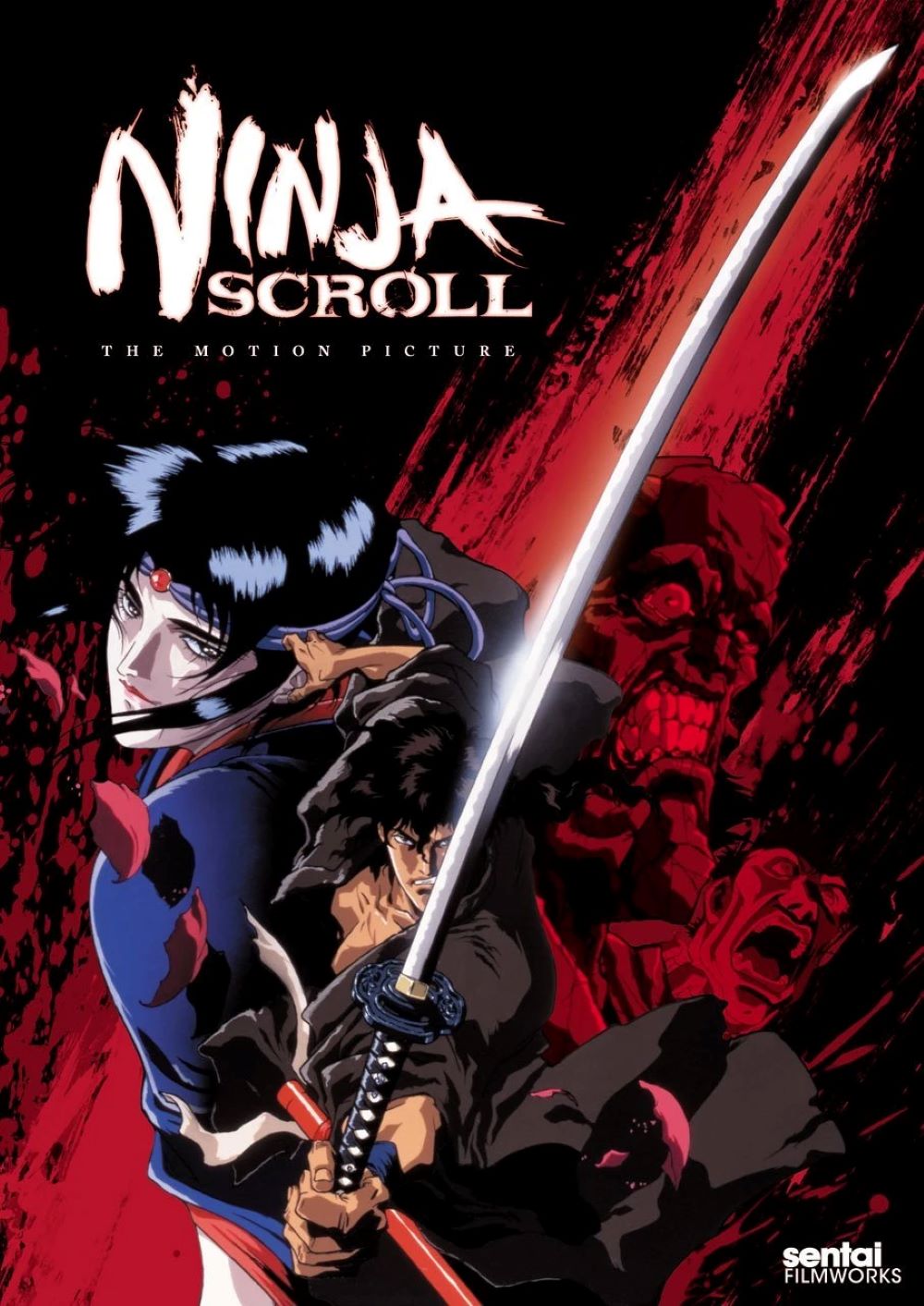
Ninja Scroll, the 1993 anime film directed by Yoshiaki Kawajiri, stands as a landmark in anime history for its groundbreaking animation, intense action, mature themes, and unique blending of historical fantasy with the supernatural. Its fluid, detailed hand-drawn animation vividly brings to life brutal sword fights and supernatural battles, while the richly textured 17th-century Japan setting immerses viewers in a dark, menacing world. This artistic achievement set a high benchmark, elevating anime’s global reputation as a cinematic art form beyond works like Akira.

The story follows Kibagami Jubei, a wandering mercenary ninja drawn into a plot involving the immortal villain Genma and the feared Eight Devils of Kimon. Though the plot remains straightforward—largely focused on Jubei’s confrontation with powerful enemies—it gains depth through morally ambiguous characters and mature themes of sacrifice, honor, and survival. A key emotional element is the relationship between Jubei and Kagero, a female poison ninja cursed to kill anyone who touches her, which sidesteps typical romance tropes and develops themes of vulnerability and resilience.

The voice acting, particularly in the English dub, is a significant highlight, delivering performances that imbue characters with seriousness and emotional nuance, broadening the film’s international appeal and cementing it as a gateway for adult animation in the West. While Ninja Scroll excels in action and atmosphere, it also courts controversy for its graphic violence and explicit sexual content. There is a notably disturbing sexual assault scene involving Kagero, which has long sparked discomfort and debate. However, it is important to clarify that while the film uses explicit sexual content to enhance its darker tone, it does not cross into hentai territory; the sexual content serves a narrative purpose rather than mere eroticism. This mature material intensifies the film’s psychological tension and power struggles, positioning it firmly within adult-oriented anime.

Sexual violence directed mostly at female characters has been a persistent source of controversy surrounding Ninja Scroll. While the sexual content is relatively tame compared to many contemporary non-hentai anime, its depiction of sexual assault and coercion has never lost its provocative edge. The character Kagero, despite being a formidable and dangerous figure, is victimized through sexual violence that many viewers and critics find disturbing. Scenes such as her being captured and violated by monstrous enemies contribute to an uneasy juxtaposition of empowerment and victimhood, with Kagero often used as a plot device to motivate male protagonists rather than as a fully autonomous character. This imbalance and the graphic nature of these depictions have led to censorship in some countries and sparked ongoing debates around the ethics of such content in adult media. Critics often argue that these portrayals risk glamorizing or exploiting sexual violence, while defenders contend that the shocking nature heightens the dark tone of the film’s world, reflecting its brutal and morally fraught universe. Nonetheless, these themes remain divisive, challenging viewers to grapple with how mature animation handles issues of gendered violence and trauma.

One of Ninja Scroll’s defining strengths lies in its animation style. The kinetic action sequences are not only meticulously choreographed but also executed with an extraordinary fluidity and dynamism that were revolutionary for the early 1990s. The hand-drawn fight scenes feature sweeping, graceful movements punctuated by sharply detailed strikes and counterattacks, bringing a visceral sense of speed and impact seldom achieved in other works of the period. This fluidity is complemented by innovative techniques like the use of deleter dot screens for shading and shadow effects, which add texture and depth without sacrificing motion smoothness.

The animation’s prowess extends beyond just the fight choreography. The film’s use of lighting and atmospheric effects creates a hauntingly dreamlike world that feels simultaneously realistic and mythical. Backgrounds are richly painted with a softness that evokes Impressionistic influences, enveloping characters in an environment that accentuates the eerie and supernatural tone. The balance between detailed character animation and these painterly settings builds a distinct visual identity that has aged gracefully over decades.

This combination of fluid, kinetic action and richly atmospheric artistry contributed significantly to Ninja Scroll being considered one of the modern classics of anime. It elevated expectations for what animated films could achieve in terms of dynamic movement and aesthetic sophistication. The influence of its animation style can be traced through numerous subsequent anime productions, as well as Western media inspired by anime’s visual storytelling techniques.

Ninja Scroll’s legacy is extensive and multifaceted. Its DNA can be seen clearly in later samurai-themed anime such as Samurai Champloo and Afro SamuraiSamurai Champloo echoes Ninja Scroll’s stylistic blending of Edo-period Japan with anachronistic influences—infusing hip-hop culture with samurai narratives—while maintaining intense, fluid sword fights and a mix of humor and gravitas. Afro Samurai shares its dark tone, violent action, and lone-protagonist vengeance quest, carrying forward the mood and narrative style originally forged by Ninja Scroll. Director Kawajiri’s subsequent works, including his segments in The Animatrix, further pursue this blend of hyper-realistic violence, dark fantasy, and mature storytelling. His visual style and thematic preoccupations continue to set standards for adult anime storytelling.

Beyond anime, Ninja Scroll substantially impacted Western filmmakers. Its dynamic animation and mature tone influenced the Wachowskis’ Matrix trilogy, particularly in its kinetic martial arts choreography and philosophical depth. This cross-cultural influence helped establish anime as a vital creative wellspring for global media, encouraging Hollywood to adopt similar stylistic and narrative innovations. The film’s success helped popularize ninja and samurai mythologies worldwide, inspiring Hollywood action films and series exploring similar themes.

In conclusion, Ninja Scroll is a seminal work blending technical brilliance, compelling voice performances, stark mature themes, and memorable characters. Its relatively simple yet focused plot allows intense action and emotional depth to shine. While its graphic sexual content remains controversial, especially due to its depiction of sexual violence toward women, this aspect underscores the dark world the film portrays rather than serving gratuitous ends. Its influence spans subsequent anime like Samurai Champloo and Afro Samurai and extends into Western filmmaking, confirming Ninja Scroll’s importance as a groundbreaking and enduring classic that shaped adult animation globally.

Horror Film Review: Godzilla vs. Megaguirus (dir by Masaaki Tezuka)


It has always bothered me whenever a long-running franchise decides that the best way to reboot things is to wipe away its own history.

Consider the James Bond films, in which the current producers apparently decided that Daniel Craig’s grim and whiny interpretation of the character was so definitive that it would be no big deal to wipe all of the previous Bond films out of existence.  Sorry, Sean Connery.  Sorry, Roger Moore, Timothy Dalton, Pierce Brosnan, and even George Lazenby.   Sorry, everyone who enjoyed the original Bond films and who enjoys spies who are relatively free of angst and self-pity.  Your films are now no longer canon, all because someone thought it would be a good idea for Bond and Blofeld to be brothers.

Consider the DC films, in which there are so many different versions of the same characters floating around that it’s next to impossible to keep straight what is an “official” film and what isn’t.  Admittedly, the majority of the DC films weren’t that good but still, there’s just something kind of annoying in the way that franchise in particular tends to just shrug and say, “Okay, that film doesn’t really count.”  Own your mistakes.

And then there’s my beloved Halloween franchise, ruined by David Gordon Green’s belief that he was better than the genre.  After years of brother/sister drama between Laurie Strode and Michael Myers, Green simply decided to do away with all of that and, in the process, he made the entire story (and Laurie Strode as a character) far less interesting.

Usually I think of this as being a relatively new phenomena but, as I watched 2000’s Godzilla vs. Megaguirus, I realized that reboots that do away with years of continuity are nothing new.  Godzilla vs. Megagurius opens with a narrator literally telling us to forget about all the films that came out after the original Gojira.  And we’re also told to forget about the ending of Gojira because that never happened either.  The Oxygen Destroyer was not used and Tokyo had to be abandoned.  Godzilla survived the end of Gojira and he continues to use Japan as his own personal power source, attacking not only a nuclear reactor but also a plasma reactor.  So, sorry, Mothra.  Sorry, Rodan.  Sorry, all of you fans of Ghidorah.  Sorry everyone who enjoyed the classic Godzilla films.  We’re now in a universe where none of that happened.

That’s not to say that Godzilla vs. Megagurius is a bad film, of course.  The majority of the people who watch these films (and films in general) could hardly care less about continuity.  They want to see a fight between giant monsters and they want to hear Godzilla’s roar and this film provides both of them.  After Japan attempts to destroy Godzilla with a satellite that shoots — I kid you not — miniature black holes, it finds itself being attacked by prehistoric dragonflys.  While Godzilla searches for a new power source, the dragonflys attempt to siphon off Godzilla’s energy for their own uses.  As so often happened with these movies, humanity’s attempt to destroy Godzilla actually leads to far more destruction than if they had just left Godzilla alone.  It turns out that creating miniature black holes and ripping open the time/space continuum is not the solution to all the world’s problems.  It’s the human beings who are ultimately the bigger threat than the giant monsters.

It’s an entertaining film.  The Megagurius is a good monster and a worthy opponent to Godzilla.  Godzilla does what he does best.  The film wiped out a decades worth of continuity but at least it kept the Godzilla roar.  In the end, you can’t silence a good giant monster.

Previous Godzilla Reviews:

  1. Godzilla, King of the Monsters (1958)
  2. Godzilla Raids Again (1958)
  3. King Kong vs Godzilla (1962)
  4. Mothra vs. Godzilla (1964)
  5. Ghidorah: The Three-Headed Monster (1964)
  6. Invasion of the Astro-Monster (1965)
  7. Godzilla vs. The Sea Monster (1966)
  8. Son of Godzilla (1967)
  9. Destroy All Monsters (1968)
  10. All Monsters Attack (1969)
  11. Godzilla vs Hedorah (1971)
  12. Godzilla vs Gigan (1972)
  13. Godzilla vs Megalon (1973)
  14. Godzilla vs Mechagodzilla (1974)
  15. The Terror of Mechagodzilla (1975)
  16. Cozilla (1977)
  17. Godzilla 1985 (1985)
  18. Godzilla vs. Biollante (1989)
  19. Godzilla vs King Ghidorah (1992)
  20. Godzilla vs. Mothra (1992)
  21. Godzilla vs Mechagodzilla 2 (1994)
  22. Godzilla vs SpaceGodzilla (1994)
  23. Godzilla vs. Destoroyah (1995)
  24. Godzilla (1998)
  25. Godzilla 2000 (1999)
  26. Godzilla, Mothra, and King Ghidorah: Giant Monsters All-Out Attack (2001)
  27. Godzilla (2014)
  28. Godzilla: Planet of the Monsters (2017)
  29. Godzilla, King of the Monsters (2019)
  30. Godzilla vs Kong (2021)
  31. Godzilla Minus One (2023)