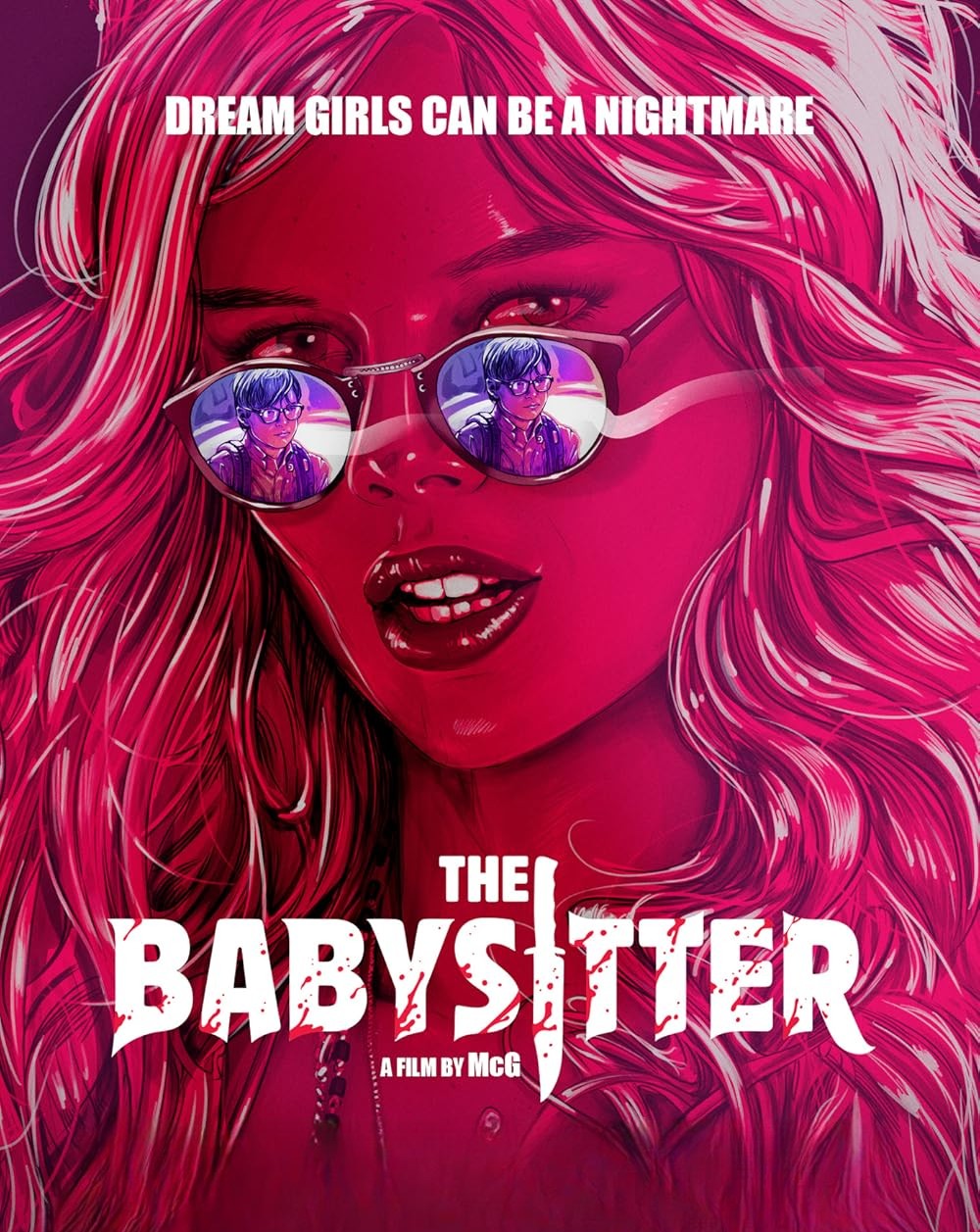
“Well, I like weird, all of the time.” — Bee
The Babysitter is, above all else, Samara Weaving’s coming-out party—a wildly entertaining showcase that proves she can carry a horror movie with charm, menace, and complete comedic fearlessness. McG’s 2017 Netflix film, written by Brian Duffield, is built around a simple, absurd premise: a lonely kid discovers his beautiful babysitter is part of a Satanic cult. The movie lives and dies on Weaving’s performance as Bee, and she delivers enough star power, humor, and danger to turn a thin genre premise into a fast, colorful, gleefully violent horror comedy.
The story follows Cole, played by Judah Lewis, a nervous twelve-year-old who is still young enough to need a babysitter but old enough to hate that fact. His parents leave for the weekend, leaving him in the care of Bee. Cole has a massive crush on her, which makes the movie’s central betrayal sting even more. After staying up past bedtime to spy on the adults, he sees Bee and her friends murder someone as part of an occult ritual. Suddenly, the cozy suburban house becomes a battlefield, and Cole has to survive a night of Satanic murder, increasingly absurd violence, and the horrifying realization that the person he trusted most is trying to kill him.
Without Weaving, this premise could easily collapse into forgettable direct-to-streaming filler. Bee could have been nothing more than a one-dimensional “hot evil babysitter,” but Weaving gives her real charisma. She is funny, flirtatious, warm, and completely unhinged, often within the same scene. The film understands that Bee works best when she is both genuinely likable and genuinely dangerous. Cole trusts her because she treats him kindly, and that makes the reveal hurt. Weaving also gets most of the movie’s best lines and biggest moments, and she plays them with the kind of gleeful theatricality the material demands. This is the performance that announced her as a major modern horror presence, and it is easy to see why filmmakers and audiences took notice.
What makes The Babysitter work beyond Weaving is its total commitment to the bit. The film is essentially Home Alone filtered through a Satanic slasher and a teenage sex comedy. Cole fights back with household objects, improvisation, and pure panic, while Bee and her friends keep getting killed in ways that are gruesome, creative, and often funny. The movie never takes its mythology seriously enough for the ritual stuff to become dull. The cult’s plan is mostly an excuse for carnage, but the carnage is lively enough that the thin plot barely matters. This is a movie where a kitchen can become a weapon, a pool can become a crime scene, and a teenage cultist can be defeated by the kind of slapstick logic usually reserved for cartoons.
The supporting cult members are broad, ridiculous characters, but they fit the movie’s tone. Robbie Amell plays Max, a jock who clearly believes he is the coolest person in any room. Bella Thorne’s Allison is glamorous, vain, and increasingly undone as the night falls apart. Hana Mae Lee’s Sonya is the quiet, strange one, while Andrew Bachelor’s John is the guy who thinks he is more essential to the group than anyone else believes. None of them are deeply developed, but they do not need to be. They are archetypes, and the actors lean into that. Their banter is often juvenile, sometimes forced, but it matches the movie’s hyperactive, self-aware energy.
McG’s direction is both part of the film’s appeal and one of its biggest problems. He directs it like an extended music video: saturated colors, quick cuts, pop songs, pop-culture references, and a camera that rarely wants to sit still. When the style clicks, The Babysitter feels punchy and alive, with the energy of a comic book come to life. But McG leans so heavily into the comedy side that the movie often loses its horror footing. The jokes, quips, and broad performances are constantly pushed to the front, and when the film tries to shift into an actual horror beat, the moment frequently lands flat. The cult members are too goofy, the kills too cartoonish, and the tone too jokey for the movie to build much dread. Some jokes land with a thud, some references feel dated already, and the constant visual busy-ness can overwhelm the simpler pleasures of the premise. The film succeeds despite McG’s excesses, not entirely because of them.
The horror is more splattery than scary. Anyone expecting real dread, slow-building tension, or a genuinely unsettling villain will likely be disappointed. The movie’s comedy comes from the collision of childhood anxieties with extreme genre nonsense. Cole is afraid of bullies, girls, being alone, and growing up; the film literalizes those fears by putting him in a house full of murderous adults who want to sacrifice him. Beneath the blood and jokes, there is a surprisingly sincere coming-of-age story. But because the comedy is so relentless, the horror rarely gets room to breathe, and the movie’s scarier moments feel more like brief interruptions than genuine escalations.
Cole’s arc gives the chaos a little heart. At the beginning, he is passive, scared, and constantly humiliated. By the end, he has been forced to confront every fear he has, usually while covered in gore and running for his life. Judah Lewis is not giving a nuanced performance, but he is likable and believable as a terrified kid pushed past his limits. His friendship with Melanie, played by Emily Alyn Lind, adds another layer of warmth. Melanie encourages him to stand up for himself, and their awkward middle-school dynamic gives the movie a sweet emotional center beneath all the occult murder.
The film’s biggest weakness is its willingness to sacrifice logic for a joke. Characters make choices that only make sense because the plot needs them to. The cult’s plan is not especially well thought out. Adults and neighbors are conveniently unaware of gunfire, explosions, and general mayhem. The movie also sometimes views its female characters through Cole’s adolescent gaze, especially early on, which can make Bee and Allison feel more like fantasy objects than full people. The film gives them more agency as it goes, but the perspective remains very much that of a horny, terrified twelve-year-old boy. Whether that works for you depends on how much patience you have for that kind of teenage-male fantasy.
Still, The Babysitter has personality to spare. It is bright, brash, mean in a playful way, and unapologetically silly. It does not have the atmosphere of a prestige horror film or the emotional weight of the genre’s best work. It is not trying to be The Babadook or Hereditary. Instead, it is trying to be a bloody, funny, high-energy midnight movie, and it mostly succeeds. It is the kind of film best watched late at night, with low expectations and a high tolerance for cartoonish violence.
By the time the credits roll, The Babysitter has done exactly what it set out to do: deliver a loud, bloody, ridiculous good time while making Samara Weaving impossible to ignore. McG’s direction can be excessive, the comedy often crowds out the horror, and the scares are mild, but the film has enough energy, humor, and personality to make up for its flaws. Weaving turns Bee into one of the most entertaining horror villains of the Netflix era and uses the role as a true coming-out party for her career. Cole’s survival story gives the mayhem a surprisingly sweet coming-of-age core, but Weaving is the true engine of the film. It may not be a horror classic, but it is a very enjoyable piece of genre junk food: loud, colorful, violent, ridiculous, and much more fun than it has any right to be.

