So, guess what I did earlier today? That’s right — I put on a blindfold, a stumbled over to my ever-growing DVD, Blu-ray. and even VHS collection and I randomly selected 12 films!
Why did I do this?
I did it so you, the beloved readers of Through the Shattered Lens, could once again have a chance to tell me what to do. At the end of this post, you’ll find a poll. Hopefully, between now and next Sunday (that’s August 21st), a few of you will take the time to vote for which of these 12 films I should watch and review. I will then watch the winner on Sunday and post my review on Monday night. In short, I’m putting the power to dominate in your hands. Just remember: with great power comes great … well, you know how it goes.
Here are the 12 films that I randomly selected this afternoon:
Abduction — From 1975, this soft-core grindhouse film is based on the real-life abduction of Patty Hearst and was made while Hearst was still missing. Supposedly, the FBI ended up investigating director Joseph Zito to make sure he wasn’t involved in the actual kidnapping.
Aguirre, The Wrath of God — From director Werner Herzog and star Klaus Kinski comes this story about a Spanish conquistador who fights a losing battle against the Amazon.
Black Caesar — In one of the most succesful of the 70s blaxploitation films, Fred Williamson takes over the Harlem drug trade and battles the mafia.
Don’t Look Now — Donald Sutherland and Julie Christie are a married couple who attempt to deal with the death of their daughter by going to Venice, Italy. Christie quickly falls in with two blind psychics while Sutherland pursues a ghostly figure in a red raincoat through Venice. Directed by Nicolas Roeg.
The Lion In Winter — From 1968, this best picture nominee stars Peter O’Toole and Katharine Hepburn as King Henry II and his wife, Eleanor of Aquitaine. Taking place on Christmas Eve, Henry and Eleanor debate which one of their useless sons will take over a king of England. This film is also the feature debut of both Anthony Hopkins and Timothy Dalton.
Logan’s Run— From 1976, this sci-fi film features Michael York and Jenny Agutter as two future hedonists seeking Sanctuary and instead finding Peter Ustinov and a bunch of cats. Filmed in my hometown of Dallas.
Lost Highway — From director David Lynch comes this 1997 film about … well, who knows for sure what it’s about? Bill Pullman may or may not have killed Patricia Arquette and he may or may not end up changing into Balthazar Getty.
Mystic River— From director Clint Eastwood comes this film about murder, guilt, redemption, and suspicion in working-class Boston. Starring Sean Penn, Kevin Bacon, and Tim Robbins.
Naked Massacre — From 1976, this stark film is something a grindhouse art film. It takes the true life story of Chicago mass murderer Richard Speck and transfers the action to Belfast. Also known as Born for Hell.
Night of the Creeps— From 1986, this film features alien slugs that turn an entire college campus into a breeding ground for frat boy zombies. Tom Atkins gets to deliver the classic line: “Well don’t go out there…”
Petulia — Considered by many to be one of the best American films ever made and one of the definitive films of the 60s, Petulia tells the story of a divorced doctor (George C. Scott) who enters into an odd relationship with Julie Christie. Directed by Richard Lester, this film also stars Joseph Cotten, Richard Chamberlain, and the Grateful Dead.
What Have You Done To Solange? — From 1975, What Have You Done To Solange is a classic giallo that features dream-like murders, disturbing subtext, and one of the best musical scores of all time.
So, there’s your 12 films. Vote once, vote often, have fun, and I await your decision.
How do I explain my fascination with Klaus Kinski, an actor who died long before I even saw my first movie? Certainly, it’s not due to his charming screen presence. Kinski never made any secret of the fact that he loathed most of his films and that loathing is usually painfully apparent on-screen. Nor can my fascination be linked to the quality of the films he made. With the exception of a few Italian spaghetti westerns and a set of films he made with Werner Herzog, the majority of Kinski’s films are of little interest beyond his performance in them. Kinski’s film career was largely made up of playing countless murderers, rapists, and psychopaths. By most (but certainly not all) accounts, he committed even worse behavior offscreen.
Yet somehow, Klaus Kinski has captured not only my imagination but the imagination of film buffs around the world. A very good friend of mine has confessed to me that she finds watching Kinski in a bad film to be an almost erotic experience and I have to admit that I do as well. Kinski had one of those faces that was so ugly that it was almost beautiful and, watching him onscreen, it’s hard not to feel as if the you are literally watching cinematic exorcism. It’s as if the fictional characters that Kinski creates are little more than his real-life demons being captured on-screen. A lot of actors specialize in playing insane but Kinski seemed to actually be insane. Even today, watching his performance in Augirre, The Wrath of God on DVD, it’s hard not to feel as if Kinski is going to jump out of the TV at any minute and proceed to destroy your living room while screaming insults in German. Even nearly 20 years after his death, Klaus Kinski remains mad, bad, and dangerous to know.
I have to admit, I’ve always had a weakness for the whole fantasy of the bad boy with the wounded poet’s soul and, even middle-aged and ugly, Klaus Kinski was the ultimate bad boy. Whether or not Kinski had the soul of a poet is another question and a difficult one to answer. However, if you’re going to solve to riddle of who Klaus Kinski really was, that’s the question that must be answered. And probably the best place to start your investigation is with Werner Herzog’s 1999 documentary/tribute, My Best Fiend.
Herzog directed Kinski in five films, beginning with the classic Aguirre, the Wrath of Godin 1972 and ending with the unfortunate Cobra Verdein 1987. The spirit of their collaboration can be seen in the fact that Herzog was rumored to have directed Kinski at gunpoint in Aguirre (though Herzog denies this) and that Kinski eventually physically assaulted Herzog during the filming of Cobra Verde. In both the contemporary press and his own controversial autobiography (entitled Kinski: All I Need Is Love) Kinski regularly declared Herzog to be “an idiot.” Herzog, for his part, regularly declared that he would never make another movie with Kinski just before signing him to another role. Despite all this however, Kinski’s best performances were given in his movies with Herzog and no other actor has ever proven to be as perfectly suited to translate Herzog’s worldview as Klaus Kinski (though Nicolas Cage came close in last year’s Bad Lieutenant). My Best Fiend is Herzog’s attempt to understand his late muse.
The film opens with a classic Kinski image. We see a young, long-haired Kinski, standing on stage. He’s in the middle of one of his infamous one-man shows and has decided that the audience is not paying proper attention to him. He responds to this by literally attacking the audience.
We soon learn that shortly after this footage was filmed, Kinski agreed to star in Aguirre, the Wrath of God. Over archival footage of Kinski scowling and screaming in the Amazon, Herzog talks about both working with Kinski as an actor and about filming Aguirre in general. (Even if you’re not interested in the twisted life of Klaus Kinski, My Best Fiend is fascinating as a behind-the-scenes look at filmmaking.) Herzog talks about how Kinski regularly threatened to leave the production and how he responded by threatening to murder Kinski if he did. Members of the film crew are interviewed. They create a portrait of a monstrous man who, at one point during filming, shot off a cameraman’s thumb for no discernible reason. And yet, as all of this is presented to us, Herzog also shows us clips of Kinski’s amazing performance in the movie. Much like Herzog, we are forced to wonder how such a loathsome human being could also be such a gifted (and, in his admittedly warped way, sensitive) artist.
Though most of the film is devoted to Aguirre, Herzog does offer up anecdotes about his other collaborations with Kinski. He tells how Kinski would regularly threaten to have him killed and he admits to often fantasizing about killing Klaus Kinski himself. He goes as far as to mention that, during several film shoots, members of the crew would frequently (and seriously) offer to kill Kinski for him. He also tells of the hurt of continually reading the latest Kinski interview in which Kinski would, without fail, refer to his director as being an untalented hack.
And yet, the portrait of Klaus Kinski that emerges here is not exactly negative. Even as Herzog tells us that he often wanted to murder Kinski, he finds the time to visit the apartment where an undiscovered, penniless Kinski once lived. He talks to people who knew Kinski when he was younger and they offer up stories of a young man who, while undeniably arrogant, was also refreshingly honest in his refusal to compromise his own unique vision of the world. Herzog interviews two of Kinski’s costars, Eva Mattes and Claudia Cardinale. Both Mattes and Cardinale describe Kinski as being gentle, calm, and supportive while dealing with them. Mattes is especially touching as the amount of affection she felt for this supposed madman is obvious in every word she says. Kinski, himself, is seen assuring Herzog that all the insults and extreme negativity in All I Need Is Love is simply a ruse to convince people to buy the book. In short, Kinski is simply giving the people what they want.
As much as I loved My Best Friend, there were still some things that I wish the movie had spent more time on. Beyond a few tantalizing hints, we learn little of Kinski’s life before he first met Herzog (though we do learn that Kinski had spent time in a mental hospital where he was diagnosed as being schizophrenic) and even less time is spent on the hundreds of films that Kinski made without Herzog. While this makes sense as the film is about Herzog’s relationship with Kinski, it also creates the impression that Kinski was an unknown before Herzog cast him. This simply is not true as Kinski was already had something of a cult following as the result of appearing in several Italian spaghetti westerns. As well, Herzog doesn’t go into near enough detail about the Cobra Verde shoot that eventually led to the end of his collaboration with Kinski. Perhaps its understandable that Herzog would prefer to concentrate on obvious triumphs like Aguirre and Nosferatu but it’s still hard not to feel that he’s allowing his own ego to get in the way of telling the full story of his relationship with Klaus Kinski.
However, any and all flaws are rendered moot by the film’s final scenes. We first see Kinski, during the shooting of Fitzcarraldo, angrily screaming and shouting at a crew member. This is Kinski at his worst (though Herzog insists this is actually a rather mild example of Kinski’s anger), a raving madman who seems to intent of inspiring his audience to rise up and destroy him.
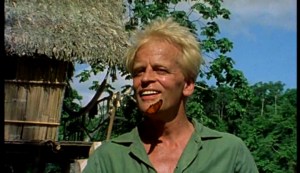
This is followed by a scene in that same Peruvian jungle where Kinski, smiling almost beatifically, gently plays with a butterfly.
After seeing that scene, it leaves me convinced (as it did Herzog) that there truly was the soul of poet lurking underneath the monstrous facade of Klaus Kinski.