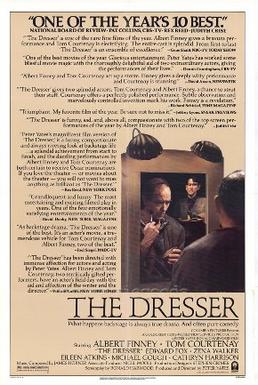
Lisa Reviews An Oscar Nominee: The Dresser (dir by Peter Yates)


(With the Oscars scheduled to be awarded on March 4th, I have decided to review at least one Oscar-nominated film a day.  These films could be nominees or they could be winners.  They could be from this year’s Oscars or they could be a previous year’s nominee!  We’ll see how things play out.  Today, I take a look at the 1983 best picture nominee, The Dresser!)
Taking place during World War II, The Dresser is a story of the theater.

Sir (played by Albert Finney) was once a great and famous Shakespearean actor but that was a long time ago.  Now, he is reduced to playing in regional theaters, traveling across Britain with a company made up of a motley collection of forgotten has-beens and never-weres.  He can still draw an audience, one made up of elderly theater goers who remember seeing him in London and people who are merely looking for a distraction from the war.  While bombs echo outside, Sir alternates between playing Othello and King Lear.  Backstage, Sir talks about the memoir he’s going to write and barks out orders to the members of his company.

Though Sir’s overly florid style of acting may seem old-fashioned, there’s no denying that his talent.  We don’t see much of his performance but, when we do see him, we never doubt his claim that he was once declared to the greatest King Lear to have ever appeared on the British stage.  Onstage, Sir is in complete control.  Offstage, he often struggles to remember where he is or what play he’s going to be performing.  At one point, when he’s meant to be getting ready to play Lear, he puts on his Othello makeup.

Fortunately, Sir has a dresser.  Norman (Tom Courtenay) doesn’t appear to have much of a life outside of taking care of Sir’s every whim.  Perpetually high-strung but blessed with a biting wit and an all-important bottle of Brandy that he takes a drink from whenever Sir gets too difficult to deal with, Norman is the one who holds the theatrical company together and who, most importantly, protects Sir.  When Sir can’t remember who he’s playing, Norman reminds him.  When Sir harasses a young actress, Norman is the one who hushes it up.  When Sir insults another actor (Edward Fox), Norman is the one who brokers a peace.  When it’s time for Sir to play King Lear, Norman is the one who helps Sir to transform into Shakespeare’s most tragic monarch.  Neither Sir nor the rest of the acting company seems to have much respect for Norman. The other actors consider Norman to be an ass-kisser and Sir … well, Sir doesn’t have much respect for anyone.  But for Norman, a gay man living at a time when homosexuality was illegal in Britain, Sir’s theatrical company provides him with the only safe place he’ll ever find.

The Dresser is an adaptation of a stage play.  (A few years ago, another version was produced for the BBC with Ian McKellen as Norman and Anthony Hopkins as Sir.)  It’s a good film, though I imagine that it’ll be best appreciated by people who have actually worked in theater.  Finney and Courtenay are both great and I also liked the performance of Edward Fox.  That said, it’s definitely a filmed play the feels more appropriate for PBS than for a movie screen.  As a result, it seems to be a bit of an odd pick for a Best Picture nomination.  I imagine that, much like Birdman, it benefitted from being a movie about actors and performing.

The Dresser lost Best Picture to Terms of Endearment.  It’s still worth seeing, if just for Courtenay’s final monologue.
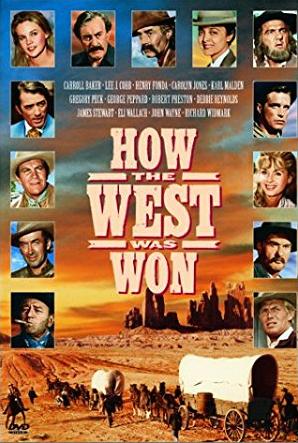
Lisa Reviews An Oscar Nominee: How The West Was Won (dir by Henry Hathaway, George Marshall, John Ford, and Richard Thorpe)


(With the Oscars scheduled to be awarded on March 4th, I have decided to review at least one Oscar-nominated film a day.  These films could be nominees or they could be winners.  They could be from this year’s Oscars or they could be a previous year’s nominee!  We’ll see how things play out.  Today, I take a look at the 1963 best picture nominee, How The West Was Won!)

How was the west won?

According to this film, the west was won by the brave men and women who set out in search of a better life.  Some of them were mountain men.  Some of them worked for the railroads.  Some of them rode in wagons.  Some of them gambled.  Some of them sang songs.  Some shot guns.  Some died in the Civil War.  The thing they all had in common was that they won the west and everyone had a familiar face.  How The West Was Won is the history of the west, told through the eyes of a collection of character actors and aging stars from Hollywood’s Golden Age.

In many ways, How The West Was Won was the Avatar of the early 60s.  It was a big, long, epic film that was designed to make viewers feel as if they were in the middle of the action.  Avatar used 3D while How The West Was Won used Cinerama.  Each scene was shot with three synchronized cameras and, when the film was projected onto a curved Cinerama screen, it was meant to create a truly immersive experience.  The film is full of tracking shots and, while watching it on TCM last night, I tried to imagine what it must have been like to see it in 1963 and to feel as if I was plunging straight into the world of the old west.  The film’s visuals were undoubtedly diminished by being viewed on a flat screen and yet, there were still a few breath-taking shots of the western landscape.

The other thing that How The West Was Won had in common with Avatar was a predictable storyline and some truly unfortunate dialogue.  I can understand why How The West Was Won was awarded two technical Oscars (for editing and sound) but, somehow, it also picked up the award for Best Writing, Screenplay or Story.  How The West Was Won is made up of five different parts, each one of which feels like a condensed version of a typical western B-movie.  There’s the mountain man helping the settlers get down the river story.  There’s the Civil War story.  There’s the railroad story and the outlaw story and, of course, the gold rush story.  None of it’s particularly original and the film is so poorly paced that some sections of the film feel rushed while others seem to go on forever.

Some of the film’s uneven consistency was undoubtedly due to the fact that it was directed by four different directors.  Henry Hathaway handled three sections while John Ford took care of the Civil War, George Marshall deal with the coming of the railroad, and an uncredited Richard Thorpe apparently shot a bunch of minor connecting scenes.

And yet, it’s hard not to like How The West Was Won.  Like a lot of the epic Hollywood films of the late 50s and early 60s, it has its own goofy charm.  The film is just so eager to please and remind the audience that they’re watching a story that could only be told on the big screen.  Every minute of the film feels like a raised middle finger to the threat of television.  “You’re not going to see this on your little idiot box!” the film seems to shout at every moment.  “Think you’re going to get Cinerama on NBC!?  THINK AGAIN!”

Then there’s the huge cast.  As opposed to Avatar, the cast of How The West Was Won is actually fun to watch.   Admittedly, a lot of them are either miscast or appear to simply be taking advantage of a quick payday but still, it’s interesting to see just how many iconic actors wander through this film.

For instance, the film starts and, within minutes, you’re like, “Hey!  That’s Jimmy Stewart playing a mountain man who is only supposed to be in his 20s!”

There’s Debbie Reynolds as a showgirl who inherits a gold claim!

Is that Gregory Peck as a cynical gambler?  And there’s Henry Fonda as a world-weary buffalo hunter!  And Richard Widmark as a tyrannical railroad employee and Lee J. Cobb as a town marshal and Eli Wallach as an outlaw!

See that stern-faced settler over there?  It’s Karl Malden!

What’s that?  The Civil War’s broken out?  Don’t worry, General John Wayne is here to save the day.  And there’s George Peppard fighting for the Union and Russ Tamblyn fighting for the Confederacy!  And there’s Agnes Moorehead and Thelma Ritter and Robert Preston and … wait a minute?  Is that Spencer Tracy providing narration?

When Eli Wallach’s gang shows up, keep an eye out for a 36 year-old Harry Dean Stanton.  And, earlier, when Walter Brennan’s family of river pirates menaces Karl Malden, be sure to look for an evil-looking pirate who, for about twenty seconds, stares straight at the camera.  When you see him, be sure to say, “Hey, it’s Lee Van Cleef!”

How The West Was Won is a big, long, thoroughly silly movie but, if you’re a fan of classic film stars, it’s worth watching.  It was a huge box office success and picked up 8 Oscar nominations.  It lost best picture to Tom Jones.

(By the way, in my ideal fantasy world, From Russia With Love secured a 1963 U.S. release, as opposed to having to wait until 1964, and became the first spy thriller to win the Oscar for Best Picture.)

Lisa Reviews An Oscar Nominee: The Emigrants (dir by Jan Troell)


(With the Oscars scheduled to be awarded on March 4th, I have decided to review at least one Oscar-nominated film a day.  These films could be nominees or they could be winners.  They could be from this year’s Oscars or they could be a previous year’s nominee!  We’ll see how things play out.  Today, I take a look at the 1972 best picture nominee, The Emigrants!)

Since I’m currently dealing with either a really bad cold or the onset of the flu (let’s hope that it’s the former), I decided that Monday would be the perfect night to stay up extremely late and watch a 190-minute Swedish movie.

The Emigrants was released in Sweden in 1971 and it received an Oscar nomination for Best Foreign Language Film.  Then, it was released in the United States in 1972 and it managed to receive four more Oscar nominations, including one for Best Picture.  The Emigrants was the third foreign language film to be nominated for Best Picture, the first film to be nominated in multiple years, and also the first Swedish film to contend for the Academy’s top prize.  (The following year, Ingmar Bergman’s Cries and Whispers would also become the second Swedish film nominated for Best Picture.)  At the same time that The Emigrants was nominated for Best Picture, its sequel, The New Land, was nominated for Best Foreign Language Film.  1972 was an interesting year.

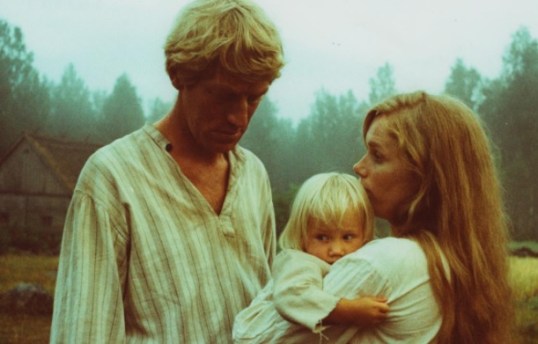
The Emigrants opens in 1844, in Sweden.  Karl Oskar (Max Von Sydow) has married Kristina (Liv Ullmann).  Like his father before him, Karl Oskar is a farmer.  It’s an exhausting life.  There is never enough food to eat.  The weather is perpetually gloomy.  The harvest is always disappointing.  As poor farmers, Karl Oskar and his family face constant prejudice.  In Sweden, the only thing more corrupt than the government is the church.  After one of his daughters starves to death, what choice does Karl Oskar and his family have other than to escape to America?

As Karl Oskar’s brother, Robert (Eddie Axberg), explains, the best rice comes from the Carolinas.  The best farmland is in America.  In America, anyone can become rich.  Anyone can walk up to the President and talk to him without running the risk of being imprisoned or executed.  (In 1844, ordinary citizens could stop by the White House and make an appointment to see the President.  This, of course, would change decades later, after a disgruntled office seeker shot President Garfield.)  In America, Robert says excitedly, no one works more than 14 hours a day!  Even slaves can own land and make their own money!

The Emigrants deals with their Karl Oskar and his family’s voyage to America.  Karl Oskar and Kristina do not travel alone.  Kristina’s uncle (Allan Edwall) is with them and hopes that, in America, he will be allowed to freely practice his religious beliefs.  A former prostitute, Ulrika (Monica Zetterlund), is also with them, hoping a new land will mean a better life for both herself and her daughter.  Even Robert’s best friend, Arvid (Pierre Lindstedt), going with them.  It’s not an easy journey.  Not everyone survives the voyage to North America but those that do soon find themselves in a young and untouched country where anything seems to be possible.

Swedish cinema has a reputation for being dark and brooding but those are two words that definitely do not apply to The Emigrants, which is about as positive a portrait of America as you could ever hope to see.  Regardless of whatever tragedy may occur during the journey, this movie leaves no doubt that the journey was more than worth it.  It unfolds at a pace that is perhaps a bit too leisurely but, at the same time, it’s also an achingly pretty movie with shots that bring to mind the best of Terrence Malick.  In fact, there are times when the film is almost too pretty.  It’s possible to get so caught up in looking at all the beauty around Karl Oskar and Kristina that you lose track of the story.  Max Von Sydow and Liv Ullmann are both achingly pretty as well and, even more importantly, they’re believable as a married couple who are often equally in love and equally annoyed with each other.

It was interesting to go from watching The Grapes of Wrath to watching The Emigrants.  If The Grapes of Wrath was an American nightmare, The Emigrants is about as pure a celebration of the American Dream as you’re going to find.  It lost the Oscar for Best Picture to a far different film about the immigrant experience in America, The Godfather.

Lisa Reviews An Oscar Nominee: The Grapes of Wrath (dir by John Ford)


(With the Oscars scheduled to be awarded on March 4th, I have decided to review at least one Oscar-nominated film a day.  These films could be nominees or they could be winners.  They could be from this year’s Oscars or they could be a previous year’s nominee!  We’ll see how things play out.  Today, I take a look at the 1940 best picture nominee, The Grapes of Wrath!)

How dark can one mainstream Hollywood film from 1940 possibly be?

Watch The Grapes of Wrath to find out.

Based on the novel by John Steinbeck and directed by John Ford, The Grapes of Wrath tells the story of the Joad family and their efforts to neither get sent to prison nor starve to death during the Great Depression.  When they lose their farm in Oklahoma, they head for California.  Pa Joad (Russell Simpson) has a flyer that says someone is looking for men and women to work as pickers out west.  The 12 members of the Joad Family load all of their possessions into a dilapidated old truck and they hit the road.  It quickly becomes apparent that they’re not the only family basing all of their hopes on the vague promises offered up by that flyer.  No matter how much Pa may claim different, it’s obvious that California is not going to be the promised land and that not all the members of the family are going to survive the trip.

Tom Joad (Henry Fonda) is the oldest of the Joad sons.  He’s just been released from prison and he’s killed in the past.  Having been in prison during the start of the Great Depression, Tom doesn’t realize how bad things truly are until he arrives home and sees someone he grew up with using a tractor to knock down a house.  (It’s just business, of course.  The owners of the house can’t pay their bills so the house gets destroyed.)  The film’s story is largely told through Tom’s eyes and Henry Fonda gives a sympathetic performance, one the gets the audience to empathize with and relate to a character who is a total outsider.

As for the rest of the Joad Family, Ma (Jane Darwell) is the glue who holds them together and who refuses to allow them to surrender to despair.  (And yet even Ma is forced to make some tough choices when the starving children of one work camp ask her to share her family’s meal with them.)  Rosasharan (Dorris Bowdon) is pregnant while Grandpa (Charley Grapewin) is too sickly for the trip but doesn’t have anywhere else to go.  And then there’s Casy (John Carradine), the former preacher turned labor organizer.  Casy is not blood-related but he soon becomes a member of the family.

The Joads have a healthy distrust of the police and other authority figures and that turns out to be a good thing because there aren’t many good cops to be found between Oklahoma and California.  Instead, the police merely serve to protect the rich from the poor.  Whenever the workers talk about forming a union and demanding more than 5 cents per box for their hard work, the police are there to break heads and arrest any troublemakers on trumped up charges.  Whenever a town decides that they don’t want any “Okies” entering the town and “stealing” jobs, the police are there to block the roads.

The Grapes of Wrath provides a portrait of the rough edges of America, the places and the people who were being ignored in 1940 and who are still too often ignored today.  John Ford may not be the first director that comes to mind when you think of “film noir” but that’s exactly what The Grapes of Wrath feels like.  During the night scenes, desperate faces emerge from the darkness while menacing figures lurk in the shadows.  When the sun does rise, the black-and-white images are so harsh that you almost wish the moon would return.  The same western landscape that Ford celebrated in his westerns emerges as a wasteland in The Grapes of Wrath.  The American frontier is full of distrust, anger, greed, and ultimately starvation.  (Reportedly, the film was often shown in the Soviet Union as a portrait of the failure of America and capitalism.  However, it was discovered that Soviet citizens were amazed that, in America, even a family as poor as the Joads could still afford a car.  The Grapes of Wrath was promptly banned after that.)  John Ford is often thought of as being a sentimental director but there’s little beauty or hope to be found in the images of The Grapes of Wrath.  (Just compare the way The Grapes of Wrath treats poverty to the way Ford portrayed it in How Green Was My Valley.)  Instead, the film’s only hint of optimism comes from the unbreakable familial bond that holds the Joads together.

As dark as it may be, the film is nowhere near as pessimistic as the original novel.  The novel ends with a stillborn baby and a stranger starving to death in a barn.  The film doesn’t go quite that far and, in fact, offers up some deus ex machina in the form of a sympathetic government bureaucrat.  (Apparently, authority figures weren’t bad as long as they worked for the federal government.)  That the book is darker than the movie is not surprising.  John Steinbeck was a socialist while John Ford was a Republican with a weakness for FDR.  That said, even though the film does end on a more hopeful note than the novel, you still never quite buy that things are ever going to get better for anyone in the movie.  You want things to get better but, deep down, you know it’s not going to happen.  Tom says that he’s going to fight for a better world and Fonda’s delivers the line with such passion that you want him to succeed even if you know he probably won’t.  Ma Joad says the people will never be defeated and, again, you briefly believe her even if there’s not much evidence to back her up.

Even when viewed today, The Grapes of Wrath is still a powerful film and I can only guess what it must have been like to see the film in 1940, when the Great Depression was still going on and people like the Joads were still making the journey to California.  Not surprisingly, it was nominated for best picture of 1940, though it lost to Alfred Hitchcock’s Rebecca.

Lisa Reviews An Oscar Nominee: The Lion in Winter (dir by Anthony Harvey)


(With the Oscars scheduled to be awarded on March 4th, I have decided to review at least one Oscar-nominated film a day.  These films could be nominees or they could be winners.  They could be from this year’s Oscars or they could be a previous year’s nominee!  We’ll see how things play out.  Today, I take a look at the 1968 best picture nominee, The Lion in Winter!)

“I don’t much like our children.”

— Eleanor of Aquitaine (Katharine Hepburn)

“Oh God, but I do love being king.”

— King Henry II (Peter O’Toole)

“What family doesn’t have its up and down?”

— Eleanor of Aquitaine

To be honest, it’s tempting to just spend this entire review offering up quotes from this film.  Based on a play by James Goldman and featuring a cast of actors who all specialized in delivering the most snarky of lines with style, The Lion In Winter is a film that is in love with the English language.  As visually impressive as the film and its recreation of the 12th Century is, it’s tempting to close your eyes while watching The Lion In Winter and just listen to the dialogue.

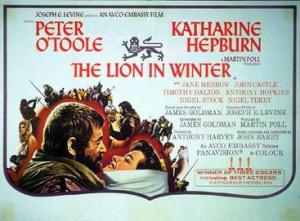
The year is 1183.  England has a king.  His name is Henry II (Peter O’Toole) and he’s held power for a long time, through a combination of willpower and political manipulation.  He’s married to Eleanor of Aquitaine (Katharine Hepburn), though he long since had her imprisoned.  Before marrying Henry, Eleanor was the wife of Louis VII.  Now, Henry’s mistress is Alais (Jane Merrow), the daughter of Louis and his second wife.  In order to get Alais’s dowry, Henry has promised her half-brother, Philip II (Timothy Dalton), that she will be married to the next king of England.  Philip, incidentally, is the son of Louis’s third wife.  To be honest, it’s confusing as Hell to try to keep up with all of it but that’s medieval politics for you.

Of course, everyone knows that Henry II will not be king forever.  He’s already 50 years old, which is quite an advanced age for 1183.  Being king means that everyone, even his own family, is plotting against him.  It also means living in a remarkably dirty and drafty castle.  (If you’re looking for a film that celebrates the splendor of royalty, this is probably not the film to watch.)  Henry has three sons, all of whom feel that he should be the rightful heir.

For instance, there’s Richard (a young Anthony Hopkins).  Richard is Henry and Eleanor’s eldest son.  He is a fierce, outspoken, and judgemental man.  He describes himself as being a legend and a poet.  He looks and acts like a future king.  Of course, he’s also a bit of a pompous ass.  Richard is Eleanor’s pick to be king, though Richard is always quick to equally condemn both of his parents.

And then there’s John (Nigel Terry).  Early on, John is described as being “pimply and smelling of compost.”  For some reason, John is Henry’s favorite.  He’s also a sniveling weakling, the type who is never smart enough to know when his father is being honest or when his father is bluffing.  Halfway through the film, he comes close to accidentally starting a civil war.

And finally, there’s Geoffrey (John Castle).  Geoffrey is the smartest of the princes and the most manipulative.  Of the three princes, he’s the only one who is as smart as both Henry and Eleanor.  However, whereas Henry and Eleanor enjoy their complicated lives and manage to maintain a sense of (very dark) humor about it all, Geoffrey is bitter about his place as the middle child.

Christmas has arrived and Henry has temporarily released Eleanor from prison so that she can spend the holidays with him, his sons, and his mistress.  Also coming over for the holiday is King Phillip II, eager to either take back his sister’s dowry or to attend her wedding to the next King of England.  What follows is a holiday of politics, manipulation, and shouting.  In fact, there’s lots and lots of shouting.

It’s a thoroughly enjoyable film, one that expertly mixes British history with domestic drama and dark comedy.  Obviously, the film’s main appeal comes from watching two screen icons, Peter O’Toole and Katharine Hepburn, exchanging snappy dialogue.  Hepburn deservedly won an Oscar for her performance as Eleanor.  O’Toole should have won an Oscar as well but he lost to Cliff Robertson for Charly.  In fact, O’Toole and Hepburn are so good that they occasionally overshadow the rest of the very talented cast.  Anthony Hopkins and Nigel Terry both make indelible impressions as Richard and John but my favorite princely performance came from John Castle, who is a malicious wonder as Geoffrey.  As easy as it is to dislike Geoffrey, it’s hard not to feel that he does have a point.

(Of course, in real life, both Richard and John would eventually serve as king while Geoffrey would die, under mysterious circumstances, in France.  Reportedly, Philip II was so distraught over Geoffrey’s death that he attempted to jump on the coffin as it was being lowered into the ground.)

The Lion In Winter was nominated for seven Oscars and won three, for Best Actress (Katharine Hepburn), Best Adapted Screenplay (James Goldman), and Best Music Score (John Barry).  It lost best picture to Oliver!

Lisa Reviews An Oscar Nominee: Grand Illusion (dir by Jean Renoir)


(With the Oscars scheduled to be awarded on March 4th, I have decided to review at least one Oscar-nominated film a day.  These films could be nominees or they could be winners.  They could be from this year’s Oscars or they could be a previous year’s nominee!  We’ll see how things play out.  Today, I take a look at the 1937 best picture nominee, Grand Illusion!)

A few things to consider when watching Jean Renoir’s La Grande Illusion:

It is considered to be one of the greatest French films of all time and yet, at the outbreak of World War II, it was banned by France pour la durée des hostilités.  It was also banned by Nazi Germany, with Joseph Goebbles declaring it to be “Cinematic Public Enemy No, 1.”  Italy followed suit, banning the film as well.

It’s a pacifist film but all of the main characters are soldiers.

It’s a war film but we never see any battles.  We hear about them, of course.  Characters cheer when they hear that their country has taken another town.  Towards the end of the film, when a gun finally is fired, it’s jarring because it’s the first gunshot that we’ve heard throughout the entire film.

It’s a film about change, specifically the change brought about by the First World War.  Captain de Boeldieu (Pierre Fresnay) may be French and Major von Rauffenstein (Erich van Stroheim) may be German but they both share the bond of being aristocrats.  (After Rauffenstein captures Boeldieu, the two of them have a friendly conversation about their shared acquaintances.)  Both of them serve in the army, not for ideological reasons but because they consider themselves to be patriots and tradition holds that aristocrats go to war for their countries.  At the start of the film, both Boeldieu and Rauffenstein seem to be above the fighting but, in the end, both realize that the old ways — their ways — will not survive in the new world that’s being created by the Great War.

(In another scene, a group of Russian soldiers are excited to receive a care package from “the Czarina,” just to open up the box and discover that, instead of Vodka, they’ve been sent used textbooks.  The soldiers respond by setting the box on fire.  For audiences in 1937, it would be impossible to watch this scene without reflecting on the fact that the Czarina herself would soon be dead, executed by revolutionaries.)

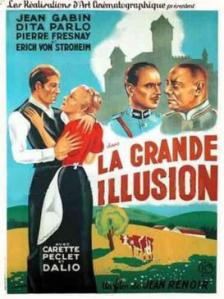
Grand Illusion tells the story of three French officers, prisoners of war who hope to somehow escape and make their way to neutral Switzerland.  Unlike the aristocratic Boeldieu, Marechal (Jean Gabin) is a member of the working class, a mechanic.  Lt. Rosnethal (Marcel Dalio) comes from a wealthy family but, as a Jew, he is still viewed as an outsider.  (Reportedly, Renoir specifically made Grand Illusion‘s most sympathetic and generous character Jewish as a specific rebuke to Nazi Germany and their policies.)  It’s Rosenthal who gives meaning to the film’s title when he says, regarding the belief that the great war will end all other wars, “That’s just an illusion.”

All three of them are moved from prison camp to prison camp, until they eventually find themselves at the camp commanded by the man who first captured both Boeldieu and Marechal, Major van Rauffenstein.  Rauffenstein explains that he was given his new post after being seriously wounded in combat and his movements are sometimes so stiff that he almost resembles a marionette, suggesting that war has reduced this proud man to merely being a puppet for his government’s war machine.

Grand Illusion is a film about the forgotten people who get caught up in the madness of war.  The French POWs may say they want to return to the front but, when they meet a woman who has lost her husband and three brothers to the war, they are reminded that even “victory” comes with a steep price.  Rauffenstein and Boeldiue may share much in common but ultimately, the only thing that the world cares about is that one is French and one is German.  Grand Illusion was Jean Renoir’s eloquent plea for peace, issued a mere two years before Europe plunged into World War II.

In 1938, Grand Illusion was the first foreign-language film to receive an Oscar nomination for best picture.  However, it lost to Frank Capra’s You Can’t Take It With You.


Lisa Reviews An Oscar Nominee: Love Is A Many-Splendored Thing (dir by Henry King)


(With the Oscars scheduled to be awarded on March 4th, I have decided to review at least one Oscar-nominated film a day.  These films could be nominees or they could be winners.  They could be from this year’s Oscars or they could be a previous year’s nominee!  We’ll see how things play out.  Today, I take a look at the 1955 best picture nominee, Love Is A Many-Splendored Thing!)

Before I talk about Love Is A Many-Splendored Thing, let’s play a little trivia game.

I’m going to list ten films.  Your job is to guess what they all have in common:

Did you guess?  All ten of these films came out in 1955 and not a single one of them was nominated for best picture.  That’s something that I found myself thinking about quite a bit as I watched Love Is A Many-Splendored Thing on TCM last night.  Of course, at this point, everyone knows that deserving films are often ignored by the Academy and that what seems like a great film during one year can often seem to be rather forgettable in subsequent years.

So, you can probably guess that I wasn’t terribly impressed with Love Is A Many-Splendored Thing but, before I get too critical, I want to start things off on a positive note.  William Holden was, without a doubt, one of the best actors to ever appear in the movies.  He started his film career in the 1930s and worked regularly until his death in 1981.  Just consider some of the films in which Holden appeared: Golden Boy, Our Town, Sunset Boulevard, Stalag 17, Sabrina, Picnic, Network, and so many others.  Of course, not every film in which Holden appeared was a masterpiece.  He made his share of films like Damien: Omen II and When Time Ran Out.  But the thing is that, regardless of the film, Holden was always good.

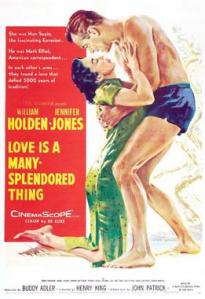
That’s certainly the case with Love Is A Many-Splendored Thing.  It’s not one of Holden’s better films but William Holden is his usual dependable self.  He plays Mark Elliott, a rugged American correspondent who is living in Hong Kong in the 1940s.  While the Chinese Civil War rages nearby, Mark deals with his failing marriage.  His wife is back in the States.  They’re separated but not quite divorced.  Mark owns a really nice car and, since he’s played by William Holden, he delivers the most world-weary of lines with an undeniable panache.  He also appears shirtless for a good deal of the film.  Between this and Picnic, 1955 was the year of the shirtless Holden.

The problem with Love Is A Many-Splendored Thing is not with William Holden.  Instead, the problem is with the miscasting of Jennifer Jones as Han Suyin, the woman with whom Mark Elliott falls in love.  Han Suyin was a real-life person, a doctor who wrote the autobiographical novel on which Love Is A Many-Splendored Thing was based.  Han Suyin was Eurasian.  Jennifer Jones most definitely was not.  Throughout the film, Han Suyin and Mark often discuss what it’s like to be Eurasian and to be in the middle of two very different cultures.  There’s even a discussion about whether Han Suying should try to pass as European.  It all has the potential to be very interesting except for the fact that Jennifer Jones, who was so good in so many films, is in no way convincing in her role.  Whenever she mentions being Eurasian, which she does frequently, the film come to a halt as we all stare at Jennifer Jones, one of the first film stars to ever come out of Tulsa, Oklahoma.

It all leads to a rather strained movie, one that never really drew me into its cinematic world or story.  (For the record, a lot of people on twitter disagreed with me on this point.)  Ultimately, the main reason to watch it was for William Holden.  According to the film’s Wikipedia entry (how’s that for in-depth research), Holden and Jones reportedly did not get along during filming, with Jones apparently chewing garlic before their love scenes and there was a definite lack of chemistry between them.  Maybe I got spoiled by William Holden and Kim Novak dancing in Picnic but I never believed that Mark and Han Suyin were attracted to each other.  Interestingly, Jones and Holden would later both appear in another best picture nominee, 1974’s The Towering Inferno.  However, they didn’t share any scenes.

Love Is A Many-Splendored Thing was nominated for best picture but it lost to a far different love story, Marty.  This was also the final film directed by Henry King to be nominated for best picture.  Previous King films to be nominated included State Fair, In Old Chicago, Alexander’s Ragtime Band, The Song of Bernadette, Wilson, and Twelve O’Clock High.

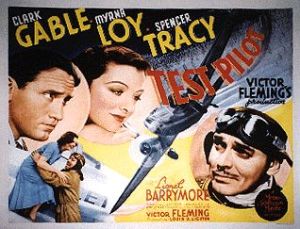
Lisa Reviews An Oscar Nominee: Test Pilot (dir by Victor Fleming)


(With the Oscars scheduled to be awarded on March 4th, I have decided to review at least one Oscar-nominated film a day.  These films could be nominees or they could be winners.  They could be from this year’s Oscars or or they could be a previous year’s nominee!  We’ll see how things play out.  Today, I take a look at the 1938 best picture nominee, Test Pilot!)

Test Pilot is all about charisma.

It tells a fairly simple story.  I imagine that the plot seemed just as familiar in 1938 as it does in 2018.  Jim Lane (Clark Gable) is a test pilot.  In the early days of aviation, long before people took the idea of flight for granted, Jim Lane is a hero and celebrity.  Whenever a new aviation technique is developed, Jim is the one who tests it.  He’s the one who makes sure that it’s safe.  Every day, when Jim goes to work for Mr. Drake (Lionel Barrymore), there’s a chance that he might not make it home.  Not surprisingly, he’s cocky, reckless, and not prone to commitment.  He’s also handsome, charming, manly, and quick with a quip.  In short, he’s Clark Gable.

When the movie starts, Jim has only one real friend.  Gunner (Spencer Tracy) is his mechanic.  Gunner is a by-the-book, no-nonsense professional.  He might enjoy a drink every now and then but Gunner knows his job and he knows his planes and, even more importantly, he knows Jim.  Gunner’s a man of unimpeachable integrity, the type who will always call things as he sees them.  In short, he’s Spencer Tracy.

One day, while on a test flight, Jim is forced to make an emergency landing on a farm in Kansas.  That’s where he meets Ann Barton (Myrna Loy).  Ann is beautiful and outspoken.  She quickly proves that she can keep up with Jim, quip-for-quip.  In short, she’s Myrna Loy and, before you know it, she and Jim are in love.  Just as quickly, Jim and Ann are married.

The movie starts out as a bit of domestic comedy.  Jim may know how to fly a plane but it quickly becomes obvious that he doesn’t know much about commitment or being a husband.  When Jim attempts to buy his wife a nightgown, he doesn’t even know how to pronounce the word lingerie.  (He asks a store clerk for help in finding the “lonjur department.”)  However, Jim soon starts to find that married life agrees with him.

Of course, that’s a problem when your job requires you to defy death on a daily basis.  Ann worries that Jim is going to go to work and never come home, fears that are intensified after a race with another airplane ends in a terrible and (for the other pilot) fatal crash.  Gunner, meanwhile, starts to fear that there’s only so many times that Jim can cheat fate.  Both Ann and Gunner promise that they will never leave Jim’s side.

Well, you can probably already guess everything that’s going to happen.  Test Pilot is not exactly the most narratively adventurous movie ever made but, when you’ve got Gable, Tracy, Loy, and Barrymore all in the same film, you don’t really need to break any new ground, storywise.  Test Pilot is an example of the power of pure movie star charisma.  It’s watchable because the performances are just as entertaining today as they were in 1938.  The film features Gable doing what he did best and Tracy doing what he did best and Loy and Barrymore all doing what they did best.  In this case, that’s more than enough.

When it comes to the film’s numerous flight sequences, it’s perhaps best to try to put yourself in the shoes of someone seeing the film in 1938.  Today, of course, we’ve been spoiled by CGI.  We tend to assume that literally anything can happen in a movie.  In the 30s, however, people couldn’t take special effects for granted.  When they watched the flight footage in Test Pilot, they did it with the knowledge that it was filmed by people who actually were putting their lives at risk to get it.  At a time when commercial aviation was considered to be a luxury, Test Pilot provided audiences with a view of the world in the sky and of the world below, a view that they probably wouldn’t have gotten a chance to see otherwise.

A huge box office success, Test Pilot was nominated for best picture but lost to another film featuring Lionel Barrymore, Frank Capra’s You Can’t Take It With You.

Here’s What Won At The 2018 Sundance Film Festival!


Compared to previous years, the buzz around this year’s Sundance Film Festival has felt pretty subdued.  There haven’t been any headlines about any huge distribution deals.  I haven’t seen many articles declaring that “Next year’s Oscar race has already begun at Sundance!” this year.

That said, Sundance remains the first big event of the film year.  Even if the coverage was unusually subdued this year, it still appears that there were some intriguing films at this year’s festival.  Myself, I’m definitely planning on making the time to see Burden, Blaze, Lizzie, Colette, Eighth Grade, and The Tale.

On Saturday night, the following films won awards at the Sundance Film Festival:

U.S. DRAMATIC COMPETITION

Grand Jury Prize: “The Miseducation of Cameron Post”

Audience Award: “Burden”

Directing: Sara Colangelo, “The Kindergarten Teacher”

Waldo Salt Screenwriting Award: Christina Choe, “Nancy”

Special Jury Award for Outstanding First Feature: Reinaldo Marcus Green, “Monsters and Men”

Special Jury Award for Excellence in Filmmaking: “I Think We’re Alone Now”

Special Jury Award for Acting: Benjamin Dickey, “Blaze”

U.S. DOCUMENTARY COMPETITION

Grand Jury Prize: “Kailash”

Directing: Alexandria Bombach, “On Her Shoulders”

Audience Award: “The Sentence”

Special Jury Award for Social Impact: “Crime + Punishment”

Special Jury Award for Creative Vision: “Hale County This Morning, This Evening”

Special Jury Award for Breakthrough Filmmaking: “Minding the Gap”

Special Jury Award for Storytelling: “Three Identical Strangers”

WORLD CINEMA DRAMATIC COMPETITION

Grand Jury Prize: “Butterflies”

Audience Award: “The Guilty”

Directing Award: Ísold Uggadóttir, “And Breathe Normally”

Special Jury Award for Acting: Valeria Bertucecelli, “The Queen of Fear,”

Special Jury Award for Screenwriting: Julio Chavezmontes & Sebastián Hofmann, “Time Share”

Special Jury Award for Ensemble Acting: “Dead Pigs”

WORLD CINEMA DOCUMENTARY COMPETITION

Grand Jury Prize: “Of Fathers and Sons”

Audience Award: “This Is Home”

Directing Award: Sandi Tan, “Shirkers”

Special Jury Award: Steven Loveridge, “Matangi/Maya/M.I.A.”

Special Jury Award for Cinematography: Maxim Arbugaev, Peter Indergand “Genesis 2.0”

Special Jury Award for Editing: Maxim Pozdorovkin & Matvey Kulakov, “Our New President”

OTHER AWARDS

NEXT Audience Award: “Search”

NEXT Innovator Award: “Night Comes On” AND “We the Animals”

Alfred P. Sloan Feature Film Prize: “Search”

Sundance Institute NHK Award: Remi Weekes, “His House”

Sundance Institute/Amazon Studios Producers Awards: Katy Chevingy & Marilyn Ness (“Dark Money”) AND Sev Ohanian (“Search”)

Sundance Open Borders Fellowship Presented by Netflix: Talal Derki (“Of Fathers and Sons”) AND Chaitanya Tamhane AND Tatiana Huezo (“Night on Fire”)

Previous Sundance Film Reviews:

  1. Blood Simple
  2. I Don’t Feel At Home In This World Anymore
  3. Circle of Power
  4. Old Enough
  5. Blue Caprice
  6. The Big Sick
  7. Alpha Dog
  8. Stranger Than Paradise
  9. sex, lies, and videotape
  10. Reservoir Dogs

Here Are The 90th Oscar Nominations!


You know that I’ve had a busy Tuesday when I’m only now getting around to posting the 90th Annual Oscar nominations!

Here they are.  Nominees in bold appear on both the Academy’s list and my list of the films that I would have nominated if I was the one solely in charge!

Best Picture:

Call Me By Your Name,

Darkest Hour,

Dunkirk,

Get Out,

Lady Bird,

Phantom Thread,

The Post,

The Shape of Water

Three Billboards Outside Ebbing Missouri

Best Director

Paul Thomas Anderson for Phantom Thread

Guillermo Del Toro for The Shape of Water

Greta Gerwig for Lady Bird

Christopher Nolan for Dunkirk

Jordan Peele for Get Out

Best Actor

Timothee Chalamet in Call Me By Your Name

Daniel Day-Lewis in Phantom Thread

Daniel Kaluuya in Get Out

Gary Oldman in Darkest Hour

Denzel Washington in Roman Israel Esq.

Best Actress

Sally Hawkins in Shape of Water

Frances McDormand in Three Billoards Outside Ebbing Missouri

Margot Robbie in I, Tonya

Saoirse Ronan in Lady Bird

Meryl Streep in The Post

(At this point, I got tired of typing out all of the nominees myself and I did a cut and paste from the list of nominees posted at Awards Watch.  Please thank Awards Watch by visiting their wonderful site.)

Actor in a Supporting Role

WILLEM DAFOE
The Florida Project
WOODY HARRELSON
Three Billboards outside Ebbing, Missouri
RICHARD JENKINS
The Shape of Water
CHRISTOPHER PLUMMER
All the Money in the World
SAM ROCKWELL
Three Billboards outside Ebbing, Missouri

Actress in a Supporting Role

MARY J. BLIGE
Mudbound

ALLISON JANNEY
I, Tonya
LESLEY MANVILLE
Phantom Thread
LAURIE METCALF
Lady Bird
OCTAVIA SPENCER
The Shape of Water

Writing (Original Screenplay)

THE BIG SICK
Written by Emily V. Gordon & Kumail Nanjiani
GET OUT
Written by Jordan Peele
LADY BIRD
Written by Greta Gerwig
THE SHAPE OF WATER
Screenplay by Guillermo del Toro & Vanessa Taylor; Story by Guillermo del Toro
THREE BILLBOARDS OUTSIDE EBBING, MISSOURI
Written by Martin McDonagh

Writing (Adapted Screenplay)

CALL ME BY YOUR NAME
Screenplay by James Ivory
THE DISASTER ARTIST
Screenplay by Scott Neustadter & Michael H. Weber
LOGAN
Screenplay by Scott Frank & James Mangold and Michael Green; Story by James Mangold
MOLLY’S GAME
Written for the screen by Aaron Sorkin
MUDBOUND
Screenplay by Virgil Williams and Dee Rees

Animated Feature Film

THE BOSS BABY
Tom McGrath and Ramsey Naito
THE BREADWINNER
Nora Twomey and Anthony Leo
COCO
Lee Unkrich and Darla K. Anderson
FERDINAND
Carlos Saldanha
LOVING VINCENT
Dorota Kobiela, Hugh Welchman and Ivan Mactaggart

Foreign Language Film

A FANTASTIC WOMAN
Chile
THE INSULT
Lebanon
LOVELESS
Russia
ON BODY AND SOUL
Hungary
THE SQUARE
Sweden

Documentary Feature

ABACUS: SMALL ENOUGH TO JAIL
Steve James, Mark Mitten and Julie Goldman
FACES PLACES
Agnès Varda, JR and Rosalie Varda
ICARUS
Bryan Fogel and Dan Cogan
LAST MEN IN ALEPPO
Feras Fayyad, Kareem Abeed and Søren Steen Jespersen
STRONG ISLAND
Yance Ford and Joslyn Barnes

Documentary (Short Subject)

EDITH+EDDIE
Laura Checkoway and Thomas Lee Wright
HEAVEN IS A TRAFFIC JAM ON THE 405
Frank Stiefel
HEROIN(E)
Elaine McMillion Sheldon and Kerrin Sheldon
KNIFE SKILLS
Thomas Lennon
TRAFFIC STOP
Kate Davis and David Heilbroner

Music (Original Score)

DUNKIRK
Hans Zimmer
PHANTOM THREAD
Jonny Greenwood
THE SHAPE OF WATER
Alexandre Desplat
STAR WARS: THE LAST JEDI
John Williams
THREE BILLBOARDS OUTSIDE EBBING, MISSOURI
Carter Burwell

Music (Original Song)

MIGHTY RIVER
from Mudbound; Music and Lyric by Mary J. Blige, Raphael Saadiq and Taura Stinson
MYSTERY OF LOVE
from Call Me by Your Name; Music and Lyric by Sufjan Stevens
REMEMBER ME
from Coco; Music and Lyric by Kristen Anderson-Lopez and Robert Lopez
STAND UP FOR SOMETHING
from Marshall; Music by Diane Warren; Lyric by Lonnie R. Lynn and Diane Warren
THIS IS ME
from The Greatest Showman; Music and Lyric by Benj Pasek and Justin Paul

Film Editing

BABY DRIVER
Paul Machliss and Jonathan Amos
DUNKIRK
Lee Smith
I, TONYA
Tatiana S. Riegel
THE SHAPE OF WATER
Sidney Wolinsky
THREE BILLBOARDS OUTSIDE EBBING, MISSOURI
Jon Gregory

Cinematography

BLADE RUNNER 2049
Roger A. Deakins
DARKEST HOUR
Bruno Delbonnel
DUNKIRK
Hoyte van Hoytema
MUDBOUND
Rachel Morrison
THE SHAPE OF WATER
Dan Laustsen

Production Design

BEAUTY AND THE BEAST
Production Design: Sarah Greenwood; Set Decoration: Katie Spencer
BLADE RUNNER 2049
Production Design: Dennis Gassner; Set Decoration: Alessandra Querzola
DARKEST HOUR
Production Design: Sarah Greenwood; Set Decoration: Katie Spencer
DUNKIRK
Production Design: Nathan Crowley; Set Decoration: Gary Fettis
THE SHAPE OF WATER
Production Design: Paul Denham Austerberry; Set Decoration: Shane Vieau and Jeff Melvin

Costume Design

BEAUTY AND THE BEAST
Jacqueline Durran
DARKEST HOUR
Jacqueline Durran
PHANTOM THREAD
Mark Bridges
THE SHAPE OF WATER
Luis Sequeira
VICTORIA & ABDUL
Consolata Boyle

Makeup and Hairstyling
DARKEST HOUR
Kazuhiro Tsuji, David Malinowski and Lucy Sibbick
VICTORIA & ABDUL
Daniel Phillips and Lou Sheppard
WONDER
Arjen Tuiten

Sound Mixing

BABY DRIVER
Julian Slater, Tim Cavagin and Mary H. Ellis
BLADE RUNNER 2049
Ron Bartlett, Doug Hemphill and Mac Ruth
DUNKIRK
Mark Weingarten, Gregg Landaker and Gary A. Rizzo
THE SHAPE OF WATER
Christian Cooke, Brad Zoern and Glen Gauthier
STAR WARS: THE LAST JEDI
David Parker, Michael Semanick, Ren Klyce and Stuart Wilson

Sound Editing

BABY DRIVER
Julian Slater
BLADE RUNNER 2049
Mark Mangini and Theo Green
DUNKIRK
Richard King and Alex Gibson
THE SHAPE OF WATER
Nathan Robitaille and Nelson Ferreira
STAR WARS: THE LAST JEDI
Matthew Wood and Ren Klyce

Visual Effects

BLADE RUNNER 2049
John Nelson, Gerd Nefzer, Paul Lambert and Richard R. Hoover
GUARDIANS OF THE GALAXY VOL. 2
Christopher Townsend, Guy Williams, Jonathan Fawkner and Dan Sudick
KONG: SKULL ISLAND
Stephen Rosenbaum, Jeff White, Scott Benza and Mike Meinardus
STAR WARS: THE LAST JEDI
Ben Morris, Mike Mulholland, Neal Scanlan and Chris Corbould
WAR FOR THE PLANET OF THE APES
Joe Letteri, Daniel Barrett, Dan Lemmon and Joel Whist

Short Film (Animated)

DEAR BASKETBALL
Glen Keane and Kobe Bryant
GARDEN PARTY
Victor Caire and Gabriel Grapperon
LOU
Dave Mullins and Dana Murray
NEGATIVE SPACE
Max Porter and Ru Kuwahata
REVOLTING RHYMES
Jakob Schuh and Jan Lachauer

Short Film (Live Action)
DEKALB ELEMENTARY
Reed Van Dyk
THE ELEVEN O’CLOCK
Derin Seale and Josh Lawson
MY NEPHEW EMMETT
Kevin Wilson, Jr.
THE SILENT CHILD
Chris Overton and Rachel Shenton
WATU WOTE/ALL OF US
Katja Benrath and Tobias Rosen

Congratulations to all the nominees!