Considering that it’s Ian Fleming’s birthday, what else could I have possibly picked?
Considering that it’s Ian Fleming’s birthday, what else could I have possibly picked?
Since today is John Glen’s birthday, it only seems appropriate that today’s song of the day should be one of my favorite James Bond themes. From the underrated Octopussy, here’s one of the few songs that I can sing (though I don’t sound anywhere near as good as Rita Coolidge), All Time High!
Considering that it’s Ian Fleming’s birthday, what else could I have possibly picked?
Valentine’s Day is nearly over! A day like today …. it can justify three songs of the day can’t it? Originally, I wanted to cap things off with Carly Simon’s Nobody Does It Better but that song has already been our Song of the Day once this year.
So, instead, our final song of the day is another wonderfully romantic song from the James Bond franchise. Of course, it may be bring a tear to your eye if you’ve seen On Her Majesty’s Secret Service. It turns out that Bond and Tracy did not have all the time in the world. But at least they had the time that they did!
Here is the amazing Louis Armstrong with the saddest Bond song ever!
We have all the time in the world
Time enough for life to unfold
All the precious things love has in store
We have all the love in the world
If that’s all we have, you will find
We need nothing more
Every step of the way
Will find us
With the cares of the world
Far behind us
We have all the time in the world
Just for love
Nothing more, nothing less
Only love
Every step of the way
Will find us
With the cares of the world
Far behind us, yes
We have all the time in the world
Just for love
Nothing more, nothing less
Only love
Only love
Songwriters: John Barry / Hal David
Valentine’s Day is a big deal! It can have more than one song of the day, right?
I mean, how can I let this day go by without sharing my favorite Bond theme song? All Time High may have been written because there weren’t many words that rhymed with Octopussy but it’s still not only one of my favorite Bond themes but also one of my favorite love songs.
Plus, it’s one of the few songs that I used to absolutely kill with during karaoke night at Grandpa Tony’s.
(Grandpa Tony’s was a nice little restaurant. The owner was a former boxer who had a crush on my mom so he had no problem with her four daughters singing their hearts out every Friday! The older you get, the more you treasure memories like that.)
All I wanted was a sweet distraction for an hour or two
Had no intention to do the things we’ve done
Funny how it always goes with love, when you don’t look, you find
But then we’re two of a kind, we move as one
We’re an all-time high
We’ll change all that’s gone before
Doing so much more than falling in love
On an all-time high
We’ll take on the world and win
So hold on tight, let the flight begin
I don’t want to waste a waking moment, I don’t want to sleep
I’m in so strong and so deep, and so are you
In my time, I’ve said these words before, but now I realize
My heart was telling me lies, for you, they’re true
We’re an all-time high
We’ll change all that’s gone before
Doing so much more than falling in love
On an all-time high
We’ll take on the world and win
So hold on tight, let the flight begin
So hold on tight, let the flight begin
We’re an all-time high
Songwriters: Tim Rice / John Barry

In honor of National Science Fiction Day, today’s song of the day comes from the film that sent James Bond into space!
Released in 1979, Moonraker may not get as much respect as some of the Bond films but I’ve always liked it. The theme song was the third and final Bond song to be performed by Shirley Bassey. The song was originally written for Frank Sinatra but he turned it down. Johnny Mathis then agreed to perform the song but he backed out at the last minute. Shirley Bassey came in to record the song just weeks before the film was due to premiere.
Because this is a 70s film, there were two versions of this song, the original and the disco. Because I’m the one writing this post, we’re going with the disco version.
Where are you, why do you hide
Where is that moonlight trail that leads to your side?
Just like the moonraker goes in search of his dream of gold
I search for love, for someone to have and hold
I’ve seen your smile in a thousand dreams
Felt your touch, and it always seems
You love me, you love me
Where are you, when will we meet?
Take my unfinished life and make it complete
Just like the moonraker knows
His dream will come true someday
I know that you are only a kiss away
I’ve seen your smile in a thousand dreams
Felt your touch, and it always seems
You love me, you love me
Songwriters: John Barry / Hal David
Today, the Shattered Lens wishes a happy birthday to recording artist Rita Coolidge!
Rita Coolidge, who rose from being a backing singer to being a successful headliner in her own right, sung my favorite James Bond theme song, All Time High from Octopussy.
(Not surprisingly, this was a rare care of the Bond film’s title not being used in the theme song.)
I love this song and not just because it’s one of the few that I can actually sing. As performed by Coolidge, this song captures the romance, mystery, and fun that epitomized the Bond franchise before Daniel Craig came along and turned James Bond into a sexless, weepy loser.
It only seems appropriate to make All Time High today’s song of the day!
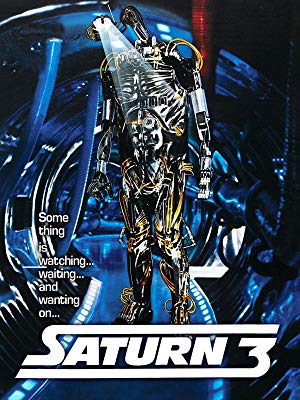 The time is the future and Earth is so polluted and overcrowded that the survival of humanity is dependent on space stations that are located across the galaxy. On one of the moons of Saturn, Adam (Kirk Douglas) and Alex (Farrah Fawcett) are researching and developing new ways to grow food. Alex is young and has never experienced life on Earth. Adam is in his 60s and says that Earth is the worst place in the universe. Alex and Adam are not just colleagues but lovers as well. Inside the tranquil facility, Adam, Alex, and Sally the Dog live a lifestyle that feels more like late 70s California than 21st century Saturn.
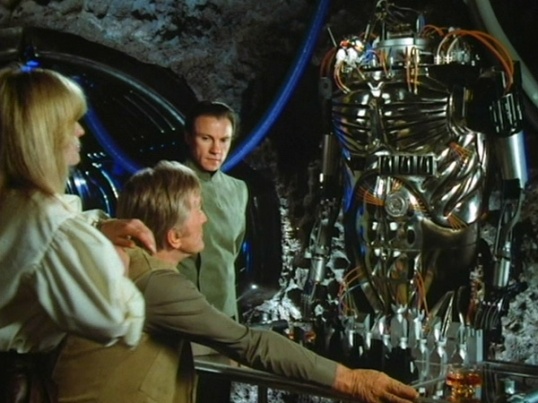
Adam is disturbed when a cargo ship arrives. The ship is piloted by Captain James (Harvey Keitel, giving the film’s only interesting performance despite having had all of his dialogue dubbed by Roy Dotrice), who immediately takes an unwelcome interest in Alex. (“You have a great body,” he says, “May I use it?”) Captain James starts telling Alex stories about life back on Earth and encouraging her to abandon Adam. Captain James also reveals that he’s accompanied by an 8-foot robot named Hector. Hector is designed to replace one of the scientists.
If that’s not bad enough, it also turns out that Captain James is not really Captain James but instead, he’s Captain Benson. Benson was originally assigned to fly the cargo ship but, after a psychological profile deemed him to be psychotic, Benson was replaced by James. So, Benson killed James by pushing him out of an airlock. Now, Benson is on Saturn 3 and he’s uploaded both his homicidal impulses and his lust for Alex into Hector’s programming. Soon, Hector is rampaging through the facility, determined to have Alex for himself.
For an ultimately forgettable film that plays like an Alien rip-off (even though the two films were actually shot at the same time), Saturn 3 has long been infamous for its troubled production. Martin Amis, who wrote an early draft of the script, even wrote a novel, Money, based on the filming of Saturn 3. (In the novel, Kirk Douglas is renamed Lorne Guyland and insists on getting naked as much as possible in order to prove that he’s still virile.) The film was originally meant to be the directorial debut of John Barry, the famed British production designer. However, Barry departed the film after two weeks, with reports differing on whether he left voluntarily or if he was fired. The film’s producer, Stanley Donen, took over as director. Stanley Donen, who also directed legitimate classics like Singin’ In The Rain, Charade, and Two For The Road, confessed to having no affinity for science fiction and it’s obvious from watching his one foray into the genre that he was not exaggerating.
The idea behind Saturn 3, with Hector taking on the personality of it creator, is an intriguing one but the film doesn’t do much with it and the film’s choppy pace indicates that there was extensive executive tinkering both during and after filming. Harvey Keitel is convincingly strange in his role but Farrah Fawcett is miscast as a scientist and Kirk Douglas does his usual grin and grimace routine, usually while naked. (It doesn’t seem that Martin Amis had to stretch the truth too far.) The 8-foot Hector looks impressive until he actually has to chase Fawcett through the facility. That’s when it becomes obvious that anyone with two functioning legs could easily outrun the lumbering robot.
In space, no one can hear you scream. But they might hear you laughing at Saturn 3.
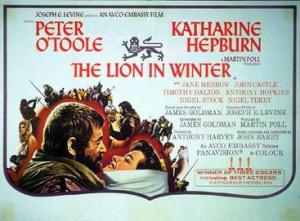
(With the Oscars scheduled to be awarded on March 4th, I have decided to review at least one Oscar-nominated film a day. These films could be nominees or they could be winners. They could be from this year’s Oscars or they could be a previous year’s nominee! We’ll see how things play out. Today, I take a look at the 1968 best picture nominee, The Lion in Winter!)
“I don’t much like our children.”
— Eleanor of Aquitaine (Katharine Hepburn)
“Oh God, but I do love being king.”
— King Henry II (Peter O’Toole)
“What family doesn’t have its up and down?”
— Eleanor of Aquitaine
To be honest, it’s tempting to just spend this entire review offering up quotes from this film. Based on a play by James Goldman and featuring a cast of actors who all specialized in delivering the most snarky of lines with style, The Lion In Winter is a film that is in love with the English language. As visually impressive as the film and its recreation of the 12th Century is, it’s tempting to close your eyes while watching The Lion In Winter and just listen to the dialogue.
The year is 1183. England has a king. His name is Henry II (Peter O’Toole) and he’s held power for a long time, through a combination of willpower and political manipulation. He’s married to Eleanor of Aquitaine (Katharine Hepburn), though he long since had her imprisoned. Before marrying Henry, Eleanor was the wife of Louis VII. Now, Henry’s mistress is Alais (Jane Merrow), the daughter of Louis and his second wife. In order to get Alais’s dowry, Henry has promised her half-brother, Philip II (Timothy Dalton), that she will be married to the next king of England. Philip, incidentally, is the son of Louis’s third wife. To be honest, it’s confusing as Hell to try to keep up with all of it but that’s medieval politics for you.
Of course, everyone knows that Henry II will not be king forever. He’s already 50 years old, which is quite an advanced age for 1183. Being king means that everyone, even his own family, is plotting against him. It also means living in a remarkably dirty and drafty castle. (If you’re looking for a film that celebrates the splendor of royalty, this is probably not the film to watch.) Henry has three sons, all of whom feel that he should be the rightful heir.
For instance, there’s Richard (a young Anthony Hopkins). Richard is Henry and Eleanor’s eldest son. He is a fierce, outspoken, and judgemental man. He describes himself as being a legend and a poet. He looks and acts like a future king. Of course, he’s also a bit of a pompous ass. Richard is Eleanor’s pick to be king, though Richard is always quick to equally condemn both of his parents.
And then there’s John (Nigel Terry). Early on, John is described as being “pimply and smelling of compost.” For some reason, John is Henry’s favorite. He’s also a sniveling weakling, the type who is never smart enough to know when his father is being honest or when his father is bluffing. Halfway through the film, he comes close to accidentally starting a civil war.
And finally, there’s Geoffrey (John Castle). Geoffrey is the smartest of the princes and the most manipulative. Of the three princes, he’s the only one who is as smart as both Henry and Eleanor. However, whereas Henry and Eleanor enjoy their complicated lives and manage to maintain a sense of (very dark) humor about it all, Geoffrey is bitter about his place as the middle child.
Christmas has arrived and Henry has temporarily released Eleanor from prison so that she can spend the holidays with him, his sons, and his mistress. Also coming over for the holiday is King Phillip II, eager to either take back his sister’s dowry or to attend her wedding to the next King of England. What follows is a holiday of politics, manipulation, and shouting. In fact, there’s lots and lots of shouting.
It’s a thoroughly enjoyable film, one that expertly mixes British history with domestic drama and dark comedy. Obviously, the film’s main appeal comes from watching two screen icons, Peter O’Toole and Katharine Hepburn, exchanging snappy dialogue. Hepburn deservedly won an Oscar for her performance as Eleanor. O’Toole should have won an Oscar as well but he lost to Cliff Robertson for Charly. In fact, O’Toole and Hepburn are so good that they occasionally overshadow the rest of the very talented cast. Anthony Hopkins and Nigel Terry both make indelible impressions as Richard and John but my favorite princely performance came from John Castle, who is a malicious wonder as Geoffrey. As easy as it is to dislike Geoffrey, it’s hard not to feel that he does have a point.
(Of course, in real life, both Richard and John would eventually serve as king while Geoffrey would die, under mysterious circumstances, in France. Reportedly, Philip II was so distraught over Geoffrey’s death that he attempted to jump on the coffin as it was being lowered into the ground.)
The Lion In Winter was nominated for seven Oscars and won three, for Best Actress (Katharine Hepburn), Best Adapted Screenplay (James Goldman), and Best Music Score (John Barry). It lost best picture to Oliver!
Addendum: It was brought to my attention that Maryam and Olivia d’Abo are actually cousins, rather than sisters. This was corrected.
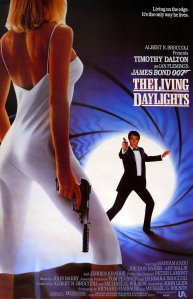
The Shattered Lens continues it’s coverage of all things Bond with 1987’s The Living Daylights. Timothy Dalton was once approached to play 007 after Connery left the franchise the first time, but being only 22 at the time, he considered himself a bit too young for the role. It was only after Roger Moore’s final role in A View to a Kill that he reconsidered and brought on as Britain’s superspy. What I liked about Dalton as Bond was that he was very cold and direct. There was nothing stylish about him, nor did he really try to be (aside for the usual Bond quip). For me, there was sense of darkness to the character. Dalton’s Bond felt like someone just a second away from doing damage to someone, but not exactly caring about how smoothly it was done. This may be partially why I’ve liked Craig so far in his films.
Below is the trailer for The Living Daylights. It makes chuckle how the word “Dangerous” gets thrown on screen every now and then.
The Living Daylights deals with a Russian plot to kill spies. General Gogol in the Roger Moore films was replaced with General Pushkin (John Rhys-Davies, Sallah from the Indy Films and Gimli from Lord of the Rings), and MI6 believes they are behind the recent deaths of agents during a training mission. Bond is asked to help eliminate a sniper for a defecting Soviet named Koskov (Jeroen Krabbe), but upon realizing that the sniper is a woman, he deliberately misses, shooting the frame of the gun and catching the sniper off guard. Bond manages to get Koskov out of Russia via a tube system, but Koskov is later kidnapped again.
We come to find that Koskov’s defection was a fake and that he’s working with an arms dealer (played by Joe Don Baker, who would later return to the Bond Franchise in Goldeneye as a different character), smuggling Opium and arms. Bond locates the sniper, who turns out to be Koskov’s girlfriend Kara (Maryam d’Abo) and poses a friend to Koskov to get closer to him. Granted, this ends up with Kara falling in love with James and we all know where that goes. d’Abo wasn’t bad as a Bond girl, but arguably her cousin, Olivia was more popular at the time.
Q Branch supplies Bond with a few fun gadgets. Back in the 80s, one fad were these keychain finders that would beep when you whistled or made a sound. 007 receives one of these with both an explosive and a smoke gas pellet inside. It’s pretty much the same setup that Connery had in From Russia With Love, placed in a more “modern day” casing (well, as modern as 25 years ago). Bond is also given an Aston Martin V8 Volante, and after all the Lotus editions in the Moore films – perhaps with the exception of the one that doubled as a sub, that one was awesome – it’s really wonderful to see the franchise return to it’s automotive roots. The car is outfitted with missiles, lasers in the hubcabs, on board skis and the all important self destruct system. As with all of Bond’s toys, he doesn’t manage to return this to Q.
From an action point of view, there isn’t a great deal in The Living Daylights. That’s a fantastic snow chase early on, and a fight on an airplane so popular that it was mimicked in the videogame Uncharted 3: Drake’s Deception. Neither of these try to be too over the top and work to great effect, but there are also a number of slow pacing moments that frankly had me wanting to fast forward through the film. I thought the sequence with the desert was drawn out just a little too much, lending to my notion that whenever a James Bond film uses the desert as a filming location, the movie just isn’t as strong in my eyes. Others, of course, may disagree. What the film does do well is establish Dalton as the new Bond. It doesn’t make fun of who he is compared to who came before in the way Her Majesty’s Secret Service did and just gives you an action sequence that says “Take it or leave it, this is who we’re running with”. I like to think it worked well. One could say it becomes the template for all of the “new 007” films
The Living Daylights notes a few changes in the Bond style. It would be the last film ever scored by long time Bond musician John Barry. The Dalton film after this, License to Kill was actually done by the late Michael Kamen (Robin Hood, Die Hard), and everything after that was either done by Eric Serra (The Professional, Goldeneye) or David Arnold (Stargate and Independence Day). A new, younger Moneypenny is introduced after Lois Maxwell’s departure, but I kind of hoped there would have been more time to see the chemistry grow there.
Overall, for a film that had to introduce a new James Bond to audiences, The Living Daylights does so with the 007 style we all know and love. It’s does downshift during the film to concentrate on the love story, but I felt Timothy Dalton’s dark and cold approach to the signature character adds a lot to the story overall.
The theme song to the film is a stand out by the band A-ha (who was popular with their song, Take On Me), and it’s orchestrated version is used heavily in the film. Tomorrow, we’ll visit License to Kill, where Bond goes rogue.

