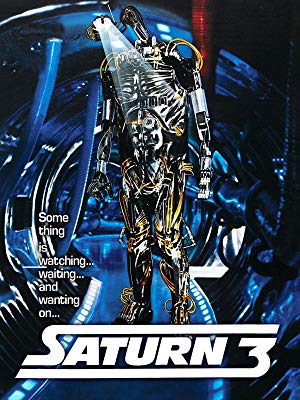
Robot In Lust: Saturn 3 (1980, directed by Stanley Donen)


The time is the future and Earth is so polluted and overcrowded that the survival of humanity is dependent on space stations that are located across the galaxy.  On one of the moons of Saturn, Adam (Kirk Douglas) and Alex (Farrah Fawcett) are researching and developing new ways to grow food.  Alex is young and has never experienced life on Earth.  Adam is in his 60s and says that Earth is the worst place in the universe.  Alex and Adam are not just colleagues but lovers as well.  Inside the tranquil facility, Adam, Alex, and Sally the Dog live a lifestyle that feels more like late 70s California than 21st century Saturn.

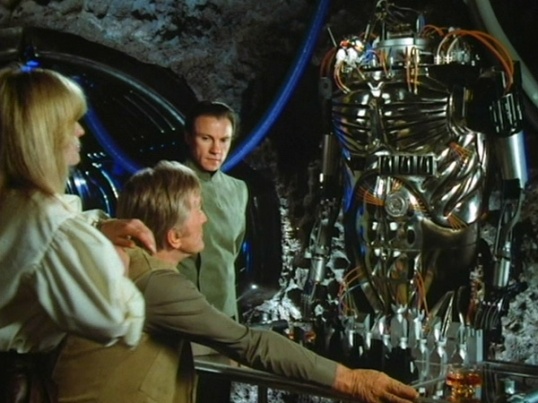
Adam is disturbed when a cargo ship arrives.  The ship is piloted by Captain James (Harvey Keitel, giving the film’s only interesting performance despite having had all of his dialogue dubbed by Roy Dotrice), who immediately takes an unwelcome interest in Alex.  (“You have a great body,” he says, “May I use it?”)  Captain James starts telling Alex stories about life back on Earth and encouraging her to abandon Adam.  Captain James also reveals that he’s accompanied by an 8-foot robot named Hector.  Hector is designed to replace one of the scientists.

If that’s not bad enough, it also turns out that Captain James is not really Captain James but instead, he’s Captain Benson.  Benson was originally assigned to fly the cargo ship but, after a psychological profile deemed him to be psychotic, Benson was replaced by James.  So, Benson killed James by pushing him out of an airlock.  Now, Benson is on Saturn 3 and he’s uploaded both his homicidal impulses and his lust for Alex into Hector’s programming.  Soon, Hector is rampaging through the facility, determined to have Alex for himself.

For an ultimately forgettable film that plays like an Alien rip-off (even though the two films were actually shot at the same time), Saturn 3 has long been infamous for its troubled production.  Martin Amis, who wrote an early draft of the script, even wrote a novel, Money, based on the filming of Saturn 3.  (In the novel, Kirk Douglas is renamed Lorne Guyland and insists on getting naked as much as possible in order to prove that he’s still virile.)  The film was originally meant to be the directorial debut of John Barry, the famed British production designer.  However, Barry departed the film after two weeks, with reports differing on whether he left voluntarily or if he was fired.  The film’s producer, Stanley Donen, took over as director.  Stanley Donen, who also directed legitimate classics like Singin’ In The Rain, Charade, and Two For The Road, confessed to having no affinity for science fiction and it’s obvious from watching his one foray into the genre that he was not exaggerating.

The idea behind Saturn 3, with Hector taking on the personality of it creator, is an intriguing one but the film doesn’t do much with it and the film’s choppy pace indicates that there was extensive executive tinkering both during and after filming.  Harvey Keitel is convincingly strange in his role but Farrah Fawcett is miscast as a scientist and Kirk Douglas does his usual grin and grimace routine, usually while naked.  (It doesn’t seem that Martin Amis had to stretch the truth too far.)  The 8-foot Hector looks impressive until he actually has to chase Fawcett through the facility.  That’s when it becomes obvious that anyone with two functioning legs could easily outrun the lumbering robot.

In space, no one can hear you scream.  But they might hear you laughing at Saturn 3.
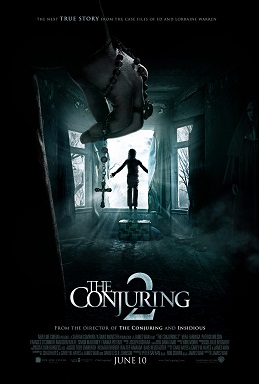
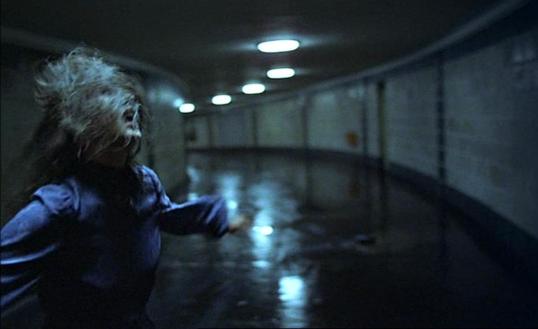
Horror Scenes That I Love: The Painting Comes To Life In The Conjuring 2


Obviously, you don’t have to be from a Catholic background to find this scene from The Conjuring 2 totally creepy but it definitely helps.

I remember watching this scene in the theaters.  As soon as Vera Farimga stepped into that room, I was like, “Uhmm …. see the painting?  Uh, there’s a painting behind you.  You might want to turn around and look at the painting….”

I really liked The Conjuring 2 and the first Conjuring as well.  I even liked the Annabelle films.  But one thing that I’ve always noticed about haunted house films is that nobody ever just turns on the lights.  It always seems to me like so much trouble could be avoided just by turning on the lights in every room and leaving them on.  Scary things only seem to happen in the dark.

Anyway, enough of my rambling!  Here’s today’s scene:

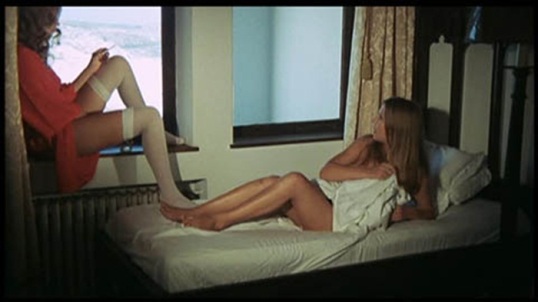
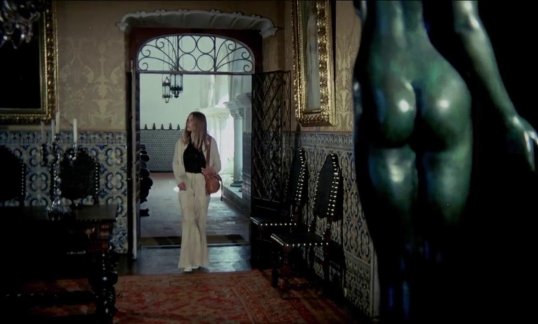
International Horror Review: A Virgin Among The Living Dead (dir by Jess Franco)


This 1973 Spanish-French-Italian production’s title is both its greatest strength and also its greatest weakness.

On the one hand, it’s impossible to forget a title like A Virgin Among the Living Dead.  It’s a title that mixes both horror and sex, which are two things of which audiences simply cannot get enough.  On the other hand, this is a a Jess Franco film and the title — which is so blatant and over-the-top — sounds like it could almost be a parody of Franco’s “unique” style of film-making.  If you were coming up with a fake Franco film, you would probably give it a title that sounded a lot like “A Virgin Among the Living Dead.”  A Virgin In The Castle of Dr. Orloff, perhaps.

Interestingly enough, Franco absolutely hated the film’s title.  It, and quite a few other titles, were slapped onto the film by distributors who were apparently unconcerned with the fact that the film was not meant to be one of Franco’s typical, give-me-my-paycheck exploitation films.  Franco’s title for the film was Night of the Shooting Stars, which is a bit bland but perhaps also a bit more honest.  Incidentally, the film was also released under the titles Christina, Princess of Eroticism and The Erotic Dreams of Christina, which again were titles that Franco disliked.

In the version I saw (and, admittedly, there’s several versions floating around), it’s never even stated that the film’s frequently unclothed protagonist, Christina (Christina von Blanc), is a virgin.  When compared to the other decadent members of her family, she certainly is innocent.  For instance, she doesn’t drink blood or engage in strange purification rituals.  When the cheerfully cynical Uncle Howard (Howard Vernon, because this is a Franco film, after all) plays a waltz while another member of the family is dying upstairs, Christina is properly shocked.  But, at no point, is Christina identified as being a virgin.

In fact, Christina is rather uninhibited, nonchalantly greeting strangers (and a rather creepy servant, played by Franco himself) in her underwear, sleeping naked in a room with an unlocked door, and later casually skinny dipping in a nearby swamp.  (When she’s informed that two wide-eyed townspeople were watching her from a nearby hill, she shrugs it off.)  Perhaps she’s meant to be an Eve-like character, unaware of sex or her nudity until she eats from the tree of knowledge.  Am I giving too much credit to Jess Franco?  As is often the case with Franco, it’s hard to say.

As far as the film itself goes …. well, the plot isn’t always easy to follow.  Christina has come to her family’s ancestral home for the reading of her dead father’s will.  Her father hanged himself and, though he’s dead, he keeps showing up.  Christina immediately discovers that the other members of her family are collection of rogues, eccentrics, and blood drinkers.  She also eventually learns that all the members of her family are the living dead and that they’re all worried that Christina will make them leave the estate.  Or are they?  Is Christina just dreaming all of this or is it really happening?  Is the Queen of Night really coming to claim everyone’s soul or is that just a part of Christina’s hallucinations?

A Virgin Among The Living Dead features all of Franco’s usual directorial quirks.  The story rambles.  Franco alternates between scenes of surreal beauty and scenes of almost indifferent framing.  At times, the score is hauntingly ominous and then, at other times, it sounds like it was lifted from a 70s porno.  Christina comes across as being a beautiful blank but Howard Vernon is memorably perverse as Uncle Howard and all the members of the family are amusingly decadent.  For once, though, all these quirks work to the film’s advantage, creating a surreal dreamscape that truly does seem to exist in a land between life and death.  A Virgin Among The Living Dead truly does become a work of pure cinema, one in which the the visuals and the mood become the narrative as opposed to the film’s story itself.

Franco may have hated the title that was slapped on it but this is actually one of his better films.  Unfortunately, how you react to the film will probably depend on which version you see.  There are several floating around, some of which feature hardcore inserts that were filmed by other directors.  There’s another version that features extra zombie footage that was filmed by Jean Rollin.  The Redemption Blu-ray features Franco’s cut of the film, with no hardcore or extra zombie footage.  That said, the scenes that Rollin shot are included as an extra.  Personally, I like Rollin’s zombie footage but, at the same time, I can also see how its inclusion would have destroyed the film’s already deliberate pace.

(And, of course, it goes without saying that I’m opposed to producers inserting extra scenes into any film, especially when that footage wasn’t directed by the original director.)

Anyway, A Virgin Among The Living Dead never reaches the existential heights of Female Vampire but it’s still one of Franco’s “good” films.  Even if he did hate the title….

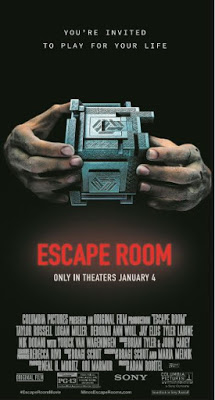
Horror Film Review: Escape Room (dir by Adam Robitel)


Does everyone here remember Escape Room?

Though it may be hard to believe now, Escape Room was actually the first surprise hit of 2019.  When the film was first released on January 4th, nobody expected much from it.  January, of course, is when the year’s worst movies are usually released.  The studios figure that they can get rid of their disasters while everyone’s busy trying to predict the Oscar nominees and usually, the studios are correct.  The ad campaign for Escape Room made it look like just another slasher movie, the mainstream reviewers were, as they tend to be with January horror movies, unimpressed and I don’t think anyone expected the film to make a dent in the box office.

And yet, in the end, Escape Room did pretty well for itself at the box office.  Not only did it open stronger than expected but it remained fairly strong (at least by the standards set by previous January horror films) during its second week of release.  The film managed to hold its own opposite Aquaman, which had pretty much drowned every other competitor.  A sequel was quickly greenlit.

What drew people to Escape Room?  I think it was the title.  For a while, people were genuinely obsessed with the idea of escape rooms.  For those who have a life outside of the internet, an escape room is a game in which a group of people are locked in a room and have to figure out how to get the door unlocked.  This usually involves searching the room, gathering clues, and figuring out a password or something similar.  Personally, I’ve never done the whole escape room thing and, being that I’m rather claustrophobic, I doubt that I ever will.  Add to that, I absolutely suck at solving puzzles so I imagine that I would be trapped in that room for a long time!  However, there are other people who absolutely love escape rooms and I imagine that every single one of them went to see this movie.

Escape Room is about a group of people who all receive a mysterious imitation, inviting them to an escape room and promising $10,000 to whomever wins.  Among those involved, there’s Zoey (Taylor Russell), who is a college student.  She’s studying physics so we automatically know that she’s going to be our hero.  Ben (Logan Miller) is a stockboy and is just bland enough to be a potential romantic interest for Zoey.  Mike (Tyler Labine) drives a truck.  Jason (Jay Ellis) is rich and, therefore, evil.  Danny (Nik Dodani) is the geeky escape room expert.  And Amanda (special guest Deborah Ann Woll) is the Iraq war veteran.  They’re a group of smart people but it apparently didn’t occur to anyone to just stay home for the weekend.  I mean, $10,000 is not that much.

Anyway, it turns out that the escape room isn’t just one room.  Instead, it’s several rooms and each room requires the group to solve a different puzzle.  Each room is also designed to potentially kill.  One heats up like an oven.  Another features a frozen pond, specifically designed to allow a player to fall through the ice.  Another room looks like an operating room from Hell.  My favorite room was the upside down pool hall with the floor/ceiling that started to break up as soon as the group entered.  That was fun.

Of course, it turns out that everyone playing the game has a secret in their past and each room has been designed to force them to confront those secrets.  Eventually, it’s revealed who is behind all of this and it’s not a shock at all.  In fact, Escape Room‘s final scenes are probably the film’s worst because the movie doesn’t really have a conclusion.  Instead, the filmmakers might as have just slapped a big “To Be Continued” across the screen.

Oh well!  Flaws and predictability aside, Escape Room is actually kind of fun.  The characters are all pretty much disposable but the actors all do their best with the material that they’ve been given.  Of course, the film’s main attraction is the chance to see all the various rooms and discovering how they’ve been booby trapped.  Fortunately, each room is fascinating in its own individual way and the puzzles are genuinely challenging.  (I would have totally died if I was in this movie.)

Escape Room is a decent enough way to spend 100 minutes.

Horror on the Lens: Nosferatu (dir by F.W. Murnau)


Today’s Horror on the Lens is a classic film that really needs no introduction!  Released in 1922, the German silent film Nosferatu remains one of the greatest vampire films ever made.  It’s a film that we share every October and I’m happy to do so again this year!

Enjoy!

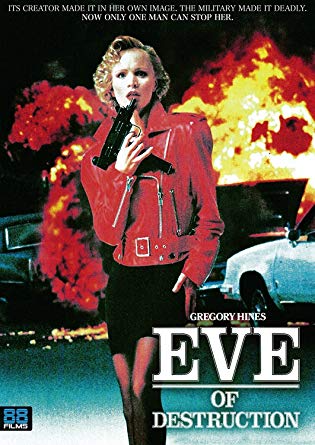
Terminator Redux: Eve of Destruction (1991, directed by Duncan Gibbins)


When Eve VIII (Renée Soutendijk), a robot that has been designed so that she can pass for a human, is taken on a test run though the city, things go terribly wrong when she gets caught up in a bank robbery.  When one of the robbers shoots her, it scrambles her circuits and causes her to switch into combat mode.  For some reason, someone thought it would be a good idea to install the equivalent of a nuclear bomb inside the robot so now, Eve VIII is wandering around the city, killing anyone who shes views as being a danger, and threatening to send both herself and everyone up in a nuclear fireball.

Realizing that Eve VIII’s test run has become a national emergency, the military calls in the best operative they’ve got and he turns out to be … Gregory Hines!?  The legendary Broadway song-and-dance man plays Colonel John McQuade, a special operative who has seen action in all of the world’s hot spots.  McQuade works with Eve VIII’s creator, Dr. Eve Simmons (also played by Renée Soutendijk) to try to track down the robot before it’s too late.  In a move that makes as much sense as installing the equivalent of a nuclear bomb inside of her, Eve VIII has also been programmed to have the same traumatic memories as her creator.  When Eve VIII destroys a cheap motel that Eve Simmons used to wonder about, McQuade announces that the key to trapping the robot is for Dr. Simmons to reval all of her “teenage sexual fantasies!”

The idea of a robot having and acting upon all of the repressed memories and desires of its creator is a good one but Eve of Destruction doesn’t do much with it.  Once McQuade and Dr. Simmons head off in pursuit of Eve VIII, it becomes just another low-budget Terminator rip-off.  Gregory Hines deals with being miscast by yelling all of his lines.  Renée Soutendijk does better as both Eve VIII and Dr. Simmons and even manages to generate some sympathy for the killer robot.  Interestingly, Soutendijk is best known for her work with Paul Verhoeven, whose RoboCop was an obviously influence on Eve of Destruction.

Eve of Destruction is a forgettable killer robot film from an era that was full of them.  Most disappointing of all is that Barry McGuire is nowhere to be heard.  If you do see the film, keep an eye out for the great Kevin McCarthy, playing yet another befuddled victim and, for some reason, going uncredited.

Scenes That I Love: Jonathan Harker Meets A Vampire Bride in Horror of Dracula


Today’s horror scene that I love comes from the classic 1958 British film, Horror of Dracula.  Horror of Dracula was not only one of my favorite horror films but iit was also a favorite of Gary’s as well and, as I spend today considering how best to honor his memory and his love of cinema, sharing a scene from this film just feels very appropriate.

Horror of Dracula was not only the film that introduced the world to Christopher Lee as Dracula but it was also the film that, for lack of a better term, “rebooted” the whole Dracula legend.  It was the film that showed that Dracula could still be intriguing and frightening in the modern era.  Even more so than the original Dracula starring Bela Lugosi, the Hammer Dracula films — and Lee’s performance as Dracula — have influenced every vampire film that has come out since.

In this scene, Jonathan Harker (John Van Eyssen) leaves his room at Castle Dracula and runs into one of Dracula’s brides (Valerie Gaunt).  Lee’s Dracula doesn’t make an entrance until towards the end of the scene but what an entrance it is!

This scene epitomizes everything that made the Hammer Dracula films so memorable.  You’ve got sex, horror, and Christopher Lee playing Dracula.  What had before merely been the subtext in previous vampire films was revealed by Hammer in all of its glory.

Enjoy!

A Blast From The Past: Responsibility (dir by Herk Harvey)


Director Herk Harvey

The year is 1953 and a rural high school — maybe one that’s a lot like yours — is in chaos!

That’s the idea behind Responsibility, a short film that was apparently designed to make students think about the importance of …. well, responsibility.  Narrated by a rather judgmental principal, Responsibility tells the story of two teenagers.  Lloyd is responsible and mature and boring and probably is destined for a middle management job at the local feed store.  Hank is a new student with a chip on his shoulder and a haircut that screams “trouble.”  Hank is irresponsible but charismatic and, in the real world, there’s absolutely no question who would be the more popular of the two.

However, this is a short film from the 50s so we’re thrown into this weird fantasy world where students actually give serious thought to their options before voting in student elections.  It’s a world where everyone might like Hank better but they just can’t forgive him for blowing off class and losing the big debate tournament.  It’s world where boring old Lloyd could possibly be a more appealing choice than a rebel in a leather jacket.

Lloyd and Hank are friends but that doesn’t stop them from both running for president of the student body.  The initial vote is tied but there is one absentee ballot.  That ballot will determine who will become the new president — unless, of course, the absentee student has a sense of humor and wrote in their own name, like I always used to do.

“Who would you vote for?” the principal asks.

Me?  Why, Gary Johnson, of course!

This is yet another educational short film from Herk Harvey.  Harvey made a career out of doing films like this but, today, he’s best remembered for directing the classic horror film, Carnival of Souls.  We’ll be watching Carnival of Souls later this month.  For now, enjoy Responsibility and ask yourself …. “Who would you vote for?”

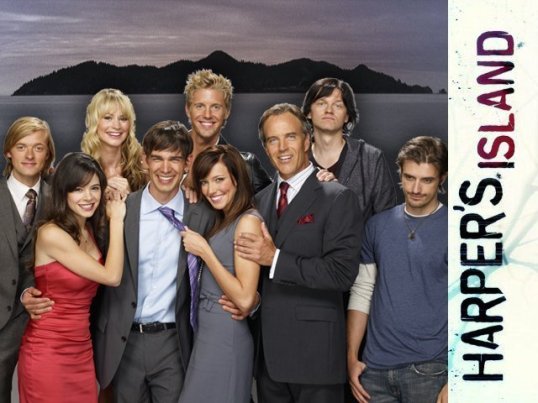
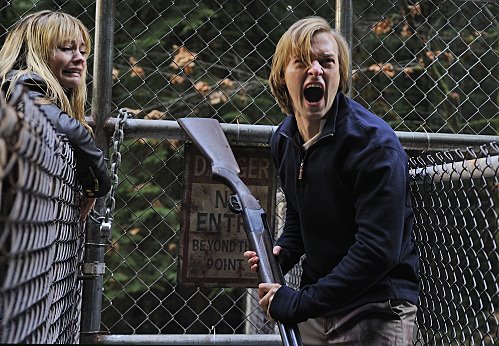
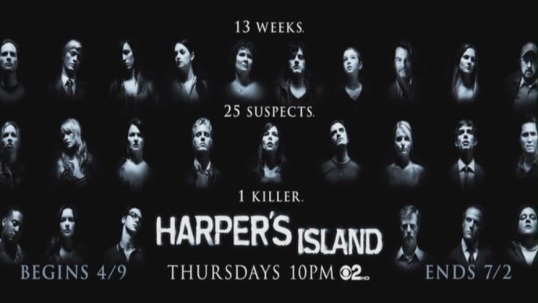
Guilty Pleasure No. 42: Harper’s Island


Oh my God, do you remember Harper’s Island!?

Way before The Walking Dead and American Horror Story made death and gore safe for mass consumption, Harper’s Island was the scariest show on television.  I have to admit that, when I first heard about the show, I wasn’t expecting it to be.  Way back in 2009, whenever the commercials for the show would air and that little girl would go, “One by one,” I would roll my eyes so hard that I once nearly gave myself a concussion.

“Really?” I would say, “A slasher television show where at least one person dies every week?  And it’s going to be on network TV?  There’s no way this is going to be bloody or scary enough to be worth watching.”

However, I did watch the first episode because I figured that I could at least be snarky about it on twitter.  (I had joined just a few months before the show premiered.  Harper’s Island was the first show that I ever live tweeted, even though I didn’t even know that there was such a thing as “live tweeting” way back then.)  The episode opened with a man tied to the propeller of a boat, screaming as the engine started.  The episode ended with Uncle Marty (played by special guest star Harry Hamlin) getting chopped in half by an unseen assailant.

“AGCK!” I said.

I was hooked from that episode on.


Believe it or not, Harper’s Island wasn’t just killings.  It actually did tell a story, about a young woman named Abby (played by Elaine Cassidy) who returns to her childhood home, on Harper’s Island, for her best friend’s wedding.  Many years ago, Abby’s mother was among those who was killed by a serial killer named John Wakefield.  From the minute that Abby arrives, she feels that something bad is going to happen and it turns out that she’s right.

Of course, Abby’s not the only one on the island.  There’s the other members of the wedding party.  There’s the island’s inhabitants, the fishermen and the deputies and the cafe owner and the local reverend whose destined to lose his head in the woods.  They’ve all got their quirks and subplots.  Boisterous Malcolm (Chris Gauthier) is in desperate need of money.  Local fisherman Jimmy (C.J. Thomason) is still in love with Abby.  The groom, Henry (Christopher Gorham), has issues from his past that he needs to deal with.  Some of them are likable.  Some of them are annoying.  Some of them, like spoiled Chloe (Cameron Richardson), are meant to be annoying but become likable as the series progresses.

And, in the end, none of their hopes and dreams really mattered because, by the end of the show, everyone was pretty much dead.  The ads for Harper’s Island promised a bloodbath and that’s what the show delivered.  It wasn’t just that at least one person died per week.  It was also that they usually died in the most macabre and disturbing ways possible.  This was the type of the show where the most likable groomsman ended up getting chopped into pieces and then tossed into an incinerator.  Another wedding guest chose to drown herself rather than be attacked by the killer.  Sometimes, the killers didn’t even have to be around for someone to get killed.  Who can forget poor Booth (played by Sean Rogerson), accidentally shooting himself in the leg and bleeding out while America watched?

And yes, you did watch every week because you wanted to see who would be the next to die.  (That’s where the guilty part of the pleasure comes in.)  But you also watched because the show was produced and directed so well.  The island was a wonderfully atmospheric location and the cast really committed themselves to bringing the show’s morbid reality to life.  At the time, it was the darkest show on television and it could have been even darker because, originally, the plan was for the killer to get away with it.  In the end, karma caught up with the killer but not before we were all traumatized upon discovering just who was responsible.  Harper’s Island‘s mystery was as intriguing as its deaths were bloody.

Being ahead of its time, Harper’s Island struggled in the ratings and it was never a big hit with critics.  But, with the help of Netflix and the the occasional marathon on SyFy, Harper’s Island‘s reputation has improved and grown over the years.  Looking back, it’s easy to see that Harper’s Island was not only the forerunner to American Horror Story but it was also a far better series.  American Horror Story tends to condescend to the horror, keeping the genre at arm’s length through misdirected pretension.  It’s a show for people who think that they’re too good for horror.  Harper’s Island, on the other hand, fully embraced both the horror and the melodrama and it did so without apology.

Seriously, what Halloween is complete without a trip to Harper’s Island?

Previous Guilty Pleasures

  1. Half-Baked
  2. Save The Last Dance
  3. Every Rose Has Its Thorns
  4. The Jeremy Kyle Show
  5. Invasion USA
  6. The Golden Child
  7. Final Destination 2
  8. Paparazzi
  9. The Principal
  10. The Substitute
  11. Terror In The Family
  12. Pandorum
  13. Lambada
  14. Fear
  15. Cocktail
  16. Keep Off The Grass
  17. Girls, Girls, Girls
  18. Class
  19. Tart
  20. King Kong vs. Godzilla
  21. Hawk the Slayer
  22. Battle Beyond the Stars
  23. Meridian
  24. Walk of Shame
  25. From Justin To Kelly
  26. Project Greenlight
  27. Sex Decoy: Love Stings
  28. Swimfan
  29. On the Line
  30. Wolfen
  31. Hail Caesar!
  32. It’s So Cold In The D
  33. In the Mix
  34. Healed By Grace
  35. Valley of the Dolls
  36. The Legend of Billie Jean
  37. Death Wish
  38. Shipping Wars
  39. Ghost Whisperer
  40. Parking Wars
  41. The Dead Are After Me

4 Shots From 4 Films: The Beyond, The House By The Cemetery, The Howling, Possession


4 Shots From 4 Films is just what it says it is, 4 shots from 4 of our favorite films. As opposed to the reviews and recaps that we usually post, 4 Shots From 4 Films lets the visuals do the talking!

This October, we’re using 4 Shots From 4 Films to look at some of the best years that horror has to offer!

4 Shots From 4 1981 Horror Films

The Beyond (1981, dir by Lucio Fulci)

The House By The Cemetery (1981, dir by Lucio Fulci)

The Howling (1981, dir by Joe Dante)

Possession (1981, dir by Andrzej Zulawski)