Horror Film Review: Daughter of Dracula (dir by Jesus Franco)


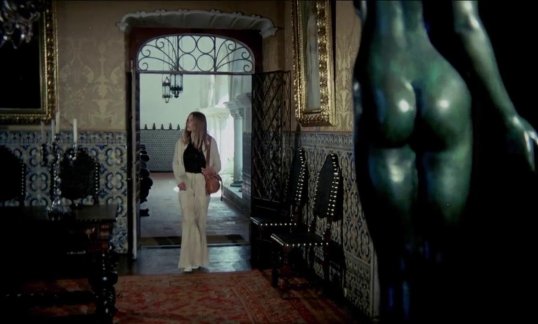
In a town off the coast of Spain, women are being murdered and their bloodless bodies left on the beach. A journalist named Charlie (Fernando Bilbao) investigates and discovers that the locals are convinced the killings are the work of a supernatural entity. Meanwhile, the aristocratic Karlstein family gathers at a chapel where the dying Countess Karlstein gives her daughter, Louisa (Britt Nichols), the key to the basement. There, Louisa discovers not only Count Dracula (Howard Vernon) but also her vampirized cousin and lover, Karine (Anne Libert).

The Karlstein family is under a vampire curse. Or maybe they’re not. It’s not always easy to follow this film’s logic. The Countess’s personal secretary (played by the film’s director, Jess Franco) is convinced a curse is at work, but Count Karlstein (Daniel White) appears to be not a vampire but simply a typical self-indulgent aristocrat. (Indeed, it’s sometimes hard to figure out how exactly Dracula ended up in the basement to begin with.) Count Karlstein is also a leading suspect in the murders. He has an alibi for at least one of them, but revealing it would mean admitting he’s been having an affair with Ana (Yelena Samarina), the secretary’s wife…

Yes, this is indeed a Jess Franco film. Even if you didn’t already know, the long, languid (and occasionally out-of-focus) shots of the Spanish beach would give it away. This was one of the eight films Franco shot in 1972, and the storyline has that incomplete feeling that often comes from a rushed production. Franco clearly had a few elements he either wanted or was contractually obligated to include: vampires, lesbians, and decadent aristocrats. A coherent plot doesn’t appear to have been a major concern. Daughter of Dracula has an improvised feel, as if Franco was making the story up as he went along. I suspect that’s exactly what he was doing.

And yet, as was often the case with Franco’s work (especially in the early ’70s), the loose structure and nonsensical plot actually work to the film’s advantage. There’s a dream-like quality to the action, one in which everyone seems to be moving either too slowly or too quickly. The atmosphere of ennui is inescapable. The Karlsteins are an aristocratic family trapped in an inescapable state of decay, and one could argue they’re meant as a stand-in for Old Europe, already being challenged by the ’70s counterculture. That decay is mirrored in Howard Vernon’s world-weary Dracula. Both the Karlsteins and Dracula are creatures from a different age who have found themselves in a rapidly changing Europe. When this film was made, Spain was still ruled by General Francisco Franco, but even he seemed to understand that his time was coming to an end.

Daughter of Dracula is ultimately a lesser Franco film. The version I saw ran a little over 70 minutes and still felt a bit too slow for its own good. It never reaches the decadent heights of Female Vampire or A Virgin Among the Living Dead. That said, Howard Vernon is always entertaining, and the film definitely sprang from the mind of Jess Franco. For better or worse, there was no other filmmaker like him.

International Horror Review: A Virgin Among The Living Dead (dir by Jess Franco)


This 1973 Spanish-French-Italian production’s title is both its greatest strength and also its greatest weakness.

On the one hand, it’s impossible to forget a title like A Virgin Among the Living Dead.  It’s a title that mixes both horror and sex, which are two things of which audiences simply cannot get enough.  On the other hand, this is a a Jess Franco film and the title — which is so blatant and over-the-top — sounds like it could almost be a parody of Franco’s “unique” style of film-making.  If you were coming up with a fake Franco film, you would probably give it a title that sounded a lot like “A Virgin Among the Living Dead.”  A Virgin In The Castle of Dr. Orloff, perhaps.

Interestingly enough, Franco absolutely hated the film’s title.  It, and quite a few other titles, were slapped onto the film by distributors who were apparently unconcerned with the fact that the film was not meant to be one of Franco’s typical, give-me-my-paycheck exploitation films.  Franco’s title for the film was Night of the Shooting Stars, which is a bit bland but perhaps also a bit more honest.  Incidentally, the film was also released under the titles Christina, Princess of Eroticism and The Erotic Dreams of Christina, which again were titles that Franco disliked.

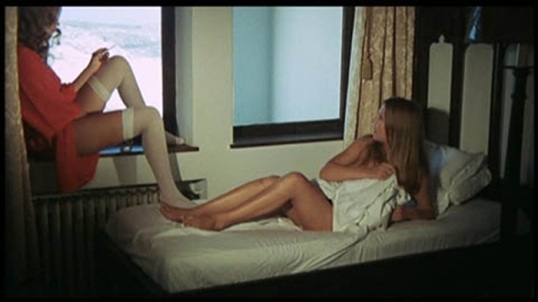
In the version I saw (and, admittedly, there’s several versions floating around), it’s never even stated that the film’s frequently unclothed protagonist, Christina (Christina von Blanc), is a virgin.  When compared to the other decadent members of her family, she certainly is innocent.  For instance, she doesn’t drink blood or engage in strange purification rituals.  When the cheerfully cynical Uncle Howard (Howard Vernon, because this is a Franco film, after all) plays a waltz while another member of the family is dying upstairs, Christina is properly shocked.  But, at no point, is Christina identified as being a virgin.

In fact, Christina is rather uninhibited, nonchalantly greeting strangers (and a rather creepy servant, played by Franco himself) in her underwear, sleeping naked in a room with an unlocked door, and later casually skinny dipping in a nearby swamp.  (When she’s informed that two wide-eyed townspeople were watching her from a nearby hill, she shrugs it off.)  Perhaps she’s meant to be an Eve-like character, unaware of sex or her nudity until she eats from the tree of knowledge.  Am I giving too much credit to Jess Franco?  As is often the case with Franco, it’s hard to say.

As far as the film itself goes …. well, the plot isn’t always easy to follow.  Christina has come to her family’s ancestral home for the reading of her dead father’s will.  Her father hanged himself and, though he’s dead, he keeps showing up.  Christina immediately discovers that the other members of her family are collection of rogues, eccentrics, and blood drinkers.  She also eventually learns that all the members of her family are the living dead and that they’re all worried that Christina will make them leave the estate.  Or are they?  Is Christina just dreaming all of this or is it really happening?  Is the Queen of Night really coming to claim everyone’s soul or is that just a part of Christina’s hallucinations?

A Virgin Among The Living Dead features all of Franco’s usual directorial quirks.  The story rambles.  Franco alternates between scenes of surreal beauty and scenes of almost indifferent framing.  At times, the score is hauntingly ominous and then, at other times, it sounds like it was lifted from a 70s porno.  Christina comes across as being a beautiful blank but Howard Vernon is memorably perverse as Uncle Howard and all the members of the family are amusingly decadent.  For once, though, all these quirks work to the film’s advantage, creating a surreal dreamscape that truly does seem to exist in a land between life and death.  A Virgin Among The Living Dead truly does become a work of pure cinema, one in which the the visuals and the mood become the narrative as opposed to the film’s story itself.

Franco may have hated the title that was slapped on it but this is actually one of his better films.  Unfortunately, how you react to the film will probably depend on which version you see.  There are several floating around, some of which feature hardcore inserts that were filmed by other directors.  There’s another version that features extra zombie footage that was filmed by Jean Rollin.  The Redemption Blu-ray features Franco’s cut of the film, with no hardcore or extra zombie footage.  That said, the scenes that Rollin shot are included as an extra.  Personally, I like Rollin’s zombie footage but, at the same time, I can also see how its inclusion would have destroyed the film’s already deliberate pace.

(And, of course, it goes without saying that I’m opposed to producers inserting extra scenes into any film, especially when that footage wasn’t directed by the original director.)

Anyway, A Virgin Among The Living Dead never reaches the existential heights of Female Vampire but it’s still one of Franco’s “good” films.  Even if he did hate the title….