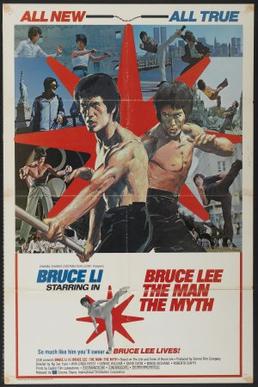
Bruce Lee: The Man, The Myth (1976, directed by Ng See-yuen)


In 1958, a Hong Kong teenager named Bruce Lee (played by Ho Chung-tao, credited under the name Bruce Li) is upset that his mother is forcing him to go to college in America.  His martial arts instructor assures Bruce that he is meant for great things and encourages him to bring his philosophy of life to all of the people of the world.

In America, Bruce finds fame as a martial arts instructor and he pursues a career as an actor.  However, everywhere he goes, he’s told that no major American studio would ever be willing to invest money in an “unknown Chinese actor.”  Bruce finds brief fame with a supporting role on The Green Hornet but his Hollywood prospects sputters when he announces that he refuses to play any demeaning stereotypes.  Taking control of his own career, Bruce returns to Hong Kong and produces his own films.  He becomes an international superstar before dying under mysterious circumstances at the age of 32.

Following the death of the real-life Bruce Lee, there were hundreds of martial arts films released that featured look-alike actors who were credited with names like Bruce Ly, Bruce Lei, Bruce Lai, and Bruce Le.  These films often featured Lee either fighting the Tongs or some other sort of international conspiracy.  Many of them also speculated about the cause of his death or flat out presented Lee as having faked his death in order to escape from his enemies.  (Typically, these films would feature at least some footage of Lee’s funeral and the real Bruce Lee lying in his coffin.)  So many of these films were released that they eventually were grouped under their own genre, Bruceploitation.

Of the faux Bruces who appeared in Bruceploitation films, Ho Chung-tao was the most successful.  Credited as Bruce Li, he not only bore a strong physical resemblance to Bruce Lee but he was also one of the few Bruce imitators to have any on-screen charisma as well.  Bruce Li may not have been Bruce Lee but, of the imitators, he was the best.  (He was also one of the most frequently frustrated, retiring from acting at the age of 40 because he was sick of only being allowed to play Bruce Lee.)

Bruce Lee, The Man, The Myth is a generally straight-forward biopic.  It covers all of the big events of Lee’s life and, unlike a lot of other Bruceploitation films, it mostly sticks to the facts.  That doesn’t mean that there aren’t a lot of fights to be found in this film.  Lee is constantly getting into fights but, for the most part, they’re just with people who want to challenge the great Bruce Lee and see if he’s really as impressive as everyone says that he is.  Other than a strange but fun scene where Bruce is approached by the daughter of a mafia boss, this film does not portray Lee as being a crime fighter or a secret agent.  Like many Bruceploitation film, this movie hints that Lee faked his own death but, in the version I saw, a narrator dismisses the reports of Lee’s survival as just being rumors.  (The narrator also says that if Bruce is still alive, he’ll emerge from hiding in 1983.  Draw your own conclusions.)

Bruce Lee, The Man, The Myth is an entertaining biopic.  When it comes to a Bruceploitation flick, all that most people really ask for is that the Bruce imitator be convincing and that the fights be exciting.  On both counts, Bruce Lee, The Man, The Myth delivers.

Original Gangstas (1996, directed by Larry Cohen)


Original Gangstas opens with shots of the deserted streets and burned-out store fronts of Gary, Indiana and narration telling us how a once great American city came to be in such disrepair.  The steel plant closed and put much of the city out of work.  While the politicians and the police looked the other way, violent street gangs rose up and took over entire neighborhoods.  Now, Gary is a shell of its former self.  Even the local movie theater has closed down.  The narrators tells us that the last movie to play at the theater was Star Wars.

Led by Spyro (Christoper B. Duncan) and Damien (Eddie Bo Smith, Jr.), the Rebels are the most feared and powerful gang in Gary.  They rule through violence and intimidation.  Talk to the police and your business is liable to get torched and you’re likely to get shot.  However, Spyro and Damien have finally gone too far and now, two men who previously escaped from Gary are returning to town to dish out some justice.

John Bookman (Fred Williamson) is a former football player who wants to avenge the shooting of his father.  Jake Trevor (Jim Brown) is a boxer who once killed a man in the ring and who wants revenge for the death of his son.  When they were young men, John and Jake were the original Rebels and now they’re getting the old gang back together again.  With the help of Laurie (Pam Grier), Bubba (Ron O’Neal), and Slick (Richard Roundtree), the original gangstas are going to take back the streets of Gary.

Original Gangstas was released at a time when, largely thanks to the influence of Quentin Tarantino, people were just starting to feel nostalgic for the old blaxploitation movies.  The main appeal of the film, not surprisingly, is that it brings together so many of the great blaxploitation stars and sets them loose in what was then the modern era.  (Jim Kelly is missed.)  When John and Jake talk about how they’re responsible for the Rebels, they could just as easily be talking about how they’re responsible for both all of the independent crime films that came out in the wake of Reservoir Dogs and Pulp Fiction.

Original Gangstas is a tribute to both the Blaxploitation genre and the oversized personalities that made that era so memorable.  Neither Fred Williamson, Jim Brown, nor Richard Roundtree were particularly good actors but they all had so much screen presence and such an innate sense of cool that it didn’t matter whether they could convincingly show emotion or not.  (Original Gangstas gives all of the big dramatic scenes to Pam Grier, who was not only naturally cool but a damn good actress to boot.)  The minute Fred Williamson lights his cigar, he control the entire movie.  He and Jim Brown make a good team and Original Gangstas is an entertaining and violent trip down memory lane.

Kirk Douglas, R.I.P.


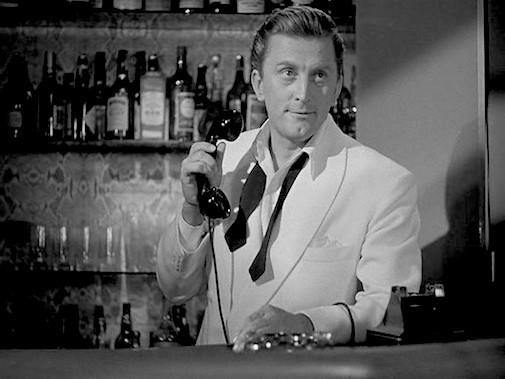
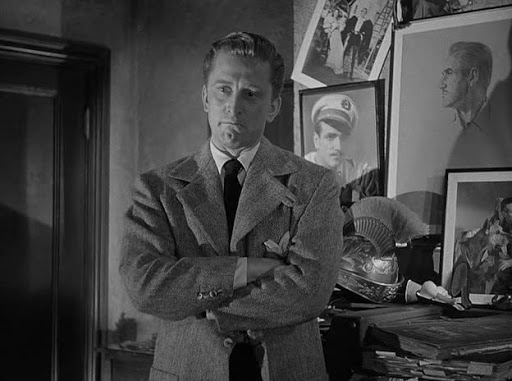
Kirk Douglas passed away today in Beverly Hills, California.  He was 103 years old.

Kirk Douglas was one of the last surviving stars of Hollywood’s Golden Age.  Douglas began his career in the 40s and he made his last film appearance in 2008.  Interestingly enough, that final appearance was in a film that was made for French television, called The Empire State Building Murders.  The film was meant to be a mockumentary and a tribute to old detective and crime films of the 40s.  It was full of archival footage of Douglas contemporaries like James Cagney, Edward G. Robinson, and Lauren Bacall.  Douglas played a character named Jim Kovalski.  As a result of a stroke that he suffered in 1996, Douglas did not speak in the film but his very presence was powerful just because he was Kirk Douglas and he was still with us.  Even though he was noticeably frail, Kirk Douglas remained an icon.

Indeed, if there was any Golden Age star that you would have expected to reach 100, it would have been Kirk Douglas.  Douglas played several different characters over the course of his career but almost all of them had one thing in common.  They were all tough.  On screen, Kirk Douglas always came across as someone who laughed at death.  One could imagine the Grim Reaper showing up at his front door and Douglas simply saying, “Get the Hell out of here.”  If anyone could bully Death into submission, it would have been Kirk Douglas.

Kirk Douglas was a survivor.  In several interviews, he described himself as being a “tough son of a bitch.”  Kirk Douglas was not the type to allow himself to be pushed around and the fact that he even had a career in Hollywood during the studio system is kind of amazing.  It wasn’t just that Douglas had a reputation for not suffering fools.  It’s also that Douglas was an actor who was willing to put his career on the line for what he believed in.  By not only hiring Dalton Trumbo to write the script for Spartacus but also giving him onscreen credit, Douglas has been credited with helping to bring the blacklist to an end.  At the height of his stardom, Douglas appeared in Stanley Kubrick’s antiwar film, Paths of Glory.  He stood up for the state of Israel and defended it against it’s most vehement critics, even rebuking his friend Jimmy Carter at one point.

What’s my favorite Kirk Douglas performance?  In Spartacus, Douglas made “I am Spartacus” a rallying cry for revolutionaries everywhere.  In Ace In the Hole, he was the perfect representation of an amoral journalist.  Playing a gangster, he was both charming and dangerous in the classic film noir, Out of the Past.  Lust for Life was an imperfect film but he gave a strong performance as Van Gogh.  Paths of Glory featured Douglas at his most compassionate and outraged.  Later in his career, he starred in the campy but entertaining Holocaust 2000.  That said, my favorite Kirk Douglas film remains The Bad and The Beautiful, which is one of the best films ever made about Hollywood.  Douglas played a real heel in The Bad and the Beautiful and, watching the film, you get the feeling he loved every minute of it.

Kirk Douglas’s death is not really a shock.  When he appeared at the Golden Globes in 2017, he was noticeably frail.  With his passing, though, we’ve lost a true icon of American cinema and one of the last living links to the Golden Age of Hollywood.

Kirk Douglas, R.I.P.

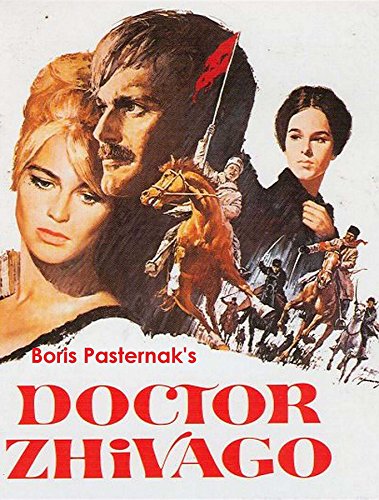
Lisa Reviews An Oscar Nominee: Doctor Zhivago (dir by David Lean)


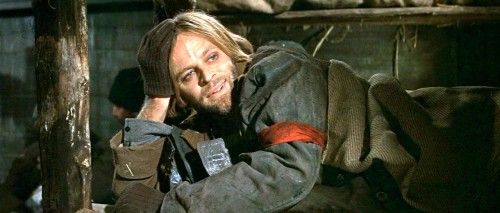
Klaus Kinski is the main reason to watch the 1965 film, Doctor Zhivago.

The legendarily difficult and erratic Mr. Kinski shows up about halfway through this 3-and-a-half hour film.  He plays a cynical and unstable prisoner on a train.  The train is full of passengers who are escaping from Moscow and heading for what they hope will be a better and more stable life in the Ural Mountains.  (The film takes place during the Communist revolution and the subsequent purges.)  That Kinski taunts everyone on the train is not a surprise.  Both Werner Herzog and David Schmoeller (who directed Kinski in Crawlspace) have made documentaries in which they both talked about how difficult it was to work with Kinski and how several film crews apparently came close to murdering Klaus Kinski several times throughout his career.

Instead, what’s surprising about Kinski’s performance is that he’s even there to begin with.  Doctor Zhivago is an extremely long and extremely stately film.  It’s one of those films where almost every actor gives a somewhat restrained performance.  It’s a film where almost every shot is tastefully composed and where the action often slows down to a crawl so that we can better appreciate the scenery.  It’s a film that stops for an intermission and which opens with a lengthy musical overture.  In short, this is a film of old school craftsmanship and it’s the last place you would expect to find Klaus Kinski luring about.

When he does show up, you’re happy to see him.  Even though he’s only onscreen for about five minute, Kinski gives the film a jolt of much-needed energy.  After hours of watching indecisive characters talk and talk and talk, Kinski pops up and basically, “Screw this, I hate everything.”  And it’s exciting because it’s one of the few time that Doctor Zhivago feels unpredictable.  It’s one of the few times that it feels like a living work of art instead of just a very pretty but slightly stuffy composition.

Just from reading all that, you may think that I don’t like Doctor Zhivago but that’s actually not the case. It’s a heavily flawed film and you have to be willing to make a joke or two if you’re going to try to watch the whole thing in just one sitting but it’s still an interesting throwback to a very specific time in film history.  Doctor Zhivago was designed to not only be a spectacle but to also convince audiences that 1) TV was worthless and that 2) Hollywood craftsmanship was still preferable to the art films that were coming out of Europe.  At a time when television and independent European cinema was viewed as being a real threat to the future of the film industry, Doctor Zhivago was a film that was meant to say, “You can’t get this on your black-and-white TV!  You can only get this from Hollywood where, dammit, people still appreciate a good establishing shot and treat the production code with respect!”  Even today, some of the spectacle is still impressive.  The beautiful shots of the countryside are still often breath-taking.  The scenes of two lovers living in an ice filled house are still incredibly lovely to look at.  The musical score is still sweepingly romantic and impressive.

It’s the story where the film gets in trouble.  Omar Sharif plays Yuri Zhivago, a doctor and a poet who falls in love with Lara (Julie Christie) while Russia descends into chaos.  The Czar is overthown.  The communists come to power and prove themselves to be just as hypocritical as the Romanovs.  The revolutionary Pasha (Tom Courtenay, bearing a distracting resemblance to Roddy McDowall) is in love with Lara and helps to bring about the revolution but is then declared an enemy of the people during the subsequent purges.  The craven Komarovsky (Rod Steiger) also wants to possess Lara and he’s so corrupt that he manages to thrive under both the Czar and the communists.  Alec Guinness plays Yuri’s half-brother and is the most British Russian imaginable.  Doctor Zhivago is based on a Russian novel so there’s a lot of characters running around and they’re all played by a distinguished cast of international thespians.  However, none of them are as interesting as the scenery.

As for the two main actors, Omar Sharif and Julie Christie convince you that they’re in love but not much else.  Sharif is never convincing as a poet and he feels miscast as a man who spends most of his time thinking.  Reportedly, Lean’s first choice for the role was Peter O’Toole and it’s easy to imagine O’Toole in the part.  But O’Toole had already done Lawrence of Arabia with Lean and didn’t feel like subjecting himself to another year of Lean’s notoriously prickly direction.  So, the role went to O’Toole co-star, Sharif.   Julie Christie turned down Thunderball to do both this film and Darling, for which she would subsequently win an Oscar.

(Speaking of the Oscars, Doctor Zhivago was nominated for Best Picture and, though it won five other Oscars, it lost the big prize to The Sound of Music, of all things.  1965 really wasn’t a great year for the Oscars.  The only 1965 Best Picture nominee that still feels like it really deserved to be nominated is Darling.  Of the other nominees, Ship of Fools is ponderous and A Thousand Clowns is almost unbearably annoying.  And The Sound of Music …. well, I prefer the Carrie Underwood version.)

Doctor Zhivago is a big, long, epic film.  It’s lovely to look at and it has a few nice scenes mixed in with a bunch of scenes that seem to go on forever.  In the conflict between the state and the individual, it comes down firmly on the side of the individual and that’s a good thing.  (The communist government attempts to suppress Yuri’s love poems because they celebrate the individual instead of society.  And though the government might be able to destroy Yuri’s life, they can’t destroy his spirit.  Again, it’s a message that would have worked better with a more thoughtful lead actor but still, it’s a good message.)  It’s a flawed film but watch it for the spectacle.  Watch it for Klaus Kinski.

Lisa’s Way, Way, Way, Way, Way, Way, Way Too Early Oscar Predictions For February


It’s a fool’s errand to try to predict next year’s Oscars nominees this early but we’re all about taking risks here at the Shattered Lens.  So, with that in mind, here is my latest set of monthly predictions.

If you look over these names, you’ll see a lot of familiar ones.  That’s because it’s early in the year and familiarity is really the only thing that a lot of these unreleased films have going for them.  Some of the films mentioned below were hits at Sundance.  From what I’ve read, I really do think Minari could be a contender because, along with being loved by critics, it sounds like it’s very much of the current cultural moment.

But the important thing to remember is that, last year at this time, no one expected Joker to become the film of the year.  No one had even heard of Parasite.  Most people were still predicting the Oscars would be dominated by Harriet.  So, my point is — take this stuff with several grains of salt.

To be honest, I think a lot depends on how the presidential election goes.  If Trump is reelected, I think you’ll see the Academy voting for angry, political films, if just as a way to get back at Trump and the people who voted for him.  (Think about the otherwise baffling love that was previously shown to a movie like Vice.)  The Trial of the Chicago 7 sounds incredibly tedious to me but I could imagine people voting for it and thinking to themselves, “This is so going to piss off the Republicans.”  If Trump is defeated, I imagine the Academy will be a bit more upbeat in their selections.

If you want to see how my thinking has evolved, check out my predictions for January here!    (It’s only been a month so my thinking hasn’t really evolved at all.  Still, we could always use the clicks.)

Best Picture

Dune

Happiest Season

Hillybilly Elegy

Ironbark

Minari

News of the World

Respect

Stillwater

The Trial of the Chicago 7

West Side Story

Best Director

Isaac Lee Chung for Minari

Paul Greengrass for News of the World

Ron Howard for Hillybilly Elegy

Steven Spielberg for West Side Story

Denis Villeneuve for Dune

Best Actor

Benedict Cumberbatch in Ironbark

Matt Damon in Stillwater

Tom Hanks in News of the World

Anthony Hopkins in The Father

Will Smith in King Richard

Best Actress

Amy Adams in Hillbilly Elegy

Olivia Colman in The Father

Clare Dunne in Herself

Jennifer Hudson in Respect

Angelina Jolie in Those Who Wish Me Dead

Best Supporting Actor

Bo Hopkins in Hillbilly Elegy

Merab Ninidze in Ironbark

Mark Rylance in The Trial of the Chicago 7

Forest Whitaker in Respect

Steven Yeun in Minari

Best Supporting Actress

Abigail Breslin in Stillwater

Glenn Close in Hillybilly Elegy

Vera Farmiga in The Many Saints of Newark

Mary Steenburgen in Happiest Season

Helena Zengel in News of the World

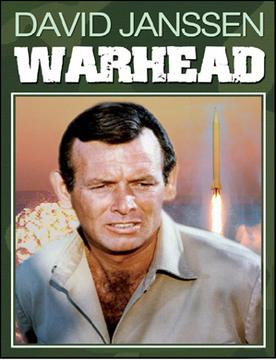
Warhead (1977, directed by John O’Connor)


Somehow, a nuclear bomb falls out of an American airplane that happens to flying over the border between Israel and Jordan.  Luckily, the bomb doesn’t explode but now it’s just sitting out in the desert where anyone can stumble upon it.  CIA operative Tony Stevens (David Janssen) just happens to be on vacation in the Middle East so he’s recruited and sent off to find the bomb before anyone else finds out about it.

At the same time, a group of Israeli soldiers, led by Captain Ben-David (Christopher Stone) and Lt. Liora (Karin Dor), are searching for a group of Palestinian terrorists, led by Malouf (Tuvia Tavi).  As soon as Tony finds the bomb, he is captured by Malouf.  He is then rescued by Ben-David but now Tony has to deal with two interested parties who want the bomb for themselves.

Warhead is a confusing movie that seems like it is trying to say something about the Middle East and America’s role as an international policeman.  Captain Ben-David feels that the Americans are being selfish with their refusal to allow other countries to develop their own nuclear missiles while Tony argues that the world would be plunged into war if everyone had the bomb.  (Remember, this film is from the 70s and was made at a time when the U.S. and the Russians were pretty much the only nuclear super powers.)  The film ends on a nihilistic note, with almost everyone either dead or disillusioned but why?  The acting is so bad and the production is so shoddy that it’s hard to figure out what this movie is trying to say.  Is Ben-David right about American arrogance or is Tony right to argue that deterrence is the only way to keep the world safe?  The movie doesn’t seem to know.  David Janssen was usually the ideal actor to play grizzled tough guys but, in this movie, he was clearly just collecting a paycheck and hopefully enjoying the chance to do some sight-seeing in the Holy Land.  The most intriguing character in the movie is a beautiful Israeli sniper played by Joan Freeman but she is killed off early and forgotten.

Warhead premiered on TV but was obviously originally intended for a theatrical release.  There’s a very gratuitous rape scene that is so awkwardly edited that it’s easy to see that it was cut down once it became apparent the movie was never going to play in theaters.  (The scene could have just as easily been removed from the film without effecting the narrative but I guess the networks wanted to give all of the dads and teenage boys a reason to not change the channel.)  According to the information I’ve found online, Warhead was filmed in 1973 but sat on the shelf for four years.  Watching the movie, it’s easy to see why.

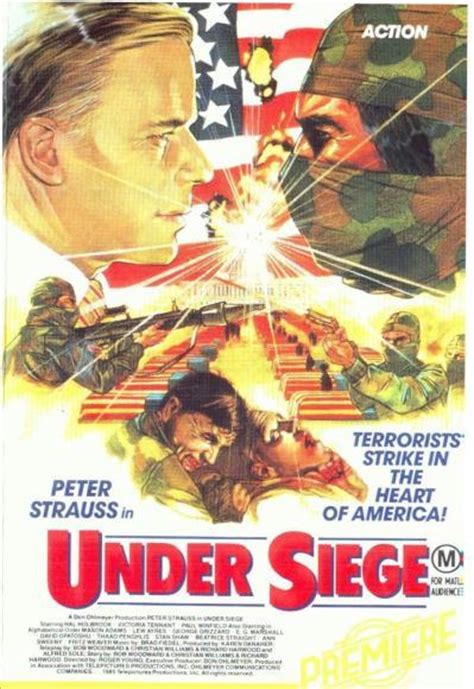
Under Siege (1986, directed by Roger Young)


Let’s say that you are the governor of Arkansas and, once again, your state is running out of money and will soon not be able to afford to pay its bills.  What do you do?

That was the problem facing Governor Bill Clinton in 1986.  His solution was to allow a big Hollywood production to come down to Little Rock and film someone throwing explosive devices at the state capitol.  The capitol building at Little Rock looks like a smaller version of the capitol building in Washington D.C.  The producers of Under Siege needed to shoot a scene where terrorists attempt to blow up Congress.  Even though the state capitol wasn’t actually blown up in the film, the dome did end up with extensive burn marks that were visible for years afterwards.  Many people in Arkansas were not amused that they had to allow a film crew to set their capitol on fire just to pay the bills.  Still, if Bill Clinton hadn’t agreed to blow up the state capitol building, Arkansas could have gone bankrupt and then he probably would have lost his reelection bid in 1986.  If Bill Clinton wasn’t reelected, he never would have been elected to the presidency in 1992, Hillary Clinton would never have been elected to the Senate in 2000 and, in 2016, the Democrats wouldn’t have been stuck with the only possible nominee who could have actually lost to Donald Trump.  When you look at it that way, Under Siege is one of the most significant films ever made.

As for the film, it’s a 3-hour, made-for-TV movie about what happens when Islamic extremism hits home.  Notorious terrorist Abu Ladeen (Thaao Penghlis) has managed to sneak into the United States and is hiding out in Detroit.  He directs a series of attacks on beloved American institutions.  Not only is the Capitol Building bombed but a mall is also attacked.  While President Maxwell Monroe (Hal Holbrook, who was born to play presidents) tries to keep America from falling apart, his hawkish advisers tell him that now is the time to launch a strike against Iran, despite Iran claiming to have nothing to do with the attacks.  Only the director of the FBI, John Garry (Peter Strauss), and the Secretary of Defense, Andrew Simon (Paul Winfield), argue that the president should exercise caution.  Garry is convinced that the attacks are the result of homegrown, domestic extremism and not an international conspiracy.  Garry is a very hands-on FBI director.  He’s the type of FBI director who will chase a terrorist down a street in Washington D.C.  Let’s see James Comey do that shit.

Under Siege probably seemed outlandish in 1986 but it seems prophetic today.  The film’s depiction of both terrorism and the government’s shady response to it turned out to be accurate.  That doesn’t mean that it’s a very good movie.  It was co-written by Bob Woodward of Watergate and Washington Post fame, so of course John Garry is righteous beyond belief and the solution to all of America’s problem begin with contacting a newspaper editor and blowing the whistle.  America may be under siege but a strongly-worded editorial is here to save the day.

Under Siege used to regularly show up on late night television and the DVD was popular overseas.  (In France, it was called Au Revoir, America.)  Not surprisingly, after 9-11, it vanished from circulation.  If you can find a copy, watch it and ask yourself, “Would I blow up my state capitol just to pay the bills?”

Here’s The Super Bowl Teaser For Minions: The Rise of Gru!


The Minions are back.

Actually, the <inions are cute.  One of the first things that Arleigh and I bonded over was our love of the Minions.  That said, I have my doubts that there’s really much more that can be done with the Minions.  Still, I get the feeling this new movie will be cute.

We’ll see!


Here’s The Super Bowl Teaser For No Time To Die!


No Time To Die is the 25th James Bond film and apparently, it’s going to be Daniel Craig’s last.  I’ve been pretty critical of Craig’s interpretation of Bond and I hated SPECTRE but the Super Bowl teaser for No Time To Die actually looked kind of good.

So, let’s hope for a film that will leave us stirred and not shaken!

Here’s The Super Bowl Teaser for Black Widow!


Hell yeah!  This teaser is literally one of the main reasons I’m watching the Super Bowl this year!  I’m a little bit worried that the movie is going to be like, “Yes, Scarlett Johansson’s Black Widow is dead but here’s a replacement that we won’t have to pay as much!” but still, I can’t wait to see it.

Seriously, if I could be any MCU character, I would be the Black Widow.  (I also would have shoved Jeremy Renner off that cliff in Endgame.  Seriously, I’m still mad about that scene.)