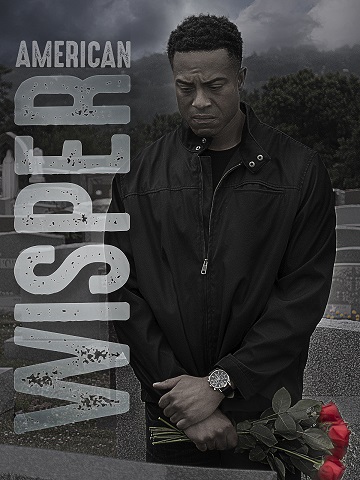
Film Review: American Wisper (dir by Russ Emanuel)


Josiah Wisper (Christian Barber) is a young and successful businessman.  He owns a few bars in Harlem.  He owns a few New York apartment building and, to his tenants, he’s a familiar site, walking up and down the hallways and making sure that everyone has paid their rent.  He and his family have a nice, big house in New Jersey where, not insignificantly, they’re the only black family living in the neighborhood.  Josiah is brash and confident and so sure of his future that he’s even hired a videographer to record every aspect of his life.  Everywhere he goes, she follows and films.

She films him when he’s at his bar, kicking out a drug dealer.  She films him while he’s collecting rent.  She films when he’s talking to his parents.  She films him when he’s flirting with his mistress.  She even films him the night that he returns to New Jersey and discovers that his entire family has been shot to death.  She continues to film as Wisper is interrogated by the police, shunned by his neighbors, and finally forced to investigate the murder on his own.

Usually, found footage films get on my last nerve and I have to admit that I was a little bit concerned when American Wisper began with Wisper talking to the camera.  However, American Wisper actually makes fairly good use of the gimmick.  There’s no shortage of people in the film who are willing to point out how strange it is that Wisper is allowing all of this to be filmed.  In fact, once people start to suspect that Wisper committed the murder, many of them specifically claim that his obsession with being filmed proves that there’s something off about him.  It’s held up as evidence that Wisper is a narcissist who only cares about himself.  To the film’s credit, it doesn’t necessarily dismiss that possibility.  As played by Christian Barber, Wisper does come across as a man who is happy to be living in a movie.  When we first see him, he’s presiding over his bar and you can tell that he’s a man who loves being the center of attention.  Even after the murders, Wisper still often seems to be playing up to the camera, leaving you wondering if maybe it’s possible that there is something that he’s not being honest about.  It creates a genuine feel of suspense, which is more than can be said for most found footage films.

I liked American Wisper.  It’s a low-budget film, made for under $500,000, but it makes good use of that low budget.  When Wisper drives through New York or into New Jersey, he’s not visiting an elaborate Hollywood sound stage.  Instead, he’s actually walking down those streets and driving down those roads and it brings an authenticity to the film that it might have lacked with a bigger budget or a more elaborate production.  Some of the actors are a bit more convincing than others but Christian Barber does an excellent job in the lead role, making Wisper into a character with whom you sympathize despite his flaws.  American Wisper is a murder mystery that’s about more than just a crime.  It’s also an examination of race, upward mobility, and fame in America.

American Wisper can currently be viewed on Prime.
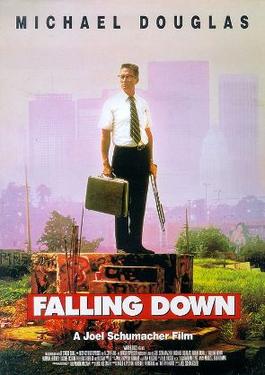
Falling Down (1993, directed by Joel Schumacher)


Earlier today, when I heard that Joel Schumacher had died, I immediately thought of Falling Down.

Falling Down stars Michael Douglas as William Foster, a man who is at the end of his rope.  He’s lost his job.  He’s just gotten a divorce and his wife has taken a restraining order out against him.  On the hottest day of the year, his car’s air conditioning has just broken down.  When he finds himself stuck in a traffic jam, he impulsively abandons his car and starts to walk across Los Angeles, collecting weapons, enemies, and admirers along the way.

Almost everyone who Foster meets annoys him in some way.  A convenience store clerk refuses to give him change so that he can make a phone call.  In the film’s most famous scene, a fast food restaurant refuses to allow him to order off of the breakfast menu, which leads to Foster pulling out a gun.  D-Fens, as he’s now known due to his personalized license plate, is making his way to his daughter’s birthday party, leaving behind  a wake of destruction behind him.  Trying to stop him is Detective Martin Prendergrast (Robert Duvall), who is, naturally, just a day away from retirement.

I think about Falling Down a lot.  It’s always been a controversial film, with critics debating whether we’re supposed to empathize with Foster or not.  The film itself often tries to have it both ways, asking us to condemn Foster’s violence while, at the same time, expecting us to cheer for him when he expresses his frustrations.  On the one hand, you can understand some of his anger.  Why can’t you order off the breakfast menu if you want to?  Who hasn’t gotten annoyed with unnecessary road work?  At the same time, it’s also hard to overlook that almost all of Foster’s victims are more obnoxious than he is.  If the store clerk has been polite when he refused to give him change, would we have still cheered when Foster destroyed the store?  Foster even has an encounter with a white supremacist that’s supposed to assure us that Foster might be an angry white man but he’s the right type of angry white man.

To understand why this film has always stuck with me, you have to understand that my Dad was an engineer.  He worked with a lot of people who basically were William Foster, except that they never got their hands on as much weaponry as Foster manages to do.  Whenever I see this movie and I see Michael Douglas with his nerdy glasses and short-sleeved white shirt and black tie, I’m reminded of visiting my father at work and listening to his co-workers complain about how much they hated the rap music that their kids were listening to.  From those experiences, I can tell you that Michael Douglas perfectly nails the role of William “D-Fens” Foster.  Though the film’s script may sometimes try to present Foster as simply being “a man who has finally had enough” (and that’s certainly the way that Foster would probably view himself), Douglas gives a much more complex performance in the role.  He plays Foster not as being a hero or even an anti-hero.  Instead, he’s a man who has realized that life is never going to be as good as he was told it would be and, watching the world change around him, he’s snapped.  He’s the villain, even if he and some of the film’s biggest fans don’t realize it.  “I’m the bad guy?” he asks and yes, he is.  The tragedy of the film is that he can’t understand how that came to be.  Neither Joel Schumacher as a director nor Michael Douglas as an actor ever suggests that Foster has become a stronger or happier person as a result of his actions.  He never becomes the societal avenger that some may want him to be.  Instead, he just wants to get to his daughter’s birthday party.

When Joel Schumacher’s death was announced today, most people talked about the Batman films that he directed.  However, Falling Down, with its brilliant lead performance from Michael Douglas, is the Joel Schumacher film that will always stick with me.

3000 Miles to Graceland (2001, directed by Demian Lichtenstein)


Five thieves show up in Vegas to rob a casino.  The casino is also hosting an Elvis convention so the criminals all dress up like Elvis before trying to pull off their heist.  Since one of the criminals is played by Kurt Russell and Russell famously played Elvis in a made-for-TV movie, it’s a meta joke.  The worst of the criminals is played by Kevin Costner because, in 2001, Costner’s career was dead in the water and he was trying to reinvent himself as some sort of badass character actor.

As a result of a shootout and series of personal betrayals, Russell and Costner are the only two thieves who survive the heist.  Kurt Russell ends up taking all of the money for himself and running off with single mother Courteney Cox.  (Yes, Cox’s then-husband, David Arquette, does have a small role in the movie.)  Costner pursues them, killing anyone who he comes in contact with until it all leads to one final shoot out.

3000 Miles to Graceland is a stupid, stupid movie that was made at the time when every director was still trying to remake Reservoir Dogs and The Usual Suspects.  If you need any proof of how bad this movie is, just consider that it is one of the few Kurt Russell films to never develop a cult following.  There are people who would jump into the mouth of a volcano if Kurt Russell told them to and even they won’t watch 3000 Miles to Graceland.  Even the worst 90s crime films have at least a few people willing to defend them but 3000 Miles to Graceland has been abandoned on the ash heap of crime film history.  Despite having a once-in-a-lifetime supporting cast — Christian Slater, Bookeem Woodbine, Kevin Pollack, Jon Lovitz, Howie Long, Ice-T, and even Paul Anka — 3000 Miles to Graceland has never even received a direct-to-video sequel.

Why is 3000 Miles to Graceland so forgettable?  The heist storyline has been done to death and this film doesn’t bring anything new to the genre.  The only new wrinkle that 3000 Miles to Graceland brings to its familiar story is that the thieves are all dressed like Elvis and that gets old pretty quick.  The other problem is that Kevin Costner is miscast as the psycho villain.  Michael Madsen could have handled the role.  So could Tom Sizemore or Woody Harrelson or just about other actor out there.  But Kevin Costner, who first found fame as a sort of modern-day Gary Cooper, never seems comfortable playing a cold-hearted sociopath.  He makes up for this discomfort by trying too hard.  Comparing his performance here to his more nuanced turn as another criminal in A Perfect World shows just how miscast he was in 3000 Miles To Graceland.

Fortunately, better things were ahead for almost everyone involved in this movie.  Kevin Costner has recently returned to playing the type of roles that made him a star to begin with and Kurt Russell has become an American idol.  Fortunately, 3000 Miles to Graceland is remembered, if at all, as just an unfortunate detour in their otherwise distinguished careers.

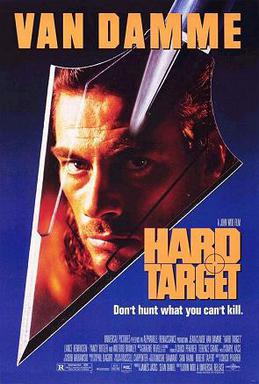
Hard Target (1993, directed by John Woo)


Nat Binder (Yancy Butler) has come to New Orleans to track down the father who she hasn’t seen since she was seven years old.  What she doesn’t know is that her father has recently been kidnapped and killed for sport by a wealthy hunter and Most Dangerous Game enthusiast named Emil Fouchon (Lance Henriksen).  After a homeless veteran named Chance Bourdeaux (Jean-Claude Van Damme) saves her from a group of muggers, Nat hires him to help her track down her father.  This turns out to be a good decision because Fouchon is sending out his private army to track down Nat and Chance is Jean-Claude Van Damme.

Jean-Claude Van Damme has never gotten as much respect as he deserves.  Even though most of his action movies were low-budget and often not very good, Van Damme was still a better actor than some of the other B-action stars of the 90s and, unlike most of his contemporaries, he could actually do most of the things that he did in the movies in real life as well.  Though Van Damme may have sabotaged his career through cocaine abuse, it’s not a surprise that most action fans would welcome a Jean-Claude Van Damme comeback far more than a comeback by someone like Steven Seagal.  Hard Target features Van Damme at his best, emphasizing his athleticism and contrasting his earnest acting style with the more flamboyant villainy of Lance Henriksen, who also brings his best to the role of Emil.  The film also features Wilford Brimley, bringing his best to the role of Bourdeaux’s uncle.  Van Damme, Henriksen, and Brimley all at their best?  How could anyone turn down Hard Target?

Hard Target was the first American film of director John Woo and he proves himself to be the perfect director for the material.  With Woo, every scene becomes an operatic set piece and it’s impossible to worry about any plot inconsistencies when Van Damme is gracefully jumping out of the way of bullets and missiles.  Woo turns the material into a live-action comic book and, even if it’s not as good as his Hong Kong films or later American films like Face/Off, it’s still undeniably entertaining.

Hard Target is Van Damme’s best film of the 90s.  Watch it on a double bill with Surviving The Game.


A Scene That I Love: Daria Nicolodi and David Hemmings in Deep Red


Deep Red (1975, dir by Dario Argento)

Today is Daria Nicolodi’s birthday so what better time than now to share a scene that I love from Dario Argento’s 1975 masterpiece, Deep Red?

Now, this might seem like a strange scene to love but you have to understand it in context of the overall film.  (And yes, the scene is in Italian but surely you can figure out that it’s a scene of two people flirting.)  Deep Red is often thought as being merely a superior giallo film but it’s also, in its way, a rather sweet love story.  David Hemmings and Daria Nicolodi may investigate a murder but they also fall in love and the two of them have a very sweet chemistry, which is fully displayed in this scene and which elevates the entire film.  Deep Red is a giallo where you care about the characters as much as you care about the murders.

While making this film, Daria Nicolodi and Dario Argento also fell in love and they went on to have a rather tumultuous relationship.  Personally, I think that Argento’s most recent films are underrated but it’s still hard to deny that the ones that he made with Nicolodi have a heart to them that is missing from some of his later work.

So, in honor of Daria Nicolodi and her important role in the history of Italian horror, here she is with David Hemmings in Deep Red!

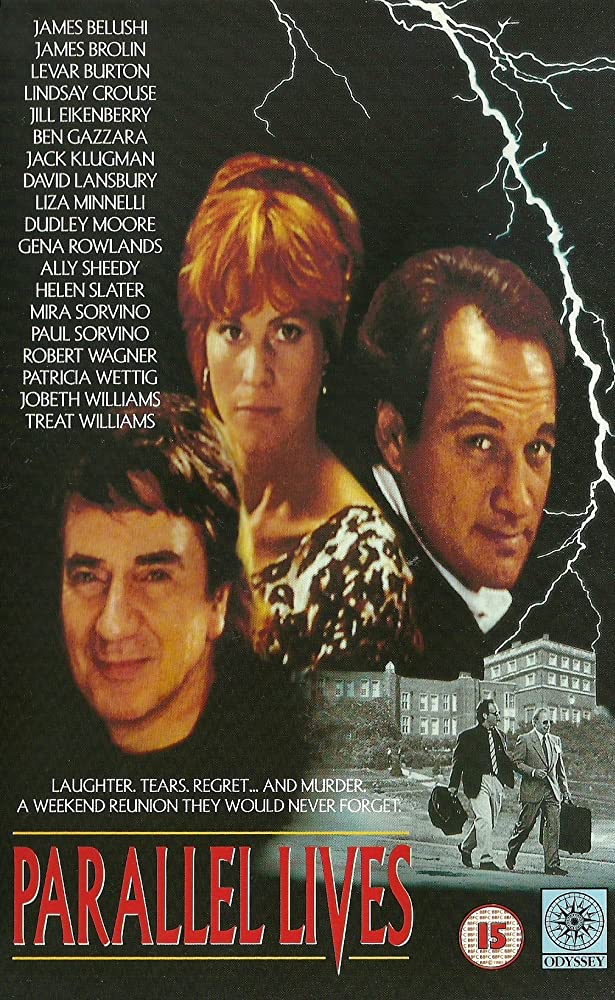
Parallel Lives (1994, directed by Linda Yellen)


A large group of people gather together one weekend for a fraternity/sorority reunion.  Since college, some of them have become rich and powerful.  Some of them are now famous.  Some of them are now seedy and disreputable.  They all have college memories, though there’s such a wide variety of age groups represented that it’s hard to believe that any of them actually went to college together.  After the men spend the day playing practical jokes and touch football and the women spend the night talking about their hopes and dreams, they wake up the next morning to discover the someone has murdered Treat Williams.  A pony-tailed sheriff (Robert Wagner) shows up to question everyone.

Parallel Lives was made for Showtime with the help of the Sundance Institute.  Today, it’s a forgotten film but, for some reason, it was very popular with American Airlines during the summer of 1997.  That summer, when I flew to the UK, Parallel Lives was one of the movies that we were shown.  (It was the second feature.  The first feature was Down Periscope, a submarine comedy starring Kelsey Grammar.  Fourteen year-old me enjoyed Down Periscope but, in retrospect, it wasn’t much of a flight.)  A month and a half later, when I flew back to the U.S., Parallel Lives was again one of the films shown on the flight!  For that reason, I may be the only person on the planet who has not forgotten that a film called Parallel Lives exists.

Parallel Lives, I later learned, was an entirely improvised film.  The huge cast were all given their characters and a brief outline of the film’s story and they were then allowed to come up with their own dialogue.  Unfortunately, no one did a very good job of it and the men were reduced to bro-ing it up while the women spent most of the movie having extended group therapy.  The story doesn’t add up too much and, even when I rewatched it from an adult’s perspective, I wasn’t sure what I was supposed to get out of everyone talking about how different the real world was from college.  Technically, the film’s a murder mystery but you can’t improvise a successful murder mystery.  This film proves that point.

Of course, it doesn’t help that there are 26 characters, all trying to get a word in at the same time.  Some of the roles don’t make much sense.  Dudley Moore shows up, playing an imaginary friend.  (How do you improvise being a figment of someone’s imagination?)  James Brolin introduces himself to everyone as being, “Professor Doctor Spencer Jones” and that appears to be as far as he got with his improv.  Ben Gazzara is a gambler and Mira Sorvino is the prostitute that he brings to the reunion while Mira’s father, Paul Sorvino, moons the camera several times.  Jack Klugman is a senator with Alzheimer’s and Patricia Wettig is his daughter.  The majority of the movie centers around Jim Belushi, playing a reporter and falling in love with JoBeth Williams.  Liza Minnelli, Helen Slater, Levar Burton, Lindsay Crouse, Matthew Perry, Ally Sheedy, and Gena Rowlands all have small roles.  How did so many talented people come together to make such a forgettable movie and why did American Airlines decide it was the movie to show people on their way to another country?  That’s the true mystery of Parallel Lives.

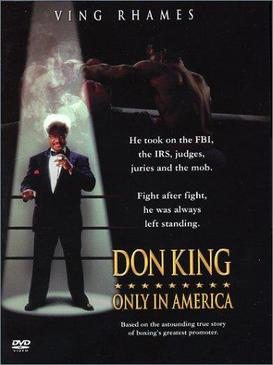
Don King: Only In America (1997, directed by John Herzfeld)


Don King: Only In America is an HBO biopic of the controversial boxing promoter, Don King.  It’s a good movie but it will probably always be overshadowed by what happened when the Hollywood Foreign Press Association voted to give Ving Rhames the Golden Globe for Best Actor in a TV-Movie or Miniseries.  When Rhames won, he called fellow nominee Jack Lemmon to the stage and gave him the award, saying “I feel that being an artist is about giving, and I’d like to give this to you.”  Lemmon, who had been nominated for his work in 12 Angry Men, accepted the statue while the audience gave Rhames a standing ovation.  The HFPA later sent Rhames a second statue and Spike Lee satirized the entire incident in Bamboozled when he had Damon Wayans give away an award he had won to Matthew Modine.

Ving Rhames plays the title role in Don King: Only in America and he definitely deserved every nomination and award that he received as a result.  The episodic film starts in the 50s, with a young King being sentenced to prison and then shows how King went on to become one of the wealthiest and most powerful men in America.  It’s not always a flattering portrait.  The movie fully documents how King cheated the boxers that he managed and the damage that he ultimately did to the image of boxing, a sport that didn’t have a particularly good reputation to begin with.  At the same time, Rhames is such a force of nature that it’s hard not to sometimes admire King’s chutzpah as he deals with and outwits everyone from the Mob to the IRS to racist fight promoters to greedy dictators.  As played by Rhames, King makes himself a success by the virtue of his own hard work and utter ruthlessness.  He’s a flamboyant showman who knows how to play hardball behind the scenes and who refuses to take no for an answer.  He ruins the lives of too many people to ever become a sympathetic figure but he remains a fascinating one.

The film features Rhames, as King, standing in a boxing ring, telling us his story and occasionally interrupting the flashbacks whenever he thinks that they’re reflecting too negatively on him.  (When the film shows Muhammad Ali, played by Darius McCrary, incapacitated by Parkinson’s, King stops the film and angrily tells us that he had nothing to do with that.)  The real Don King supposedly hated the way this film portrayed him and threatened to stop doing business with HBO after it aired but he should have appreciated Ving Rhames’s performance.  Don King is fond of saying that he could have become a millionaire “only in America,” and Rhames’s flamboyant, charismatic, and no holds barred performance convinces us that he’s right.

An Offer You Can’t Refuse #14: Contraband (dir by Lucio Fulci)


The 1980 film, Contraband, tells a story of the Neapolitan underworld.

Luca Ajello (Fabio Testi) and his older brother, Mickey, have a pretty nice operation going.  They pilot boats up and down the coast of Italy, smuggling cigarettes and booze into Naples.  It’s given both of them a pretty good life.  They own a racehorse.  Luca’s got a big house with a beautiful wife (Ivana Monti) and a precocious son.  The police are too incompetent to stop them and their disco-loving boss, Perlante (Saverio Marconi), keeps them safe from any interference from the other mob bosses working in Naples.

But then, one night, two men disguised as policeman pull Luca and Mickey over while they’re driving down an isolated road.  The fake cops proceed to fire what seems to be over a hundred bullets into Mickey.  Luca, having ducked down in his seat, is not spotted by the assassins.  Determined to find out who murdered his brother and why, Luca immediately suspects a rival mobster named Scherino but Scherino insists that Mickey’s murder was actually ordered by a mysterious French drug lord known as Il Marsigliese (Marcel Bozzuffi, who also played a French drug smuggler in The French Connection).  The French are trying to take over the rackets in Naples and a sudden surge in violence, one which sees nearly every mob boss in Naples murdered on the same day, suggests that Scherino is telling the truth.

Contraband is a brutal Italian crime film, one that is notable for being one of director Lucio Fulci’s final non-horror films.  (Contraband was released after Zombi 2 but before City of the Living Dead.)  Though the film might not feature any zombies or any talk of “the Beyond,” it’s still unmistakably a Fulci film and some of the film’s brutal violence remains shocking even when seen today.  The scene where a duplicitous drug smuggler gets her face melted with a blow torch is nightmarish and it’s followed by a scene where a rival gangster graphically gets the back of his head blown out.  (Fulci lingers on the hole in the man’s head, giving us an out-of-focus shot of the people standing behind him.)  A later gunfight leads to one gangster dying with a gaping hole in his throat while another has his face shot away, despite the fact that he’s already dead.  It’s graphic but it’s also appropriate for the story being told.  This is a movie about violent men and, as Fulci himself often pointed out whenever he was challenged about the graphic gore in his films, violence is not pretty.  Contraband is not a film that’s going to leave anyone wanting to become a gangster.

The plot is not always easy to follow but, as is typical with a good Fulci film, the striking visuals make up for any narrative incoherence.  Fulci’s camera rarely stops moving, creating a sense of unease and pervasive paranoia.  Much like the characters in the film, we find ourselves looking in every corner and shadow for a potential threat.  A meeting with an informant at a mist-shrouded sulfur pit ends with assassin literally emerging from the mist and stabbing the informant from behind.  A later gun battle on a narrow street seems to feature gunmen literally appearing out of thin air.  Fabio Testi is ruggedly sympathetic as Luca while Saverio Marconi does a great job as the decadent Perlante.  Meanwhile, Marcel Bozzuffi is legitimately frightening in his few scenes as the evil French gangster.  He’s a great villain, smug and willing to kill anyone.  You don’t have to support organized crime to support the idea of running the French out of Naples.

Contraband is a minor crime classic and proof that there was more to Fulci than just zombies and serial killers.  Today would have been Lucio Fulci’s 93rd birthday and it’s also a good day to track down Contraband, an offer that you can’t refuse.

Previous Offers You Can’t (or Can) Refuse:

  1. The Public Enemy
  2. Scarface
  3. The Purple Gang
  4. The Gang That Could’t Shoot Straight
  5. The Happening
  6. King of the Roaring Twenties: The Story of Arnold Rothstein 
  7. The Roaring Twenties
  8. Force of Evil
  9. Rob the Mob
  10. Gambling House
  11. Race Street
  12. Racket Girls
  13. Hoffa

6 Shots From 6 Films: Special Lucio Fulci Edition!


6 Shots From 6 Films is just what it says it is, 4 shots from 4 of our favorite films. As opposed to the reviews and recaps that we usually post, 6 Shots From 6 Films lets the visuals do the talking!

93 years ago today, in Rome, Lucio Fulci was born!

Today is a very special day for fans of Italian horror.  It’s also a special day for those of us here at the Shattered Lens.  Anyone who has been reading this site for a while knows that we’re big Fulci fans at the TSL.  So, in honor of the anniversary of his birth, here are….

6 Shots From 6 Films

Lizard in a Woman’s Skin (1971, dir by Lucio Fulci)

Zombi 2 (1979, dir by Lucio Fulci)

The Beyond (1981, dir by Lucio Fulci)

The House By The Cemetery (1982, dir by Lucio Fulci)

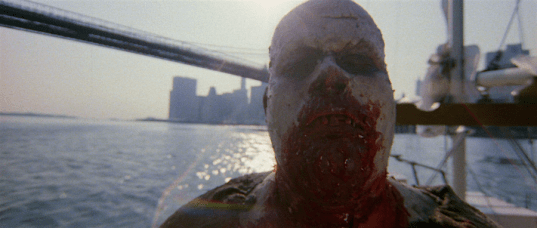
The New York Ripper (1982, dir by Lucio Fulci)

Murder Rock (1984, dir by Lucio Fulci)

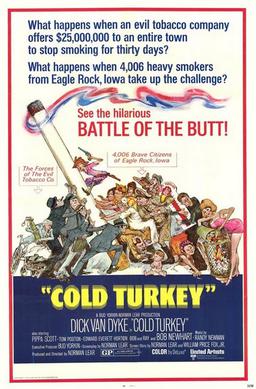
Film Review: Cold Turkey (dir by Norman Lear)


The 1971 satire, Cold Turkey, is the film that boldly explores just how much into the ground one joke can driven.

It’s a film that imagines what would happen if a big tobacco company decided to try to improve its image by giving people an incentive to quit smoking.  In the real world, of course, they ended up funding Truth.org and coming up with anti-smoking commercials that were so lame that they would make viewers want to go out and buy a pack of cigarettes just to spite the self-righteous people lecturing them during the commercial breaks.  In the film, however, Marwen Wren (Bob Newhart) comes up with the idea of offering to pay 25 million dollars to any community that can completely stop smoking for 30 days.

Wren figures that no large group of people will be able to just give up smoking for a month.  Not in 1971!  However, Wren didn’t count on the single-minded determination of the Rev. Clayton Hughes (Dick Van Dyke).  Hughes is the stern and self-righteous minister of Eagle Rock Community Church in Eagle Rock, Iowa.  He knows that Eagle Rock could really use that money so he sets off on a crusade to convince all 4,006 of the citizens of Eagle Rock to take the pledge to quit smoking.

As I said at the start of this review, Cold Turkey is pretty much a one-joke film.  The joke is that everyone in the movie — from the tobacco company execs to the citizens of Eagle Rock to Rev. Hughes — is an asshole.  They start the film as a bunch of assholes and, once they try to quit smoking, they become even bigger assholes.  Soon, everyone in town is irritable and angry.  The only people happy are the people who never smoked in the first place, largely because they’ve been set up as a sort of paramilitary border patrol.  Even though his anti-smoking crusade lands him on the cover of Time, Rev. Hughes is also upset because he started smoking right before it was time to quit smoking.  He deals with his withdraw pains through sex and frequent glowering.

Wren is concerned that the town of Eagle Rock might actually go for a full 30 days without smoking so he attempts to smuggle a bunch of cigarettes into the town and then runs around with a gigantic lighter that looks like a gun.  It’s a storyline that doesn’t really go anywhere but then again, you could say that about almost all of the subplots in Cold Turkey.  There’s a lot of characters and there’s a lot of frantic overacting but it doesn’t really add up too much.  Storylines begin and are then quickly abandoned.  Characters are introduced but then never do anything.  For a while, It seems like the film is at least going to examine the Rev. Hughes’s totalitarian impulses but no.  Those impulses are clearly there but they’re not really explored.

If I seem somewhat annoyed by this film, it’s because it really did have a lot of potential.  This could have been a very sharp and timeless satire but instead, it gets bogged down in its own frantic storytelling and the film’s comedy becomes progressively more and more cartoonish.  By the end of the movie, the President shows up in town and so does the military and it all tries to achieve some Dr. Strangelove-style lunacy but the film doesn’t seem to know what it really wants to say.  It seems to be setting itself up for some sort of grandly cynical conclusion but instead, it just sort of ends.  One gets the feeling that, at the last minute, the filmmakers decided that they couldn’t risk alienating their audience by taking the story to its natural conclusion.

Admittedly, while watching the film, I did find myself comparing Hughes and his bullying mob to the same people who are currently snapping at anyone who suggests that maybe the Coronavirus lockdowns were a bit excessive.  It’s easy to think of some modern politicians and media figures who probably would have had a great time in Eagle Rock, ordering people around and shaming anyone who wants a cigarette.  But otherwise, Cold Turkey was just too cartoonish and one-note to really work.