Insomnia File #53: A Nightmare on Drug Street (dir by Traci Wald Donat)


What’s an Insomnia File? You know how some times you just can’t get any sleep and, at about three in the morning, you’ll find yourself watching whatever you can find on cable or Netflix? This feature is all about those insomnia-inspired discoveries!
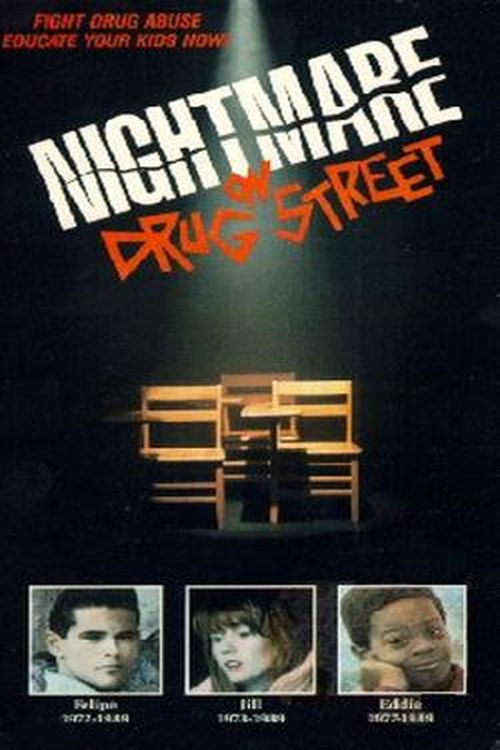
If you were having trouble getting to sleep last night, you could have gone over to YouTube and you could have done what I did when I was having trouble getting to sleep two nights ago.  You could have watched the 1989 educational film, A Nightmare on Drug Street.

Clocking in at 39 minutes, A Nightmare on Drug Street opens with three people sitting in a dark room.  Though the room seems ominous and the three people often appear to only be shadows, they turn out to to be friendly enough.  (And no, Freddy Krueger is not among them.  This is Drug Street, not Elm Street.)

“Hi, I’m Jill!” the one in the middle informs us.  “I’m dead!”

Filipe, who is is sitting to left of and is a bit less perky than Jill, mentions that they’re all dead.  Eddie, the youngest of the three, speaks up and mentions that he’s been dead for two days longer than Jill.  They all have a good laugh about that.  Jill says that she’s not sure where they are but she thinks that they’re supposed to think about their mistakes and to try to prevent other people their age from making the same mistakes.

“Jill,” I nearly shouted at the screen, “you’re in Purgatory!  It’s not that complicated!”

Eddie complains as he realizes that he’s going to have to relive his story again.  Jill laughs and says that Eddie is always complaining.  Filipe does not laugh because he’s not in a particularly good mood and I don’t blame him.  His Purgatory experience is obviously not turning out the way that he was hoping.  It would appear that Filipe has gotten trapped on the boring side of Purgatory.

Anyway, we then see how each of them ended up dead.  As you can probably guess from the title it all has to do with drugs.

For instance, after winning the big game, Filipe got both stoned and drunk and then decided that it would be a good idea to steal his brother’s car.   Needless to say, it doesn’t take long until Filipe’s more intelligent friend is demanding to be let out of the car.  It also doesn’t take long to hear the sound of an off-screen crash.  Apparently, there wasn’t enough money in the budget to film a real crash.

Jill met a guy at a party and basically allowed herself to be talked into trying cocaine.  As anyone who has ever seen a film like this can probably guess, Jill goes straight from doing that one line to stealing from her friends and selling a family heirloom so she can get more money for coke.  Her family is disappointed in her.  Her friends are angry with her.  And her drug dealer keeps hitting on her.  No wonder Jill eventually end up snorting too much.

And finally, Eddie, who is still in middle school, is handed a crack pipe by a friend.  Soon, Eddie is getting high in the bathroom while his parents try to understand why his grades have gone down.

Interestingly enough, each story is narrated by a dead teen but not the teen that actually dies in the story. So, Jill tells Filipe’s story and makes fun of him for being geeky whenever he gets high.  (Yeah, Jill, like you looked really cool with your bloodshot eyes and your red nose….)  Eddie tells Jill’s story and manages to get through it without ridiculing her.  Filipe tells Eddie’s story while wearing what appears to be a hospital gown.  There’s actually a scene in Purgatory where the three of them debate who will tell each story.  Do they automatically know the stories or is it just a case that they’re memorized them because there’s literally nothing else to talk about while in Purgatory?  The film leaves that question unanswered, which is a shame.

(Speaking of unanswered questions, why are we even in Purgatory in the first place?  The three narrators look directly at the viewer when they speak so I’m guess that I’m meant to have died as well.  But if I’m already dead, what’s the point of warning me about drugs?  Seriously, there’s a lot of unanswered questions in this film.)

Anyway, as for the film itself, it’s another well-intentioned but not quite successful attempt to make an anti-drug scare film.  Like many anti-drug short films, A Nightmare on Drug Street suffers due to the fact that the characters are more interesting when they’re high than when they’re sober.  The stories themselves often veer into melodrama though, to the film’s credit, it seems to at least be a bit self-aware when it comes to this.  When Filipe jumps in his car, Jill says that she knows that we know what’s going to happen but she asks us to keep watching anyways.  After being specifically asked to watch, you kind of feel like you have to.

For the most part, this film’s main worth is as a time capsule.  It’s all about 80s fashion and 80s lingo.  Breaking Bad fans will take note that Filipe is played by Raymond Cruz, who later played a fearsome drug dealer on the classic AMC series.  I guess Filipe found his way out of Purgatory after all.

Previous Insomnia Files:

  1. Story of Mankind
  2. Stag
  3. Love Is A Gun
  4. Nina Takes A Lover
  5. Black Ice
  6. Frogs For Snakes
  7. Fair Game
  8. From The Hip
  9. Born Killers
  10. Eye For An Eye
  11. Summer Catch
  12. Beyond the Law
  13. Spring Broke
  14. Promise
  15. George Wallace
  16. Kill The Messenger
  17. The Suburbans
  18. Only The Strong
  19. Great Expectations
  20. Casual Sex?
  21. Truth
  22. Insomina
  23. Death Do Us Part
  24. A Star is Born
  25. The Winning Season
  26. Rabbit Run
  27. Remember My Name
  28. The Arrangement
  29. Day of the Animals
  30. Still of The Night
  31. Arsenal
  32. Smooth Talk
  33. The Comedian
  34. The Minus Man
  35. Donnie Brasco
  36. Punchline
  37. Evita
  38. Six: The Mark Unleashed
  39. Disclosure
  40. The Spanish Prisoner
  41. Elektra
  42. Revenge
  43. Legend
  44. Cat Run
  45. The Pyramid
  46. Enter the Ninja
  47. Downhill
  48. Malice
  49. Mystery Date
  50. Zola
  51. Ira & Abby
  52. The Next Karate Kid

6 Classic Trailers For March 25th, 2022


Since it’s Oscar week, it seems like a good idea to devote the latest edition of Lisa Marie’s Favorite Grindhouse and Exploitation Film trailers to 6 classic films that received not a single Oscar nomination. That’s the way the Oscars are unfortunately. Sometimes, the best films are totally ignored.

For instance….

  1. Chappaqua (1967)

1967 was a great year for the movie so perhaps it’s understandable that the Academy somehow overlooked Chappaqua.  Still, this film was far more deserving a nomination than Doctor Doolittle.

2. Beyond the Valley of the Dolls (1971)

Valley of the Dolls received an Oscar nominations for its score.  However, it’s unofficial sequel didn’t even receive that.  Not a single nomination went to Beyond the Valley of the Dolls, not even Best Original Song.  In 1970, the Academy just wasn’t ready.

3. Coffy (1973)

Ellen Burstyn certainly deserved the Oscar for Alice Doesn’t Live Here Anymore but still, how could the Academy not nominate Pam Grier for her work in Coffy?

4. Dawn of the Dead (1978)

The Academy will probably never embrace the zombie genre.  They certainly weren’t prepared to do so in 1978.  That said, it’s way past time to give Tom Savini an honorary award.

5. The Warriors (1979)

The Warriors is another classic that went unnominated.  Not even the music got a nomination.  David Patrick Kelly was totally snubbed.  The Baseball Furies should have been sitting in front row on Oscar night.  It’s a true shame.

6. Death Wish 3 (1985)

Give the Giggler an Oscar!

4 Shots From 4 Films: Special David Lean Edition


4 Or More Shots From 4 Or More Films is just what it says it is, 4 shots from 4 of our favorite films. As opposed to the reviews and recaps that we usually post, 4 Shots From 4 Films lets the visuals do the talking!

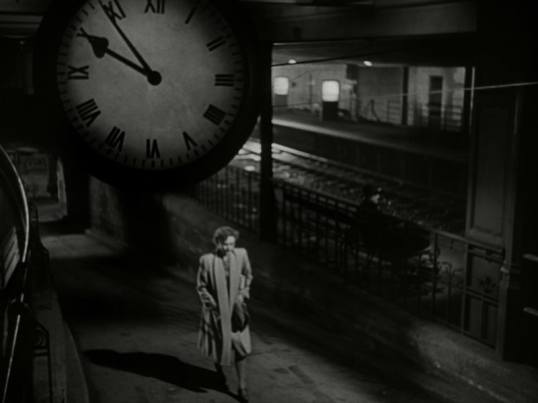
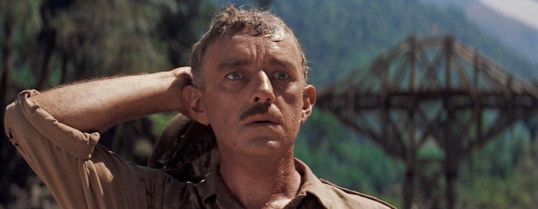
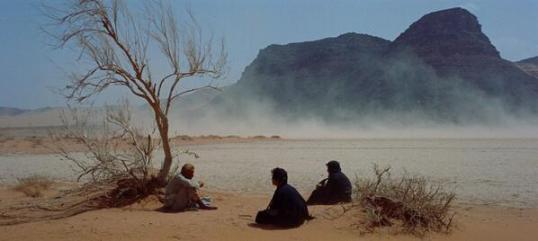
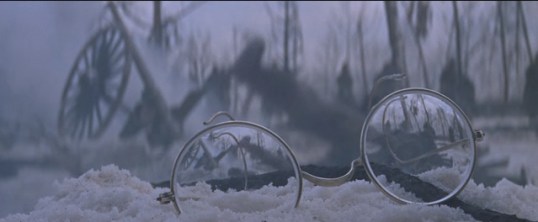
Today, we celebrate the birth and the legacy of the great British director, David Lean!  He was born 114 years ago today and went on to become one of the most important and influential directors of all time.  Lawrence of Arabia is still held up as one of the best adventure films ever made.  My personal favorite Lean film remains Brief Encounter.  Here are….

4 Shots from 4 David Lean Films

Brief Encounter (1945, dir by David Lean, DP: Robert Krasker)

The Bridge on the River Kwai (1957, dir by David Lean, DP: Jack Hildyard)

Lawrence of Arabia (1962, dir by David Lean, DP: Freddie A. Young)

Doctor Zhivago (1965, dir by David Lean, DP: Freddie A. Young)

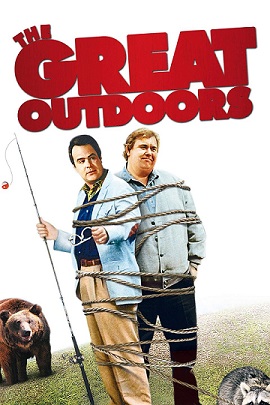
The Great Outdoors (1988, directed by Howard Deutch)


Chet Ripley (John Candy) wants to have a nice vacation up at the lake with his wife (Stephanie Faracy) and their two sons, Buck (Chris Young) and Ben (Ian Giatti).  Unfortunately, no sooner has he arrived than the vacation is crashed by Chet’s sister-in-law (Annette Bening, making her film debut) and her husband, Roman (Dan Aykroyd).  Roman represents everything that that the mild-mannered Chet hates.  Roman is loud, obnoxious, and obsessed with showing off his wealth.  Roman knows nothing about how to survive in the great outdoors and he treats Chet like he’s a loser but, for the sake of giving his family a good vacation, Chet tries to get along with Roman.  At first, it doesn’t work but eventually, Chet and Roman have to team up to find Roman’s daughters and deal with not only a bear but also talking raccoons.  Meanwhile, Buck falls in love with local girl, Cammie (Lucy Deakins).  I imagine the same can be said of a lot of people who caught this film on HBO when they were twelve.

The Great Outdoors is very much a comedy of the late 80s.  Roman may be a crass Yuppie but it doesn’t appear that Chet is suffering financially either.  The humor is broad and physical but the film never resorts to the gross-out style that has since come to define cinematic comedy.  It’s a film that makes fun of the obligations of family life while also celebrating them and you won’t be shocked to learn that the script was written by John Hughes.  John Candy is likable and Dan Aykroyd has a demented twinkle in his eye.

It’s not a bad movie but I just wish it had been funnier.  Don’t get me wrong.  When you’re a kid and you come across The Great Outdoors on cable, it’s hilarious because it’s got John Candy waterskiing and a bear and, of course, the talking raccoons.  Watching it as an adult, though, it’s easier to see just how much the material and the film’s family-safe approach holds back both Candy and especially Aykroyd.    Both of them were capable of being wild comedic performance but, in The Great Outdoors, the movie doesn’t let either one of them really go crazy and that’s too bad.  Instead of being a showcase for the best of SNL and SCTV, it becomes an amusing but ultimately very safe family comedy.  (Arguably, Hollywood never really figured out the best way to use Candy and Aykroyd’s comedic talents, though Candy’s films before his untimely death suggested that he was on the verge of a genuine breakthrough.)

I did laugh when I rewatched The Great Outdoors but I didn’t laugh as much as I did when I was a kid.  Now, I feel old and I’m thinking about how unfortunate it is that John Candy died before production could start on the biopic of Fatty Arbuckle that Candy was tentatively set to star in.  Much like Phil Hartman, it’s hard to watch John Candy today without thinking about how he was taken when he was on the verge of probably doing what would have been his best work.

Time to cheer myself up with What About Bob?

Montana Incident (1952, directed by Lewis D. Collins)


Whip Wilson (played, in a fortunate coincidence, by Whip Wilson) and his partner, Dave Conners (Rand Brooks) work for the railroad company as surveyors in the old west.  They’ve come to the town of Martinville to convince the citizens that the town would benefit from having a train station.  Mostly, they just want to go to the saloon, have a beer, and flirt with the local gals.

Albert Hawkins (WIlliam Fawcett) is the leader of the local homesteaders and he’s all for bringing the railroad to town.  Land baron Max Martin (Hugh Prosser) disagrees.  Martin is not really a bad person but his daughter, Clara (Peggy Stewart), is a greedy fanatic who doesn’t want to lose the water rights to the land.  With her boyfriend, outlaw Arnold Benson (Bruce Edwards), Clara rules the town with an iron fist.  Whip and Dave must defeat Arnold and Clara so that progress can come to the frontier.

Montana Incident is a standard western programmer but it is distinguished by having an evil female land baron instead of the usual male land baron.  Stewart tears into the world, proving that she can be just as dangerous as any man.  Fans of the old Adventures of Superman TV show will immediately recognize Noel Neill, playing the role of Clara’s much nicer sister.

If you’re a fan of B-westerns, Montana Incident is watchable enough.  Wilson and Brooks are bland heroes but Peggy Stewart is so good at being evil that she makes the movie worth watching.

4 Shots From 4 Films: Special Akira Kurosawa Edition


4 Or More Shots From 4 Or More Films is just what it says it is, 4 shots from 4 of our favorite films. As opposed to the reviews and recaps that we usually post, 4 Shots From 4 Films lets the visuals do the talking!

Today, the Shattered Lens honors both the birth and the legacy of the great filmmaker, Akira Kurosawa!  It’s time for….

4 Shots From 4 Akira Kurosawa Films

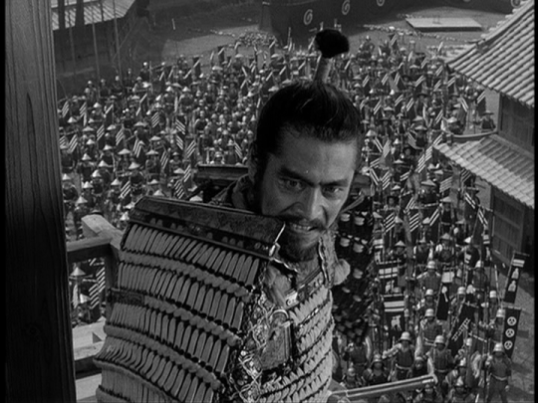
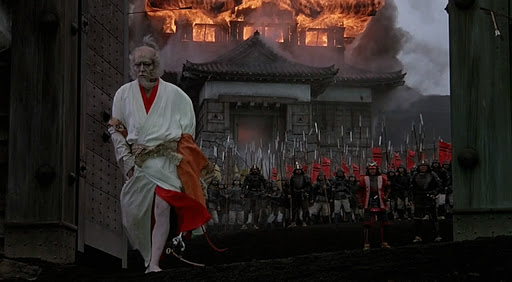
Throne of Blood (1957, dir by Akira Kurosawa, DP: Asakuza Nakai)

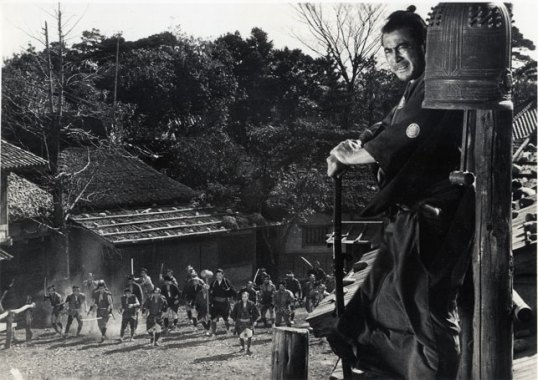
Yojimbo (1961, dir by Akira Kurosawa, DP: Kazuo Miyagawa)

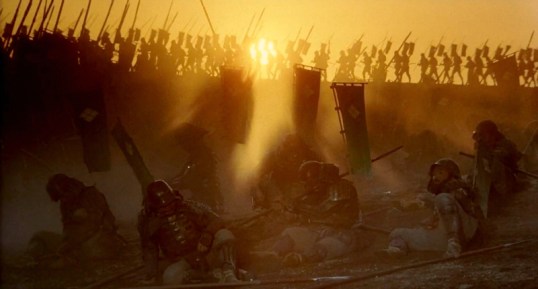
Kagemusha (1980, dir by Akira Kurosawa, DP: Takao Saito and
Masaharu Ueda )

Ran (1985, dir by Akira Kurosawa, DPs: Takao Saito, Masharu Ueda, and Asakazu Nakai)

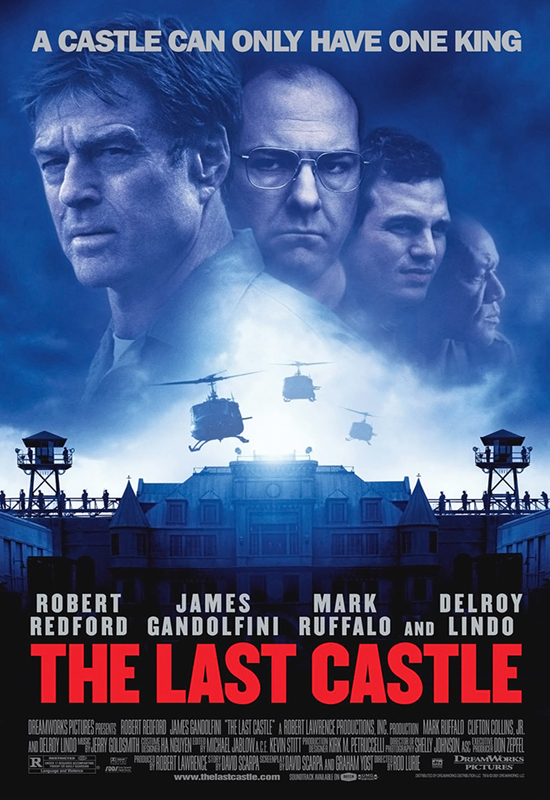
The Last Castle (2001, directed by Rod Lurie)


It’s Redford vs. Gandolfini in The Last Castle!

The last castle of the title is a United States Military Prison, one that was originally constructed during the Civil War and which resembles a castle, but with one big difference. Castles were originally designed to keep people from entering. The purpose of this castle is to keep people from leaving.

Colonel Ed Winter (James Gandolfini) is the prison’s commandant, a martinet who has never served in war but who keeps a collection of bullets and weapons in his office. Eugene Irwin (Robert Redford) is the newest inmate. Irwin was a highly respected general until he disobeyed a presidential order and eight of his men died as a result. Irwin has been stripped of his rank and sentenced to ten years. He tells Winter that he just wants to do his time and then go home. That’s fine with Winter, until he overhears Irwin disparaging his collection of battlefield memorabilia.

At first, Irwin tries to lay low.  Even when he sees firsthand that Winter is a sadist who manipulates the inmates and who isn’t above ordering his guards to kill an inmate in order to make a point, Irwin tries to stay uninvolved.  But eventually, Irwin’s natural military instincts kick in and he leads the prisoners in a revolt against Col. Winter.

The Last Castle requires a healthy suspension of disbelief.  Irwin brings the inmates together by reminding them that they were once soldiers and that, even when serving time in a military prison, they’re apart of a grand tradition of soldiers who have been court-martialed.  He soon has them saluting and standing at attention and walking in formation.  The movie overlooks the fact that most of the prisoners were sentenced to the prison by men much like General Irwin.  The idea that all of them are just waiting for someone to once again start barking orders at them just doesn’t seem plausible.  Instead, it seems more likely the Irwin, as a former general, would be the least popular inmate in a prison that’s full of enlisted men who feel that they were screwed over the army.  In the end, Irwin asks the prisoners to sacrifice a lot but, in the end, it doesn’t matter how heroically he’s framed in each scene or how much the music swells on the soundtrack, Iwin’s rebellion seems like its more about ego than anything else.  Even if it means getting rid of Col. Winter, would any of the inmates realistically be willing to die for Eugene Irwin?

At the same time, The Last Castle is worth watching just to see James Gandolfini face off against Robert Redford.  Gandolfini plays his role with the type of neurotic energy that only a method actor is capable of capturing while Redford is his typical move star self.  The contrast between their two styles of acting translates well into the contrast between Winter and Irwin’s philosophy of leadership.  Among the inmates, Mark Ruffalo and Clifton Collins, Jr. both have early roles.  Of the two, Ruffalo gets to play the only character in the film with a hint of moral ambiguity and he runs with it.  Clifton Collins, Jr., meanwhile, plays a character whose fate will be obvious to anyone who has ever seen a film before.  The Last Castle has its moment but it’s never a surprising movie.

The Last Castle ends with a spontaneous display of patriotism, one that is effective but also feels implausible and out-of-place.  It’s the perfect way to sum up this frustrating but occasionally diverting film. 


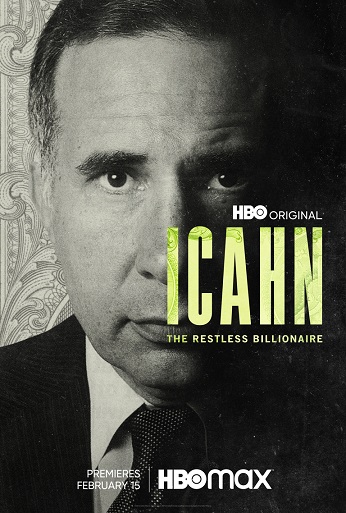
Film Review: Icahn: The Restless Billionaire (dir by Bruce David Klein)


Before I actually talk about Icahn: The Restless Billionaire, I should probably confess something.  Well, actually, this is a reconfession because I explain this every time that I review any movie or documentary the deals with stocks and investments and big shorts and corporate takeovers and all the rest.  The Stock Market confuses the heck out of me.

Seriously, I have no idea how it works.  Everything that I hear about it just confuses me.  How can you invest money that you don’t have in order to make or lose money that might not actually exist?  How can people keep buying stock in the same company?  It just seems like a company should eventually run out of stock.  And what is stock anyways?  And don’t even get me started on this whole thing where people can apparently secretly buy everyone’s stock and then force a company’s founder to resign or sell the company itself.  That’s just weird to me.

I will also admit that I actually do own stock.  I didn’t buy any of it.  Some of it, I inherited.  Some of it was gifted to me.  Some of it, I got through work.  Off the top of my head, I really couldn’t tell you much about any of the stock that I own.  I’ve been told that my stock’s doing well, which is fine with me.  Nobody ever tells me if my stocks aren’t doing well, which is also fine with me.  I don’t really need that pressure.

Some people, however, love the pressure.  Carl Icahn, for instance, has made billions by playing with the stock market and by taking over struggling companies and then selling them for a profit.  Icahn’s detractors call him a pirate or a raider.  Icahn claims that he’s an activist, taking over poorly managed companies and then selling them for a profit so that people, like me, who have no idea how any of this works can also make a profit.  (And, of course, Icahn makes a huge amount of money off of it as well.)  Carl Icahn is thought to have been one of the role models for Wall Street’s Gordon Gekko.  Consider that Wall Street was released in 1987 and you can see just how long Carl Icahn has been doing this.

Icahn: The Restless Billionaire is a documentary about both the man and his controversial career.  It delves a little into his childhood and features plenty of scenes of Icahn at his mansions and in his ornate office.  For the most part, though, it’s a collection of scenes of Icahn and some of his associates discussing the various takeovers and battles that Icahn has been involved with over the years.  The documentary is unapologetically pro-Icahn.  If you’re expecting to see AOC or Bernie pop up and start going on about taxing the rich or condemning billionaires, you’re out of luck.  In fact, the documentary is so pro-Icahn that it almost feels like a relic from a different era.  For that matter, so does Carl Icahn.  Icahn is happily pro-capitalism and he makes no apologies for that.  A lot of viewers aren’t going to be used to seeing that in a contemporary documentary, especially not one produced by HBO.  Myself, I’m a fan of capitalism and free enterprise so it didn’t bother me and the documentary, at the very least, worked as a change of pace.  Still, I can’t help but imagine that a lot of my friends would have ended up throwing something at the TV.

Carl Icahn is obviously a smart guy and he’s made a lot of money.  I enjoyed looking at the house.  At the same time, he’s not exactly the most charismatic billionaire in the world and the scenes that attempt humanize him come across as being stiff and staged.  The documentary is probably at its best when its just Icahn and his associates talking about the battles that he’s fought.  I honestly couldn’t follow what they were talking about but I also couldn’t deny that they all seemed to be having fun.

Scene That I Love: The Opening of Mulholland Drive (Happy Birthday, Angelo Badalamenti)


Happy birthday, Angelo Badalamenti!

This great composer is probably best known for his dream-like and haunting work for the films of David Lynch.  Among the many songs and musical pieces that he’s done for Lynch, he composed the jitterbug music that opened David Lynch’s 2001 film, Mulholland Drive.  The scene below features the perfect mix of Lynch’s visual vision and Badalamenti’s musical ear.  What I especially like about this scene is that the music starts out as a very cheerful and vaguely generic but then it grows steadily more ominous as the scene plays out.

Here it is.  The haunting opening of one of the best films of the current century:

4 Shots From 4 Films: Special Stardom Edition


4 Or More Shots From 4 Or More Films is just what it says it is, 4 shots from 4 of our favorite films. As opposed to the reviews and recaps that we usually post, 4 Shots From 4 Films lets the visuals do the talking!

With the Oscars approaching, it seems appropriate to pay tribute to stardom with 4 shots from 4 films!

4 Shots From 4 Films About Being A Star

Mulholland Drive (2001, dir by David Lynch, DP: Peter Deming)

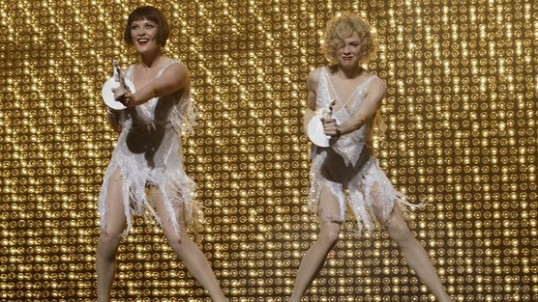
Chicago (2002, dir by Rob Marshall, DP: Dion Beebe)

Maps to the Stars (2014, dir by David Cronenberg, DP: Peter Suschitzky)

The Neon Demon (2016, dir by Nicolas Winding Refn, DP: Natasha Braier)