International Horror Film Review: En el Pozo (dir by Bernardo and Rafael Antonaccio)


In this 2019 film from Uruguay, four people spend the day at a quarry.  Needless to say, things don’t go well.

Alicia (Paula Silva) grew up in the small town of Suarez but she has since moved to the big city.  When she returns to her home to visit her parents, she brings along her new boyfriend.  Bruno (Augusto Gordillo) is well-educated and apparently wealthy.  He’s not a fan of hunting.  He finds fishing to be barbaric.  He doesn’t think much of Alicia’s small town and it’s obvious, from the first minute that we see him, that he is eager to get back to the city.  However, Alicia wants to spend the day at the water-filled quarry (“It’s as close to the beach as we get,” someone explains) with two of her old friends, Tincho (Rafael Beltran) and Tola (Luis Pazos).  Tincho is Alicia’s ex-boyfriend and is obviously still in love with her.  He gets the day off to an awkward start by telling her that he’s ready to abandon Suarez and join her in the city.  Tola, meanwhile, is a cheerful joker.  While Bruno and Tincho spend their timed trying to one-up each other, Tola is content to just smoke weed and drink beer.  While Alicia tries to keep the peace, the tension between Tincho and Bruno continues to grow.

From the start, it’s obvious that at least one member of the group is going to eventually end up trying to kill the others.  It’s just a question of who is going to snap first.  The film tells its story with a deliberate pace, capturing each moment of growing tension.  When Bruno kicks away Tincho’s soccer ball, we wonder, “Is this the moment that’s going drive Tincho to murder?”  When Tincho taunts Bruno into risking serious injury by diving into the quarry, we again wonder if this is the moment that Bruno is going to finally lose it.  Even Tola occasionally seems somewhat suspicious.  I mean, no one can be that laid back!  As women have done since the beginning of time, Alicia tries to keep the men from killing each other in their attempts to impress her with their displays of machismo.  It takes a while but the inevitable violence does arrive and I have to say that I was actually a little surprised to see who instigated it.

En El Pozo (the name translates to In The Quarry) is a well-acted and tense film.  One thing that works to the film’s advantage is that no one in the film is one-dimensional.  None of them are perfect but none of them are totally evil.  Bruno is correct when he says that Tincho is trying to bait him but, at the same time, Bruno is also a bit condescending to both Tincho and Alicia.  Tincho may be an immature jerk but his feelings for Alicia are real.  And while I sympathized and related to Alicia, I did have to wonder why she thought it would be a good idea to have her new boyfriend hang out with her ex-boyfriend in an isolated quarry.  The violence erupts suddenly and the events that happen afterwards are as much a result of panic as they are of maliciousness.  En El Pozo is well-acted and well-directed, with the atmosphere becoming progressively more claustrophobic as the tensions continue to rise.  It all leads to appropriately dark and downbeat ending.  Así es la vida.
8 Shots From 8 Horror Films: 1990 — 1993


4 Or More Shots From 4 Or More Films is just what it says it is, 4 shots from 4 of our favorite films. As opposed to the reviews and recaps that we usually post, 4 Shots From 4 Films lets the visuals do the talking!

This October, I’m going to be doing something a little bit different with my contribution to 4 (or more) Shots From 4 (or more) Films.  I’m going to be taking a little chronological tour of the history of horror cinema, moving from decade to decade.

Today, we take a look at 1990, 1991, 1992, and 1993!

8 Shots From 8 Horror Films: 1990 — 1993

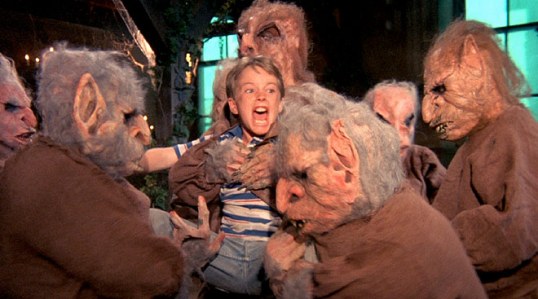
Troll 2 (1990, dir by Claudio Fragasso, DP: Giancarlo Ferrando)

It (1990, dir by Tommy Lee Wallace, DP: Richard Lieterman)

Frankenstein Unbound (1990, dir by Roger Corman, DP: Armando Nannuzzi)

The People Under The Stairs (1991, dir by Wes Craven, DP: Sandi Sissel)

Twin Peaks: Fire Walk With Me (1992, dir by David Lynch, DP: Ron Garcia)

Bram Stoker’s Dracula (1992, dir by Francis Ford Coppola, DP: Michael Ballhaus)

Witchboard 2: The Devil’s Doorway (1993, dir by Kevin S. Tenney, DP: David Lewis)

Cronos (1993, dir by Guillermo Del Toro, DP: Guillermo Navarro)

Horror Film Review: The Watcher (dir by Joe Charbanic)


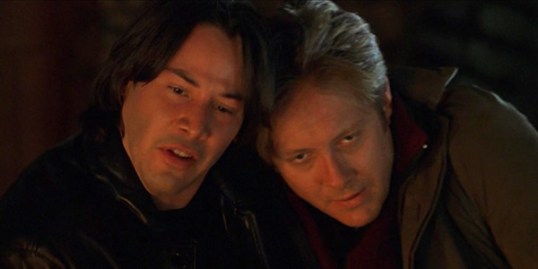
Released in 2000, The Watcher is one of those movies where a burned out FBI Agent finds himself locked in a game of cat-and-mouse with an overly verbose serial killer. The FBI agent doesn’t want to get involved and is struggling with a drug addiction. (It’s always either drugs or a wife who doesn’t feel like she knows him anymore.) The serial killer is surprisingly intelligent and well-spoken, despite the fact that most real-life serial killers are only a step or two away from blowing themselves up in a meth lab. Movies love the idea of a witty sociopath but it rarely happens in real life.

Anyway, you get the point. Probably just from reading the previous paragraph, you already know everything that happens in The Watcher. There’s not a single moment in this movie that will take you by surprise. In fact, this movie is so full of clichés that, when I watched it, I actually got mad at the film’s characters for not being able to figure out that they were all just characters in a predictable serial killer film. Seriously, if I woke up and discovered that I was only a character in a movie, I imagine that I would devote at least a few minutes to having an existential crisis. There is also a lot of random slow motion in this movie. The slow motion doesn’t create suspense or generate thrills or anything like that. It’s just kind of there.

Really, the only interesting thing about The Watcher is the cast. For a movie like this, it has a surprisingly good cast. James Spader plays the FBI agent. Marisa Tomei plays the agent’s therapist. (She’s also the only female character to have more than 10 lines in the entire movie. To be honest, it’s a role that anyone could have played but Tomei does her best with what she’s been given.) The serial killer, who is named David Allen Griffen because all serial killers have three names, is played by Keanu Reeves.

Keanu as a serial killer is strange casting. For the most part, Keanu’s appeal has always been that he comes across like someone who, to quote Mother Bates, wouldn’t hurt a fly. Keanu flashes his charming smile and speaks politely with his future victims and, at no point, does he make much of an effort to be a believable killer. Some of that may be because Keanu apparently didn’t want to do the film. Keanu has always said that one of his assistants forged his name on a contract, legally obligating Keanu to appear in this movie. That’s a strange story. When you hear it, you think to yourself, “This the type of thing that could only happen to Keanu Reeves.”

For more than Keanu, James Spader is convincing in his role. Spader spends the entire movie looking like 1) he’s going through massive drug withdrawal and 2) like he’s on the verge of losing his mind. So much of acting is expressed through the eyes and, throughout this movie, Spader’s eyes are bloodshot and exhausted. It’s a superior piece of acting and it’s hard not to feel that it’s probably more than this movie deserved.

Horror on the Lens: Nosferatu (dir by F.W. Murnau)


Today’s Horror on the Lens is a classic film that really needs no introduction!  Released in 1922, the German silent film Nosferatu remains one of the greatest vampire films ever made.  It’s a film that we share every October and I’m happy to do so again this year!

Enjoy!

The TSL’s Horror Grindhouse: Beyond The Time Barrier (dir by Edgar G. Ulmer)


This 1960 film tells the story of Bill Allison (Robert Clarke), an air force test pilot who flies his test craft into space and then returns to discover that Earth has totally changed!

The Air Force base where he previously worked is now deserted and desolate.  After he’s captured by a group of silent soldiers, Allison is taken to an underground city known as the Citadel.  He meets the head of the city, an older man known as The Supreme (Vladimer Sokoloff).  The Supreme explains that only he and his second-in-command, The Captain (Red Morgan), can speak and hear.  The rest of humanity communicates through telepathy.  Though the Supreme’s granddaughter, Princess Trirene (Darlene Tompkins), telepathically insists that Allison is not a threat, the Supreme and the Captain still exile him to live with a bunch of angry, bald mutants who are determined to destroy the city.  Allison meets three other exiles and discovers that they too are time travelers.  The scientists explains that Bill has found himself in the far future.  The year is no longer 1960.  No, the year is …. 2024!

OH MY GOD, WE’VE ONLY GOT TWO YEARS LEFT!

Actually, we’ve probably got less than two years left.  This is October and the film appears to be taking place in the summer so we’ve probably only got 18 months to go!

(Cue Jennifer Lawrence: “We’re all gonna die!”  Cue Leonardo Di Caprio: “I’m so scared!”  Okay, tell them both to shut up now.)

Anyway, Allison assumes that society must have collapsed due to a global war but the scientists explain that the first manned spacetrip to the moon actually ushered in an era of peace.  (Wow, how did I miss this?)  In fact, humans had colonized the Moon, Mars, and Venus by 1970.  (Woo hoo!  Yay, humanity!)  However, years of nuclear testing had weakened the Earth’s atmosphere and, in 1971, the planet was bombarded by cosmic rays.  (Uh oh….)  Humanity was forced to move into underground cities.  Some of them developed telepathy and became super advanced.  Others became bald mutants.  Unfortunately, everyone is now sterile and the Supreme probably expects Allison to impregnate Trirene and do his part to repopulate the planet.

On the one hand, Allison and Trirene are falling in love.  Allison is handsome and strong.  Trirene has pretty hair and is the only citizen of the Citadel who gets to wear anything flattering.  They’re a cute couple.  On the other hand, if Allison sticks around the repopulate the planet, he’ll never be able to go back to his present and warn everyone about the upcoming cosmic ray plague.  Plus, it soon becomes clear that the scientists have an agenda of their own.  Allison finds himself torn between the two factions trying to control the Citadel.

Made for next to no money and filmed at Fair Park in Dallas, Beyond The Time Barrier is a surprisingly good film.  It was directed by Edgar G. Ulmer, an Austrian director who started out as an associate of Fritz Lang’s and who followed Lang to the United States.  Ulmer made films for the Poverty Row studios and he was a master of creating atmosphere on a budget.  He was one of the pioneers of film noir and he brought that same style to his horror and sci-fi films.  As envisioned by Ulmer in Beyond The Time Barrier, the future is full of menacing shadows, dangerous con artists, and untrustworthy authority figures.  It’s a fatalistic film, one that ends on a surprisingly downbeat note.  Even if Allison can save humanity, will it really be worth all the trouble?  Much like Detour, Ulmer’s best-known film, Beyond The Time Barrier plays out like a deliberately-paced dream, full of surreal moments and ominous atmosphere.

Beyond The Time Barrier is available on YouTube and Prime.  Watch it now before we have to go underground.

RUN! Short Film Review by Case Wright


Normally, I would have all kinds of tags about the filmmaker and actors, but I can’t find any. There are far too many “RUNS!”. I didn’t know that the horror short of “a woman being chased while jogging with her headphones on” wasn’t as much of a subgenre as much as it was a meme.

Not to say that running alone with your headphones on is not an extremely dangerous activity- IT IS! However, do we really need 30+ shorts of this same thing?

HOW ABOUT NO?

They were trying to be funny, but they ended up being kinda scary. I know they didn’t mean to do it, but it failed up. I was unsettled by it. It’s also possible that I’m burned out from too many Alex Magana films and by studying this all day:

Yes, I know to solve this… mostly. Slow down ladies, there’s enough Case for everyone.

I know many of you are thinking: sure steam generators are hot and sexy and all, but we’re here for the short-film review and now I’m all sweaty. Fine, I’m here for it.

This film creeped me out because it’s too much like real life. When I moved across the country, I was alone except for my cat- Love you, wherever you are. I would see signs in Montana- Next Services 250 Miles. I realized that if my truck broke down, I’d die here or if some psycho disabled my vehicle, I’d be lost forever and ever. The actress’ vulnerable got to me. I mean Without a Trace had 9 Seasons – that’s According to Jim territory. Point is, we’re not as safe as we want to believe that we are. We could vanish. We are at the mercy of the social contract, but not everyone is a party to it.

This short tapped into that. It failed, but it did fail up.

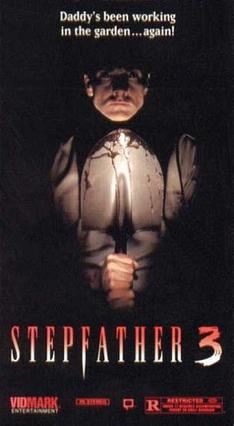
Stepfather III (1992, directed by Guy Magar)


As if Stepfather II was not bad enough on its own, 1992 saw the release of Stepfather III.

Once again, Jerry Blake/Gene Clifford manages to survive being mortally wounded at the end of the previous film.  After he recovers, he is sent to the exact same institution that he previously escaped from.  Guess what happens?  He escapes again!  Now using the name Keith, he marries Christine Davis (Priscilla Barnes) and become stepfather to her son, Andy (David Tom).  Andy is in a wheelchair.  Keith is convinced that Andy is faking his condition and keeps calling him “slugger.”  When Andy doesn’t respond, Keith prepares to move on to another single mother (Season Hubley).  But, before he can move on, Keith needs to take care of his current family.  Good thing that he has a woodchipper.

Terry O’Quinn did not return for Stepfather III.  The Stepfather is played by Robert Wightman, who looked and sounded nothing like Terry O’Quinn.  The film tries to explain it away by saying that the Stepfather got plastic surgery after he escaped from the institution but, unless the plastic surgeon was God, there’s no way that Jerry/Gene could ever have become Keith.

Stepfather III goes through the motions and even repeats the first film’s “buckle up for safety” gag.  By repeating all of the key scenes from the first (and even the second) movie, the third movie only succeeds in reminding us that The Stepfather doesn’t work without Terry O’Quinn’s performance and Joseph Ruben’s intelligent direction.  Keith becomes a standard movie slasher with a wood chipper.  He does inspire Andy to get out of his wheelchair, in a scene that will inspire more laughter than cheers.

One positive note: Season Hubley is in this movie!  Much as with Jill Schoelen in the first movie and Meg Foster in Stepfather II, this franchise had a way of attracting actresses who deserved better.

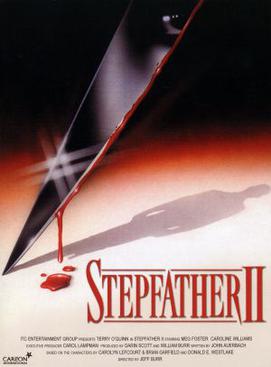
The Stepfather II: Make Room For Daddy (1989, directed by Jeff Burr)


Remember how, at the end of the first Stepfather film, Jerry Blake (played, in a classic horror performance, by Terry O’Quinn), was killed by the family that he was planning on murdering for not living up to his expectations?

It turns out that he wasn’t dead after all.  He was shot.  He was stabbed in the back.  Somehow, he wasn’t killed.  Also, despite being a mass murderer, he was sent to a mental institution where the security is so lackadaisical that he manages to murder a psychologist and a guard and then escape once again.

Taking on the name of Gene Clifford and passing himself off as a family therapist, the Stepfather continues his search for the perfect family.  He meets and becomes engaged to Carol (Meg Foster), who doesn’t find it weird that Gene is always whistling Camden Races.  Before he can marry Carol, Gene is going to need to dispose of her ex-husband and her best friend.  And, of course, Carol and her son Todd (Jonathan Brandis) are going to have to live up to Gene’s ideal of the perfect American family.

This is a disposable sequel, which eliminates all of the humor of the first film and just turns Jerry/Gene into another generic slasher.  The strength of the first film was that Jerry seemed likable up until the moment that his idealized vision of the perfect family was threatened.  Then he snapped and ended up in the basement, ranting and raving.  In Stepfather II, Gene is obviously dangerous from the start and a lot less interesting.  The movie is unfortunate and unnecessary and even Terry O’Quinn seems to be bored.  Give the film some credit, though, for giving Meg Foster a sympathetic role.  Gene may be crazy but no one could blame him for falling for Carol.  How could anyone resist those eyes?

Horror Scenes I Love: The Cenobites Make Their First Appearance In The Original Hellraiser


AGCK!

This is from the original 1987 Hellraiser.  The Cenobites were probably never scarier than they were in their very first appearance.  Perhaps the most interesting thing about them is that, rather than being stereotypically good or evil, they’re actually neutral.  They’re doing their job and, if you don’t want to see them, don’t mess around with the puzzle box.  Doug Bradley was brilliant in the role of the head Cenobite (who, of course, would later be known as Pinhead).

International Horror Review: Don’t Deliver Us From Evil (dir by Joel Seria)


Reportedly, when this 1971 film was released in Europe, it was advertised as being “The French film that was banned in France.”

That wasn’t just hyperbole.  Don’t Deliver Us From Evil was so controversial that it was accused of promoting “blasphemy” and it was barely released in its native country.  It would be thirty years before the film was finally released in the United States and, even then, it would just be a DVD release.  The United States and France may not have agreed on much but apparently, they both agreed that Don’t Deliver Us From Evil was just too dangerous to be released into theaters.

The film is loosely based on a true story, the same 1954 Parker-Hulme murder case that would later inspire Peter Jackson’s Heavenly Creatures.  In Don’t Deliver Us From Evil, Pauline Parker and Juliet Hulme are reimagined as Anne de Boissy (Jeanne Goupil) and Lore Fournier (Catherine Wagener), two 15 year-old girls who meet at boarding school and become fast friends.  Together, they read sordid novels, they spy on the nuns, and they taunt the priest with fictional confessions.  (Anne has erotic fantasies about the priest during Mass.  Are you starting to get why some people considered this film to be blasphemous?)  During the summer, Lore stays at Anne’s estate.  Spending all of their time together, they start to play games that become increasingly dangerous and cruel.  For instance, they playfully taunt a pervy goat herder until the man attempts to rape Lore.  Lore and Anne manage to escape and they get their revenge by burning down the man’s home.  Meanwhile, they also find the time to cruelly taunt their mentally disabled gardener, pledge their souls to Satan, and eventually kill a stranger.  Uh-oh, summer’s over!  Time to go back to school.  Hopefully, Lore and Anne were able to successfully hide the stranger’s body because there certainly are a lot of police around.  It all leads to a shocking and rather disturbing finale.

The question running through the film is whether the girls are evil or if they’re just playing a game.  Many of their actions are undeniably cruel, especially when it comes to taunting the gardener.  But there are other times when Anne and Lore are revealed to be painfully naïve.  Having been raised by nuns and often ignored by their wealthy parents, Anne and Lore’s knowledge of sex and sexuality is largely the result of the “forbidden” books that they read late at night when everyone else is asleep.  For most of the movie, neither seems to care that their “games” have real world consequences but is that due to them being evil or is it due to them being completely sheltered and cut-off from the rest of the world?  When they pledge their souls to Satan, is it because they truly want to be evil or is it just something to do for a laugh?  Anne is undeniably the dominant personality in their friendship.  Anne has a near breakdown when she spends two days apart from Lore but, at the same time, it’s Anne who is constantly instructing Lore to do things that put her safety at risk.  Lore herself seems to be a follower, one who follows Anne even when Anne is putting Lore’s life at risk.

Don’t Deliver Us From Evil has enough sex, violence, and nudity (though Lore and Anne are both 15, the actresses playing them were 19 and 20) that it’s not surprising that the film was controversial.  That said, it’s not a bad film.  Much as Peter Jackson did when he told his version of the Parker-Hulme Murder Case, Don’t Deliver Us From Evil refuses to pass easy judgment on either of the girls.  Instead, it’s left to the viewer to try to figure out if Anne and Lore are evil or if they’re just immature and confused.  Director Joel Seria directs most of his ire not at the girls but at the Church and at Anne’s upper class parents.  Having pushed her off on the Church to raise, Anne’s parents never seem to be particularly interested in what their daughter is doing.  Even during the film’s apocalyptic finale, Anne’s parents (and really, just about every adult in the film) is clueless as to what’s actually happening right in front of them.

Watching the film, I could imagine the controversy that it caused when it was first released.  While some of the once-shocking scenes are tame by today’s standards, there are still a few moments that retain their power to shock.  Ultimately, though, Don’t Deliver Us From Evil is an intelligent exploration of la mauvaise caractère.