Happy Horrorthon! I have seen a lot of bad movies over the years, but this might be the worst movie ever made. “The Room” by Tommy Wiseau is provably better than “Shark Encounters of the Third Kind” because much of “The Room” took place in rooms; whereas, this “shark horror film (note the poster above)” took place mostly on land, kitchens, parking lots, docks, and a creepy onanist’s basement. There is actually a scene where an incel guy slowly walks down the stairs to his “Man Basement” and puts in a VHS tape, sighs, leans back, and…. he watches a documentary on alien abductions. Yep, that’s all he was up to…watching a documentary. “Shark Encounters of the Third Kind” sponsored by the Carpal Tunnel Foundation of America.
Some of you might be like- “Case, you always judge these films really hard and these people have feelings… probably.” Hear me out, the Polonias (this films’ director/producer) and Alex Maganas (Smiling Woman creator) of the world don’t care about my feelings when they make these terrible things. I was thinking: is there a way that I would be able to give this film a positive review? I think so: if my neighbor had a three year old and this three year old told me, “Mr. Casey, I made a movie and a boom boom.” I’d watch the movie with his family and cheer him on, but this is not the case here. So, this movie gets no breaks from me. Really, look at the villains!
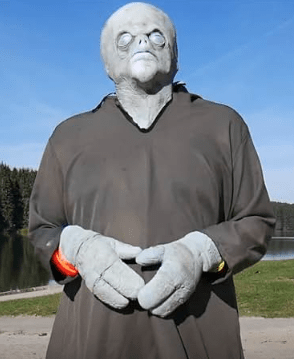
This Alien Has EVIL Potholders! I believe this is the plot: the villains are NOT the sharks. The villains are aliens who are doing a reconnaissance mission to earth and there are sharks involved somehow – rarely. Mostly, this film is a big honking crazy mess. The poster is not terrible…. so there’s that.
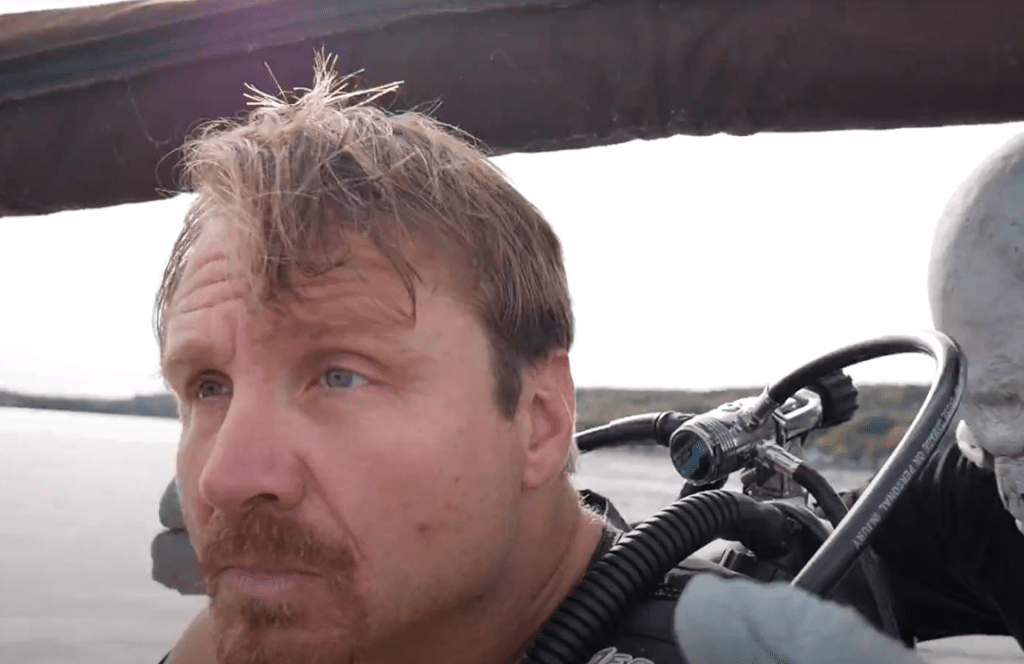
Another observation: the film is really into doing closeups….A LOT. For example, they spend a lot of time on this actor’s face (below). He is definitely NOT a shark. You wonder why this movie only has 8 minutes of shark scenes. I think the shark scenes were too expensive and you need to make more time for Oven Mitt Alien guy (above).
There is really no reason for you to watch this film. I’m sure that you have done something good in your life- spare yourself.
A direct sequel to Godzilla Against Mechagodzilla, 2002’s Godzilla: Tokyo S.O.S. begins with the Shobijin, those two little annoying girls who hang out with Mothra, appearing to a Japanese scientist and his family and explaining to them that Godzilla won’t stop attacking Japan until the government does away with their Mechagodzilla, Kiryu. Kiryu was constructed using the bones of the original Godzilla and, as a result, the current Godzilla is drawn to him.
Instead, the Shobijin suggest that the Kiryu should be tossed in the ocean. In return, the latest incarnation of Mothra will serve as Japan’s champion whenever Godzilla attacks.
So, to make clear, Japan can either be protected by a badass cyborg that was created out of the skeletal remains of the original Godzilla or it can be protected by a giant moth that has to spend time in a cocoon before it can even become an effective monster. And, along with the whole cocoon thing, Mothra also comes with two annoying little sidekicks who are constantly popping up and going on and on about how stupid humanity is.
Now, I don’t know about you but, if I was in charge, I would probably just stick with the cyborg. If nothing else, the cyborg looks like a badass and it can destroy just as much property as Godzilla. The cyborg exists to say, “Hey, Godzilla — you’re not the only pointlessly destructive monster on this planet!” Add to that, the cyborg can be piloted and controlled by humans. The cyborg doesn’t talk back. The cyborg doesn’t tell humanity that everything is their fault. The cyborg can be shut down whenever there’s not a monster attack going on. In other words, get lost, Mothra!
In Tokyo S.O.S., The government of Japan agrees with me, which of course leads to a huge fight between Godzilla, Kiryu, and eventually Mothra. Mothra does that thing where she wraps Godzilla up in string and also where she appears to sacrifice her life. The problem is that, after you see enough of these films, you know that Mothra is always going to sacrifice her life and she’s always going to be reborn.
So, the story isn’t that spectacular. It’s pretty much just Godzilla Against Mechagodzilla all over again. But here’s the important thing: the fights are really cool. Yes, the fights are a bit familiar and there’s nothing about them that will really take you by surprise but, if you just want to watch Godzilla destroy stuff, this film delivers plenty of that.
Tokyo S.O.S. is unique amongst the Godzilla films of its era in that it was a direct sequel as opposed to be a reboot. In fact, it was only the direct sequel of the so-called Millennium Era. The next Godzilla film, Godzilla: Final Wars, would be a reboot and a spectacular one at that. We’ll take a look at it next week.
What’s an Insomnia File? You know how some times you just can’t get any sleep and, at about three in the morning, you’ll find yourself watching whatever you can find on cable or streaming? This feature is all about those insomnia-inspired discoveries!
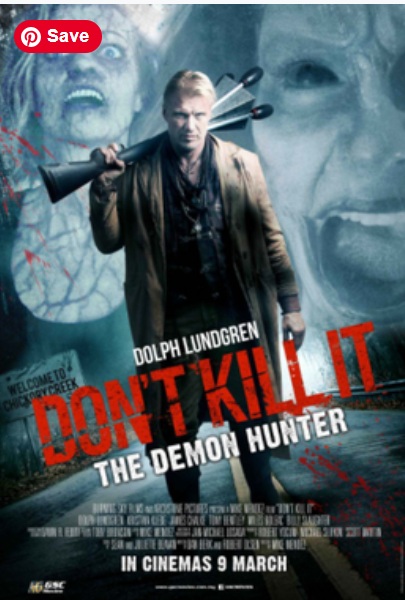
Last night, if you were having trouble getting to sleep, you could have gone to either YouTube or Tubi and watched the 2016 horror film, Don’t Kill It!
Don’t Kill It! takes place in a small Mississippi town. After a hunter shoots his suddenly viscous dog and then murders his wife and children, the hunter is gunned down by another man. That man then proceeds to kill his own family. FBI agent Evelyn Pierce (Kristina Klebe) thinks that it was a case of domestic terrorism. Demon hunter Jebediah Woodley (Dolph Lundgren) disagrees. Woodley explains that there’s a demon on the loose. The demon jumps from host to host. Killing one host means becoming possessed yourself. As Woodley explains it, the only way to avoid becoming possessed is not to kill it but then you run the risk of being killed yourself.
At first, everyone is skeptical of Woodley’s claims. But as Evelyn investigates the case (and we watch a lot of slow motion flashbacks that appear to have been included to pad out the running time), she comes to realize that Woodley is correct. There is a demon and it is possessing people. But how can it be stopped?
Don’t Kill It may be a low-budget film but it gets the most out of that budget, making good use of the country atmosphere of its setting and getting generally good performances from the cast. (The possession scenes are simple but still very well-done and creepy.) The main appeal here is Dolph Lundgren, playing his role with just the right amount of self-awareness to let the viewer know that Lundgren knows exactly what type of film he’s appearing in and that he’s going to do his best to keep things entertaining. It’s a film that’s perfect for late night horror season viewing.
Admittedly, I watched the film with a group of friends, some of whom dropped out during the opening massacre. I could understand their feelings but I think the important thing to consider is, for all the bad things that happened, a hero still showed up to put things right. Indeed, one could argue that the film’s theme of murder leading to more murder is actually a plea for peace. “Don’t kill it!” Woodley says and it’s a message for everyone watching.
That, in itself, is perhaps not a surprise. Roberts, by his own admission, is an actor who will appear in just about any production that is willing to pay him a relatively modest fee. As a result, this Oscar nominee and industry veteran has appeared in a countless number of low-budget movies, many of which would be considered far outside of the Hollywood mainstream. For example, BrokenChurch, which was released earlier this year, is an evangelical religious film and, hence, about as far outside of the Hollywood mainstream as you can get.
That said, Eric actually gets to a do a bit more than usual in this film. He plays John Parker, the father-in-law of Rev. James Logan (Art Parsells). When the Rev. Logan is released from prison after being wrongfully convicted of embezzling from his church, Logan and his wife, Beverly (Jennifer Adams) move in with Parker. John Parker is running for the U.S. Senate and the last thing he wants or needs bad publicity about his son-in-law. It leads to a tense relationship between Parker and Logan. Luckily, by the end of the film, Logan has become a faith healer (the type who inspires the crippled to toss down their crutches and then run around the churchyard) and this leads to Parker moving up in the polls. The same demon that framed the Rev. Logan also tries to frame Parker but Parker’s too smart to accept any campaign donations from her. In a film that is full of all sorts of implausible plot contrivances, a politician refusing money may be the biggest.
BrokenChurch is a low-budget film that features a few familiar faces, like Robert and Bill Cobbs and Kevin J. O’Connor. It’s portrayal of a church divided by rumor and accusations will undoubtedly ring true for some, just as its portrayal of politics will leave most people rolling their eyes. John Parker may be running for the Senate but he seems to be spend most of his time hanging out in his suburban home. Where are the campaign aides? Where are the reporters? Why is the phone not ringing nonstop? With his campaign falling apart, Parker goes on vacation with his wife and declares he doesn’t want to hear anything else about the election. That attitude won’t get anyone to the White House!
This is a bit of a silly film, really. But at least Eric Roberts is in more than just one scene.
Previous Eric Roberts Films That We Have Reviewed:
The year was 1979 and Fred Silverman, the president of NBC, had an idea.
How about a television series in which each week’s episode would depict a different group of passengers going on a trip? The passengers would all be dealing with their own stories, some of which would be dramatic and some of which would be humorous. With any luck, some of them might even fall in love over the course of their journey!
To keep the audience interested, the show would also feature a cast of regular characters, the crew. Edward Andrews would play the captain, a sensible and by-the-book type. Robert Alda played Doc, the doctor who was also a bon vivant. Patrick Collins was the goofy purser. Nita Talbot played Rose, the perky director of entertainment. Michael DeLano was the bartender who always had the best advice for the passengers….
Does this sound familiar?
If you think that it sounds like Fred Silverman just ripped off The Love Boat …. well, you’re wrong. The Love Boat took place on a boat. Supertrain took place on a train.
At the time that Supertrain went into production, it was the most expensive television production of all time. Before the pilot film was even shot, NBC had spent ten million dollars on the Supertrain sets. Not only was a fake train built but two models were also constructed for the shots of the train moving through the countryside. At the time, the assumption was that the costs would be easily covered by the money that NBC stood to make from broadcasting the 1980 Summer Olympics. Unfortunately, Jimmy Carter decided that the U.S. would be boycotting the Olympics as a way to protest Russia’s invasion of Afghanistan. The only thing that kept NBC from going bankrupt was that the BBC was apparently run by someone even more incompetent than Fred Silverman. The BBC paid $25,oo per episode for the rights to air Supertrain in the UK. Supertrain proved to be such a disaster that the BBC never actually aired the episodes that they had purchased.
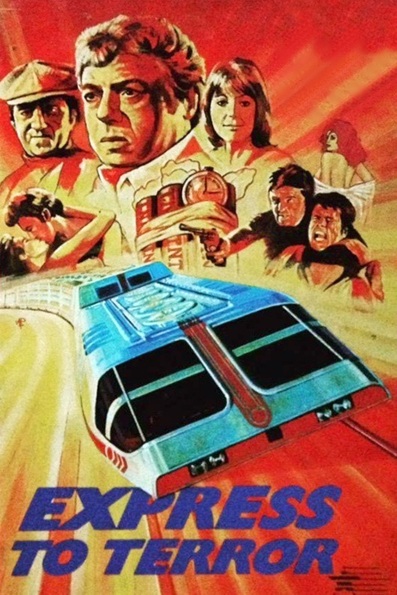
1979’s Express to Terror was the pilot to Supertrain. (It was later released in some territories as a stand-alone film.) Directed by horror impresario Dan Curtis (who was also brought in to produce the series), Express to Terror opens with an apparently drunk Keenan Wynn playing the role of railway baron Winfield Root. Winfield loudly announces to a group of nervous investors that he has created ” an atom-powered steam turbine machine capable of crossing this country in 36 hours!” A few months later, Supertrain sets off from New York to Los Angeles.
The main thing that one notices about the train is that it’s incredibly tacky. For all the money that Winfield Root (not to mention NBC) poured into the thing, it looks awful. The cabins are bland and also seem to be constantly shaking as the train rumbles over its tracks. Whereas The Love Boat featured glorious shots of passengers enjoying themselves on an open-air deck, Express to Terror features a lot of shots of passengers trying to squeeze their way through narrow and crowded hallways. There’s a disco car, which sounds like fun but actually looks like a prom being held in a locker room. There’s a swimming pool but you can’t really lay out by it because it’s on a train. Winfield is among the passengers and he continually refers to the train as being “Supertrain” in conversation, which just sounds dumb. “The next person who stops Supertrain,” he announces “will be walking to L.A!”
The main drama features Steve Lawrence as Mike Post, a Hollywood agent with a gambling problem who thinks that someone on the train is trying to kill him. Actually, the assassin is after a different Mike Post (Don Stroud) but that Mike Post is a criminal who, after entering the witness protection program, changed his name to Jack Fisk. The criminal Post is hoping that the agent Post will be killed by mistake. The criminal Mike Post has a girlfriend named Cindy (Char Fontane) who falls in love with the agent Mike Post. Fred Williamson appears as a football player-turned-assassin. George Hamilton plays a Hollywood executive. Don Meredith is the alcoholic best friend of the agent Mike Post. Stella Stevens is on the train as a diva. So is Vicki Lawrence, playing a naive innocent.
Express to Terror tries to mix comedy and drama but it doesn’t really work because the “Good” Mike Post doesn’t really seem to be worth all the trouble. Steve Lawrence gives a mind-numbingly bad performance in the role and, as a result, “Good” Mike Post really isn’t any more sympathetic than “Bad” Mike Post. The main problem is that “Good” Mike Post comes across as being a coward and there’s only so much time that you can watch a coward act cowardly before you lose sympathy for him. Being scared is one thing. Being so dumb that accidentally gets your fingerprints on a knife that’s just been used to kill a man is another thing.
As for the members of the crew — the captain, the doctor, the bartender, and such, they take a back seat to the drama of the two Mike Posts. It’s a bit odd because no one on the train — not even Winfield Root — seems to be that upset by the fact that one of their passengers is murdered while the train is going through a tunnel. You would think that everyone would be worried about the future of Supertrain at that point. A murder is not good for publicity but Winfield Root is oddly unconcerned about it. I swear, light rail people are almost as heartless as bicyclists!
Of course, the worst thing about Express to Terror is that it promises terror but it doesn’t deliver. When I see a the word “terror” in a film directed by Dan Curtis, I expect a little terror! Other than Steve Lawrence’s overacting, there really wasn’t anything particularly terrifying about Express to Terror.
As for Supertrain, it ran for nine episodes and was promptly canceled. Fred Silverman left NBC and spent the rest of his career as an independent producer. Supertrain’s tracks got too close to the sun and they nearly took down a network.
Though the Academy of Motion Picture Arts and Sciences claim that the Oscars honor the best of the year, we all know that there are always worthy films and performances that end up getting overlooked. Sometimes, it’s because the competition too fierce. Sometimes, it’s because the film itself was too controversial. Often, it’s just a case of a film’s quality not being fully recognized until years after its initial released. This series of reviews takes a look at the films and performances that should have been nominated but were, for whatever reason, overlooked. These are the Unnominated.
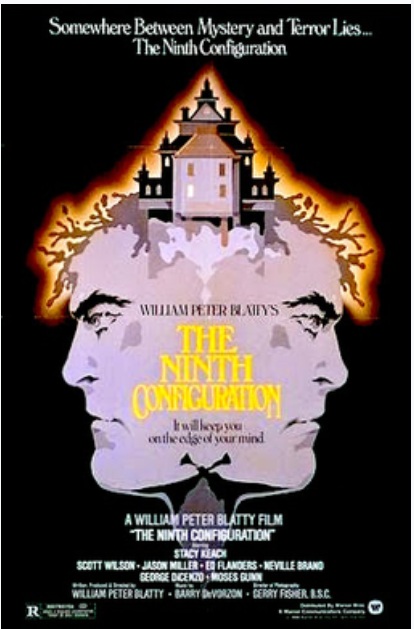
Some films defy easy description and that’s certainly the case with 1980’s The Ninth Configuration.
The film opens with a shot of a castle sitting atop of a fog-shrouded mountain. A voice over tells us that, in the early 70s, the castle was used by the U.S. government to house military personnel who were suffering from mental illness. Inside the castle, the patients appear to be left to their own devices. Lt. Reno (Jason Miller) is trying to teach dog how to perform Shakespeare. Astronaut Billy Cutshaw (Scott Wilson) is haunted by the thought of being alone in space and refuses to reveal why he, at the last minute, refused to go to the moon. The men are watched over by weary and somewhat sinister-look guards, who are played by actors like Joe Spinell and Neville Brand.
Colonel Kane (Stacy Keach) shows up as the new commandant of the the castle. From the first minute that we see Kane, we get the feeling that there might be something off about him. Though he says that his main concern is to help the patients, the man himself seems to be holding back secrets of his own. With the help of Colonel Fell (Ed Flanders, giving an excellent performance), Kane gets to know the patients and the guards. (Despite the objections of the guards, Kane says that his office must always be unlocked and open to anyone who want to see him.) He takes a special interest in Cutsaw and the two frequently debate the existence of God. The formerly religious Cutshaw believes the universe is empty and that leaving Earth means being alone. Kane disagrees and promises that, should he die, he will send proof of the afterlife. At night, though, Kane is haunted by dreams of a soldier who went on a murderous rampage in Vietnam.
The film start out as a broad comedy, with Keach’s smoldering intensity being matched with things like Jason Miller trying to get the dogs to perform Hamlet. As things progress, the film becomes a seriously and thoughtful meditation on belief and faith, with characters like Kane, Billy, and Colonel Fell revealing themselves to be quite different from who the viewer originally assumed them to be. By the time Kane and Cutshaw meet a group of villainous bikers (including Richard Lynch), the film becomes a horror film as we learn what one character is truly capable of doing. The film then ends with a simple and emotional scene, one that is so well-done that it’ll bring tears to the eyes of those who are willing to stick with the entire movie.
Considering all of the tonal shifts, it’s not surprising that the Hollywood studios didn’t know what to make of The Ninth Configuration. The film was written and directed by William Peter Blatty, the man who wrote the novel and the script for The Exorcist. (The Ninth Configuration was itself based on a novel that Blatty wrote before The Exorcist.) By most reports, the studio execs to whom Blatty pitched the project were hoping for another work of shocking horror. Instead, what they got was an enigmatic meditation on belief and redemption. The Ninth Configuration had the same themes as The Exorcist but it dealt with them far differently. (Because he wrote genre fiction, it’s often overlooked that Blatty was one of the best Catholic writers of his time.) In the end, Blatty ended up funding and producing the film himself. That allowed him complete creative control and it also allowed him to make a truly unique and thought-provoking film.
The Ninth Configuration was probably too weird for the Academy. Though it received some Golden Globe nomination, The Ninth Configuration was ignored by the Oscars. Admittedly, 1980 was a strong year and it’s hard to really look at the films that were nominated for Best Picture and say, “That one should be dropped.” Still, one can very much argue that both Blatty’s script and the atmospheric cinematography were unfairly snubbed. As well, it’s a shame that there was no room for either Stacy Keach or Scott Wilson amongst the acting nominee. Keach, to date, has never received an Oscar nomination. Scott Wilson died in 2018, beloved from film lovers but never nominated by the Academy. Both of them give career-best performances in The Ninth Configuration and it’s a shame that there apparently wasn’t any room to honor either one of them.
The Ninth Configuration is not a film for everyone but, if you have the patience, it’s an unforgettable viewing experience.
198o’s He Knows You’re Alone opens with a young couple making out in a car. (The guy, who is named Don, is played by Russell Todd, the devastatingly handsome actor who played the first victim in Friday the 13th Part II.) A report comes over the radio. There’s a killer on the loose. The girl is concerned. The guy is cocky. It’s hard not to notice that both of them look a little bit too old to be playing high school students. Suddenly the killer attacks and….
We sitting in a movie theater, watching as two friends, Ruthie (Robin Lamont) and Marie (Robin Tilgham), watch the film. Marie covers her eyes while Ruthie announces, excitedly, that the couple is going to die. Marie, uncomfortable with the onscreen violence, goes to the washroom. She splashes water on her face. She catches her breath. When she returns to the theater, Ruthie is excited because the girl on screen is about get slashed by her stalker. Marie hides her eyes. Just as the girl onscreen screams, the man sitting behind Marie drives a knife into the back of her neck, killing her.
It’s a brilliantly edited sequence, one that comments on how audiences love depictions of violence while fearing it in real life. It’s also a genuinely scary sequence, especially if you’re someone who frequently goes to the movies. (Would the sequence have the same impact on someone who has grown up almost exclusively in the streaming age? Probably not.) It’s a sequence that shows a hint of a self-awareness that was lacking in many 80s slasher films. It’s also so good that the rest of the film struggles to live up to it.
The killer in He Knows You’re Alone is Ray Carlton (played with wild-eyed intensity by Tom Rolfing), a serial killer who preys on women who are engage to be married. While Detective Len Gamble (Lewis Arlt) tries to track down Ray and get revenge for the murder of his fiancée, Ray stalks Amy Jenson (Caitlin O’Heaney) and her bridesmaids, Nancy (Elizabeth Kemp) and Joyce (Patsy Pease). (Why Ray focuses on the bridesmaids before going after Amy is never really explained.)
We also meet a few red herrings, all of whom would probably be suspects if the film hadn’t already shown us that Ray is the murderer. Joyce is having an affair with a married professor named Carl (James Rebhorn). While we don’t really get to know Amy’s fiancé, we do spend a good deal of time with her ex-boyfriend, hyperactive morgue attendant Marvin (Don Scardino). We also meet Nancy’s date for the weekend, a psych major named Elliott (Tom Hanks). This was Hanks’s film debut and, even though he doesn’t get much screentime, he’s so instantly likable that it’s easy to understand why he became a star.
As I mentioned earlier, the rest of He Knows You’re Alone struggles to live up to its opening moments. That doesn’t meant that He Knows You’re Alone is a bad movie. Though there are a few scenes that comes across as being filler, it’s still an effective slasher film. The fact that the killer is just some anonymous loser as opposed to a Freddy Krueger-style quip machine makes him all the more frightening. Ray Carlton is a killer who you can actually imagine siting behind you, preparing to strike. The film also makes good use of its chilly Long Island locations. There’s a grittiness to the film that leaves the viewer feeling as if the world itself is decaying along with Ray’s victims.
And then there’s Tom Hanks, a ray of cheerfulness amidst the drabness of the Mid-Atlantic hellhole that is New York. At one point, his psych student talks about how scary stories and movies can help people deal with the horrors of the real world, another hint that this film was more self-aware than the usual slasher flick. Originally, Hanks’s character was meant to be one of Ray’s victims but director Amand Mastroianni (who later went on to direct several episodes of Friday the 13th: The Series) said that Hanks proved to be so likable in the role that no one could stand the thought of killing him off.
He Knows You’re Alone is an effective little slasher flick. Watch it with the lights on. You never know who might be behind you.
To be absolutely honest with you, I’m starting to think that the Amityville films aren’t exactly being honest about the whole “based on a true story” thing.
I mean, on the one hand, it is true that, in the early 70s, a teenage heroin addict named Ronald DeFeo murdered his family in their home in Amityville, New York. Perhaps realizing that there was no way anyone was going to buy his original claim that the Mafia killed his entire family but somehow left him alive, Ronald DeFeo eventually claimed that he had been possessed by a demon. Some people believed that story because some people will believe anything that involves demon possession.
It’s also true that a family called the Lutzes moved into the Amityville murder house and then moved out a few weeks later and claimed that they had been haunted by the same demons that drove Ronald DeFeo to kill. It was a stupid story but it played into the 70s’s obsession with the apocalypse and demonic possession. It was the decade of The Exorcist and The Omen. A non-fiction novel was published and it became a best-seller. In 1979, a movie was made and it became a hit. And, in the years since, there have been over 50 films with the words “Amityville” in the title. Some of those films have been actual Amityville films and some of them have just been generic low-budget horror flicks that just borrowed the term. What they all have in common is the claim that the Ronald DeFeo was possessed by Satan and that the Lutzes weren’t lying about the house being haunted. Of course, if there really is an Amityville Demon, it’s probably seriously pissed off by now, These films do not make him look good.
The current popular gimmick is the idea that even things that used to be in the Amityville house have been filled with demonic energy that they still carry with them, even outside of the house. 2016’s Amityville Toolbox features Mark (played by Mark Popejoy) receiving a toy monkey for his 50th birthday. No sooner has he unwrapped the monkey then he’s acting moody, drinking alcohol after years of sobriety, and then chopping wood with an axe. His family, who have gathered at his country home for the weekend, watch him and wonder if anything’s wrong with Dad. Well, he’s wandering around with an axe and now he’s loading a shotgun so what do you think?
Directed by Dustin Ferguson, Amityville Toolbox is a low-budget film that features dialogue that feels like it’s been improvised. Up until Mark finally listens to the vengeful ghost of his father (Colby Coash) and finally starts doing the full DeFeo to his family, the pace is almost torturously slow. That said, the film actually has a few fairly good shots. A tracking shot down the foggy road leading to Mark’s home is a hundred times more creepy than it has any right to be. Colby Coash is properly intimidating as the evil spirit and Mark Popejoy does a credible-enough job as the disturbed father who handles his midlife crisis in the worst way possible. Mark snaps and it’s actually a bit disturbing. The rest of the cast is struggles with their underdeveloped characters but some of the visuals are primitively effective.
That said, I think Mark was more to blame for his actions than the Amityville house or the toy monkey. Sometimes, even murderers need to take responsibility for their choices.
The year is 1972 and the news is grim. The fighting continues in Vietnam. The protests continue at home. Crime is rising. The economy is struggling. Groups like the Weathermen and the SLA are talking about taking the revolution to the streets. In New York, the notorious murderers Krug Stillo (David Hess) and Fred “Weasel” Podowksi (Fred Lincoln) have broken out of prison and are one the run. They are believed to be traveling with Krug’s drug-addicted son, Junior (Marc Sheffler), and a woman named Sadie (Jeramie Rain), who is said to be feral and bloodthirsty.
However, Mari Collingwood (Sandra Cassel) doesn’t care about any of that. She’s just turned seventeen and she can’t wait to go to her first concert with her best friend, Phyllis (Lucy Grantham). Mari is naive, optimistic, and comes from from a comfortably middle-class family. Phyllis is a bit more worldly and tougher. As she explains it, her family works in “iron and steel.” “My mother irons, my father steals.”
While Mari’s parents (Richard Towers and Eleanor Shaw, though they were credited as Gaylord St. James and Cynthia Carr) bake a cake and prepare for Mari’s birthday party, Mari heads into the city with Phyllis. Before they go to the concert, they want to buy some weed. When they see Junior Stillo hanging out on a street corner, they assume he must be a dealer and they approach him. Junior takes them to an apartment, where they are grabbed by Weasel and Krug.
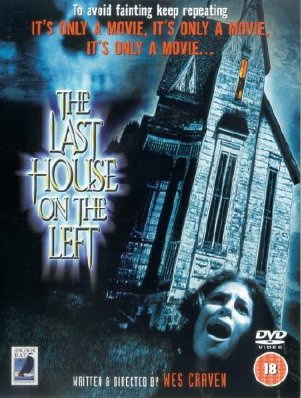
1972’s The Last House On The Left was advertised with the classic (and much-repeated line), “To avoid fainting, keep repeating, ‘It’s only a movie …. it’s only a movie…. it’s only a movie….” That advice is easy to remember during the first part of the film because, up until Mari and Phyllis approach Junior, the movie is fairly cartoonish, with Richard Towers giving an incredibly bad performance as Mari’s father. This film was Wes Craven’s debut as both a director and a writer. By his own admission, Craven had no idea what teenage girls would talk about and, as such, he just wrote a lot of dialogue in which Mari talked about her breasts and Mari’s mother complaining that young women no longer wore bras. (On the commentary that he recorded for the film’s DVD release, Craven succinctly explained, “I guess I was obsessed with breasts.”) This part of the film plays out like a weird counter-culture comedy. Even when we first meet Krug, he’s using his cigar to pop a little kid’s balloon.
The Last House On The Left (1972, dir by Wes Craven, DP: Victor Hurwitz)
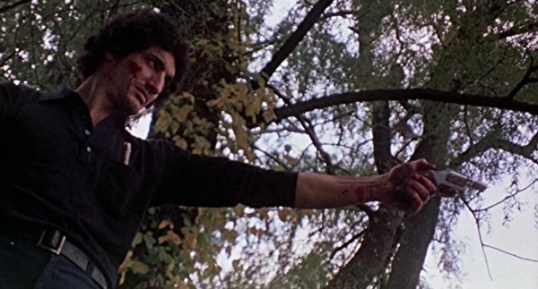
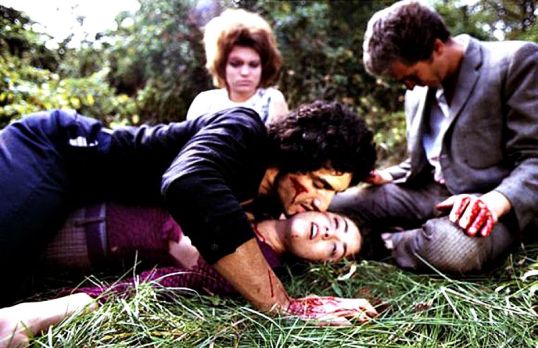
The tone of the film jarringly shifts the minute that Mari and Phyllis step into that apartment. That’s largely due to the performances of David Hess and Fred Lincoln, who are both so convincing in their roles that it can be difficult to watch them. In real life, Fred Lincoln was a stuntman (he’s in The French Connection) and an adult film actor. David Hess, meanwhile, was a songwriter who was looking to break into acting. (Hess’s songs — some of which are beautifully sad and some of which are disturbingly jaunty — are heard throughout the movie.) Hess, in particular, is so frightening as Krug that he spent the rest of his career typecast as sociopathic murderers. The middle part of the film alternates between disturbingly realistic scenes of Mari and Phyllis being tortured and humiliated and cartoonish scenes involving two incompetent cops (one whom is played by Martin Kove) and Mari’s parents. Phyllis is murdered and dismembered in a graveyard and the gore effects remains disturbingly realistic even when seen today. Mari, after being raped by Krug, recites a prayer, and then wades into a nearby lake. Krug shoots her three times. Afterwards, Krug, Weasel, and Sadie try to wash the blood off of themselves, the expression on their faces indicating that even they understand that they’ve gone too far.
Eventually, Krug, Weasel, Sadie, and Junior stop off at a nearby house, claiming to be salespeople who just had a little car trouble. What they don’t realize is that the people who are generously welcoming them to spend the night are also the parents of Mari Collingwood….
Basing his script on Ingmar Bergman’s The Virgin Spring, Wes Craven has often said that The Last House On The Left was meant to be a commentary on the Vietnam War and the way that other films had glamourized violence. That may or may not be true. (Craven has also said that, at the time, he was so desperate to direct a movie that he would have filmed almost anything.) What is true is that the violence in Last House On The Left is not easy to watch. Once it starts, it’s relentless and, at no point, is the audience given an escape. David Hess is so committed to playing a sadist that he never takes a moment to wink at the audience and say, “Hey, we’re just playacting here!” Craven shot the film in a guerilla style and the shaky camera, the natural light, and the grainy images leave you feeling as if you’re watching some sicko’s home movies. At the end of the movie, when Mari’s parents take the same joy in attacking her killers as Krug took in attacking their daughter, it’s hard not to feel that Mari has been forgotten. Everyone has been consumed by the violence that has erupted around them. Even though Richard Towers’s nearly blows the ending with a few hammy line readings, the film still leaves you exhausted.
The Last House on the Left (1972, dir. by Wes Craven, DP: Victor Hurwitz)
Not surprisingly, The Last House On The Left was attacked by most reviewers when it was originally released. The movie played the drive-in and grindhouse circuit for three years, with producer Sean Cunningham often taking out advertisements in local newspapers that read: “You will hate the people who perpetrate these outrages—and you should! But if a movie—and it is only a movie—can arouse you to such extreme emotion then the film director has succeeded … The movie makes a plea for an end to all the senseless violence and inhuman cruelty that has become so much a part of the times in which we live.” The film’s advertisements also contained a warning that no one under 30 should see the movie. Needless to say, The Last House On The Left was a huge hit, especially with viewers under 30.
(One of the great ironies of film criticism is that one of the few critics to defend Last House On The Left was Roger Ebert. Ebert, who would later be one of the slasher genre’s biggest attackers, gave Last House On The Left a very complimentary review and praised it for its political subtext.)
Seen today, The Last House On The Left still packs a punch. It’s a shocking and shamelessly sordid film, one that shows hints of the talent that would make Wes Craven one of the most important directors to work in the horror genre. It’s flawed, it’s exploitive, it’s thoroughly unpleasant, and yet it’s also a film that sticks with you. It’s powerful almost despite itself. It’s not a movie that I would necessarily chose to watch on a regular basis but, at the same time, I can recognize it as being a historically important film. For better or worse, much of modern American horror owes a debt to Wes Craven’s Last House On The Left. Even today, when one is regularly bombarded with horrific images, Last House On The Left still has the power to shock.
At a college that appears to be located on a beach in Hawaii, Dean Whitman (Eric Roberts) is about to lose his job. He’s been accused of taking advantage of his female students, something that he admits is true. Somewhat drunk and disillusioned with the world, Whitman has a conversation with a creepy clown doll. (The doll comes out a box that specifically says that it was made by voodoo priestess.) Whitman decides to play with a gun and — whoops! — shoots himself in the head. Whitman’s mind is transferred into the doll’s body. In the form of the clown doll, Whitman goes after the sorority that he blames for his downfall.
Eric Roberts is only onscreen for a handful of minutes in 2015’s Sorority Slaughterhouse but we hear his voice throughout the film. It turns out that doll is a total pervert! What’s odd is that the doll is also really small and it moves somewhat stiffly, leading me to wonder just how exactly it manages to effortlessly kill so many people. Admittedly, most of the deaths are edited in such a way that we never actually see the doll and the victim in the same shot but it’s still hard to look at that doll and imagine it as a killer. Of course, the victims are all just dumb enough to fall victims to a killer doll. One girl uses the doll as a vibrator. A guy is suffocated with a balloon animal. Someone else is murdered by having Drain-O poured over her. I can’t imagine that product placement was appreciated.
This is a David DeCoteau film and I’m pretty sure that the sorority house was the same house that DeCoteau used in Bigfoot vs D.B. Cooper. It’s hard not to appreciate DeCoteau’s determination to make mockbusters for next to no money. This film obviously owed a lot to Child’s Play and the DeCoteau-directed Puppet Master films and DeCoteau wasn’t going to let a lack of special effects get in the way of the particular killer doll movie. That said, the action moves very slowly and the doll is in no way intimidating, even if it does sound like Eric Roberts reading dirty DMs. Personally, when it comes to collaborations between Eric Roberts and David DeCoteau, I prefer A Talking Cat!?!
Previous Eric Roberts Films That We Have Reviewed:





 Through the Shattered Lens