Back to School #69: Superbad (dir by Greg Mottola)


Superbad

One of the great things about the 2007 comedy Superbad is that it has a title that allows for snarky but overworked reviewers like me to come up with an easy review.

For instance, if I disliked Superbad, I could just say, “Superbad more than lives up to its name!”  However, since I happen to like Superbad, I can say that Superbad is supergood, supercool, and superfun!

See how easily that works?

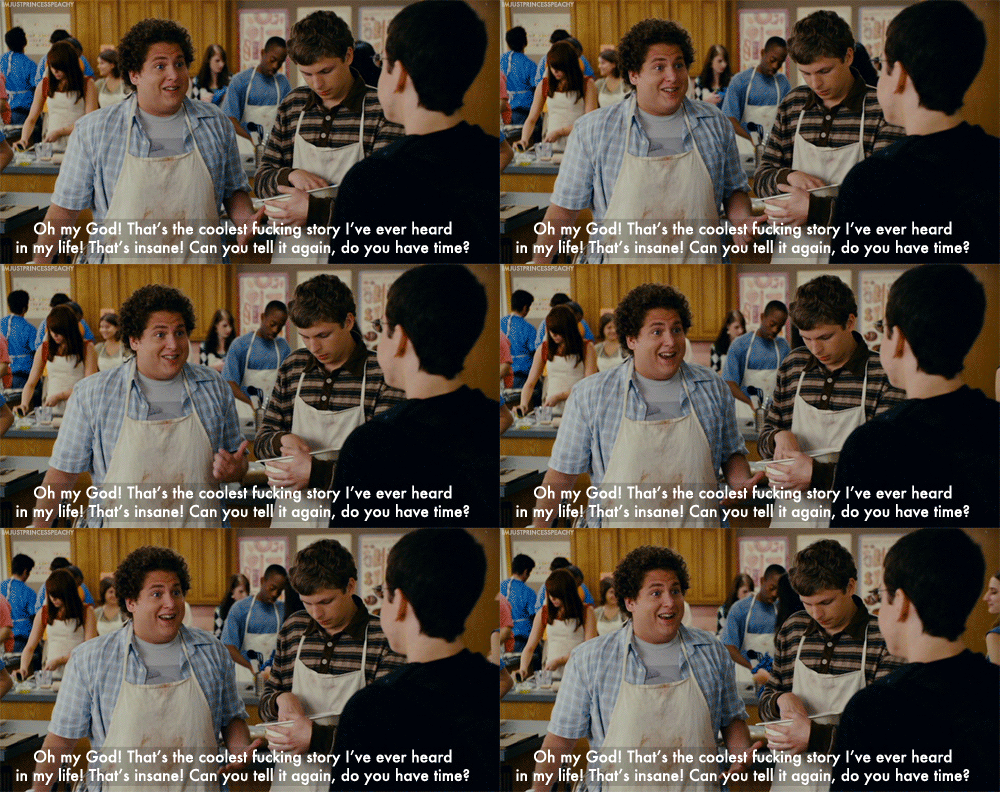
Plotwise, Superbad tells a story that will be familiar to anyone who has ever seen a teen comedy.  Three guys try to get laid.  Seth (Jonah Hill) is the rotund and boisterous one, the one who has a crush on Jules (Emma Stone), who is your basic good girl with a wild side.  Evan (Michael Cera) is the sweet and sensitive one.  And then there’s Fogell (Christopher Mintz-Plasse), the nerdy one with the thick glasses.  Fogell is the one who gets a hilariously bad fake ID, one that tells the world that his name is McLovin.
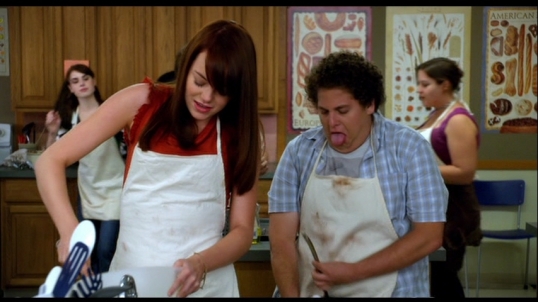
Superbad2

After Jules invites Seth to a party, he and Evan enlist Fogell to use his fake ID to buy them alcohol.  However, as often happens in the type of films, things get complicated.  While Fogell is buying the beer, the convenience store is held up.  The police arrive and Evan and Seth panic and run off.  Meanwhile, Fogell is befriended by the two cops (played by Seth Rogen and Bill Hader), both of whom are incredibly impressed that their new friend has as wonderful a name as McLovin.

(“You’re name’s McLovin?  That’s badass!”
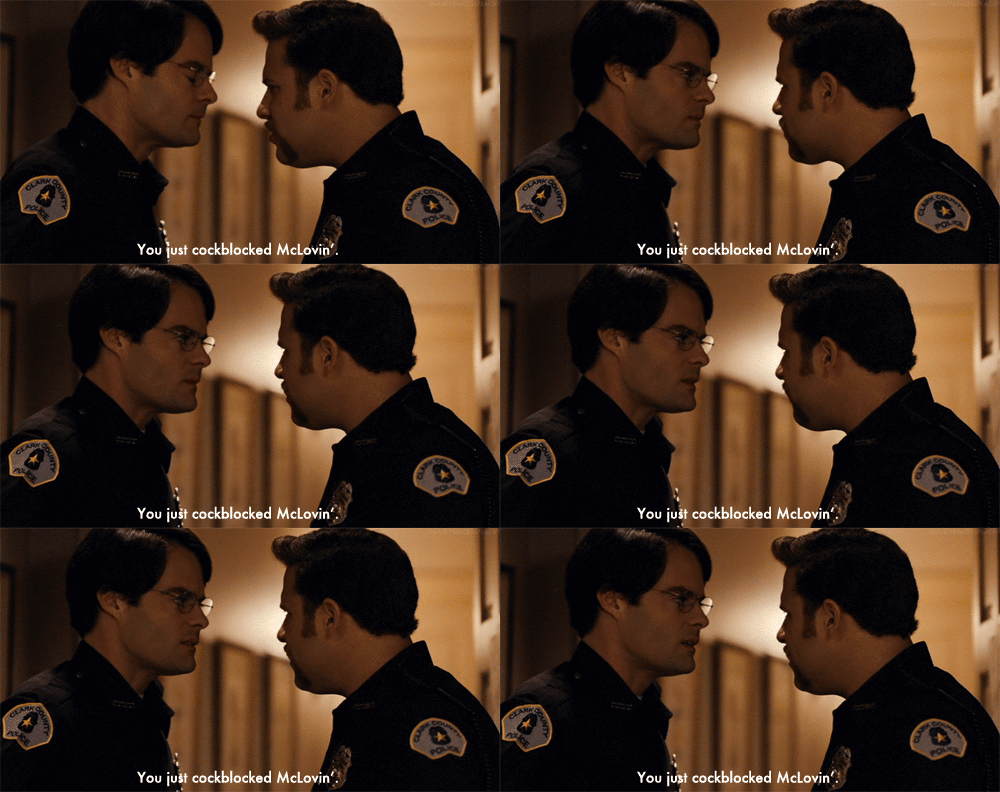
Superbad23

And so, while McLovin bonds with his new cop friends, Seth and Evan continue to try to find beer and make their way to Jules’s party….

Superbad was produced by Judd Apatow and it features his usual combination of raunchy humor and sentimental bromance.  In fact, it’s such a male-centered film that I’m always a little bit surprised at how much I enjoy it.  However, Superbad is a seriously funny movie.  The script (which Seth Rogen and Evan Goldberg reportedly starting on when they were 13 years old) is full of great lines and Michael Cera and Jonah Hill make for an adorable comedy team.  And then there’s Christopher Mintz-Plasse who takes the character of Fogell to his most logical extreme and then just keeps going.  McLovin’s adventures may not be the most realistic or subtle part of the movie but they are still a lot of fun to watch.

Speaking of McLovin and his adventures with the cops, I love the performances of both Seth Rogen and Bill Hader.  If you don’t laugh at the way Seth Rogen says, “Oh no!  It’s the cops!,” then you need to be worried about your sense of humor.

Superbad is supergood, supercool, superfun, supersweet, and just plain super.
Superbad

Back to School #68: Juno (dir by Jason Reitman)


Junoposter2007

(SPOILERS BELOW)

Even though he’s a likable actor and has appeared in several films that I enjoyed, I am always a little bit uneasy whenever I see Jason Bateman on screen.  To me, he will always be Mark, the seemingly perfect husband from the 2007 best picture nominee Juno.  Mark and his wife Vanessa (Jennifer Garner) are unable to conceive so they agree to adopt the unborn child of pregnant teenager Juno (Ellen Page).

At first, Mark seems like the nicest guy on the planet.  Unlike his wife, Mark appears to be laid back and friendly.  Whereas Vanessa tries to maintain a polite distance between herself and Juno, Mark quickly befriends her.  It’s a familiar dynamic.  Vanessa is the one who keeps the household running.  Mark is the one who keeps the household fun.  Vanessa is the adult and Mark is the guy who is young at heart.  It’s not surprising that Juno finds herself feeling closer to Mark than to his wife.

Much like Juno, those of us in the audience are initially fooled into preferring Mark to his wife.  For me, the first indication that Mark was not quite the great guy he seemed to be came when he attempted to convince Juno that Herschell Gordon Lewis was a better director than Dario Argento.  But even that could be forgiven because, as Mark made his arguments, he revealed that he had a pretty good library of DVDs from Something Weird Video.

(Seriously, at that moment, I really hoped that the movie would just spend five minutes letting us see every title in Mark’s movie collection.)

But then there was that moment.  After telling Juno that he was planning on leaving his wife, he looked at her and asked, “How do you think of me?”  And I have to give Jason Bateman a lot of credit.  He delivered that line with just the right amount of needy selfishness.  It’s rare that you see an actor — especially one who has essentially built a career out of being likable — so fully commit to playing a reprehensible character.  When Mark reveals his true nature, it’s shocking because we were so ready to like Mark.  With that one line, we’re forced to re-examine the entire film and we realize that, much like Juno, we allowed ourselves to be fooled by Mark.

Juno is a film about growing up.  Vanessa is a grown up.  Mark refuses to grow up.  And, by the end of the film, Juno has grown up enough to know that she’s not ready to be a mother but Vanessa is.  Juno has grown up enough that she can allow herself to get close to the baby’s father, sweet-natured track star Paulie (played by Michael Cera).

For many people, Juno seems to be a love-it-or-hate-it type of movie.  There rarely seems to be a middle ground.  It seems that for every person who appreciates Ellen Page’s sardonic line readings, there’s another one who finds her character to be abrasive.  For every one who enjoys Diablo Cody’s script, there seems to be another one who finds it to be overwritten.  The same holds true for Jason Reitman’s direction.  Viewers either respond to his quirky vision or else they dismiss him as being far too showy for the film’s own good.

As for me, I’m firmly and unapologetically pro-Juno.  I think Juno is one of the best films of the past ten years and I think that, eventually, both the character of Juno and Ellen Page’s performance will be viewed as being iconic.  When future historians are watching movies for clues as to what it was like to be alive during the first decade of the 21st Century, Juno is one of the films that they will watch.

And when they do, hopefully, they will understand that Jason Bateman was just an actor giving a good performance as a bad person.

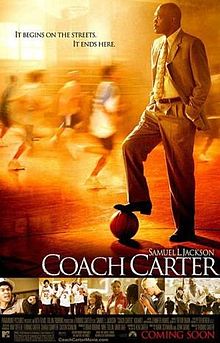
Back to School #67: Coach Carter (dir by Thomas Carter)


220px-Coach_Carter_poster

You all have got twitter to blame for this review.  I vaguely remember Coach Carter playing in theaters back in 2005 but I didn’t see it.  To be honest, the only thing that bores me more than high school football is high school basketball.  I have to admit that I really can’t stand to watch basketball, largely because I hate the way the player’s shoes are always squeaking on the court.  It just hurts my ears.

But, I’ve noticed that whenever Coach Carter shows up on television, everyone on my twitter timeline seems to get excited about it.  Coach Carter is one of those films that is obviously popular with a lot of people so, when I saw that it was going to be playing on Showtime last week, I figured why not?

And you know what?

Coach Carter is actually a pretty good movie.  If I don’t seem overly enthusiastic about it, that’s because I’m just not into sports.  But I do love movies and Coach Carter is an effective film.  That it’s predictable isn’t really that much of a surprise.  Predictability is actually probably one of the main appeals of the sports genre.  But Coach Carter is distinguished by a strong cast and it has a pretty good message to boot.

Plus, it’s based on a true story!  How true I don’t know but I’d like to think that the movie stuck pretty close to the facts if just because the story is so appealing.

Anyway, the Coach Carter of the title is played by Samuel L. Jackson.  At the start of the film, Carter takes over as basketball coach at the same inner city high school that he graduated from.  When he first starts, his team is rude, disrespectful, and undisciplined.  The majority of them have little direction in their lives and have basically pinned whatever hope they have for the future on eventually playing professional basketball.

(I will admit right now that I was really excited to discover that Channing Tatum played one of the players.  The only thing that would have made me happier would have been for James Franco to suddenly show up.)

Carter informs his team that, in order to play for him, they have to be willing sign a contract that states that they will treat everyone respectfully, that they will wear a tie on game days, and that they will all maintain a C+ average.  Some of the players refuse to sign (and are promptly kicked off the team) but those who do quickly discover that Carter expects them to honor the terms of the contract.

And, under Carter’s leadership, the team goes on to have a great season.  They’ve got an undefeated record and appear to be heading for the play-offs when Carter discovers that several members of the team have failed to keep up their grades.  To the shock of both the faculty and the community, Carter benches his entire team and announces that none of them will play until all of them have at least a 2.3 GPA.

Needless to say, it all leads to one of those emotional school board meetings that always seems to show up in films like this.

As I stated above, it’s all fairly predictable but the movie itself is well-made.  And if anyone was born to play an outspoken basketball coach who isn’t going to let anyone tell him how to run his team, it’s Samuel L. Jackson.  Jackson is one of those actors who is so good and so powerful that I think we sometimes tend to take him for granted.  Perhaps the best thing about Coach Carter is that it gives Jackson a chance to show what he’s truly capable of doing as an actor.

Again, I really don’t know that much about basketball and I’m not a fan of the game.  But, with all that in mind, I was still entertained by Coach Carter.  If nothing else, it proved that a lot of the people on my twitter timeline aren’t crazy.

Back to School #66: Mean Creek (dir by Jacob Aaron Estes)


mean-creek1

2004’s Mean Creek is one of those films that makes me cry every time.

The story that it tells is, at first glance, a rather simple one.  It’s only as you start to dig beneath the surface that you discover just how complex the film really is.  Sam (Rory Culkin) is being picked on by the school bully, the overweight George (Josh Peck).  When Sam accidentally knocks over George’s video camera while George is filming himself playing basketball, George beats Sam up.

Sam’s older brother Rocky (Trevor Morgan) decided to get revenge and recruits two of his friends to help him out, Clyde (Ryan Kelly) and Marty (Scott Mechlowicz).  Their plan is to invite George to Sam’s birthday party and to take him on a rafting trip.  Eventually, they plan to challenge him to truth or dare, get him to strip naked, and then basically abandon him.

Needless to say, things don’t quite go as planned.

For one thing, it turns out that George is sincerely happy to have been invited to Sam’s party and he even shows up with a gift. George, it turns out, doesn’t consider himself to be a bully.  Instead, he’s just an overweight kid who is insecure about his dyslexia and who doesn’t have any social skills.  Once the boys and Sam’s girlfriend Millie (Carly Schroeder) are floating down the creek, they’re forced to reconsider their plans. Some want to forget about it and let George go.  Some want to still go through with the plan.

And, meanwhile, poor George continues to be his own worst enemy…

Mean Creek is a fascinating film because George is such an unexpectedly complex character.  When we first see him, it’s easy to dismiss him as just your standard middle school bully but, as the film progresses, it becomes apparent that there’s more to George than our first impressions may have suggested.  And yet, every time that we start to feel truly sorry for George, he says the wrong thing or he displays some sort of behavior that reminds us of why he was invited to the birthday party in the first place.  In the end, we’re as conflicted about him as everyone else on the boat.  He’s a bully but he’s not a bad kid.  Can we forgive him for being a bully or does he still need to be taught a lesson?

That’s the question at the heart of Mean Creek and the film’s final answer (or, perhaps I should say, lack of a final answer) makes me cry every time.  I don’t want to spoil the film for those who haven’t seen it (and everyone should see it), so I’m not going to give any more details about the film’s plot.  I’ll just say that Mean Creek is an important film and one that will leave you thinking about what you’ve just seen and how you feel about it.

Mean Creek

Back to School #65: Mean Girls (dir by Daniel Waters)


Mean Girls Poster

Mean Girls is a film that has a lot of nostalgic importance for me.  It came out when I was a senior in high school and it was the last film that I saw before I graduated.  So, for me, Mean Girls always brings back memories of the excitement of knowing that my “real” life was about begin.  When I watch it or think about it, I’m always transported back to that time when the future seemed limitless.  I knew I was going to go to college, I was going to meet the love of my life, and I was going to have a great time doing it.  Thoughts of Mean Girls transports me back to one of the most exciting times of my life and, for that reason, I like to think of it.

Add to that, Mean Girls happens to still be a pretty funny and perceptive movie.

One thing that I do always find interesting about films like Mean Girls and 10 Things I Hate About You is that, even though they may be critical of the traditions of high school, they all seem to be taking place in the type of idealized high school that we all wish that we could have attended.  These high schools are always huge with brightly colored walls and quick-witted students who never have a bad hair day.  The rich, popular kids are always so clever with the way that they express their disdain.  And even the outcasts are still pretty good-looking.  Even more importantly, the outcasts are always so sarcastic and political.  They don’t just accept their outcast status.  Instead, they spend all of their spare time plotting ways to overthrow the system.  Perhaps best of all, all of the various cliques have such clever nicknames.

From my experience, most public high schools aren’t actually like this.  Then again, I went to high school in Texas and most of these films were made in California so maybe it’s just a west coast thing.  The important thing about a film like Mean Girls is that, even though it takes place in a heightened reality, there’s still enough reality that anyone watching it can relate to the film’s story.

(It’s been my experience that even real life mean girls love Mean Girls, mostly because I think everyone assumes that in high school, they were one of the clever, sarcastic outcasts, regardless of whether they actually were.)

In Mean Girls, the popular clique is nicknamed the Plastics and they’re led by Regina George (Rachel McAdams).  New student Cady  (Lindsay Lohan) is the latest member of the clique but what the Plastics do not suspect is that Cady is actually an infiltrator who has been recruited by outcasts Janis (Lizzy Caplan) and Damien (Daniel Franzese) to take down the Plastics from the inside.  However, as Cady goes out of her way to destroy Regina’s reputation and turn the rest of the school against her, she soon discovers that she’s running the risk of becoming just as mean as Regina…

Mean Girls is a comedy but, at its center, there rests a very important message about the need for people to not … well, to not be mean.  That may seem like a simplistic message and I guess it is.  But it’s still a good message to get out.  The script by Tina Fey is both clever and funny, deftly mixing the message with the comedy.  Finally, the film has a great cast, with Lindsay Lohan and Rachel McAdams as stand-outs and great supporting turns from Amanda Seyfried, Lacey Chabert, and Tim Meadows.

Thanks for the memories, Mean Girls!

Mean Girls

Back to School #64: Friday Night Lights (dir by Peter Berg)


For the past three weeks, I’ve been looking at some of the best, worst, most memorable, and most forgettable high school and teen films ever made.  I’ve been posting the reviews in chronological order and, as I look back over the previous 63 Back to School reviews, one thing that I can’t escape is football.

It’s funny.  Despite being a Texas girl, I know very little about football and, whenever I have found myself watching a game, I’ve usually end up getting bored out of my mind.  I’m not a huge fan of sports films, either.  It’s just not my thing.  And yet, as a result of doing this series of reviews, I’ve watched more football films over the past month than I had probably seen in my entire life previously.  Some of the films that I’ve reviewed specifically were football films — The Pom Pom Girls, All The Right Moves, and Varsity Blues, for example.  However, even the film that weren’t specifically about the sport often featured scenes set on the football field.  Just think of Forest Whitaker in Fast Times At Ridgemont High or the socially conflicted jocks from Dazed and Confused.

For a lot of films, football and high school seem to go together.  And one of the most acclaimed high school football films is 2004’s Friday Night Lights.  Now, I have to admit that Friday Night Lights is not one of my favorite films.  It’s a football film, I’m not into football, and therefore, Friday Night Lights is a film that I respect more as a well-made film than like as a source of entertainment.  Perhaps the best thing that I can say about Friday Night Lights is that I understand why so many people who do love football also happen to love this film.

And I do have to say that I appreciate that Friday Night Lights is also a film about Texas that actually manages to realistically portray my home state without resorting to the predictable clichés that dominated Varsity Blues.

Taking place in Odessa, Texas, Friday Night Lights follows the 1988 season of the Permian Panthers.  As opposed to most sports films, Friday Night Lights does not focus on a team of lovable underdogs.  Instead, the Panthers are already known for being a championship team.  As the season begins, Coach Gary Gaines (Billy Bob Thornton) is under tremendous pressure to continue that winning tradition.  However, when the team’s star player is injured during the first game of the season, the Panthers suddenly find their pre-ordained winning season in doubt.  Gaines finds himself being alternatively celebrated and demonized depending on how the previous night’s game has gone and his players find themselves under tremendous pressure from everyone in town.  The film features a great performance from Billy Bob Thornton and a really good one from Derek Luke, playing a player who abruptly goes from being a future superstar to a present could-have-been.  In fact, the entire film is well-acted with even country singer Tim McGraw giving a surprisingly multi-faceted performance as a former player-turned-drunk.

In short, Friday Night Lights is a lot like Varsity Blues, except that it doesn’t suck.

(Incidentally, Friday Night Lights did inspire a TV series.  I never watched it.)

Friday_night_lights_ver2

Back to School #63: Thirteen (dir by Catherine Hardwicke)


Have you ever seen a film and thought to yourself, “Oh my God, that’s my life?”

That’s the way I always feel whenever I see the 2003 film Thirteen.  Thirteen is one of my favorite movies but I always get uncomfortable whenever I watch it because a lot of the film hits really close to home for me.  Thirteen tells the story of 13 year-old Tracy (played, in an amazing performance, by Evan Rachel Wood) who, after befriending Evie Zamora (Nikki Reed, who also co-wrote the script along with director Catherine Hardwicke), goes wild.  Soon, Tracy is shoplifting, self-harming, experimenting with drugs and sex, and striking out at her mother, Melanie (Oscar nominee Holly Hunter).

As played by Hunter, Melanie is probably one of the best moms to ever show up in a contemporary film.  I’m tempted to say that Hunter’s performance here is the American equivalent to Sophia Loren’s work in Vittorio De Sica’s Two Women.  Melanie is not portrayed as being perfect.  Instead, she’s a recovering alcoholic who is dating a former drug addict (played by Jeremy Sisto) and she doesn’t always say the right thing and sometimes she does wish that she could just be selfish and not have to deal with her rebellious daughter.  When Evie, claiming that she’s being abused at her own home, literally moves in with Tracy, Melanie instinctively knows that Evie is a bad influence but she can’t bring herself to turn her away.  And yet, for all the mistakes that she makes, Melanie is still a good mom.  She loves her daughter and finally proves that she’s willing to sacrifice her own happiness to try to save Tracy.  Off the top of my head, I can’t tell you who won the Oscar for Best Supporting Actress of 2003, but it should have gone to Holly Hunter.

Thirteen was the directorial debut of one of my favorite director, Catherine Hardwicke.  Hardwicke doesn’t get the critical respect that she deserves, largely because she directed the first Twilight.  (Twilight, however, is not a badly directed film.  The trouble is with the source material, not Hardwicke’s direction.)  With Thirteen, Hardwicke approaches the film with a matter-of-fact directness that keep the movie grounded and prevents it from going over-the-top with its nonstop parade of delinquent behavior.

Thirteen

It’s a difficult film for me to watch because, when I was thirteen, I basically was Tracy.  I was angry at my Dad for leaving us and a part of me blamed my mom but an even bigger part of me blamed myself.  Like Tracy, I felt as if I had been abandoned and I felt as if control of my life was out of my hands.  I resented the life that I imagined I would never get to live and so, I went out of my way to make sure that everyone knew that I didn’t need them but they certainly needed me.  I struck out in whatever way I could and, looking back at it now, I know that, basically from the ages of 13 to 17, I caused a lot of unneccessary pain to the people who loved me.

Thirteen captures all of that perfectly and, therefore, it’s not easy for me to watch.  But, at the same time, I’m always glad after I do watch it because I know that I turned out okay and that gives me hope that, despite the film’s ambiguous ending, Tracy will turn out okay as well.

Thirteen2003Poster

Back to School #62: Elephant (dir by Gus Van Sant)


Gus Van Sant’s dream-like 2003 film Elephant is not an easy film to review.  Working with a non-professional cast and avoiding any easy answers or traditional narrative tricks (and indeed, the film ends with the fates of most of the characters still unknown), Elephant is ultimately a disturbing and nightmarish film.  It’s also an important film, one that examines the violence that runs through our current culture.

I’m one of the lucky ones.  I managed to get through all 12 years of my public education without ever getting shot at.  There’s quite a few people my age who can’t make the same claim.  I’d be lying if I said that I spent a lot of time in school obsessing over whether or not someone was going to start shooting but now, when I look back, I sometimes wonder how close I may have come.  One of the scarier things about the typical profile of school shooter is that we’ve all known somebody who fits it.  Sometimes, I can’t help but wonder if I just got lucky.  Maybe the guy who was planning on shooting up my school couldn’t get his hands on a gun.  Maybe, at the last moment, he changed his mind and decided to leave his gun in his locker instead of taking it out before the start of second period.  We come into contact with thousands of people over the course of our lives and we can never for sure what any of them are truly thinking or planning.

According to Wikipedia, there were a dozen school shootings in the U.S. during the time I was in high school.  Thankfully, none of them happened at my high school but, as I looked over the list, I couldn’t help but wonder why my classmates and I were spared the trauma of random violence while the students at Rocori High School in Cold Springs, Missouri were not.  Were we somehow better or more deserving than the students at Rocori?  Had they done something wrong or had we done something right?  Why were they forced to deal with violence while I was spared?  It all just seems so random.

And that’s the terrifying thing about random violence — it is, in the end, all so random.  We always tend to look for explanations afterward.  We try to assign blame and we try to come up with a reason because we know that, if we can explain random violence, then we can do something about it.  But, far too often, there are no reasons.

Elephant perfectly captures this randomness.  The film’s ensemble of characters spend what for many of them will be their final hours randomly wandering through their high school and their lives. Three mean girls eat lunch and then duck into toilet stalls where all three of them proceed to throw up.  John (John Robinson) searches for his drunk father (Timothy Bottoms) who may be wandering around the campus.  Awkward Michelle (Kristen Hicks) goes from her gym class to the library, little aware that she will soon be the first to be confronted by the gunmen.  Once the shooting starts, silent jock Bennie (Bennie Dixon) walks through the body-strewn halls, a potential hero until he is randomly shot.  The film is full of flash forwards and flashbacks, in which we see Alex (Alex Frost) and Eric (Eric Duelen) planning their rampage and we’re given clues as to their motives but we’re not given any answers.

Perhaps most memorable of all, at least to me, is the character of Eli (Elias McConnell), an aspiring photographer who gets one picture of Alex and Eric as they enter the library.  Up until that moment, the entire film has pretty much centered on Eli.  We’ve gotten to know him.  We’ve come to like him.  And yet, when Eli is shot, it happens almost as an afterthought.  One minute, he’s standing in the background and the next moment, he’s gone.  And we’re left to wonder if he survived or if it was even him who got shot.  Ultimately, what we realize is that, in that one split second, Eli ceased to be.  Even if he does survive being shot, he’ll never be the same person we saw earlier.  Even if he wasn’t shot, he’ll always be one of the students who went to that school.  In the end, we may have cared about Eli but none of that could stop the random violence.

Elephant is not an easy film to watch but then again, it shouldn’t be.  (If you want to read a bunch of comments from some people who just don’t get it, you can go read the simple-minded comments that some of them have posted over on the movie’s page at the imdb.) Elephant is a dark and troubling film, one that gave me nightmares after I saw it.  It’s a film so effective and powerful that one viewing is more than enough.

(Incidentally, one of Elephant‘s credited producers was JT Leroy, the pen name of Laura Albert whose books inspired a similarly difficult but powerful film, Asia Argento’s The Heart is Deceitful Above All Else.)

images

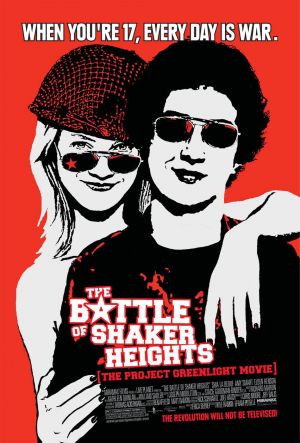
Back to School #61: The Battle of Shaker Heights (dir by Efram Potelle and Kyle Rankin)


Poster_of_the_movie_The_Battle_of_Shaker_Heights

“When you’re 17, every day is war.” — Tagline of The Battle of Shaker Heights (2003)

Anyone here remember Project Greenlight?  It’s a show that used to be on HBO and Bravo, in which Matt Damon and Ben Affleck would arrange for a director and screenwriter to get a chance to make their low budget feature film debuts.  The catch, of course, is that a camera crew would then follow the director as he (and all of the Greenlight “winners” were male) struggled to get the film made.  Mistakes would be made.  Money would be wasted.  Producer Chris Moore would randomly show up on set and start yelling.  In short, it was typical reality show drama with the catch being that the film itself would then be released in a theater or two.

Well, after being consigned to footnote status for the past nine years. Project Greenlight is coming back for a fourth season and a lot of people are pretty excited about it.  And why not?  I own the first two seasons of Project Greenlight on DVD and I’ve watched the third season on YouTube.  It’s a lot of fun, mostly because all of the directors, with the exception of season 3 winner John Gulager, turned out to be so incredibly inept.  (Gulager is one of the few Project Greenlight success stories — not only did his movie, Feast, come across as being made by a professional but he’s actually had a career post-Greenlight.)  It all makes for good televised drama.

However, it doesn’t necessarily make for a good movie.

Case in point: 2003’s The Battle of Shaker Heights.

The Battle of Shaker Heights is about a creepy 17 year-old named Kelly (played by the reliably creepy Shia LaBeouf).  His mother (Kathleen Quinlan) is an artist.  His father (William Sadler) is a former drug addict who, despite having been clean for 6 years, still has to deal with his son’s constant resentment.  Kelly is a high school outcast who spends all of his spare time thinking and talking about war.  Every weekend, he takes part in war reenactments.  At night, he works in a 24-hour grocery store where he doesn’t realize that he’s the object of Sarah’s (Shiri Appleby) affection.

(Why Sarah has so much affection for Kelly is a good question.  Maybe it’s the scene where he throws cans of cat food at her…)

At a reenactment of the Battle of the Bulge, Kelly meets and befriends Bart (Elden Hansen), which leads to him meeting Bart’s older sister, Tabby (Amy Smart).  Tabby is an artist, because the film isn’t imaginative enough to make her anything else.  (We’re also told that she’s a talented artist and it’s a good thing that we’re told this because otherwise, we might notice that her paintings are the type of uninspired stuff that you can buy at any county art fair.)  Kelly decides that he’s in love with Tabby but — uh oh! — Tabby’s getting married.  Naturally, she’s marrying a guy named Minor (Anson Mount).  Imagine how the film would have been different if his name had been Major.

As a film, the Battle of Shaker Heights is a bit of a mess.  It never establishes a consistent tone, the dialogue and the direction are all way too heavy-handed and on the nose, and Shia LaBeouf … well, he remains Shia LaBeouf.  In some ways, Shia is actually pretty well cast in this film.  He’s an off-putting actor playing an off-putting characters but the end of result is an off-putting film.

Of course, if you’ve seen the second season of Project Greenlight, then you know that The Battle of Shaker Heights had an incredibly troubled production.  Neither one of the film’s two directors were particularly comfortable with dealing with the more low-key human aspects of the story.  Screenwriter Erica Beeney was not happy with who was selected to direct her script and basically spent the entire production whining about it to anyone who would listen.  (Sorry, Erica — your script was one of the film’s biggest problems.  When you actually give a character a name like Minor Webber, it means you’re not trying hard enough.)  Finally, Miramax took the completed film away from the directors and re-edited it, removing all of the dramatic scenes and basically leaving a 79-minute comedic cartoon.

So, in the end, Battle of Shaker Heights is not a very good film.  But season two of Project Greenlight is a lot of fun!

Back to School #60: Crazy/Beautiful (dir by John Stockwell)


Oh, memories!

I don’t know if I can describe how much my girlfriends and I loved Crazy/Beautiful when it first came out in 2001.  We saw it in the theaters, we rewatched it when it came on cable, and after I bought it on DVD, we watched it at my house.  We loved the movie because we all dreamed of having a sensitive, hot boyfriend like Carlos Nunez (played by Jay Hernandez), who would love us no matter how obnoxious or bratty we may have been.  Even if we sometimes got annoyed with her, we still all related to out-of-control Nicole (Kirsten Dunst), who everyone in the world had given up on but who ultimately just wanted her father to pay as much attention to her as he did to his new wife and his new baby.  We liked the film because we wanted to be both crazy and beautiful.

And, of course, there was all the sex, all of it filmed in beautiful soft-focus with the camera always suggesting that it was showing more than it actually was.  Crazy/Beautiful was one of those films that made you feel grown up while still being very careful not to lose its PG-13 rating.

Yes, back in the day, I loved Crazy/Beautiful.

And you know what?

It may just be the nostalgia talking but I still love it.  I recently rewatched Crazy/Beautiful and, despite the fact that I was now watching as a “critic” as opposed to a 15 year-old with issues, I quickly fell under the film’s spell.  There’s just something about Crazy/Beautiful that I simply cannot resist.

It’s a beautiful film.  Director John Stockwell has made a career out of making movies about pretty people hanging out on pretty beaches and Crazy/Beautiful has a lot of both.  When Carlos, a responsible high school senior who lives in East Los Angeles and who is hoping to attend the U.S. Navy Academy, first meets Nicole, she’s doing community service by picking up trash on the beach.  What Carlos doesn’t find out until later is that Nicole is the daughter of U.S. Rep. Tom Oakley (played, somewhat inevitably, by Bruce Davison).  Nicole is haunted by her mother’s death and feels that her well-meaning but ineffectual father has abandoned her.  At first, her relationship with Carlos seems to be yet another part of her rebellion but soon, both she and Carlos are madly in love.

Can Carlos save Nicole from herself?  Can Nicole love Carlos without leading him down the path of self-destruction?  Will Nicole and her father ever reconnect?  Will … oh, who cares?  You already know the answers.  Crazy/Beautiful is less about the story and more about how the story is told.  Stockwell keeps the story moving along and fills the screen with colorful and romantic images that make Crazy/Beautiful into the perfect teenage daydream.  He also makes perfect use of the undeniable chemistry between Jay Hernandez and Kirsten Dunst.  Both of the stars give such good performances that you really do come to care about the characters that they are playing and hope that things work out for them.  Kirsten Dunst, in particular, gives a brave performance and doesn’t shy away from playing up Nicole’s abrasiveness.  It takes courage to play a character who can be unlikable.  It takes talent to make that unlikable character sympathetic and, fortunately, Kirsten Dunst shows a lot of both in Crazy/Beautiful.

CrazyBeautiful