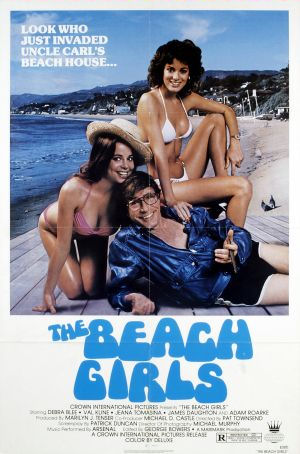
As you may have guessed from the combination of the film’s title, the film’s poster, and the film’s dialogue, the 1982 comedy The Beach Girls is yet another production from Crown International Pictures.
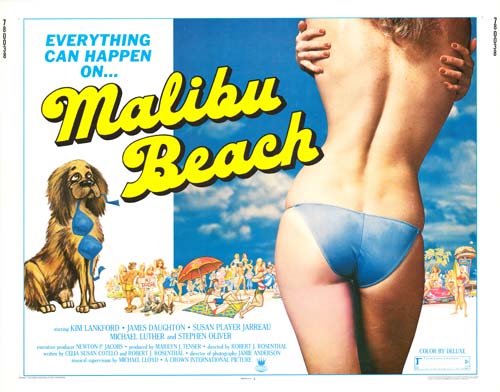
And if you had any doubts, The Beach Girls quickly erases them by not only featuring the exact same songs that were heard in both The Pom Pom Girlsand Malibu Beachbut by also reusing a good deal of beach footage that originally appeared in Malibu Beach. Remember that dog in Malibu Beach that kept stealing everyone’s bikini top? Apparently, the folks at Crown International really liked that dog because all of his scenes are awkwardly inserted into The Beach Girls.
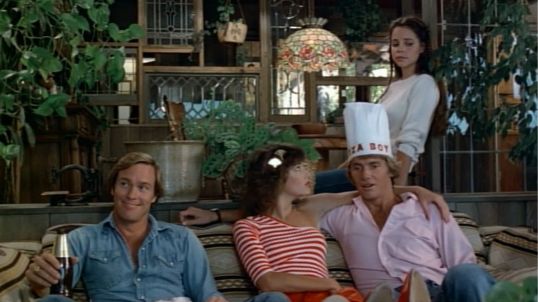
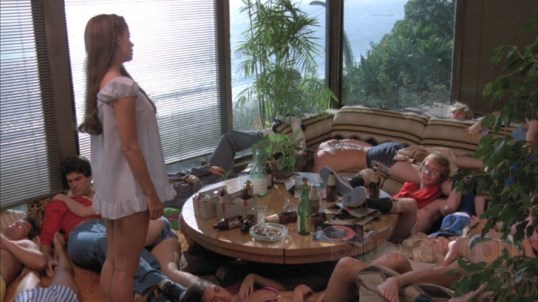
In between all of the Malibu Beach footage, The Beach Girls tells the story of three girls who have a nice beach house for the summer and who proceed to throw a party. That is literally the plot of the entire film. Two of the girls — Ginger (Val Kline) and Ducky (Jeana Tomasina) — are up for anything while their best friend, the shy and intellectual Sarah (Debra Blee), desperately needs to relax and have a good time. Fortunately, there’s a sensitive musician at the party. His name is Scott and he’s played by James Daughton, who was also in Malibu Beach. With Scott’s help, Sarah starts to come out of her shell, which largely means that she starts to progressively wear less and less clothes.
Just when it looks like the party might be on the verge of concluding, six garbage bags of weed wash up on the beach. That comes in handy once all of the uptight authority figures start to show up and demand that the party end. Fortunately, the super weed inspires everyone to just relax and have fun. Not even the eventual arrival of the Coast Guard can stop this party…
The Beach Girls is pretty much your typical Crown International teen sex comedy. The main thing that distinguishes it from The Pom Pom Girls and Malibu Beach is that the main characters in The Beach Girls are all female. And while the three main characters all still required to spend a good deal of the film undressed, this is a rare teen comedy where the guys are just as likely to get naked as the girls and where the girls have as much fun as the guys. As a result, there’s little of the misogyny that lay underneath the surface of The Pom Pom Girls and, to a lesser extent, Malibu Beach.
Don’t get me wrong. The Beach Girls, which is currently available Hulu and has also been included in a few Mill Creek box sets, is hardly a great or even a good film. It’s pretty much a standard sex comedy where both the characters and the jokes are predictably dumb. But, when taken on its own modest terms, it’s an inoffensive little time capsule.
Plus, the film’s beach house is really nice! Seriously, that’s one thing that I love about films from the 80s. Even the low-budget comedies always take place in the nicest houses!
Yesterday, I started my 2-week miniseries of reviews on beach movies by taking a look at 1963’s Beach Party. For my next review, I will be jumping forward 15 years and taking a look at 1978’s Malibu Beach.
Just by comparing the two films, you can tell that a lot changed during those 15 years. As opposed to the euphemism-spouting surfers of Beach Party, the teenagers that hang out on Malibu Beach know exactly what they want and they’re not ashamed to say it. What Beach Party could only hint at, Malibu Beach has the freedom to make explicit. The film’s poster claims that “everything can happen on Malibu Beach” and, in theory, that’s certainly true.
And yet, at the same time, MalibuBeach has more in common with Beach Party than you might think. Ultimately, they’re both about the same thing: celebrating the idea of being young and having freedom. Both films are a bit of a chore to try to watch today but are interesting as cultural time capsules. Beach Party had no plot. Malibu Beach has no plot. Beach Party featured some oddly generic music. Malibu Beach features the same three generic songs being played over and over and over again. Beach Party features Erich Von Zipper and his motorcycle gang. MalibuBeach features a muscle-bound bully named Dugan (Steve Oliver). Beach Party featured a cameo appearance from Vincent Price. Malibu Beach features a dog that steals bikini tops. Beach Party was produced by American International Pictures. Malibu Beach was produced by Crown International Pictures.
That’s right! Malibu Beach is a Crown International Picture and anyone who loves 70s exploitation knows what that means. Malibu Beach is a cheaply produced film that was made to exploit then-current trends and bring in a lot of money. Like a lot of Crown International Films, it’s technically a pretty bad film but it’s so sincere and honest about what it is that it almost feels petty to be too critical of it.
Oddly enough, Malibu Beach pretty much feels like a remake of a previous Crown International Picture, The Pom Pom Girls, the main difference being that, while the visual style of The Pom Pom Girls was almost oppressively ugly, Malibu Beach at least features some pretty beach scenery.
Much like in the Pom Pom Girls, the heroes of Malibu Beach are two high school jocks, one of whom, Bobby (played by James Daughton, who, that same year, also played the evil Greg in National Lampoon’s Animal House), is dark and brooding while the other, Paul (Michael Luther), is skinny and dorky.
Much as in The Pom Pom Girls, one of the heroes has a nemesis for no particular reason. Seriously, I never could figure out why Bobby and Dugan hated each other but they certainly did. What’s odd is that, whenever there’s a confrontation between the two of them, Malibu Beach suddenly gets extremely serious. Bobby and Dugan glare at each other and speak through clenched teeth. Suddenly, there’s no music on the soundtrack and all we can hear are seagulls above and the tide rolling in and it all feels very ominous. I sat through Malibu Beach expecting either Dugan and Bobby to be dead at the end of the film, that’s how seriously their conflict is portrayed.
Also, much like The Pom Pom Girls, Bobby and Paul each have girlfriends. Paul is dating the spacey Sally (Susan Player). Bobby, meanwhile, is romancing the new lifeguard, Dina (Kim Lankford). Dina has a big scene where she tells Bobby that she can’t handle being caught in the middle of his increasingly intense rivalry with Dugan. Again, it’s a deadly serious scene and it’s just so strange to see it there, awkwardly dropped in between scenes of a bumbling cop smoking weed and a dog stealing bikini tops.
Finally, the main similarity between The Pom Pom Girls and Malibu Beach is that the exact same three songs appear in both films! Obviously, somebody at Crown International, really loved those three songs.
Malibu Beach is one of those films that was obviously made to appeal to hormonal teens at a drive-in but, by today’s standards, it’s rather tame. It’s currently playing on Hulu and it’s also available in several of those Mill Creek box sets that we all know and love. Is the film any good? No. Do I recommend it? Not really. But, much like Beach Party, it is a portal into the past.
“Congratulations! You just destroyed government property!” —
33963 (Lee Tergesen) in Into the Dark (2014)
The quote above comes from a 14-minute short film that I was recently fortunate enough to have the opportunity to view. If you’ve read my previous reviews on this site, then you probably know that I’m not a huge fan of government property in general so, as you can imagine, that line made me smile. Within the context of the film, it also provided a brief moment of triumph for two men who have both reached a point where they have to be happy for whatever temporary victory they may happen to achieve.
Into the Dark opens with a haunting image of an urban skyline. The moon hangs over the city and, as we watch, we briefly see that something has been launched into the night sky. That object is a small capsule that includes two men who have been strapped in back-to-back. The two men are identified not by name but by number. 58257 (Lukas Hassel, who also wrote and directed Into the Dark) is angry and shouts at the unseen people who are watching him. Meanwhile, 33963 (voiced by Lee Tergesen) gives him advise on how to turn off a strobing blue light and tells him that, no matter how loudly he shouts, nobody watching can hear a word that he’s saying. No one on Earth is interested in what these two men have to say for themselves. Instead, the audience simply wants the catharsis of seeing what happens to them.
As we listen, it becomes apparent that these two men have broken the law and this space ride is a part of their punishment. 33963 was a political revolutionary while 58257’s crimes are a bit more ambiguous. Every few seconds, a condescending computerized voice tells them to think about what they’ve done. As their punishment approaches, 33963 begs 58257 to just talk to him and to allow him to experience some sort of human interaction…
Into the Dark may take place in the future but it deals with a very modern reality: we live in a very bloodthirsty time and that’s especially true in the way that we treat those who have been convicted of breaking the law. At a time when people feel like they have less and less control over their own fates, there’s a need to punish those who break “the rules,” never mind the fact that some rules make more sense than others. At any given times, you can turn on the television and watch reality shows about cops arresting lawbreakers, attorneys prosecuting the accused, and guards watching the convicted. These shows presents us with a world where the is no difference between a murderer and some guy who happened to have a little bit of weed in his car and where the only thing that matters is that people are being held responsible for breaking the rules that it’s assumed the viewer automatically and unquestioningly obeys. These shows allow an insecure society to feel superior.
That’s one reason why Into the Dark is so memorable. The final twist, the truth of why Hassel and Tergesen are in that capsule together, is totally plausible. It’s something that we, as an audience, know is probably going to end up happening some day. When the plausibility of that twist is mixed with the emotional power of the performances of Tergesen and Hassel, the end result is a thought-provoking look at crime, punishment, and the manufacturing of televised reality.
Another thing that makes Into The Dark so memorable is that the end credits mention that the majority of this film was shot in “Lukas Hassel’s apartment.” You wouldn’t know that from watching the film, which takes wonderful advantage of the production’s low-budget. The inside of the capsule is claustrophobic and cramped in the way that you would expect an intergalactic jail cell to be small and cramped. Despite almost entirely taking place in one small set, Hassel and cinematographer Henry Lee never allow the action to get stagey. Instead, it’s a fully cinematic experience and the fact that it was shot in someone’s apartment should give hope to aspiring independent filmmakers every where.
It seems a little bit strange that today was, for many people, the first day of Spring Break.
First off, it was cold and rainy today and, whenever I found myself glancing out a window and being confronted by the gray weather, it was very hard for me to imagine having any fun on a beach.
Secondly, for reasons that I never quite understood, the University of North Texas’s Spring Break was always a week after everyone else’s. As a result, I’ve been conditioned to think of Spring Break as starting during the third week of March.
I always looked forward to Spring Break, despite the fact that we always got out a week late. In fact, it was kind of nice to know that, when my friends and I got down to that year’s beach, the most obnoxious of the alcoholic frat boys would already be back in Oklahoma. I’ve always loved the beach, which is odd because I’m scared of drowning. Fortunately, you don’t have to swim to look good in a bikini.
Now, of course, I’m an adult and I don’t get a Spring Break. But that doesn’t mean that I can’t relive the fun of it all by spending the next few days watching and reviewing beach movies!
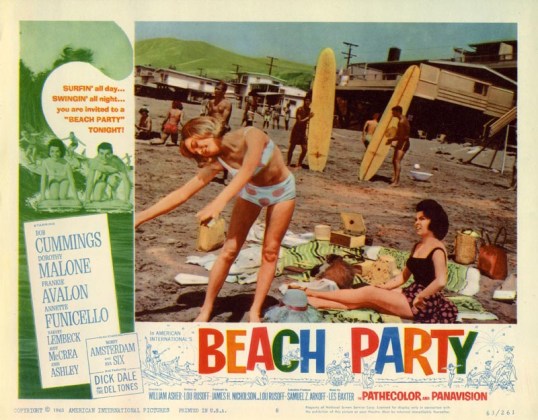
For instance, earlier today, I discovered that the 1963 film Beach Party was available on Netflix. I watched the first 40 minutes during my lunch and then, as the day progressed, I watched the rest of it in bits and pieces until finally, nearly 8 hours after starting the film, I finished it. Needless to say, this is absolutely the worst way to watch a film like Beach Party. Beach Party was designed to be a film to be enjoyed but not thought about. It’s the cinematic equivalent of fast food. Watching Beach Party in increments of 2 or 3 minutes at a time is a bit like buying a Wendy’s bacon cheeseburger and not eating it until the next day.
(Or so I assume. I would never do that because, seriously, Wendy’s makes the best bacon cheeseburgers!)
It feels kind of silly to try to describe the plot of something like Beach Party but here goes: Frankie (Frankie Avalon) and Delores (Annette Funicello) are two teenagers in love. Or, at the very least, Delores is in love. Frankie, however, has a hard time saying it. Frankie and Delores are planning on spending the weekend at a beach house where, Frankie tells her, it will be just like they’re married. Though it’s never explicitly stated (like many films from the early 60s, Beach Party is all about the euphemisms), Frankie is obviously expecting that he and Delores will finally be having sex in that beach house. However, Delores had the same idea so she invited all of their friends to stay at the beach house as well, specifically to keep her from giving in during a moment of weakness.
Meanwhile, Prof. Robert Sutwell (Robert Cummings) is also hanging out on the beach. He’s an anthropologist who has a rather prominent beard. He’s studying the sex lives of teenagers. Since they’re adults, Robert and his assistant Marianne (Dorothy Malone) are actually allowed to say the word “sex.”
Speaking of which, that’s one thing that nobody on the beach seems to be doing. Robert is too obsessed with his work, Marianne is too frustrated with his lack of interest, Frankie is too busy surfing and singing, and Delores says she’s not interesting in “being a woman” until she’s married. There’s constant flirting going on, of course but, for the most part, these teenagers make the spring breakers from From Justin To Kelly look wild. (One can only guess what would happen if any of them ever ran into the spring breakers from Spring Breakers….)
That said, I do think that I did spot Frankie and his friends passing around a joint during one scene. According to some comments at the imdb, it was probably meant to be a cigarette that Frankie was sharing with his friends Ken (John Ashley) and Deadhead (Jody McCrea) but it sure looked like a joint to me. Plus, Frankie was listening to beatnik poetry at the time and we all know those crazy kids loved the poetry and loved the marijuana.
Oh! And did I mention that there’s a motorcycle gang in this film? Because there so totally is. The Rat Pack is led by a guy named Erich Von Zipper (Harvey Lembeck) and they pretty much show up whenever the film starts to run out of ideas…
Now, it may sound like I’m being pretty critical of Beach Party but actually, I thought it was fun in a time capsule sort of way. This is one of those films that is so obviously a product of the time in which it was made that watching it is a bit like getting to take a ride in a time machine. Everything about this film — from the dialogue to the cultural attitudes to the clean-cut teenagers to the music to the bizarrely modest bikinis — practically screams 1963. As a secret history nerd, I loved the part of Beach Party.
Add to that, Vincent Price has a cameo! That’s always fun.
Anyway, Beach Party is currently available to be watched on Netflix and Hulu. If you can’t get to the beach this year, you can always watch Frankie Avalon getting high in Beach Party.
This week’s blast from the past is a 9-minute educational film from 1947. In Are You Popular?, we enter into the world of high school in the 1940s and we discover that our grandparents were amazingly judgmental teenagers.
We start out with a bunch of teenagers sitting in a cafeteria and debating why the new girl at school, Caroline, is so popular. Then Ginny, the old girl at school, tries to sit at the table but no one’s willing to make room for her. A stern-voiced narrator informs us that Ginny thinks that she’s popular because she goes “parking” with all the boys. “No,” the narrator informs us, “girls who park in cars are not really popular…not even with the boys that they park with.”
Interestingly enough, none of the boys are condemned for all “parking” with the same girl. No, instead, it’s all on Ginny.
Anyway, once Ginny has been properly shamed, the film becomes about the efforts of two boys to win a date with Caroline. Caroline comes across like one of those girls in high school who would get upset whenever someone wore a short skirt.
Seriously, Ginny is too good for those losers….
Anyway, in the interest of providing a window into the deeply repressed and judgmental world that was 1947, here’s Are You Popular?
On Saturday night, I watched the latest Lifetime original film, Watch Your Back!
AnnaLynne McCord is stalked in Watch Your Back. I love the old guy trying not to laugh.
Why Was I Watching It?
I was not in a very good mood on Saturday night, largely because of the fact that I knew I would be losing an hour later that night. Seriously, Daylight Savings Time sucks! What better way to cheer myself up than be watching the latest Lifetime movie?
What Was It About?
Sarah (AnnaLynne McCord) seems as if she has it all. She has a successful career in advertising and an assistant (Darla Taylor) who views her as being a role model. She has a new husband named Kurt (Mark Ghanime) who is an aspiring novelist. Her stepdaughter even calls her “mommy.”
However, one day, Sarah starts to receive photos that someone has been taking of her. However, since the photos are sent using flashchat (not relation to snapchat), the evidence that she’s being stalked is deleted minutes after she sees it. Soon, she realizes that someone has been breaking into her house. Her husband, meanwhile, is tricked into thinking that there’s a bomb in the mailbox.
As Sarah grows more and more paranoid, it starts to become apparent that this is not your average stalking case. Instead, it all links back to a shadowy organization of professional assassins. And, from there, the film just gets stranger and stranger…
What Worked?
So, here’s the thing with this movie: For this first 78 minutes or so, nothing about this film seemed to be working. Sarah came across as being unlikable and stubborn. Her refusal to call the police made it difficult to have any sympathy for her. Add to that, she never seemed to be particularly concerned about anyone who got hurt over the course of the film. At one point, she chased a totally innocent photographer into oncoming traffic. Needless to say, the photographer ended up getting struck by a car and appeared to be on the verge of death. Sarah didn’t seem to feel much guilt about this and I found myself thinking, “Are we actually supposed to like her?” Meanwhile, Kurt came across as being such a wimp that I pretty much found myself not caring about either of them.
But then, during the final 10 minutes of the movie, Watch Your Back goes completely and totally batshit crazy. The film’s “big” twist is so over-the-top and ludicrous that, in its own strange way, it actually manages to redeem almost the entire film. Of course, that doesn’t mean that the twist makes any sense but it certainly is memorable.
And, once the twist is revealed, AnnaLynne McCord’s performance actually starts to make sense. Suddenly, you realize that McCord’s strange performance was actually what was needed to set up the film’s strange ending.
What Did Not Work?
There have been a lot of wimpy husbands in a lot of different Lifetime films but it’s hard to think of any that were as totally wimpy as the character of Kurt. Kurt was nice and sensitive but he was pretty much useless in a crisis. Don’t get me wrong. I love sensitive guys but sometimes, you just need a man to actually be a man.
Also, I could have used an update on what happened to that photographer after Sarah nearly got him killed. The film just kind of abandoned him.
“Oh my God! Just like me!” Moments
Needless to say, I related to Julie (Darla Taylor), the much put upon administrative assistant. As I watched Julie deal with an increasingly neurotic supervisor, I found myself thinking, “I know that feeling.” When Julie has to deal with Sarah’s paranoid glances and condescending tone, I nodded and said, “Been there.” And when, at the end of the film, when Julie got to deliver a kick ass one liner, I thought to myself, “I better remember that, just in case I ever find myself in the exact same situation.”
Lessons Learned
Since Watch Your Back took place in a weird, batshit crazy universe that had absolutely no relation to our real universe, I can honestly say that I didn’t learn a thing from this movie.
There’s a lot of reasons why a movie might become a guilty pleasure. Often times, it’s because the film is technically terrible and yet still, for whatever reason, it’s fun. And then sometimes, it’s because the film was made at a different time and, as a result, our modern cultural overlords demand that we dislike it regardless of how much we may also enjoy it.
And then there are films that you literally feel guilty for owning, watching, and sometimes enjoying. These are the films that you always find yourself making excuses for owning, Whenever I let anyone know that I have 2003’s From Justin To Kelly on DVD, I always make sure to point out that I also own the Criterion edition of Jean Renoir’s Rules of the Game and several films directed by Werner Herzog.
“Don’t judge me!” I shout, as my guests stare down at Kelly Clarkson and Justin Guarini’s retouched smiles beaming at them from the cover of From Justin To Kelly, “I actually do have good taste….”
And, if worst comes to worst, I just tell them that it was a gift from an old boyfriend who, just two days after giving me the DVD, was tragically killed while doing charity work in Vermont. “The enemy is hunger…not the hungry!” I say and, while they sagely nod in agreement, I always push the DVD to the side.
However, the fact of the matter is that I do own From Justin To Kelly and I actually have watched it more times than I’m willing to admit. It’s difficult for me to explain why. It’s not that From Justin To Kelly is a good film. There’s a lot of people who claim that From Justin To Kelly is one of the worst films ever made and, while I think that’s a bit of an exaggeration, it’s hard to deny that the film really is pretty terrible.
FromJustin To Kelly, of course, is the American Idol film. By coming in first and second at the end of Idol‘s first season, Kelly Clarkson and Justin Guarini were contractually obligated to appear in a movie that would be written by Kim Fuller, the brother of Idol‘s producer. From Justin To Kelly was quickly written and filmed so that it could both appear in theaters and be released on video before the start of Idol‘s second season. If From Justin To Kelly had been a success, I imagine that all future American Idol winners and runner-ups would have been forced to appear in similar films. And I have to admit that it’s kind of disappointing that From Justin To Kelly was not a success because I would have loved to have seen a beach movie starring Taylor Hicks and Katharine McPhee.
However, From Justin To Kelly was not a success. In fact, it was such a failure that the producers of Idol decided to give up on movies and instead concentrate on doing what they’re good at — i.e., neutering otherwise interesting singers by forcing them to sing ballads written by Kara DioGuardi. For the most part, the only time that you hear about From Justin To Kelly is when Kelly Clarkson talks about how much she hated making it.
(Reportedly, Kelly spent hours sobbing after reading the script.)
As for the film itself, it’s a romantic comedy musical beach party movie sort of thing. Texas-born Kelly Clarkson plays Kelly, a girl from Texas. Pennsylvania-raised Justin Guarini plays Justin, a guy who was raised in Pennsylvania. Kelly is a waitress who gets dragged down to Florida for Spring Break by her friends, Alexa (Katharine Bailess) and Kaya (Anika Noni Rose). (Bailess and Rose deliver their lines in the least convincing Texas accents ever. However, since Kelly won American Idol and is very much a Texan, her movie friends had to be Texan too.) Justin, meanwhile, is the “King of Spring Break,” which is odd since he and his friends Brandon (Greg Siff) and Eddie (Brian Dietzen) host parties that feel like they’d be more appropriate for a church camp. (Then again, maybe Justin was meant to be the King of Bad Spring Break. Maybe, if Idol had continued to make movies, Adam Lambert would have eventually gotten to play the King of Good Spring Break.)
Anyway, Kelly and Justin eventually meet. Justin likes Kelly. Kelly thinks he’s a player. Justin’s like, “No, I’m not a player.” Kelly’s like, “Okay, I guess we can be in love.” But then Alexa decides that, no, Kelly and Justin should not be in love and, whenever Justin tries to text Kelly, Alexa texts back that Kelly’s not interested. And, meanwhile, Kaya falls in love with a surly busboy (Jason Yribar), Brandon keeps getting ticketed by the same policewoman, and Eddie keeps failing to hook up with a girl that he met online. Because, you know, the kids are so crazy with their text messages and their online dating and their … busboys.
(Seriously, did From Justin To Kelly really warrant that many subplots?)
During the whole time, everyone keeps singing songs and breaking out into choreographed dance numbers on the beach. The film’s director, Robert Iscove, also did She’s All That and From Justin To Kelly at times feels as if it’s just a 80 minute version of She’s All That‘s prom dance-off, except in this case it’s performed by people who really can’t dance.
And yet, I’m going to take a minute to defend From Justin To Kelly. While it’s true that the film’s songs don’t have anything to do with the film’s plot and they all lean a bit towards the vapid side, it’s also true that a few of them are catchy. One reason why Kelly Clarkson is one of the few Idol winners to actually make a career for her outside of Idol is because she can make almost anything sound good. For that matter, Justin Guarini is a far better singer than most people seem to remember him as being. While it is true that, judging from their work here, neither Kelly or Justin can act, they’re both likable. (Unfortunately, they also have next to no chemistry. I was actually surprised to learn that Kelly and Justin apparently dated while making From Justin To Kelly because, for the most part, they both look terrified whenever they actually have to kiss on camera.)
From Justin To Kelly also has a massive nostalgia value. After so many seasons and so many forgettable winners, it’s easy to forget about what a big deal American Idol was during that first season. I was 16 years old and I watched every episode and I got so emotionally involved in who was staying and who was going home. Today, it seems incredibly silly that a movie would have been a part of Idol but, back then, it made total sense. (That said, I know a lot of people who loved the first season of American Idol but I don’t know anyone who actually saw From Justin To Kelly in a theater.)
But, ultimately, I think the main reason why From Justin To Kelly remains an oddly fascinating bad film is because it takes place in a world that has absolutely nothing in common with the real world. Nobody at Spring Break acts anything like any of the characters to be found in From Justin To Kelly. Imagine a Spring Break where no one touched liquor, no one did drugs, and no one got laid. Imagine a Spring Break where college students danced on the beach while wearing the most modest of bathing suits and flashing the most eager and innocent of smiles. Even the film’s whipped cream bikini contest feels oddly chaste. From Justin To Kelly might as well be science fiction and it’s just so odd to watch.
As you watch, you can not help but imagine how the people involved with both Idol and the film reacted to it all. It’s actually fun to try to imagine what the cast talked in between shooting scenes. Did they spent their time laughing at how bad the movie was going to be or did they try to fool themselves into thinking that it would all be okay? (I’ve been involved in some bad community theater productions, which is what From Justin To Kelly resembles. I know how darkly humorous thinks can get back stage as people try to come to terms with what’s happening.) You watch and you ask yourself, “Did Kim Fuller actually think this is how American teenagers act when there’s no adults around?” Even more fun, you can try to imagine what Randy, Paul and Simon said when they first saw the film. I imagine it when something like this:
“Yo dawg, that was just alright for me, I don’t know, man, that was strange. Paula?”
“Argle bargle margle largle. Simon?”
“It was rather like watching a small parakeet attempt to eat a 60 year-old man…”
And, as such, From Justin to Kelly remains a pleasure of mine.
It’s just one that I feel guilty about admitting to.
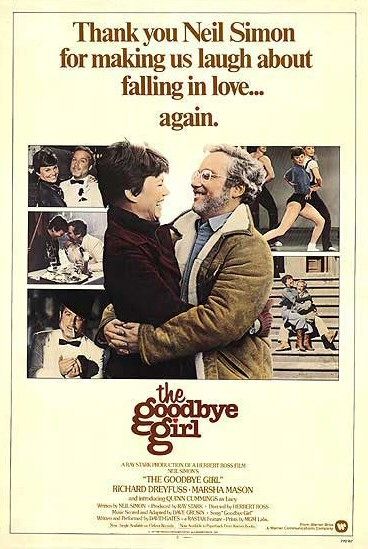
After I watched San Francisco, I decided to watch yet another film that I had DVRed during TCM’s 31 Days of Oscar. I had several films to choose from and I ultimately decided to watch the 1977 best picture nominee The Goodbye Girl because, in general, I like movies from the 70s. Add to that, the film was described as being a comedy and who am I to turn down the chance to laugh?
The Goodbye Girl asks the question, “What would happen if two of the most annoying people on Earth were forced to live together and then ended up falling in love with each other as a result?” Paula (Marsha Mason) is recently divorced and is trying to raise her 10 year-old daughter, Lucy (Quinn Cumming), while also trying to relaunch the dance career that she put on hold when she got married. As played by Marsha Mason, Paula is probably one of the most humorless characters to ever be at the center of a romantic comedy. It’s not just that Paula is written to be a very angry character. (For the most part, Paula has every right to be angry). Instead, it’s that Mason gives such a totally sour performance that you get the feeling that Paula has probably never smiled once over the course of her entire life. When, later on in the film, she does smile, it feels forced and unnatural. You worry that her face is going to split in half.
In the course of one very bad week, she is abandoned by her actor boyfriend (he’s going to Italy to shoot a film) and she discovers that, before he left, her ex also sublet their apartment to another actor. That actor is Elliott Garfield (Richard Dreyfuss), who is hyperactive, immature, self-centered, and very, very talkative. He does things like play guitar in the nude and meditate in the morning.
Once Elliott shows up and barges his way into the apartment, a familiar pattern is established. Elliott does something eccentric. Paula yells at him. Elliott yells back. Paula yells in reply. Elliott yells some more. Even if you never quite buy the idea that the two of them would ever fall in love, you’re glad when they do because at least it gives them something to do other than yell.
(Of course, The Goodbye Girl was written by Neil Simon, which means that not only are Elliott and Paula yellers but they’re also very quippy yellers. And while I guess we should be happy that Elliott tells the occasional joke, the constant barrage one liners is ultimately rather alienating. Every time you think that the film is about to make an interesting point about human relationships, Elliott says something quippy and ruins the mood.)
Which is not to say that The Goodbye Girl is a terrible movie. The scenes where Elliott rehearses and then appears in a terrible production of Richard III are brilliantly done and wonderfully satirize theatrical pretension. As well, during its second hour, the film settles down a little bit. Or, I should say, Richard Dreyfuss settles down and actually starts to give a performance that’s more than just a collection of nervous tics. It helps that once Elliott and Paula are in love, they don’t yell at each other quite as much. There’s even a rooftop dinner scene where the two actors finally show a hint of chemistry.
Ultimately, The Goodbye Girl is an uneven film that feels a lot like a sitcom. It’s one of those films that you watch and, even though it’s not terrible, you still find yourself thinking, “This was nominated for best picture?”
As I sit here writing this, I’m snowed in, my asthma’s acting up, and our cat is quickly losing patience with me. On the plus side, however, this weather has given me an opportunity to watch some more of the old best picture nominees that I had saved up on my DVR.
For instance, I just finished watching the 1936 best picture nominee, San Francisco.
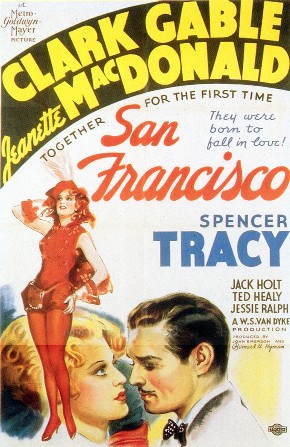
San Francisco was one of the first disaster films, a film that follows a group of characters as they attempt to survive the 1906 earthquake that destroyed the town of San Francisco. And it has to be said that, nearly 80 years after the film was first released, the climatic earthquake remains effective and scary. San Francisco, of course, was made long before there was any such thing as CGI. Many of the film’s sets were built on special platforms that were designed to shake back and forth, just like in an actual earthquake. When you see walls and buildings collapsing in San Francisco, you know that those walls are breaking apart and collapsing for real and the extras running for their life are literally doing just that. After the earthquake, Clark Gable, as the film’s hero, walks through the ruins of San Francisco with the haunted look of a true survivor. Gable was such a confident actor that it’s still jarring to see him looking overwhelmed.
Unfortunately, before you get to that spectacular earthquake, you have to sit through the rest of the film. It’s a massive understatement to say that the pre-earthquake portion of San Francisco drags. Clark Gable is Blackie Norton, a notorious gambler and saloon keeper. Blackie may be a rogue but he’s a rogue with a heart of gold. His childhood friend, Father Tim (Spencer Tracy), wants Blackie to run for the board of supervisors. Blackie, however, is more interested in Mary Blake (Jeanette MacDonald), the newest singer at his club.
OH MY GOD, IS THIS WHOLE MOVIE JUST GOING TO BE JEANETTE MacDONALD SINGING!? WHERE'S THE EARTHQUAKE!? #SanFrancisco
— Lisa Marie Bowman (@LisaMarieBowman) March 5, 2015
From the minute she first appears to the very end of the film, Jeanette MacDonald is singing. Even when she’s not at the center of the scene, you can often hear her singing in the background. And, after a little while, you just want her to stop singing. But, whenever that happens, she tries to act and you realize that the only thing more boring than Jeanette MacDonald singing is Jeanette MacDonald acting.
Anyway, the film goes through all of the expected melodrama. Blackie wants to reform. Blackie decides not to reform. Father Tim believes that there’s good in Blackie. Father Tim gives up on Blackie. Father Tim decides to give Blackie another chance. Mary loves Blackie. Mary fears Blackie. Mary leaves Blackie. Mary comes back to Blackie. Mary leaves Blackie again. Mary sings. And sings and sings and sings…
But then, just when you’re about to fall asleep, the city starts to shake and all is forgotten in the wake of a natural disaster. Even earthquakes serve a purpose…
San Francisco was a huge box office success. It was nominated for best picture. Somehow, Spencer Tracy received a nomination for best actor, despite the fact that he’s really not that impressive in the film. (His role is primarily a supporting one and he’s consistently overshadowed by Gable.) The only Oscar that San Francisco won was for best sound recording and it must be said that, after all these years, the earthquake still sounds terrifying.
As for the film itself, I’d suggest skipping ahead to the earthquake. That, after all, is the main reason anyone would be watching the film and, by skipping ahead, you’re spared having to sit through an hour and a half of Jeanette MacDonald singing.
Now, don’t get me wrong. This isn’t going to be one of my series like Shattered Politics or Embracing the Melodrama. I’m not going to post six best picture reviews a day for the next three weeks until I’ve reviewed every single one of them. Instead, I’m just going to keep my eyes open. When I see that a best picture nominee is going to be on TCM, I’ll be sure to record, watch, and review it. On days that I have some extra time, I’ll watch and review something from my DVD and Blu-ray collection. And, of course, I’ll keep make sure to keep up with what’s available on Netflix, Hulu, and all the other streaming services.
And, on a night like tonight when its sleeting outside and I’m aware that I probably won’t be going outside for the next two or three days, I’ll be sure to look through my DVR and see what I still need to watch.
Tonight, for example, I did just that and I ended up watching the 1939 best picture nominee, Love Affair.
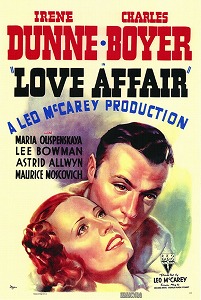
Love Affair tells the story of two rich people in love. Michel (Charles Boyer) is a painter and a notorious playboy. Terry (Irene Dunne) is an aspiring singer. They’re both engaged to other people but, when they meet on a cruise, it’s love at first sight. They try to avoid each other. They try to remain faithful to their significant others. But, when the boat docks off of the island of Madeira, Terry agrees to visit Michel’s grandmother with him.
Michel’s grandmother is played by Maria Ouspenkaya and, while Ouspenkaya does a good job playing the eccentric grandma and even received an Oscar nomination for her 10 minutes or so of screen time, it’s hard to look at her without imagining that she’s about to say something about what happens when the moon is full. Or, at least, that’s the case if you’re a fan of the old Universal horror films and you’ve seen Ouspenkaya play the gypsy in original Wolf Man. Instead of talking about the curse of lycanthropy, Michel’s grandma instead tells the two that they are meant to be together.
Anyway, once they return to New York, Michel and Terry agree to separate and, if after six months they still can’t stop thinking about each other, they’ll meet at the top of the Empire State Building. Michel spends his six months becoming a more responsible human being. Terry spends her six months singing.
Six months pass. Michel stands at the top of the Empire State Building. Little does he know that, on her way to meet him, Terry got struck by a car. Michel is convinced that Terry stood him up. Meanwhile, Terry is confined to a wheelchair.
Wow, depressing movie, huh? Well, don’t worry. That’s only the first half of the movie. There’s still a lot more misunderstandings to get through before Terry can deliver her classic final line.
Occasionally, I’ve seen an old film referred to as being creaky but I don’t think I ever understood what that meant until I saw Love Affair. Love Affair is such an old-fashioned melodrama and such a product of a bygone era that it can’t help but be a little bit fascinating. Love Affair is definitely a film that was made at a different time and for a very different, far less cynical audiences and, watching the film today, definitely requires a bit of an attitude adjustment. However, what Love Affair may now lack in entertainment value, it makes up for in historical value. By today’s standards, Love Affair may seem slow and a bit too melodramatic but it remains a time capsule. If you want to go back to 1939, you can either build a time machine or you can watch Love Affair.
(And, fortunately, Love Affair is in the public domain, which means it’ll be a lot easier to find than a working time machine.)