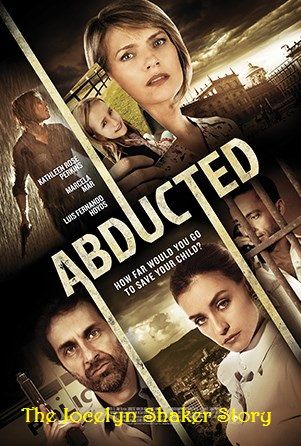
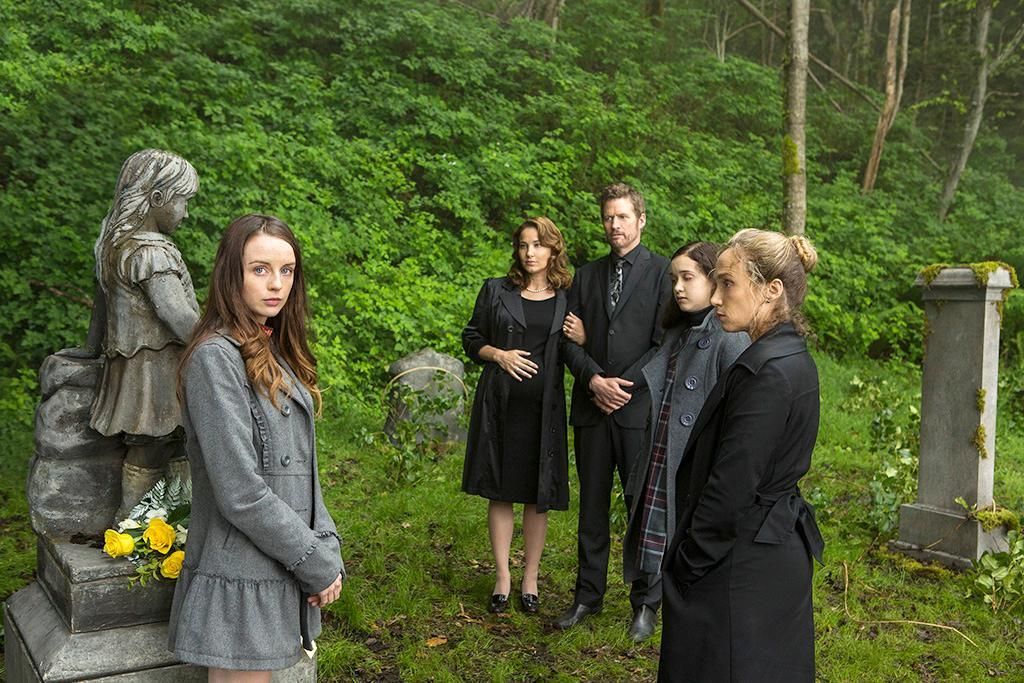
Last night, as a part of my continuing effort to watch 38 movies in 10 days, I watched Abducted: The Jocylen Shaker Story. Abducted originally aired February 14th on Lifetime. That’s right — this movie premiered on Valentine’s Day! I was in San Antonio when it aired, enjoying a romantic night down on the Riverwalk, so I missed the original showing. Fortunately, the DVR saves all.
And really, Abducted is a strange movie to show on Valentine’s Day. It’s not a romantic film at all. Instead, it’s a missing child thriller. Caitlin Shaker (Kathleen Rose Perkins) is an American who has married a wealthy Colombian businessman, Javier (Kamar de los Reyes). While Caitlin and Javier are visiting a resort in the rain forest, their daughter, Jocelyn, vanishes.
Suddenly, Caitlyn and Javier find themselves suspected of having done something to Jocelyn. Though one Colombian detective, Susanna (Eileen Roca Torralva), believes that Caitlin is innocent, she is ignored by her sexist superiors. The head of the investigation, Captain Rojas (Luis Fernando Hoyos), declares that Javier must be guilty and has him arrested for murder.
Caitlin knows that her husband is innocent but she can’t convince anyone to help her look for her child. The Colombian authorities want to close the case as quickly as possible. The American media declares that, even if they are innocent, Caitlin and Javier are still to be blamed for taking Jocelyn to a foreign country in the first place.
Eventually, only Susanna is willing to help Caitlin investigate Jocelyn’s disappearance…
The best thing about Abducted is that it gives Kathleen Rose Perkins a starring role. If you’ve ever seen the Showtime series Episodes, you will immediately recognize Perkins from her role as the wonderfully neurotic and often stoned network executive, Carol Rance. Episodes is a fairly terrible show but Perkins has always been one of the few bright spots. In Abducted, she really throws herself into the role of Caitlin, delivering her lines with an emotional intensity that always feels authentic and real. She is totally sympathetic in the role and elevates the entire film.
As for the film itself, it starts out as your standard Lifetime abduction film but the final 15 minutes, after the real villain has been revealed and Caitlin and Susanna are trying to rescue Jocelyn while rain pours around them, are exciting and well-executed. It helps that Perkins gives such a great performance that she makes even the most melodramatic and heavy-handed dialogue sound totally and completely credible. You won’t necessarily be surprised when you discover who the real villains is but you’ll still be happy to see them get their comeuppance.
(Comeuppance … that’s a strange word, no?)
Finally, Abducted was shot on location in Colombia. Reportedly, the Colombian government has been trying to attract filmmakers, with the hope of changing the country’s international image. Colombia is a beautiful country and Abducted takes full advantage of all that breathtaking scenery.
This time around I actually have a couple of movies I can recommend. One of them I can recommend strongly. We also have the return of the ridiculously misleading Amazon Prime posters for foreign films.
Dolls and Angels (2008, dir. Nora Hamdi) – Ah, ha! The return of the poster to make you think it’s a lesbian movie. They went further this time than that poster for 9 1/2 Dates. First off, only one of those girls on that poster is a main character. The other one is just her friend. Her friend played by none other than Léa Seydoux. She also gets top billing on that poster while the actual two main characters are listed after her. You may know Léa Seydoux from Spectre (2015) or The Grand Budapest Hotel (2014). I know her from somewhere else. I wonder what they were trying to confuse people into thinking this movie was like?
Yep, only one of the most well known and lauded lesbian/bi-sexual/fluid sexuality love stories of the past few years. I’m telling you, one of the most fun things about watching these movies is to see these posters. Makes me think of when they retitled the Sylvester Stallone porno The Party at Kitty and Stud’s (1970) to The Italian Stallion after Rocky came out. They even made this incredible bullshit trailer.
Here is a realistic poster for Dolls and Angels.
That trailer is even misleading. Not because it doesn’t lay out the actual characters and give you an idea of what is going on, but that it’s way better made than the movie itself. This is one of the worst directed, edited, written, and shot movies I’ve sat through in a while. The closest is David A.R. White’s film Redeemed (2014), which is a mess. I think this movie even beats it.
Oh, and as for that talking that is played over things actually happening in the trailer. Yeah, that is in the movie, but all we see is the tomboy-ish girl frantically writing or walking around a roof while an incessant and annoying voice over plays with a little musical accompaniment. Ugh! The director also wrote the book and the screenplay. I get the feeling she didn’t know how to adapt some of her internal monologues that are common in books to the screen where they rarely belong or if they do, sparingly and kept short. A good example of this type of thing done right is The Hunger Games (2012). The book has a bunch of Katniss’ thoughts, but when they adapted it for a film, they transferred it to the visual medium instead of having us hear all those thoughts via a voice over. This feels like Nora Hamdi thought if Godard did it all the time, then surely it will work here. It doesn’t. If the editing and other things weren’t worse, then this would be the thing that made me the angriest while watching this film.
This movie even made a mistake that is so simple that I rarely see it done. It’s when you don’t make it clear a character has left the movie or will come back. Yet, they are gone long enough that the viewer is left wondering if they missed something. You are wondering if the character will come back, or if they are really gone now. Not because you should be, but because the movie is confusing and thus, unintentionally frustrating for the viewer. Then sometimes they suddenly reappear to say, “Hi! Yeah, I’m still in the movie,” only to possibly disappear again.
It wouldn’t be as much of an issue if the film had a single protagonist, but this one doesn’t. When you have only one person, then the world of the film is created around that character. Where they go, we follow. To modify a very tired cliche: If the character isn’t in the forest to see the tree fall, then the tree doesn’t make a sound. If the character hasn’t been to the forest at all, then the forest itself doesn’t exist.
However, when you have multiple protagonists that you switch between, then you no longer have a world being created by a single character as they travel through it. Now you have a living world in which your multiple protagonists exist. When you do that, then you can’t be unclear about things such as whether a character is no longer part of the world of the film. This is also true in TV Shows. That’s why they usually make it quite clear whether a character has truly left the world of the show or not. You actually can have a character disappear for a long period of time, but there needs to be a reason, and/or a payoff. Not just a, “Oh, they are still here. I almost forgot they were part of this movie.”
I guess I need to talk a little bit about the plot now.
The movie is about two sisters named Lya (Leïla Bekhti) and Chirine (Karina Testa). They are ethnically Persian and live in the projects of France. It was funny to actually see a character named Chirine in a movie. I knew a girl in college named Shirine who was also ethnically Persian. But enough of me reminiscing about someone that is both way more beautiful and smart than this movie.
The trailer tries to play up that the father, mother, and the youngest daughter are part of the story, but it’s not really true. What you have are two sisters that take opposite directions after being given a Barbie doll as kids. Lya became introspective, tough, and kind of a tomboy. I say “kind of” because I knew an actual tomboy in elementary school. Lya is just a girl that doesn’t doll herself up all the time. She leaves that to her sister Chirine who went in the opposite direction and tried to become that doll.
Chirine tries to get into modeling, but she really just gets stuck with a guy who claims to be an agent, but is rather shady. While that is going on, Lya is doing her own thing. The next movie was so good that it kind of obliterated my memory of this one. Lya just mainly battles with her identity in various ways. Sometimes it’s the annoying voice overs, and other times it’s actually trying to do what her sister does, but quickly finding out it doesn’t work for her.
No recommendation here at all. Next!
Girlfriends/Les autres filles (2000, dir. Caroline Vignal) – This is not to be confused with the TV Show that started the same year. In fact, if you are going to look this movie up on IMDb, then you are better off typing in the French title. If you type in Girlfriends, then it won’t show up in the results. If you click on “More title matches”, then it still isn’t in the list. Only when you click on “Exact title matches” does it suddenly show up.
I love that poster! First off, I’m quite sure neither of those girls are characters from the film. Secondly, notice there are no actor’s names listed. That’s probably because Julie Leclercq who plays the main character Solange, and the supporting character of Gary played by Benoîte Sapim never went on to do anything else. Lucky for them, it’s a very good movie. In fact at this point, out of the 167 films I’ve seen this year, it’s the best so far that I’ve watched. I don’t tear up easily, but I did. It takes a fair amount to get me to tingle, but this movie did it. Here’s the realistic poster for the movie.
Despite what that horrible poster makes you think, this is not a movie about two fun loving girlfriends who like to party. Although, the line “How was your first time?” does have something to do with movie. It’s about a teenage girl named Solange that is learning how to be a hairdresser. Think of those dental school type things where you can get the work done free or cheap because you are helping the students to learn. It’s like that where Solange and other girls are learning by working on actual people under the supervision of a teacher. The film is Solange coming of age in numerous facets.
Let me explain this in a couple of parts. First is what is in the title. Solange thinks that at her age she should have already had sex. She calls a radio show similar to Loveline in order to ask about losing your virginity. She even nearly loses it to a random guy who backs off as soon as he realizes just how young she is, and that she is a virgin. Even he has standards, and that means he can’t bring himself to make this girl’s first time be a random fuck in the grass no matter whether she wants it or not. She does eventually lose it, but at that point she has also undergone a drastic transformation in several ways. So much so that her losing it really isn’t that important at that point. It’s more of a capstone on her actual coming of age.
The second part of this is that the movie sends a bunch of hints at you to make you think she might be a lesbian, bi-sexual, or even transgender. Honestly, I think she’s probably bi-sexual and transgender, but the film will never actually confirm it. She starts off even more of a tomboy then the girl in Dolls and Angels. By the end of the film, she dresses more masculine and has cut her hair very short. She also carries herself in a more masculine manner. That is partially tied to her greatly increased confidence, but I believe there’s more going on there. Especially because the guy she ends up having sex with is shown wanting to cuddle while she just gets up, gets dressed, and leaves like that dumbass guy in a movie who goes off, then wants to get out of there as soon as possible.
The last part is hard to put my finger on. It’s just done so well throughout the movie in every respect. I would be lying if I said it was flawless. I’m not one of those people who buys all the crazy hype around Mad Max: Fury Road (2015), which is the same hype that once surrounded The Dark Knight (2008). Both of those movies have flaws, and so does this one. However, just like those movies, this is still very good. I actually enjoyed it more than Mad Max: Fury Road to be honest. That’s probably because I went into this movie not expecting anything. Going into Mad Max: Fury Road, I expected the moon based on what people were saying. As a result, I kept seeing the flaws. I need to see it again so I can just enjoy it for what it actually is rather than what people say it is. The big flaw I would say is that the shift in her character near the end felt a little sudden. Enough that I mention it, but not nearly jarring enough to be an issue.
Two special mentions here. The acting is excellent. In particular, the performance from Leclercq. The second thing is the scene that got me tingling. There is a scene when she cuts a guy’s hair. It was one of the most erotic things I’ve seen a long time, and it was just Solange cutting his hair. It sent a warm feeling through my body like I haven’t felt in a long time.
I can’t recommend this movie enough right now. Maybe I’ll end up seeing something better this year, but right now, it’s easily the best. If you are doing that 52 films directed by women thing that’s going on this year and want to go off the beaten path, then check this one out.
Just Sex and Nothing Else (2005, dir. Krisztina Goda) – Wow! “Young, Single, Ready to Mingle”. I wonder where that film is because if by young, they mean people in their early to mid 30’s playing like they are closer to their late 30’s/early 40’s, then sure. They are single. That’s true. As for being ready to mingle, that’s pretty misleading.
Even this poster is misleading. That poster says love triangle between the good girl, the bad girl, and a guy who seems like he wants to be with the good girl, but wouldn’t mind a little bad girl once in awhile. That’s not the movie. Oh, and yes. This is another Hungarian film. So is the next one. For some reason that’s a thing now for these posts. Every four of them, there is now at least one movie from Hungary. Over the course of this experiment so far, I’ve seen five Hungarian movies. Jeez!
Here’s is the trailer. Although, it’s dubbed into German you still sort of get an idea of the kind of movie you are in for. Even if it does leave out a pivotal character altogether.
Not Ali (Antal Czapkó), the nice Turkish baker who turns out to also like doing exotic dancing. He’s prominently featured in the trailer as he should be. He’s pretty great in this movie. No, the character that is very important in the movie, but totally missing from the trailer is Péter played by Zoltán Seress. Or as I like to call him: The Hungarian Patrick Norton.
Zoltán Seress
Patrick Norton
If you are a techie and maybe from the Bay Area, then he needs no introduction, but for everyone else. Patrick Norton is a prominent tech journalist and tech show host. The two most well known being The Screen Savers, from when TechTV was a thing, and Tekzilla on Revision3. Although, he’s all over the place.
Back to the movie. You can think of this movie as one part Hallmark romantic comedy. It’s got the girl looking for love. There’s a right guy and a wrong guy. The difference is that this movie makes them both good guys, and never delivers a brick to your head to tell you who she should be with. The other part is Samantha from Sex and the City if she were completely all over the place about what she wants.
The movie has four main characters. Dóra played by Judit Schell is the never knowing what she wants Samantha type character. Zsófi played by Kata Dobó has a lot of sex, but only appears to be happy. She’s part advisor to Dóra and part female counterpart to Tamás played by Sándor Csányi. He also has a fair amount of sex, but the unhappiness part never really completely overtakes him, and only starts to catch up with him when Dóra comes into his life.
The way Dóra comes into his life is rather humorous. We see her walk past four road workers who definitely take notice of her, and she seems to like it. However, she goes right to the obviously married guy who she doesn’t know is married. When his wife shows up he quickly puts her out on the balcony of his office with only her panties on. Tamás lives in the same building, notices her, and tells her she’s better off coming across to get out through his place. If nothing else, as he puts it, because if she doesn’t, then the four workers will never be done fixing the road.
Don’t ask me how this part comes together, but here it is in two parts. First, Dóra and Tamás are putting together a production of a Dangerous Liaisons type play. Yeah, I know. Two Hungarian movies in a row with ties to that novel. Weird. The second part is Dóra trying to figure out what she really wants. Does she want stability with the real good guy Péter? Does she just want sex like Zsófi and Tamás seem to enjoy having a lot of? Does she just want to get pregnant? She really bounces around quite a bit here. Actually, that’s the main flaw with this movie. She bounces around so much that it starts to stop being funny, and starts to feel like a chore following her around. It never ruins the film, but it started to get to me.
In the process, we get the usual speed dating scene that is always in these kind of movies. The only thing noteworthy about it is that one of the guys is a trans man. He’s actually the sanest appearing one of the lot, but at that point she wants to get pregnant so that rules him out. Also, it was probably not the best idea for him to open with a line about how after he has bottom surgery it will work just like the real thing.
We also get the fun, nice, but quirky guy we know she won’t end up with, but we like having around. That’s Ali in this movie. He’s a Turkish baker who is really nice. She actually goes to him at one point, but he has to go back to Turkey for a couple of weeks. That’s until he figures out a way to make it work anyways and shows up at her door. He then drops his pants to reveal leopard print briefs and starts doing a little dance. I love the old lady across the hall who sees it, and Ali tells her to stop looking cause it’s not a peepshow. Of course, he does end up coming back only to fail once more with Dóra, but not with the old lady. After Dóra closes her door, she puts her hand out with some money to pay Ali to dance for her. He accepts it. You can tell, I really enjoyed Ali in this.
Overall, I’d say this is a reasonably fun romantic comedy. It looks like it might be getting a remake in the United States. If you type in the title on IMDb, there’s another film with that same title listed as being “in development”. It wouldn’t surprise me. I mean My Sassy Girl went from being a South Korean film to a Japanese mini-series, and was remade in the US the same year, which was 7 years after the original film. It could happen.
Also of note, the ending made me think of the Boombox Serenade scene from Say Anything… (1989) except she does it with her own voice instead of Peter Gabriel’s.
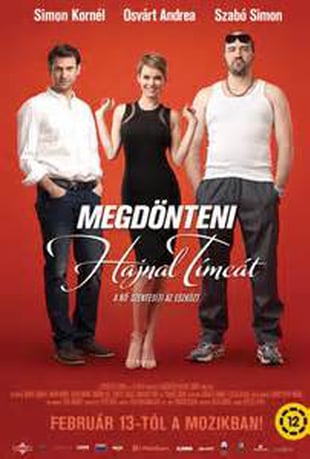
What Ever Happened to Timi/The Good, The Bad, and The Pretty (2014, dir. Attila Herczeg) – Yes, yet another Hungarian comedy. This one really can’t make up it’s mind poster wise. That’s the poster that is on Amazon Prime. Here is another one.
And here is yet another one.
I have to be honest here. I had almost no idea what was going here. Thank goodness there is a short plot summary available on Amazon Prime: “When a soon-to-be-married good guy has a one night stand with a beautiful former high school classmate, they think it’ll just be a quick fling. But the class bad boy has other plans.” There’s also a trailer.
Basically, what you have here is a Hungarian sex comedy that I really can’t recommend. But I probably should elaborate a little. The movie starts off with a high school prom dance. The narrator was there and slightly bumped his crotch against his dream girl’s butt. Very slightly, but it was enough that he went to the bathroom and jerked off. That tells you something about this guy right away.
Now we cut to the high school reunion where we think the two guys and a couple of girls are our only main characters, but none of the voices match the narrator. The narrator is actually a supporting jackass character. Sex happens here, and our scumbag narrator films it, then uses it to blackmail the other guys into getting him laid by the girl he had a crush on as a kid. That’s it really.
I didn’t like it. I didn’t like the characters. I really did find it confusing. I didn’t like story. I didn’t like the resolution. Oddly, I could have gone for a movie that just followed the douchebag around. He’s reasonably funny, interesting, and isn’t just a stock character like the others came across to me as being. I could have gone for something that actually did put him at the center rather than this film that actually teases you about that and says that the film is never about a guy like him. Why not? I might have actually enjoyed that movie.
Definitely check out Girlfriends and for some laughs Just Sex and Nothing Else. Avoid the other two.
————-
For those of you who waded through all of that. Here is the Joker from a 1991 Batman movie from the Philippines.
Last night, after I finished The More The Merrier and watched the latest episodes of Dance Moms and The People vs. OJ Simpson, I returned to the DVR and watched one more movie that I had recorded off of Lifetime. Kruel (which was broadcast with the slightly altered name of Cruel) is a dark little horror thriller. It is memorable for featuring the world’s creepiest ice cream man. (That’s him in the picture above.)
Now, when I say that Kruel was a dark film, I don’t just mean that it was thematically disturbing, though it certainly was. Instead, what I mean is that, at times, the film was literally dark! A good deal of the film took place either at night or in unlit rooms and there were more than a few scenes that took place in complete darkness. During those scenes, the screen was totally black and the only way you knew that there was still a film going on was because you could hear the characters running around and screaming. It was an interesting technique, one that was occasionally effective and occasionally annoying.
As for the film itself, it tells the story of Jo (Kierney Nelson), a teenage girl who, after he confesses to cheating on her, breaks up with her dumbass boyfriend, Ben (Dakota Morrissey). In order to deal with her depression, Jo devotes almost all of her time to babysitting. However, it would probably be a lot easier for Jo to do her job if not for the fact that, every few seconds, an ice cream truck comes rolling down the road. The ice cream truck is being driven by Willie (J.T. Chinn) and wow, is Willie ever creepy! It’s not just the makeup though, seriously, that would have terrified me when I was little. (It would still make me go, “Agck!” today.) It’s also the fact that Willie and his truck always seem to be nearby. Almost as if he’s stalking Jo…
When one of the kids that Jo babysits disappears, she knows that Willie kidnapped him. When the police ignore her, Jo decides to track down Willie herself. Volunteering to help is none other than dumbass Ben. Can Ben help to rescue the child while also repairing his relationship with Jo? Will Jo ever be able to forgive him for cheating on her? And will Willie ever take off his makeup…
Well, actually, I can go ahead and answer one of those questions without spoiling the movie. Willie does take off his makeup when he’s home and, in fact, he spends the majority of the movie not wearing any makeup at all. And, though I’m sure some horror fans would disagree with me on this, I think that’s the right decision for the story that Kruel is trying to tell. It’s definitely more realistic to have Willie look normal (well, normalish) when he’s just hanging out around his house. And, when it comes to a film like this, it’s good to try to keep things a little bit realistic. When Kruel is effective, it’s because it makes you wonder what you would do if you ever found yourself in the same situation. When the film is realistic, it makes you wonder if you could survive. If Willie never took off the makeup, he would be too cartoonish to be a real threat.
Despite being a low-budget film and featuring a few noticeably amateurish performances, Kruel has a nightmare-like intensity that serves it well. (The film features a throat slashing that, even though darky lit, is one of the most graphic things that I’ve ever seen on Lifetime.) J.T. Chinn is properly creepy as Willie and Kierney Nelson totally commits to the role of Jo, turning her into a sympathetic and compelling heroine.
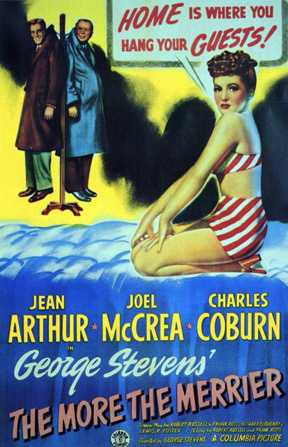
After I finished with Watch On The Rhine, I decided to watch another film from 1943. Like Watch On The Rhine, The More The Merrier is a film about life during wartime and it takes place in Washington, D.C. However, that’s all that they have in common. Whereas Watch On The Rhine was a serious and somber affair, The More The Merrier is thoroughly delightful little comedy.
The More The Merrier opens with a retired millionaire named Benjamin Dingle (Charles Coburn) arriving in Washington D.C. He’s been asked to serve as an adviser for a commission that has been tasked with solving America’s housing shortage. (This was apparently a very real concern during World War II.) However, as soon as Dingle arrives, he finds directly effected by the problem that he’s supposed to be solving. His hotel room won’t be available for two days and he has no where to stay. After a quick look through the newspaper, Ben finds an ad for a roommate.
When he arrives at the apartment, he discovers a long line of men waiting outside. They’re all in the same situation as him and are hoping that Connie Milligan (Jean Arthur) will select him for her roommate. However, Connie picks Ben, largely because he’s old and rich and she won’t have to worry about him hitting on her on like most guys nor does she have to worry about him borrowing her clothes or getting jealous of her, like she would have to with a female roommate. Connie is engaged to a boring but well-paid bureaucrat named Charles Pendergrast (Richard Gaines). She doesn’t really love Pendergrast (and he has an annoying habit of shushing her) but, after growing up poor because her mother married for love, Connie is determined to not to make the same mistake.
Ben and Connie struggle, at first, to adjust to each other’s habits. Connie keeps to an exact schedule and claims to not have any use for frivolity. Ben is the exact opposite. The early scenes of them trying (and, of course, failing) to stay out of each other’s way are hilarious, with both Coburn and Arthur giving brilliant comedic performances. (I’m jealous of how wonderfully Jean Arthur could express exasperation.) Connie’s apartment is already small and it gets even smaller once she sublets half of it to Benjamin Dingle.
However, things are about to get even more crowded. One day, while out exploring Washington, Ben runs into Joe Carter (Joel McCrea), a sergeant who has a few days before he’s scheduled to be shipped overseas and who has no place to stay. Generously, Ben agrees to sublet half of his half of the apartment to Joe. Of course, Ben does this without telling Connie.
When, after another hilarious and artfully done sequence of the three new roommates wandering around the apartment and just barely missing each other, Connie discovers what Ben has done, she orders both Ben and Joe to leave the apartment. Ben agrees to do so, if she gives him back his security deposit. Unfortunately, Connie already spent that money on a hat…
So, they’re stuck together. Connie is attracted to Joe and Joe to Connie but Connie is also determined to marry Pendergrast. (When Joe scornfully says that he bets Pendergrast combs his hair “every hour on the hour,” Connie snaps back, “Mr. Pendergrast has no hair!”) Fortunately, Ben — being older and wiser — can see that Joe and Connie are perfect for each other and he starts doing everything he can to bring the two together.
As Ben says more than once, “Damn the torpedoes! Full speed ahead!”
Jean Arthur is one of my favorite actresses of Hollywood’s Golden Age. She had this perfect “no bullshit” attitude, mixed with an unexpected vulnerability. In The More The Merrier, she’s just as credible when she’s ordering Ben and Joe to leave as when she’s breaking into tears after she catches Ben reading her diary. In the role of Ben, Charles Coburn is warm, kind, and wonderfully eccentric. (When Joe asks him what does for a living, Ben cheerfully replies, “I’m a well-to-do retired millionaire. How ’bout you?”) And then you have Joel McCrea, in the role of the “cute but dumb” Joe Carter. He’s not really that dumb but he certainly is cute. Wisely, McCrea never tries to be funny. Instead, he gets most of his laughs just by reacting to all of the craziness going on around him.
Briskly directed by George Stevens, The More The Merrier features a snappy script from Frank Ross, who was married to Jean Arthur. It’s full of hilarious lines but, at the same time, there’s an undercurrent of melancholy to it as well. Hanging, like a shadow over all of the comedy and the romance, is the fact that Joe is soon going to be shipped overseas. Even while you laugh, you’re very aware that there’s a chance he might not be coming back. That reality brings an unexpected depth to the film’s otherwise cheerful love story.
The More The Merrier was nominated for best picture but it lost to Casablanca. However, Charles Coburn did win the Oscar for best supporting actor.
After I finished watching Around The World In 80 Days, I decided to watch the 1943 film, Watch on the Rhine. Though both films are immortalized in the record books as a multiple Oscar nominee, Watch on The Rhine might as well have taken place in a totally different universe from Around The World In 80 Days. Based on a play by the always politically outspoken Lillian Hellman, Watch On The Rhine is as serious a film as Around The World In 80 Days is frivolous.
It’s also somewhat infamous for being the film for which Paul Lukas won an Oscar for best actor. When Lukas won his Oscar, he defeated Humphrey Bogart, who was nominated for his iconic performance in Casablanca. This is justifiably considered to be one of the biggest mistakes in Oscar history and, as a result, there are people who will tell you that Watch On The Rhine is a totally undeserving nominee, despite having never actually seen the film and not being totally sure who Paul Lukas was.
Up until I watched the film yesterday, you could have included me among those people.
What’s interesting is that Watch On The Rhine almost feels like a companion piece to Casablanca. Both films were resolutely anti-fascist, both of them dealt with a member of the Resistance trying to escape from a German agent, and both films climaxed with a gunshot. The part played by Paul Lukas, a German engineer named Kurt Muller, feels like he could be an older version of Casablanca‘s Victor Laszlo. Finally, whereas Casablanca centered around “letters of transit,” Watch On The Rhine centers around money. Kurt is smuggling money to the Resistance. Teck de Brancovis (George Coulouris), a dissolute Romanian count, demands money in exchange for not informing the Germans of where Kurt’s location.
(Of course, both Casablanca’s letters and Watch on the Rhine’s money are an example of what Hitchcock called the MacGuffin. The letters and the money are not important. What’s important is that both films use the thriller format to inspire viewers to support the war effort.)
The film takes place in 1940, when America was still officially neutral. Kurt and his American wife, Sara (Bette Davis), have secretly entered the United States through Mexico. Officially, they are only visiting Sara’s brother (Donald Woods) and mother (Lucille Watson) in Washignton, D.C. Unofficially, they are looking for political sanctuary. However, Kurt still finds himself drawn back to Germany, especially after he finds out that one of his friends in the Resistance has been arrested by the Gestapo.
Not surprisingly, considering its theatrical origins, Watch On The Rhine is a very talky and a very stage-bound film. Almost all of the action takes place in one location and a good deal of the film’s running time is devoted to Kurt giving speeches. Don’t get me wrong, that’s not a complaint. Though the film may have been released at the height of the war, the play was written at a time when America was still officially neutral and many elected officials were adamant that, even if it meant Hitler taking over the entire continent, America should never get involved in the affairs of Europe. Watch On The Rhine was Hellman’s attempt to both expose what was happening in Germany and to rally them to the anti-fascist cause. Watch On The Rhine may be propaganda but its anti-Nazi propaganda and who can’t appreciate the importance of that?
When it was originally released, Watch On The Rhine was sold as a Bette Davis vehicle. To be honest, Davis doesn’t really do much in the film. She supports her husband and she has a few sharp words for Teck but, otherwise, her role is definitely secondary to Paul Lukas. Davis took the role because she believed in the film’s message. It’s a good message and, for that matter, Watch On The Rhine is a pretty good film. It’s well-acted, intelligently written, and perfectly paced.
But what about Paul Lukas’s Oscar? Well, let’s state the obvious. Humphrey Bogart should have won the award for Casablanca. That doesn’t mean that Paul Lukas doesn’t give a worthy performance. He originated the role on stage and he does a good job of bringing the character to life on film, bringing a sincere intensity to even the most stagey of Kurt’s monologues. Whenever Lukas speaks, he’s explaining to the filmgoers why the U.S. must take a stand against Hitler and his followers. Considering that Watch On The Rhine was released at the height of World War II, I imagine that this, more than anything, led to Lukas winning his Oscar.
Watch On The Rhine was also nominated for Best Picture. It was deserved nomination but, in this case, the Academy made the right decision and gave the Oscar to Casablanca.
Last night, as a part of my effort to clean out my DVR by watching and reviewing 38 movies in 10 days, I watched the 1956 Best Picture winner, Around The World In 80 Days.
Based on a novel by Jules Verne, Around The World In 80 Days announces, from the start, that it’s going to be a spectacle. Before it even begins telling its story, it gives us a lengthy prologue in which Edward R. Murrow discusses the importance of the movies and Jules Verne. He also shows and narrates footage from Georges Méliès’s A Trip To The Moon. Seen today, the most interesting thing about the prologue (outside of A Trip To The Moon) is the fact that Edward R. Murrow comes across as being such a pompous windbag. Take that, Goodnight and Good Luck.
Once we finally get done with Murrow assuring us that we’re about to see something incredibly important, we get down to the actual film. In 1872, an English gentleman named Phileas Fogg (played by David Niven) goes to London’s Reform Club and announces that he can circumnavigate the globe in 80 days. Four other members of the club bet him 20,000 pounds that he cannot. Fogg takes them up on their wager and soon, he and his valet, Passepartout (Cantinflas) are racing across the world.
Around The World in 80 Days is basically a travelogue, following Fogg and Passepartout as they stop in various countries and have various Technicolor adventures. If you’re looking for a serious examination of different cultures, this is not the film to watch. Despite the pompousness of Murrow’s introduction, this is a pure adventure film and not meant to be taken as much more than pure entertainment. When Fogg and Passepartout land in Spain, it means flamenco dancing and bullfighting. When they travel to the U.S., it means cowboys and Indians. When they stop off in India, it means that they have to rescue Princess Aouda (Shirley MacClaine!!!) from being sacrificed. Aouda ends up joining them for the rest of their journey.
Also following them is Insepctor Fix (Robert Newton), who is convinced that Fogg is a bank robber. Fix follows them across the world, just waiting for his chance to arrest Fogg and disrupt his race across the globe.
But it’s not just Inspector Fix who is on the look out for the world travelers. Around The World In 80 Days is full of cameos, with every valet, sailor, policeman, and innocent bystander played by a celebrity. (If the movie were made today, Kim Kardashian and Chelsea Handler would show up at the bullfight.) I watch a lot of old movies so I recognized some of the star cameos. For instance, it was impossible not to notice Marlene Dietrich hanging out in the old west saloon, Frank Sinatra playing piano or Peter Lorre wandering around the cruise ship. But I have to admit that I missed quite a few of the cameos, much as how a viewer 60 years in the future probably wouldn’t recognize Kim K or Chelsea Handler in our hypothetical 2016 remake. However, I could tell whenever someone famous showed up on screen because the camera would often linger on them and the celeb would often look straight at the audience with a “It’s me!” look on their face.
Around The World in 80 Days is usually dismissed as one of the lesser best picture winners and it’s true that it is an extremely long movie, one which doesn’t necessarily add up to much beyond David Niven, Cantinflas, and the celeb cameos. But, while it may not be Oscar worthy, it is a likable movie. David Niven is always fun to watch and he and Cantinflas have a nice rapport. Shirley MacClaine is not exactly believable as an Indian princess but it’s still interesting to see her when she was young and just starting her film career.
Add to that, Around The World In 80 Days features Jose Greco in this scene:
Around The World In 80 Days may not rank with the greatest films ever made but it’s still an entertaining artifact of its time. Whenever you sit through one of today’s multi-billion dollar cinematic spectacles, remember that you’re watching one of the descendants of Around The World In 80 Days.
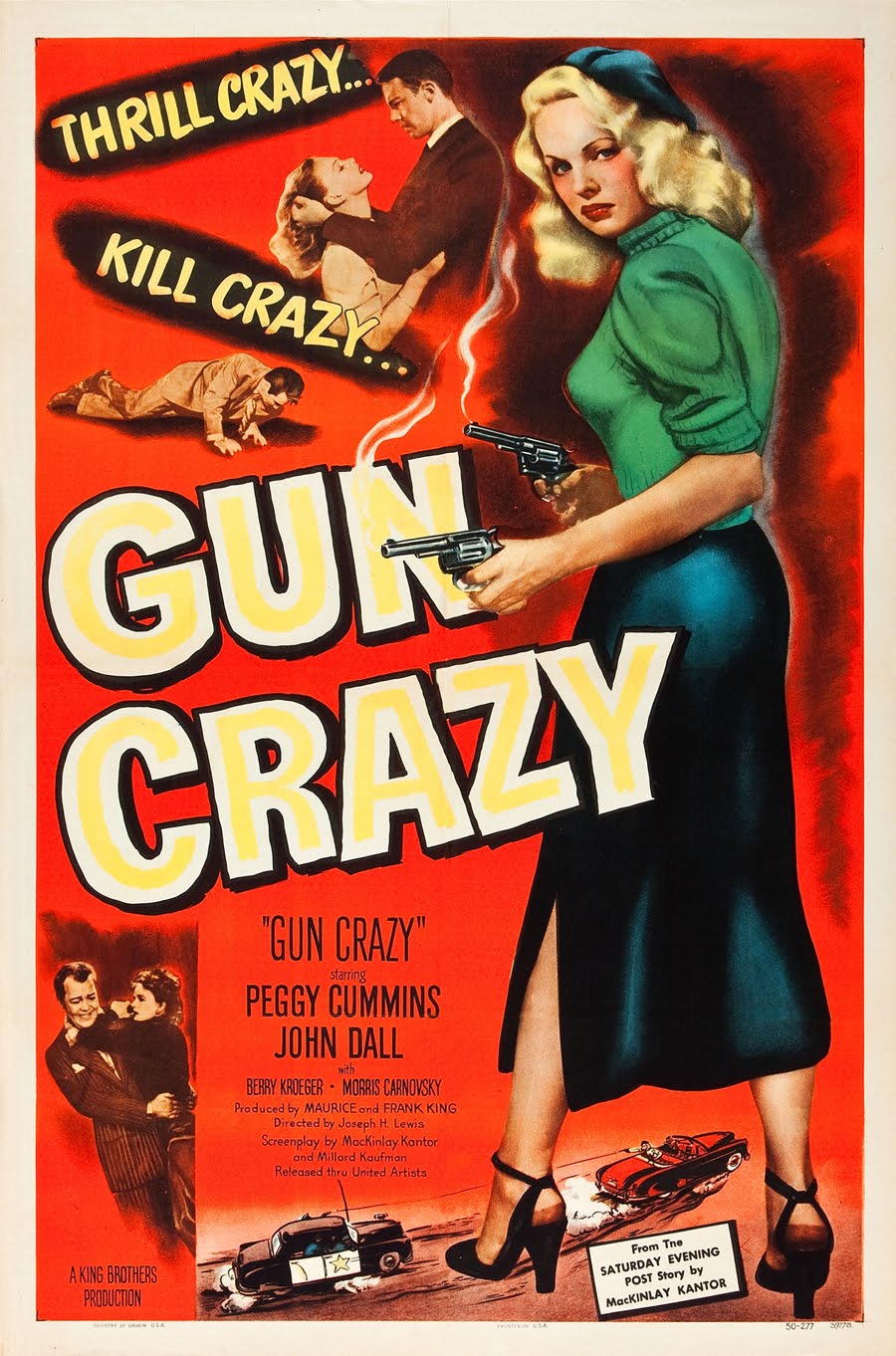
GUN CRAZY is a thrill ride that will have you hanging on for dear life as it takes its protagonists on a downward-spiraling roller coaster ride that turns straight downhill into rock bottom. This is the ultimate noir, moving at breakneck speed towards its inevitable conclusion, a sordid tale of sex and violence that’s second to none. GUN CRAZY was a huge influence on many later films, especially 1967’s BONNIE & CLYDE, right down to the fashion style of lead Peggy Cummins.
Bart Tare loves guns. So much so that, as an adolescent, he smashes a store window to steal one. Busted by the cops, he’s sent to reform school until he’s of age. After a stint in the Army, Bart returns to his hometown, and with old pals Dave and Clyde, attends a carnival. It’s there he meets Annie Laurie Starr, a trick-shot artist. There’s immediate heat between the two, as their mutual…
Last night, after I finished watching My Sweet Audrina, I decided to watch one more film off of the DVR. Seeing as how I had already watched a coming-of-age drama, a classic war film, and a Lifetime melodrama, I decided that my final film of the night would be 1938’s Four Daughters. According to the plot description, it was the story of four musically talented sisters and their father. It sounded nice and undemanding.
I recorded Four Daughters off of TCM, where it was shown as a part of the 31 Days of Oscar. When it originally aired, I was warned about it by some of my fellow Oscar fanatics. They all told me that it was an okay movie but it was nothing special. “Don’t let the best picture nomination fool you!” they all said. And, it’s true that the Four Daughters is one of the more forgotten best picture nominees. Go check out the list of external reviews on the imdb and you’ll see that only a handful of reviews have been posted for Four Daughters.
But you know what? I liked Four Daughters. Yes, when compared to some of the other films that have been nominated for best picture, Four Daughters may seem rather slight. Just compare it to some of the other films that were nominated for best picture of 1938: Grand Illusion, The Adventures of Robin Hood, Jezebel, and the winner, You Can’t Take It With You. Interestingly enough, Michael Curtiz directed both The Adventures of Robin Hood and Four Daughters. Curtiz was nominated for directing Four Daughters, though Robin Hood is certainly the better regarded film.
And yet, with all that in mind, Four Daughters is still a perfectly charming and rather sweet movie. Adam Lemp (Claude Rains) is a musician who loves classic music. He has four daughters, all of whom are musically talented. The oldest, Emma, is played by Gale Page while the other three daughters are played the Lane Sisters, who were apparently a very popular singing act in the 30s. Lola Lane plays Thea Lemp, Rosemary Lane plays Kay Lemp, and the youngest daughter, Ann, is played by Priscilla Lane.
While the film was obviously designed to capitalize on the popularity of the Lane Sisters, it’s not all just music and performing. The Lemps also own a boarding house, which is frequently visited by potential suitors. While Kay Lemp struggles with whether or not to accept a music scholarship and leave home, Emma is pursued by Ernest (Dick Foran) and Thea is courted by Ben (Frank McHugh), a wealthy older man.
And then there’s Ann, the youngest daughter and the one to whom I most related. Despite saying that she never wants to marry, Ann finds herself being pursued by two men. One of them is a composer named Felix Deitz (Jeffrey Lynn). The other is Felix’s best friend, Mickey (John Garfield).
John Garfield was one of the first Method actors to make the transition from stage to screen. (It’s generally argued that, in the beginning, Paul Muni begat John Garfield who begat Montgomery Clift who begat Marlon Brando who begat Robert De Niro who begat Leonardo DiCaprio.) Four Daughters was one of his first major roles and it also provided him with his first Oscar nomination. It’s interesting to contrast Garfield’s brooding and internalized performance with the somewhat more bland actors who play the other suitors. He grounds Four Daughters, giving the film a necessary jolt of reality.
However, I have to admit that my main reason for liking Four Daughters is a personal one. I am the youngest of four sisters and there was so much about Four Daughters that I related to. (I saw a lot of myself in Ann Lemp.) From the opening scenes of the sisters fighting and laughing at the same time to the countless scenes of the sisters supporting each other, Four Daughters gets it right. The film may have been made in 1938 but sisterhood is eternal.
In the end, I glad that I took the time to record and watch Four Daughters. It’s a sweet movie, one that will be enjoyed by sisters everywhere.
After I finished watching The Bridge on The River Kwai, I decided to watch a more recent film that was on my DVR. I selected My Sweet Audrina, a film that made its debut, this January, on Lifetime. Would My Sweet Audrina prove to be as good a film as The Bridge on the River Kwai? Read on to find out…
I have to admit that, despite my well-known love for over-the-top Lifetime melodrama, I was not particularly enthusiastic about watching My Sweet Audrina. Though I missed the film when it was originally broadcast, I did see the commercials leading up to it. “From the author of Flowers In The Attic,” the commercials announced, which led me to believe that My Sweet Audrina would be yet another installment in the Flowers saga. And don’t get me wrong — I enjoyed Flowers In The Atticand I thought If There Be Thorns had some good moments but, after four movies about that messed up, incestuous family, I was ready to move on.
However, once I started watching the film, I quickly discovered that — despite some definite similarities — My Sweet Audrina has nothing to do with Flowers in the Attic. True, it does deal with family secrets and sexual repression and a young woman who is never allowed to leave her family’s Victorian mansion but other than that, it has absolutely nothing to do with Flowers In the Attic.
Audrina (India Eisley) believes that she is nine years old but she is actually a teenager. She spends almost all of her time isolated from the rest of the world. Her father (James Tupper) refuses to let Audrina interact with the outside world, convinced that she will suffer the same fate that happened to a mysterious figure known as “the first Audrina.” Audrina’s older sister, Vera (Toni Atkins), is jealous of the attention that their father devotes to Audrina. She deals with her anger by intentionally injuring herself and having sex with everyone she meets and then taunting the repressed Audrina with the details. When a handsome piano teacher shows up to give her lessons, Audrina is ashamed when she feels attracted to him and then is angered when Vera steals him away.
Fortunately for Audrina, a very understanding neighbor named Arden Lowe (William Moseley) has fallen for in love with her. (In what world does a handsome young man fall in love with a strange girl who has no friends, no understanding of the world, and is totally terrified of sex? The world of Lifetime, of course!) However, even after marrying Arden, Audrina is still haunted by disturbing nightmares and is incapable of enjoying sex.
Of course, it all comes down to the mystery of what happened to the first Audrina. And fear not! All questions are eventually answered. Of course, the answers don’t really make any sense but I guess that’s kind of the point. The melodrama of My Sweet Audrina is so pure and unapologetically over the top that it doesn’t have to follow any logic other than its own.
Visually, My Sweet Audrina follows the lushly gothic pattern previously established by Flowers In The Attic. The sets are elaborate, the clothes are to die for (even Audrina’s supposedly drab outfits have a definite flair to the,), and all of the performers are nice to look at. India Eisley does a good job as Audrina but, for me, Toni Atkins stole the entire film as the obsessively self-destructive Vera.
For lovers of over-the-top melodrama, My Sweet Audrina is a lot of fun.
And if you’re not a lover of over-the-top melodrama … well, then you probably wouldn’t be watching Lifetime in the first place!
(But, to answer the question I asked at the start of this review, My Sweet Audrina is not as good as The Bridge on The River Kwai. But it’s still pretty entertaining!)
Last night, after I watched Captains Courageous, I continued to clean out the DVR by watching the 1957 film, The Bridge On The River Kwai.
The Bridge On The River Kwai is a great film but it’s not necessarily an easy one to review. It’s always easier to review a film when you can be snarky and dismissive but The Bridge On The River Kwai is one of the few films that can truly be called great. Everything about it — from the directing to the cinematography to the script to the acting (especially the acting!) — works. It’s a 3 hour film that never drags. It’s a rousing and exciting adventure story that also works as an anti-war film. As directed by David Lean, it’s probably about as perfect as a film can get.
The Bridge On The River Kwai takes place during World War II and really, it’s two films in one. One film tells the story of Shears (William Holden), a POW at a Japanese prison of war camp in what was then Burma and what is now Myanmar. Knowing that, under the rules of the Geneva Convention, officers are exempt from manual labor, Shears pretends to be a commander. However, when the camp’s commandant, the harsh Col. Saito (Sessue Hayakawa), announces the all prisoners — regardless of rank — will have to build a railway bridge over the River Kwai, Shears manages to escape. With the help of local villagers, Shears makes it to an Allied hospital.
It’s at the hospital that Shears has a two-scene romance with a nurse because the film’s producer, Sam Spiegel, was worried that the film was too male dominated. It’s also at the hospital that Shears is informed that he will be returning to the POW camp, with a group of British commandos, on a mission to destroy the bridge. When Shears explains that he’s not even an officer, British Maj. Warden (Jack Hawkins) explains that’s why the Americans have agreed to let the British use Shears for their mission.
The film’s 2nd storyline deals with Col. Nicholson (Alec Guinness), the senior British officer at the POW camp. When we first meet Nicholson, he’s in a battle of wills with Saito. When Nicholson insists that no officer will work on the bridge, Saito first forces all of the British officers to spend an entire day standing in the heat. When that doesn’t work, Saito has Nicholson locked in an iron box. However, Nicholson refuses to back down and becomes a hero to the other prisoners. Realizing that the bridge will never be finished on time and that he will be required to commit suicide because of his failure, Saito decides to take a different approach to dealing with Nicholson.
After releasing Nicholson from the iron box, Saito shows him the poor job that the British prisoners have been doing on the bridge. Saito appeals to Nicholson’s vanity.
And it turns out that Col. Nicholson is a very vain man indeed.
Soon, Nicholson is ordering his men to do a good job on the bridge, announcing that they are going to show the Japanese what the British can accomplish. Nicholson claims that the project will be a morale booster and that the bridge will be a permanent monument to British ingenuity.
This part of the film is an unexpectedly nuanced character study and Guinness gives a brilliant performance. For the film’s first hour, Nicholson is our hero but then, just as suddenly, he reveals himself to be a far more complicated character and our feelings towards him become much more mixed. We’re forced to reconsider everything that we previously felt towards him. Was Nicholson standing up for his men because it was the right thing to do or was he doing it because he desired the camp’s adulation? His motives are complicated and difficult to figure out and the implications are, at times, rather frightening. About the only thing that can definitely be said about Nicholson is that he becomes so obsessed with showing what the British can do that he loses sight of what the Japanese are going to do with that bridge once it is complted. Nicholson’s short-sightedness become a metaphor for blind nationalism and war in general.
When these two storylines finally intersect, it leads to one of the most justifiably climaxes in cinema history, one that leads one of the film’s few surviving characters to exclaim, “The madness, the madness!”
As I mentioned earlier, The Bridge On The River Kwai won the Oscar for best picture and for once, not even I can disagree with the Academy.