So, as I mentioned earlier, I was in the mood for some late night horror and I decided to rewatch Dario Argento’s Three Mothers trilogy. I started watching Suspiria at midnight and, after that, I moved on to Argento’s 1980 follow-up, Inferno.
Having just finished watching Inferno, I now realize that it’s almost time for me to start getting ready for my day, which means that I may have to hold off on watching the third film in the trilogy, The Mother of Tears. That’s really quite frustrating because I think I may be the only person in the world who thinks that Mother of Tears is actually a good film.
Oh well! Such is life, right?
But before I hop in the shower and get dressed and all that good stuff, I did want to share a scene that I love from Inferno.
So, instead, I’ll share a scene that comes shortly after Irene’s famous swim. In the scene below, Irene’s brother, a music student who is played by a somewhat forgettable actor named Leigh McCloskey (reportedly, Argento wanted to cast a young James Woods in the role and he would have been awesome, too), is sitting in class and attempting to read a letter from his troubled sister.
And that’s when he finds himself being subtly menaced by the Mother of Tears.
The Mother of Tears is played by the beautiful Ania Pieroni, who lovers of Italian horror will immediately recognize as both the mysterious housekeeper in Lucio Fulci’s House By The Cemetery and the doomed shoplifter from Argento’s Tenebrae.
To me, this scene is Argento at his best. Not much happens in the scene. McCloskey attempts to read a letter and finds himself unnerved by Pieroni’s intense stare. And yet, it’s a scene that’s full of menace and atmosphere. It’s a scene that leaves the viewer with no doubt about the power of the Three Mothers.
Watch the scene below. And then, if you haven’t, be sure to watch Inferno because it’s a wonderful and underrated horror film, one that I would argue is even better than Suspiria. And, while you’re watching the scene and considering the wonders of Italian horror cinema, I’ll be busy getting ready for my Friday!
(Unless, of course, you’re reading this on a day other than today and at a time other than 4:35 am.)
Hi there! I’m in the mood for some late night horror so I’m currently watching Dario Argento’s Three Mothers Trilogy! I just finished Suspiria and, before I started Inferno, I figured I would devote a hundred or so words to sharing one of my favorite scenes from Suspiria.
As you probably guessed from the title of this post, that scene is the famous “Names that start with S” scene. This is the scene in which dance student Suzy Banyon’s new roommate explains that names that start with S are often the names of snakes! Suzy’s new BFF, Sarah, disagrees.
When I first saw Suspiria, this was a scene to which I, as a dance student, could immediately relate. As odd as the dialogue may have sounded and as silly as the two students may have appeared to be, it actually felt very authentic. By nature, dancers are competitive and we are dramatic. If anyone is going to accuse you of having the name of a snake, it’s probably going to be dancer.
Admittedly, no one ever told me that I had the name of the snake. But there was the girl who told me that I was “soooooo pretty,” or at least I would be pretty if I got the nose job that I obviously required if I ever had any hope of being happy or successful. “But,” she added as she turned away from me, “I guess you’d have to figure out how you could possibly pay for it.” Of course, she was also quick to explain that she was only telling me the truth and that she had the best of intentions. I had about the same reaction to her advise as Sarah has to be calling a snake.
(Sarah stuck out her tongue. I may have said something about her boyfriend not having any issue with the size of my nose when he was hitting on me the night before. But basically, it was pretty much the same reaction…)
This scene made such an impression on me that, in the months after I first saw Suspiria, I would often randomly launch into the name of snakes monologue. Unfortunately, I had failed to take into account that I was literally the only student at my high school who would actually take the time to watch an Italian horror film from the 1970s. As such, no one knew what I was talking about and I lost a few friends named Susan and Sarah as a result.
Oh well!
Anyway, you can watch the scene below! Pay special attention to the way Jessica Harper reacts to being caught in the middle of the conversation. Dario Argento will probably never be known as a great director of actors but Jessica Harper is great in Suspiria!
I know I already wrote about this film in one of my Amazon Prime experiment posts. For reasons that aren’t important, I am writing a long form review of this film. A bit of a fresh look.
Before anything, the movie starts with a title card saying something I’ve never seen on a movie. It says “Deposito Legal: V1912-2012”. From what I can gather online, this seems to essentially be a cultural preservation program by the Spanish government. Regardless, I’m not sure why it was necessary for it to be there at the beginning of the film along with the normal opening credits that you’d expect. Then again, this is a foreign indie movie from Amazon Prime so I guess I should be thankful there are even credits on this thing.
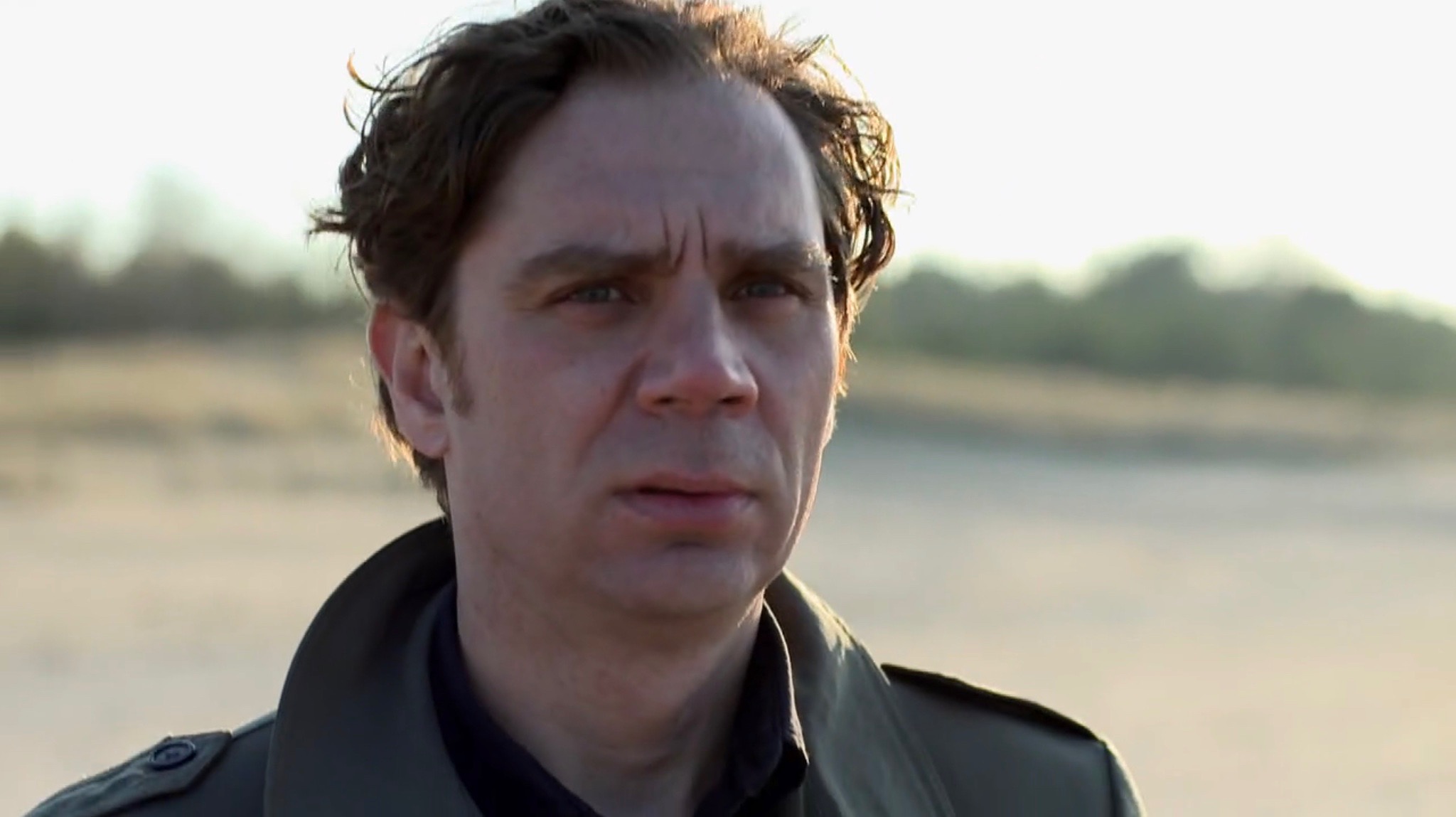
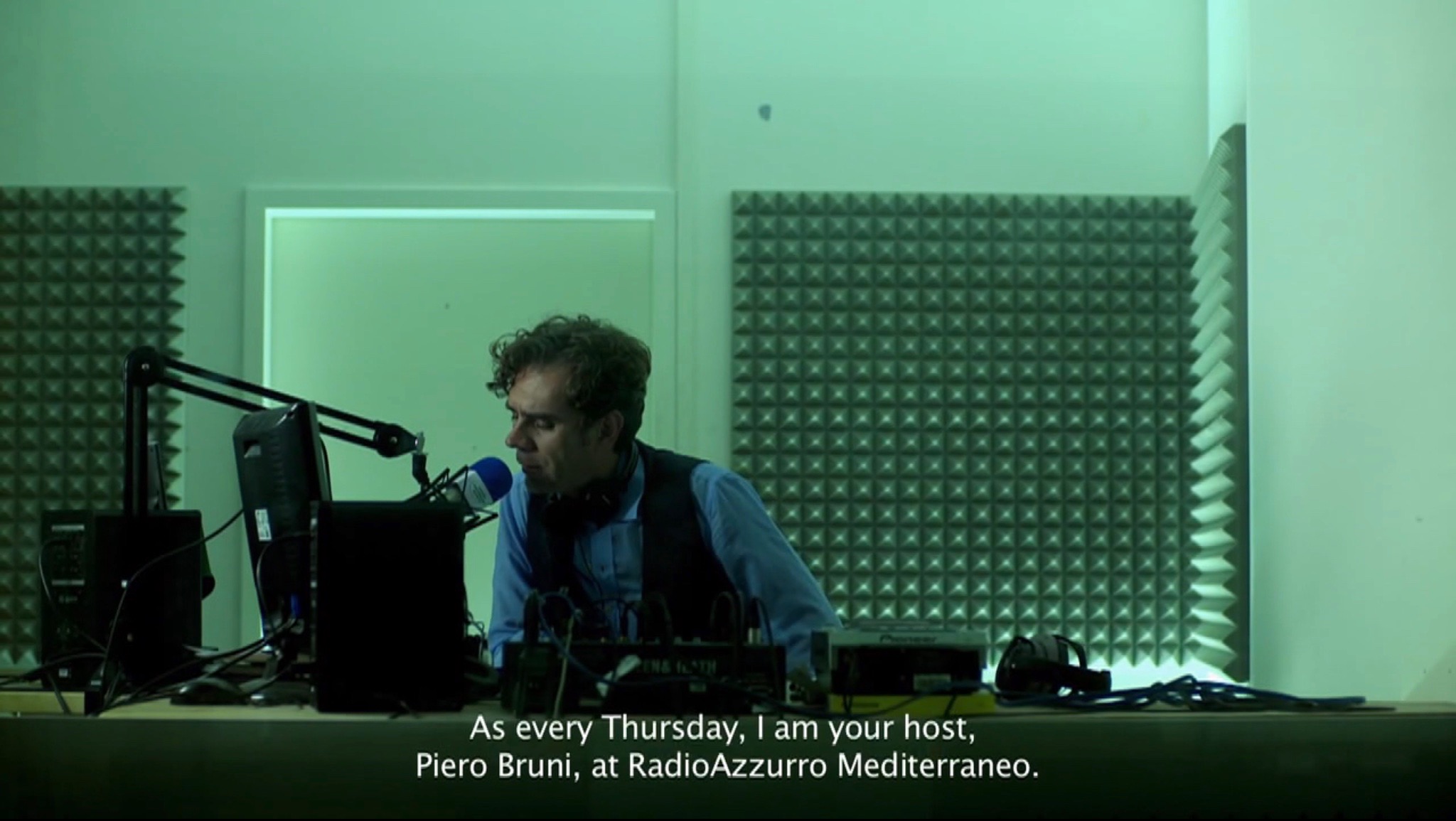
During the opening credits we get a kind of cool jazz sound that you might expect in a 90s late night cable movie or TV Show. Spicy City had one of these. Then we cut to a beach and meet one of our leads named Piero (Andrea Bruschi).
If you like that shot, then you might actually enjoy this movie because he and the female lead will often stare at things. Sometimes they will even stare right at you. Cut to title card, then we find out where Piero works.
I must admit that after the late night cable soundtrack over the credits followed by a guy on the radio, I was having flashbacks to Zalman King’s Pleasure or Pain.
Pleasure or Pain (2013, dir. Zalman King)
However, this movie won’t be assaulting you with endless erotica. Instead, it will be assaulting you with endless art film cliches. Also, he really reminded me of DJ Fernando Martinez from Grand Theft Auto: Vice City. You can take a listen below if the video is still up.
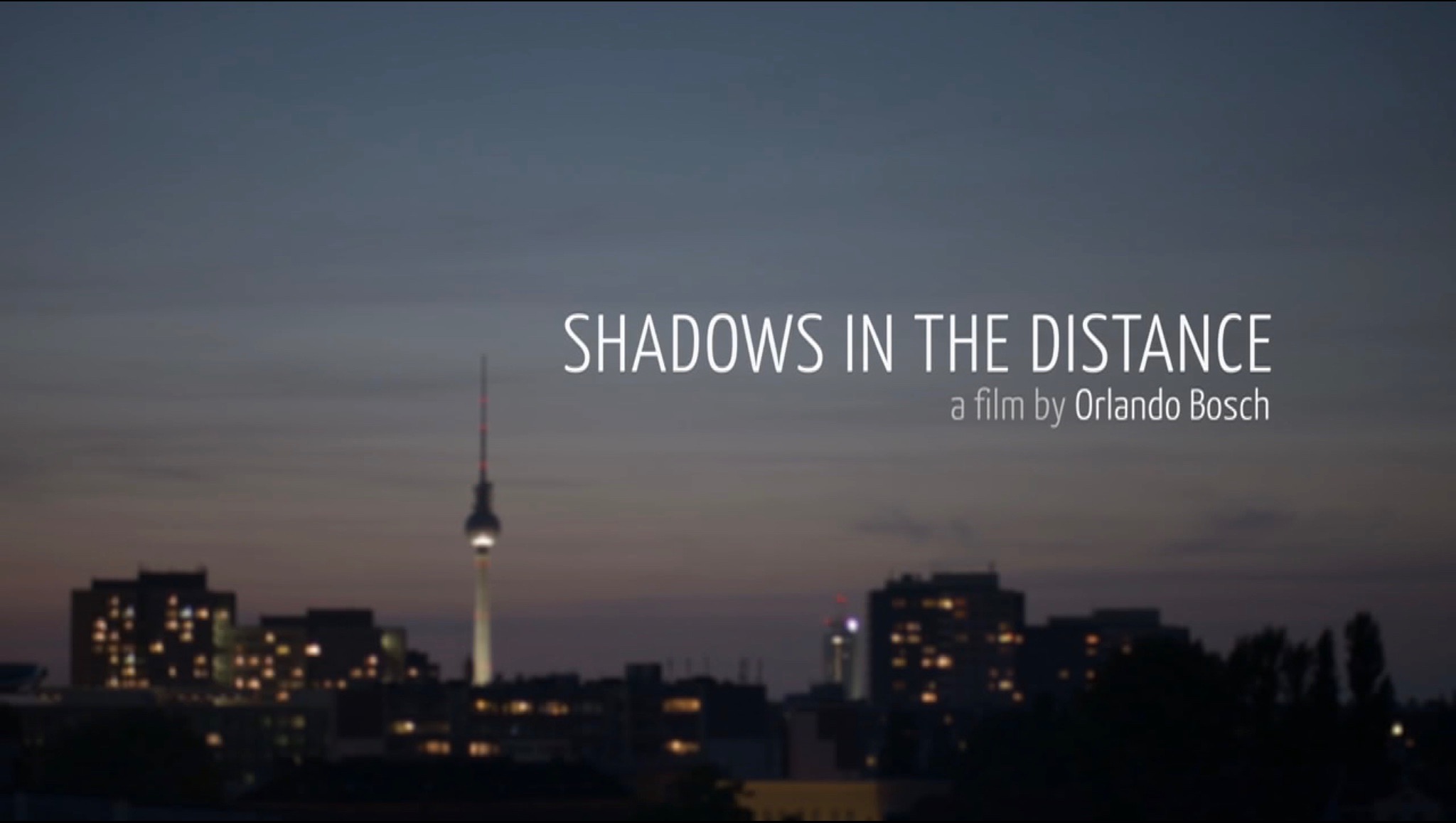
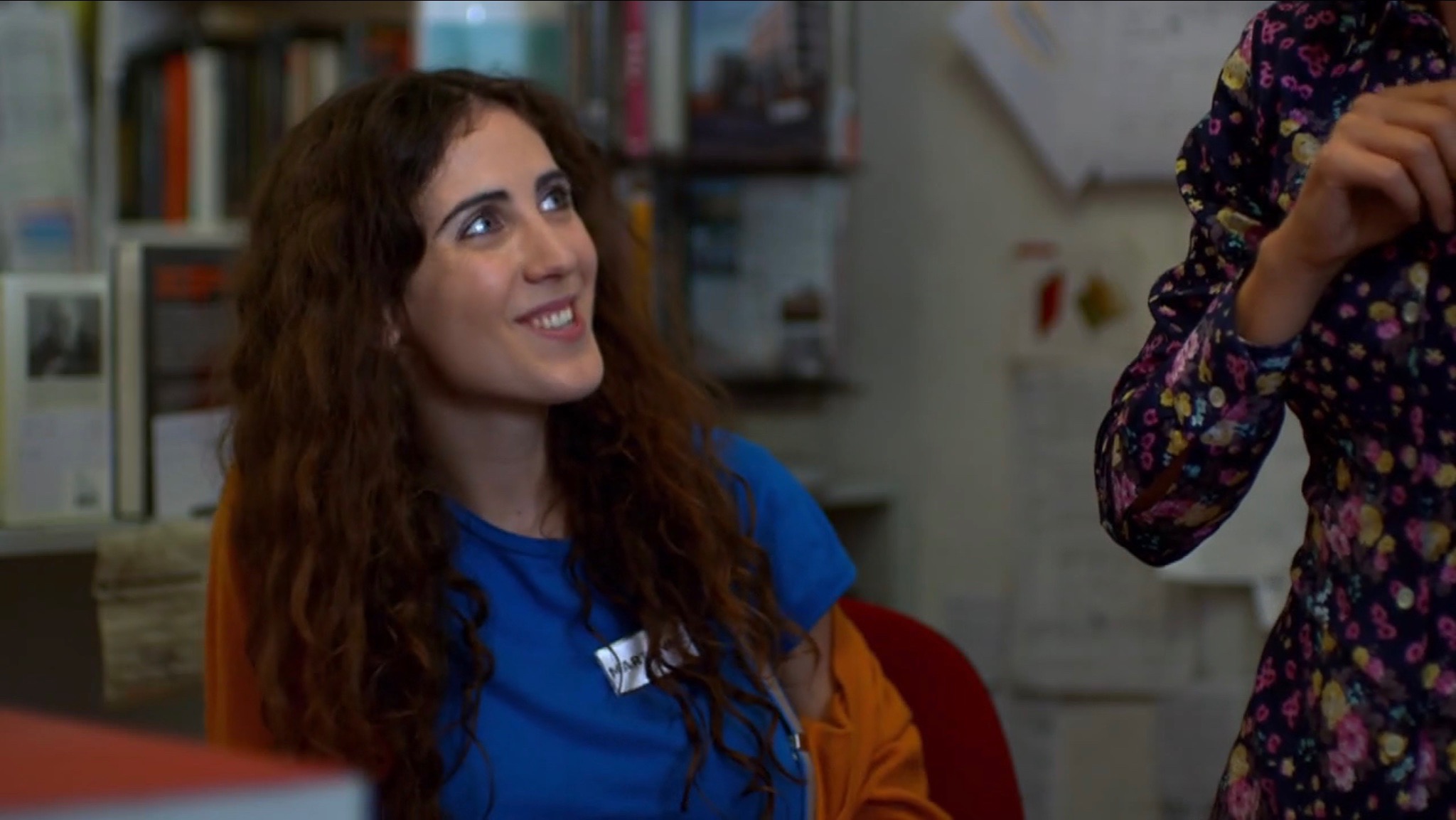
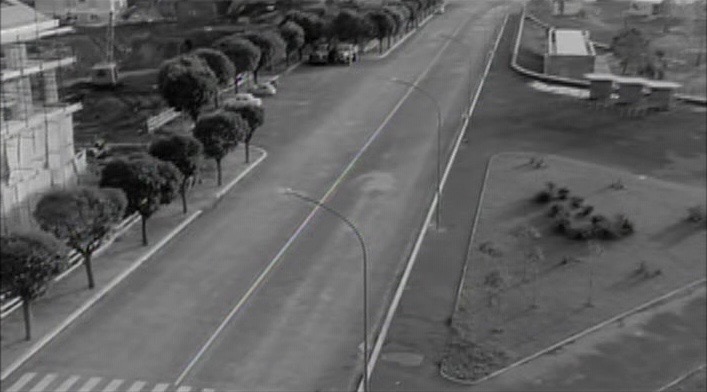
He also mentions that he is broadcasting from Berlin before cutting to some empty places to make sure we know some Antonioni things are going to be happening in this movie. Then we meet our female lead Andrea (Katrin Bühring).
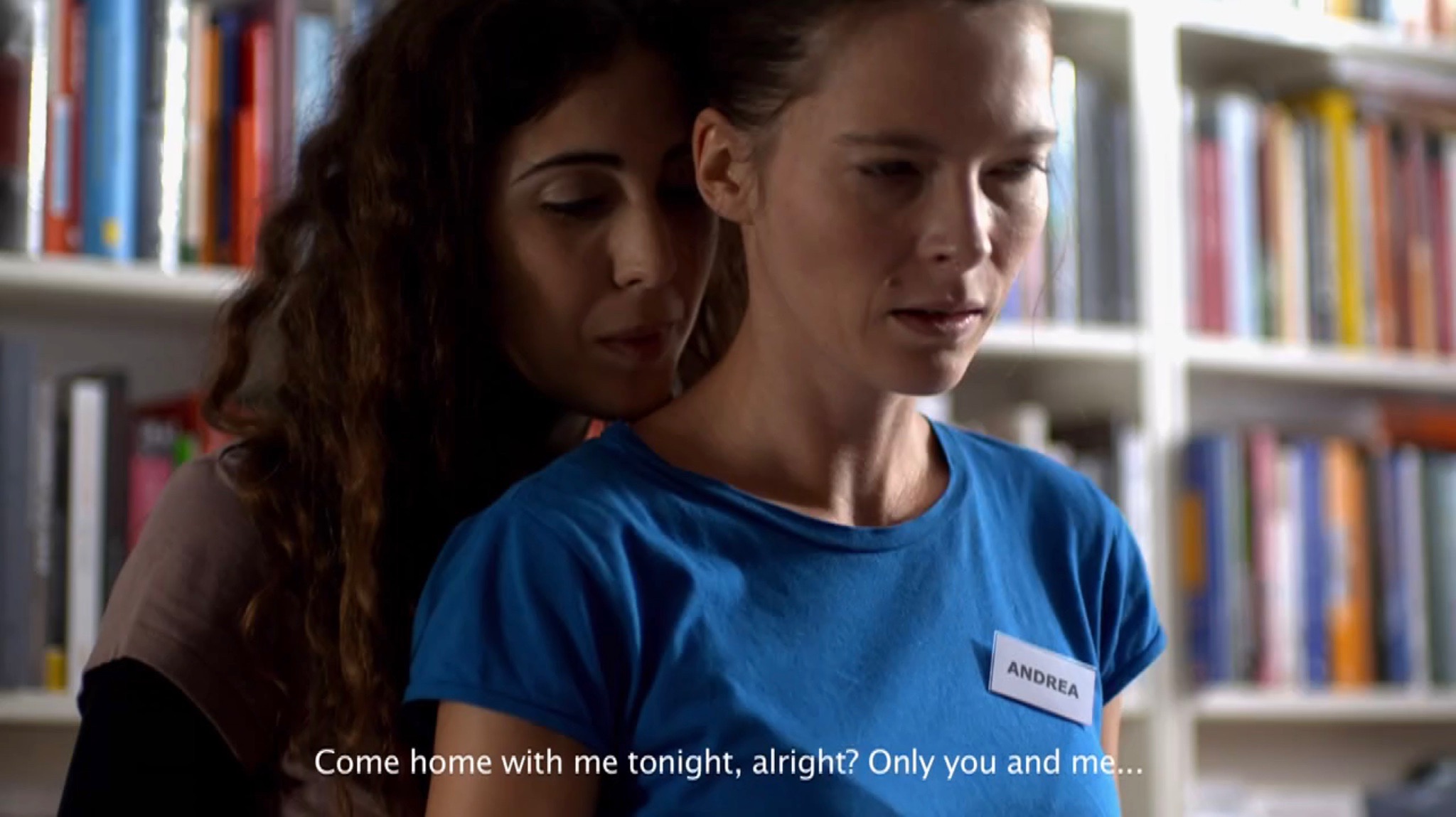
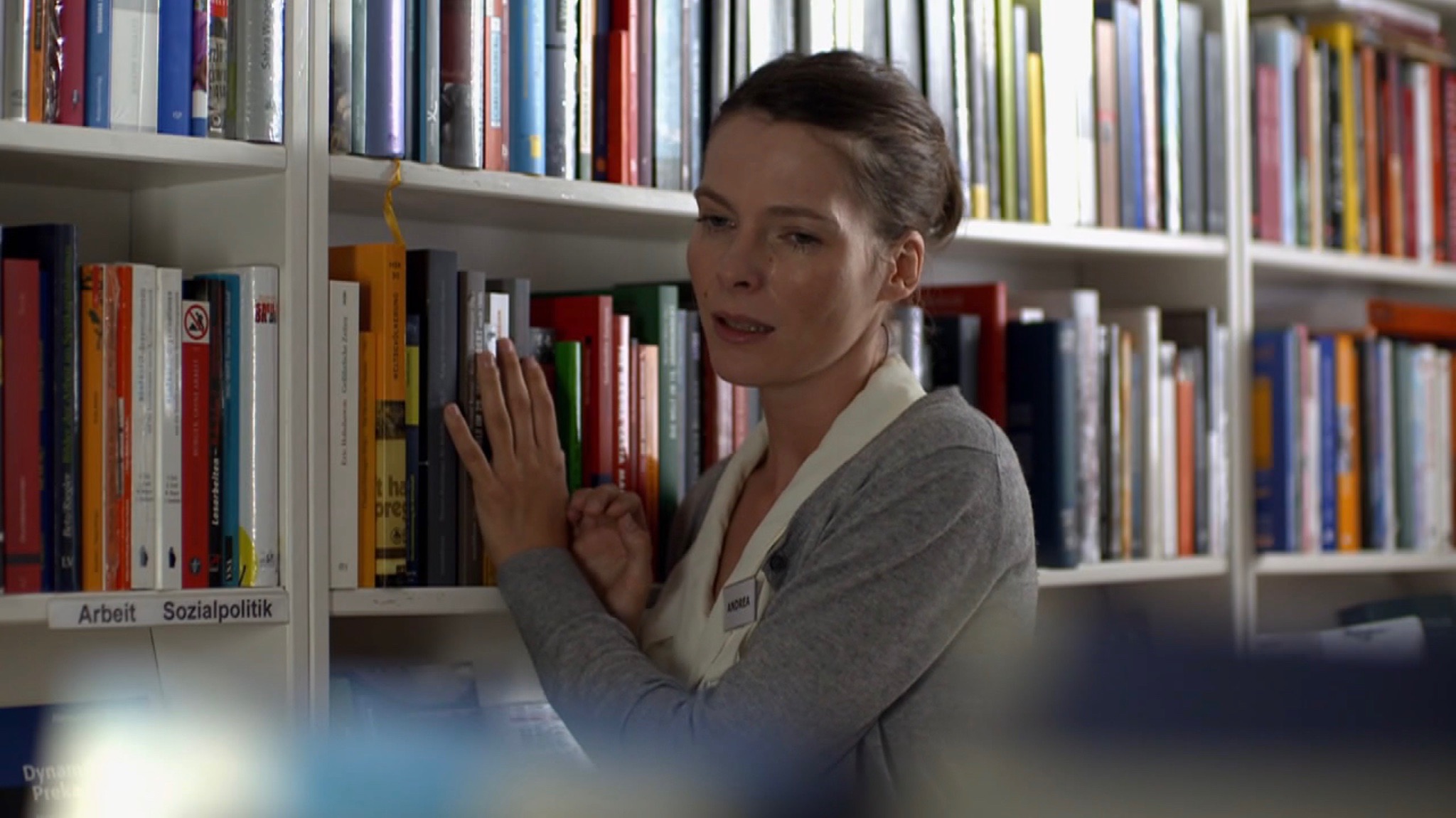
This should ring some French New Wave bells for me, but I just can’t think of any. No worries! I have plenty more. She’s on her way to the bookstore. She works there with her friend Marianne (Katharina Rivilis) that is most likely a lesbian and likes to stare and rub up against Andrea.
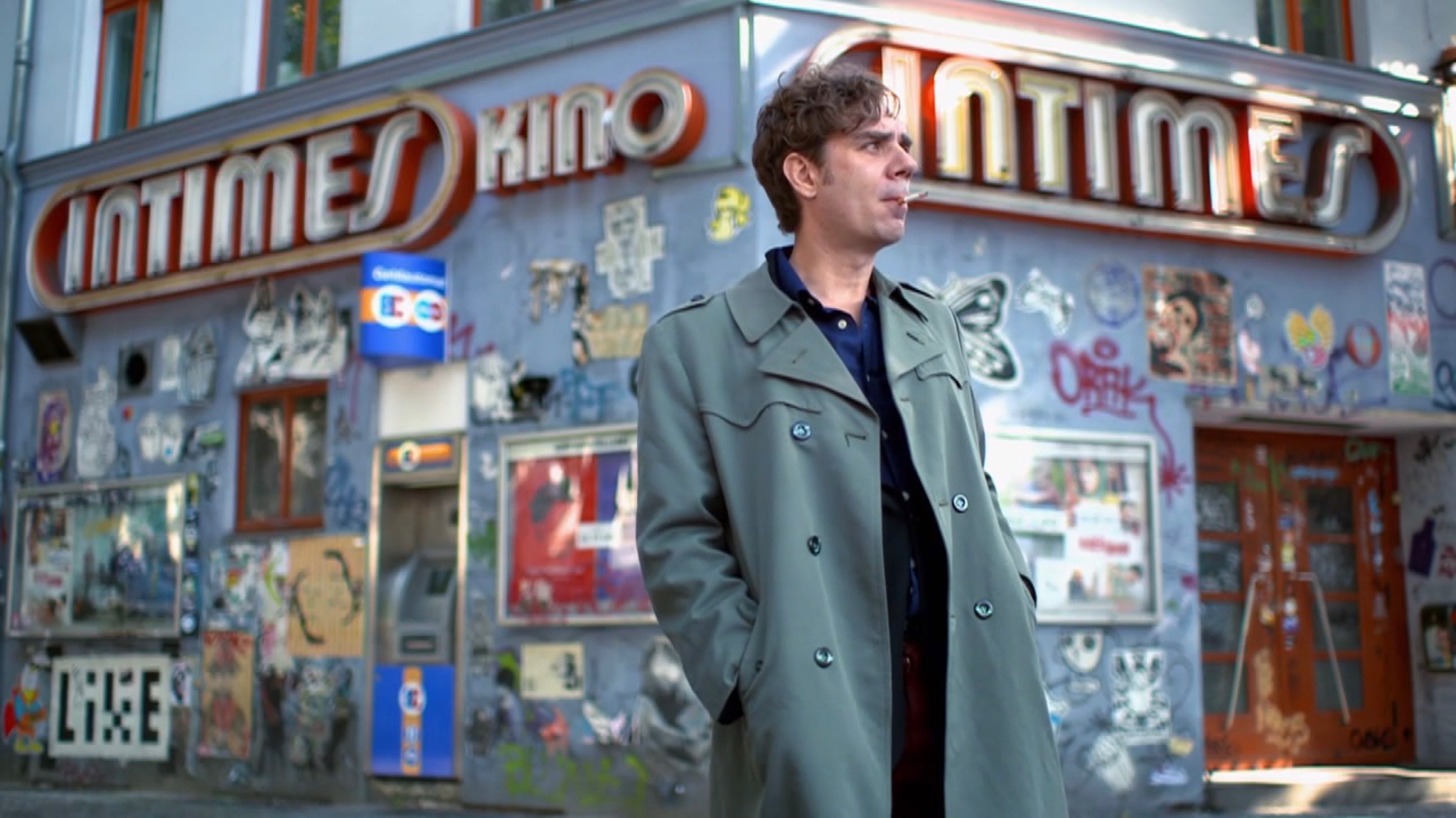
This is when we find out she is involved with a guy named Oliver who is too busy to go and see French movies with her. You can’t really blame Oliver. She could be going to see Nouvelle Vague (1990). Apparently, someone ordered a book by Wilhelm Genazino because any movie with a lot of French New Wave references must include books. Now we cut to Piero making a call at a phone booth. He sets up a meeting before walking in front of what appears to be a rundown theater.
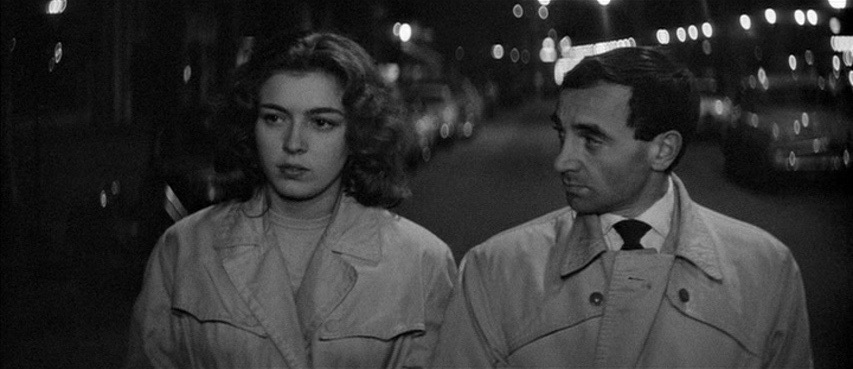
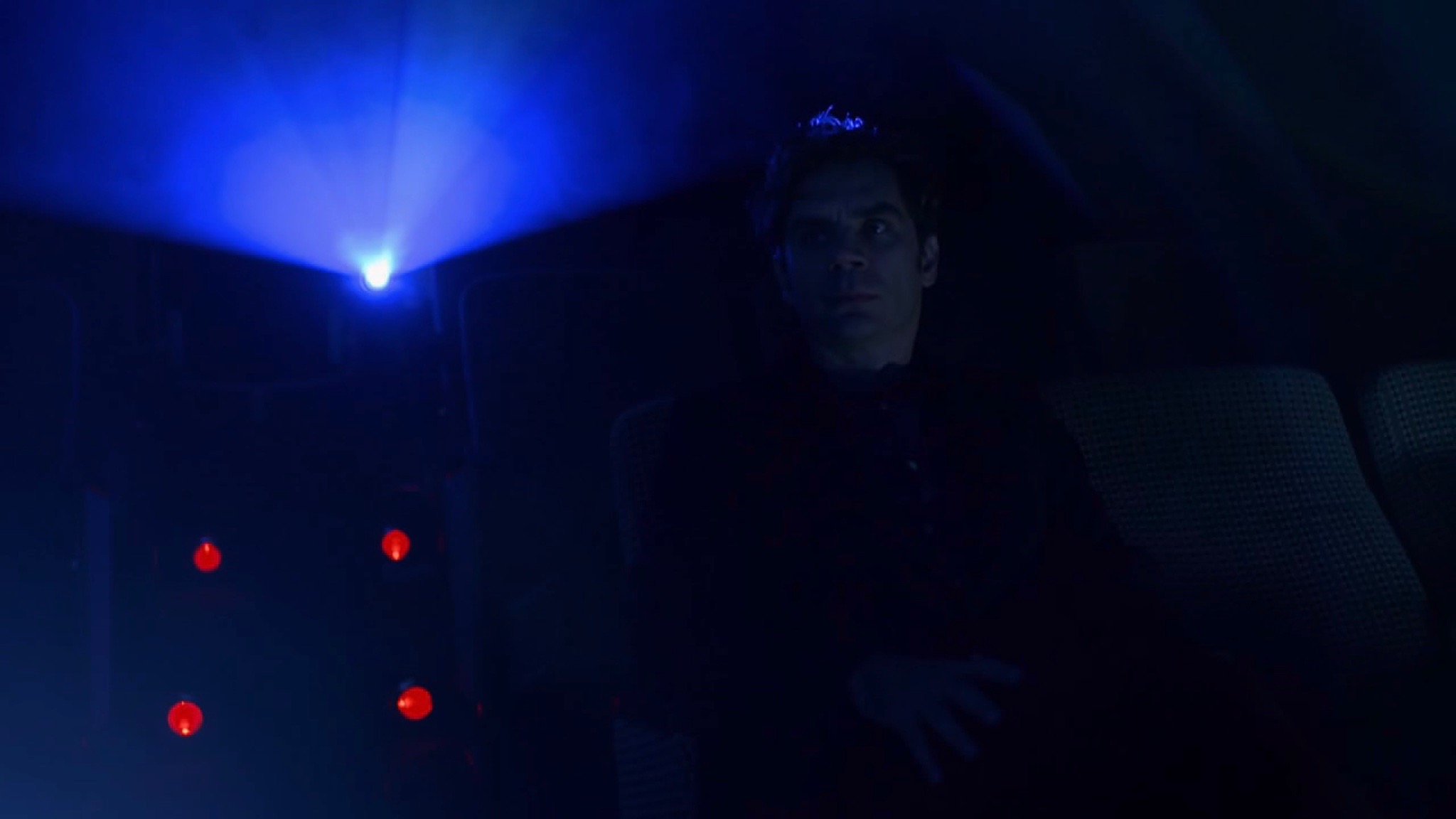
After standing there, he turns and goes inside. He happens to show up near the beginning of Shoot The Piano Player (1960).
Shoot The Piano Player (1960, dir. François Truffaut)
That was François Truffaut’s second feature film. It’s the first scene between Charlie and Léna. A large part of the movie is Charlie trying to get over his past and open up to her. It’s also about pulp fiction gangsters riding around with a kid, which contains one of the most awesome insert shots of all time. One of the gangsters says, “If I’m lying, may my mother keel over this instant!”
Shoot The Piano Player (1960, dir. François Truffaut)
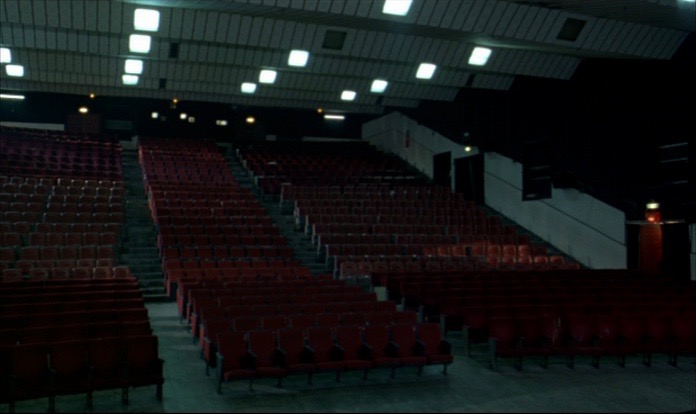
No one else is in the theater except our two leads.
I’m just going to assume that the ghosts from Good Bye, Dragon Inn (2003)…
Good Bye, Dragon Inn (2003, dir. Ming-liang Tsai)
migrated to Germany in the past decade or so to haunt this theater. The two of them of course take notice of each other, but don’t say anything. By that, I mean they stare at each other before cutting to the final scene of Shoot The Piano Player after Charlie is back at the bar, finds a new barmaid working there since Léna was gunned down, and somewhat solemnly plays the piano while looking off into the space behind the camera.
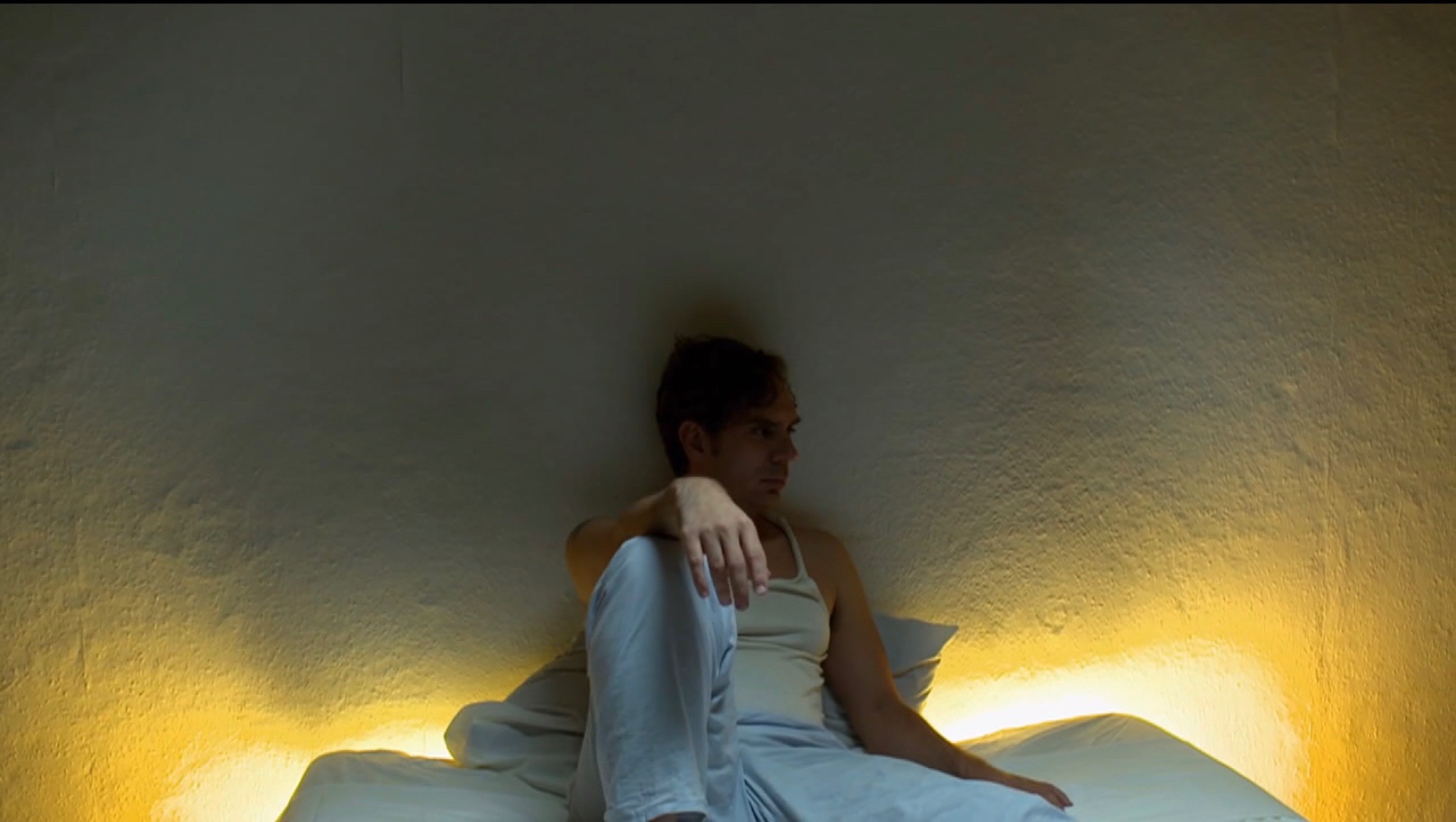
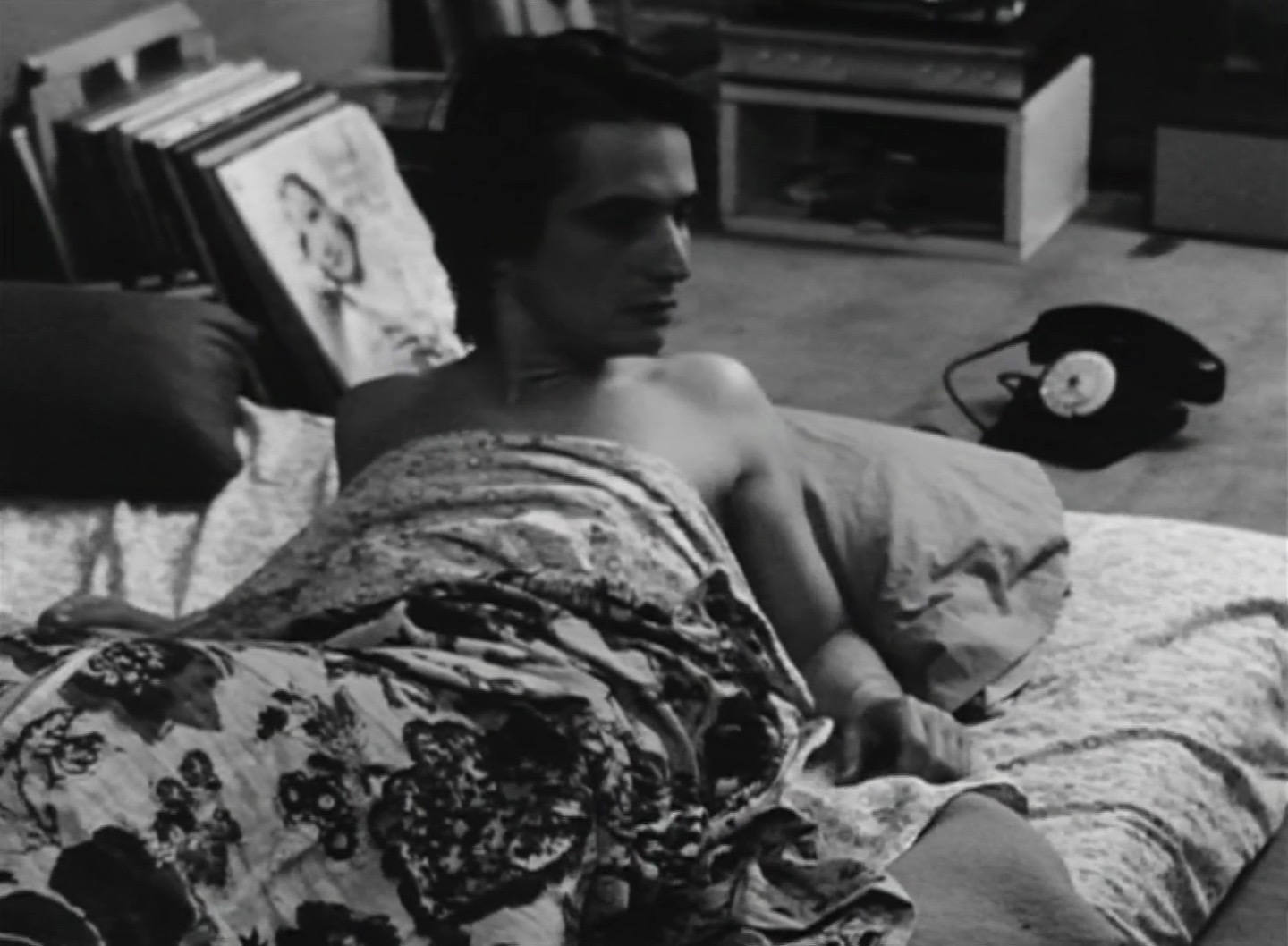
We see them briefly on a bus before going home with Piero where he seems to have just records, some lights, and a mattress on the floor.
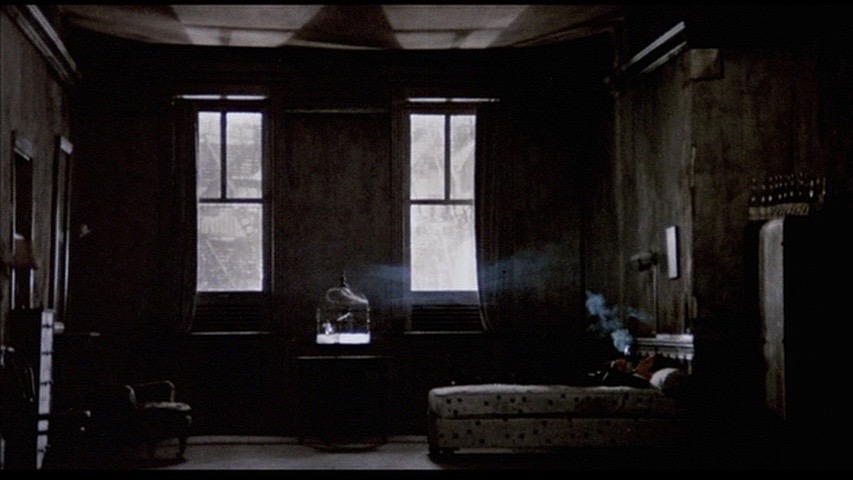
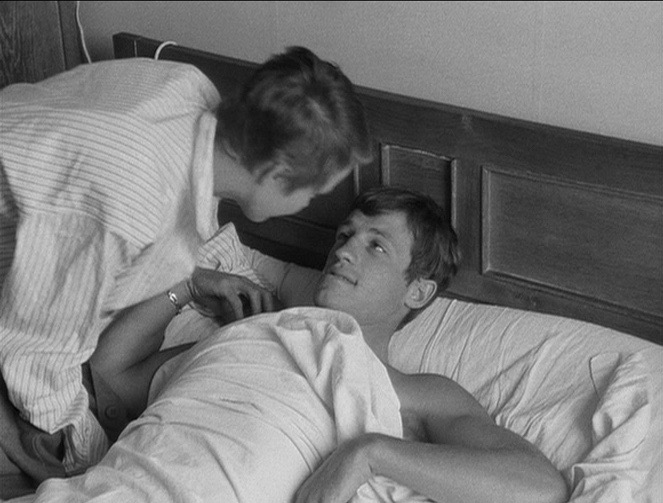
Nice to know the Alain Delon spartan bedroom design caught on after Le Samouraï (1967).
Le Samouraï (1967, dir. Jean-Pierre Melville)
Okay, to be fair, Bosch was probably thinking of the bedroom from The Mother and the Whore (1973).
The Mother and the Whore (1973, dir. Jean Eustache)
Especially since that is considered to be the last film of the French New Wave, and we see a clip from the film that is considered to have given birth to the French New Wave later on in this movie.
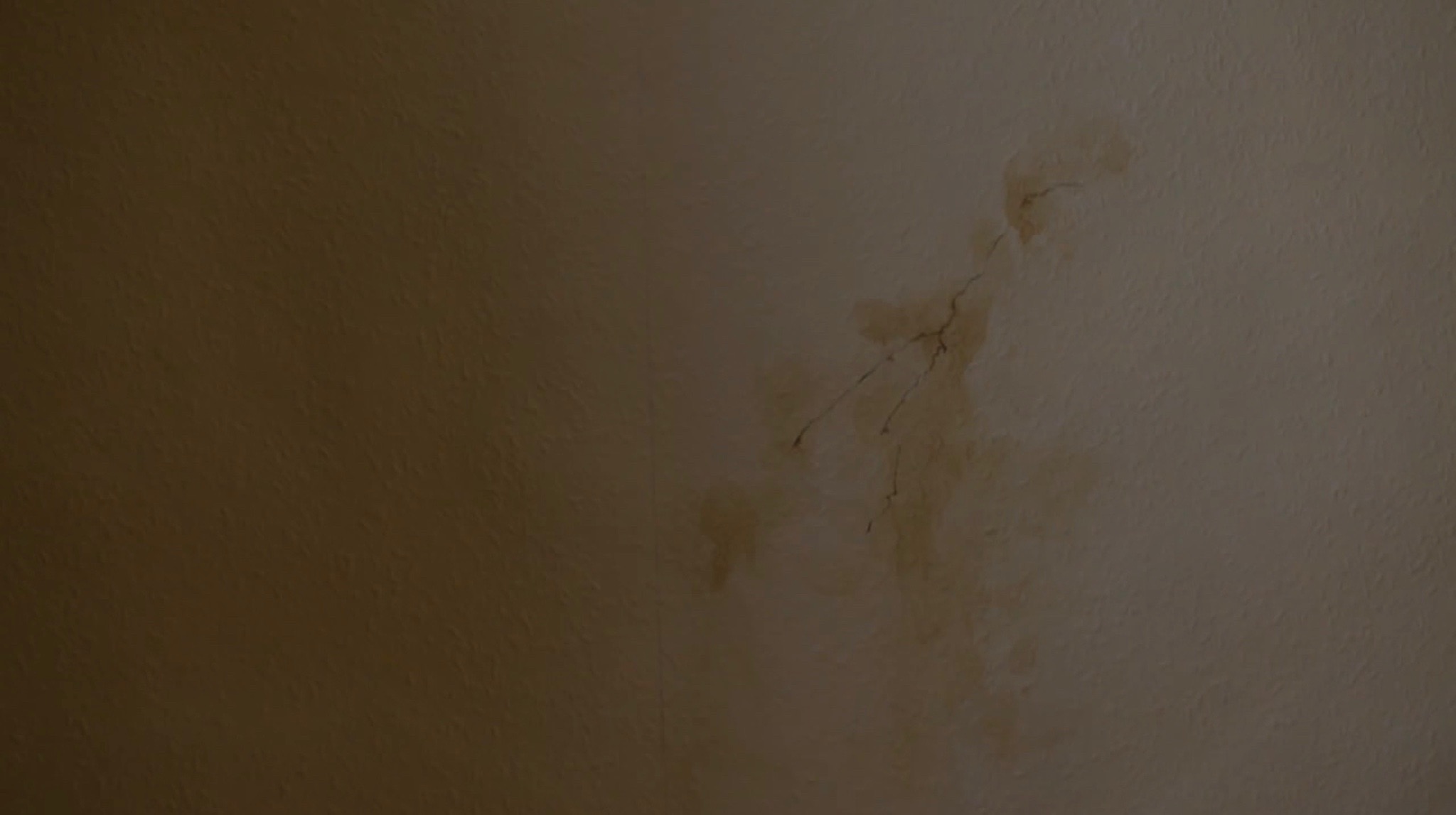
He looks up to see a crack in his ceiling.
Doctor Who
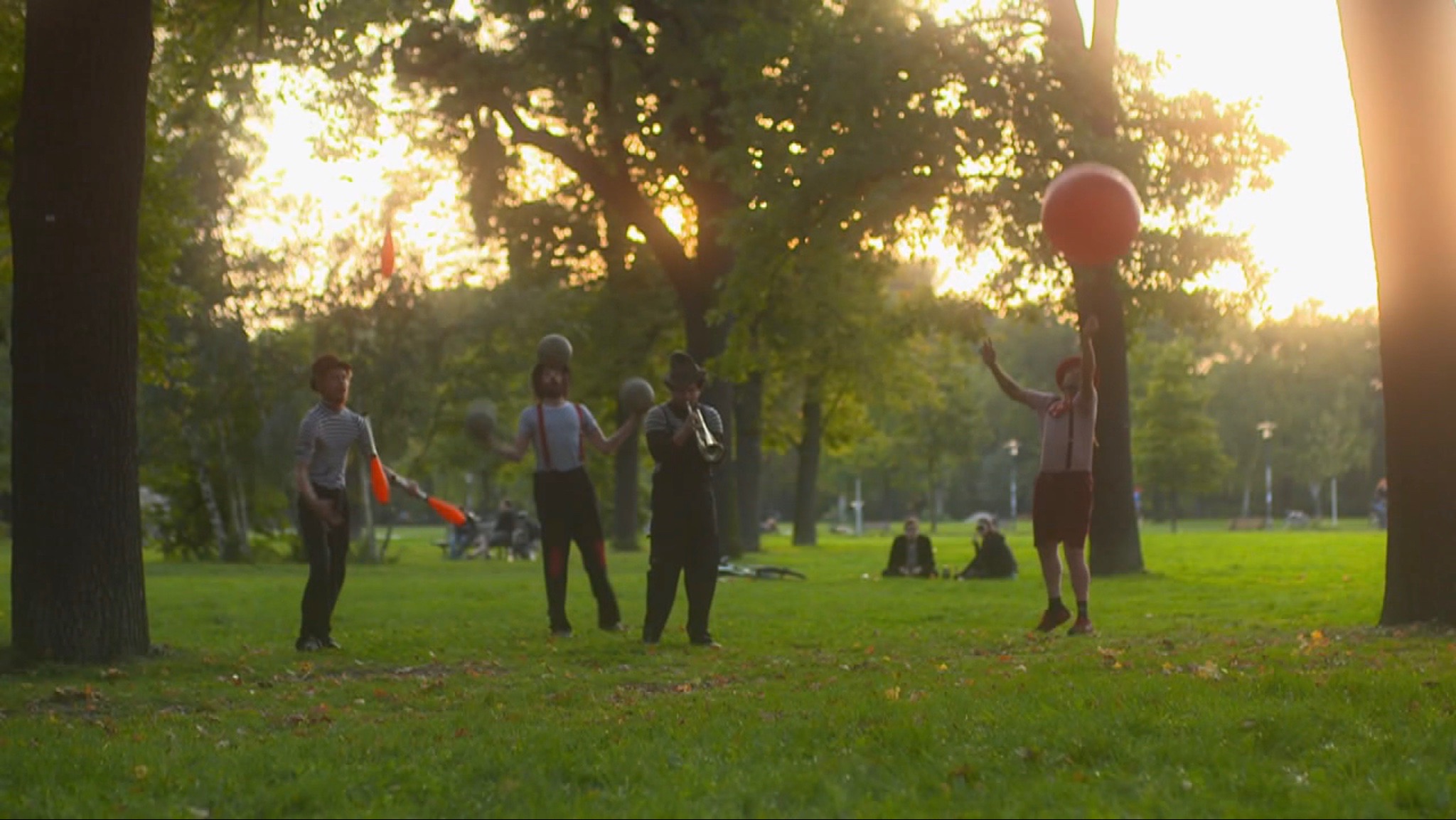
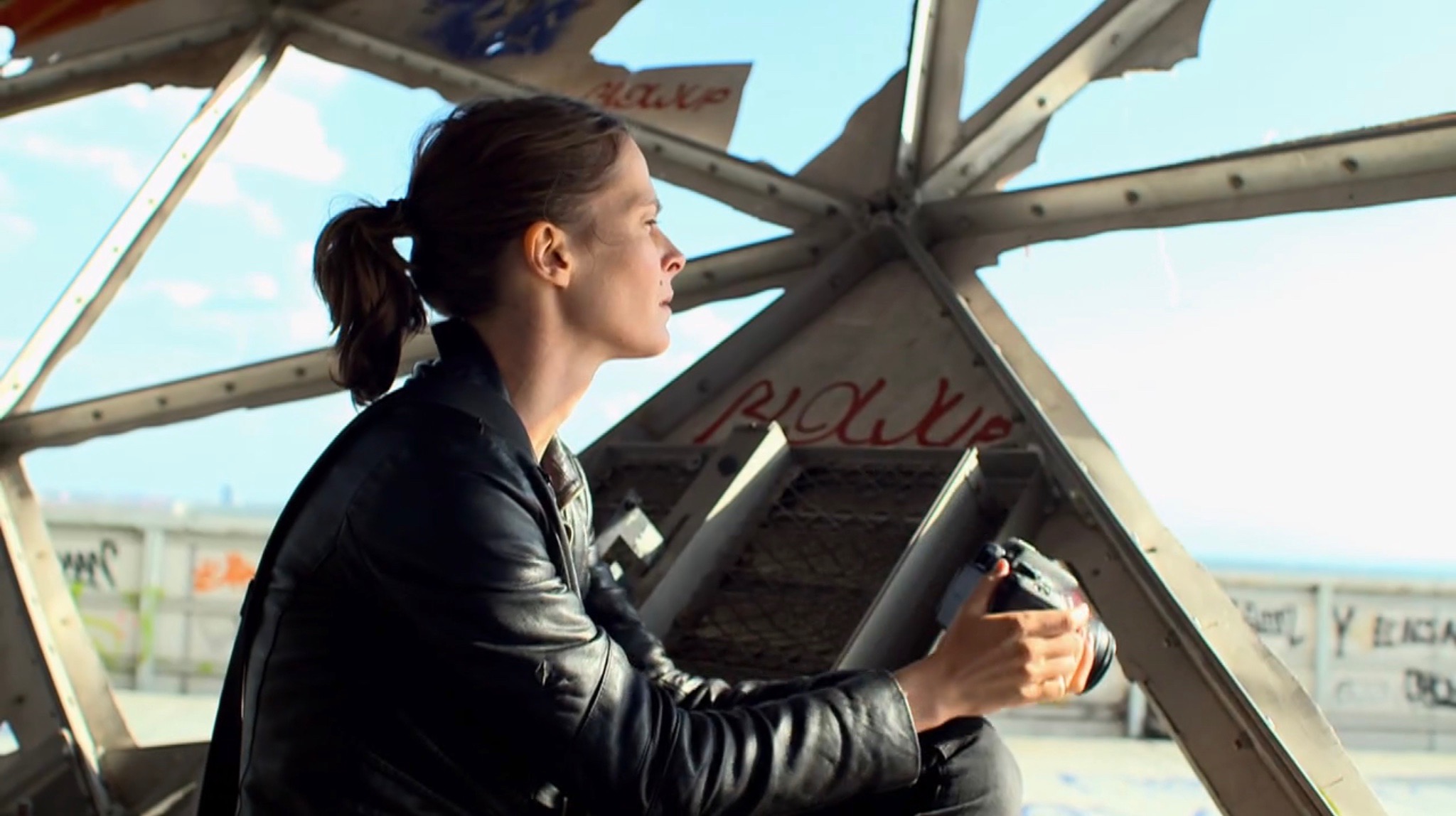
We now cut to more empty spaces to remind us of Antonioni before going to a park. Andrea is talking about how she needs to go and take photos of an abandoned building so the movie can reference Red Desert (1964) and Blow-Up (1966) before it is turned into a shopping mall. They also complain about development in the city, which is followed by people doing annoying things in the park.
Would have made my day if it were some people re-enacting Symbiopsychotaxiplasm: Take One (1968). Instead, it’s just some street performers waiting around for the ending of Nights of Cabiria (1957).
We then go to the title card with the camera panned left of the tower before we are back in the radio booth with Piero. He’s here to tell us that he has become obsessed by a guitarist that he hopes to get into the studio.
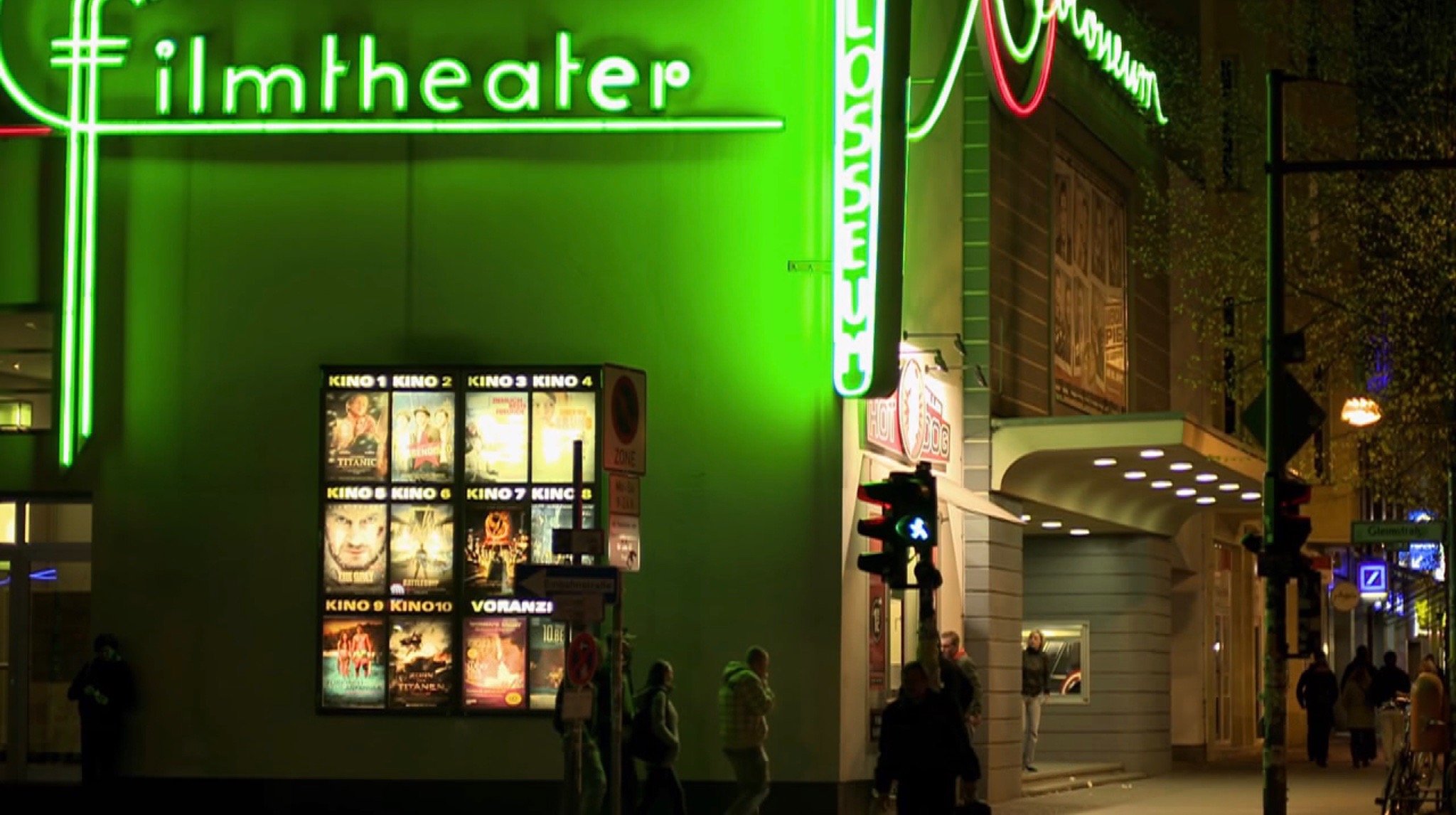
More scenes of outside including a shot to remind us this was probably shot in 2012.
That, and multiplexes are destroying single screen theaters with disposable films like The Hunger Games (2012). We should be returning to get more and more out of films like Shoot The Piano Player. Or simply buy the DVD like I did, and save yourself the trouble of a theater. After convincing his boss that he should go and interview this guitarist, we cut to every conversation an art film like this must include. Luckily they remember to leave dialogue heavy conversations to Éric Rohmer films by ending it short so we can get back to Antonioni.
Also, more of Andrea’s co-worker staring at her.
Now Piero’s girlfriend breaks up with him via a shot through glass into a restaurant. Not sure of why they weren’t filming in the restaurant, but I think this screenshot sums up this whole girlfriend thing.
We get the same scene with Andrea and her boyfriend, but they don’t breakup. Some more things happen, which has Andrea assaulted by jump cuts before she stares at the movie ticket. Then more outside Antonioni shots.
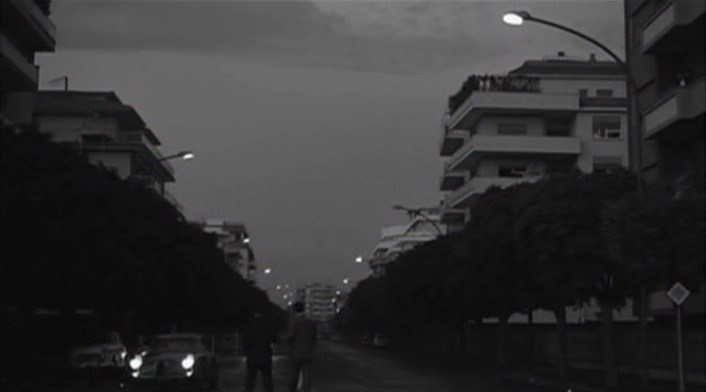
Just assume that if I don’t show it, then you’re getting shots like the ending of L’Eclisee (1962).
L’Eclisse (1962, dir. Michelangelo Antonioni)
L’Eclisse (1962, dir. Michelangelo Antonioni)
Back in the plot of the film, Piero goes to the bookstore where she works. He’s looking for a book on the sea and Andrea brings him one that happens to be written by Marguerite Duras. That way I can show a screenshot of her film India Song (1975).
India Song (1975, dir. Marguerite Duras)
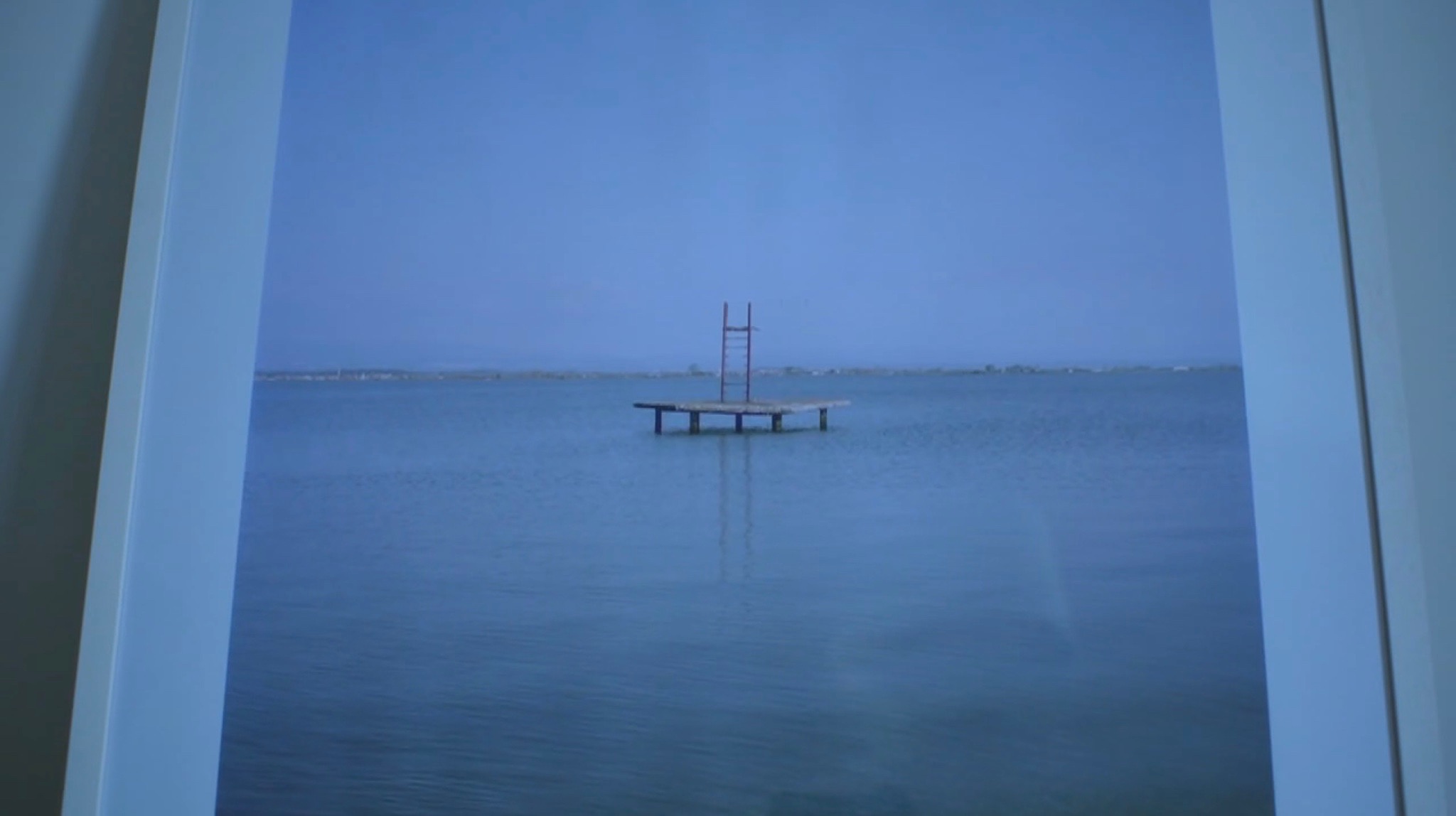
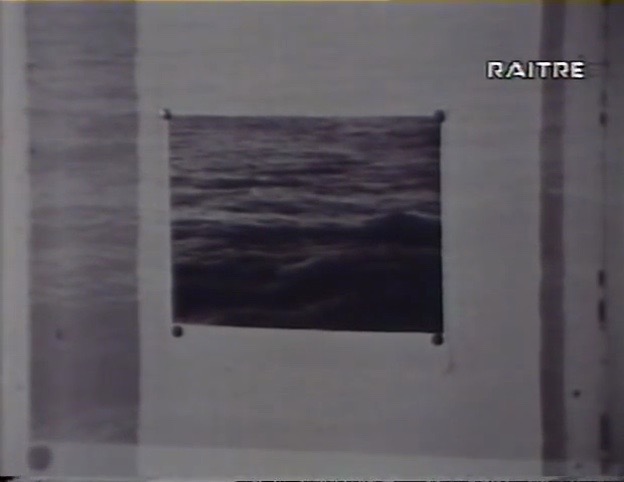
It juxtaposed cool imagery with sound that was played from a separate soundtrack which didn’t match what was onscreen even when people spoke to each other. I recall it being about trying to create a cultural island while trapped in another countries’ sea. Ties in with this film. They don’t actually acknowledge that they saw each other in the theater, but he makes note of her name before leaving. Then we cut so the movie can do a mini-version of Wavelength (1967) by zooming in on a picture of the sea, but this time with a platform at the center of it.
Wavelength (1967, dir. Michael Snow)
Piero stares at the crack wishing Matt Smith would come and fix it for him before walking past some red neon lights to pose, then goes back to the mysterious cinema.
Back at the bookstore, an annoying customer comes in so that Andrea will also have a reason to return to the theater. First, she kindly lets them shoot some handheld camerawork on her while she walks to get on a bus. Sadly, she goes from one annoyance to another.
That’s right, they are playing that movie.
Breathless (1960, dir. Jean-Luc Godard)
However, he’s not there now probably because he thought they were going to be playing a better French New Wave film like The 400 Blows (1959). That’s why after more DJ and Antonioni, we cut to a tracking shot. You didn’t think you’d get away watching a movie comprised of art film cliches from the 1960s that built on and fought cliches of Old Hollywood to tie in with the film’s ambivalence about the interconnections of the modern world while fighting against the destruction of local culture without one of these, did you?
I’m sure if they had held this shot a little longer than Jean-Pierre Léaud would have walked by Piero. It could have happened! He was waiting around on a bench in What Time Is It There? (2001).
What Time Is It There? (2001, dir. Ming-liang Tsai)
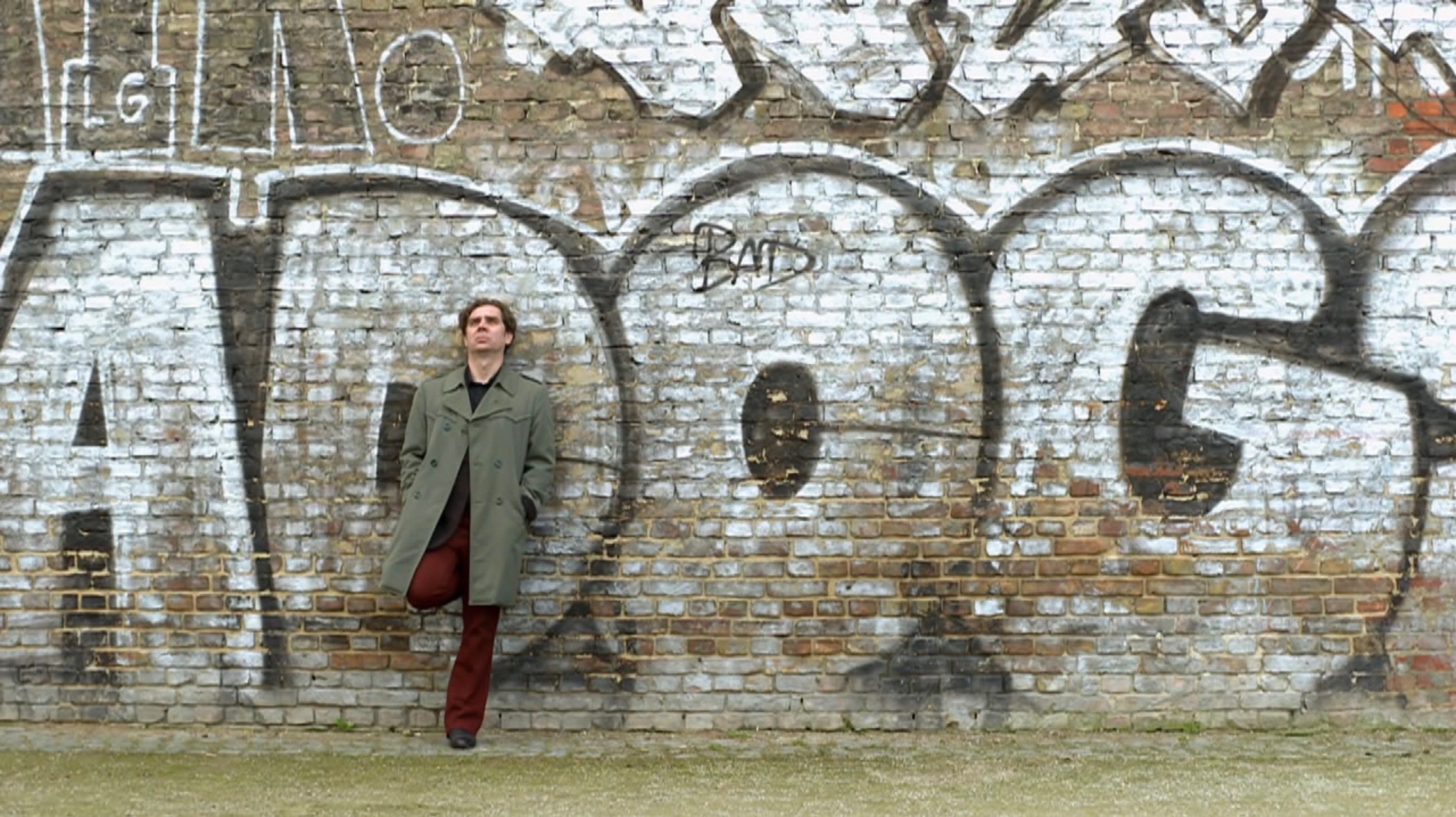
Then Piero goes and stands against a wall.
There isn’t even a clean white Antonioni wall to lean against anymore.
L’Avventura (1960, dir. Michelangelo Antonioni)
Also, he stands there so that I can embed Michael Jackson’s Smooth Criminal.
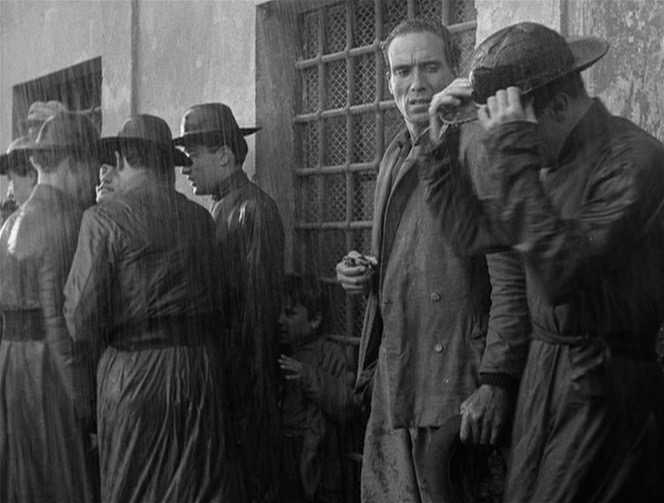
Cut to more buildings, then we see Andrea run into a telephone booth. Not for any real reason other than so Piero can also run in there like in Old Hollywood movies and they can have a moment. They are also there because in movies the rain conveniently stops after the scene has finished. Just like in Bicycle Thieves (1948).
Bicycle Thieves (1948, dir. Vittorio De Sica)
The rain started so we could get this great scene with these guys. Then they turned off the rain machine so Antonio could spot the original international title of the movie and begin to chase him.
He tells her he has a radio program, they acknowledge each other’s existence, and their meeting in the cinema before parting ways. They are both not happy with it. He even takes a video of her walking away from him with his cellphone.
This is as good a time as any to mention that they keep switching languages in this movie to further the mish mash of cultures.
She goes home and we apparently need to see a shot of her head in the shower for a few seconds before she broods on the couch. Then we cut to Orlando Bosch’s Instagram feed…
to tell us that Piero has finally decided to “travel” to see the musician he was obsessed with before meeting Andrea. He sees the musician playing and goes to sit on a fountain. If the ghost of Anita Ekberg isn’t in it, then I don’t care about this part of the film.
Back home, Andrea is smoking, like they both do in this movie, before she notices that Piero is on the radio.
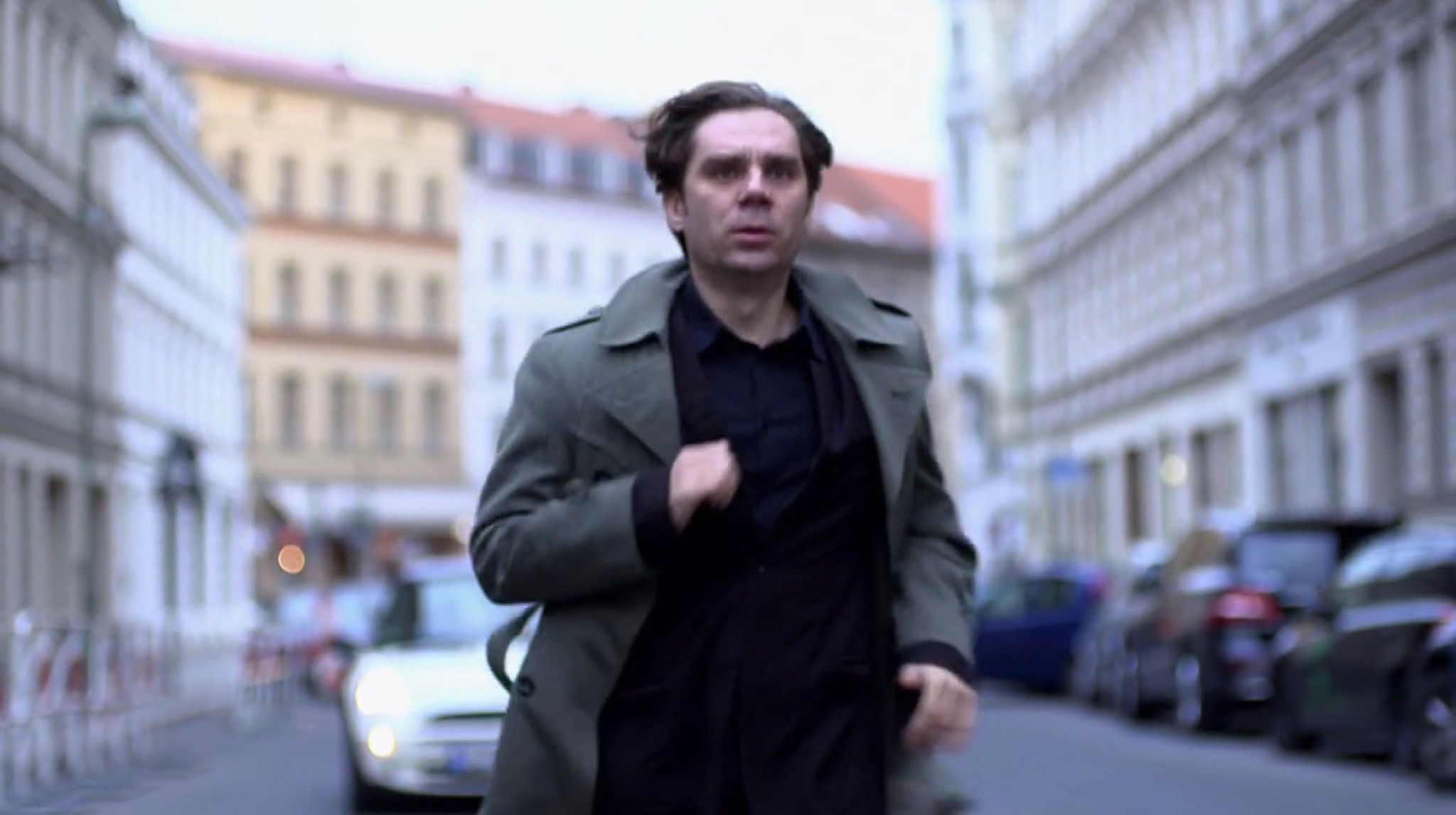
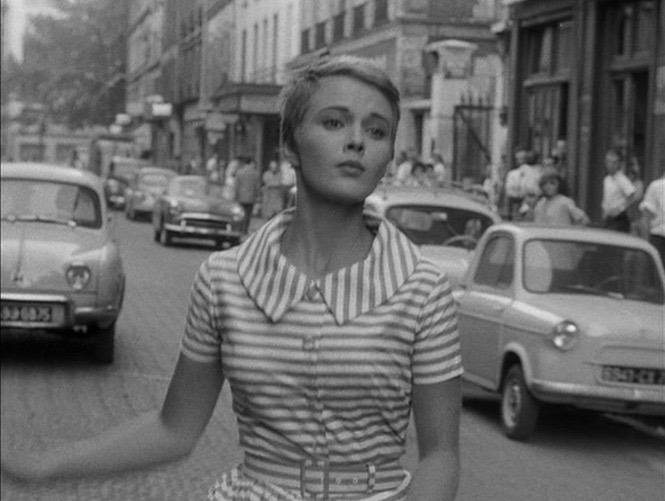
Now Piero runs down the street because he’ll be damned if Andrea is the only one who will do the Jean Seberg run at the end of Breathless in this movie.
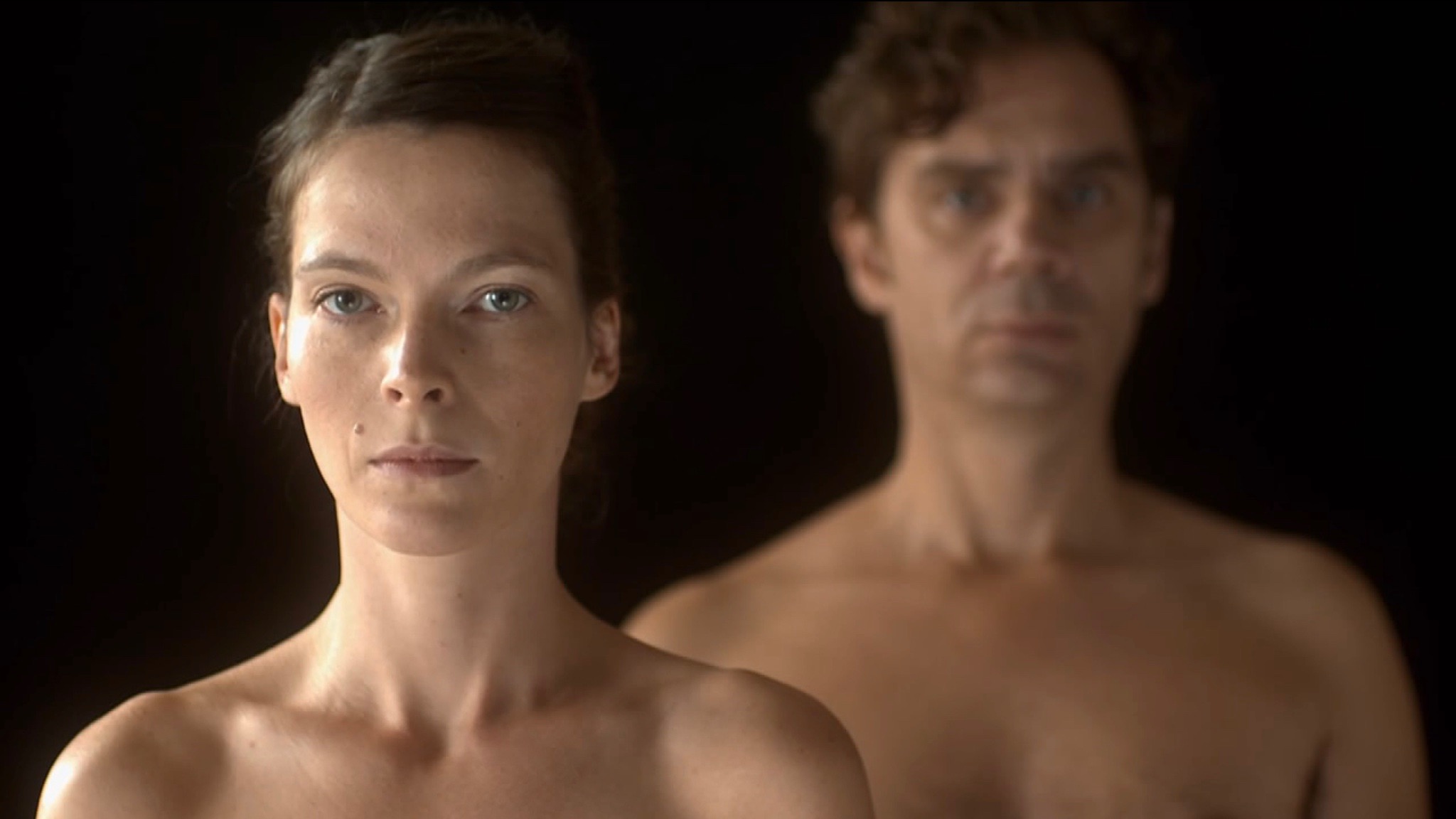
Oh, and immediately after posting that picture of Piero, I realized that actor Andrea Bruschi has the same first name as the female character his character falls in love with. Well played, Orlando. Well played. He should go on one of those movie game shows like the one in We All Loved Each Other So Much (1974) where one of the main characters lost because of a technicality over whether the question was asking about the character or the actor. It’s probably an easter egg about their interconnectedness. It fits since the next scene has Andrea staring at a candle before we are transported to the white dimension! Here they have sex before staring at us naked.
I’m sorry, but I took one look at this and instantly thought of Black Love (1971).
Black Love (1971, dir. Herschell Gordon Lewis)
Piero then talks more on the radio and I don’t care. We now go to Andrea walking across the streets before she goes into fast-motion. She does this so that I can include Kylie Minogue’s The Loco-motion.
During this fast-motion she appears to cross the same crosswalk twice. Could just be a similar looking one. I guess she is really out there hoping to run into him. She should have known that he would be standing in front of street art of Marilyn Monroe and Elvis Presley.
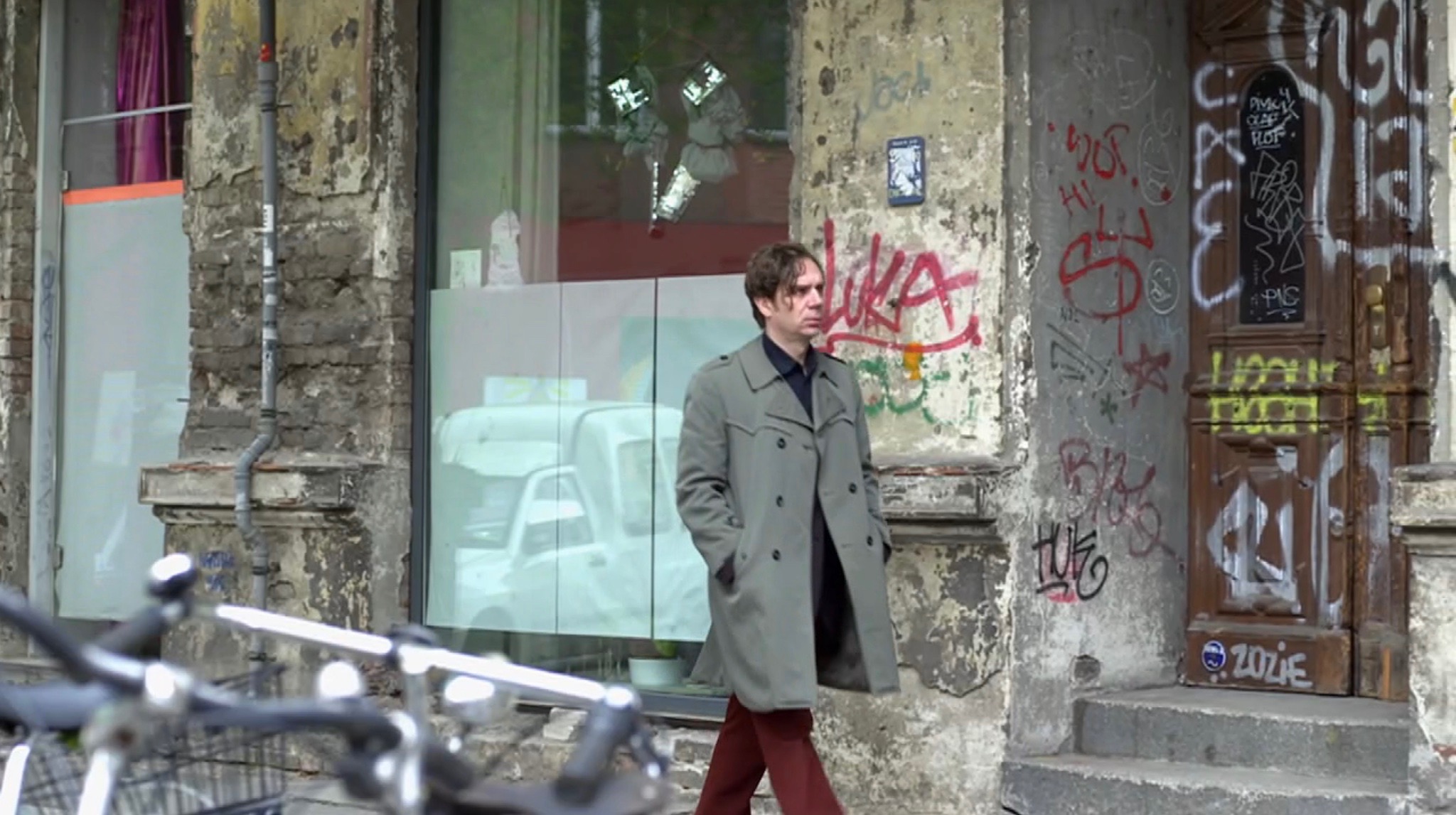
Luckily he then walks by a building that says “Luka” on the side of it now.
Lucky for me because I never have a good excuse to include a Suzanne Vega song in a review.
Or it’s supposed to be a reference to Luka from ER seeing as the character was from Croatia, ER is one of the most important TV Shows of all time, and Germany and Croatia have a history of relations so important that there’s even a Wikipedia article on it. Nah, I’m going with Suzanne Vega.
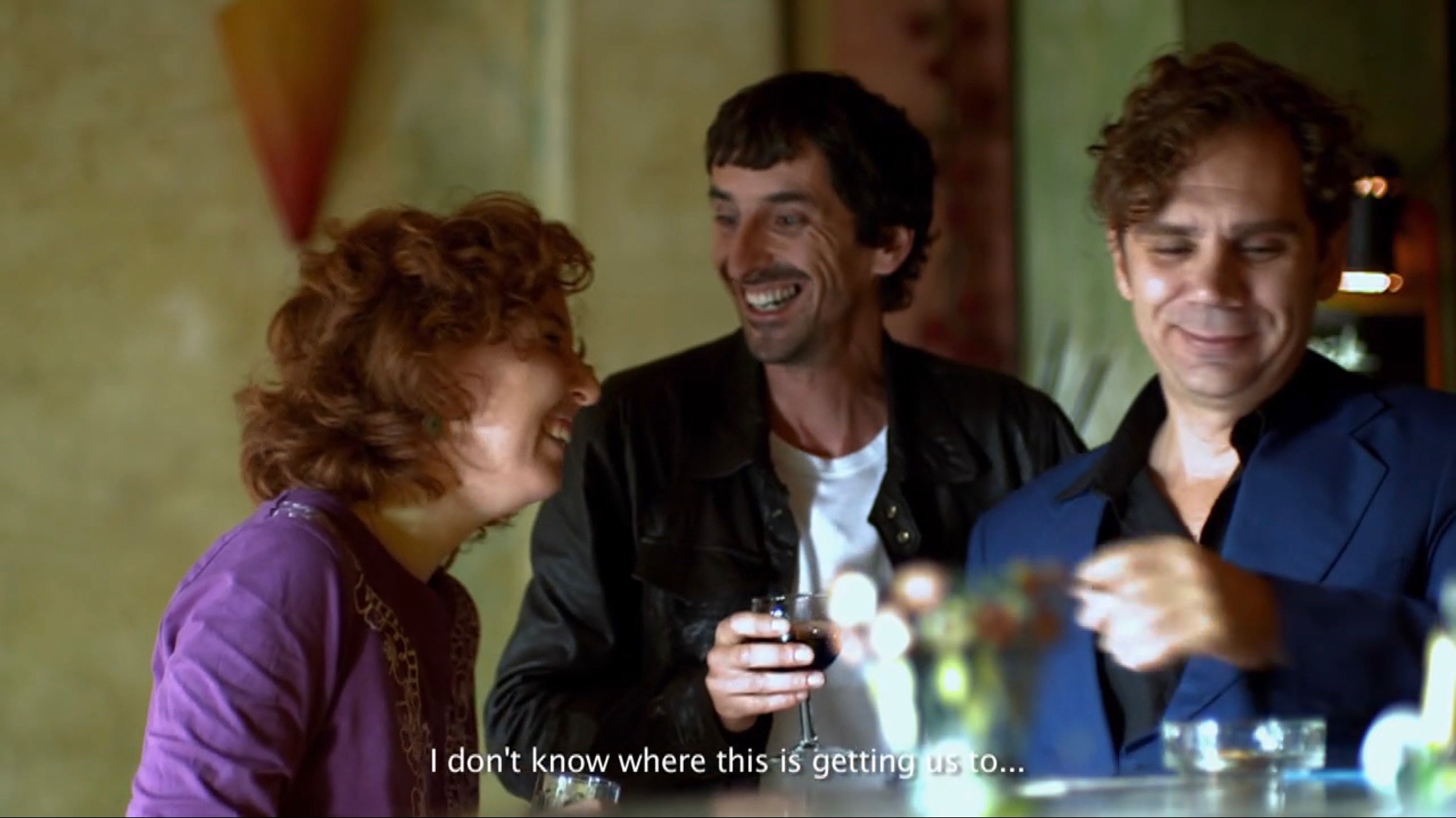
Then we cut to him at a record shop before settling on him at a bar. He meets some girl, there’s bad singing while they are drunk, he sleeps with her, and off he goes. I have no idea why that scene exists other than that it looks like they stumble onto the set of Before Sunset (2004) at one point. Doesn’t have anything to do with the movie either as far as I can tell, so onward.
Andrea now goes to abandoned buildings to take photographs…
because there were no colorful looking factories to take pictures of.
Red Desert (1964, dir. Michelangelo Antonioni)
Red Desert (1964, dir. Michelangelo Antonioni)
Meanwhile, David Hemmings is back in the park from earlier taking photographs.
Blow-Up (1966, dir. Michelangelo Antonioni)
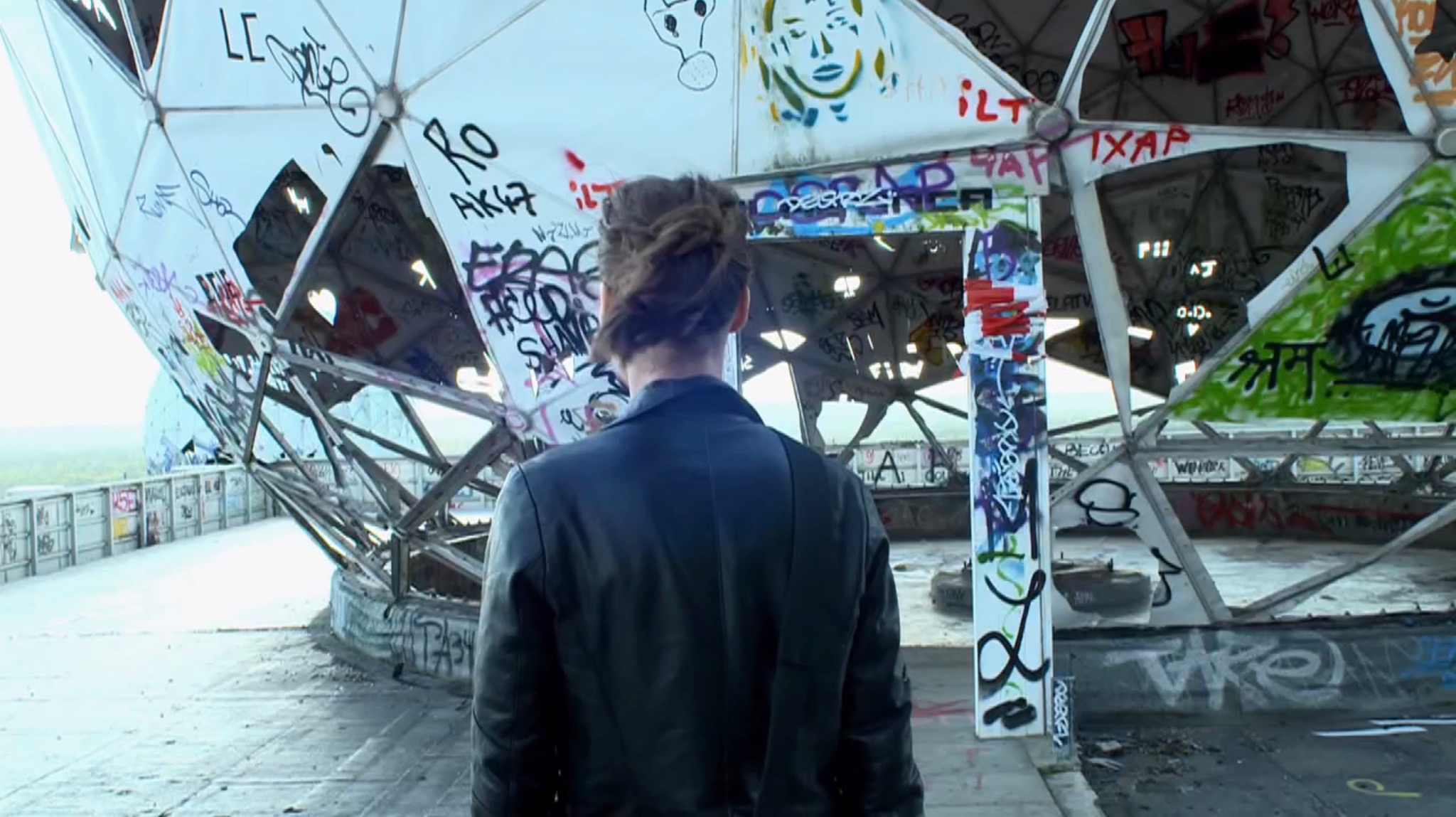
There is something noteworthy here because this film does love to use art film cliches. When she walks through the entrance of the globe I’m quite sure it does a temporal overlap twice so we see her enter it three times from three different angles. Also…
Hemmings clearly beat Andrea to taking pictures here and left his calling card. I love how during that shot you can hear sound that I swear is like music Goblin would compose for one of Argento’s films. I only mention that since Hemmings was in Deep Red (1975).
We then go back to her place. We can see she uses a Sony Vaio computer. She uploads her photos to Facebook. The ghost theater has it’s own Facebook page. Most likely because Kino Intimes is an actual theater in Berlin that has been around since 1909. The scene is there so that she can notice a picture of the theater and remember the chance encounter.
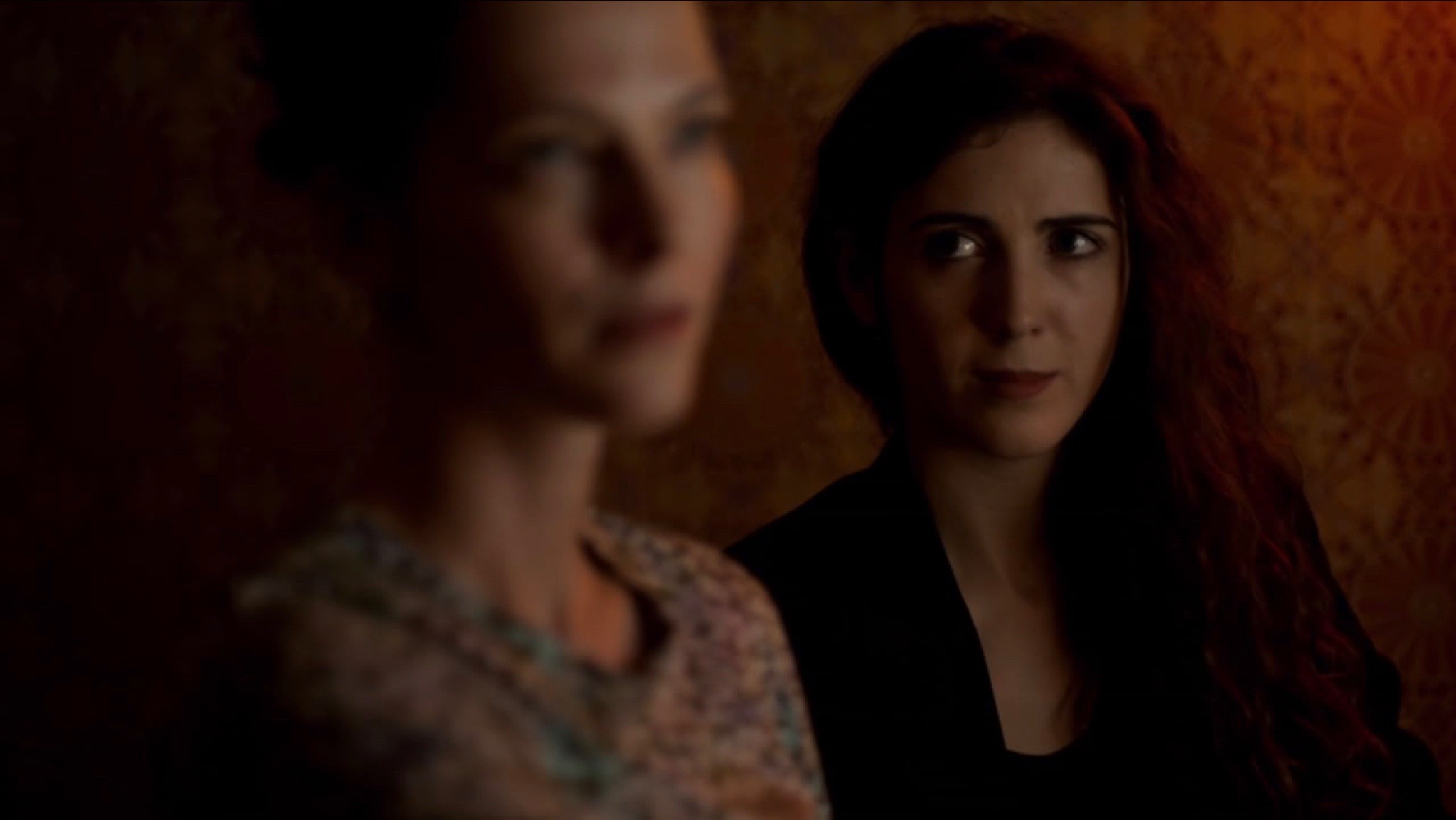
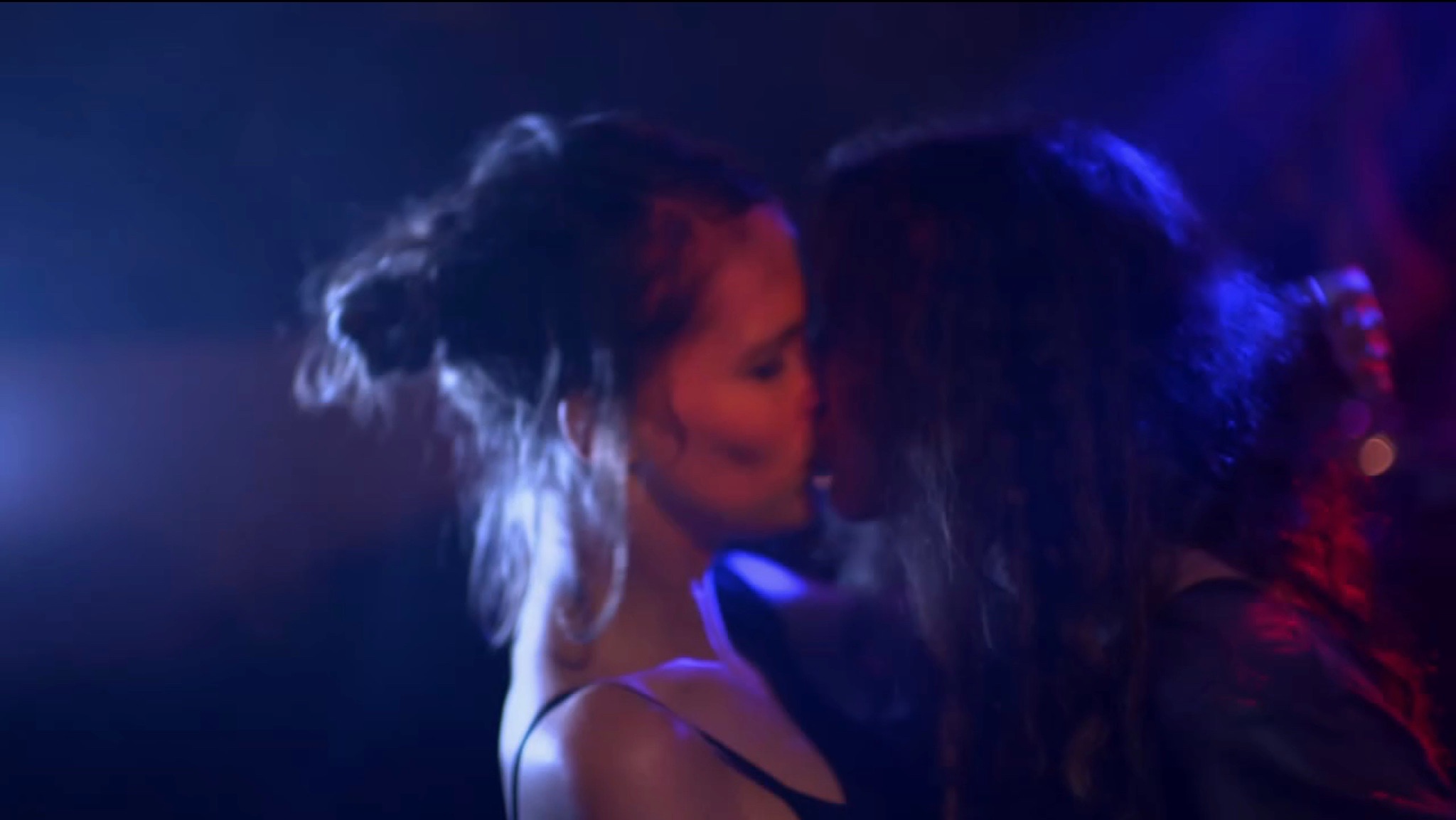
She now turns to her creepy co-worker. She says she knows he hosts a radio show at midnight. She also gets a call from that long forgotten boyfriend of hers. She tells him she’s too busy for him. That’s when it’s time to go club dancing.
Dancing and kissing your co-worker. She goes to the bathroom to try and cool off, but the jump cuts aren’t helping matters. Then suddenly we are back at the bookstore to find out that Angela was so drunk she didn’t know she had kissed Marianne, which as we all know is when to make your move.
She’s says no thanks, but is clearly not happy. The jump cuts make matters worse for her though so after more Antonioni and Piero talking on the radio, she goes and has sex with her boyfriend. Then she immediately breaks up with him. She takes a bath and dunks her head underneath the water. This time we are transported to the black dimension for more of the living art exhibit.
Realizing how stupid the shots were, she pulls her head out of the water and proceeds to start drinking. Once again, the jump cuts only make matters worse for her. Then it’s off to walking for Andrea. She walks through a tilt shift shot before settling on a bench.
The Passenger (1975, dir. Michelangelo Antonioni)
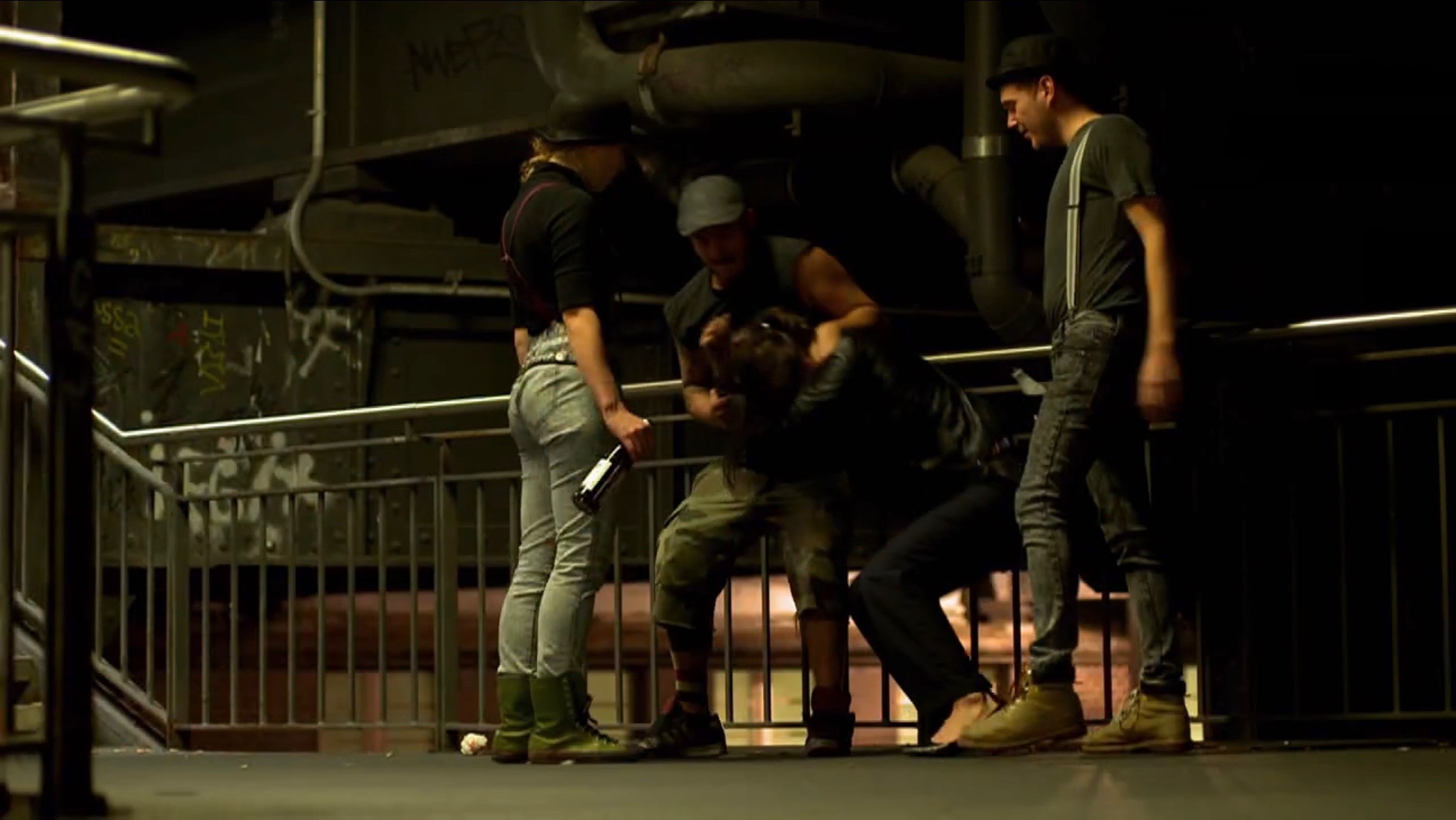
Back at the bookstore, Piero returns. He finally asks her out. They are going to meet on a bridge. It’s difficult to get dressed when jump cuts keep interfering. Anyways, as she is going to the bridge she is attacked by the Clockwork Orange gang because…
Leos Carax already struck a claim on lovers meeting on a bridge many years ago.
The Lovers on the Bridge (1991, dir. Leos Carax)
As a result, they miss their meeting. Think he’s simply going to return to the bookstore under the assumption that something must have come up like a normal person would do? Are you crazy? When someone misses a meeting with you, then it’s time to brood in public and drive out into the middle of nowhere to stare into the distance naked.
Andrea decides to stare into the candle, which in the past transported her to the white dimension. It doesn’t work this time so she runs back to the phone booth to feel it up. After Piero stares at the crack in his ceiling some more, he decides to not go back to the bookstore, but to also go and mope in the phone booth. Honestly, this is where the film should have quit while it was ahead. We could have just chalked him not sticking around, not returning to the bookstore, and her not looking up the radio station to two people who had a sudden connection, but were easily scared back into isolation. They had both returned to the place they shared a meeting, and would have never seen each other again. People do that kind of thing in real life. It’s not unrealistic. Unfortunately, the movie goes on for another 10 minutes.
We cut to Andrea and she tries calling the radio station where he works, but they moved. More jump cuts ultimately make this task impossible for her. She also has the painting of the sea the editing gave us the impression was at his place earlier.
After she has a conversation with her creepy co-worker about love, we cut to what could have been, as they have a meeting on the bridge that never happened. We get some of that sweet 80’s music video black and white like in Simply Red’s If You Don’t Know Me By Now.
Or if you can forgive some of the grain, then the black and white from Debbie Gibson’s Only In My Dreams. Black and white took the place of color in the 80s for dream sequences.
Again, it could stop here too, but it continues. Piero goes on the radio to say more dialog that probably ties in with the story, but I don’t care about. Both Andrea and Piero go to a train station and miss each other there because what would a movie like this be without a train scene with the characters missing each other?
The big problem here is that the longer this missing each other and trying to find each other stuff goes on, you just keep wondering more and more why he doesn’t go back to the bookstore. He even returns to the movie theater, but apparently the bookstore is off limits.
Andrea is now bothered at the bookstore by a little kid and out of focus camera obstructions at the bottom of the frame…
so she returns to the park from earlier. Those street performers finally have their time to shine, which culminates in tossing her a glass globe before running away. She goes home because that’s where the jump cuts live. They help her this time because she gets a call with an address of where Piero resides. Then it’s time for her to do the Seberg run.
Breathless (1960, dir. Jean-Luc Godard)
She arrives at his place and stands in his doorway staring. It cuts to the white dimension to show her naked, then back to him naked looking out his window. Then cut to the beach from the start of the film where he says, “I once dreamed she was coming to me and looked at me.” End of movie.
So, what part was real? Any of it? Was this one of those movies with an unreliable narrator like this one.
Last Year at Marienbad (1961, dir. Alain Resnais)
Maybe he’ll return to the bookstore in a year to try and convince her they had a thing once while playing a symbolic game with her creepy co-worker.
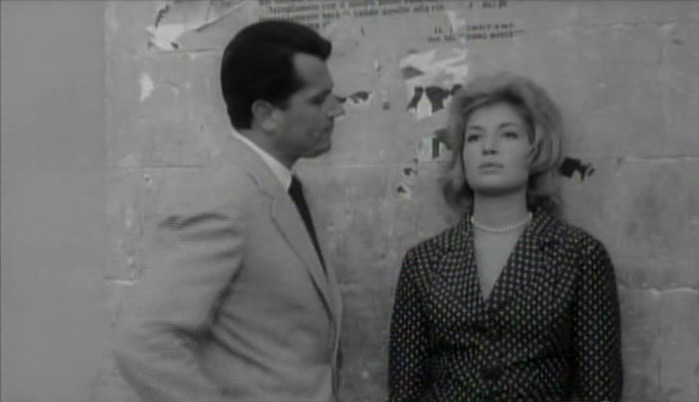
If you feel like Monica Vitti looks here…
L’Avventura (1960, dir. Michelangelo Antonioni)
then I don’t blame you.
It’s obvious that Orlando Bosch put a lot of thought into making this movie, but he forgot a few things. The first is that it was 2015 when he released this movie. These art film cliches were old by the time The Lovers on the Bridge came out in the 90s after being filtered through MTV. I don’t care if they were metaphors for something else as one user review I read somewhere says. They are endless and really grate on the nerves. You stop caring what they could possibly be there for, and just want them to stop.
He also couldn’t have picked a worse 60’s art film director to focus on than Antonioni. Ingmar Bergman is even quoted on IMDb as not liking him, which of course is somewhat hilarious since he died on the same day as him. Even my first film class book makes special note about the criticism about his work: “All his characters live lives that are boring and empty, meaningless and sterile and that his films are accordingly boring, sterile and abstract.” A view I do not share. Antonioni just seems to be the trend these days so I’m guessing that’s why he went with it. I’ve seen it show up in many films of the past 25 years that cover similar themes to this film. You can even say that The Time Machine (I Found at a Yard Sale) (2011) tried to do the Antonioni thing.
It’s annoying and it has holes in the script when it doesn’t end at the right time. Just let this stuff go. All of these films are readily available if people want to revisit them. There’s no need to compile a best of collection. Leave them in the past, and move on. They are perfectly captured and preserved. I hope Bosch takes the talent he seems to have, and puts it into his own work, with his own style.
Once upon a time, Paramount Pictures released a movie about an Italian-American organized crime family.
It was a self-styled epic that used the Mafia as a metaphor for both business and politics. The movie mixed scenes of violent death with family and community ceremonies. The main mafioso was played by a famous actor who was a big box office draw in the 1950s and another character, a war hero who was initially reluctant to get involved in the family business, was played by an up-and-coming young actor. The majority of the movie took place in New York but there were several scenes that were set in Sicily.
It may sound like The Godfather but actually, it was The Brotherhood, a film that flopped so badly that Paramount executives nearly passed on the chance to make a movie out of Mario Puzo’s bestselling novel. According to Peter Biskind’s The Godfather Companion, Francis Ford Coppola frequently cited The Brotherhood as being exactly the type of movie that he did not want to make while he was directing The Godfather.
Kirk Douglas, who both produced and starred, plays Frank Ginetta. Frank, an old-fashioned and honorable mobster, is hiding out in Sicily with his wife, Ida (Irene Pappas). Frank knows that a rival gangster, Jim Egan (Murray Hamilton), has put a price on his head. When Frank’s brother, Vinnie (Alex Cord), shows up in Palermo, Frank is overjoyed at first. But Ida reminds him, “They’re going to send someone.”
Most of the film is taken up with flashback to Frank and Vinnie’s old life in New York. When Vinnie returns from serving in the army, he marries Emma Bertolo (Susan Strasberg), the daughter of Don Bertolo (Luther Adler who, as a stage actor and director, served as an early mentor to the future Don Corleone, Marlon Brando). Frank grew up idolizing their Sicilian father and, at first, he is happy when Vinnie announces that he wants to enter the “family business.” But then Vinnie starts to side with non-Sicilian gangsters like Egan and Sol Levin (Alan Hewitt).
The scenes in Sicily work the best, with Frank unsure as to whether or not Vinnie has arrived to visit or to murder him. But the scenes in New York are such a mess that it took me a while to realize that they were even supposed to be flashbacks. It is hard to keep track of how much time has passed from scene to scene and Alex Cord and Kirk Douglas are two of the most unlikely brothers imaginable.
The main problem with The Brotherhood is that it is impossible to watch it without thinking about The Godfather. The Brotherhood has much in common with The Godfather but it has none of its authenticity and does not come close to matching its epic scale. Kirk Douglas tries his best and puts a lot of effort into talking with his hands but he is miscast from the moment he first appears. Robert Evans once said that he chose Coppola to direct The Godfather because he wanted to “smell the pasta.” The Brotherhood was directed by Martin Ritt and you never smell the pasta.
The Brotherhood is an interesting footnote in the history of The Godfather but ultimately, it’s an offer you can refuse.
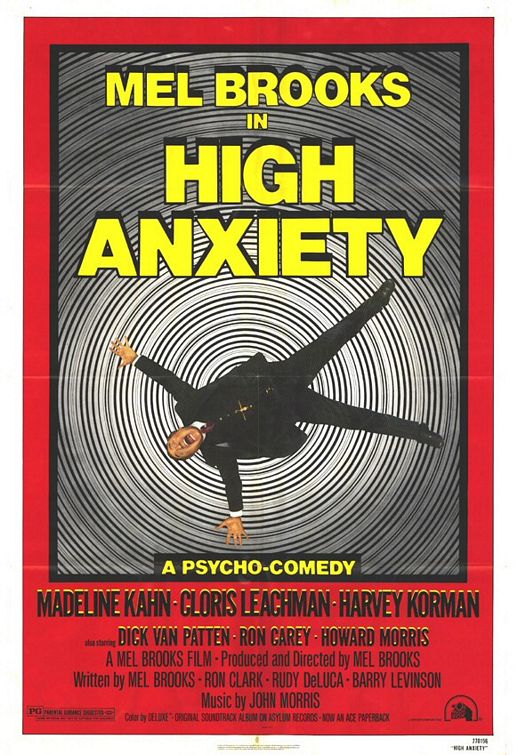
Mel Brooks loves films as much as the rest of us do. After skewering Westerns in BLAZING SADDLES and horror movies in YOUNG FRANKENSTEIN, Mel set his satirical sights on Alfred Hitchcock in HIGH ANXIETY. The result is a film biff’s dream, with the gags coming fast and furious as Mel and his band of merry pranksters pay a loving but hysterical homage to the films of the Master of Suspense.
Mel takes the lead here as Dr. Richard Thorndyke, the new head of the Psycho Neurotic Institute for the Very, Very Nervous. Thorndyke’s aide, the inept Brophy, thinks the former director was “a victim of foul play”. At the Institute, he meets oily Dr. Montague and starched Nurse Diesel, whose S&M/B&D relationship isn’t their only secret. Thorndyke has an ally in his mentor, Prof. Lilloman (say it slowly). The professor works as a consultant, and tries to help Thorndyke conquer his own…
In a perfect world, the new film Money Monster would feature a monster that was literally made out of money. Its name would be Monblar and it would shamble down Wall Street and breathe coins made of fire.
Or, if not featuring a literal Money Monster, the film would at least open with the angry spirit of Andrew Jackson springing out of a twenty and seeking vengeance over being replaced by Harriet Tubman. In order to defeat the bitter old president, it would be necessary to summon the spirits of both Tubman and currency hottie Alexander Hamilton. Seriously, that would be a great movie!
Unfortunately, Money Monster is just another boring recession thriller. I’ve lost track of how many bad movies have been released since 2008, all featuring saintly blue collar workers who are forced to resort to extreme measures as a result of losing all of their money due to corporate greed. While they seek revenge by either pulling off a tower heist or an assault on wall street, villainous CEOs sit in their offices, smoke cigars, and laugh at the evil of it all. In between the inevitable gunshots and the collapsing families and the evictions, there’s always time for a didactic speech or two. And don’t get me wrong. I’m not fan of Wall Street but I’m also not a fan of preachy movies.
George Clooney plays Lee Gates, who has a show called Money Monster where he tells people where they should invest their money. Lee is charming. Lee is glib. Lee’s show features backup dancers, clips from old movies, and a rap theme song that is just so 2002. At the start of the show, Lee even dances as Money Monster tries to convince us that Lee’s a hyperactive showman despite the fact that he’s being played one of the most laid back actors of all time. Lee is totally unaware and/or unconcerned about the people who have occasionally lost their life savings due to his advice.
One of those people is a deliveryman named Kyle Budwell (Jack O’Connell) and we know he’s a good, honest guy because his name is Kyle Budwell as opposed to Kyle Evilguy. Kyle follows Lee’s advice to invest his family’s savings in IBIS Global Capital. (At first, I thought that the company was called ISIS Global Capital and I was like, “Hey, you betray your country, you pay the consequences…”) One week later, the IBIS stock crashes, Kyle is suddenly dead broke, The Big Short only manages to win one Oscar, and Hillary Clinton defeats Bernie Sanders in the New York primary. What other choice does Kyle have other than to go on Lee’s show, force Lee to wear a bomb vest, and demand answers!
Yawn.
There’s not a single surprising moment in Money Monster. I was going to say that you immediately know that IBIS’s CEO is evil because he’s played by Dominic West but actually, you know he’s evil because he’s a CEO and he’s appearing in a movie called Money Monster. Meanwhile, you know that Kyle isn’t really a bad guy because he looks like likable, clean-cut, and handsome Jack O’Connell. If Money Monster had any guts, it would have cast some fat 60 year-old slob with bad teeth in the role of Kyle Budwell. Money Monster ends with a twist that you’ll guess within the first few minutes of film. It’s an annoying twist, if just because it seems to assume that the audiences can’t handle moral ambiguity.
(Then again, there’s really no reason to assume that audiences can handle moral ambiguity so maybe Money Monster has a point…)
I suppose I should mention that Julia Roberts is also in the movie but there’s really no reason for her to be there. She plays Lee’s producer, Patty, and there’s nothing about the role that demands it be played by a star. There is a subplot about how, up until the Kyle takes Lee hostage, Patty had been planning on quitting her job but … well, who cares? Whenever Patty and Lee talked, I found myself cringing and thinking, “Do we really have to sit through this conversation?”
(In all fairness to Money Monster, that’s actually my reaction to most conversations…)
Money Monster was directed by Jodie Foster. It’s funny how we always assume that just because someone is a good actor that they’ll also be a good director. For instance, Angelina Jolie has directed three mediocre films and yet, with the announcement of each new Jolie-directed movie, we still continue to assume that she’s eventually going to win an Oscar for her work behind the camera. (Remember when Unbroken and By The Sea were being touted as guaranteed Oscar nominees?) George Clooney has directed five films and none of them are really that good. (Confessions of a Dangerous Mind only works because of Sam Rockwell’s performance. Goodnight and Good Luck is overrated. Leatherheads is boring. The Ides of Marchis tedious and The Monuments Men is one of the worst movies that I’ve ever seen.) Money Monster is Foster’s fourth film as a director and it’s almost as much of a tonal mess as The Beaver. Then again, The Beaver was at least weird. Money Monster was just boring. Foster is an incredibly compelling actress and an incredibly blah director.
That said, you would think that Foster would at least be able to get good performances out of the cast. As good as they often are, both George Clooney and Julia Roberts have actorly tics that they tend to fall back on whenever they’re working in the absence of a strong directorial vision and let’s just say that this is a very tic-filled film. Meanwhile, poor Jack O’Connell is running the risk of turning into Taylor Kitsch.
Amazingly enough, Money Monster was this week’s “big” release. Personally, I would recommend seeing Captain America: Civil War for a second or third time. Now that was a good movie!
How have I ignored Roger Corman here for so long, save for a short “Cleaning Out the DVR” review of THE TERROR ? The King of the Low Budget Quickies has long been a favorite filmmaker of mine, and has probably had more impact on American cinema than people realize. Well, now that TCM is running its month-long salute to AIP, I’m about to rectify that oversight. (By the way, Corman himself is cohosting the retrospective every Thursday night along with TCM’s own Ben Mankiewicz!)
American International Pictures scored a hit with 1960’s HOUSE OF USHER, an Edgar Allan Poe adaptation starring Vincent Price and directed by Corman. Studio honchos James Nicholson and Samuel Z. Arkoff looked at the box office numbers and, realizing they had a cash cow on their hands, asked Corman to produce a follow-up. Rapid Roger decided on PIT AND THE PENDULUM, shot in 15 days for less…
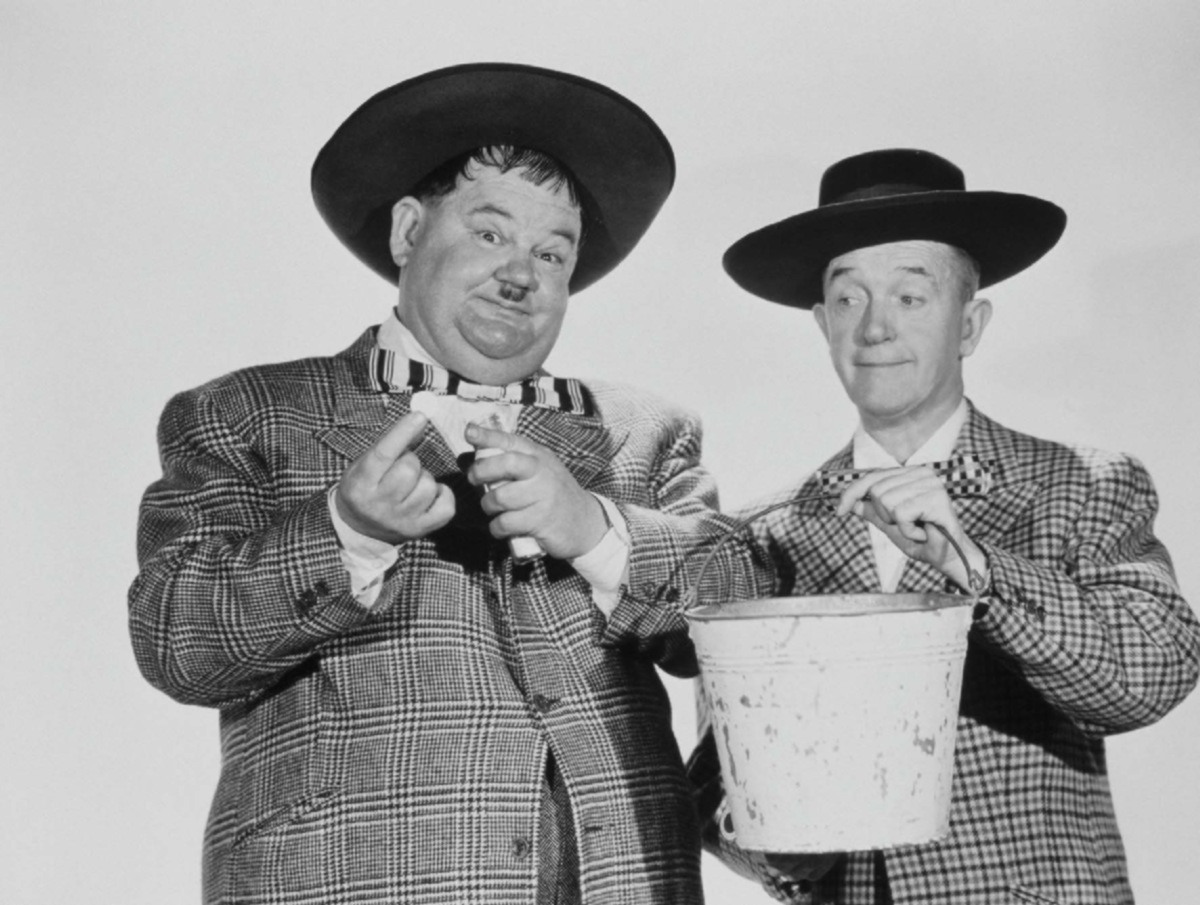
Stan Laurel and Oliver Hardy were two of the screen’s most beloved comics. Their Hal Roach comedy shorts contain some of the screen’s funniest moments, capitalizing on their unique comic personas. But by the 1940’s, Stan and Ollie had separated from Roach, and were plying their trade in features at 20th Century Fox. No longer in control of their material, the roles they played could’ve been filled by any pair of comic actors. That’s what makes later L&H efforts like JITTERBUGS so depressing.
Stan and Ollie are two itinerant musicians (“The Original Zoot Suit Band”) conned into aiding con artist Chester Wright into hawking “instant gas pills”. The scam gets uncovered in the small town of Midville, where Chester accidentally steals pretty young Susan’s purse. Since he’s smitten with her, he returns it, and discovers Susan is being swindled by some gangland goons. The con plays a con on these cons, aided by Stan…
On Saturday night, my friends the Snarkalecs and I turned over to the Lifetime Movie Network and we watched the premiere of the latest Fred Olen Ray thriller, A Mother’s Revenge!
Why Were We Watching It?
Well, the obvious answer is that the film was on the Lifetime Movie Network and it was directed by Fred Olen Ray! However, I have to admit that I nearly missed A Mother’s Revenge. Because it was the night before Mother’s Day, Lifetime was planning on broadcasting a film about a basketball player and his mom. I was definitely not looking forward to watching that but then my friend Trevor informed me that, on the Lifetime Movie Network, A Mother’s Revenge would be airing at the exact same time! YAY!
I then went on twitter and I discovered that not only was A Mother’s Revenge the latest film from Fred Olen Ray but that it also involved Gerald Webb, the producer and star of A House Is Not A Home and the favorite actor of snarkalecs everywhere! Once I discovered that all of my fellow snarkalecs would be taking part in the live tweet, there was no way that I wasn’t going to join them!
What Was It About?
It was about a mother and how she got revenge!
(That’s the one line version.)
More specifically, it’s the story of Jennifer (Jamie Luner), a pill-popping, recovering alcoholic who travels to Buffalo so that she can watch her daughter, Katey (Aubrey Whitby), graduate from college. From the minute that Jennifer arrives, things refuse to work out the way that she wants.
First off, Katey wants to spend some time with her friends as opposed to hanging out with her mother.
Secondly, Jennifer’s ex-husband (Jason-Shane Scott) has also shown up for the graduation and tension, both sexual and otherwise, is everywhere.
Third, Jennifer accidentally grabbed the wrong bag at the airport. Supercreepy Conner (Steven Brand) wants his bag back and he’s willing to both commit murder and kidnap Jennfer’s daughter to accomplish his goals.
And finally, Buffalo’s best detectives (played by Gerald Webb and Richard Lounello) suspect that Jennifer may be mentally unstable. Once a dead body shows up, Jennifer automatically becomes their main suspect.
All in all, Jennifer has quite a bit to be upset about…
What Worked?
I liked A Mother’s Revenge. Fred Olen Ray kept the action moving at a steady pace and I appreciated the way the film emphasized how one totally random mistake (like grabbing the wrong bag at the airport) can change someone’s life forever. It nicely conformed into my own point-of-view, which is that the universe is basically as chaotic and unpredictable as a Werner Herzog documentary.
Jamie Luner appears in a lot of these movies and she knows how to balance melodrama and pathos. She and Aubrey Whitby were totally believable as mother and daughter. Also believable was Steven Brand, who was properly creepy as the sadistic Conner.
A Mother’s Revenge was shot on location in Buffalo and it must be said that the city looked really good. The Mayor of Buffalo, Byron Brown, made a cameo appearance and who can blame him? A Mother’s Revenge made me want to visit his town.
Another great thing about A Mother’s Revenge is that a lot of the film’s crew and cast joined in with the live tweet and they were all very gracious, informative, and handled the occasional snarkiness with class and good humor. What I especially enjoyed was seeing some of the tweets from the various citizens of Buffalo who had been involved with the production. It was one of the most positive live tweets that I’ve ever taken part in and it generated the type of good vibes that you normally don’t associate with film twitter.
What Did Not Work?
It all worked!
“Oh my God! Just like me!” Moments
I’ve actually grabbed the worng bag before. I did not get blackmailed as a result but maybe I was just lucky. (However, I did get a week’s worth of new clothes, none of which really worked for me. I was sad. Hopefully, the Goodwill appreciated my donation.)
Lessons Learned
Be careful about grabbing the wrong bag. And, if you do grab the one bag, don’t let anyone find out.
That, in a nutshell, is my main thought when it comes to Captain America: Civil War. It’s a movie that we spent a year anticipating. It’s a movie that we were continually assured would be great. And it’s a movie that, unlike Batman v Superman, actually lived up to all the hype. It’s also a movie that has already been reviewed here on the Shattered Lens. Check out Arleigh’s review by clicking here and be sure to check out Gary’s review as well.
So, what’s really left for me to say about Captain America: Civil War? Beyond, of course, that it was freaking awesome.
Of course, it’s hard to talk about Captain America: Civil War without also talking about Batman v Superman. Both films start with the same basic idea: the heroic activities of super heroes has led to cities being destroyed and innocent people dying. In Batman v. Superman, Batman takes it open himself to avenge the destruction of Metropolis and expose Superman as being the biggest false God since Baal. In Civil War, the United Nations announces that, from now on, all super hero activity has to be cleared with them. In Batman v. Superman, Batman and Superman are manipulated into fighting each other. In Captain America: Civil War, Captain America and Iron Man are manipulated into fighting each other. In Batman v Superman, Jesse Eisenberg plays a neurotic villain. In Captain America: Civil War, Daniel Bruhl plays a neurotic villain. Batman v Superman features more heroes than just Batman and Superman. Civil War features more heroes than just Captain America and Iron Man. Batman v Superman ends with a promise of more films to come. So does Civil War. Both films are huge and expensive star-filled spectacles and both of them are a part of a larger cinematic mythology. They both even have roughly the same running time. Of course, Batman v Superman seems even longer while Civil War is over far too quickly.
And yet, Civil War is a thousand times better than Batman v Superman. For all of its sound and fury, Batman v Superman is ultimately an empty shell. I left the film feeling not at all emotionally moved but definitely deafened by all the explosions and the yelling and the ranting and the pounding score. As I left the theater, the world sounded like it was underwater. Batman v Superman opens with the world exploding and the explosion continues for another two and a half hours. Civil War, on the other hand, takes its time. After the initial battle scene (which features a nice cameo from the great Frank Grillo), Civil War slows down. It explores its characters and their relationships and their motivations. The first hour of Civil War may be dominated by people debating but its compelling to watch because, after 8 years, the MCU and the characters within feel as alive as the world outside the theater.
In Batman v Superman, Henry Cavill and Ben Affleck appeared to be acting in separate films. That’s not a problem in Civil War. When you watch Chris Evans and Robert Downey, Jr., you believe that they are friends and, when they fight, you don’t just thrill at the action. You mourn the end of a friendship. If Batman v Superman‘s battle ultimately felt hollow, the final battle in Civil War leaves you wincing in pain.
Which is not to say that Civil War is not a fun movie. It’s the most genuinely fun film that I’ve seen so far this year. There’s a joy to the best films of the MCU, a joy that — with the exception of Gal Gadot’s cameo — was totally lacking from the somber and self-important mess that Batman v Superman. I have never heard an audience applaud more than they did while watching Civil War. The film may have been dominated by Evans and Downey but every citi of thzene MCU got a chance to shine. Scarlett Johansson, Paul Rudd, Sebastian Stan, Anthony Mackie, Don Cheadle, Jeremy Renner, Chadwick Boseman, Paul Bettany, and Elizabeth Olsen all proved their worth to this new cinematic mythology. After years of using Halloween to pay homage to Scarlett Johansson, I may have to go as Wanda Maximoff this year. After seeing Hollywood waste her off-center and damaged talent in films like Godzilla, it was good to see Elizabeth Olsen playing Wanda as if she could have been a cousin to her character from Martha Marcy Mae Marlene.
The audience saved their loudest and most enthusiastic cheers for Tom Holland, who claimed the role of Spiderman as his own and thankfully freed AndrewGarfield to go back to being the intriguing actor that we all remember from The Social Network and Never Let Me Go.Holland doesn’t have a large role in Civil War but he’s still well-served by the film and the script makes great use of the character and Holland’s energetic performance. As opposed to the super hero cameos in Batman v Superman, Spiderman’s appearance didn’t just feel like merely a teaser for a future film. He belonged in the story.
Of course, Civil War is dominated by the battle between Iron Man and Captain America and it says something about how successful the MCU has been that the battle feels less like a marketing gimmick and more like the natural result of what happens when two differing worldviews come into conflict. When Tony Stark sides with the UN, it makes sense. Ever since the very first Iron Man, Tony has been motivated by both guilt over making weapons and a fear that he doesn’t deserve his success. Of course Tony would side with the UN. Doing so not only allows him to alleviate his guilt but it also frees him of responsibility for any future actions that the Avengers may take. It makes just as much sense that Captain America would feel the exact opposite. His name is Captain America, not Captain United Nations. When the UN was founded, he was still frozen in a block of ice.
(Also interesting to note: Civil War was the first MCU film that I could follow without once having to ask my boyfriend for any background info on who all the characters were. The MCU has become such a part of our culture that we all know the characters, regardless of whether we have ever read a Marvel comic or not.)
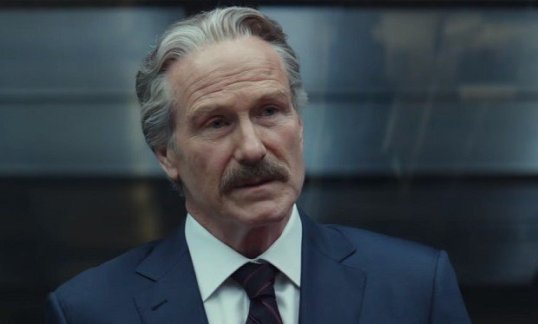
There is a nominal villain. Daniel Bruhl plays Zemo and his role is actually pretty small. That said, Zemo is definitely more interesting than the typical MCU villain (he’s certainly more memorable than Corey Stoll was in Ant-Man) and Bruhl does a good job playing him. (Watching Civil War, it was hard not to think about how much better SPECTRE would have been if Bruhl, as opposed to Christoph Waltz, had played Blofeld.) But, for me, the real villain of the film was the U.S. Secretary of State (played by William Hurt). The character represented everything that all good people hate about the power structure. William Hurt turned him into the epitome of unthinking and unreasonable authority.
After Civil War was released, Salon’s Amanda Marcotte (who, let’s just be honest, ceased to be interesting the minute that she sold out and briefly worked for John Edwards in 2007) complained that Captain America had become “a douchey Libertarian.” I would argue that 1) Captain America is definitely not douchey and 2) it’s his “libertarian” stance that makes him a hero. Captain America does not represent any institution or ideology and he doesn’t take orders from faceless bureaucrats. Captain America doesn’t need permission to do the right thing. As played by Chris Evans, there’s something undeniably poignant about Captain America attempting to cling onto his idealism and his belief in personal freedom in an increasingly complicated and totalitarian world. When told that he has a duty to become an anonymous, order-taking drone, Captain America says, “NO!”
(As a sidenote: If you want to see what the world expects Captain America to become, check out William Klein‘s Mr.Freedom.)
I know that some are claiming that Civil War is the best MCU film so far. I wouldn’t quite go that far. The film never quite reaches the lunatic heights of Guardians of the Galaxy nor does it match the subversive glee of Winter Soldierrevealing that smug old Robert Redford is an agent of HYDRA. But, no matter! Captain America: Civil War is pretty freaking great!
Here are the other MCU reviews that have appeared here on the Shattered Lens:





















 Once upon a time, Paramount Pictures released a movie about an Italian-American organized crime family.