The Fabulous Forties #28: Jack London (dir by Alfred Santell)


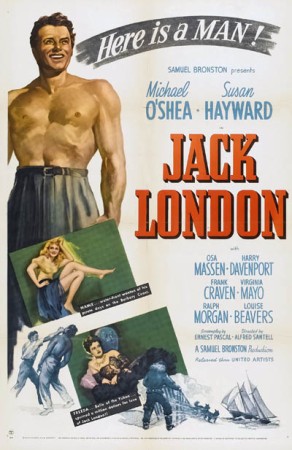
Jack-London-1943

The 28th Film in Mill Creek’s Fabulous Forties box set was a 1943 biopic about the writer, Jack London.  Not surprisingly, the title of the film was Jack London.

Now, I should start this review off by mentioning that I know very little about Jack London.  I don’t think that I have ever read any of his short stories or his novels.  I know that he wrote a novel called White Fang but that’s largely because there’s been so many different film versions of the book.  (Long before directing Zombi 2, even Lucio Fulci made a version of White Fang.)  Here’s what I do know about Jack London:

  1. He was a prominent writer at the turn of the century.
  2. He was reportedly an alcoholic.
  3. He was a Socialist who even ran for mayor of Oakland, California on the party’s ticket.
  4. He was an atheist.
  5. In 1916, depending on the source, he either committed suicide, died of alcohol poisoning, or simply passed away as the result of 40 years of hard living.

Of those 5 facts, 4 are totally ignored in Jack London.  The film does acknowledge that Jack London eventually became a prominent writer, even going so far as to open with stock footage of a U.S. warship being named after him.

As for his alcoholism, we never see London drunk.  Indeed, the film’s version of Jack London is so earnest that it’s hard to believe he’s ever had a drink in his life.

As for his Socialism, we are shown that London grew up in a poor family.  When, after serving at sea, he takes a writing class, he argues with a professor over London’s desire to write about the poor.  However, we never hear London express any specific ideology.  We certainly don’t see him running for mayor of Oakland.

As for his atheism — yeah right.  This film was made in 1943!  There’s no way that Jack London was going to be portrayed as talking about why he didn’t believe in God.

As for his death — well, Jack London ends with the writer very much alive.  There’s not even a title card informing us that London eventually died.

Instead, Jack London is much more concerned with Jack (played by Michael O’Shea) dealing with the Japanese.  Oh sure, we get some scenes of Jack London watching a shootout and breaking up a bar fight in Alaska.  And Susan Hayward shows up as Jack London’s always supportive wife.  (For that matter, Louise Beavers also shows up as Jack London’s always supportive house keeper.)

But, in the end, the majority of the film features Jack London as a war correspondent covering the turn of the 20th century war between Russia and Japan.  When he’s captured by the Japanese, he observes the harsh way they treat prisoners and is shocked when he witnesses several prisoners being ruthlessly executed.  When he talks to a Japanese commandant, he’s outraged as the commandant explains how the Empire of Japan is planning to take over the world.  When Jack finally gets back to America, he’s less concerned with writing White Fang and more concerned with warning the American people to remain vigilant…

Jack London is basically wartime propaganda disguised as a biopic.  The entire point of the film seems to be that if Jack London was still alive, he would want the men in the audience to enlist and the women to buy war bonds.  None of it is subtle and, beyond its value as a time capsule of how Americans viewed the Japanese in 1943, none of it is particularly interesting as well.

In the end, Jack London plays out like one of those earnest but dull educational films that tend to show up on PBS when no one’s watching.

The Fabulous Forties #27: Sundown (dir by Henry Hathaway)


40s

You may remember how, back in April, I started on a mission to review all 50 of the films included in Mill Creek’s Fabulous Forties box set.  I actually got off to a pretty good start and, by the end of the month, I was about halfway through.  Yay me!

However, then the month of May began.  And May turned out to be a very, very busy month.  As I sit here writing this, it’s been 27 days since I last posted a Fabulous Forties review.  That review was …. well, I can’t even remember what it was.  After I post this, I’ll click on this link to find out.

However, things have calmed down a bit and now I can go ahead and finish up the Fabulous Forties box set.  And that’s a good thing because, between me and you, I am more than ready to move on to the Nifty Fifties box set!

Anyway, without further ado, let’s consider the 27th film in Mill Creek’s Fabulous Forties, 1941’s Sundown!

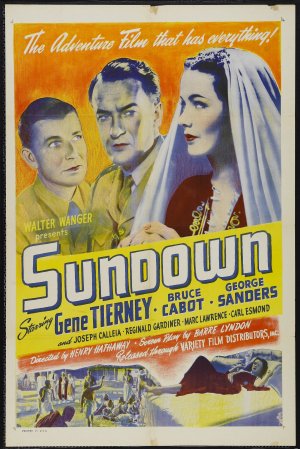
Poster_of_the_movie_Sundown

Sundown was released by United Artists in 1941.  It’s a propaganda film, telling the story of British soldiers in North Africa and their attempts to both maintain the peace among the natives and to keep the Axis powers from arming the local rebels.  Bruce Cabot is the experienced soldier who knows how things work in Africa.  George Sanders is the new commander who is a bit more by-the-book.  At first, you think that the film is going to be dominated by the rivalry between Sanders and Cabot but actually it’s not much of a rivalry.  For the most part, they get along just fine and I guess that’s to be expected considering that the film was made at a time when the emphasis was on everyone remaining unified against the Nazis.

Speaking of the Axis powers, they’re always in hovering in the shadows of the film but it’s rare that we actually see any enemy soldiers.  Perhaps this is because the film was made at a time when the United States was technically neutral.  Joseph Calleia plays a prisoner of war who has rejected fascism and instead just wants to sing opera and cook for Sanders and Cabot.  Calleia’s character is specifically identified as being an Italian.  If not for that (and the fact that the film was made in 1941), it would be just as easy to assume that Sanders and Cabot were fighting the French or maybe the Russians.

There’s an enemy agent in one of the tribes and it’s up to Sanders and Cabot to figure out who.  Helping them out is the local big game hunter, played by Harry Carey.  And, on top of that, there’s also a mysterious native woman played by Gene Tierney.  Gene Tierney is totally miscast but that adds to this film’s odd charm.

And, for modern viewers, it definitely is an odd charm.  I watched Sundown twice and I’m still not sure exactly what happened in the film.  Sundown is one of those films that doesn’t so much have a plot as it just has a lot of scenes that kind of tell a story, assuming that you have the patience and concentration to figure out how they all link together.  Between Cabot’s roguish smile, Sanders’s stiff upper lip performance, Calleia’s enjoyable overacting, and Gene Tierney’s otherworldly beauty, Sundown is unexpectedly dream-like.  The film even features a sudden sermon in which a clergyman (Sir Cedric Hardwicke) exhorts everyone to fight.  The clergyman is never seen again.

Sundown was a strange movie, one that I often found myself struggling to follow.  It was also apparently a box office bomb, though it did receive 3 Oscar nominations.  One of those nominations was for Charles Lang’s cinematography and it was definitely deserved.  Even the version I saw (which suffered from a typically poor Mill Creek transfer) was still impressive to look at.

It’s Better Than Last Stand: X-Men: Apocalypse (2016, directed by Bryan Singer)


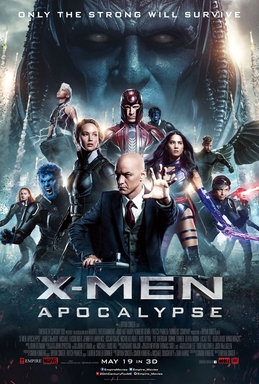
X-Men_-_ApocalypseIt is easy to forget what a big deal the first X-Men movie was in 2000.  At a time when Joel Schumacher was still the industry’s go-to director for super hero films, X-Men announced that films based on comic books did not have to be campy, silly, stupid, or feature Alicia Silverstone.  When X-Men was first released, critics and audiences were surprised to see a comic book film that was intelligent, well-acted, and actually about something.

The only people who were not shocked were those of us who grew up reading the X-Men books.  We already knew that the X-Men was about more than just heroes with super powers and flashy costumes.  We knew that the battles within the pages of the X-books were always meant to serve as a metaphor for racism and real-world prejudice and, since many of us felt like outcasts and mutants ourselves, we related to the characters.  We already knew that Magneto was often a sympathetic villain while Prof. X was not always a likable hero.  We knew that almost every battle that the X-Men fought came down to the question of whether or not different types of people could peacefully co-exist.  Unlike the critics, we were not shocked by X-Men‘s subtext.  Instead, we were just happy that Bryan Singer did not fuck things up.

All of the comic books films that have followed have owed a debt to critical and commercial success the first X-Men movie.  Without that success, there would probably have never been a Dark Knight trilogy or even an MCU.

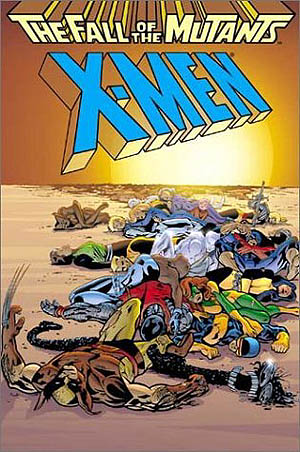
FallofmutantsThe success of X-Men has also led to a 16 year-old franchise of movies about mutants and their struggle to live in a world that fears them.  X-Men: Apocalypse is the 9th installment in that franchise and it is based on the Fall of the Mutants storyline, which ran through several Marvel comics in 1988.

Continuing the pattern set by X-Men: First Class and X-Men: Days of Future Past, Apocalypse takes place in the past, back when Charles Xavier was still James McAvoy and Magneto was still Michael Fassbender.  (Unlike Days of Future Past, neither Patrick Strewart nor Ian McKellan makes an appearance.)  The year is 1983.  Ronald Reagan is President.  The Cold War still rages.  The music is better than it is today.  Xavier is running his school for gifted mutants youngsters.  Magneto is living, under an assumed name, in Poland.  Magneto is married and has a young daughter and as soon as I saw them, I knew they were going to die.  Magneto’s family never survives.

In Egypt, an ancient and powerful mutant named En Sabah Nur (Oscar Isaac) is awakened after being entombed for centuries.  Readers of the comic books will immediately recognize En Sabah Nur as Apocalypse.  Planning to destroy the world so that he can rebuild it in his own image, Apocalypse recruits his four horseman — Storm (Alexandra Shipp), Angel (Ben Hardy), Psylocke (Olivia Munn), and Magneto.  Apocalypse also wants to recruit Xavier to his side but Prof. X still believes that humans and mutants must learn to co-exist.

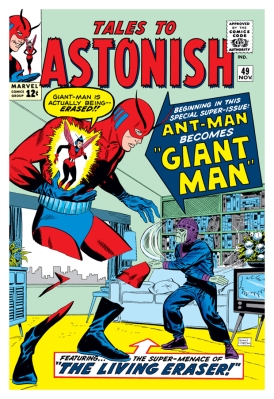
livingeraser1What’s interesting is that, even though Fassbender and McAvoy share a few scenes, this is the first X-Men film to not feature any sort of debate between Xavier and Magneto.  Magneto, one of the greatest comic book villains of all time, is actually a little boring here and, without those debates, Apocalypse lacks the subtext that distinguished the best of the previous X-Men films.  The emphasis is less on what it means to be an outsider and more on defeating Apocalypse.  Unfortunately, Apocalypse is a great character in the comic books but he does not translate well into film.  Unlike Magneto, who has several good and justifiable reasons for not trusting humanity, the film version of Apocalypse is portrayed as being pure evil and little else.  His plan to destroy the world never makes much sense and he is almost as bland as Dr. Doom in the latest Fantastic Four reboot.  Apocalypse could be any villain from any comic book movie that has been released over the past 16 years.  He could just as easily be the Living Eraser.

Apocalypse is also an origin story, showing how the modern incarnation of the X-Men first came to be.  We meet young versions of Scott Summers, Jean Grey, and Nightcrawler (played by Tye Sheridan, Sophie Turner, and Kodi Smit-McPhee) and Wolverine (Hugh Jackman) makes a brief appearance that feels like it was mostly included to set up the character’s third stand-alone film.  Jennifer Lawrence, Nicholas Hoult, and Evan Peters also return in the roles of Mystique, the Beast, and Quicksilver.  Peters is featured in the movie’s coolest scene, though that scene is basically just a redo of Days of Future Past‘s coolest scene.

hqyqxvfnbce8jfpwptqn

(There’s also a blink-or-you’ll-miss-it cameo from Dazzler, which I guess means that Marvel’s disco queen will eventually be appearing on movie screens.)

X-Men: Apocalypse is not as good as either First Class or Days of Future Past but it’s still better than The Last Stand.  (Since Apocalypse takes place in 1983, Scott and Jean go to see Return of the Jedi and talk about how the third film of any franchise always sucks.)  It’s entertaining but, without an interesting villain or any sort of examination of what it really means to be an outcast,  Apocalypse is also forgettable in a way that X2 and Days of Future Past never were.  As a lifelong fan of the X-Men, I could not help but be disappointed.

Plus, this movie needed more Deadpool! (Note: Deadpool is not in X-Men: Apocalypse.)

Plus, this movie needed more Deadpool! (Note: Deadpool is not in X-Men: Apocalypse.)

One thing that especially bothered me is that Days of Future Past ended with Xavier promising to explain to Wolverine why he, Scott, and Jean were all still alive despite having been killed in The Last Stand.  If you were hoping Apocalypse would clear that up, don’t hold your breath.  I guess that question will remain unanswered until the 10th film.

Speaking of which, First Class was set in the 1960s and Days of Future Past largely took place in the 70s.  Apocalypse is an 80s movie so the next installment should be set in the early 90s.  Will Scott be listening to Nirvana or will he be playing air guitar to November Rain?  I guess we’ll have to wait to find out!

x-men-apocalypse1

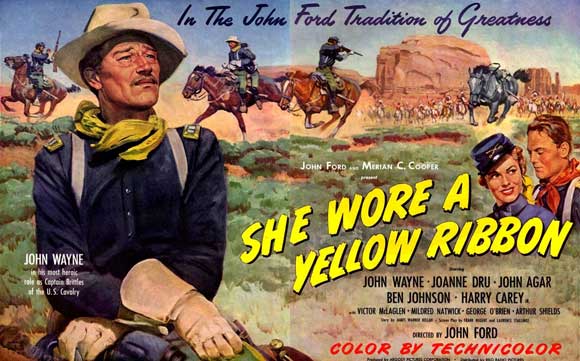
Happy Birthday John Wayne: SHE WORE A YELLOW RIBBON (RKO 1949)


gary loggins's avatarcracked rear viewer

shew1

My all-time favorite actor was born Marion Mitchell Morrison on May 26, 1907 in Winterset, Iowa. But John Wayne the movie star was born in 1930 when, after years of bit parts, he landed the lead role in Raoul Walsh’s THE BIG TRAIL. The movie flopped at the box office, but it got Wayne noticed. After scuffling along in low-budget, juvenile B-Westerns for most of the 30’s, Wayne was cast as The Ringo Kid in John Ford’s blockbuster STAGECOACH , and his career took off like a wild stallion.

“The Duke” (a nickname he picked up as a kid) was an A-Lister now, the biggest star at Republic Pictures. Wayne and Ford continued their film collaborations throughout the 40’s. At the end of the decade RKO released the second of the Wayne/Ford “Cavalry Trilogy”, SHE WORE A YELLOW RIBBON. The film was a smash hit, a rousing adventure bolstered by Wayne’s portrayal of…

View original post 898 more words

Jon Watts Is Famous Now So, Of Course, Here’s The Trailer For Clown!


Director Jon Watts is having quite a career right now!  Last year, Cop Car was released to considerable acclaim and, as a result, he was hired to direct the upcoming MCU blockbuster Spider-Man: Homecoming!

Here in America, Cop Car was pretty much sold as being Watts’s first film.  However, that wasn’t really the case.  Before Watts directed Cop Car, he made a movie called Clown.  Clown was executive produced by Eli Roth and, though it did play in Europe in 2014, it was never released in the U.S.

Until now!

Now that Watts is about the become the next big thing, Dimension Films is going to give Clown a limited release in June.

Apparently, Clown is about a man who dresses up like a clown for his son’s birthday party and then discovers that he can’t take off the big red nose.  The clown makeup is apparently demonic and it ends up possessing him.

And apparently, it’s not a comedy.

Anyway, here’s the trailer!  Again, while watching this preview, consider that Clown is apparently not supposed to be a comedy…

Insomnia File No. 15: George Wallace (dir by John Frankenheimer)


What’s an Insomnia File? You know how some times you just can’t get any sleep and, at about three in the morning, you’ll find yourself watching whatever you can find on cable? This feature is all about those insomnia-inspired discoveries!

George Wallace

If, after watching Promise last night, you discovered that you were still suffering from insomnia, you could have watched the very next film that premiered on TCM.  That film was the 1997 biopic, George Wallace.

Like Promise, George Wallace was originally made for television.  Also, much like Promise, George Wallace is a character study of a conflicted man who makes many people uncomfortable and it’s also well-acted by a cast of veteran performers.  That, however, is where the similarities end.  Whereas Promise was ultimately a rather low-key and human drama, George Wallace is an epic.  Clocking in at nearly 3 hours and telling a story that spans decades, George Wallace attempts to use one man’s life story as a way to tell the entire story of the civil rights movement.

That’s a tremendously ambitious undertaking, especially for a film that had to conform to the demands of 1990s television.  Therefore, it’s probably not surprising that the movie, as a whole, is uneven.  It’s not a bad movie but, at the same time, it doesn’t quite work.

First off, we need to talk about who the historical George Wallace was.

(Here’s where I get to show off my amazing history nerd powers.  Yay!)

George Wallace served a total of four terms as governor of Alabama.  A protegé of a populist known as “Big Jim” Folsom, Wallace first ran for governor in 1958.  He campaigned as a moderate who supported integration and, as a result, he was defeated by the KKK’s endorsed candidate, John Patterson.  (Oddly enough, a fictionalized version of Patterson was the hero of the classic and racially progressive 1955 film, The Phenix City Story.)  When Wallace ran again in 1962, he ran as an outspoken segregationist and defeated his former mentor, Jim Folsom.  Infamously, Wallace is the governor who stood in the schoolhouse door and announced that Alabama would never accept integration.  Unable to succeed himself, Wallace arranged for his wife, Lurleen, to be elected as governor.  Lurleen subsequently died in office, succumbing to cancer while Wallace was running for President as the candidate of the American Independent Party.  (As of this writing, Wallace is the last third party presidential candidate to carry any states.)  Reelected governor in 1970, Wallace married Folsom’s niece and made another presidential run.  However, after a string of primary victories, that campaign was cut short when Wallace was shot and crippled by Arthur Bremer.  (Bremer would serve as the inspiration for Robert De Niro’s Travis Bickle in Taxi Driver.)  Confined to a wheelchair, Wallace served as governor until 1978 and, in 1976, ran for President one final time.  After being out of office for four years, he was elected Governor for one final term in 1982.  Late in life (and, it should be pointed out, long after integration had been generally accepted as the law of the land), Wallace renounced his segregationist past and publicly apologized for standing in the schoolhouse door.  During his final campaign for governor, he won a majority of the black vote and he proceeded to appoint more blacks to state positions than any governor before him.

George Wallace lived a long, dramatic, and interesting life and he’s still a very controversial figure.  Who was the real George Wallace?  Was he a political opportunist who used racism to further his career?  Was he truly a racist who saw the error of his ways and repented or did he only pretend to renounce his former beliefs once they were no longer popular?  And, even if Wallace was sincere in his regret, did he deserve to be forgiven or should he always be remembered as the villainous caricature that Tim Roth portrayed in Selma?  If we forgive or make excuses for the actions of a George Wallace, do we run the risk of diminishing the success and importance of the civil rights movement?

And I, honestly, have no answers to those questions.  Unfortunately, neither does George Wallace.  But before we get into that, let’s consider what does work about this film.

George Wallace opens in 1972 with Wallace campaigning in Maryland.  Wallace is played by Gary Sinise and his second wife, Cornelia, is played by a very young Angelina Jolie.  Sinise and Jolie both give brilliant performances, perhaps the best of their respective careers.  Sinise plays Wallace as a calculating and charismatic politician who is also a very angry man.  Throughout every second of his performance, we are aware of Wallace’s resentment that his political success in Alabama has potentially made him unelectable in the rest of the country.  Watching Sinise as Wallace, you see a man who believes in himself but doesn’t necessarily like the person that he’s become.  Meanwhile, Jolie plays Cornelia like a Southern Lady MacBeth and watching her, I remembered how, at one time, Angelina Jolie really did seem like a force of nature.  The Angelina Jolie of George Wallace is the wild and uninhibited Jolie of the past (the one who once said, “You’re in bed, you’ve got a knife, shit happens.”), as opposed to the safe and conventional Jolie of the present, the one who is currently directing rather stodgy movies like Unbroken and By The Sea.

After Wallace is shot, the film goes into flashback mode.  We watch as Wallace goes from being a liberal judge to being the segregationist governor of Alabama.  Mare Winningham plays Lurleen Wallace while Joe Don Baker plays Big Jim Folsom.  They all do a pretty good job but the flashback structure is so conventional (and so typical of a made-for-tv biopic) that it makes the film a bit less interesting.

There’s also a character named Archie.  Played by Clarence Williams III, Archie is literally the only major black character in the entire film.  He is portrayed as being a former convict who has been hired to serve as Wallace’s valet.  While Wallace plots to thwart the civil rights movement, Archie stands in the background glowering.  At one point, he’s even tempted to kill Wallace.  However, after Wallace is shot, Archie helps to take care of him.  The film suggests that being shot and subsequently cared for by Archie is what led to Wallace renouncing his racist views.  (The film also suggests that Wallace was never that much of a racist to begin with and, instead, was just so seduced by power that he would say whatever he had to say to win an election in Alabama.)

At the end of the film, we’re informed that almost everyone in the film was real but that Archie was fictional.  The problem, of course, is that the film is suggesting that the fictional Archie is responsible for the real-life Wallace both rejecting racism and apologizing for the all-too real consequences of racism.  The film ends with the realization that the filmmakers were so convinced that audiences would not be able to accept an ambiguous portrait of a public figure that they created a fictional character so that Wallace could have a moment of redemption.

(It also doesn’t help that a film about civil rights only features one major black character and that character is a fictional valet who doesn’t get to say much.)

In the end, the film doesn’t seem to be certain what it’s trying to say about Wallace and the meaning of his dramatic life.  That said, I enjoyed watching George Wallace because of the acting and because, as a history nerd, I always enjoy seeing historical figures portrayed on-screen, even if the filmmakers don’t seem to be quite sure what they’re tying to say about them.

George Wallace was directed by John Frankenheimer, a good director who, it appears, was constrained by the demands of 1990s television.  If George Wallace were made today, it would probably air on HBO and would probably be allowed to take more of a firm stand one way or the other on Wallace’s character.  That said, it would probably also be directed by Jay Roach who, to put it lightly, is no John Frankenheimer.

Anyway, George Wallace doesn’t quite work but it’s definitely interesting.  Watch it for Gary and Angelina!

Previous Insomnia Files:

  1. Story of Mankind
  2. Stag
  3. Love Is A Gun
  4. Nina Takes A Lover
  5. Black Ice
  6. Frogs For Snakes
  7. Fair Game
  8. From The Hip
  9. Born Killers
  10. Eye For An Eye
  11. Summer Catch
  12. Beyond the Law
  13. Spring Broke
  14. Promise

Insomnia File No. 14: Promise (dir by Glenn Jordan)


What’s an Insomnia File? You know how some times you just can’t get any sleep and, at about three in the morning, you’ll find yourself watching whatever you can find on cable? This feature is all about those insomnia-inspired discoveries!

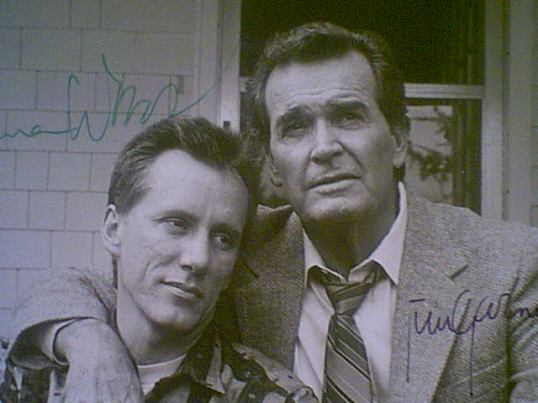
woods-james-jim-garner-1986-photo-promises-signed-autograph-with-byline-21

If you were awake at midnight last night and if you were watching TCM, you would have seen a 1986 film called Promise.

Promise stars James Garner as Bob Beuhler, who is one of those deceptively confident men who seems to have his entire life together.  He’s made a nice little life for himself, buying and selling houses and he lives in a small town where everyone appears to know and respect him.  If Promise were made today, Bob is the type of person who could probably have his own A&E reality show.

But then Bob’s mother dies and we learn of a promise that Bob made forty years ago.  It turns out that Bob has a younger brother, named D.J. (James Woods).  D.J. suffers from schizophrenia and he’s spent all of his life living with his mother.  It quickly becomes apparent that the main driving force behind Bob’s success has been the need to prove that he’s nothing like D.J.  When he doesn’t take his medication, D.J. is unpredictable and suffers from violent mood swings.  Bob loves his brother but he’s also scared of him.

However, Bob made a promise and he’s going to try to honor it.

It turns out to be even more difficult than he expected.  Sometimes, D.J. is calm and sweetly shy.  Other times, he becomes violent.  The rest of the town starts to gossip about Bob’s “crazy” brother.  After one fight, Bob discovers that D.J. has become catatonic.  When Bob calls an ambulance, everyone in the neighborhood lines up on Bob’s lawn to watch as D.J. is taken away.

Even though D.J. is eventually released from the hospital and returns home, Bob still is unsure of whether or not he can properly care for his brother.  When they go on a trip to a cabin that they often visited as children, Bob is surprised to see how “normal” D.J. is acting.  But how long will it last?

When I looked up Promise on the imdb, I was not surprised to discover that it was originally made for television.  The fact that nobody in the film ever curses was a dead giveaway and the script occasionally threatens to turn into a PSA.  But, with all that in mind, Promise is still a wonderfully effective and rather heartbreaking little movie.  James Woods has the more showy role and does a great job with it’s the far more low-key James Garner who keeps the film grounded.  Watching a film like Promise, you see that Garner was really a great actor.

Promise is a sad film but it’s definitely one worth watching.

Previous Insomnia Files:

  1. Story of Mankind
  2. Stag
  3. Love Is A Gun
  4. Nina Takes A Lover
  5. Black Ice
  6. Frogs For Snakes
  7. Fair Game
  8. From The Hip
  9. Born Killers
  10. Eye For An Eye
  11. Summer Catch
  12. Beyond the Law
  13. Spring Broke

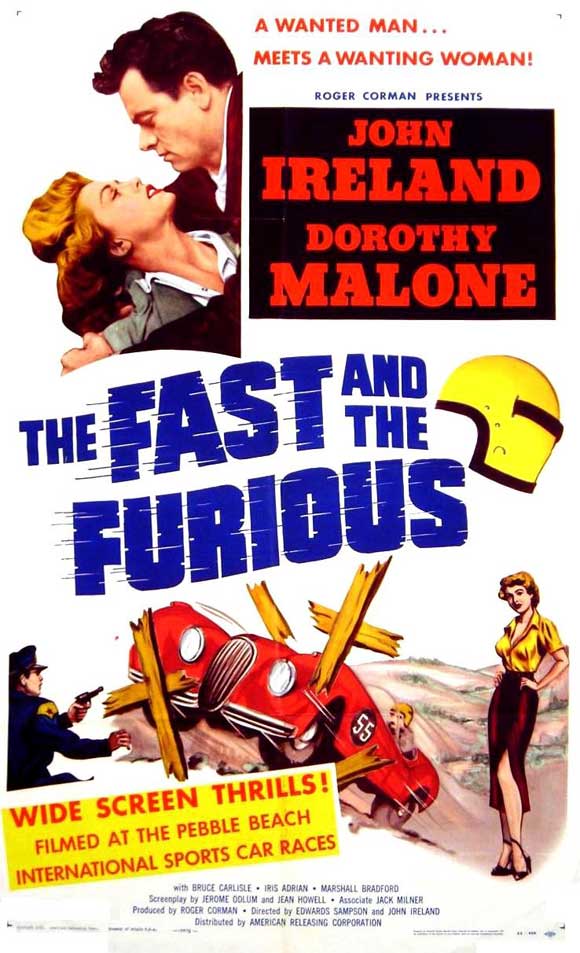
A Fast Look at THE FAST AND THE FURIOUS (AIP 1955)


gary loggins's avatarcracked rear viewer

the-fast-and-the-furious-movie-poster-1955-1020452824

I’ve never seen any of those FAST AND FURIOUS movies with Paul Weller, Vin Diesel, and The Rock (yeah I know, Dwayne Johnson, but he’ll always be The Rock to me). Nope, not even one. I just never had much interest in them. I’d heard of the 1955 THE FAST AND THE FURIOUS, an early Roger Corman production, but never watched it either, until now. Seems I wasn’t missing anything.

THE FAST AND THE FURIOUS is Corman’s second film as producer, and first release for American International Pictures, under the moniker American Releasing Corporation. It’s an inauspicious debut for the company, to put it mildly. The story concerns escaped con Frank Webster, who kidnaps sports car racer Connie Adair and her white Jaguar (which is a nice car, by the way). They bicker with some tough-talking dialogue, as Frank plans on crossing the border to Mexico by driving the Jag in a…

View original post 241 more words

What Lisa Watched Last Night #151: Marriage of Lies (dir by Danny J. Boyle)


Last night, after I got home from my aborted attempt to celebrate Memorial Day a week early (read the previous post for details), I watched the latest Lifetime premiere, Marriage of Lies!

marriageoflies_300x290

Why Was I Watching It?

Well, the obvious answer is that not only was it on Lifetime but it also had one of the most stereotypically Lifetime titles ever.

Marriage of Lies!

It just screams Lifetime melodrama, doesn’t it?

There I was, still feeling embarrassed over getting the date of Memorial Day wrong, and what do I see listed in guide?  Marriage of Lies!  As soon as I saw that title, I knew everything was going to be okay.

What Was It About?

Call it Gone Guy.

One morning, Rachel Wilson (April Browlby) wakes up to discover that her husband, popular teacher Tye Wilson (Brody Hutzler), is gone.  Because their marriage is already troubled because of a past infidelity on Tye’s part, Rachel thinks that Tye has just temporarily gone off on his own.  She doesn’t report him missing for two days and, after she does, she suddenly finds that she’s the number one suspect.

Everyone thinks that Rachel murdered her missing husband, including a world-weary detective named Gus (played by Corin Nemec).  At first, it seems like Rachel’s only ally is her best friend (Virginia Williams) but soon, Rachel starts to doubt even her.

With reporters camping out in her front yard and the entire world convinced of her guilt, Rachel starts to wonder if Tye’s actually been abducted and/or murdered or if maybe there’s something even stranger going on…

What Worked?

Marriage of Lies was fairly well-done.  The actors all did a good job.  Among those of us who were live-tweeting the film on twitter, Detective Roper (played by Zachary Garred) quickly emerged as our favorite character.  Roper was Gus’s partner.  Whereas Gus was cynical and beaten-down by life, Roper seemed to actually be having fun with his job.  Of course, he was also pretty quick to assume that Rachel was guilty but that was just Roper being Roper!

The ending, with its suggestion that the truth means nothing and that sensation-seeking observers have no real interest in reality, was properly cynical and nicely done.

What Did Not Work?

The movie played a bit too slowly and the pacing definitely felt a bit off.  (Of course, it’s difficult to judge these things when the action has to stop every 17 minutes or so for a commercial break.)

After all of the build up, I was hoping that the eventual solution to Tye’s disappearance would turn out to be totally fucked up and weird but instead, it pretty much played out the way that I predicted it would after the first five minutes of the film.

“Oh my God!  Just like me!” Moments

I have to admit that I related to the character of Kinna (Madison Iseman), who was one of Mr. Wilson’s students and who had a huge crush on him.  I felt that way about some of my teachers when I was in high school.  Also, much like Kinna, I would probably be totally useless as a member of a search party.

Lessons Learned

It’s easier to vanish than you might think.

Scenes That I Love: The Classroom Scene From Dario Argento’s Inferno


So, as I mentioned earlier, I was in the mood for some late night horror and I decided to rewatch Dario Argento’s Three Mothers trilogy.  I started watching Suspiria at midnight and, after that, I moved on to Argento’s 1980 follow-up, Inferno.

Having just finished watching Inferno, I now realize that it’s almost time for me to start getting ready for my day, which means that I may have to hold off on watching the third film in the trilogy, The Mother of Tears.  That’s really quite frustrating because I think I may be the only person in the world who thinks that Mother of Tears is actually a good film.

Oh well!  Such is life, right?

But before I hop in the shower and get dressed and all that good stuff, I did want to share a scene that I love from Inferno.

Of course, the most famous scene from Inferno is the scene that opens the film, Irene Miracle’s underwater swim.  In fact, it’s such a famous scene that I have already shared it.

So, instead, I’ll share a scene that comes shortly after Irene’s famous swim.  In the scene below, Irene’s brother, a music student who is played by a somewhat forgettable actor named Leigh McCloskey (reportedly, Argento wanted to cast a young James Woods in the role and he would have been awesome, too), is sitting in class and attempting to read a letter from his troubled sister.

And that’s when he finds himself being subtly menaced by the Mother of Tears.

The Mother of Tears is played by the beautiful Ania Pieroni, who lovers of Italian horror will immediately recognize as both the mysterious housekeeper in Lucio Fulci’s House By The Cemetery and the doomed shoplifter from Argento’s Tenebrae.

To me, this scene is Argento at his best.  Not much happens in the scene.  McCloskey attempts to read a letter and finds himself unnerved by Pieroni’s intense stare.  And yet, it’s a scene that’s full of menace and atmosphere.  It’s a scene that leaves the viewer with no doubt about the power of the Three Mothers.

Watch the scene below.  And then, if you haven’t, be sure to watch Inferno because it’s a wonderful and underrated horror film, one that I would argue is even better than Suspiria.  And, while you’re watching the scene and considering the wonders of Italian horror cinema, I’ll be busy getting ready for my Friday!

(Unless, of course, you’re reading this on a day other than today and at a time other than 4:35 am.)

Enjoy!