Hi there and welcome to October! This is our favorite time of the year here at the Shattered Lens because October is horror month. For the past three years, we have celebrated every October by reviewing and showing some of our favorite horror movies, shows, books, and music. That’s a tradition that I’m looking forward to helping to continue this year.
Let’s start things off by watching the 1953 sci-fi “classic,” Robot Monster!
Yes, Robot Monster is the movie where a gorilla wearing a diving helmet terrorizes that last surviving humans on Earth. It also features some oddly placed dinosaur stock footage. But, that being said … Robot Monster is a lot of fun. There are few movies that have truly earned the “so bad that it’s good” label and Robot Monster is one of them.
Add to that, watching Robot Monster in October is kinda of a tradition in these parts!
Welcome to The Most Wonderful Time of the Year!!! It’s October- Horror Month!!! I will be reviewing many great and terrible films for your reading pleasure. My advice to you Gentle Readers: decorate your house, turn the lights down low, read my posts, like them, retweet them, tell your friends and family about them BECAUSE if you don’t demons will get you! Here we go!!!
I am watching a man have extreme explosive diarrhea and cough up furballs, when I think, some poor asshole paid to see this.
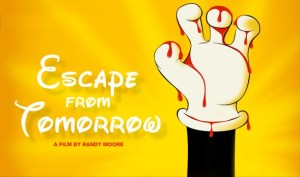
Escape From Tomorrow is a quasi horror film about a man on vacation with his family to Disneyworld and things go absurdly weird and boring. It’s black and white, which gives it a good eerie feel. It is, in fact, filmed entirely at Disney World and Disney Land. My expectations were raised- too bad for me.
The dad is fired in the first scene over the phone right before he takes his family to tour Disney World. Upon entering the monorail to the park, the dad ogles and passively stalks two girls. One of the ladies he ogles is Annet Mahendru – “Nina” – from The Americans and the other is a REALLY young lady. He ogles them both on the monorail, in line, and pretty much all over the park. His stalking is the only part of the movie that is moderately creepy and scary. At so many points in the show I thought, Dude, your children are right there! Gross!
They arrive at the most wonderful place on Earth to find people coughing. The dad goes on rides and hallucinates. You expect it to get scary and it fizzles out like a damp sparkler. Eventually the mom and dad go to different parts of the park and the Dad is left to stalk the two girls again, but he gets distracted and blacks out and wakes having sex with a woman who looks a lot like a sexy version of the wicked witch in Snow White – It’s weird. The story gets rapidly off the rails and you have to grab at plot points like wet tissue paper. There’s a “Cat Flu, a ridiculous scene inside of Epcot, and redneck in scooter; it’s truly nonsensical and dull. SNORE.
This is why the film fails to do anything but disappoint: he had done it- Randy Moore got into Disney and did pure guerilla filmmaking. However, he forgot to have one thing: a story. OOPS!!! Maybe he left the story at Universal Studios?! I hear the shark can really startle you on the tram! From written accounts, Moore was so worried that he would be sued, he edited the film in South Korea. What a waste of cash! Disney realized quickly what I did- the film sucks and isn’t worth the paper to file suit in Court.
There was ONE and ONLY one part of the film that was compelling. The dad had a drinking problem. He does drink …. A LOT, but the movie strays from that interesting plot point to go off on some boring surreal tangent. If the movie got away from the surreal bullshit and focused on the dad ruining his family and himself at Disney because of alcoholism, it would have been the most moving story about drinking since Leaving Las Vegas. Moore, however, squandered that great opportunity and will either learn from this mistake or go into Real Estate.
He did manage to film in Disney without anyone giving a shit, which is novel and a bit impressive. Also, I have to be stingy with my “As” and “Fs”. Therefore, I give
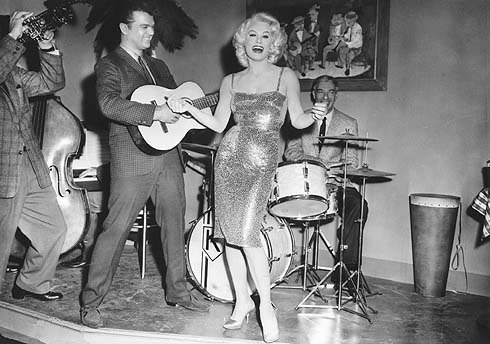
Let’s get it out of the way right now- SEX KITTENS GO TO COLLEGE is bad. Real bad. Like mind-numbingly bad. Despite the presence of sex kittens Mamie Van Doren and Tuesday Weld, this movie is a smelly litter box in desperate need of cleaning. It’s an Albert Zugsmith extravaganza, so you know right off the bat it’s gonna be a stinker. Zugsmith had once been a producer at Universal, overseeing prestige films like WRITTEN ON THE WIND and TOUCH OF EVIL. But when he went into independent productions, Zugsmith chose to go the low-budget exploitation route and even though he managed to attract some well-known names, his little epics usually stunk to high heaven.
The movie revolves around the talents of Mamie Van Doren, a beautiful creature whose best assets weren’t her acting. She plays Dr. Mathilda West, a genius hired to take over the science department at Collins College. Thinko, a supercomputer/robot type thing…
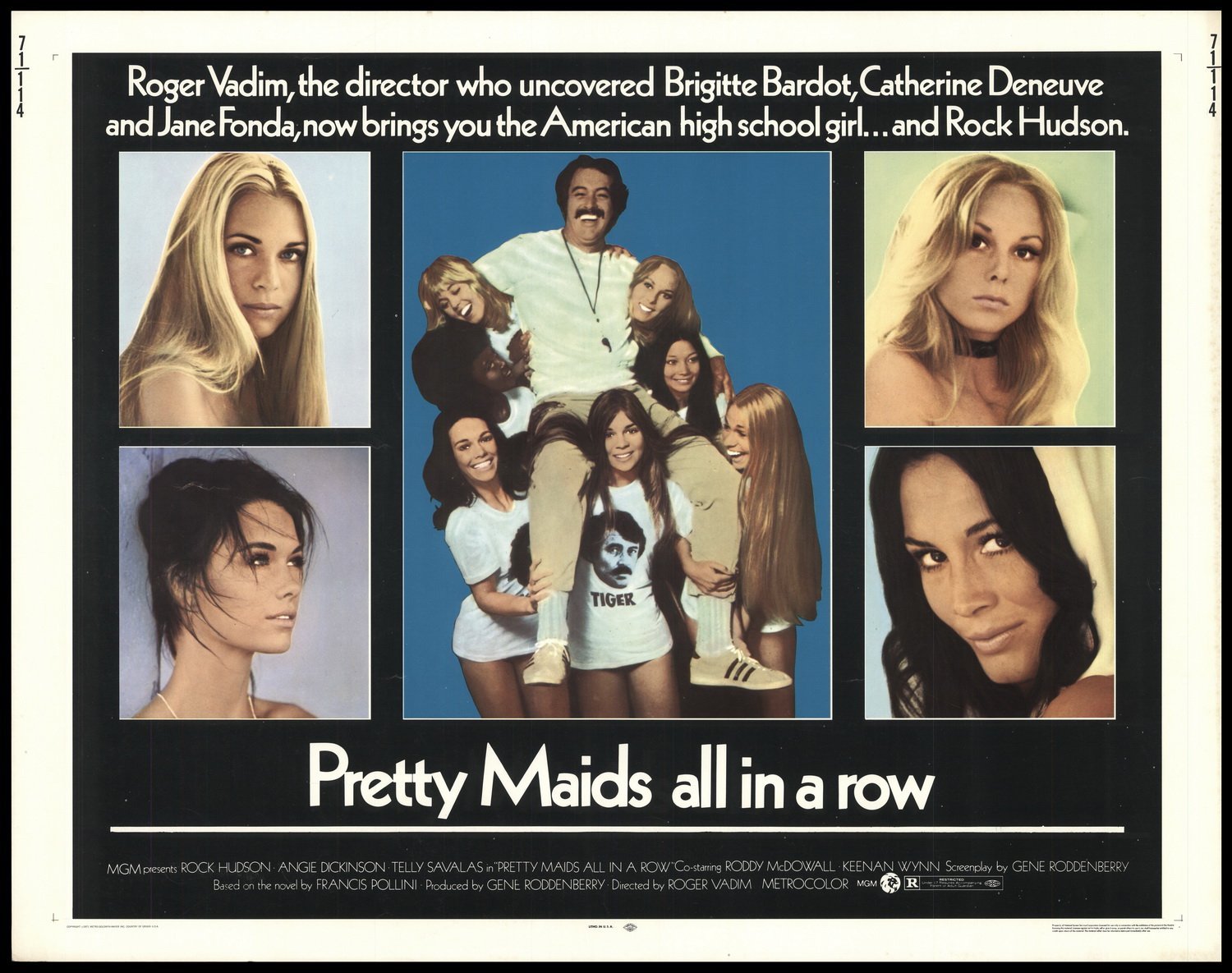
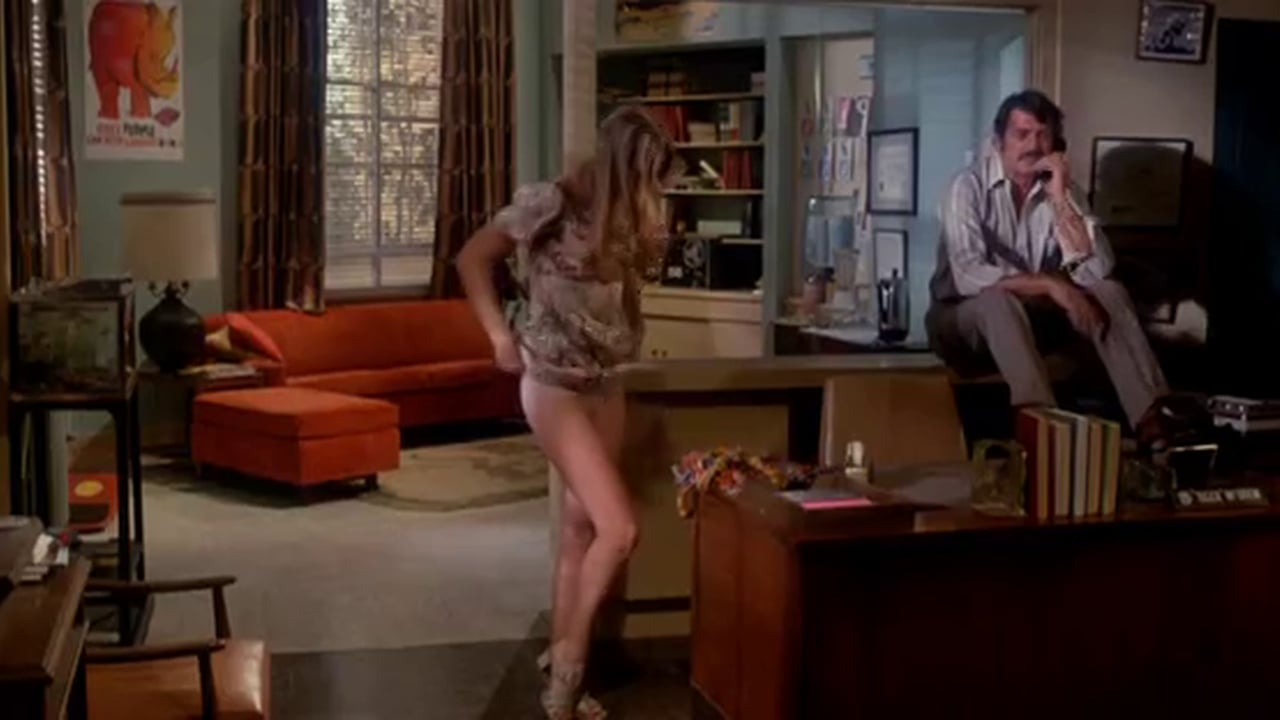
Gene Roddenberry’s post-STAR TREK career had pretty much gone down the tubes. The sci-fi series had been a money loser, and Roddenberry wasn’t getting many offers. Not wanting to be pigeonholed in the science fiction ghetto, he produced and wrote the screenplay for PRETTY MAIDS ALL IN A ROW, a black comedy skewering the sexual revolution, with French New Wave director Roger Vadim making his first American movie. The result was an uneven yet entertaining film that would never get the green light today with its theme of horny teachers having sex with horny high school students!
All-American hunk Rock Hudson was in the middle of a career crisis himself. After spending years as Doris Day’s paramour in a series of fluffy comedies, his box office clout was at an all-time low. Taking the role of Tiger McGrew, the guidance counselor/football coach whose dalliances with the cheerleading squad leads to murder…
Leon Alastray (Anthony Quinn) is an outlaw in 18th century Mexico who is given sanctuary and hidden from the Spanish authorities by a kindly priest, Father Joseph (Sam Jaffe). In return, Leon agrees to escort the priest to a peasant village that is under siege from the Yaqui Indians. During the journey, Joseph dies and when Leon arrives at the village, he is mistaken for the priest. Even though Leon’s an atheist and a womanizer, he pretends to be a man of God and tries to broker a peace with the Yaqui’s bloodthirsty leader, Golden Lance (Jaime Fernandez). Standing in the way is Teclo (Charles Bronson), a mestizo rebel who wants to keep the Spanish and the Yaqui at war.
Because it features a score by Ennio Morricone and co-stars Charles Bronson, Guns For San Sebastian is often mistakenly referred to as being a spaghetti western. Instead, it was a big budget American-French co-production that was filmed, on location, in Mexico. (The majority of spaghettis were filmed in Spain.) While revolution in Mexico was a popular backdrop for many spaghetti westerns, none of them were as sympathetic to the church or the government as Guns for San Sebastian. If Guns For San Sebastian were a true spaghetti western, Teclo would be the hero.
Guns For San Sebastian is an above average western that starts out slow but gets better as it approaches the exciting final battle between the villagers and Yaqui. Morricone provides another great and rousing score but the main reason to watch Guns For San Sebastian is to see Anthony Quinn and Charles Bronson, two legendary tough guys, acting opposite each other and competing to see who can be the most intimidating. In the movie, Quinn may win but you can still see the determined presence that led to Bronson becoming an unlikely movie star in the 70s.
James Cooper (John Ireland) is a non-violent bank robber in the old west. He wants to hold up one last bank and then retire to his farm with his wife (Gloria Milland) and daughter (Nadia Marconi). However, he is double-crossed by his partner, Moxon (Mirko Ellis), who kills everyone who works at the bank and tries to steal the money for himself. After Cooper throws Moxon over the side of a cliff and hides the loot, he is approached by Miguel (Antonio Sabato, Sr.), a young artist who had just deposited his money moments before the bank was robbed. Miguel explains that he’s been saving up for a future exhibition in New York and he convinces Cooper to give him back his money.
Cooper is soon arrested and, because he was seen talking to the robber, Miguel is accused of being his accomplice. In jail, Miguel helps Cooper to fight off the other inmates. When it becomes obvious that Miguel was innocent, he is released. He promises Cooper that he will check in on Cooper’s family.
Years later, dying of malaria, Cooper escapes from prison and discovers that his family is missing and Miguel seems to be working for Moxon, who survived going over the side of that cliff and is still looking for the loot.
Co-written by Bruno Corbucci (the brother of Django director Sergio Corbucci), Hate For Hate is a by-the-numbers spaghetti western that does not ever match the grandeur of the work of Sergios Leone or Corbucci. It had a troubled production, with the original director being replaced by a former assistant to Pasolini and the film’s tone changes halfway through, going from being a light-hearted adventure to being a grim and fatalistic story of a dying man seeking revenge. There are a few good scenes, like when Miguel holds off a group of outlaws by fooling them into believing that he has an army with him. For spaghetti western fans, the most interesting thing about Hate For Hate is that it was the first excursion into the genre for both John Ireland and Antonio Sabato.
There’s a large hue and cry about the upcoming remake of THE MAGNIFICENT SEVEN (and remakes in general) among classic film fans. “How dare they”, it kind of goes, “Why, that’s blasphemy!”. The truth is, Hollywood’s been cannibalizing itself since almost the beginning, and remakes have long been a staple of filmmakers. THE MAGNIFICENT SEVEN is a remake of Akira Kurasawa’s Japanese film SEVEN SAMAURI, moved to the American west by producer/director John Sturges . And while quite frankly most remakes can’t hold a candle to the originals, this 1960 action epic can stand on it’s own as one of the great Western adventures.
Sturges assembled a macho cast to tell the tale of bandits terrorizing a small Mexican village, and the seven hired guns who take on the job of defending them. Top billed is Yul Brynner as Chris, the black clad gunslinger who puts together the crew. First among them is
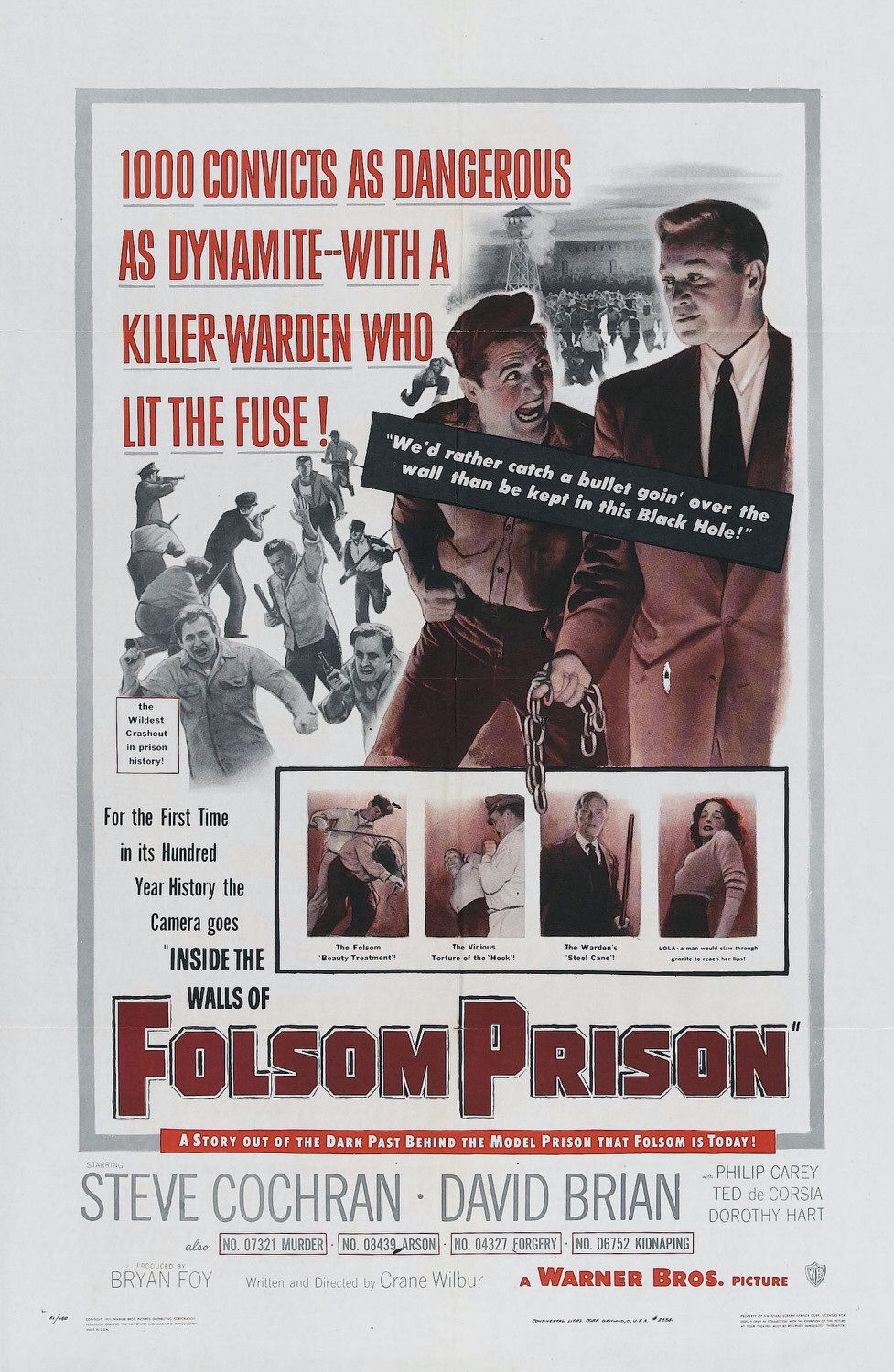
Filmed on location inside the infamous prison, and with a testosterone-loaded cast led by Steve Cochran , David Brian, Ted de Corsia, and Philip Carey , I expected INSIDE THE WALLS OF FOLSOM PRISON to be slam-bang entertainment along the lines of BRUTE FORCE . Well, not so much. The trouble’s not with the cast, nor the atmospheric direction of Crane Wilbur. It’s Wilbur’s script that commits the cardinal sin of any action film: too much talk!
Even the prison itself talks, narrating the opening credits: “I am Folsom Prison. At one time they called me Bloody Folsom. And I earned it…”, intones the prison, voiced by Charles Lung (an appropriate name for someone who talks to much!). The movie begins with an attempted jailbreak, put down by sadistic Warden Rickey (de Corsia) and his thugs. He then ratchets up the punishment, making life even more miserable for the cons, until…
Remember that old game where you would go up to a stranger’s house, ring the doorbell, and then run off? It’s one of those simple games that really shouldn’t be that much fun and yet, strangely, it is. The thrill of the game really doesn’t come from the fact that you’re making someone open the front door for no good reason. Instead, the thrill comes from seeing if you can run away before that door opens.
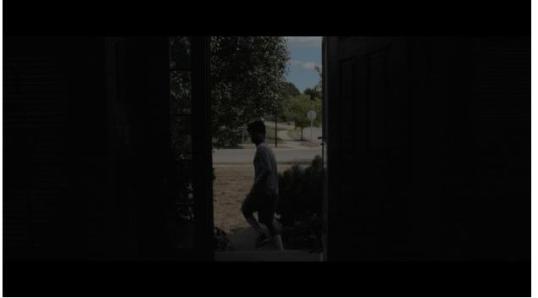
You Can’t Escape, the latest short film from Rubbish Rebel Media, opens with a child (Rayce Zatye) walking through an apparently suburban neighborhood and doing just that. He runs up to houses, he rings the doorbell, and then he runs off. As he does this, we can’t help but notice that the neighborhood appears to be deserted. Where are all the other people? Does anyone ever actually answer their door? From the way that the film is directed, we get the feeling that someone may be watching the child but who?
And when the child returns to his own house … well, I won’t spoil the film. Let’s just say that it concludes with a surreal bang.
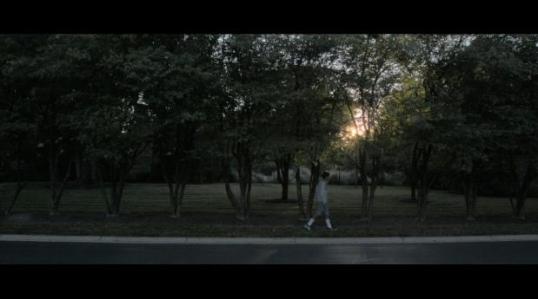
You Can’t Escape lasts just a little over 2 minutes and the end leaves us with just as many questions as answers. That’s okay, though. The key to horror is the fact that not all questions have easy answers. Director Renner Zatye emphasizes atmosphere and, despite the film’s short length, he captures several uneasy images. The scenes of Racye Zatye walking through that deserted neighborhood are undeniably creepy. A scene where the child walks by several trees especially made me nervous. This is one of those films that asks you to consider what could be hiding behind those trees and whether or not you’re ever as safe as you think.
You Can’t Escape should be getting a release in a few months so be sure to keep an eye out for it!
(For the past three weeks, Lisa Marie has been in the process of reviewing 56 back to school films! She’s promised the rest of the TSL staff that this project will finally wrap up by the end of today, so that she can devote her time to helping to prepare the site for its annual October horrorthon! Will she make it or will she fail, lose her administrator privileges, and end up writing listicles for Buzzfeed? Keep reading the site to find out!)
Well, here we are! It’s taken nearly four weeks but we have reached the conclusion of Back to School Part II! I started this series by taking a look at Teenage Devil Dolls. Along the way, I’ve reviewed everything from Andy Warhol’s Vinyl, A Clockwork Orange, Animal House, and Can’t Hardly Wait to Hollywood Highand Keith. I’ve even found an excuse to review fourdifferentDegrassifilms! I’ve had a lot of fun but, with October approaching, I’m happy to be finishing up this series of reviews so that I can concentrate on the TSL’s annual horrorthon!
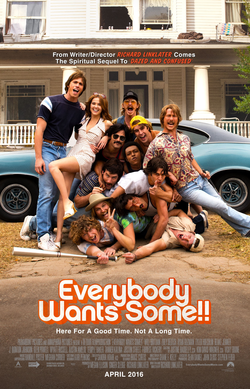
So, without further ado, let’s take a look at Richard Linklater’s Everybody Wants Some!!
Everbody Wants Some!! generated a small flurry of excitement when it was first released back in March. Not only was it Linklater’s first narrative film since the critically acclaimed Boyhood but it was also advertised as being a spiritual sequel to Dazed and Confused. Like Dazed and Confused, Everybody Wants Some!! was a period piece that would follow an ensemble of Texas teenagers over the course of one long weekend, the big difference being that Everybody Wants Some!! would take place in 1980 (as opposed to 1976) and it would deal with college freshmen (instead of high school juniors). There were even a few articles that pointed out that several of the actors in Everybody Wants Some!! physically resembled some of the actors in Dazed and Confused.
(Seriously, Glen Powell looks like he could be Matthew McConaughey’s younger brother.)
The film was well-reviewed by critics, even though few of the reviews were as rapturous as the reviews that greeted previous Linklater films like Boyhood and Before Midnight. As for the audience reaction … well, Everybody Wants Some!! was not exactly embraced by audiences. I saw it at the Alamo Drafthouse and the theater was nearly deserted. (Considering that the Alamo’s audience prides itself on embracing independent film, a near-empty theater for a showing of a Linklater film is not a good sign.) The few people in the theater seemed to feel that the film went on for too long and that it needed a stronger plot. That’s a complaint that I’ve heard a lot of people make against Everybody Wants Some!!
It’s not a complaint that I agree with. Those who complained that Everybody Wants Some!! was essentially plotless obviously haven’t seen many Richard Linklater films. Though Linklater has made his share of commercial films, his more personal work — like Everybody Wants Some!! — is often plotless. That’s actually one the keys to Linklater’s aesthetic. He’s more interested in recreating a specific time and place and observing how different characters react to their environment than he is in telling conventional stories. A film like Everybody Wants Some!! is less about telling a story with a definite beginning and end and more about capturing a very specific experience.
And, on that level, the film definitely succeeds. Watching Everybody Wants Some!!, you literally do feel as if you’ve stepped into a time machine and you’ve been transported to the past. Jake (Blake Jenner), a college freshman who is attending fictional Southeast Texas College on a scholarship, may be the main character but, ultimately, he’s not that important. More important is seeing how people lived, interacted, and thought in 1980. Everybody Wants Some!! is a time capsule film.
(Apparently, it’s a bit of an autobiographical film as well. Cinema snobs like me tend to forget that, before he became a filmmaker, Linklater was a jock who, like Jake, attended college on a baseball scholarship. As much as we may not want to admit it, not all artistic geniuses spent high school writing angsty poetry about eating disorders. Some of them played sports.)
Everybody Wants Some!! follows Jake and his fellow baseball players over the course of the weekend before classes begin. One night, they end up in a redneck bar. Another night, they end up at a punk club. They go to a drama department party. They practice baseball. They all drink. Some of them smoke weed. Some of them get laid. And, at the end of the weekend, two of them sit down in their first class of the semester and promptly fall asleep.
One problem that I did have with Everybody Wants Some!! is that, as good as job as it does of creating a time and place, it didn’t necessarily convince me that it was a time in which I would want to live in. As I stated earlier, Everybody Wants Some!! was promoted as being a spiritual sequel to Dazed and Confused. However, Dazed and Confused featured a greater variety of characters. Practically everyone of note in Everybody Wants Some!! is a member of the school’s baseball team. True, some of them are smarter than others. Some of them smoke weed. Some of them are ultra religious. But, ultimately, they’re all jocks and they’re all frat boys. How much you enjoy hanging out with these characters will depend on how much tolerance you have for jocks, frat boys, and their hyper-masculine rituals. Whenever I’ve seen Dazed and Confused, I’ve thought to myself that if I had been alive and in high school in 1976, I would have wanted to be friends with at least a few of the characters. On the other hand, if I had been alive and in college in 1980, I would have gone out of my way to avoid that baseball team.
(And, as a result, I probably would have missed a chance to meet Richard Linklater! There’s a lesson to be learned there.)
Ultimately, though, Everybody Wants Some!! succeeds because, even if the characters aren’t particularly likable, the film itself does capture the feeling and the excitement of having your entire future ahead of you. Admittedly, there’s a hint of melancholy running through the film. One character is revealed to be a 30-something imposter who regularly uses a false identity to enroll in different colleges because he loves to play baseball but he knows that he’ll never succeed in the major leagues. Throughout the film, there are hints that none of these baseball players are ever going to be as successful as they are during that one particular weekend. But, ultimately, the film tells us that the future doesn’t matter. What matters is that, for that one weekend, they had their entire future ahead of them and it seemed like anything was possible.
Everybody Wants Some!! may not be Linklater’s best but it definitely deserves to be seen!
(And that concludes Back to School! Thank you everyone for reading! Love you!)


 Leon Alastray (Anthony Quinn) is an outlaw in 18th century Mexico who is given sanctuary and hidden from the Spanish authorities by a kindly priest, Father Joseph (Sam Jaffe). In return, Leon agrees to escort the priest to a peasant village that is under siege from the Yaqui Indians. During the journey, Joseph dies and when Leon arrives at the village, he is mistaken for the priest. Even though Leon’s an atheist and a womanizer, he pretends to be a man of God and tries to broker a peace with the Yaqui’s bloodthirsty leader, Golden Lance (Jaime Fernandez). Standing in the way is Teclo (Charles Bronson), a mestizo rebel who wants to keep the Spanish and the Yaqui at war.
 James Cooper (John Ireland) is a non-violent bank robber in the old west. He wants to hold up one last bank and then retire to his farm with his wife (Gloria Milland) and daughter (Nadia Marconi). However, he is double-crossed by his partner, Moxon (Mirko Ellis), who kills everyone who works at the bank and tries to steal the money for himself. After Cooper throws Moxon over the side of a cliff and hides the loot, he is approached by Miguel (Antonio Sabato, Sr.), a young artist who had just deposited his money moments before the bank was robbed. Miguel explains that he’s been saving up for a future exhibition in New York and he convinces Cooper to give him back his money.


 Through the Shattered Lens