What Lisa Marie Watched Last Night: FANatic (dir by Jean-François Rivard)


Around 2 a.m. this morning, I watched the latest Lifetime Movie Network premiere, FANatic!
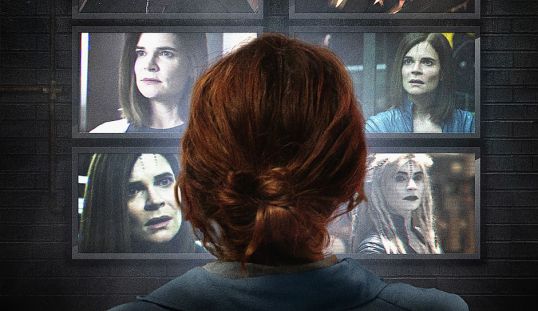
fanatic

Why Was I Watching It?

Okay, so technically, I didn’t watch this last night.  It premiered last night and I recorded it because I was watching the latest episode of The Walking Dead.  However, I don’t think What Lisa Recorded Last Night has quite the same ring to it.

As for why I watched it at 2 in the morning — well, I fell asleep last night around 11:00.  And then I woke up at one.  Seeing as how I had already gotten my usual two hours of sleep, I decided that I might as well watch a movie!

What Was It About?

Nikki Myers (Katy Breier) has finally landed her dream job.  She’s working as an assistant to Tess Daniels (Betsy Brandt), a highly acclaimed actress who happens to be the star of Nikki’s favorite show!  It’s an enjoyably silly sci-fi show, one on which Tess co-stars with her husband, Hunter Clay (Benjamin Arthur).  When the show started, Tess and Hunter were equals and Tess considered her role to be empowering.  But, over the past few seasons, things have changed.  Tess now finds her role to be demeaning and limiting.  While Hunter gets to play the hero, Tess’s role becomes more and more about providing fan service for the show’s male viewers.  Tess wants to leave the show…

But if Tess leaves the show, where does that leave Nikki!?  Nikki’s spent the last few weeks bragging to her two friends about her job!  If the show ends, how will Nikki be able to continue to steal props from the set?  And how will she be able to continue to lie to her friends about the imaginary affair she’s having with Hunter!?

Seriously, when you look at things from her point of view, can you blame Nikki for becoming a little bit homicidal?

What Worked?

Yay!  If nothing else, FANatic showed that the Lifetime-Degrassi conduit still exists!  Perhaps because so many Lifetime films are produced in Canada, it’s not unusual to see former Degrassi actors pop up in supporting (and, sometimes, lead) roles.  On Degrassi, Jake Epstein played the lovable, bipolar, drug addicted musician/photographer Craig Manning.  In FANatic, he plays a slightly less likable character, a misogynistic television producer.  Still, it’s always good to see Jake.

Anyway, FANatic was a lot of fun to watch, mostly because of the loving detail that was put into creating Tess and Hunter’s irresistibly silly sci-fi show.  What’s interesting is that, if that show actually was on the air, it probably would be, at the very least, a cult hit.  I knew more than a few people who would probably watch every episode.

Katy Breier did a good job playing the fanatic of the title.  A film like FANatic is only as good as its villain and Breier brought a lot of life to the role.

What Did Not Work?

Seriously, why are redheads always crazy in Lifetime movies?  Of course, that’s really not something that didn’t work.  That’s just something that I, as a member of the 2% of the world’s population who has red hair, always notice.

But back to the question — hey, it all worked!

“Oh my God!”  Just like me moments!

It’s hard for me to imagine myself ever becoming obsessed with any show to the extent that Nikki does.  Then again, if that show starred James Franco…

Lessons Learned

You can’t spell “fanatic” without “fan!”
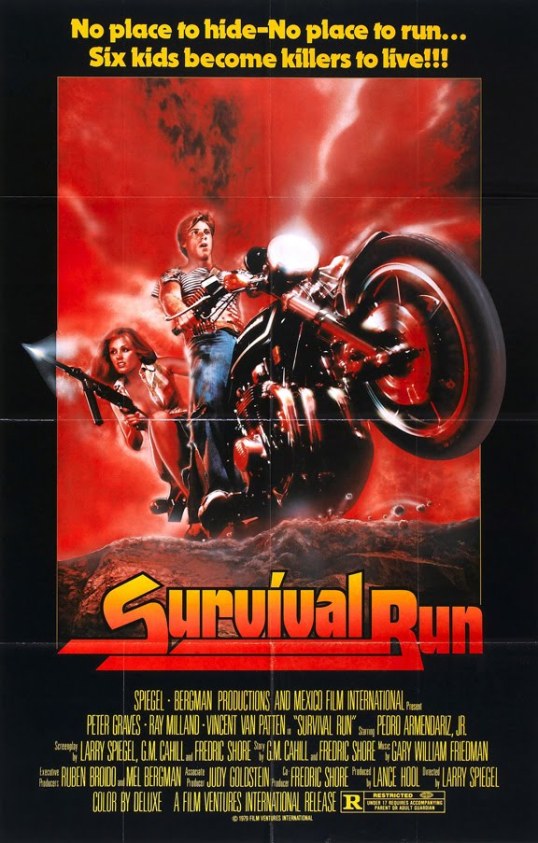
A Movie A Day #50: Survival Run (1979, directed by Larry Spiegel)


This poster for Survival Run reflects absolutely nothing that happens in the movie.

This poster for Survival Run reflects absolutely nothing that happens in the movie.

“We are young/ We are free/ Anyone know a better place to be?/ Takin’ it easy/ My baby and me….”

So goes the deceptively mellow opening theme song of Survival Run.  In this one, teenager Chip (Vincent Van Patten) and his five best friends take off for the weekend.  When their van breaks down in the middle of the desert, they light a campfire, sing a song, and have sex.

Takin’ it easy, my baby and me.  

When they later decide to search for help, they stumble across a group of men in the valley.  The men are being led by Peter Graves, who tosses one of the teens a beer and says, “This’ll put hair on your chest, kid.”  The kid looks down at his chest, says, “Where’d it go!?,” and then touches him armpits.  “There it is!” he says.

We are young, we are free

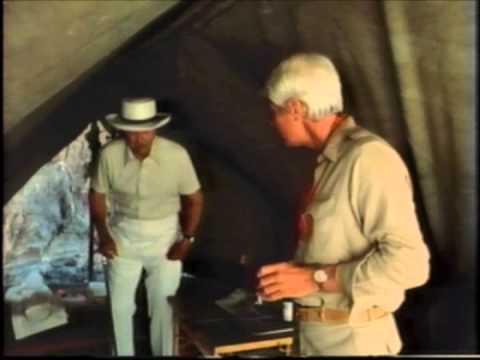
The men say they’re prospectors but they’re actually drug smugglers.  When the same teen who couldn’t find his chest hair is murdered, a fight for survival begins.  Despite that killer opening song, Survival Run takes forever to get started, the action scenes are poorly directed, and the teens are too stupid and poorly written to be sympathetic.  However, Survival Run does feature Peter Graves and Ray Milland as the two most unlikely drug smugglers in the world.  Peter Graves wears a red ascot and an all khaki outfit with rapidly spreading sweat stains.  Ray Milland wears a suit while sitting out in the broiling desert.  Milland, who was 72 at the time, spends most of the movie sitting.  One of the teenage girls thinks he’s intriguing.

Dangerous international drug smugglers Ray Milland and Peter Graves

Infamous international drug smugglers Ray Milland and Peter Graves

When I was growing up in Baltimore, Survival Run used to frequently come on TV in the afternoon.  I’m still not sure why but I imagine a lot of fans of the Biography Channel were tricked into tuning into this one, just to watch in shock as Peter Graves killed teenagers in the middle of the desert.  Ray Milland did this 35 years after winning an Oscar for The Lost Weekend.  As for Vincent Van Patten, he was the Van Patten who didn’t appear in Mel Brooks films or win an Emmy for his work on Boardwalk Empire.

Peter Graves and Ray Milland vs. the least known member of the Van Patten family.

Anyone know a better place to be?

Film Review: The Twin (dir by Max Derin and Fred Olen Ray)


twin

According to the imdb, Fred Olen Ray is, as of this writing, credited with directing 148 films.  Few of those films have necessarily been acclaimed by the mainstream critics but almost all of them are a lot of fun when taken on their own terms.

Take The Twin for instance, on which Ray shares a directing credit with screenwriter Max Derin.

Now, in many ways, The Twin is a ludicrous film.  It’s very, very melodramatic and the whole film’s central issue (i.e., which twin is which) could have been very easily resolved if just one person in the movie had used a little common sense.

But you know what?

Criticism like that misses the entire point of the film.  The Twin is a lot of fun and it’s certainly not a film that’s meant to be taken seriously.  This is not a serious look at mental illness, young love, sibling rivalry, or anything else for that matter.  This is an over-the-top and rather silly piece of pure entertainment and, if we can’t enjoy something like that, what hope is there for the world?

The film deals with Tyler (Timothy Granaderos), who would seem to be almost perfect.  He’s handsome.  He’s intelligent.  He’s compassionate.  He’s a wonderful boyfriend, always polite and considerate to his girlfriend, Jocelyn (Jess Gabor).  Even Jocelyn’s overprotective mother, Ashley (Brigid Brannah), seems to like him.

However, Tyler has a secret.  Years ago, his parents were killed in a car accident.  The accident was caused by Tyler’s brother, Derrick.  As you may have guessed from the film’s title, Derrick is Tyler’s twin.  And we all know that, whenever a movie is called The Twin, that means that there’s going to be a good twin and an evil twin.  It turns out that Derrick is the evil twin and that accident was no accident.

Derrick has spent the last few years in a mental asylum.  When Tyler shows up to visit his brother, the staff tells Tyler that Derrick has picked up a strange new habit.  He’s telling everyone that he’s actually Tyler and Tyler is Derrick.  Oh well, Tyler shrugs, that’s what happens when you’ve got a sociopathic twin.

Later, when Tyler is alone with his twin, he’s shocked when Derrick attacks him.  Derrick knocks him out and then switches clothes with him.  Claiming to be Tyler, Derrick walks out of the hospital and into the lives on Jocelyn and Ashley.  Meanwhile, Tyler is stuck in the hospital, begging for someone to just give him a blood test so that he can prove who he is….

Anyway, you can probably guess what happens next but that’s part of the fun.  Derrick (as Tyler) spends a lot of good, quality time with Ashley and Jocelyn, both of whom are surprised by how different “Tyler’s” personality seems to now be.  Ashley, of course, is more suspicious than Jocelyn.  (This film premiered on Lifetime so you better believe that overprotective mom is eventually proven right.)

It may be predictable but, like I said, it’s all a lot of fun.  I don’t know which parts of the film were directed by Derin and which parts by Fred Olen Ray but, as a whole, the film is cheerfully content to be a B-movie and you have to kind of love it for that.  At a time when everyone is taking everything so seriously and so many filmmakers are giving into portentous pretension, it’s nice to see a thriller that’s pure entertainment.

Plus, Timothy Granaderos is a lot of fun as both Tyler and Derrick.  Tyler is nice but kind of dull.  Derrick is exciting but totally batshit crazy.  Granaderos seems to be enjoying himself as he switches back and forth between being good and evil.  An evil twin movie is only as good as its twins and Granaderos is pretty good.

So, keep an eye out for The Twin.  Melodrama this enjoyable should not be missed.

Film Review: Britney Ever After (dir by Leslie Libman) #FreeBritney


britney-ever-after-trailer

Earlier tonight, I watched the latest Lifetime celebrity biopic, Britney Ever After.

Ever since that ill-fated Aaliyah movie, Lifetime biopics have had a reputation for being hot messes and I’m sure that a lot of people will say the same thing about Britney Ever After.  Britney Ever After is about Britney Spears, following her from her first tour with *NSYNC through her relationship with Justin Timberlake through her marriages to both Jason Alexander and Kevin Federline and finally concluding with her well-publicized breakdown in 2008.  As usually seems to happen with these biopics, the whole story is framed by interviews with a documentary crew.  From what I saw, the twitter reaction was pretty savage and I’m sure that there will be all sorts of snarky reviews tomorrow.

But you know what?

As far as Lifetime celebrity biopics go, Britney Ever After was not that bad.

It suffered from some obvious problems.  Since neither Britney nor her management had anything to do with the making of the film, none of Britney’s original music was heard.  That means there was no Oops! I did it again!  There was no Baby One More Time.  No Toxic.  No If U Seek Amy.  There was no Work Bitch, which incidentally is both the greatest song that Britney’s ever done and my favorite song to sing while stuck in traffic.  I think it was mentioned, at one point, that Britney was working on a song called Womanizer but I may have misheard.  When the actress playing Britney sang, it was only to cover songs by other artists.  In the film, Britney performed I Love Rock and Roll and a bit of Walking After Midnight.

For what I presume are legal reasons, the film had to be circumspect.  Yes, Justin Timberlake (played by Nathan Keyes) was a character in the movie but he was portrayed so blandly that he could have been any hyperactive teenager with good hair.  Jason Allen Alexander (Kelly McCabe) shows up just long enough to marry Britney and then be told that the marriage is going to be annulled.  Amazingly, Britney’s entire marriage to Kevin Federline (Clayton Chitty) takes place over less than 10 minutes of screen time.  Adnan Ghalib (Serge Jaswal) and Sam Lufti (Benjamin Arce) get more attention that Kevin but both of them are portrayed so negatively that they probably wish they hadn’t.

(Adnan and Sam both made the mistake of testifying about Britney in court, meaning that their douchebaggery was a part of the public record and free for Britney Ever After to portray.)

As for Britney’s “rivalry” with Christina Aguilera (which, early in their careers, pretty much defined both of their public personas), it goes unmentioned.  Christina is only briefly seen in a long shot.  For those of you hoping for any details about the dark side of life at the Mickey Mouse Club, Britney Ever After is not for you.  Really, the film’s main problem was one of logistics.  Britney Ever After had only 90 minutes to tell the story of a very dramatic and complicated life.  If the film felt rushed, that’s because it had a lot to show and not much time to do it.

But, even with all that in mind, Britney Ever After was not the disaster that some seem to believe that it was.  In the role of Britney, Natasha Bassett did far better than I was expecting.  There were some issues, of course.  Her attempt to duplicate Britney’s Southern accent led to her sounding more like Jessica Simpson than Britney Spears.  During the film’s early scenes, she seemed almost too innocent to be believed but it quickly became apparent that this was intentional on the film’s part.  One of the themes running through the film was how Britney’s image was continually shaped by her parents, her management, and her boyfriends.  In the end, Britney is portrayed as having no control over her own life.  When Britney suffers a break down in 2007, she’s at least trying to live her own life.  When everyone around her panics, are they concerned about her health or are they concerned about her image and their investment in her career?  This unanswered question hangs over the final 30 minutes of Britney Ever After.  If Natasha Bassett never quite seemed to be Britney, she was still very believable as a character living the exact same life and dealing with the exact same issues.

Plus, there was an enjoyably silly scene where Britney ran into Justin in a club and they had an epic dance off.  If only all relationship issues could be solved by a dance off!

That said, I was a bit disappointed that, at no point, was Crossroads mentioned.

(Seriously, a Britney movie with no mention of Crossroads!?)

But give the film some credit.  It did a good job of capturing the suffocating experience of being hounded by paparazzi.  And the film was even-handed and compassionate when it came to portraying Britney’s 2007 breakdown.  Like Britney, I’m bipolar and I’ve always felt that I could understand what she was going through while the rest of the world was finding so much entertainment in her very public struggle.  Since 2008, Britney’s father has had conservatorship over her life and control of all of her assets.  For nearly ten years, Britney Spears has not been allowed to stand on her own and has essentially made a lot of money for everyone but her.  During the documentary segments that provide a wrap-around to the film’s story, Britney Ever After obliquely hints at this sad reality.  In those sequences, there’s a sadness to Bassett’s performance, an acknowledgement that Britney has paid a price for public stability.

Britney Ever After was on Britney’s side, which is more than can be said of many other biopics.

#FreeBitney!


A Movie A Day #49: Body Chemistry 4: Full Exposure (1995, directed by Jim Wynorski)


51tj679zxfl

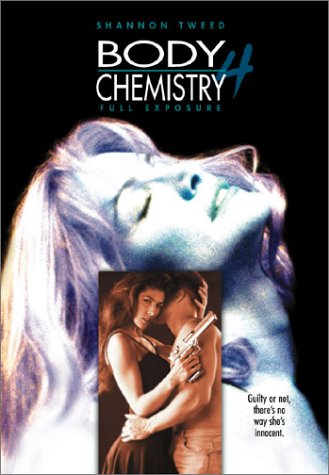
After five years of kinky sex and murder, the Body Chemistry franchise ended with Body Chemistry 4: Full Exposure.

Like the third film, Full Exposure was directed by Jim Wynorski and produced by Andrew Stevens.  Shannon Tweed stepped into the role of murderous Dr. Claire Archer, replacing Shari Shattuck.  Shannon Tweed was always one of the most talented of the actresses who regularly appeared on what was then nicknamed Skinemax.  It wasn’t just that Tweed always seemed to being give it her all in her films’ frequent sex scenes.  Tweed also had the look and style of an old-fashioned femme fatale.  It was easy to imagine her trading sultry quips with Alan Ladd or Tom Neal.  This made Tweed perfect for the role of Claire Archer and her performance was a noticeable improvement on Shari Shattuck’s.  It’s just too bad the rest of the film was such a snoozefest.

In Full Exposure, after getting away with three murders in the first two Body Chemistry films, Claire has finally been arrested.  She is on trial for killing Alan Clay (Andrew Stevens) at the end of the third film.  However, she has a hotshot lawyer named Simon Mitchell (Larry Poindexter) and she is soon up to her old tricks, having sex with Simon in his office, a parking garage, and an elevator.  Simon’s aide, Lane (Marta Martin), has come across proof of Claire’s crimes but Claire has a plan to take care of that.  She always does.

Full Exposure starts out as a typical Body Chemistry film, with neon-lit sex scenes, but it quickly get bogged down in lengthy courtroom sequences.  In the previous three films, Claire at least had some sort of motivation but here, it’s never clear why she would try to destroy her lawyer’s life during the trial instead of waiting until he had, at least, gotten her off the hook.  Tweed is a perfect Claire but the rest of the cast is just going through the motions.   Though Claire once again got away with murder, there were no more chapters to her story after this one.  The Body Chemistry franchise managed to do a lot with a very thin premise but Full Exposure shows, that by the fourth film, there was no where left to go.

The Game’s Afoot: THE SEVEN-PER-CENT SOLUTION (Universal 1976)


gary loggins's avatarcracked rear viewer

71

Sherlock Holmes has long been a favorite literary character of mine. As a youth, I devoured the Sir Arthur Conan Doyle stories, marveling at the sleuth’s powers of observation and deduction. I reveled in the classic Universal film series starring Basil Rathbone and Nigel Bruce as Holmes and Watson, and still enjoy them today. I read Nicholas Meyer’s 1974 novel “The Seven-Per-Cent Solution” as a teen, where a coked-out Holmes is lured by Watson to Vienna to have the famed Sigmund Freud cure the detective of his addiction, getting enmeshed in mystery along the way. I’d never viewed the film version until recently, and while Meyer’s screenplay isn’t completely faithful to his book, THE SEVEN-PER-CENT SOLUTION is one of those rare instances where the movie is better than the novel.

72

This is due in large part to a pitch-perfect cast, led by Nicol Williamson’s superb performance as Sherlock. We see Holmes at his worst…

View original post 393 more words

Lisa Reviews an Oscar Winner: All Quiet On The Western Front (dir by Lewis Milestone)


all_quiet_on_the_western_front_1930_film_poster
“When it comes to dying for your country, it’s better not to die at all!”

— Paul Baumer (Lew Ayres) in All Quiet On The Western Front (1930)

Tonight, I watched the third film to ever win the Oscar for Best Picture, the 1930 anti-war epic, All Quiet On The Western Front.

All Quiet On The Western Front opens in a German classroom during World War I.  Quotes from Homer and Virgil, all exalting heroism, are written on the blackboard.  The professor, a man named Kantorek (Arnold Lacy), tells his all-male class that “the fatherland” needs them.  (It’s all very patriarchal, needless to say.)  This, he tells them, is a time of war.  This is a time for heroes.  This is a time to fight and maybe die for your country.  He beseeches his students to enlist in the army.  The first to stand and say that he will fight is Paul Baumer (Lew Ayres).  Soon, almost every other student is standing with Paul and cheering the war.  Only one student remains seated.  Paul and the others quickly turn on that seated student, pressuring him to join them in the army.  That seated student finally agrees to enlist, even though he doesn’t want to.  Such is the power of peer pressure.

A year later, a visibly hardened Paul returns to his old school.  He’s on furlough.  He’s been serving in a combat zone, spending his days and nights in a trench and trying not to die.  He’s been wounded but he hasn’t been killed.  He can still walk.  He can still speak.  He hasn’t gone insane.  He is one of the few members of his class to still be alive.  (That student who didn’t want to enlist?  Long dead.)  When Kantorek asks Paul to speak to his new class, Paul looks at the fresh-faced students — all of whom have just listened to Kantorek describe the glories of war — and Paul tells them that serving in the army has not been an adventure.  It has not made him a hero.  The only glory of war is surviving.  “When it comes to dying for one’s country, it’s better not to die at all!”  Kantorek is horrified by Paul’s words but he needn’t have worried.  The students refuse to listen to Paul, shouting him down and accusing him of cowardice and treason.

(This scene is even more disturbing today, considering that we live in a time when accusations of treason and calls for vengeance are rather cavalierly tossed around by almost everyone with a twitter account.)

What happened between those two days in the classroom is that Paul saw combat.  He spent nights underground while shells exploded over his head.  He watched as all of his friends died, one by one.  One harrowing night, spent in a trench with a French soldier who was slowly dying because of Paul stabbing him, nearly drove Paul insane.  In the end, not even his friend and mentor, Kat (Louis Wolheim), would survive.  From the first sound of bombs exploding to the film’s haunting final scene, the shadow of death hangs over every minute of All Quiet On The Western Front.  By the end of it all, all that Paul has learned is that men like Kantorek and the buffoonish Corporal Himmelstoss (John Wray) have no idea what real combat is actually like.

All Quiet On The Western Front may be 87 years old but it’s still an incredibly powerful film.  There are certain scenes in this pre-code film that, after you watch them, you have to remind yourself that this film was made in 1929.  I’m not just talking about a swimming scene that contains a split second of nudity or a few lines of dialogue that probably wouldn’t have made it past the censors once the production code started to be enforced.  Instead, I’m talking about scenes like the one where a bomb goes off just as a soldier attempts to climb through some barbed wire.  When the smoke clear, only his hands remains.  And then there’s the sequence where the camera rapidly pans by soldier after soldier falling dead as they rush the trenches.  Or the scene where Paul literally watches as one of his friends, delirious and out-of-his-mind, suddenly dies.  Or the montage where a pair of fancy boots is traded from one doomed soldier to another, with each soldier smiling at his new boots before, seconds later, laying dead in the mud.  Or the harrowing scene where Paul tries to keep a French soldier from dying.

All Quiet On The Western Front remains a powerful film.  It’s perhaps not a surprise that, when it briefly played in Germany, the Nazis released live mice in the theaters to try to keep away audiences.  (Both the film and the book on which it was based were later banned by the Nazi government.)  Sadly, we’ll never get to see All Quiet On The Western Front the way that it was originally meant to be seen.  A huge hit in 1930, All Quiet On The Western Front was rereleased several times but, with each rerelease, the film was often edited to appease whatever the current political climate may have been.  Over the years, much footage was lost.  The original version of All Quiet On The Western Front was 156 minutes long.  The version that is available today is 131 minutes long.  But even so, it remains a harrowing and powerful antiwar statement.

With all due respect to both Wings and Broadway Melody, All Quiet On The Western Front was the first truly great film to win the Oscar for Best Picture.  Sadly, it remains just as relevant today as when it was first released.

A Movie A Day #48: Body Chemistry III: Point of Seduction (1994, directed by Jim Wynorksi)


big

In Body Chemistry III, Jim Wynorski and Andrew Stevens take over the venerable franchise and things quickly get meta.

Alan Clay (Andrew Stevens, who also produced) is a TV director who wants to make serious films about the environment but his producer, Bob (Robert Forster), is only interested in exploitation films.  His wife, soap opera star Beth Chaney (Morgan Fairchild). wants Alan to direct her in a great role but Alan tells her, “I’m not a creative artist, Beth!  I’m a TV director who specializes in women-in-jepordy thrillers!”  That should make Alan the perfect choice to make a movie about Claire Archer.

Having gotten away with murdering both of her two previous lovers and her boss at the radio station, Dr. Claire Archer (Shari Shattuck, replacing Lisa Pescia) is now hosting her own TV talk show, Looking At You With Claire Archer.  She has also written a best-selling textbook called Sex and Violence and Vice Versa.  Her former colleague, Freddie (Chick Venerra, taking over the role played by Dave Kagen in the first film), has quit the sex research game is now a screenwriter.  He wants to write a script about Claire but he can not convince her to sign over the rights to her story.  Maybe a night with Alan can change her mind.

Claire’s soon up to her old tricks.  Alan wants to break it off with her, Freddie is figuring out that Claire is a murderer, and Beth wants to play her in the movie.

Featuring no one from either of the two original Body Chemistry films (even when Freddie sees a picture of Big Chuck from Part 2, an anonymous extra has replaced Morton Downey, Jr) and shot in Jim Wynorski’s signature “drop your top,” straight-to-video style, Body Chemistry 3 is a deliberate parody of the genre.  It’s easy to recognize Robert Forster’s Bob as being a stand-in for Body Chemistry‘s executive producer, Roger Corman while Freddie is the most obnoxious screenwriter since the one Tim Robbins killed in The Player.  All of that makes Part 3 more interesting than the first two Body Chemistry films.  If the sultry Lisa Pescia had returned to play Dr. Archer, it might even be a classic.  Shari Shattuck gives a game performance but lacks the demented intensity that Pescia brought to the role.

For tomorrow’s movie a day, Wynorski and Stevens return but Shannon Tweed takes over the role of Claire Archer in Body Chemistry 4: Full Exposure.


Insomnia File #22: Insomnia (dir by Christopher Nolan)


What’s an Insomnia File? You know how some times you just can’t get any sleep and, at about three in the morning, you’ll find yourself watching whatever you can find on cable? This feature is all about those insomnia-inspired discoveries!

Last night, if you were up at 2 in the morning, you could have turned over to Starz and watched the atmospheric 2002 mystery, Insomnia.

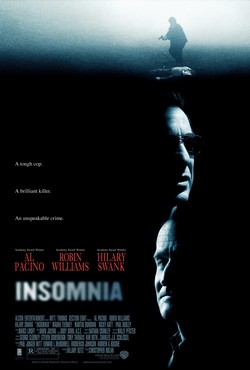
I have to admit that I’m cheating a little bit by including Insomnia in a series about obscure films that you might find on cable late at night.  While Insomnia does seem to often turn up during the early morning hours, it’s hardly an obscure film.  A remake of an acclaimed Norwegian film, it not only stars three Oscar winners (Al Pacino, Robin Williams, and Hilary Swank) but it was directed by Christopher Nolan.  Insomnia got a lot of attention when it was first released in 2002.  But, doing an insomnia file about a movie that’s actually about insomnia was just too good of an opportunity to pass up.

I should also mention that I didn’t have insomnia last night.  I was up because I currently have a cold and I watched Insomnia in a feverish and congested haze.  And yet I couldn’t help but feel that, somehow, that was actually the ideal way to watch Insomnia.  With its ominous atmosphere and Nolan’s eye for the surreal, Insomnia plays out like a semi-lucid fever dream.

A teenage girl has been murdered in a small Alaskan fishing village.  The chief of police (played by the great character actor Paul Dooley) asks his former LAPD partner, Will Dormer (Al Pacino), to come to Alaska and help with the investigation.  Accompanying Dormer is his partner and friend, Hap Eckhart (Martin Donovan).

Dormer has issues that go far beyond anything happening in Alaska.  He’s burned out and he’s plagued by rumors that, in the past, he was a crooked cop.  He’s being investigated by Internal Affairs and, shortly after they arrive in Alaska, Eckhart admits that he’s been given immunity as part of a deal to testify against Dormer.  While pursuing the suspected murderer through the Alaskan fog, Dormer fires his gun.  When the fog clear, Dormer discovers that he’s killed Eckhart.  Was it an accident or did Dormer intentionally shoot  his partner?  Not even Dormer seems to know for sure.  He lies and says that the murderer shot Eckhart.

Working with a local detective (Hilary Swank), Dormer tries to solve the Alaska murder, with the knowledge that, once he does, he’ll have to return to Los Angeles and he’ll probably be indicted.  Because of the midnight sun, night never falls in Alaska and, tortured by guilt, Dormer cannot sleep.  Add to that, the murderer knows that Dormer shot Eckhart.  And now, he’s calling Dormer and cruelly taunting him.

Who is the murderer?  His name is Walter Finch.  He’s a writer and, in a stroke of brilliance, he’s played by none other than Robin Williams.  To me, Robin Williams’s screen presence always carried hints of narcissism and self-destruction.  Even in comedic roles, there was a transparent but very solid wall between Williams the audience.  When he was shouting out a thousand words a minute and rapidly switching from one character to the next, it always seemed as if it was all a technique to keep anyone from figuring out who he really was.  In Insomnia (and, that same year, in One Hour Photo), Robin Williams reveals an inner darkness that he rarely showed before or after.  Finch may possess Williams’s trademark eccentric smile and nervous voice but, underneath the surface, he’s an empty shell who views human beings as being as disposable as the characters in his paperback novels.

Christopher Nolan takes us directly into the heads of these two enemies, with shots of the desolate Alaskan landscape seeming to perfectly capture the inner desolation of two minds destroyed by guilt and paranoia.  (Neither Finch nor Dormer is capable of connecting with the world outside of his damaged psyche.)  As seen through Nolan’s lens, Alaska becomes as surreal and haunting as one of the dream landscapes from Inception.  For those of us who found both The Dark Knight Rises and Interstellar to be so bombastic that they verged on self-parody, Insomnia is a nice reminder that Nolan doesn’t need a pounding Han Zimmer score to make a great movie.  With Insomnia, Nolan gives us not bombast but a deceptively low-key and atmospheric journey into the heart of darkness.

Ironically, for a film about two men who cannot sleep, Insomnia will haunt your dreams.

insomnia2002poster

Previous Insomnia Files:

  1. Story of Mankind
  2. Stag
  3. Love Is A Gun
  4. Nina Takes A Lover
  5. Black Ice
  6. Frogs For Snakes
  7. Fair Game
  8. From The Hip
  9. Born Killers
  10. Eye For An Eye
  11. Summer Catch
  12. Beyond the Law
  13. Spring Broke
  14. Promise
  15. George Wallace
  16. Kill The Messenger
  17. The Suburbans
  18. Only The Strong
  19. Great Expectations
  20. Casual Sex?
  21. Truth

A Movie A Day #47: Body Chemistry II: Voice of a Stranger (1992, directed by Adam Simon)


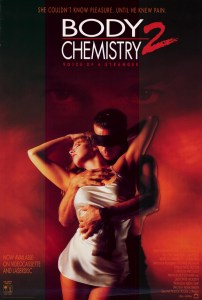
body-chemistry-ii-the-voice-of-a-stranger-movie-poster-1992-1020211070Dr. Claire Archer is back!

Having gotten away with murder at the end of the first Body Chemistry, Claire (played again by Lisa Pescia) is now working as a radio psychologist, taking the 9 pm to 1 am slot at a station managed by a sleazy chain smoker named Big Chuck (played by real-life sleazy chain smoker Morton Downey, Jr.).  Claire invites her listeners to call with their deepest desires.  “Without pain, you’re not truly alive.”

One night, “John” calls.  When Claire looks at the list of callers and sees, “John likes rough sex,” she immediately put him on the air.  John is actually Dan (Gregory Harrison).  Dan is dating Claire’s call screener, Brenda (Robin Riker), who cannot recognize her own boyfriend’s voice over the telephone.  Dan is a former high school football star who left town and became a cop in Los Angeles.  When his violent impulses became impossible to control, Dan was kicked off the force and he returned home.  Dan wants to suppress his dark side but Claire has other ideas.

Body Chemistry II is a marginal improvement over the first Body Chemistry, because Dan is a more sympathetic victim character than Marc Singer was in the first film and Body Chemistry II puts Lisa Pescia’s vampy performance front and center.  Though both films tell the same basic story, Body Chemistry II is stylistically a very different film.  Body Chemistry II takes it cue from film noir, which means a lot of dark rooms with Venetian blinds.  Dan’s flashbacks and nightmares also add some surreal moments to Body Chemistry II, distinguishing it from the more straight forward first film.

Though there would be two more Body Chemistry sequels, this would be the last time that Lisa Pescia would play Dr. Archer.  Keep an eye out for Clint Howard, Jeremy Piven, and director John Landis, all of whom show up in small roles.

For tomorrow’s movie a day, Shari Shattuck takes over the role of Claire Archer in Body Chemistry III: Point of Seduction.