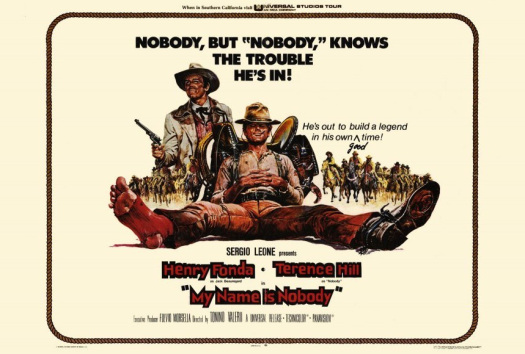
Western Zing: MY NAME IS NOBODY (Titanus 1973)


gary loggins's avatarcracked rear viewer

Sergio Leone  wasn’t quite done with the Western genre after DUCK, YOU SUCKER. MY NAME IS NOBODY is based on “an idea by Sergio Leone”, and though Leone’s former Assistant Director Tonino Valerii is given full credit,  the Maestro reportedly directed a couple of scenes as well as some second-unit action in the film. Whatever the case, the film puts a comic spin on Spaghetti Westerns in general and Leone’s movies in particular, with the comedic talents of star Terence Hill standing in sharp contrast to the old school Hollywood hero Henry Fonda .

Hill was the brightest star on the Italian horizon, having starred in Giuseppe Colizzi’s GOD FORGIVES… I DON’T, ACE HIGH, and BOOT HILL alongside burly Bud Spencer, adding elements of humor as they went along . But with 1970’S THEY CALL ME TRINITY, the duo went full-bore into comedy territory, giving the Spaghetti genre a…

View original post 557 more words

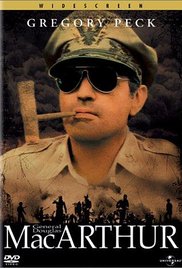
A Movie A Day #326: MacArthur (1977, directed by Joseph Sargent)


The year is 1962 and Douglas MacArthur (Gregory Peck), the legendary general, visits West Point for one last time.  While he meets the graduates and gives his final speech, flashbacks show highlights from MacArthur’s long military career.  He leaves and then returns to Philippines.  He accepts the Japanese surrender and then helps Japan rebuild and recover from the devastation of the war.  He half-heartedly pursues the Presidency and, during the Korean War, gets fired by Harry Truman (Ed Flanders).

MacArthur is a stolid biopic about one America’s most famous and controversial generals.  It was produced by Frank McCarthy, a former general who knew MacArthur and who previously won an Oscar for producing Patton.  McCarthy was obviously hoping that MacArthur was do its subject what Patton did for George Patton and both films follow the same basic pattern. a warts-and-all portrait of a World War II general with all of the action centered around the performance of a bigger-than-life actor in the title role.  Though obviously made for a low budget, MacArthur is a well-made and well-acted movie but it suffers because Douglas MacArthur was just not as interesting a figure as George Patton.  Gregory Peck does a good job subtly suggesting MacArthur’s vanity along with capturing his commitment to his duty but he never gets a scene that’s comparable to George C. Scott’s opening speech in Patton.  The main problem with MacArthur, especially when compared to Patton, is that George Patton was a born warrior while Douglas MacArthur was a born administrator and it is always going to be more exciting to watch a general lead his men into battle then to watch him sign executive orders.

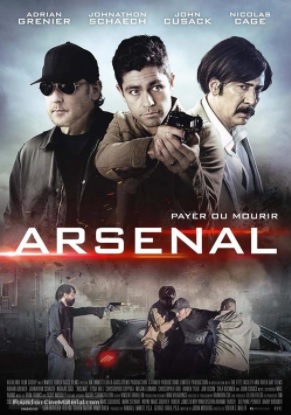
Insomnia File #31: Arsenal (dir by Steve C. Miller)


What’s an Insomnia File? You know how some times you just can’t get any sleep and, at about three in the morning, you’ll find yourself watching whatever you can find on cable? This feature is all about those insomnia-inspired discoveries!

If you were having trouble getting to sleep last night around midnight, you could have turned over to Showtime and watched Arsenal, a film that had a brief theatrical run in January and which has now made its way to cable.

Arsenal tells the story of two brothers.  When we first meet them, they’re kids and they’re living with their uncle.  But then their uncle kills himself and the two brothers find themselves going down very different paths.  JP (who is played, as an adult, by Adrian Grenier) turns a part-time job mowing lawns into a full-time job as the owner of a construction company.  Meanwhile, Mikey (played, as an adult, by Jonathon Schaech) stumbles across gangster Eddie King (Nicolas Cage) while Eddie is busy killing a man.  JP heads for a life of respectability.  Mikey heads for a life of crime.  Much like the Bulger brothers, they remain close despite their differing lifestyles.

But who cares about the brothers?  Adrian Grenier and Jonathon Schaech both do the best that they can with these two underwritten parts but ultimately, neither JP nor Mikey is that interesting.  If anything, they’re like the guys who you keep around as backups in case the guy you really like never works up the courage to talk to you.  Instead, let’s discuss about Eddie King.

As I said before, Eddie King is played by Nicolas Cage.  As you can probably guess, Cage does not exactly show anything resembling restraint when he plays King.  That may not be surprising but what is surprising that, after twenty years or going totally overboard in almost every role that he’s played, Cage can still surprise audiences by just how far he’s willing to go.  Every time that you think Cage’s performances can’t get any more bizarre, something like Arsenal comes out and proves you wrong.

There is so much to love about Cage’s batshit crazy performance as Eddie King.  For one thing, it makes absolutely no sense.  If you look at real-life mobsters, one thing that becomes clear very quickly is that the best ones may have been sadistic but they were usually smart enough to know when to lay low.  Eddie, on the other hand, never lays low.  He’s so crazy that he might as well be wearing a shirt that reads, “I kill people and then laugh about it.”  So, not only do you have Cage giving one of his most over-the-top performances but, for some reason, he’s also wearing this extremely fake nose and the movie doesn’t really make much of an effort to disguise the fact that it’s a fake nose.  I mean, you can literally see the glue that’s holding the fake nose over the old nose.  And then there’s Cage’s haircut, which would appear to suggest that Eddie King shares a barber with every pervy humorist who has ever had a job working for Minnesota public radio.  When we first see Eddie, he’s gruesomely killing a man and Cage gets so into it and there’s so much blood flying that I was half-expecting Eddie to then turn into Pennywise the clown.  Eddie gets another scene where he writes a letter to his dead brother.  Cage acted the Hell out of that scene.  It’s as if he was saying, “You thought my Left Behind performance was strange?  CHECK THIS OUT, DAMN YOU!”

Of course, Cage isn’t the only good actor acting weird in Arsenal.  John Cusack plays a cop.  He always wears sunglasses and a cap and he also keeps his shoulder slouched.  Was it a character thing or was Cusack sincerely hoping no one would recognize him in the movie?  I’m not really sure but it’s still fun to try to figure out.

Anyway, Arsenal is your typical low-budget gangster film, where there’s a lot of yelling and people getting shot and tortured and all the rest of the usual crap.  There are thousands of these films and they tend to blend together into one tedious mass of pointless mass of sadism.  One of the brothers gets kidnapped.  The other one has to shoot a lot of people.  Bleh.  Boring.  Outside of the people who need something to watch while at the Russian mafia sleepover, who cares?  WAKE ME WHEN THE BULLETS HAVE STOPPED FLYING AND IT’S ALL OVER!  But at least Cage and Cusack are around to keep things kind of interesting.

Previous Insomnia Files:

  1. Story of Mankind
  2. Stag
  3. Love Is A Gun
  4. Nina Takes A Lover
  5. Black Ice
  6. Frogs For Snakes
  7. Fair Game
  8. From The Hip
  9. Born Killers
  10. Eye For An Eye
  11. Summer Catch
  12. Beyond the Law
  13. Spring Broke
  14. Promise
  15. George Wallace
  16. Kill The Messenger
  17. The Suburbans
  18. Only The Strong
  19. Great Expectations
  20. Casual Sex?
  21. Truth
  22. Insomina
  23. Death Do Us Part
  24. A Star is Born
  25. The Winning Season
  26. Rabbit Run
  27. Remember My Name
  28. The Arrangement
  29. Day of the Animals
  30. Still of The Night


A Movie A Day #325: Damnation Alley (1977, directed by Jack Smight)


Anyone who has seen Damnation Alley knows that the only thing that matters is the Landmaster.

Damnation Alley has a slight plot.  A nuclear war has knocked the Earth off of its axis.  The skies are green and purple.  The scorpions are huge and the cockroaches eat humans.  Crazed survivors are living like savages, attacking anyone that they come across.  When a radio signal seems to indicate that there might still be civilization in Albany, four military men (George Peppard, Jan-Michael Vincent, Paul Winfield, and Kip Niven) decide to drive across the country to check it out.  To reach Albany, they will have to cross an inhospitable stretch of land called Damnation Alley.  They will be making the journey in two Landmasters, amphibious vehicles that provide RV comfort with the extra advantage of a rocket launcher.  Along the way, they fight scorpions, roaches, and pick up some extra passengers (Dominique Sanda and Jackie Earle Haley).

The radioactive sky looks cool but otherwise, the scorpions and the cockroaches are all obviously fake and no one in the cast makes any effort to do more than recite their lines.  But no one who has watched Damnation Alley cares about any of that.  We just want to drive a Landmaster.

There is nothing that the Landmaster cannot do.  It  can speed across desert sand.  It can tear up city streets.  It can break through walls.  It can turn into a boat.  It can fire missiles.  It also appears to be bigger on the inside than the outside, just like the TARDIS.  Either that or whoever did the set design for Damnation Alley was not detail-oriented.

Despite the awe-inspiring Landmaster, Damnation Alley was neither a critical nor a box office hit.  It was one of two science fiction films released by 20th Century Fox in 1977.  The other one was Star Wars, which was a good movie but didn’t have a Landmaster.

As for the Landmaster itself, it currently resides in California and has appeared in a handful of other movies.  Sadly, it missed out on the opportunity to appear in any of the Smoky and the Bandit movies.  Burt Reynolds driving a Landmaster?  That would have been box office gold.

Right, Burt?

A Movie A Day #324: The Housekeeper (1987, directed by Ousama Rawi)


Eunice Parchman (Rita Tushingham) has always had a secret.  She is dyslexic.  When she was in school, the kids made fun of her for saying, “god” instead of “dog.”  When she grew up, her cruel father threatened to send her to a special school so that she could learn how to read.  Eunice suffocated him with a pillow and then moved to America, where she was hired as a housekeeper.  Eunice is a good housekeeper except she can not read any of the directions that her obnoxious employers leave for her.  When she befriends a religious fanatic (Jackie Burroughs) and accidentally overwaters her employer’s prized orchids in the same week, it can only lead to one thing, a shotgun rampage.

When I was growing up, The Housekeeper (also known as A Judgement In Stone) used to show up regularly on television.  As far as I know, it is the only horror film to have been inspired by dyslexia.  Eunice is so paranoid about people discovering that she can’t read that she is willing to murder to protect her secret.  It does not help that, in America, she works for the Coverdales, a family that is so obnoxious that they probably would give her a hard time about being dyslexic.  The film takes its time to get going but Rita Tushingham gives a good performance and all of her victims are so annoying that it won’t upset anyone when Eunice takes her revenge on them.  The best part of the film is the performance of Jackie Burroughs as an insane religious fanatic who brags about her sex life at a revival meeting.

Rockin’ in the Film World #13: Elvis Presley in KID GALAHAD (United Artists 1962)


gary loggins's avatarcracked rear viewer

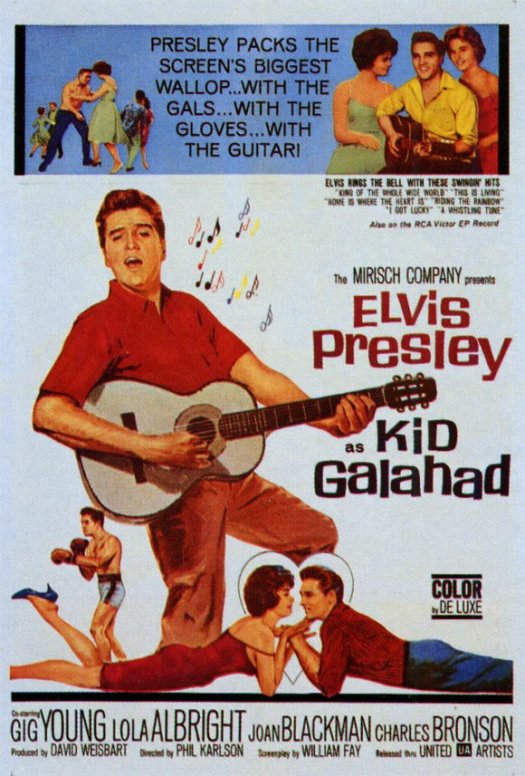
Let’s face it – with a handful of exceptions, most of Elvis Presley’s  post-Army 1960’s movies are awful. They follow a tried-and-true formula that has The King in some colorful location torn between two (or more!) girls, some kind of vocational gimmick (race car driver, scuba diver), and a handful of forgettable songs. KID GALAHAD is one of those exceptions; although it does follow the formula, it’s redeemed by a stellar supporting cast, a fair plot lifted from an old Warner Brothers film, and a well choreographed and edited final boxing match.

The movie’s very loosely based on 1937’s KID GALAHAD, a boxing/gangster yarn that starred Edward G. Robinson, Bette Davis, Humphrey Bogart, and Wayne Morris in the role now played by and tailored for Presley. He’s a young man fresh out of the Army (how’s that for typecasting?) who returns to his upstate New York hometown of Cream Valley…

View original post 557 more words

Playing Catch-Up: Beatriz at Dinner (dir by Miguel Arteta)


Beatriz at Dinner is very much a film of the moment, which is a polite way of saying that it’s not very good but it does accurately reflect the way that a lot of people are feeling right now.  I imagine that’s the main reason why it’s received a good deal of critical acclaim.  It was even cited, by the National Board of Review, as one of the top ten independent films of the year.  By 2019, I doubt anyone will even remember that this film exists.

Salma Hayek plays the title character.  Beatriz is a massage therapist in Los Angeles.  She’s not having a good day.  Not only has her neighbor killed one of her goats but, while she’s at the house of one of her wealthy clients, her car suddenly won’t start.  Beatriz says that she can call a friend to come pick her up but that he won’t be able to show up until after he gets off work.  Beatriz’s client, Kathy (Connie Britton), invites Beatriz to stay for dinner.

Kathy is a familiar type.  She’s the rich, privileged white woman who probably brags about how nice she is to her maid.  Kathy’s husband (David Warshofsky) may not want Beatriz to stay but Kathy feels that they owe a debt to Beatriz because Beatriz helped their daughter recover after she was treated for cancer.  Kathy not only insists that Beatriz stay for dinner but she also asks Beatriz to not only stay the night but also to sing everyone a song after they’ve eaten.  As Kathy’s rich friends start to arrive for dinner, Kathy treats Beatriz like a prop, blithely unaware of how awkward Beatriz feels around her guests.

The main dinner guest is an arrogantly vulgar businessman named Doug Strutt (John Lithgow).  Doug is best known for building hotels, forcing poor people off of their land, and constantly bragging about how rich and famous he is.  He is even working on a memoir.  (In perhaps Beatriz at Dinner‘s only show of restraint, the film does not make him a reality show host.)  The first time that Doug sees Beatriz, he assumes that she must be a maid and asks her to get him a drink.  When Beatriz later launches into a monologue about her childhood in Mexico and how she first came to the United States, Doug interrupts to boorishly ask if she came legally.  Whenever anyone admonishes Doug for being rude, he merely laughs it off and says that he doesn’t mean to be offensive.  He’s just telling it like it is.

Hmmmm … I wonder who Doug is supposed to be a stand-in for?

Anyway, this all sounds promising enough but Beatriz at Dinner doesn’t really do much with this material.  Just as with his previous overrated film, Cedar Rapids, director Miguel Arteta fails to generate any sort of narrative momentum.  Basically, the entire film is Doug saying something offensive and Beatriz glaring at him.  We keep waiting for Beatriz to blow up but when she finally does start to talk back to Doug, it’s anti-climatic.  The dialogue suddenly starts to feel forced and unnatural.  Doug goes from being a disturbingly credible vulgarian to just being another comic book villain and, as a result, Beatriz’s speech feels almost as empty as an angry thread of tweets.  When Beatriz does take more concrete action towards Doug, the film ruins it all with an obvious twist that is nowhere close to being as profound as the filmmakers seem to think it is.  If Beatriz at Dinner was truly as revolutionary as it seems to think it is, that twist wouldn’t be there.

(Buñuel and Godard, who are both obvious influences on Beatriz at Dinner, would dismiss the twist as bourgeois bullshit.)

In the lead role, Salma Hayek is good but not great.  There’s really not much depth to Beatriz as a character.  She functions more as a symbol than as a human being.  (In many ways, the filmmakers treats Beatriz much in the same way that Kathy treats Beatriz, as a prop.)  John Lithgow steals the entire movie, giving the only performance that actually shows a hint of real and dangerous charisma.  As hateful a person as Doug may be, he is truthful about one thing.  He is the only character in the movie who always says exactly what is on his mind.  Lithgow plays Doug as not just a vulgarian but also as someone who is proud of being vulgar and who specifically goes out of his way to see how offensive he can be.  At times, Lithgow is the only member of the cast actually bringing any life to this stifling bore of a film.  Unfortunately, Lithgow is so good that he overpowers the rest of the cast.  When Beatriz rebukes him, Hayek delivers her lines with a heartfelt fury that briefly threatens to rescue the movie from Doug but all Lithgow has to do is smirk and just like that, he’s taken the movie back from her.

For a lot of people, the appeal of Beatriz at Dinner is that Doug is obviously meant to be Trump and Beatriz says everything that they wish they could say.  They see Beatriz’s frustration and anger and they immediately recognize it as being their frustration and anger.  That’s a perfectly legitimate and understandable reaction but that doesn’t necessarily make Beatriz at Dinner a good film.  It just makes it a film of the moment.

A Movie A Day #323: Ted & Venus (1991, directed by Bud Cort)


Strange movie, Ted & Venus.

Actor Bud Cort (you remember him from Harold and Maude) both directs and stars as Ted.  Ted is a homeless poet who lives on the beach and only has one friend, a mellow beach bum named Max (Josh Brolin).  Kim Adams plays Linda, who is the Venus of the title, a social worker who has a bodybuilder jerk for a boyfriend (Brian Thompson, who you might remember as the main villain in Cobra).  When Ted sees Linda, it is love at first sight and at first, the movie seems like it is going to be a quirky romantic comedy where Ted eventually wins Linda over.  When Linda turns down Ted’s advances, Ted does not give up.  Instead, Ted starts following her everywhere and making harassing phone calls.  Ted starts out as a nuisance and goes on to become a full-out stalker.  Everyone, even Max, tells Ted to stop bothering Linda but he is convinced that he can make her fall in love him.  He’s wrong.

Because of the presence of Cort both in front of and behind the camera, Ted & Venus sometimes seems like Harold and Maude: The Later Years.  Harold, the iconoclast that everyone loved, has grown up and become Ted, the unemployable stalker.  It’s an interesting idea and Cort pulls it off as an actor but not as a director.  You have to admire Cort’s devotion to his vision but it’s impossible to be certain what that vision was because the film’s tone is all over the place.  Cort gets a far better performance from himself than he does from the rest of the cast.

Speaking of the cast, the movie is full of familiar faces.  In fact, there are almost too many familiar faces.  It’s hard not to get distracted by all of the cameos.  If you somehow see this obscure movie, keep an eye out for: Woody Harrelson (who gets two lines and five seconds of screen time), Rhea Pearlman, Carol Kane, Martin Mull, Gena Rowlands, Pat McCormick, Vincent Schiavelli, Cassandra Peterson, and Andrea Martin.  When Ted is hauled into court, charged with stalking, the judge is played by LSD guru Timothy Leary.  I am not sure what Ted & Venus was trying to say but Bud Cort assembled an impressive cast to say it.

A Movie A Day #322: CHiPs (2017, directed by Dax Shepard)


Based on the campy 70s cop show that will live on forever in syndication, CHiPs is about two unlikely partners who, after a rough beginning, work together to catch a cop’s killer and capture a gang of armed robbers.
Officer Jon Baker (Dax Shepherd) is a flaky former motocross champion who joins the California Highway Patrol to try to impress his estranged wife (Kristen Bell).  Baker pops painkillers like candy, throws up whenever he enters an unfamiliar house, and has a knee that randomly goes out.  Baker can’t shoot, fight, or think but he sure can ride a bike.

Officer Francis Llewelyn “Ponch” Poncherello (Michael Pena) is actually an FBI agent named Castillo who has been assigned to work undercover to investigate corruption in the CHP.  Ponch is a sex addict who is obsessed with yoga pants and who keeps accidentally shooting his former partner (Adam Brody).

Both Baker and Ponch are given one identifying characteristic.  Baker’s thing is that he always says the wrong thing and then apologizes.  Ponch’s thing is that he always says the wrong thing and then doesn’t apologize.  That is about as deep as things get.

I’m not really sure who this movie is supposed to appeal to.  Michael Pena and Dax Shepard have been good in other productions but they’re both awful here, let down by a script that does not have much to offer beyond tepid bromance and dick jokes.  The humor is too deliberately lowbrow and raunchy to appeal to the people who were fans of the quaintly innocent TV show but it’s also neither meta nor clever enough to appeal to the audience that made hits out of 21 and 22 Jump Street.  I guess the ideal audience for this film would be people who still find gay panic jokes to be hilarious because CHiPs is full of them.  If the last movie you saw was made in 1999 and starred Adam Sandler and David Spade, CHiPs might be right up your alley.

CHiPs is a terrible fucking movie but what really distinguishes it from other terrible movies is the amount of contempt that it seems to have for its source material.  The Jump Street movies might have poked fun at the TV series that inspired them but it was still obvious that the films were being made by fans.  CHiPs can’t even be bothered to use the original’s theme music as anything other than a way to punctuate a few cheap jokes.  Erik Estrada, the original Ponch, does have a cameo but only so he and the new Ponch can talk about eating ass in Spanish.  Otherwise, there is nothing that links the movie to the TV show.  A more accurate title would have been Two Assholes On Motorcycles, except the motorcycles really are not that important to the film.  So, I guess the title would actually just have to be Two Assholes.  That sounds about right to me.

CHiPs proves that not every stupid cop show needs a movie version.  Now, excuse me while I get back to work on my T.J. Hooker spec script…

I’ll Be Superamalgamated!: DOC SAVAGE, THE MAN OF BRONZE (Warner Brothers 1975)


gary loggins's avatarcracked rear viewer

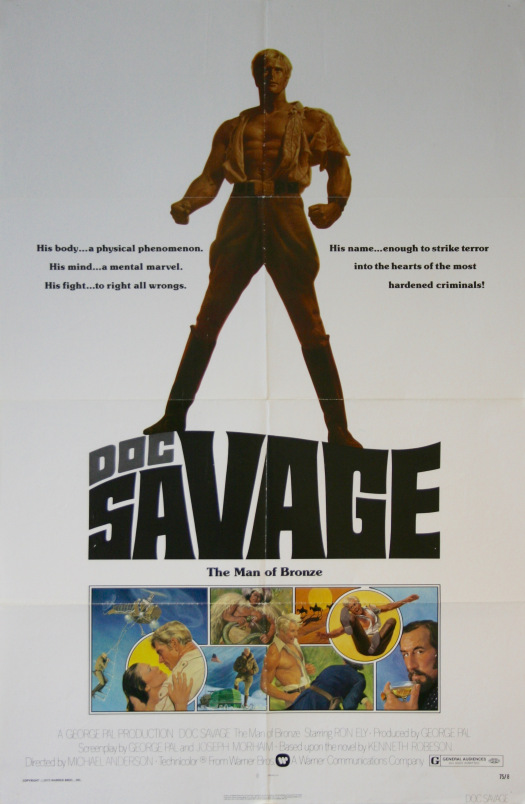
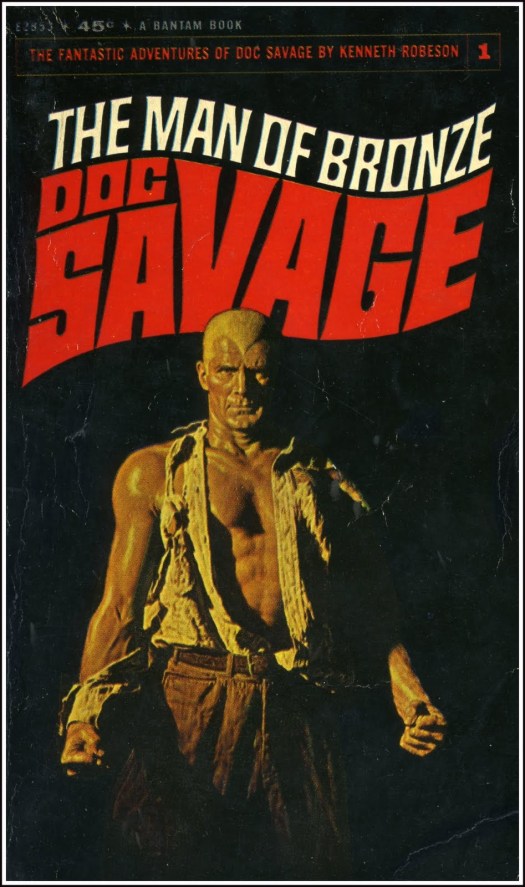
I used to devour those Doc Savage pulp novels reissued as paperbacks by Bantam Books. You know, the ones with those cool James Bama covers? They were filled with action, adventure, intelligence, and good humor, as written by Lester Dent under the pseudonym ‘Kenneth Robeson’. Doc himself was a paragon of goodness, trained from birth in the arts and sciences, a perfect physical specimen adept at all the fighting disciplines with near super-human strength. In fact, one could make a case for Doc Savage as the world’s first mass-market superhero, the Man of Bronze predating DC’s Superman (The Man of Steel) by a good five years.

Doc’s amazing adventures screamed for a screen treatment, but it wasn’t until 1975 that producer George Pal bought the character’s rights from Dent’s widow Norma and made DOC SAVAGE: THE MAN OF BRONZE. Pal, whose credits include sci-fi classics like WHEN WORLDS COLLIDE, WAR…

View original post 442 more words