The TSL’s Grindhouse: Spiral: From the Book of Saw (dir by Darren Lynn Bousman)


I can imagine the pitch sessions for Spiral: From The Book Saw.

“What do people really like the Saw movies?”

“The Jigsaw Killer!”

“Right!  So let’s make a Saw movie without the Jigsaw Killer.  What else do people like about the Saw movies?”

“The gory but clever torture scenes!”

“Right!  So, let’s only have a few torture scenes that are gory but not particularly clever.  What else would make this a good Saw film?”

“A star in the leading role!”

“Right!  So, let’s cast a comedian who is a notoriously terrible actor.”

“YAY!”

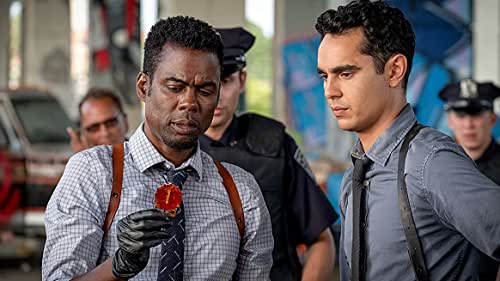
Anyway, Spiral features Chris Rock as a hard-boiled homicide detective who spends almost the entire movie with a scowl on his face.  He does make a few jokes but they’re all of the “This is a New Jack city!” variety.  Rock is living in the shadow of his wildly popular police chief father, played by Samuel L. Jackson.  Rock is a tough cop who does things HIS WAY!  And he can’t trust anyone else on the force because he’s just so honest.

Spiral does not feature Tobin Bell, though we do briefly see a picture of him when someone mentions that the latest round of murders seem like they may have been committed by a Jigsaw copycat.  The thing with copycats is who cares?  They can’t even come up with an original idea.  They have to copy another killer.  I mean, there’s a lot of movies about killers in the woods but people remain loyal to Jason Voorhees because he was the original.  Just like with Halloween. Every reboot, except for the third one, has featured Michael because without Michael, who cares?  You can lose everyone else but Michael, and how people react specifically to Michal, is what the franchise revolves around.  So, with Saw, if Jigsaw is not there …. WHO CARES!?

Listen, I don’t even like the Saw movies but even I was annoyed by this film’s lack of Jigsaw.

Anyway, it’s a dumb movie.  It tries for a bit of political relevancy by making almost all of the victims crooked cops but it’s like Defund Copycat Serial Killers, not the police.  Chris Rock and his new partner are investigating all the murders and Rock tries so hard to give a convincing performance that it becomes painful to watch.  Seriously, if you’re good at comedy, do comedy.  Be proud of it because a lot of people are not good at comedy.  If playing a dramatic character is that much of a struggle for you, don’t do it.  That’s why we’ve got actors like …. uhmmm, that guy who was in that really dramatic movie, whatever it was called.  It was really good and dramatic.  He would have been good for the lead in Spiral.  Actually, Ethan Hawke would have been good as the lead too.  Or maybe Denzel Washington.  But good luck getting them to agree to be in a Saw movie that doesn’t feature Tobin Bell.

Anyway, Spiral was pretty disappointing.  Chris Rock is funny and likable in comedies so maybe that’s what he should stick with for now.  Leave the dramatic crime stuff to the cast of the latest Dick Wolf show, y’know?  And if there is another Saw movie, Jigsaw better come back to life because otherwise, what’s the point?
International Horror Film Review: Lisa and the Devil (dir by Mario Bava)


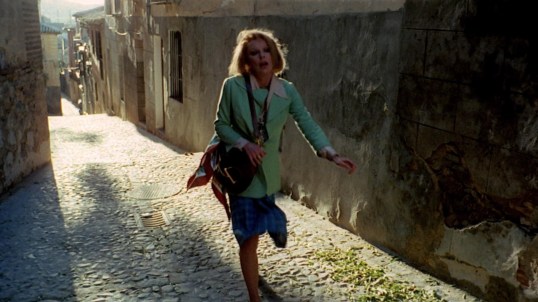
Originally filmed in 1972 and tragically not seen the way it was intended to be seen until years after Mario Bava’s death, Lisa and the Devil tells the story of Lisa (Elke Sommer), a tourist who is visiting the city of Toledo, Spain with a friend.  From the first minute we see Lisa walking through the streets of the city, something seems to be off.  The city seems strangely deserted.  The streets themselves seem menacing, in much the same way that streets of Vienna did in The Third Man.

Lisa leaves her tour group and goes in a store.  A menacing, bald man (Telly Savalas) gives Lisa a strange look as he buys a dummy.  The man resembles a portrait of the devil that Lisa saw earlier.  Running from the shop, Lisa runs into another man (Espartaco Santoni) who appears to be following her.  The man appears to fall to hi death but, despite that, the man will return later.  People have a way of returning in Lisa and the Devil.

Lisa’s tour group appears to have vanished.  She eventually runs into a seemingly friendly couple (Sylvia Koscina and Eduardo Fajardo) who, along with their driver (Gabriee Tinti), agree to take Lisa back to her hotel.  But instead, they somehow end up outside of a dilapidated, mannequin-filled mansion.  When the car breaks down, the group is invited to spend the night by the Countess (Alida Valli, who also appeared in The Third Man), who lives in the mansion with her strange but handsome son, Maximilian (Alessio Oriano).  Maximilian is still mourning his ex-girlfriend, Elena.  Elena, we’re told, bore a striking resemblance to Lisa.

However, it turns out that the Countess and Maximilian are not alone in the mansion.  Also living in the house is the Countess’s second husband, Carlos, who just happens to be the same man that was following Lisa in the city!  And finally, there’s the butler, Leandro, who is the same man who Lisa earlier saw in the shop!

Lisa and the Devil is one of my favorite Italian horror films.  Yes, some of that is because I shared the same name as the movie’s main character and I love it when people say my name a lot.  But I would love this film even if Elke Sommer was playing someone named Annalise or Tiffany.  Mario Bava said that this film, or at least his version of the film, was one of his most personal works and the entire movie does feel like a puzzle that only one person could possibly solve.  In the movie, only Leandro seems to full understand what’s happening in both the city and the house.  In real life, it’s likely that only Mario Bava understood everything that happened in the film.  The film mixes a giallo mystery (because people do soon start to die the mansion) with a surreal exploration of memory, regret, sin, and guilt.  The movie plays out like a waking dream, leaving us to wonder just who exactly Lisa truly is and who the Devil of the title might be.  It’s easy to spot the Devil.  It’s less easy to spot which parts of the film are meant to be reality and which parts might simply be happening in Lisa’s mind.

Unfortunately, the film’s producer had no idea what to do with Bava’s surreal masterpiece.  The few people who saw the film were baffled.  The Italian censors demanded massive cut for both sex and violence and, as a result, Lisa and the Devil was one of the few Bava films not to get a theatrical release in his native country.  It apparently did play in South Korea and Spain, though the Spanish version did not feature Bava’s original, mind-twister of an ending.

Even worse, for the film’s American release, the film’s producer requested that Bava add some exorcism scenes so that the film could take advantage of the popularity of The Exorcist.  By now realizing that his preferred version of the film would probably never be seen, Bava agreed.  With the help of his son, Lamberto, Mario Bava shot several scenes featuring Elke Sommer acting possessed while a priest played by Robert Alda tried to exorcise the demon.  The original Lisa and the Devil footage was presented as being scenes from the dimension Lisa’s soul had been sent to while the demon controlled her body.  The film was retitled House of Exorcism in Amercia.  And here’s the thing — House of Exorcism is hardly a bad movie.  Bava is Bava, afterall.  Sommer does a convincing job acting possessed and the mix of new and old footage is edited together fairly well.  But it’s still not the film that Bava set out to make.

Sadly, Bava’s original version of Lisa and the Devil would not get a proper video release until decades after his death.  It’s not always an easy film to follow.  I’ve seen it several times and there are still things about it that I still don’t fully understand.  It’s a surreal masterpiece, one that is perhaps not meant to be fully understood and the type of dream-film that shows why Bava is one of the few directors that David Lynch has regularly cited as being an influence on his own work.  Lisa and the Devil is a trip through a world dominated by dark and disturbing things and it’s one of the best Italian horror films to come out of the 70s.  Thankfully, it can now be seen the way that Bava intended.


A Blast From The Past: Halloween Safety (dir by Herk Harvey)


Director Herk Harvey

Tomorrow, we will be sharing the classic film Carnival of Souls. That means that today, it’s for us to show our last Herk Harvey short film of the 2021 Horrorthon. And appropriately enough, it’s all about Halloween!

This short film was made in 1977, long after the release of Carnival of Souls. In it, safety tips are offered up to make sure that all the kids have a safe Halloween. Make sure you can see clearly, even if you’re wearing a mask. Don’t wear dark clothing. Grab a flashlight. Don’t trick or treat alone! Hey, it’s all good advice. And Herk Harvey seems like someone who knew a little something about having a good Halloween!

From 1977, here’s some lessons on Halloween Safety!

Horror Film Review: The Terror (dir by Roger Corman, Monte Hellman, Francis Ford Coppola, Dennis Jakob, Jack Hill, and Jack Nicholson)


Can you follow the plot of the 1963 horror film, The Terror?

If so, congratulations!  You’ve accomplished something that even the people who made the film have admitted to being unable to do.

The film opens in 19th century Europe.  Andre Duvalier is an earnest French soldier who has somehow gotten lost in Germany.  Andre is played by a youngish, pre-stardom Jack Nicholson.  Nicholson, that most contemporary, sarcastic, and American of actors, is thoroughly unconvincing as an idealistic Frenchman from 1806.  Obviously unsure of what do with the character, Nicholson delivers his lines stiffly and does what he can to downplay the naturally sardonic sound of his voice.  This is probably the only film where Jack Nicholson is a “nice young man.”

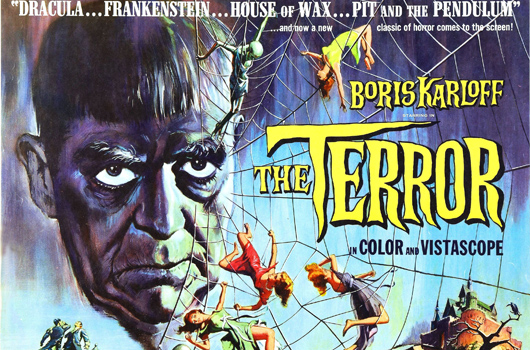
Andre meets a mysterious woman named Helene (played by Sandra Knight, who was Nicholson’s wife at the time).  Helene appears to live in a castle with the Baron (Boris Karloff) and his servant, Stefan (Dick Miller, who makes no effort to come across as being, in anyway, European).  However, Helene bears a distinct resemblance to the Baron’s long-dead wife, Ilse, who the Baron killed after discovering her with another man.  However, a witch in the village claims that Ilse’s lover was her son so she put a curse on the Baron and the presence of Helene is a part of that curse.  However, Stefan claims that the Baron isn’t actually the Baron and and that Ilse’s husband isn’t actually dead.  However….

Yes, there’s a ton of plot twists in this movie, which is probably the result of the fact that the film was shot without a completed script.  In fact, the only reason the movie was made was because Roger Corman had access to Boris Karloff and a castle set that he used for The Raven.  When he discovered that he could use the set for two extra days, he shot some random footage with Boris Karloff and then he tried to build a movie around it.  As a result, the cast and the directors largely made up the story as the filmed.

Yes, I said directors.  While Corman shot the Karloff scenes, he no longer had enough money to use a union crew to shoot the rest of the film.  Because Corman was a member of the DGA, he couldn’t direct a nonunion film. So, he assigned the rest of the film to one his assistants, an aspiring filmmaker named Francis Ford Coppola.  Coppola shot the beach scenes and, in a sign of things to come, he went overbudget and got behind schedule.  Coppola was meant to shoot for three days but instead went for eleven.

Though Coppola shot the majority of the film, he got a better job offer before he could do any reshoots.  Coppola suggested that a friend of his from film school, Dennis Jakob, take over.  Jakob shot for three days and reportedly used most of the time to shoot footage for his thesis movie.

Still feeling that the movie needed a few extra scenes to try to make sense of the plot, Corman then gave the film to Monte Hellman and, after Hellman got hired for another job, Jack Hill.  Hellman would later go on to direct films like The Shooting and Two-Lane Blacktop.  Jack Hill would later direct Spider Baby and several other exploitation films in the 70s.  Reportedly, on the final day of shooting, even Jack Nicholson took some time behind the camera.  It was Nicholson’s first directing job.  (Nicholson, for his part, has often said that his original ambition in Hollywood was to become a director and not an actor.)

So, yes, the film’s a bit disjointed.  The plot doesn’t make any sense.  Nicholson shows little of his trademark charisma.  But Dick Miller has a lot of fun as the duplicitous Stefan and Boris Karloff brings his weary dignity to the role of the Baron.  Oddly, even though the Baron’s scene were shot before the script had even been written, they’re the ones that make the most sense.  It’s a messy film but it plays out with a certain hallucinatory style.  It’s a piece of Hollywood history and a testament to Roger Corman’s refusal to waste even two days of shooting.  If you’ve got a star and a set for two days, you’ve got enough for a movie!

Horror on the Lens: The Little Shop of Horrors (dir by Roger Corman)


(It’s tradition here at the Lens that, every October, we watch the original Little Shop of Horrors.  And always, I start things off by telling this story…)

Enter singing.

Little Shop…Little Shop of Horrors…Little Shop…Little Shop of Terrors…

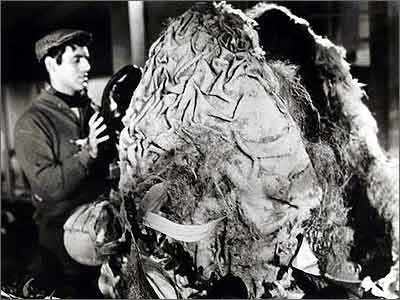
Hi!  Good morning and Happy October 29th!  For today’s plunge into the world of public domain horror films, I’d like to present you with a true classic.  From 1960, it’s the original Little Shop of Horrors!

When I was 19 years old, I was in a community theater production of the musical Little Shop of Horrors.  Though I think I would have made the perfect Audrey, everybody always snickered whenever I sang so I ended up as a part of “the ensemble.”  Being in the ensemble basically meant that I spent a lot of time dancing and showing off lots of cleavage.  And you know what?  The girl who did play Audrey was screechy, off-key, and annoying and after every show, all the old people in the audience always came back stage and ignored her and went straight over to me.  So there.

Anyway, during rehearsals, our director thought it would be so funny if we all watched the original film.  Now, I’m sorry to say, much like just about everyone else in the cast, this was my first exposure to the original and I even had to be told that the masochistic dentist patient was being played by Jack Nicholson.  However, I’m also very proud to say that — out of that entire cast — I’m the only one who understood that the zero-budget film I was watching was actually better than the big spectacle we were attempting to perform on stage.  Certainly, I understood the film better than that screechy little thing that was playing Audrey.

The first Little Shop of Horrors certainly isn’t scary and there’s nobody singing about somewhere that’s green (I always tear up when I hear that song, by the way).  However, it is a very, very funny film with the just the right amount of a dark streak to make it perfect Halloween viewing.

So, if you have 72 minutes to kill, check out the original and the best Little Shop of Horrors

Cleaning Out The DVR: Wicked Stepmother (dir by Larry Cohen)


Weird movie, this one.

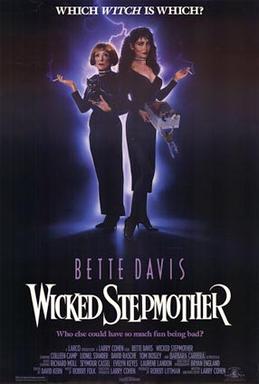
The 1989 film, Wicked Stepmother, was Bette Davis’s final film.  She was cast as Miranda, an enigmatic woman who meets and marries a man named Sam (Lionel Stander).  Sam’s daughter, Jenny (Colleen Camp) and her husband, Steve (David Rasche), are stunned to come home from a vacation just to discover Miranda living in their house.  Miranda chain-smokes, despite Jenny and Steve asking her not to.  Miranda cooks and eats meat, despite Jenny being a vegetarian.  Miranda brags about her sex life which freaks Jenny out even though I suppose really old people do occasionally have sex.  When it becomes apparent that Miranda is a witch who seduces and shrinks her victims, Jenny decides that something must be done.

Wicked Stepmother was not only Bette Davis’s last starring role but it was also the last production that she ever walked out on.  Early on in filming, she announced that she didn’t like the script, she didn’t like the way she was being filmed, and that she didn’t like the director, venerable B-move maestro Larry Cohen.  For his part, Cohen said that Davis left the movie because she was in bad health but she didn’t want to announce that to the world.  In Cohen’s defense, Davis does appear to be rather frail in the movie and often seems to be having trouble speaking.  (Davis has a stroke a few years before appearing in Wicked Stepmother.)  Davis died just a few months after Wicker Stepmother was released so I tend to assume that Cohen was correct when he said that the main reason Davis left the film was because of her health.  That doesn’t mean the script wasn’t bad, of course.  But, in the latter part of her career, Davis appeared in a lot of badly written movies.  She did Burnt Offerings, afterall.

Regardless of why she left, Davis’s absence did require that Wicked Stepmother work around her character.  But how do you do that when Bette Davis was literally the title character?  This film’s solution was to bring in Barbara Carrerra as Priscilla, Miranda’s daughter.  It turns out that Miranda and Priscilla both inhabit the body of a cat but only one of them can use the body at a time.  So, when Priscilla is in the cat, Miranda is among the humans.  When Miranda is in the cat, Priscilla is …. well, you get the idea.  In the film, Priscilla leaves the body of the cat and then refuses to reeneter it because “I’m having too much fun.”  So, whenever we see the cat glaring in the background, we’re meant to assume that we’re actually seeing Miranda in the background.

Got it?

Now, believe it or not, the whole thing with the cat is probably the least confusing thing about Wicked Stepmother.  Jenny can’t convince Steve that Miranda and Priscilla are actually witches.  Steve actually has sex with Pricilla and is shocked when Priscilla starts to turn into a cat but the whole incident is never mentioned again and Steve quickly goes from being an adulterous jerk to a loyal husband.  Sam goes on a game show and, with Priscilla’s help, wins a lot of money even though the questions that he answered were so simple that he shouldn’t have needed the help of a witch’s spell.  (“Who won the election of 1876?” is one question.  The correct answer, by the way, is Rutherford B. Hayes.  Screw you, Samuel Tilden.)  Jenny gets some help from a cop, a private detective, and a priestess of some sort.  The whole thing ends with a big magical battle that involves Barbara Carrera mouthing pre-recorded Bette Davis dialogue.

None of it makes any sense.  The special effects are incredibly cut-rate.  It’s hard not to regret that Bette Davis didn’t go out on a better film.  And yet, when taken on its own terms, Wicked Stepmother itself is oddly likable.  Colleen Camp is sympathetic as Jenny, which is saying something when you consider that Jenny is written to be a humorless vegetarian.  Lionel Stander appears to be having fun as Sam.  Larry Cohen was a good-enough director that, even though he couldn’t save the film from its own bad script and miniscule budget, the movie itself is never boring.  It’s cheap and stupid but its watchable in the same way that Michael Scott’s Threat Level Midnight was watchable.  It may not be particularly good but you just can’t look away.

Insomnia File #51: Ira & Abby (dir by Robert Clary)


What’s an Insomnia File? You know how some times you just can’t get any sleep and, at about three in the morning, you’ll find yourself watching whatever you can find on cable or Netflix? This feature is all about those insomnia-inspired discoveries!

Oh Lord.

So, if you were having trouble getting too sleep last night, you could have turned over to one of the many Showtime channels you could have watched the 2006 film, Ira & Abby.

I doubt it would have helped though.  Ira & Abby is one of those extremely cutesy little love stories where a neurotic guy meets a quirky woman and they spend the entire film having so many easily solved relationship problems that it’ll drive your anxiety through the roof just watching them.

Ira (Chris Messina) is the son of two psychologists (Judith Light and Robert Klein).  Ira is planning on becoming a psychologist himself and, of course, he’s in therapy.  At the start of the film, his therapist tells him that he’s beyond help and that he needs to do something spontaneous for once.  Ira takes this to mean that he should go the gym.

At the gym, Ira meets Abby (Jennifer Westfeldt), who is quirky and universally beloved by everyone who meets her.  (Westfeldt also wrote the script, which …. might explain a little.)  Abby has a positive attitude and lives with her musician parents (Fred Willard and Frances Conroy).  After Ira sees Abby somehow talk a mugger out of robbing everyone on a subway car, he decides that they have to get married.  Free-spirited Abby agrees.

Marriage follows!  Complications follow!  Annulment and remarriage and more follows!  Everyone ends up seeing a different therapist while, at the same time, Ira’s mom has an affair with Abby’s dad.  And yes, it eventually does end with every character in the film gathering in one room and taking part in a giant therapy session.  It’s exhausting to watch, largely because it just seems like all of the problems could be solved by people not being stupid or foolishly impulsive.  Ira is neurotic to the point of no longer being sympathetic.  Abby is so perfect and wonderful that you soon get sick of her and her positive attitude.  Even Ted Lasso would tell her to turn it down a notch.

The most frustrating thing about the movie is that it features good actors like Chis Messina but it goes out of its way to sabotage them every chance that it gets.  Out of the large and impressive cast, only Fred Willard and Judith Light manage to transcend the script.  I would have loved to have watched a movie just about their characters.

Previous Insomnia Files:

  1. Story of Mankind
  2. Stag
  3. Love Is A Gun
  4. Nina Takes A Lover
  5. Black Ice
  6. Frogs For Snakes
  7. Fair Game
  8. From The Hip
  9. Born Killers
  10. Eye For An Eye
  11. Summer Catch
  12. Beyond the Law
  13. Spring Broke
  14. Promise
  15. George Wallace
  16. Kill The Messenger
  17. The Suburbans
  18. Only The Strong
  19. Great Expectations
  20. Casual Sex?
  21. Truth
  22. Insomina
  23. Death Do Us Part
  24. A Star is Born
  25. The Winning Season
  26. Rabbit Run
  27. Remember My Name
  28. The Arrangement
  29. Day of the Animals
  30. Still of The Night
  31. Arsenal
  32. Smooth Talk
  33. The Comedian
  34. The Minus Man
  35. Donnie Brasco
  36. Punchline
  37. Evita
  38. Six: The Mark Unleashed
  39. Disclosure
  40. The Spanish Prisoner
  41. Elektra
  42. Revenge
  43. Legend
  44. Cat Run
  45. The Pyramid
  46. Enter the Ninja
  47. Downhill
  48. Malice
  49. Mystery Date
  50. Zola

The TSL’s Grindhouse: Terrifier (dir by Damien Leone)


Are you scared of clowns?

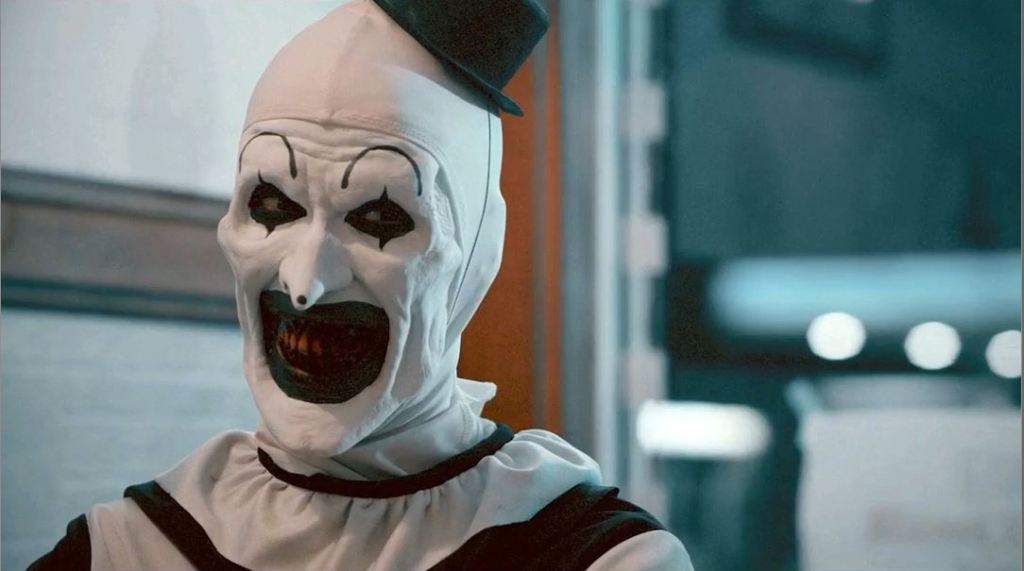
I’ve never really had much of a problem with clowns, beyond the fact that some of them really do need to learn how apply lipstick without getting it all over their face. That said, two years ago, I watched the 2016 horror film, Terrifier, on Netflix and I now totally understand why some of my friends are totally terrified of the grinning men in the white makeup. I mean, I will send a Pennywise GIF to my clownphobic friends without even worrying about what damage I may or may not be doing to their mental well-being but I can guarantee you right now that I will never send any of them a picture of Art the Clown.

Art the Clown

Art (who is played by David Howard Thornton) is the clown at the center of Terrifier and, as you can tell from looking at the picture above, he’s not exactly a clown that you want to meet in the middle of the night. Unfortunately, over the course of the film, several innocent people do just that. There’s the homeless woman who meets him in an abandoned building. There’s the two drunk girls who, after leaving a Halloween party, make the mistake of laughing at Art. There’s the owner of the pizzeria who makes the mistake of kicking Art out of his establishment. Art, it turns out, doesn’t deal well with rejection. It also turns out that Art can turn just about anything into a deadly weapon. (We also later learn that Art just happens to have a chainsaw. Agck!)

Art doesn’t speak. We never learn where Art came from and why he insists on killing everyone that he meets. This lack of motivation makes Art a very scary clown indeed. We can only assume that he kills because he’s evil and, being a creature of pure evil, there’s really no way to reason with him or to rationalize his actions. Art is pure chaos released into the world and, as a result, he’s terrifying. If nothing else, Terrifier is a film that lives up to its name.

Director Damien Leone made Terrifier with a budget of a $100,000 and he uses that low budget to his advantage. The deserted building where Art stalks the majority of his victims is a genuinely atmospheric location and, even if they were done cheaply, the gore effects are disturbingly nightmarish. Fortunately, Leone gets some good performances from his cast, which makes the film all the more frightening. David Howard Thornton has enough presence to make Art the Clown intimidating, even when he’s just standing still and staring at nothing. As the film’s “final girl,” Samantha Scaffidi gives a likable and relatable performance. Wisely, the film neither turns her into a super warrior nor a simpering fool. Instead, she’s just a normal person trying to survive the night, much like those of us watching the film in what we hope is the safety of our own home.

Terrifier is an effectively scary little slasher film. It’s not for everyone, of course. It’s a film for horror fans and it has little interest in reaching out to people who don’t normally enjoy the genre. The violence is brutal and the film doesn’t shy away from gore. Those of you who easily fall prey to nightmares may want to stay away. As for those of you who are scared of clowns …. well, Terrifier will prove the correctness of your phobia. Seriously, if clowns scare you, don’t watch this movie. It’ll be safer for you just to watch It again….

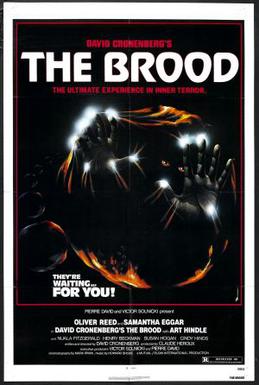
International Horror Film Review: The Brood (dir by David Cronenberg)


O Canada!
Our home and native land!
True patriot love in all of us command.
With glowing hearts we see thee rise,
The True North strong and free!
From far and wide,
O Canada, we stand on guard for thee.
God keep our land glorious and free!
O Canada, we stand on guard for thee.

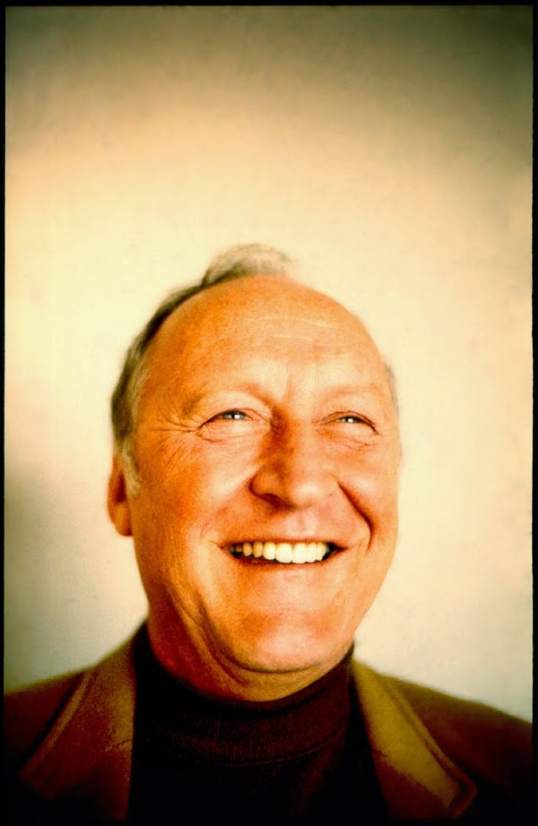
Canada!  It always seems like such a nice country until you watch a David Cronenberg film.  Hailing from Toronto, Cronenberg started his film career with two satirical, black-and-white science fiction shorts and then went on to become one of Canada’s best-known filmmakers.  At a time when most people associated Canada with politeness and maple syrup, Cronenberg made visceral and often-disturbing films, ones that often mixed sexuality with graphic body horror.  At a time when the genre was being dominated by Italian filmmakers, Cronenberg brought a uniquely Canadian sensibility to horror.

Take 1979’s The Brood, for instance.

The Brood tells the story of one very doomed marriage.  Frank (Art Hindle) and Nola (Samantha Eggar) Carveth are fighting for custody of their five year-old daughter, Candice (Cindy Hinds).  (Not coincidentally, Cronenberg was going through his own custody battle when he first came up with the idea for The Brood.)  Nola, who has been emotionally scarred by both her alcoholic parents and her troubled marriage to Frank, is a patient at Somafree Institute.  Her psychotherapist, Dr. Hal Raglan (Oliver Reed), practices a technique called “psychoplasmics.”  Though it’s not easy to describe (and, wisely, Cronenberg doesn’t spend too much time trying to justify the science of it), it basically involves channeling anger and suppressed emotions into body modification.  What you or I might consider to be a hive or a welt is what Dr. Raglan would call a major breakthrough.

Frank is skeptical about Dr. Raglan’s theories but he still takes Candice to visit her mom.  However, when Candice returns from one visit bruised and scratched, Frank is convinced that Nola has been abusing her.  Hoping to both win custody of Candice and prove that Dr. Raglan’s methods are dangerous, Frank starts his own investigation into just what exactly has been happening at the Somafree Institute.

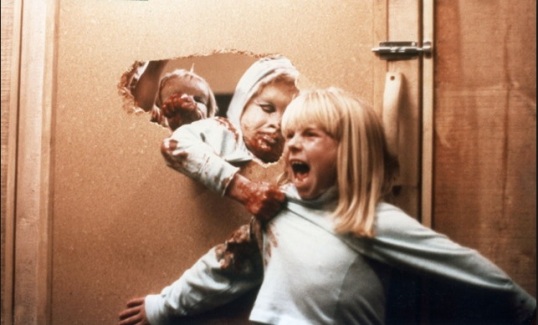
That’s when the children start to show up.  The children are small, with pale skin and light hair and oddly featureless faces.  They never smile.  They never speak.  They show up without any warning and violence always seems to follow them.  They attack both Nola’s mother and father.  When Nola suspects that Frank might be having an affair with Candice’s teacher, two of the children suddenly appear in her classroom.  Candice is scared of the children but still seems to have some sort of connection to them…

Even if you didn’t know this was a Cronenberg film, it would take just one look at the snow-covered landscape to identify The Brood as being a Canadian film.  As was often the case with Cronenberg’s early horror films, the imagery is frequently cold and chilly.  However, The Brood is not a cold film.  With its look at dysfunctional families and its emphasis on Frank’s attempts to protect his daughter, The Brood is actually one of Cronenberg’s most emotional films.  It’s a film about not only anger but also how people deal with that anger.  The killer kids are both literally and metaphorically children of rage.

Even by the standards of Cronenberg, things get grotesque.  Fortunately, the film’s talented cast keeps you interested, even when the bloody visuals might make you want to find a nice comedy to watch instead.  Art Hindle and Cindy Hinds are sympathetic as the father and daughter.  Oliver Reed keeps you guessing as to what exactly Dr. Raglan is actually trying to accomplish.  Nicholas Campbell and Robert A. Silverman, two members of the Cronenberg stock company, both make an impression in smallish roles.  And Samantha Eggar totally throws herself into her role, turning Nola into an absolutely terrifying monster.

Though it never quite reaches the flamboyant heights of either Scanners or ShiversThe Brood is still an effective horror film.  As opposed to some of his other films of the period, Cronenberg actually seems to not only care about the characters in the film but it also comfortable with encouraging us to care about them as well.  As a result, The Brood becomes about more than just trying to shock the audience.  The Brood is a film that sticks with you.

The Brood (1979, dir by David Cronenberg DP: Mark Irwin)

A Blast From The Past: Shake Hands With Danger (dir by Herk Harvey)


Director Herk Harvey

Since I’m going to be sharing Herk Harvey’s Carnival of Souls on Saturday, I’ve been preparing by showing some of the short films that Harvey directed before and after making his only feature. 1980’s Shake Hands With Danger was actually one of Harvey’s final films and, needless to say, it came out long after Carnival of Souls.

This short film is all about being safe while working with heavy machinery. If Candace Hilligoss had shown more caution, she wouldn’t have had to shake hands with danger in Carnival of Souls. See, it’s all connected! Welcome to the Herkiverse.

Here’s the film. Watch and learn: