Horror Review: “One for the Road” (by Stephen King)


Stephen King’s writing style in “One for the Road” exemplifies his mastery of atmosphere, character voice, and narrative restraint. While much of his later work often invests heavily in world-building over long stretches, this short story demonstrates his ability to deliver a rich, immersive experience in a concise format. His choices here, both stylistic and structural, serve the story’s central purpose: to convey unspoken dread and the inevitability of evil.

The story serves as a chilling epilogue to ’Salem’s Lot, set during a brutal New England winter many years after a fire destroyed the infamous town. Told by Booth, an elderly local from nearby Falmouth, it begins in the warm familiarity of Herb Tookey’s bar, where Booth and Herb are longstanding fixtures. Their evening is interrupted when Gerald Lumley, cold and near collapse, stumbles in. Lumley explains that his car broke down in the snow miles away, and that he left his wife and daughter in the vehicle while seeking help. Tension deepens when he reveals the breakdown happened near Jerusalem’s Lot—a place everyone in the area fears but rarely discusses. Despite knowing the dangers, Booth and Herb reluctantly agree to help him return.

Their journey into the storm is both physically taxing and emotionally tense, as the two locals understand all too well what they might find. As they approach the outskirts of The Lot, King uses sparse detail and implication to build dread. By the time they reach Lumley’s car, the supernatural horror makes itself known, hammering home the message that evil never truly dies—it lingers, waiting for an opportunity to strike.

King’s decision to frame “One for the Road” within a harsh New England winter is critical to its success. The cold itself becomes an antagonist—slowing movement, reducing visibility, and draining the characters’ strength—adding a physical urgency to the supernatural threat. Snowstorms are a recurring motif in his work (The ShiningStorm of the Century) because they isolate the characters, making escape impossible and forcing confrontation with whatever is lurking nearby. The blizzard in this story intensifies feelings of claustrophobia, despite the vastness of the open, rural landscape.

King also makes the setting deeply familiar for his readers. Falmouth feels like a lived-in place, with its bar, locals who know one another’s routines, and whispered legends about The Lot. The story doesn’t waste time describing Jerusalem’s Lot in detail; instead, its horrors exist in the margins, in what the locals refuse to say.

The choice of Booth as the first-person narrator adds authenticity and intimacy. Booth speaks with the cadence of an elder New Englander—practical, reserved, and hardened by experience. Readers never doubt that this is the account of someone who understands the local history and its dangers. The conversational delivery, sprinkled with regional colloquialisms, draws the reader into the moment rather than presenting a polished, detached recounting.

Rather than sensationalizing The Lot’s horrors, Booth lets them linger unsaid. King understands that withholding explicit details can fuel imagination more effectively than extravagant description. This restraint makes the story’s climax more impactful because the dread has been steadily fed through implication.

The story’s pacing is deliberate but tight. King introduces the danger early—Lumley’s car is stranded near Jerusalem’s Lot—then uses the journey back to extend suspense. The structure mirrors a descent into darkness: starting in the relative safety of Herb Tookey’s bar, venturing into the blizzard, and finally confronting the true horror at the edge of The Lot. King avoids unnecessary subplots, instead focusing on a single mission: rescuing Lumley’s family. This gives the narrative relentless forward motion while allowing tension to rise in small increments.

One of King’s most notable thematic choices is the portrayal of evil as a constant, indestructible force. In ’Salem’s Lot, that evil once emanated from the Marsten House, a decaying mansion that served as both the symbolic and literal heart of darkness. By the time of “One for the Road,” however, the Marsten House has been burned down and stripped of its power. Yet, rather than eradicating the evil, its essence has expanded outward—the town itself has inherited its malign influence. The Lot has effectively become the new Marsten House, and its ruined streets and frozen remains now radiate the same dark gravity that once resided solely within those walls. King transforms the geography of evil: what was once contained in a single haunted house has transposed itself over the entire landscape, infecting the air, the snow, and the silence with something sentient and waiting.

King also plays with the tension between duty and self-preservation. Booth and Herb could have ignored Lumley’s plea. Their choice to help—despite knowing what might await them—aligns with King’s recurring motif that true courage lies in facing evil with no guarantee of victory.

Even when weaving atmosphere, King exercises a tight control over detail. The bar scene is economical: we know just enough about Herb, Booth, and their friendship to trust their dynamic. The blizzard is described vividly but without purple prose. This brevity forces the reader to focus on what matters—the growing realization that Lumley’s family is in mortal danger. The vampires themselves receive minimal “screen time,” a deliberate choice that allows the prior suspense to make their eventual appearance all the more devastating.

As a companion piece, “One for the Road” functions as both a continuation and a tonal reinforcement of ’Salem’s Lot. Rather than tying up loose ends, King emphasizes that nothing was truly resolved. Evil is only temporarily held back, and the destruction of the town did not remove its blight. By telling the story through outsiders who skirt the edge of The Lot without entering deeply into it, King preserves the town’s mystique, forcing readers to imagine the horrors that remain—an imaginative space where dread thrives long after the last page.

Nightmares and Dreamscapes: From the stories of Stephen King, Battleground, Review by Case Wright


bg4.jpg

Happy Horrorthon!!! I decided to do a bit of a hybrid review of one of my favorite stories:  “Battleground” by Stephen King.  This book is part of a short story anthology in Night Shift.  Battleground was written in 1972 by King.  This was back in the days when he wasn’t just hungry, he was starving.  He was working in laundries, substitute teaching, maybe even a paper route.  This particular work was published in Cavalier, which was a low-rent Playboy.  In those days, he would sell stories to Swank – a low-rent Penthouse as well.  Many of these stories were real gems or at least gems in the rough.  For example, Night Surf (Cavalier and Night Shift) evolved into his opus The Stand about a decade later.  Battleground was made into a 52 minute long episode of the above short-lived series (watch them on youtube before they are taken down!!!).

This episode starred William Hurt and like the short-story there is ZERO dialogue, giving the episode a silent movie feel that is very compelling.  Throughout the episode, you only hear ambient noise or grunts or yells, but no spoken dialogue.  In fact, even when a newscaster is announcing that a murder has taken place, it’s done with subtitles.  This is as close to genius television as it gets.  I was truly saddened that it was not renewed.

The episode depicts William Hurt as a nameless hitman who is taskered to kill a toymaker.  He does.  When Hurt goes back home to his San Francisco condo, he receives a package.  Inside the package is compilation of army men and “additional surprises”.  These aren’t your grandpa’s plastic army men; however, they are alive and they have cruel intentions for Mr. Hurt!

Within moments of opening the package, the army men attack William Hurt in very Army like fashion. They take a covered position under Hurt’s couch and open fire, forcing William to flee to the bathroom.  This solace is short-lived because they have mini-howitzers.  Yes, I was primed to like this one.  There are even mini-helicopters that attack Hurt and they send nasty notes to one another demanding and refusing surrender.

The battle to avenge the toy maker’s death continues even out to the ledge of the building, which is likely an Easter Egg to another King story “The Ledge”.  Hurt prevails against the army men, but there are two more “Additional Surprises” 1) a commando who very resourceful and 2) a mini thermonuclear device.  The mini thermonuclear device is the only dumb part of the story because there is no such thing as a tiny Thermonuclear reaction – these are atoms we’re fusing or splitting afterall.  If detonated (regardless of its “mini” nature) , it would’ve destroyed all of San Francisco, but let’s give King- a liberal arts major- a break on that one because it’s still a fun story.

I will review a few more of these stories that were in Night Shift or episodes from this show.

Happy Halloween!!!!

Book Review: ‘Salem’s Lot by Stephen King


The town of Jerusalem’s Lot, Maine has two new arrivals.

One is Ben Mears, a successful writer who, we’re told, even has his own FBI file.  (Apparently, it only consists of a report that he once attended an anti-war rally.)  Ben spent part of his childhood is Jerusalem’s Lot and, upon returning, he discovers a small but friendly town.  Sure, there’s some drama going on behind closed doors.  There’s the sleazy real estate agent, for instance.  And then there’s the Catholic priest who, naturally, has lost his faith.  And then there’s the unhappy teenage mother and, of course, there’s the usual collection of alcoholics, adulterers, and cranky bus drivers.  Maybe Jerusalem’s Lot isn’t that friendly after all….

The other new arrival is Kurt Barlow.  Barlow’s from Austria and he’s moved into the old Marsten House.  (The Marsten House, like most old houses that you come across in Stephen King novels, used to belong to a notorious gangster.)  Barlow’s going to be opening up an antique store.  Interestingly enough, hardly anyone ever seems to see Barlow.  His business partner, Richard Straker, claims that Barlow is often away on buying trips.

Anyway, the townspeople have a lot more to worry about than what’s going on with Kurt Barlow.  For instance, a lot of people are disappearing.  And even those who aren’t vanishing are growing ill and having a bad reaction to sunlight.  Hmmm …. what could possibly be going on?

First published in 1975, ‘Salem’s Lot was Stephen King’s second published novel and it actually holds up better than most of his recent work.  It’s interesting to read ‘Salem’s Lot after Carrie, just to see how much King grew as a writer in between the two books.  Whereas King often seemed uncomfortable with the plot of his first novel and tended to hold Carrie White at a distance, he dives right into ‘Salem’s Lot.  It’s not just that King is obviously more comfortable writing about a male writer than a teenage girl.  It’s also that King creates a town that seems so real that we feel as if we could find it on a map.  King tells his story with such enthusiasm and confidence that it doesn’t matter that ‘Salem’s Lot is a fairly predictable and traditional vampire story.

Clocking in at a briskly paced 440 pages, ‘Salem’s Lot is quite a bit longer and more detailed than Carrie without, at the same time, getting bogged down in the type of stylistic self-indulgence that has come to typify a lot of King’s recent work.  (One gets the feeling that if King wrote ‘Salem’s Lot today, it would be a 1,200 page novel and that Barlow wouldn’t show up until page 900.)  King does a good job of offering up little snippets of life in Jerusalem’s Lot, just enough to make sure we have enough knowledge to mourn the eventual death of the town.  ‘Salem’s Lot takes Dracula, drops him in the middle of a small town melodrama, and the results are still entertaining to this very day.

Book Review: Baal by Robert R. McCammon


Baal begins with an act of violence.

In the late 60s, a woman is raped in an alley by a stranger whose touch burns her skin.  Nine months later, Jeffrey Harper Raines is born.  The woman’s husband fears the baby and tries to drown him, just to be stopped and murdered by Jeffrey’s mother.

Jeffrey is sent to a Catholic orphanage, where he proves himself to be an intelligent and troubled child, the type who can not only mentally control all of the other children but also inspire them to go on a rebellious and destructive rampage.

Years later, a mysterious cult leader named Baal has emerged, first in California and then eventually in Kuwait.  His followers come from all walks of life and they include some of the wealthiest men on the planet.  A researcher tries to gain access to Baal’s cult and promptly disappears.  The researcher’s mentor, an elderly theologian named Dr. Virga, goes to Kuwait in search of his protegé.

What he discovers is that Baal is not only extremely dangerous but that his followers are willing to do anything that he orders them to do.  Fortunately, Virga does find one ally out in the desert — a mysterious man named Michael….

(I guess it was Gabriel’s week off.)

Baal was first published way back in 1978 and reading it, it’s obvious that the novel was heavily influenced by films like The Omen and Rosemary’s Baby.  In fact, it’s so derivative of those films that it’s impossible not to get kinda annoyed at not only how predictable the story is but also at the fact that it takes the people in the book so much longer to figure out what the reader realizes immediately.  You really do have to wonder if a cult leader couldn’t have perhaps come up with a name other than Baal.  I mean, that’s kind of like naming yourself Lou C. Ifer or something like that.  You’re just giving the game away.

Today, Baal is best known for being the debut novel of Robert R. McCammon.  McCammon was only 25 years old when he wrote and published Baal and most of the book’s problems — the lack of focus, the occasionally clumsy plot twists– are problems that many debut novels seem to have in common.  For quite some time, McCammon refused to allow Baal to be republished, saying that he felt it was inferior to his later historical and crime novels.  For the record, McCammon’s correct about that but Baal still has enough trashy and sordid moments to be occasionally entertaining.  I guess my point here is that Baal isn’t great and, at times, it’s barely good but it’s still better than Bob Honey Who Just Do Stuff.

Star Trek: The Next Generation, Through The Mirror, Review by Case Wright


mu11.jpg

Happy Horrorthon!!! We are back in the eeeeeeeeevil Star Trek universe! Why is it evil? Obviously, it’s because they have beards and follow strict capitalist principles with a healthy dose of militarism.

Before I get into the story, I want to write that David and Scott Tipton do a good job of not having the mirror universe characters seeing themselves as villains.  This may seem obvious, but it’s actually very common – especially in comics.  For example, Stan Lee once had Magneto lead a group of mutants with the moniker of Brotherhood of Evil Mutants.  I get that the X-Men thought they were evil, but why would Magneto?

This volume: Through the Mirror brings our Mirror Universe to the Next Generation universe our youth for supplies and plunder.  Bearded Picard is faced with blockades from rival species in his universe and needs materiel and plunder to fuel his war machine in order to bring the Terran Empire back to its former glory before Emperor Spock made them go all drum-circle kumbaya…bleh.

My main complaint with the Volume Two is actually in the first installment.  It opens with Worf investigating the theft of precious minerals from a mining colony in the “good universe”.  He sees the thief and nearly catches him.  This is a recurring issue with volume 2; the story should be only from the perspective of the mirror universe characters.  There is simply too much of the “good universe”.  They also have the “Good Universe” find an Andorian Ship that has been attacked by Evil Picard after the fact.  WHY?  Show us the Evil Planning, Show us the Pirate Picard attack, Show us why they believe they are justified.  We bought the book; therefore, we are invested in these anti-heroes.   The story could be great if we just get to bathe in their villany.  Don’t judge them.  This is their code.  This is their society.  They don’t see themselves as evil and neither should we.  We can only judge them as evil if they violate their own code of morality not ours.  This isn’t our universe.  The good universe should be treated like MSG a little is … ok… too much and you vomit.

Back to the story, Pirate Picard lures the good enterprise into a trap, hoping to seize it.  They fail, but they failed too much.  It should’ve been more of a draw with a push to the evil universe. Scott and David – the evil guys are your heroes.  They need to win at least a bit.  You can have a close game, but don’t have them get their ass kicked because it makes it too much of a Good Next Gen story.  The other knock is that they left Evil Barclay behind, dragging us back unnecessarily into the good universe.  You are thwarting them waaaaay too much.

It’s time for Evil Picard to kick some ass, but it in a good way.  Is it just for wealth for Pirate Picard?  I don’t think so.  In this universe, the Terrans see themselves as Superior like the British or Roman Empire.  Therefore, when the Klingons and Cardassians took back a lot of the Empire they likely took many Human captives as slaves.  This must be disgustingly unacceptable to Pirate Picard or any Terran Empire member.  Have them liberate a planet, rescuing Human captives.  From their perspective, they are not only NOT EVIL, but good because they are reasserting rightful human dominance to their universe.   If you have to, make some propaganda posters with Pirate Picard.  Make it personal for Pirate Picard.  Maybe Picard’s brother joined the fleet and was captured?  Make it personal! Go for it!  Have Pirate Picard risk it all: mutiny, the ship, the Terran Empire to liberate and rescue his brother and nephew Robert.  It would be epic!!!!! You have an unending depth that you can give Pirate Picard.  Give him his version of humanity.

This volume was ok, but they are not fulfilling some great story potential here.   This could be a great way to reboot the series.  Just remember: They Don’t Consider Themselves Evil.


Cycle of the Werewolf, Book Review by Case Wright


cw1.jpg

Happy Horrorthon!!!! We are already in week 2 and we are makin’ it work!!!  Cycle of the Werewolf is very 1980s Stephen King.  It clocks in at 100+ pages and moves briskly.  In comparison, The Stand was 1000 pages and one chapter was actually from a Golden Retriever’s point of view….really.  If you ever watched old movies on Showtime, you’ll remember this story as “Silver bullet” starring Corey Haim.  The movie was actually fairly close to the book, except no Gary Busey.

The book takes place over the twelve months of the calendar year and I almost did this post as Twelve Days of Christmas song, but with werewolves….it could’ve worked!  The first six months follow the werewolf killing on every full moon in Maine.  As usual in Stephen King’s books the people of Maine are total dirt bags of all varietals: blowhard dirt bags, wife-beating dirt bags, racist dirt bags, and drunken dirt bags.  In short, the townsfolk could all use some killing.

The month of July comes and the story shifts to Marty, a handicapped child, who really loves the 4th of July.  As in the movie, Marty gets a bunch of fireworks from his Uncle and uses them to make the werewolf purblind.  We learn the werewolf is the town Baptist preacher.  As the months progress, Marty starts sending the preacher poison pen letters urging him to kill himself and signs his name to provoke a final confrontation.  The confrontation is a bit anticlimactic because Stephen never really fleshed out the story and the final battle is no different.  There is no close game or near run thing…nope…werewolf comes into the house, leaps at Marty, and Marty kills the werewolf dead. Boom.  That’s it.  It is fun to read these old Stephen King stories; he’s clearly still flexing his creative muscles and not totally sure of himself.

Have a spooky night.

Book Review: The Children by Charles Robertson


Wow, look at all of those creepy kids on the cover of this book!

They really do look like an insufferable pack of brats, don’t they?  If nothing else, this cover confirms that children can be creepy, especially when they all go to the same private school and they all have the same grim expression on their face.

First published in 1982, The Children opens with a series of mysterious deaths.  The richest man in the world dies on an airplane.  His lawyer is killed on another airplane.  A network anchorman and his one night stand are gunned down in his apartment, by an 11 year-old.  A private investigator is pushed off of a subway platform while a bunch of children watch.  There’s something weird about those kids.

The covers describes The Children as being “a novel of terror” but, unfortunately, after a strong opening, it gets bogged down with two characters — glamorous anchorwoman Shelley James and hard-boiled columnist Mark Chandler — investigating the murders and rather inevitably falling in love.  I think a part of the problem is that we know that the children are evil before Shelley and Chandler and it takes the two of them so long to figure out what we already know that it’s difficult not to get annoyed with them.  In fact, after the initial murders, it’s another 200 pages or so before the book actually returns to the involvement of the children and, even then, the payoff is nowhere as exciting as you may have hoped.

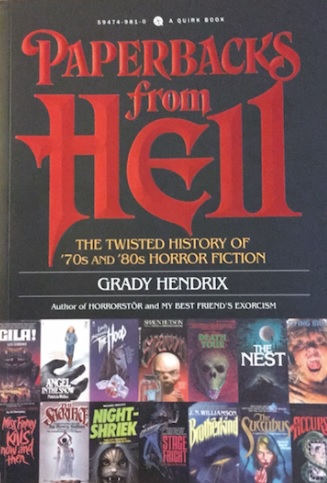
Like 666 and The Rapture, The Children is another book that I ended up reading because I came across it in Grady Hendrix’s Paperbacks from Hell.  While I can’t really recommend The Children to anyone else, I will definitely recommend that, if you haven’t already read Paperback from Hell, that you order a copy today!

Book Review: The Dead Man’s Kiss by Robert Weinberg


Way back at the end of August, in anticipation of the TSL’s Horrorthon, I went down to my local Half-Price Books and I explored their collection of old horror paperbacks.  Among the books that I pulled off the shelf was The Dead Man’s Kiss by Robert Weinberg.

I randomly opened the book and I found myself reading about a woman named Sarah having sex with a resurrected Egypitan sorcerer.  I flipped to another part of the book and suddenly, I was reading about a bunch of Neo-Nazis working with a resurrected Egyptian sorcerer to overthrow the U.S. government.  I flipped through the book again and suddenly, I was reading about two wisecracking cops discussing how weird it was that they had gone from chasing Neo-Nazis to chasing a resurrected Egyptian sorcerer.

In short, it sounded like a weird book so I bought it and I read it.

And you know what?  It is a strange book.  Published in 1992, it tells the story of Jambres, a priest in ancient Egypt who was punished for a crime that he didn’t commit.  Somehow, this led to his soul being split in half and, now that he’s convinced a bunch of Neo-Nazis to resurrect him, he’s determined to bring the two halves together and then rule the world.  Unfortunately, the only way that Jambres can walk around the modern world is by entering someone’s body through their mouth.  This may kill the host but it gives Jambres a body and a set of memories to use.  The only problem is that the body starts decaying as soon as Jambres enters it, so he and the white supremacists are constantly having to search for a new body for him to inhabit.

While Jambres and the Nazis are wondering around Chicago, they’re being pursued by two unflappable cops.  Also on the case is a former MOSSAD agent, who has been assigned to protect the mild-mannered museum worker that Jambres has targeted for death.  It all leads to love, of course.  Love and death.

The plot of Dead Man’s Kiss has a make-it-up-as-you-go-along feel to it.  It’s ludicrous but likable, complete with bizarre dialogue and improbable plot twists.  The book may not make too much sense but it does make for an entertaining 250 pages.

Star Trek: The Next Generation, Mirror Broken- Review By Case Wright


eu1

Happy Horrorthon!!! This review is going to be a deep dive into eeeeeeevil nerdism.  I understand that not everyone reads this site is a techie nerd, BUUUUUUT I think we have a healthy plurality. Nothing is better than to merge an evil universe with my love of Star Trek.

I’m going to give brief recap of the Star Trek Mirror Universe.  There’s a parallel universe in Star Trek that basically capitalist/imperialist.  In that timeline, humans are aggressive and conquered the Vulcans.  You can tell they are evil because they are avaricious and have beards- Think if Seattle/Portland went less drum circle and went more Roman.  It’s common to kill your superior to advance in the chain of command, it’s totally capitalist, and more fun in some ways because it’s a lot less model UN and much more Model Viking.

The evil universe never appeared in the Next Generation, but it did appear in Star Trek: The Original Series and then the second tier properties of Enterprise, Deep Space Nine and Voyager.  In those second tier properties, they set up a timeline that when the “Good Kirk” encouraged Spock to be reformist, it worked.  Too bad for Earth because the Empire got attacked by the other Alien Races we conquered and now Humans are pushed back to their solar system and will likely to be conquered.

Where there’s life, there’s hope.  In this comic, the writers Steven and David Tipton imagine if Jean Luc Picard was an uncompromising badass who is determined to bring the Terran Empire back to its former glory. How does he do this besides being really JACKED? Picard sets out to steal the Galaxy Class Enterprise.  This creates a great heist story, but it’s also super fun because it explores all of the old characters from the Next Generation and I mean ALL! There are character that were all but extras in Next Generation that are featured in the background of the book.  There are so many interesting takes on our old heroes.  Barclay is cunning, Data is experimenting with Borg-technology, and Geordie has his paramour from Next Gen, but she’s an alcoholic.  It’s so fun to go down this rabbit hole.

Back to the story, Picard assembles our familiar crew and seizes the Galaxy Class Enterprise for his own.  He could just take off and be rich, but he doesn’t.  Through some cool maneuvers, Picard decimates the Klingons and Cardassians …..nooooooo not the ones with large posteriors …. the ones with the krinkly heads.  Anyway, they go on war rampage and look like they might actually get to restore the Terran Empire!

TERRANS UNITE!

TEee

EV3

Book Review: Frankenstein: The First Two Hundred Years by Christopher Frayling


If you’re a fan of horror and more specifically the several different versions — both literary and cinematic — of Frankenstein’s Monster, Frankenstein: The First Two Hundred Years is a book that you simply must own.

It’s really two books in one.  The first half of the book deals with the original creation of Frankenstein.  It goes into a detail about not only the famous night and game that led to Mary Shelley writing Frankenstein but it also details everything that not only influenced Shelley’s imagination but which led to the world becoming fascinated by her creation.  How you react to this section of the book will largely depend on how interested you are in history.  Me, I’m an unapologetic history nerd so I loved it.

The second part of the book is a visual history of the Monster through the years, featuring everything from his many film appearances to his use in advertisements and political cartoons to his appearances in various comic books.  It’s not just a collection of pictures, though.  It’s also a testament to the power of Mary Shelley’s creation and how the Monster has come to be a universal figure, one who has been adopted by every culture and ideology.

Christopher Frayling is a witty and engaging writer, which helps to get through some of the denser sections of the first half of the book.  His love for the Monster comes through every page, which makes Frankenstein: The First Two Hundred Years a perfect celebration of the world’s most famous reanimated body.