Since it’s the holiday season, I’m going to do a bonus-sized, two-part edition of Lisa Marie’s Favorite Grindhouse and Exploitation Film Trailers this week. So, assuming that I’m not upset by who wins the Amazing Race and that Julia Stiles survives tonight’s episode of Dexter, I’ll put together and post part two sometime later tonight. And if I am upset, expect to see it sometime Monday.
Anyway, here’s the first part of our special, pre-holiday edition of Lisa Marie’s Favorite Grindhouse and Exploitation Trailers. Just a quick note, three of these films are apparently not available on DVD or even on VHS! To be honest, I imagine their trailers are probably a lot more fun than the actual movie.
1) Wicked Wicked
What is Anomorphic Duovision? Well, I did some research last night and I’ll explain it all after the trailer.
Duovision, it turns out, is a fancy way of saying, “Split screen.” Like you remember in 24 whenever Keifer Sutherland would start purring in that sexy voice of his, “Dammit! CHLOE!” and Chloe would go, “Get off my ass, Bauer!” Well, more often than not, that was shown in Anomoprhic Duovision. Brian DePalma also used it in Carrie when Sissy Spacek sets the prom on fire. In other words, none of that would have been possible if not for Wicked Wicked. Apparently, in Wicked Wicked, one half of the screen featured Tiffany Bolling singing and the detective guy investigating and the other half featured the killer doing his thing.
I give this trailer mad props for resisting the temptation to be all like, “And she makes house calls…”
3) Zaat
Believe it or not, this is not, as I originally assumed, a parody trailer. I did actual research (yes, believe it or not, I do try to verify these things) and I discovered that this was a real movie from 1972 and apparently, it made a lot of money playing the drive-in circuit (a.k.a. the grindhouses of the South).
4) Angel, Angel, Down We Go
From 1969 — His name is Bogart Peter Stuyvesant and he’s hot!
This little “shocker” from 1970 was directed by Andy Milligan, who was infamous for making movies that were so bad that they often ended up being effective despite themselves.
I’ve never actually seen this film but I’ve certainly heard about it. It has a reputation for being one of the worst horror films but I have to admit, I think the trailer has an oddly dream-like power. A Night To Dismember was the last film to be directed by Doris Wishman, who — when she first started making early “nudie” flicks (the best known of which was the Nude on the Moon) in the 50s — was one of the first women to ever actually direct a theatrically released film. After her husband died, Doris’s films changed from being rather innocent and campy stories about dorky guys trying to discreetly ogle nude women to being dark and puritanical tales of the sexually active being punished. A Night To Dismember was her final film and its troubled production has become legendary. I found it on DVD once and nearly bought it but, at the last minute, put it down and bought a copy of Larry Cohen’s God Told Me To instead. The next week, when I went back to buy A Night To Dismember, I discovered that the store had been shut down and permanently closed the day after I made my last purchase. That’s just freaking typical, isn’t it?
So, here’s the Carrie Nations performing the song “Find It” at the high school prom. I think what makes this scene stand out is, not only the music, but the discovery that apparently, 30 year-olds still went to high school in the 1970s.
I went to see Harry Potter and the Deathly Hallows, Part One earlier today and, before the film started, I saw the trailer for the upcoming Red Riding Hood. The trailer itself gives off a definite Twilight vibe, which isn’t surprising since both films were directed by Catherine Hardwicke and, regardless of what we may think of them, the Twilight films have made a lot of money. So, it makes sense that the trailer would be designed to bring in as many Twilight fans as possible…
Still, I’m looking forward (though admittedly, with a certain amount of caution) to Red Riding Hood. Why? Well, first off, Gary Oldman’s in it and Gary Oldman would have made Twilight a lot better as well. Plus, both of the leads are pretty to look at. (And, it should be noted, if Amanda Seyfried could give a good performance in a terrible film like Chloe than she can probably give a good performance in anything.) And finally — Catherine Hardwicke made her debut with Thirteen back in 2003 and I love that film so much that I can even forgive her for a hundred Twilights.
The Visual Branch Executive Committee of the Academy of Motion Pictures Arts and Scienes (yes, you can say it five times fast but can you say it five times fast while eating a pop tart — I think not!) has released a list of the 15 semifinalists for the 2010 Oscar for Best Visual Effects.
And here they are:
Alice in Wonderland
The Chronicles of Narnia: The Voyage of the Dawn Treader
Clash of the Titans
Harry Potter and the Deathly Hallows Part 1
Hereafter
Inception
Iron Man 2
The Last Airbender
Percy Jackson and the Olympians: The Lightning Thief
Prince of Persia: The Sands of Time
Scott Pilgrim vs the World
Shutter Island
The Sorcerer’s Apprentice
TRON: Legacy
Unstoppable
This list will be narrowed down again to 7 semifinalists and then in February, the actual nominees will be announced.
Looking over this list, there’s a few bright spots. I don’t think anyone’s surprised that Inception made the cut but it’s still good to see it there. I’m also happy to see that there’s at least a chance that Scott Pilgrim Vs. The World might get some love. Same thing with Shutter Island.
As for the rest of the list — well, it’s pretty much what you would expect to see, isn’t it? Clash of the Titans? Really? I have to admit that I don’t remember the film all that well but didn’t the special effects kinda look like …. well, crap? I can only assume that the voters were overwhelmed by the raw charisma of Sam Worthington. Prince of Persia was a little better but still, for the most part, the effects were routine, dull, and predictable. Hereafter featured an impressive tsunami but otherwise, the visual effects were pretty much limited to making the afterlife resemble a poorly lit office of the DMV.
As usual, I guess what’s really interesting about this list isn’t what’s listed as much as what’s not. I would happily replace both Clash of the Titans and Price of Persia with Splice and Skyline, two mediocre films that were distinguished by impressive f/x work.
For that matter, even the Social Network featured Armie Hammer acting opposite himself.
I’m also disappointed to see that Black Swan was left off the list. In typical Darren Aronofsky fashion, they did indeed come close to going over the top. The fact that they didn’t is exactly why they deserve to be honored.
(I found this list of semifinalists on AwardsDaily.com but I’m not including a link because the site is run by an elitist dumbfug who apparently thinks that she’s the end-all/be-all of Oscar commentators. Yes, she’s a commentator and not just some grubby little blogger like the rest of us. Or, as she once put it — “I know the game. Hell, I am the game…” When I call someone a toadsucker, that’s the type of person I’m talking about.)
Do critics (specifically, professional film critics) matter? In a word, no.
This is something I’ve been thinking about for a while now, ever since I came across an article by “professional” critic Sasha Stone in which she asked the exact same question and came to the exact opposite conclusion. Her argument boiled down to one quote: “You see things differently when you’re 20 than when you’re 30.”
And she’s right. I see things differently at 25 than I did when I was 13. And I imagine that when 30 comes around, I’ll have a whole new set of opinions. For that matter, I’m sure that as a Texan I probably see some things differently than how a native of California would see them. As I mentioned in my previous review of Black Swan, a lot of my reaction to that film was due to my own history and experiences. Would someone who has never had those same experiences have the same reaction? Probably not.
So, yes, Sasha is right. People see things differently.
And I’m even more right when I say that a 30 year-old critic matters about as much as a 20 year-old critic.
At the heart of professional film criticism is this elitist notion that somehow, Roger Ebert’s opinion is more worthy of consideration than some guy who actually had to spend money to get a ticket so he could watch the movie in theater surrounded by strangers while he eats rancid move theater nachos.
Ultimately, criticism is just an opinion and the only opinion that matters is yours. Just because I hated Avatar doesn’t mean that Avatar is a terrible movie. It just means that from my point of view, it sucks. And, as much fun as I have explaining why I felt it sucked, that’s ultimately just my opinion. Whether or not Avatar is a good film or if Black Swan is a great film , the only person that can answer that question is you.
When it comes to film (and really, all art) I think we would do best to remember the words of Aleister Crowley: “Nothing is true. All is permitted.”
This has been on my mind a lot recently as we went Oscar season and so many critics are now taking it upon themselves to announce which films are the best and we’re all expected to follow along with their opinions like lemmings going over a cliff. Around this time, the old school film critics start to get paranoid about all of us bloggers who have the nerve to offer up our opinions on film as if our opinion matters. That’s because most of these critics are a part of that generation that was raised to believe that only certain people were allowed to speak and that they only had the right as long as what they said was safe and predictable. Independent bloggers scare them because it proves what we all know: that anyone can provide an opinion.
Perhaps that’s why they’ve been so enthusiastic about embracing The Social Network, a film that suggests that blogging was the invention of sociopaths.
But ultimately, a critic is just another person providing their opinion. And maybe you respect that opinion enough that you’ll allow it to influence what you chose to see or not to see. And there’s nothing wrong with that. To me, the best thing that a critic can do — and what I hope I can do on occasion — is make the viewer aware of a film that he or she might otherwise not be aware of. If you see a film because I recommended it, I thank you and I hope you enjoyed the film as much (or as little) as I did. And if you didn’t, that’s cool too. I’m just a viewer with an opinion.
But when it comes to the movie itself, critics do not matter. The only thing that matters is the individual viewer. Art is the eye of the beholder.
At this time of year, we’re reminded that so much of so-called “professional” film criticism is simply about building a bandwagon and hopping on. Here’s hoping that in the future, we set that bandwagon on fire and let it burn.
The final 15 minutes or so of Black Swan are so intense and exhilarating that, after I watched them, I ended up having an asthma attack. The movie literally left me breathless.
I saw this movie last Saturday at the Plano Angelika and I’ve been trying to figure out just how exactly to put into words my feelings about this movie. Why is it so much easier to talk about movies we hate than the movies we love? Perhaps it’s because we all know what a bad movie looks like but a great movie is something unique and beautiful. I fear that any review I write it going to cheapen this experience.
However, I’m going to try. And if my words can’t convince you then just see the movie yourself. You’ll either love it or you’ll hate it. As with all great works of art, there is no middle ground. Unfortunately, I don’t see any way for me to talk about this film without talking about a few key plot points that could be considered spoilers. So, if you haven’t seen the movie yet, read on with caution.
This year, there’s been two types of filmgoers. There’s been those who have spent 2010 waiting for The Social Network and then there are people like me who have been waiting for Black Swan. There’s a lot of reasons why I had been so looking forward to seeing this movie. First off, it’s directed by Darren Aronofsky, one of my favorite directors. Requiem for a Dream is a personal favorite of mine and I thought The Wrestler was one of the best films of 2008. Secondly, the movie stars Natalie Portman, a great actress who rarely ever seems to get parts worthy of her talent.
However, the main reason was a personal one. Black Swan takes place in the world of ballet and, for several years, ballet was literally my life. My family used to move around a lot but whether we were living in Ardmore, Oklahoma or Carlsbad, New Mexico or Dallas, Texas, ballet always remained my constant. Every town we ended up in, my mom tracked down the closest dance studio and enrolled me. I’ve loved all types of dance (and still do) but ballet is what truly captured my heart. It provided structure for my otherwise chaotic life. Ballet was something that I knew not everyone could do and when I danced, I felt special. I felt like I was something more than just an asthmatic girl with a big nose and a country accent. I felt beautiful and strong and special. When I danced, I felt alive.
As much as I dreamed of being a prima ballerina, I always knew that I wasn’t really that good at it. I’ve always danced with more enthusiasm than technique and, if forced to choose between perfect execution and just having fun, I almost always chose to have fun. My body also conspired me against me as I’ve been a D-cup since I was 14 and while boobs don’t necessarily make ballet impossible, they don’t exactly help. Of course, my main problem was that I was (and still am) a klutz. When I was 17 years old, I tripped, fell down a flight of stairs, and broke my ankle in two places. And so ended my ballet career.
To a certain extent, falling down those stairs is the best thing that ever happened to me because it forced me to explore a life outside of the idealized fantasy of ballet. It forced me to consider ambitions that don’t necessarily have to end the minute one turns 30. It allowed me to realize how much I love to write and how much I love to watch movies. Still, I do miss ballet. While I still love to dance, it’s just doesn’t feel the same. I still have fun but it no longer makes me feel special.
I guess I was hoping that Black Swan would remind me of that feeling that I had lost. And it did.
But enough about me. Let’s talk about Black Swan.
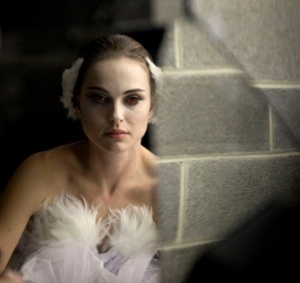
Natalie Portman plays Nina, a veteran ballerina who, despite being young enough to still live with her mother (and, it’s hinted, to still be a virgin), is also approaching the age when she’ll be considered too old to ever be a prima ballerina. She is a member of a struggling New York dance company that is run by Thomas (Vincent Cassel, turning up the sleaze level to 11). Thomas has decided that the company’s next show will be Tchaikovsky’s Swan Lake and that it’s time to replace the company’s prima ballerina, Beth (played by Winona Ryder), with a younger dancer. Nina begs for the chance to be Beth’s replacement but Thomas rejects her, claiming that her dancing is technically perfect but has no passion. He then attempts to kiss her which leads to Beth biting his lip and, apparently, convincing him that she has passion after all. Thomas soon announces that Nina will dance the lead in Swan Lake.
Unfortunately, even before winning the role, Nina is obviously unstable. Whether she’s obsessively stretching in her hideously pink bedroom, forcing herself to vomit up the contents of her stomach, or seeing shadows down every corridor, Nina’s every action and thought seems to be obsessed with finding the idealized perfection that ballet demands and life seldom affords. No matter how much she and her controlling mother (Barbara Hershey) cut her nails, she still wakes up with mysterious scratch marks across her back. Even worse, as she gets deeper and deeper into the role, she finds herself strangely drawn to and fearful of Lilly (Mila Kunis), a younger, free-spirited dancer who may, or may not, have her eye on taking Nina’s place.
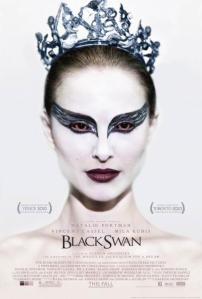
Along with being an homage to such classic films as Repulsion, Suspiria, and All About Eve, Black Swan is also a modern-day reinterpretation of Swan Lake. Swan Lake tells the story of Odette, a princess who has been cursed by an evil sorcerer. As a result of the curse, Odette is only allowed her human form at night. During the day, she exists only in the form of a white swan. A prince named Siegfried meets Odette in her human form and falls in love with her so Rothbart tricks the prince by transforming his own daughter, Odile, into the Black Swan, a seductress who looks just like Odette except she wears black. One reason why the lead role in Swan Lake is so coveted is because the same ballerina plays both the innocent and fragile White Swan and the seductive and uninhibited Black Swan. As such, the two roles are presented as opposite sides of the same coin. (I’ve always thought of the White Swan as representing what men idolize and the black swan representing what men actually desire.) The challenge is to be convincing in both roles while still perfectly executing the idealized movements of ballet.
Over the course of Black Swan, Nina is continually told (by Thomas) that she is perfect for the role of the innocent and sheltered White Swan but that she doesn’t have what it takes to be the sexy and uninhibited Black Swan. At one point, Thomas gives her a homework assignment for the role, ordering her to go home and touch herself. (Nina eventually does so just to suddenly realize, right when she’s on the verge of bringing herself to climax, that her mother is sleeping in the exact same room. This sudden shot of Barbara Hershey sleeping in that chair both made me jump and laugh at the same time.)
Thomas also suggests that Nina study that way that Lilly dances. In many ways, Lilly appears to be the exact opposite of Nina. (Though wisely, Aronofsky emphasizes how much Portman and Kunis — not to mention Ryder and Hershey — all resemble each other physically, therefore creating the feeling that we’re seeing four different versions of the same basic human being.) Whereas Nina’s every dance move appears to be the product of rigorous training, Lilly dancing follows her emotions. While Nina’s expression while dancing is always one of a grimly obsessive dedication, Lilly smiles and enjoys the moment. Whereas Nina is scared of sex and can barely bring herself to look a man in the eye, Lilly is openly flirtatious with both men and women. In short, Lilly is Nina’s Black Swan.
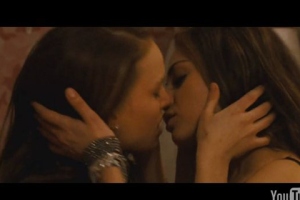
Even as Nina studies Lilly, Lilly starts to pursue Nina, even showing up at her apartment and inviting Nina out for a night on the town. Desperate to escape her controlling mother (whose goal seems to be to keep Nina as the innocent White Swan for the rest of her life), Nina goes out with Lilly. They hit the clubs, Lilly convinces Nina to drink a spiked drink, and soon Nina is making out with random men in corners and eventually with Lilly in a taxi cab.
Now, I know this is something that a lot of people are wondering about so I’ll just confirm it. Yes, Mila Kunis does go down on Natalie Portman in this film. And yes, it’s hot. But even more importantly, it works as something more than just a juvenile male fantasy of what we girls do when you guys aren’t around. When Nina touches Lilly, she is reaching out for and accepting the side of her personality that she’s previously tried to deny. She’s accepting what she knows could destroy her.
(SPOILERS BELOW READ CAREFULLY)
And sure enough, after her encounter with Lilly (which Lilly subsequently claims never happened), Nina’s world grows more and more distorted. She looks at the paintings that line her mother’s room and she sees a hundred faces laughing at her. On the subway, men leer at her. And suddenly, Thomas seems to be paying more attention to Lilly (who is named as her alternate) than to her. Lilly visits Beth in the hospital where Beth is recovering from a car accident. Beth responds to Lilly’s presence by mutilating herself with a fingernail file. And so things go until the film reaches its climax in a dizzying mix of dance and blood.
Much like ballet itself, Black Swan presents a very stylized view of existence and, in order for the film to work, the performances have to be perfect. I’m happy to say that everything you’ve heard about Natalie Portman in this film is correct. She gives a brilliant performance. The film doesn’t provide a definite explanation as to what lies at the root of Nina’s mental instability but the clues are all there in Portman’s subtle but effective performance. Perhaps even more importantly, Portman is convincing in the ballet sequences. She captures perfectly the rigorous and often times painful dedication that ballet demands. In the movie’s finale, as she dances on stage while her fragile world collapse around her, she was suddenly creating my own fantasy of what it would be like to be a true prima ballerina. Watching her, I felt her every move as if I was on the stage dancing the role. It left me exhausted and breathless and I have to admit that after the movie, I foundd myself crying for a solid hour as I realized that would truly be as close as I would ever get to living my old teenage fantasy.
Portman pretty much dominates the entire film but still leaves room for Hershey, Cassell, and especially Mila Kunis to give impressive performances. Alternatively loving and spiteful, Hershey is the stage mother from Hell. Cassell’s character is almost too sleazy for his own good but Cassell still has fun with the role and even adds a few notes of ambiguity. However, Mila Kunis is the true standout among the supporting players. Playing a role that requires her to be both likable and vaguely threatening, Kunis holds her own with Portman and proves here that she actually can act. Her character also provides the film with a few much-needed moments of humor. Lilly gets all the best one-liners and Kunis delivers them flawlessly.
So, I’m sure many people might be saying at this point, “That’s great that you loved it, Lisa Marie. But you’re like all convinced that this film is actually about you. What about us normal people who don’t really care about ballet? Is there anything here for us?”
That’s not an easy question for me to answer precisely because I do love ballet and I did relate a lot of this film to experiences — both good and bad — from my own life. It’s also an issue that Aronofsky acknowledges in a rather clever scene where Nina and Lilly flirt with two frat boy types who react to Nina’s talk of ballet with boredom. However, I do think that this film can be seen and appreciated by those who aren’t into ballet for the exact same reason why I loved The Wrestler despite being interested in professional wrestling like not at all.
I’ve always felt that ballet — and by that, I mean the whole experience of both the dancing and all the stuff that goes on before and after the actual dance — was in many ways the perfect metaphor for life.
For instance, in my experience, there were always two separate cliques in any dance school or company.
There was the group of dancers who had spent their entire lives preparing for the one moment they would become a prima ballerina. These were the girls who spent hours obsessing over their technique and who minutely examined every performance for the least little flaw. These were the girls who risked their health to maintain perfect dancer bodies. They obsessed over everything they ate, which struck me as strange since they usually just threw it all back up a few minutes later anyway. They had parents who not only spent the money to make them the best but who, unlike the rest of us, actually had the money to spend in the first place. These were the girls who knew every move they were supposed to make but they never knew why.
And then, there was the group that I was always a part of. We were the girls who never worried about perfect technique. We would laugh when we missed a step and we joked about our mistakes. When we danced, we followed our emotions and if that meant breaking a rule, so be it. The perfect girls hated us because, for the most part, we were more popular than they were because we allowed ourselves to be real as opposed to perfect. And we hated the perfect girls because we knew that they would eventually have the life that we fantasized about.
I used to think that was unique to ballet and certainly, in Black Swan, it’s clear that Portman would be one of the perfect girls and Kunis would be one of us. However, once my life was no longer solely about ballet, I realized that everyone was either a part of the perfect group or a part of the real group. It wasn’t just ballet. It was life, the conflict between those who try to create an idealized fantasy and those who simply take advantage of the randomness of everyday life. And, when I watched Black Swan, it was obvious that Aronofsky recognizes this as well.
Ballet is all about creating perfection, of telling a story through exactly choreographed movements. As the film progresses, it become obvious that the root of Nina’s psychosis is that the reality has not lived up to her idealized worldview. Nina hides from the real world because the real world, unlike ballet, is not messy. Movement in ballet is controlled but movement in reality is random and often frightening. However, by submerging her identity into ballet, Nina has fallen into another trap because, as a prima ballerina, her every movement has to be perfect. There’s no room for error. There’s no room for her to break free of Thomas’s choreography. Her every move has been dictated for her and not a single mistake can be tolerated.
And I guess that’s truly why this film got to me because who hasn’t felt like that? Who hasn’t felt as if the world is watching and waiting to pounce on you for failing to live up to their ideal? While I’m not suggesting that men don’t face unique pressures of their own, this theme especially hit home for me as a woman. Everyday, I wake up knowing that I’m being expected to live up to some sort of societal concept of perfection that was set up long before I was born by people I’ll never actually meet. Every day, I wake up knowing that I’m always look my best without flaunting it in a way that would suggest that I know I look my best, to find a husband and devote my life to the agonizing pain of childbirth, to suffer my period in respectful silence, to always be weak when I want to be strong, and certainly to never, ever view sex as anything other than a duty. It’s the type of expectation that leads every woman to consider embracing her own black swan. Some of us are brave enough to do it. And others, scared of being rejected as imperfect, simply try to pretend that they never saw it in the first place.
For me, that’s what Black Swan is truly about. It’s not about ballet and it’s not about Mila Kunis bringing Natalie Portman to orgasm. It’s about finding the courage to live life regardless of how scary it might be. Much as Aronofsky used pro wrestling to tell the story of everyone who ever refused to be anonymous and forgotten, Black Swan is the story of every one who ever struggled to reconcile the demands of society with the realities of existence.
Since this is an Aronofsky film, viewers will either love it or hate it. As exhilarating as I found that film’s finale to be, I can already hear other viewers saying, “What!?” As a director, Aronofsky has always been willing to walk that thin line between art and excess and you’re reaction to him will probably depend a lot on where you personally draw that line. Throughout the film, Aronofsky comes close to going over the top. However, he also directs the film in such a way as to make it clear that we’re not meant to be watching an exact recreation of reality. Instead, we view most of the film’s events through the prism of Nina’s own unstable mind and both the film’s grainy cinematography and the deliberately odd camera angles perfectly capture the feel of a mind losing its grip on reality.
Again, I should admit that I’m bipolar and, as such, I reacted very sympathetically to Nina’s struggle to distinguish the real world from the world created by her own paranoid fears because I recognized much of it from my last major manic episode. Now, would I have had a different reaction if not for my own personal experiences? The honest answer is that I don’t know. All I know is that Darren Aronofsky gets it right.
The film’s ending will surely be the root of not a little controversy. (Again: MAJOR SPOILER WARNING) Much like the end of the The Wrestler we’re left to wonder whether our main character has truly triumphed or if she’s been defeated. Is Aronofsky celebrating self-destruction or is he celebrating the individualistic impulse that leads people to pursue their passions no matter what the end result? Has Nina found true perfection and freedom or has she been destroyed by her own demons?
Aronofsky leaves it up to the viewer to decide and a lot of people won’t like that.
However, for me, Black Swan is the best film of 2010.
So, I’m currently still working on my review of Black Swan, which I saw this weekend and loved so much that I ended up having an asthma attack at the end of it. But anyway, as we wait for me to discover articulation, why not check out 6 more of my favorite grindhouse and exploitation film trailers?
Now, this is an interesting debut film from the prolific Canadian director Bob Clark (the man who later gave the world both Black Christmas and A Christmas Story). A young soldier is killed in Viet Nam and shows up back in his hometown one night later without a soul. The allegory is pretty obvious but it’s still effectively done and crawls under your skin. This film was also one of Tom Savini’s early films. The soldier’s father is played by John Marley who later appeared in The Godfather with a horse’s head in his bed.
Director Lucio Fulci made this film around the same time he was making his more famous zombie films but it never got the same attention, despite starring David Warbeck. I love the cat — he’s so cute and he reminds me of my own cat. Plus, he’s quite effective at killing people.
Apparently, this is a nunsploitation film from Japan! That nunsploitation was a very popular genre in Italy, Spain, and Ireland makes sense when you consider that those are three of the most Catholic countries on the planet. But Japan?
The trailer for the 1971 Italian lesbian vampire film goes on for a bit too long but I think it has nice atmospheric feel to it (the same can be said of the film itself).
Since we started with a zombie film, let’s end with one as well. The Dead Pit is pretty silly but I enjoyed it and would happily star in a remake. Plus, the trailer’s line about “the thickness of the door” just amuses me on so many levels.
Since we all just watched the season finale of the Walking Dead (you did watch it, didn’t you?), I figured I’d highlight two scenes from one of my favorite “zombie” films, 1973’s Messiah of Evil.
The first scene is one that I never fail to think about whenever I find myself going down to Wal-Mart at 3 in the morning.
The second scene is one that really hits home for me because it takes place in a movie theater. If nothing else, it perfectly illustrates why you should always have a date (preferably a strong one) if you’re going to the movies. As sidenote, the unfortunate actress in this scene was named Joy Bang.
Willard Huyck, director of this film, also co-wrote the script for American Graffiti.
It’s December and that means that it’s the Christmas season and that can only mean an abundance of Christmas movies both at movie theaters and on television. This Christmas movie has even become a genre in a way that the Thanksgiving movie or the Bank Holiday movie never has.
I love the Christmas season because 1) it’s one of the few times that there’s half a chance of seeing snow in Texas, 2) it gives me an excuse to bond with family, and 3) I get lots of presents. And I enjoy Christmas movies so much that I can pretty much quote every line from It’s A Wonderful Life from memory. I’ve even been known to enjoy the holiday movie marathons that pop up on the Lifetime Movie Network (especially if they feature Jeff Fahey and his bluer than blue eyes). However, my favorite Christmas movie remains the original Miracle on 34th Street because Natalie Wood was one of my mom’s favorite actresses and Miracle was one of her favorite films.
However, in this post, I want to highlight 10 movies that have either been overlooked in the past or else films that, while properly acknowledged as classics, are rarely mentioned as being Christmas films.
1) In Bruges (2008) — Two Irish hitman (Colin Farrell and Brendan Gleeson, both wonderful) hide out in Belgium during the Christmas holiday. I love this film for so many reason but I have to specifically mention the performance of Ralph Fiennes, who plays an English crime boss with a foul mouth, a murderous personality, and a firmly held set of ethics.
2) Brazil (1985) — One reason why I love Terry Gilliam’s dark satire is because I actually have quite a bit in common with it. We’re both often misunderstood, we’re both pretty to look at, and we were both released in 1985. While Brazil is now often acknowledged as one of the best and most imaginative films of the last century, it’s often forgotten that all of this film’s action takes place over the Christmas season. If you’ve never seen Brazil, see it now. But be aware that you’ll never look at Michael Palin quite the same way again.
3) Three Days of The Condor (1975) — This espionage thriller (which stars a young, pre-Leatherface Robert Redford) skillfully contrasts cold-blooded violence with the bright outer happiness of the Christmas season.
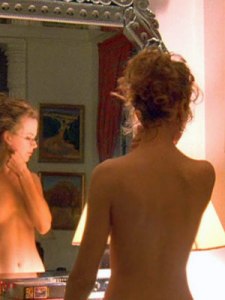
4) Eyes Wide Shut (2000) — Stanley Kubrick’s final film is a tribute to MK-Ultra conspiracy theories and features rich people trying to be kinky during the Christmas season. Nicole Kidman does redheads proud with her performance here and we get to see Tom Cruise smoke pot.
5) P2(2007) — Rachel Nichols is trapped in a parking garage on Christmas Eve by a very scary Wes Bentley. I have to admit that I’ve always had a morbid fear of either dying, getting seriously injured, or disappearing on Christmas Eve and therefore ruining the holiday for my family. I guess that’s why P2 resonated with me.
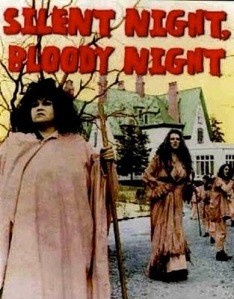
6) Silent Night, Bloody Night (1974) — No, this is not a killer Santa film. This is the film where a bunch of former Warhol superstars (Ondine and Candy Darling being the most prominent) play a bunch of mental patients who massacre their doctors in a disturbing, sepia-toned sequence. Years later, on Christmas, another former Warhol superstar — the wonderful Mary Woronov — comes to investigate. This is actually a fairly good film from director Theodore Gershuny.
7) Christmas Evil (1980) — Now this is a killer Santa film. Harry is a loser who works in a toy factory but he’s obsessed with Christmas because, when he was a child, he saw mommy humping Santa Claus. (Isn’t that a song?) So, one Christmas, Harry dresses up like Santa and goes around killing neglectful parents and others who don’t have the Christmas spirit. This is an oddly sweet film with an ending that brought very sincere tears to my eyes.
8 ) To All A Good Night (1980) — Okay, this is another killer Santa film and it’s one of those early ’80s slashers where everyone dies because they’re total and complete idiots but two things distinguish this film from other Killer Santa slasher films: 1) it features not one but two psycho Santas and the movie was directed by David Hess, star of Last House On The Left and The House On The Edge of the Park.
9) The Silent Partner (1978) — However, the greatest of all killer Santas is to be found in this Canadian crime thriller. Christopher Plummer plays a psycho bank robber who — disguised as Santa — robs a bank. Elliot Gould plays a lonely bank clerk who uses the robbery as an excuse to steal some cash for himself which leads to Plummer eventually coming after him. Plummer makes the scariest Saint Nick ever!
10) Kiss Kiss Bang Bang (2005) — This is pure grindhouse brilliance, a dark comedy and a metafictional satire disguised an action movie. Robert Downey, Jr. is a small-time criminal who accidentally becomes a film star and ends up investigating a murder with a hard-boiled PI (a surprisingly self-aware performance from Val Kilmer). And it all takes place during the holidays.
I recently discovered that Dallas’s own Newy Scruggs has become something of a Youtube cult figure as a result of a report he filed from San Francisco shortly before the start of the World Series.
I think Newy is the sports reporter for one of the local stations down here. I’m not sure which station because, to be honest, I make it a point not to watch the news. (I rely on rumor and street innuendo for my knowledge of current events…) However, I do know about Newy because when there’s somebody living in your city with a name like Newy Scruggs, you better know about it.
So, now the question is this — what lies in the future for Newy Scruggs? Will he become a famous, legendary Youtube messiah like the Garbage Day Guy from Silent Night, Deadly Night Part 2?
Or will Newy Scruggs suffer the same tragic fate as past Youtube stars?
One thing is for sure. I will always enjoy randomly saying “Newy Scruggs.”