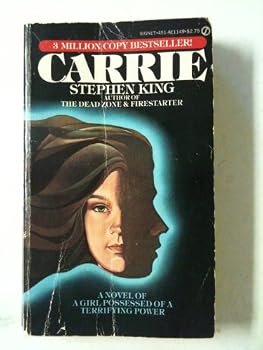
As I mentioned in my previous post, I’ve been watching Mike Flanagan’s Carrie on Prime. I’ve made it through four episodes and to say that I’m not enjoying it would be an understatement. The miniseries is spending 8 hours on a story that Stephen King handled in about 200 pages and which Brian De Palma was able to tell in a little over 90 minutes. Of course, De Palma was smart enough not to give Carrie an invisible friend. He also didn’t introduce a psychic cult. De Palma knew the story worked as it was.
If you haven’t read Stephen King’s original novel, you really should. That’s especially true if you’re currently watching the Flanagan miniseries and you’re wondering what all of the complaints are about. Carrie was King’s first published novel and King himself has admitted that it’s a flawed work. It’s a mix of passages that are definitely the work of King and excerpts from government hearings, Carrie’s notebook, and Sue Snell’s autobiography. The split format shows that King still wasn’t totally sure how he wanted to tell the story. That said, when the book works, it really does work. King doesn’t shy away from Carrie’s anger and bitterness. He doesn’t try to make the story about anything more than what it is. And even the government hearings and Sue Snell’s autobiography show us that Carrie, the outcast with telekinetic powers, will never be forgotten.
For the record, I do know that King has endorsed Flanagan’s revisions. With the exception of Stanley Kubrick’s The Shining, Stephen King tends to endorse everything and one gets the feeling that, much as was the case with Frank Darabont, King enjoys the fact that Flanagan is such a fan. That’s just human nature. That said, the novel, flaws and all, is infinitely superior to Flanagan’s miniseries.
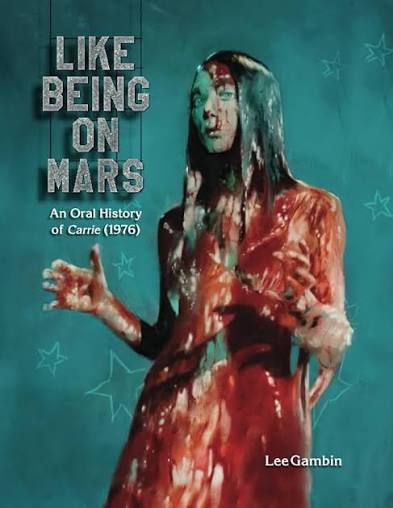
Again, as I mentioned in my previous post, if you’re watching Flanagan’s miniseries but haven’t seen Brian De Palma’s film, that’s something you need to rectify. After you watch Brian De Palma’s film, be sure to check out Like Being On Mars: An Oral History Of Carrie (1976) by Lee Gambin. This book is all about the production of the film that changed horror in much the same way that Star Wars, a year later, would later change science-fiction. Gambin interviews the key players: Sissy Spacek, Piper Laurie, Nancy Allen, Amy Irving, William Katt, P.J. Soles, De Palma, Stephen King, and even Bill Paxton! (Paxton worked on the crew.) It’s a great book for lovers of both movies and horror.
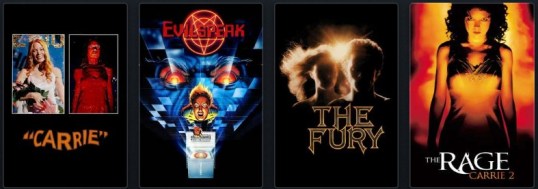
Fortunately, you can currently stream Brian De Palma’s Carrie (1976)and, if you haven’t seen it, you really do have an obligation to do so. Flanagan needs 8 hours to tell his story. De Palma only needed 98 minutes and a cast that could actually deliver their lines in something that wasn’t a robotic drone. The film works because De Palma never feels the need to apologize for making a horror film. It also works because it actually has a nicely macabre sense of humor, something that’s lacking in both King’s novel and Flanagan’s work in general. The film is currently on Prime.
The Rage: Carrie 2 (1999) doesn’t get much respect from a lot of horror fans but I’ve always liked it. Interestingly, The Rage actually covers some of the same thematic ground as Flanagan’s adaptation. The difference is that, once again, it only needs 105 minutes to make its point and it doesn’t apologize for being a horror film. The scene where the football players go crazy while getting their heads shaved (and, in the process, become indistinguishable from one another) is surprisingly disturbing. The finale, where Rachel goes on a rampage, is effectively violent and horrific, even if it can’t match the power of De Palma’s prom. I was scared to wear my reading glasses after watching this movie. Emily Bergl gives a good performance as Rachel. Jason London sells the film’s final scene. The oldest son from Home Improvement loses his testicles in closeup. Be careful with those spearguns! The film is on Prime.
Evilspeak (1981) is the film that asks, “What if Carrie was a guy and what if he was a student at a military academy and what if he got his powers from a personal computer and what if he was played by Clint Howard?” That’s a lot of questions but, for the most part, the answers are all entertaining in their own demented way. Evilspeak is interesting because Stanley Coopersmith (played by the great Clint Howard) is not particularly sympathetic but his tormentors are so much worse that you still feel Stanley deserved his revenge and you don’t mind when the cannibal pigs show up. This is also an example of one of my favorite mini-genres, the killer computer film. I guess that people in the early 80s though you could do anything with a computer, even summon the denizens of the damned. The film is on Prime.
The Fury (1979) was De Palma’s follow-up to Carrie and I have to admit that I’m not a huge fan of this film. That said, I know that the film does have its fans. The fact that I’m listing it here shows just how much I’m currently disliking Flanagan’s Carrie. I’d even rather rewatch The Fury then suffer another minute of the new Carrie! That said, The Fury is occasionally interesting. De Palma mashes up a lot of genres. Kirk Douglas grimaces as if the world depended upon it. Amy Irving takes the film a bit too seriously, as if she expected to follow in the footsteps of Sissy Spacek and receive an Oscar nomination for playing a telekinetic teen. Carrie Snodgress is annoying but then her character dies in slow motion. Never let “Here comes The Pony Express!” by your final words. John Cassavetes later said he did the film for the money. Bless him. The film is on Prime.
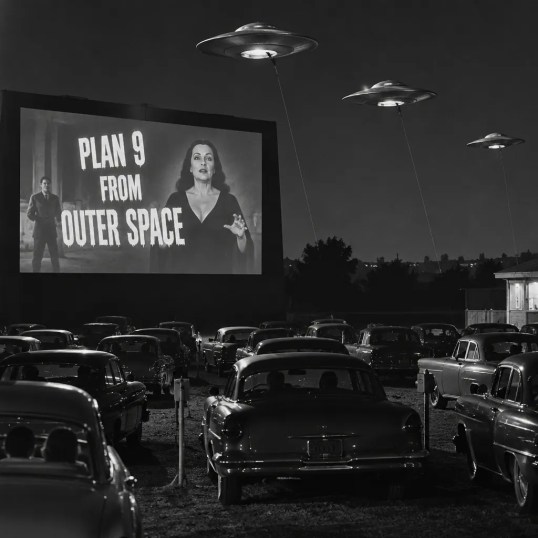
That’s the question posed to us by Ed Wood’s Plan 9 From Outer Space. The aliens have not only raised the dead and flown their saucers over Hollywood but they’ve also dared to lecture us just because we want to build a bomb that will blow up sunlight. Humanity has responded by trying to stop the zombies and also by trying to blow their flying saucers out of the sky. Those attempts failed.
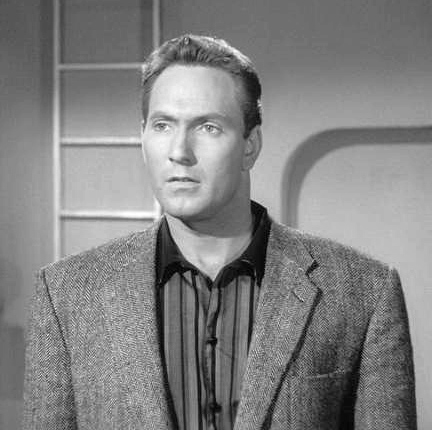
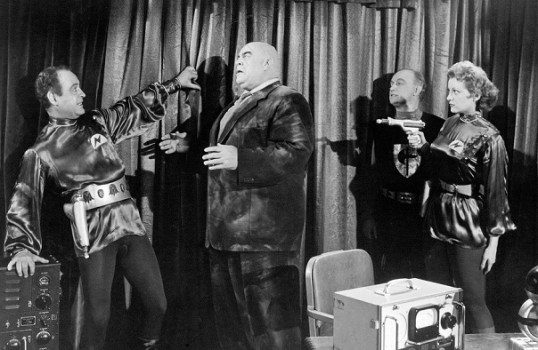
But then Jeff Trent — a simple, hard-working airline pilot — announces that “that’s all I’m taking” and promptly punches the smug alien in the face. A few seconds later, the flying saucer explodes. Luckily, Jeff and the other humans were able to escape before it did. The aliens were less lucky.
And that’s how you save the world!
Gregory Walcott, who went on to appear in several mainstream productions and became a favorite of Clint Eastwood’s, was reportedly not a huge fan of Plan 9, at least not at first. He only agreed to appear in the film as a favor to his pastor, who was one of the people who helped to finance the film. Walcott probably gives the best performance in the film. When he punches that alien, you feel his frustration.
Later, in 2010, Walcott said, in regards of Plan 9, “It’s better to be remembered for something than nothing.” He even started to attend screenings and meet with fans of the film. I was glad to have learned that. It’s not everyday that you get to save humanity for the dead.
Jeff Trent was a true hero and Gregory Walcott was a hero for bringing him to life.
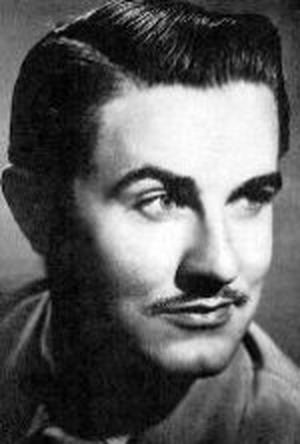
Today, we pay respect to Edward D. Wood, Jr. on the date of his birth. He was born 102 years ago today.
Some films need no introduction and that’s certainly the case with Wood’s 1957 masterpiece, Plan 9 From Outer Space.
Plan9 is a film like no other, a film that mixes UFOs with zombies and which ends with a rather sincere plea for world peace. When Eros the Alien explains that the Solarnite bomb could destroy the entire universe, the film’s hero, airline pilot Jeff, doesn’t point out that Eros’s logic doesn’t make sense. Instead, he just says that he’s glad that America is the one that has the bomb. “You’re stupid! Stupid minds!” Eros shouts before Jeff flattens him with one punch. Go Jeff! Don’t take any backtalk from that judgmental alien!
From Criswell’s introduction to Tor Johnson’s rise from the dead to Lyle Talbot casually standing with his hands in his pockets while a UFO explodes above him, Plan9 is a true classic of some sort.
As some of our regular readers undoubtedly know, I am involved in a few weekly live tweets on Twitter and Mastodon. I host #FridayNightFlix every Friday, I co-host #ScarySocial on Saturday, and I am one of the five hosts of #MondayActionMovie! Every week, we get together. We watch a movie. We tweet our way through it.
Tonight, at 10 pm et, #ScarySocial presents 1978’s Damien — The Omen II!
If you want to join us this Saturday, just hop onto twitter, start the movie at 10 pm et, and use the #ScarySocial hashtag! It’s a friendly group and welcoming of newcomers so don’t be shy.
The Harbinger is available on Prime! See you there!
As we already mentioned, today would have been the 102nd birthday of the pioneering indie director, Edward D. Wood, Jr!
Today’s song of the day is the theme from Tim Burton’s 1994 biopic of the director. In my opinion, this remains Burton’s finest film. Burton also directed the musical video below while the great Toni Basil choreographed. And, best of all, the dancer is named Lisa Marie!
In this scene from the classic Ed Wood film, Plan 9 From Outer Space, Eros the Alien (Dudley Manlove) explains that he and his comrades had no choice but to invade Earth and raise the dead because mankind’s scientists have created …. SOLARMITE!
What is Solarmite?
Don’t worry, Eros will explain it to us and it will all make total sense….
4 Shots From 4 Films is just what it says it is, 4 shots from 4 of our favorite films. As opposed to the reviews and recaps that we usually post, 4 Shots From 4 Films lets the visuals do the talking!
Today, on what would have been his 102nd birthday, we take time to honor Edward D. Wood, Jr.
4 Shots From From 4 Ed Wood Films
Bride of The Monster (1955, dir by Edward D. Wood, Jr., DP: Ted Allan and William Thompson)
Plan 9 From Outer Space (1957, dir by Edward D. Wood, Jr., DP: William C. Thompson)
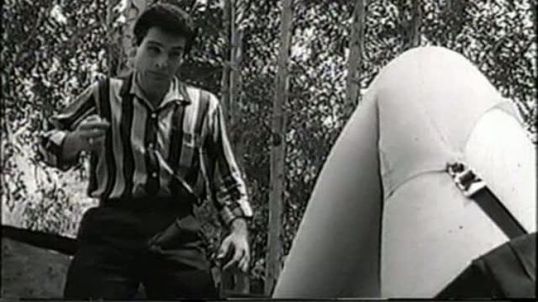
The Sinister Urge (1960, dir by Edward D. Wood, Jr., DP: William C. Thompson)
Since today would have been the 102nd birthday of director Edward D. Wood, Jr., it seems appropriate to dedicate this week’s edition of Lisa Marie’s Favorite Grindhouse Trailers to him!
Below …. can you handle six trailers for six Ed Wood films!?
Though the Academy of Motion Picture Arts and Sciences claim that the Oscars honor the best of the year, we all know that there are always worthy films and performances that end up getting overlooked. Sometimes, it’s because the competition too fierce. Sometimes, it’s because the film itself was too controversial. Often, it’s just a case of a film’s quality not being fully recognized until years after its initial released. This series of reviews takes a look at the films and performances that should have been nominated but were, for whatever reason, overlooked. These are the Unnominated.
Why am I talking about 1979’s The Warriors in October?
No, it’s not a traditional horror movie, even though the film does have some creepy moments and it features David Patrick Kelly playing one of the most memorable psychos in film history. At heart, it’s a film about a group of youngish gang members trying to survive the night and reach safety. (The characters are all meant to be teenagers, though that can be hard to remember when two of the film’s main characters are played by Michael Beck and James Remar, both of whom were close to 30 when the film was made.) The other gangs that the Warriors mostly either battle or escape from often feel as if they’ve stepped out of a nightmare. Everyone remembers the Baseball Furies because, as a gang, they were both intimidating and ludicrous at the same time. Myself, I was freaked out by the skinheads who drove around New York in a bus. The gang led by the guy on roller skates was pretty frightening as well. One thing about the rival gang members is that, with the exception of Luther, few of them speak. Instead, they simply show up and attack.
The Warriors (1979, directed by Walter Hill, DP: Andrew Laszlo)
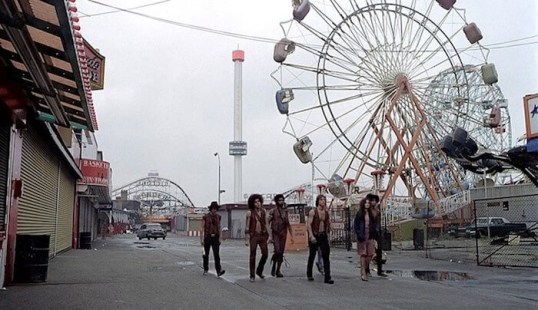
The Warriors is a surreal film, which is not surprising when you consider that it was written by Walter Hill. The film takes place almost entirely at night and the streets of New York are eerily empty. Watching the film, I was reminded of the dying Paris from Jean Rollin’s Night of the Hunted and Dario Argento’s claim that Tenebraewas meant to take place in a future where there were far fewer people on the planet. At the same time, there are hints of the real world littered throughout the film. Four teenagers who are obviously heading home from prom find themselves on a train, sitting across from a bruised Swan (Michael Beck) and Mercy (Deborah Van Valkenburgh). Occasionally, we see people in bars or just trying to get back to their own homes. The subway stations are crawling with cops, one of whom throws Fox (Thomas G. Waites) in front of a moving train. Throughout the film, the members of the Warriors keep count of who is still with them on their journey to Coney Island, but no one mentions Fox after his sudden death. One could argue that they don’t want to think about how easily things could go wrong for them. They’re in a fantasy world where there are no consequences. Of course, a more likely reason is because Fox’s death was a last-minute development that was a result of actor Waites proving to be difficult to work with.
The Warriors (1979, dir by Walter Hill, DP: Andrew Laszlo)
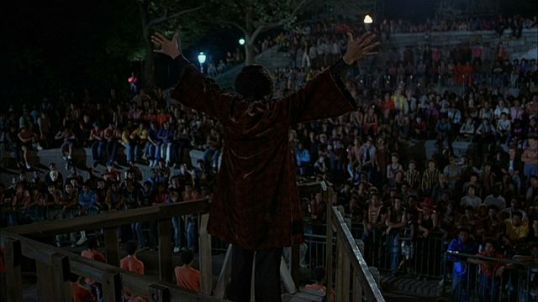
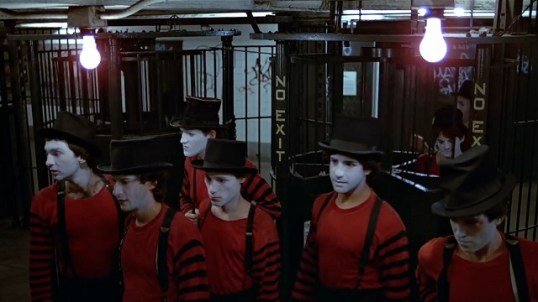
Ultimately, The Warriors is a film for Halloween because it’s a film about costumes. The members of each gang are defined by what they wear. Some of them dress up. Some of them dress like they’re doing some sort of Bruce Springsteen-style working-class cosplay. There’s even a group of mimes who wear top hats. I feel bad for any neighborhood that is weak enough to be taken over by mimes. The film’s first great set piece—the meeting in the park—is rightly remembered for Roger Hill’s charismatic performance as Cyrus. (“Can you dig it!?”) But it also deserves to be remembered for the hundreds of extras, all of whom are wearing their costumes and mixing together. That’s the respect that Cyrus commands. The mimes and the pimps and the skinheads and the roller skaters are all willing to come together for Cyrus. And when Luther assassinates Cyrus and then blames the Warriors, the gangs of the city are prepared to destroy the gang of Coney Island.
The Warriors (1979, dir by Walter Hill, DP: Andrew Laszlo)
It’s a great and exciting film that has stood the test of time. It’s not a surprise that it wasn’t Oscar-nominated. The film was controversial when it was released, with some claiming that it glorified gang life and that it promoted violence. Beyond that, the film is unapologetically pulpy. Walter Hill was and is a brilliant genre filmmaker and he’s never apologized for that fact. His films were never obvious award bait. That said, it does seem a shame that The Warriors didn’t even get a nomination for its propulsive score. The film’s cinematography turned a familiar city into an alien landscape and the editing kept viewers on the edge of their seats. It’s rare to see a film that captures the feeling of the world closing in on a group of people as well as The Warriors does. As far as the acting goes, the majority of the cast was inexperienced and there were more than a few times when that inexperience came through. It’s a film that’s more about visual style than deep performances. That said, Michael Beck was likable and had the right look to be a leader and Hill was very smart in how he framed him on screen. James Remar also did a good job as Ajax, playing him as being strong-willed and obnoxious and a bit too obsessed with proving his masculinity but also fiercely loyal to his gang. (As played by Remar, Ajax was the only Warrior who truly seemed like he could handle himself in a fight.) Deborah Van Valkenburgh was effective in an underwritten role. If anyone from the cast deserved a nomination, it was probably David Patrick Kelly. “Warriors, come out to play!” Kelly was a force of pure chaos. In the end, the big Oscar winner of 1979 was Kramer vs. Kramer, a film that might as well have taken place on a different planet from The Warriors.
If I may close on a personal note, I was feeling pretty sick last Thursday. I hadn’t gotten much sleep. I was stressed about getting my Horrorthon reviews written. I had given myself a headache. But then, I watched The Warriors and I got so sucked into its world (despite the fact that I had already watched the film more than a few times) that I forgot that I wasn’t feeling well. My headache went away. By the time the film ended, I was feeling a hundred times better.
Nominated or not, that’s the power of a good movie.
The Warriors (1979, dir by Walter Hill, DP: Andrew Laszlo)