Cinemax Friday: The Babysitter (1995, directed by Guy Ferland)


Teenager Jennifer (Alicia Silverstone, shortly before she starred in Clueless) is hired to babysit Jimmy (Ryan Slater), the son of Denise (Lee Garlington) and Harry Tucker (J.T. Walsh) while the Tuckers attend a party over at the the home of Bill and Bernice Holstein (played by George Segal and Lois Chiles).  Harry spends the night drinking and fantasizing about Jennifer while Denise spends the night fantasizing about Bill.  Who does Bernice fantasize about?  The movie doesn’t say.

The adults aren’t the only ones fantasizing.  Bill’s son, Mark (Nicky Katt), is also obsessed with Jennifer and, while his parents are holding their party, he hangs out with his friend Jack (Jeremy London), who also happens to be Jennifer’s bitter ex-boyfriend.  Jack and Mark both start to discuss their own fantasies about Jennifer and they make plans to head over to the Tucker House and surprise Jennifer.  (Mark has even more in mind.)  Meanwhile, even little Jimmy is having fantasies of his own.

Today, it can be easy to forget just what a big deal Alicia Silverstone was in the early to mid-90s.  Even before she landed her star-making turn in Clueless, Silverstone achieved fame as the star of three videos from Aerosmith, all of which featured her playing roles that personified male fantasies.  Her role in The Babysitter fits right in with those Aerosmith videos as the entire film is devoted to men fantasizing about her.  Not much is revealed about who The Babysitter is and her name isn’t even revealed until the end of the movie.  Instead, the movie is about how every male in town, except for George Segal, is obsessed with her.  (What makes George Segal so special?)  Fortunately, Silverstone had the right mix of innocence and sultry beauty to be believable as everyone’s object of lust.  She does a good job playing both the normal teenage girl who just wants to make some extra money babysitting and also the exaggerated caricature who appears in everyone’s fantasies.  (Some of the fantasy scenes are ridiculous but most fantasies are.)

Especially after the release of Clueless, The Babysitter was advertised as being a softcore thriller and it used to show up frequently on late night Cinemax, playing alongside films like Body Chemistry.  Actually, it’s a satire of the suburbs that follows all of the men as they have too much to drink and make fools of themselves.  Thematically, it has more in common with movies like American Beauty, The Ice Storm, and The Virgin Suicides than it does to anything that’s ever been made by Shannon Tweed.  While many viewers were undoubtedly disappointed that Silverstone remained clothed for the majority of the film (and that even the scene where she took a bath was carefully shot to suggest more than it showed), The Babysitter was not a bad movie and it provided the great J.T. Walsh with a rare leading role.  The Babysitter is a better-than-expected mix of Nabokov and Cheever.
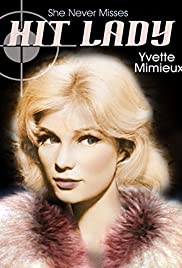


Hit Lady (1974, directed by Tracy Keenan Wynn)


Beautiful blonde Angela de Vries (Yvette Mimieux) shows up at a Texas barbecue and starts to chat up over-the-hill but very wealthy cowboy Buddy McCormick (Keenan Wynn).  Buddy thinks that he has hit the jackpot and when Angela suggests that they go off together for some alone time, he doesn’t turn her down.  Unfortunately for Buddy, the only reason Angela was talking to him was so she could get him alone and kill him with no witnesses!

(Buddy is played by Keenan Wynn because his son, screenwriter Tracy Keenan Wynn, directed this made-for-TV movie.  Angela is played by Yvette Mimieux because she got tired of only being cast in bland roles so she wrote a script with a juicy lead role for herself.)

Angela is a contract killer but she wants to get out of the business so that she can settle down with her seemingly oblivious boyfriend, a photographer named Doug (Dack Rambo).  Angela’s boss, Roarke (Clu Gulager), insists that Angela carry out one last hit.  He wants her to take down labor leader Jeffrey Baine (Joseph Campanella).  Angela really needs the money so she eventually accepts the job.  Roarke wants Baine’s death to look like an accident so that means Angela is going to have to learn everything that she can about Baine and his life.  When she learns that Baine loves Mozart, she decides to arrange an “accidental” meeting with him at a concert.  Is Angela the only contract killer in Los Angeles?  Couldn’t Roarke have found someone willing to do the job without so many preconditions?

Angela does meet Baine and, of course, the two of them start to fall in love.  Is Angela willing to both betray her boss and her boyfriend or will she carry out the hit?

Hit Lady is very much a product of the 70s, with one scene actually taking place at a disco.  Mimieux gives a good performance in a part that she wrote for herself and I’m sure many viewers will appreciate the lengthy amount of time she spends wearing just a bikini.  Mimieux gets to do most of the action movie things that, at the time, only men were usually allowed to do and she looks both good and convincing doing them.  Unfortunately, the love story with Jeffrey Baine does not work because the rough-hewn Campanella is not convincing as a Mozart-loving romantic lead and he and Mimieux never seem as if they really have any deep feelings for each other.  It’s easier to understand why Campanella would be attracted to Mimieux but than why she would be attracted to him.  That storyline probably would have worked better if Campanella had switched roles with Clu Gulager.  Hit Lady ends with an obvious twist but fans of 70s cheese and Yvette Mimieux should enjoy it.

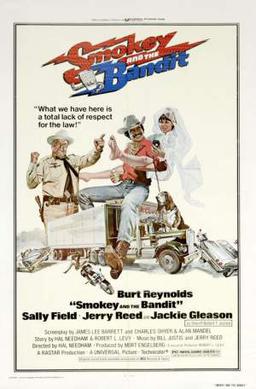
Smokey and the Bandit (1977, directed by Hal Needham)


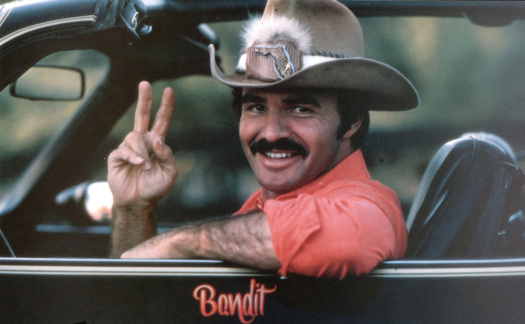
Smokey and the Bandit is a simple film. Burt Reynolds is the Bandit. He’s hired by two bored brothers to smuggle beer from Texas to Georgia. Working with the Snowman (Jerry Reed), Bandit is easily able to pick up the beer but it’s while driving back that the two of them run afoul Smokey, a.k.a. Sheriff Buford T. Justice (Jackie Gleason, who reportedly improvised most of his profane lines). Bandit also picks up a hitchhiker and runaway bride (Sally Field) who he calls Frog.

There’s not much to Smokey and the Bandit. The Bandit has an incredibly cool car and he drives really fast. Snowman is funny and has a dog. Smokey has a dumb son and is constantly threatening to hit people.   It’s a dumb movie but it works.   The cars are fast, the crashes are spectacular, and the entire film is the perfect daydream for when you’re sitting in your office at work and wondering whether there’s something more rewarding you could be doing with your life.

Who hasn’t wanted to the Bandit at some point in their life?

Who hasn’t wanted to get behind the wheel of black trans am and just take off, driving down country roads while giving the slip to old Smoky and joking with Snowman on your CB radio and maybe picking up a young Sally Field while smuggling beer and winning a bet?

(There’s been a lot of terrible moments on The Family Guy but, for me, one of the absolute worst was when Brian Griffin went into the past and asked 70s Burt Reynolds, “So, you’re going to go get some of that hot Sally Field action, huh?” Anyone who has seen Smokey and the Bandit knows that Sally Field was smoking hot back in 1977!)

Smokey and the Bandit comes to us from a different time. No one worries about what speeding halfway across the country in a little over 24 hours is doing to the environment. No one apologizes for who they are or where they’re from. The Bandit lives by a simple rule: Treat him with respect and he’ll treat you with respect. Talk down to him or try to tell him what to do and the Bandit’s just going to jump in his car and leave you standing in a cloud of dust.

During the latter part of his career, Burt Reynolds would often lament that appearing in financially successful but critically lambasted films like Smokey and the Bandit made him a huge star but also kept him from getting the type of roles that he felt he deserved. Reynolds was right but there are worse things than being known as The Bandit.   For many, Burt Reynolds will always be the Bandit because he was so perfectly cast for the role. Not many actors could pull off the scene where, after fooling a cop, the Bandit looks straight at the camera and grins. Burt Reynolds could. Playing the Bandit may have never won Burt Reynolds an Academy Award but it did make him an American icon.

If you’re feeling down, watch Smokey and the Bandit. If you need an escape, watch Smokey and the Bandit. It demands so little and gives so much.

Flesh and the Spur (1956, directed by Edward L. Cahn)


When farmer Matt Ransom (John Agar) is murdered for his horse and his gun, his twin brother Luke (also John Agar) sets out to get revenge.  He knows that his brother’s murderer was a member of the infamous Checkers Gang.  Because the gun that the killer stole was one of two identical pairs specially made for the twins by their father, Luke knows that all he has to do is find the outlaw who is carrying a gun that looks just like his.  During Luke’s search, he meets several others who have their own reasons for wanting to destroy the Checkers Gang.  Luke teams up with a beautiful Native American woman named Willow (Marla English), a snake oil salesman named Windy (Raymond Hatton), and a mysterious but deadly gunman named Stacy Doggett (Mike “Touch” Connors).

This B-level Western is best known for a scene where a group of rogue Indians tie Willow to an anthill in order to punish her for “traveling” with the white man.  The scene was not originally in the script.  It was added after a poster was designed that featured Willow bound to a stake.  While the scene was undoubtedly enjoyed by the teenage boys who the film was marketed towards, it feels out-of-place in the movie.  Some of the problem is that, while shooting the scene, the ants refused to go anywhere near Marla English and would instead run away whenever they were dropped on English’s feet.  After spending several minutes tied to a stake and having ants poured on her, English said, “Look, you’ve got six ants there.  Isn’t that enough?”  Marla English retired from acting shortly after appearing in this film.

Flesh and the Spur is a B-western through and through but it has a few good moments, like the scene where Luke and Stacy check out a saloon’s gun rack to see if anyone has hung up Matt’s gun.  Touch Connors is convincingly deadly as Stacy and there’s a good twist with his character at the end of the film. Marla English gives such a good performance as Willow that it’s too bad that the ants may have played a part in her early retirement from acting.  Unfortunately, John Agar is just as dull and colourless as always and he was obviously too old to be playing someone like Luke, who is meant to be a naive neophyte.

Flesh and the Spur may not be a classic but there’s enough there to keep western fans entertained.

Trapped (1973, directed by Frank De Felitta)


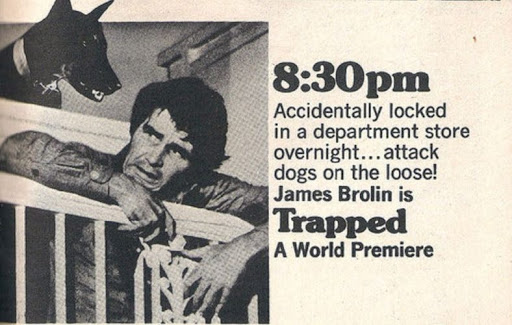
Chuck Brenner (James Brolin) is out shopping when he’s mugged and left unconscious in a men’s room stall.  By the time Chuck wakes up, the store is closed for the weekend and the place is deserted except for him and six doberman guard dogs.  The dogs are trained to hunt down and attack anyone who shouldn’t be in the store and, as far as they’re concerned, that includes Chuck.  Chuck now has to survive the night and try to figure out a way to get out of the store.  Not helping is that Chuck still hasn’t recovered from taking a blow to the head and he’s been bitten by one of the dogs, leaving a blood trail for them to follow.

This made-for-TV movie is a simple but effective thriller about an ordinary man trapped in an extremely dangerous situation.  Frank De Felitta (who would later direct one of my favorite made-for-tv horror film, The Dark Night of the Scarecrow) does a good job of creating suspense as Chuck tries to make it from one area of the department store to the next without getting attacked.  (One of the best scenes involves Chuck, dizzy because he has a concussion, jumping from one cabinet to another while the dogs wait below him.)  Even dog lovers will become nervous as the dobermans prowl the aisles, looking for their prey.  James Brolin gives a good everyman performance and he’s ably supported by Susan Clark as his ex-wife and Earl Holliman as Clark’s new husband.  The film is so well-executed that it was only after it ended that I started to wonder why any store would leave six dog unsupervised in their store overnight.  Just the effort that would have to be made to clean up after them would cancel out whatever money was being saved by not using a human security guard.

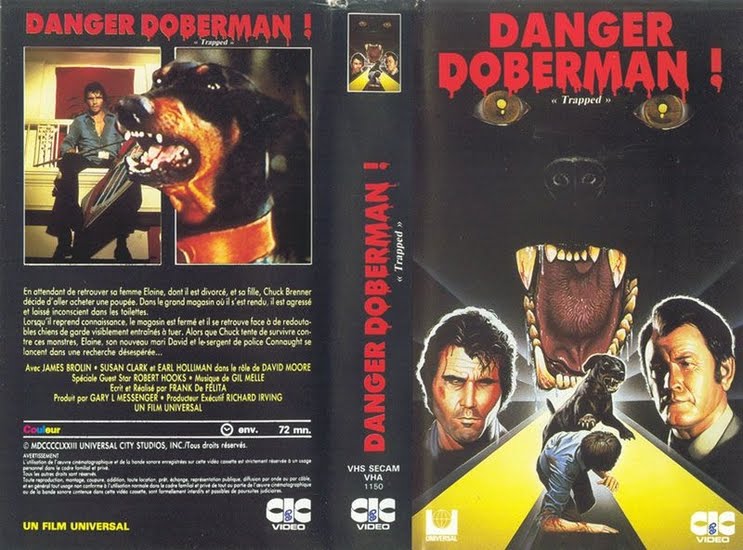
Trapped has been released under several titles, the best known of which is The Dobermn Patrol.  My personal favorite, though, is Danger Doberman!

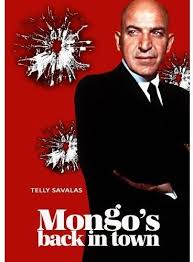
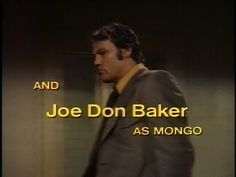
Mongo’s Back In Town (1971, directed by Marvin J. Chomsky)


During the Christmas season, Mongo (Joe Don Baker) returns home.  However, Mongo hasn’t just come back for the holidays.  Mongo is professional killer, one of the best in the business.  His older brother, mob boss Mike Nash (Charles Cioffi), has a job for him.  He wants Mongo to wipe out a rival gangster.  Mongo’s willing to do it but he expects to be properly compensated for his trouble.  Family is family but Mongo’s a professional and a professional has to get paid.  Lt. Pete Tolsted (Telly Savalas) and his partner, Gordon (Martin Sheen), are the two cops who know that Mongo is bad news and who are determined to discover why Mongo is back in town.  Meanwhile, Mongo is falling in love with the naive Vicki (a very young Sally Field), a young woman who has fled West Virginia and is looking to restart her life in the big city.

This made-for-TV movie may not contain any huge surprises but it’s worth tracking down just for the cast.  Joe Don Baker, Telly Savalas, Martin Sheen, and Sally Field, all in the same movie and all at the top of their considerable game?  That’s more than worth the effort.  Joe Don Baker, in particular, is good.  Unfortunately, Baker doesn’t always get the respect that he deserves an actor.  It’s true that he’s appeared in his share of bad films and his range is limited.  But whenever he was cast in the right role — like in this movie or the first Walking Tall — he was a force of nature.  What’s most interesting about Mongo is that he doesn’t really like his work and he resents that it’s something that he’s been trapped into doing but, at the same time, he’s so good at it that it’s hard not to wonder what other career he could have possibly found as much success in.

Mongo’s Back In Town was released theatrically overseas under the title Steel Wreath.  (Maybe someone realized that Mongo’s Back In Town makes the movie sound like a screwball comedy.)  It can be viewed, under its original title, on YouTube.


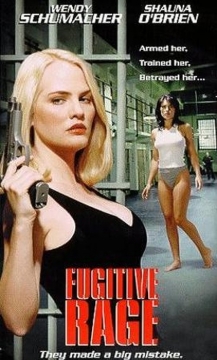
Cinemax Friday: Fugitive Rage (1996, directed by Fred Olen Ray)


When gangster Tommy Stompanato (Jay Richardson) is acquitted of murdering her sister, ex-cop Tara McCormick (Wendy Schumacher) gets justice her own way.  She shoots him.  Six times.  In the middle of a crowded courtroom.  Somehow, Tommy survives taking six bullets at point blank range while Tara is arrested and sent to prison.

In prison, Tara stands up to the usual collection of cruel inmates and predatory guards.  She bonds with her cellmate, Josie (Shauna O’Brien).  Josie may be a murderer but the only man she killed was her abusive husband so, like Tara, she had a good reason for committing her crime.  Tara and Josie become so close that when an federal agent named O’Keefe (Tim Abell) offers to spring Tara from jail in return for her help in taking down Tommy, Tara demands that Josie receive a pardon as well.

After O’Keefe agrees to her demands, Tara leaves the prison with him.  While they get busy at a safehouse, Tommy and his right-hand man, Ryker (Ross Hagen), arrange for Josie to be kidnapped from the prison.  With Josie being held as a hostage, it’s time for a final confrontation between Tara and Tommy.  There’s a “surprise” twist at the end so don’t you dare to tell anyone about the final ten minutes of Fugitive Rage.

Fugitive Rage may be a typical hyrbid of the action and women-in-prison genres but it’s also a Fred Olen Ray film, which means that it’s got even more nudity than expected and that it’s more self-aware of the conventions of the genre than some other films about women behind bars.  There’s a lot that you can say about Fred Olen Ray’s style of filmmaking but no one will ever accuse him of taking himself too seriously and Fugitive Rage at least has a sense of humor about itself.  It’s hard to watch scenes like the one where Tara guns down a crooked lawyer just because he’s a lawyer without thinking that Fugitive Rage is deliberately poking fun at itself.

Fugitive Rage ends with the promise that Tara and Josie are going to become the new “Thelma and Louise” but, as far as I know, Fugitive Rage never got a sequel.  Instead, it just found a home on late night Cinemax.

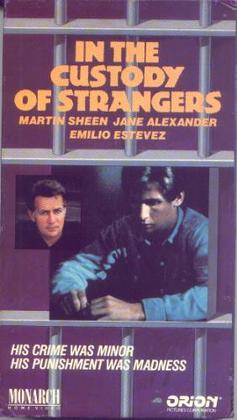
In The Custody of Strangers (1982, directed by Robert Greenwald)


In this television film, Emilio Estevez plays the world’s worst son but his behavior makes sense because he also has the world’s worst father (played by Estevez’s real-life father, Martin Sheen).

When teenager Danny Caldwell (Estevez) gets arrested for crashing into a police car while driving drunk, his mother, Sandy (Jane Alexander), wants to bail him out and bring him home.  However, Frank Caldwell (Sheen) is an old-fashioned disciplinarian and he decides that his son needs to spend a night in jail in order to teach him a lesson.  Even though, as a juvenile, Danny is given a private cell, he still snaps when the older inmate in the cell next door starts coming onto him.  After smashing the man’s head against the cell bars, Danny picks up a battery charge and is sucked into the system.

While Frank and Sandy struggle to get Danny released from jail, Danny falls deeper and deeper into despair and anger.  It’s an overcrowded, busy jail and Danny is often left in isolation for both his safety and the safety of the other prisoners.  Even though the warden (Kenneth McMillan) is sympathetic to Danny and can tell that he’s not really a hardened criminal, there’s only so much that he can do for him.  Meanwhile, on the outside world, Frank stubbornly refuses to admit that he made a mistake by leaving Danny in jail overnight.  When a job opportunity presents itself in another state, the unemployed Frank misses some of Danny’s hearings so that he can interview for it, leaving Danny feeling abandoned all over again.

For obvious reasons, the casting of Martin Sheen and Emilio Estevez as father and son works very well in this film.  Not only is there the obvious family resemblance but both Sheen and Estevez project the same attitude of anger and resentment towards the world.  If Danny has a chip on his shoulder, it’s because he inherited from his father.  In The Custody of Strangers does a good job of showing how being imprisoned can often turn someone who made a mistake into a hardened criminal but, even though it’s mostly critical of the criminal justice system, it doesn’t let Frank off the hook either.  Frank may say that he was just trying to discipline his son but the film makes clear that what he actually wanted was for jail to do his job as a parent.  The results are disastrous and the film ends on a note of ambiguity.  After what Danny has been through, it’s clear that he’ll never be the same person again.

Sheen, Alexander, and Estevez all give good performances in In The Custody of Strangers.  The only ray of hope that the film offers is the kindly warden and he’s also the film’s biggest flaw because it’s hard to believe that, with everything else going on in the jail, he would have had time to take such a benevolent interest in just one inmate.  In real life, Danny Caldwell would have been even more lost than in this movie.

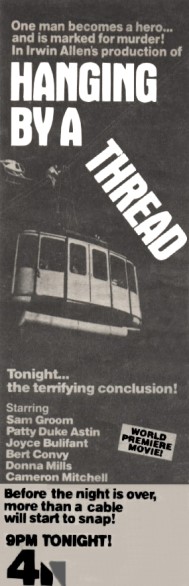
Hanging By A Thread (1979, directed by Georg Fenady)


A group of old friend who call themselves the Uptowners’ Club (yes, really) want to go on a picnic on top of a remote mountain.  The only problem is that they have to ride a cable car up to the mountain and there are reports of potentially bad weather.  It’s not safe to ride in a cable car during a thunderstorm.  Drunken ne’er-do-well Alan (Bert Convy) doesn’t care and, since his family owns both the mountain and the tramway, his demands that he and his friends be allowed to ride the cable car are met.  One lightning strike later and the members of the Uptowners’ Club are stranded in a cable car that is perilously suspended, by only a frayed wire, over treacherous mountain valley.

With no place to go, there’s not much left for the members of the Uptowners’ Club to do but bicker amongst themselves and have lengthy flashbacks that reveal every detail of their own sordid history.  Paul (Sam Groom) is angry with Alan because Alan is now engaged to his ex-wife (Donna Mills).  Sue Grainger (Patty Duke) is angry with everyone else because they don’t want to admit how their old friend Bobby Graham (Doug Llewellyn) actually died.  The other members of the Uptowners’ Club are angry because there’s not much for them to do other than watch Duke and Convy chew on the scenery.  Because of the supposedly fierce winds, someone is going to have to climb out on top of the cable car and repair it themselves.  Will it be Paul or will it be cowardly drunk Alan?  On top of everything else, Paul is set to enter the witness protection program and has got hitmen who want to kill him.

This made-for-TV disaster movie was produced by Irwin Allen.  Are you surprised?  It’s also three hours long and amazingly, Leslie Nielsen is not in it.  It’s hard to understand how anyone could have produced a cable car disaster film and not given a role to Leslie Nielsen.  Cameron Mitchell’s in the film but he’s not actually in the cable car so it’s a missed opportunity.  Any film that features Patty Duke detailing how her friends got so drunk that they ended up killing the future host of The People’s Court is going to at least have some curiosity value but, for the most part, Hanging By A Thread gets bogged down by its own excessive runtime and lack of convincing effects.  Hanging By A Thread came out at the tail end of the 70s disaster boom and it shows why the boom didn’t continue into the 80s.

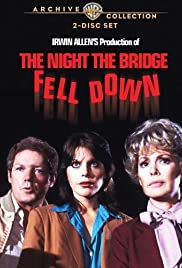
The Night the Bridge Fell Down (1983, directed by Georg Fenady)


When civil engineer Carl Miller (James MacArthur) discovers that the Madison Bridge is on the verge of collapsing, he goes to his superior (Philip Baker Hall!) and explains that the bridge has to be closed down or people could die.  Since there wouldn’t be a movie if anyone listened to Carl’s concerns, he’s ignored.

No sooner has Carl been told that he doesn’t know what he’s talking about than the bridge suddenly starts to collapse.  With both ends of the bridge collapsing into the river below, a diverse group of people find themselves stranded in the middle.  The group is made up of the usual group of disaster movie characters and, of course, one of them is played by Leslie Nielsen.  This time, Nielsen is a crooked businessman with a mistress (played by Barbara Rush) and a baby to worry about.  Eve Plumb (who was a member of the original Brady Bunch) is a nun.  Richard Gilliland is a wounded cop.  Gregory Sierra is a landscaper.  Perhaps most improbably, clean-cut Desi Arnaz Jr. is a bank robber who keeps losing his temper and pointing a gun at everyone.  Carl has to figure out how to get everyone off of the bridge before the entire things collapses.  This leads to many shots of chunks of concrete falling off what’s left of the bridge, as if we need to be reminded that it’s dangerous to be on a bridge that’s in the process of very slowly collapsing.

After finding success making movies about fires, overturned ocean liners, volcanoes, cave-ins, and killer bees, I guess it only makes sense that Irwin Allen would finally get around the producing a movie about a collapsing bridge.  The Night The Bridge Fell Down was filmed in 1980 but it wasn’t aired until 1983.  When it did air, it played opposite the series finale of M*A*S*H, which remains one of the highest rated single episodes of television ever aired.  It’s obvious that no one had much faith in a three hour film about a collapsing bridge and it only aired because NBC needed something — anything — to air at a time when they knew no one would be watching.

Because of the lengthy amount of time between the film’s production and it’s airing, The Night The Bridge Fell Down is the type of serious and plodding disaster film that was popular in the 70s but, by the time 1983 rolled around, had been rendered obsolete by the satiric bards of Airplane!  Airplane‘s Leslie Nielsen even appears here, giving the type of serious performance that he specialized in before people discovered that he was actually a very funny man.  Nielsen doesn’t give a bad performance but everything he says is thoroughly undercut by how difficult it is to take Leslie Nielsen seriously.  No matter what Nielsen says, it always seems like he’s on the verge of adding, “And don’t call me Shirley.”

The main problem with The Night The Bridge Fell Down is that it’s a three-hour movie and that’s a long time to spend with a group of thinly characterized people on a bridge.  I guess the film does feature an important message about maintaining roads and bridges.  Watch it next Infrastructure Week.