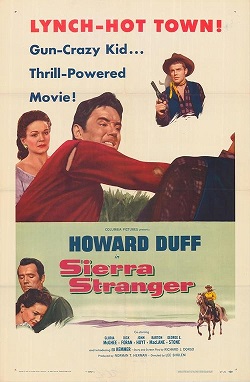
Sierra Stranger (1957, directed by Lee Sholem)


Sierra Stranger starts with a familiar western situation.  Jess Collins (Howard Duff), a penniless but honorable drifter, comes across two men tying another man to the back of a horse.  The two men claim that Sonny Grover (Ed Kemmer) is an outlaw and a claim jumper and not to be trusted. Sonny says that he’s innocent and the two men are actually the claim jumpers.  Jess does what many a western hero has done.  He sides with the underdog and saves Sonny.  To thank him, Sonny gives Jess a part of his claim.

Jess rides into the nearby town to claim his new property.  He meets and befriends Sonny’s half-brother, Bert (Dick Foran).  He also meets and falls in love with Bert’s fiancée, Meg (Gloria McGeehee).  However, soon after arriving, Jess discovers that he made a mistake and he saved the wrong man.  Sonny really is the dangerous outlaw that everyone says he is.  After Sonny robs a stagecoach and murders the driver, Jess risks his new friendship with Bert by trying to bring Sonny to justice.

Howard Duff appeared in his share of B-westerns in the 50s.  He was always a solid hero, even if he didn’t really have the screen presence of some of the other stars of the genre.  He’s pretty good in Sierra Stranger and the fact that, for once, the town is right while the drifter is wrong is an interesting twist on an otherwise standard story.  This is the rare western where the hero makes a pretty big mistake and then has to spend the rest of the movie trying to make up for it.  If you’re not a western fan, this is not the type of B-movie that’s going to change your mind.  But, for those who do like the genre, it’s an interesting twist on what we’ve been led to naturally expect.

Ten Wanted Men (1955, directed by Bruce Humberstone)


Arizona rancher Wick Campbell (Richard Boone) is angered when he discovers that one of his servants, Maria (Donna Martell), would rather marry Howie Stewart (Skip Homeier) than be with Wick.  Wick has had a long rivalry with Howie and his older brothers, John (Randolph Scott) and Adam (Lester Matthews).  Determined to get rid of the Stewarts and to have Maria for himself, Wick hires notorious gunfighter Frank Scavo (Leo Gordon) to take over the town and defeat the Stewarts, one way or another.

Ten Wanted Men (the title refers to Scavo’s gang) is an above average Randolph Scott western.  Scott was one of the best of the western heroes because he always seemed so authentic whenever he rode a horse, shot a gun, or even just put on a cowboy hat.  Scott was also an underrated actor and, as he got older, he became Hollywood’s go-to choice whenever they needed a strong, silent lead for a western.  That’s the role that he plays in Ten Wanted Men, as the patriarch of the Stewart family.  He’s instinctively fair but he will do whatever has to be done to protect his brothers.

Wick Campbell is John Stewart’s opposite, an oily rancher who hires other men to bully his enemies and who abuses his servant in a way that the Stewarts never would consider.  Though Richard Boone became best known for playing the hero on Have Gun–Will Travel, Wick is the type of cowardly villain who everyone will be happy to see get exactly what he deserves.  As played by Leo Gordon, Frank Scavo is a brutish outlaw and, unlike Wick, he doesn’t pretend to be anything else.

Ten Wanted Men is a good western.  The plot may not be surprising but the gunfights are exciting and Randolph Scott is as ideal a hero as always.  Fans of the genre will enjoy it.

Death Rides The Range (1939, directed by Sam Newfield)


In this “modern-day” western, Ken Maynard stars as Ken Baxter. While out camping in the wilderness with his trusty horse Tarzan and his two comic relief sidekicks, Pancho (Julian Rivero) and Panhandle (Ralph Peters), Ken comes across the gravely injured Professor Wahl (Michael Vallon). Wahl is an archeologist who has been left to die. Wahl is too weak to reveal who attacked him and, when Ken gets Wahl back to civilization, he discovers that Wahl’s colleagues, Dr. Flotow (William Castello) and Baron Starkoff (Sven Hugo Bard), aren’t willing to help Wahl unless he shares the location of a helium mine.

Flotow and the Baron are working for “a foreign power” and want to smuggle the helium back to Europe so that their country can use it to fuel their dirigibles. Ken and his sidekicks have to stop the bad guys from getting control of the ranch that sits near the mine. Going undercover, Ken allows himself to be hired by Joe Larkin (Charles King), who is trying to steal the property away from Letty Morgan (Fay McKenzie).  Romance and gunfight follows.  Ken’s horse, Tarzan, saves the day more than once.

The plot of Death Rides the Range is intriguing and, for a 55-minute programmer, complex. Unfortunately, the execution doesn’t allow the story to fulfill its potential. By the time Maynard starred in this film, the once-major cowboy star had alienated most of the major studios and he had a reputation being difficult. He was reduced to working for poverty row studios, like Colony Pictures. Maynard is a convincing hero and his horse, Tarzan, was one of the most talented of the animal actors working at that time but Death Rides The Range still feels rushed.

Death Rides The Range is mostly interesting as an example of the type of anti-German films that were being made before the U.S. officially entered World War II. The film keeps it ambiguous who Flotow and Starkoff are working for but any viewer who had been following the news out of Europe would automatically know they were working for the Germans. Even when he was making movies for Poverty Row, Ken Maynard was still fighting the good fight.

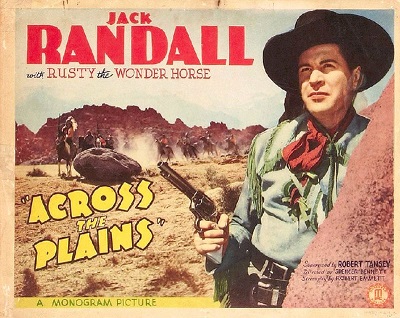
Across The Plains (1939, directed by Spencer Gordon Bennett)


In the old west, a group of outlaws attack a wagon train, killing a husband and wife but sparing their two children.  One child is taken by the outlaws, who tell him that they have saved him from an Indian attack.  He grows up to be The Kansas Kid (Dennis Moore), a wagon master who still works for Gordon (Bob Card), the outlaw who raised him.  The other child is adopted by a Native tribe and grows up to be known as Cherokee (Jack Randall).  Cherokee has been hired to protect a gold shipment that Kansas and Gordon are determined to steal.  How long until the brothers come into conflict?

Across The Plains is a pretty good programmer.  Dennis Moore and Jack Randall are convincing as two men on opposite sides of the law who don’t realize that they’re brothers and director Spencer Gordon Bennett captures the scenery of the old west.  This is a western where the frontier really feels and looks like an untouched frontier!  The gunfights are effectively choreographed and directed and the family aspect is a good spin on a simple story.  For fans of westerns, Across The Plains is an enjoyable example of the genre.

Dennis Moore and Jack Randall were both B-western mainstays.  Moore occasionally played a hero but was usually cast as a villain.  Across The Plans gives him a chance to play a more complex role than usual and he takes full advantage of the opportunity.  The Kansas Kid may be an outlaw but he’s not so much bad as just misguided.  Jack Randall was one of the many stage names used by actor Addison Randall.  He started out as a singing cowboy before playing more traditional heroes, like in this film.  In Across The Plans, Randall was as tough and convincing a western hero as he always was.    Tragically, he died six years after making this film when he fell off a horse while filming a Universal serial called The Royal Mounted Ride Again.  He was only 39 years old.

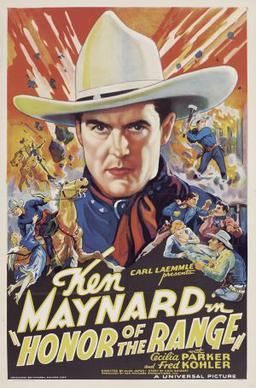
Honor of the Range (1934, directed by Alan James)


In an old west town, Sheriff Ken Bellamy (Ken Maynard) is an honest and upright lawman who thinks that he is trusted and respected by all.  His brother, Clem (also played by Ken Maynard), is a storeowner who is less respected and very jealous of his brother.  When Ken is asked to store some money in a safe, Clem decides to help the local outlaw, Rawhide (Fred Kohler), steal the money.  Clem gives Rawhide the combination but Rawhide then betrays Clem and takes him hostage.  Meanwhile, the townspeople think that Ken must has stolen the money so they toss him in jail and appoint a man named Boots (Frank Hageny) as the new sheriff.  Now, Ken has to not only figure out how to escape from jail and the townspeople but also how to defeat Rawhide’s gang.

Ken Maynard and his white horse Tarzan were two of the biggest western stars of the pre-code era.  Most of them were routine programmers but Honor of the Range stands out because it allows Maynard to step out of his usual heroic role by having him also play Clem.  Maynard could be a stiff actor when he was playing a traditional hero but here he seems to be enjoying playing the untrustworthy Clem.  Maynard actually produced Honor of the Range himself and it’s much more serious than the typical Ken Maynard western.  The town’s betrayal of the sheriff is played straight, as is Clem’s resentment of his brother.  With higher production values than usual and Maynard looking credible whenever he was holding a gun or riding his horse, Honor of the Range is one of the better westerns to be distributed by Universal during the pre-code era.

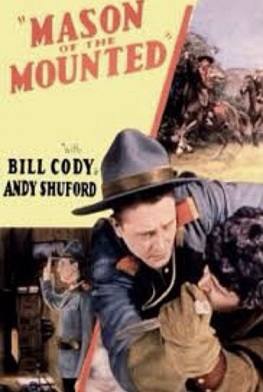
Mason of the Mounted (1932, directed by Harry L. Fraser)


Bill Mason (Bill Cody) is a member of the Canadian Mounted Police who is sent over the border to track down a murderous horse thief.  Going undercover, Mason discovers that a nearby frontier town is being terrorized by rustlers.  The townspeople have named Calhoun (LeRoy Mason) as the head of the local posse but Mason soon discovers that Calhoun is actually the horse thief!

Mason of the Mounted is only 57 minutes long but it’s a very slow-moving 57 minutes.  It’s also a pre-Code film but, other than a grisly shot of a dead body at the start of the film, there’s nothing about Mason of the Mounted that you wouldn’t expect to find in a western made under the production code.  Much of the film centers around Mason befriending an American teenager named Andy Talbot (played by Andy Shuford).  This was actually one of 8 films that Bill Cody and Andy Shuford made together.  Cody was a genuine cowboy who performed in wild west shows before and after his film career.  Shuford was a child actor whose career was primarily in Westerns.  During World War II, he enlisted in the U.S. Army Air Corps, flew many missions out of England, and eventually reached the rank of colonel.  He never returned to making films.

As for Mason of the Mounted, Bill Cody has some authentic cowboy grit and is credible when he’s on a horse or shooting a gun but the plot moves too slowly and most of the cast is stiff and awkward.  I did like the idea of the main rustler disguising himself as the only person capable of stopping the rustlers.  That was an interesting idea and I wish the movie had done more with it.  This is a film that’s mostly for fans of the genre and even the most undemanding western fan will probably have a hard time making their way through the whole thing.

Great Moments In Television History #13: The A-Team Premieres


39 years ago today, television viewers who were watching NBC primetime met a group of four former members of the Special Forces who, during the Vietnam War, were framed for a crime they didn’t commit.

The pilot for the A-Team first aired on January 23rd, 1983.  No one had much hope for the pilot, with the exception of star George Peppard who predicted the show would be a hit as soon as he read the script.  Producer Stephen J. Cannell hadn’t had a hit in a while.  When Cannell was hired by NBC, network president Brandon Tartikoff asked for one thing: “Mr. T driving a car.”

Despite what the critics thought and despite the skepticism of the network brass, The A-Team was an immediate success.  Audiences loved the four misfits who somehow always managed to win the day despite Face’s womanizing, Murdock’s insanity, and B.A.’s fear of flying.  A week after the pilot aired, the show’s first regular episode was broadcast directly after the Super Bowl.  The rest is history.

If you have a problem, the A-Team can help.  You just have to find them.

Previous Great Moments In Television History:

  1. Planet of the Apes The TV Series
  2. Lonely Water
  3. Ghostwatch Traumatizes The UK
  4. Frasier Meets The Candidate
  5. The Autons Terrify The UK
  6. Freedom’s Last Stand
  7. Bing Crosby and David Bowie Share A Duet
  8. Apaches Traumatizes the UK
  9. Doctor Who Begins Its 100th Serial
  10. First Night 2013 With Jamie Kennedy
  11. Elvis Sings With Sinatra
  12. NBC Airs Their First Football Game

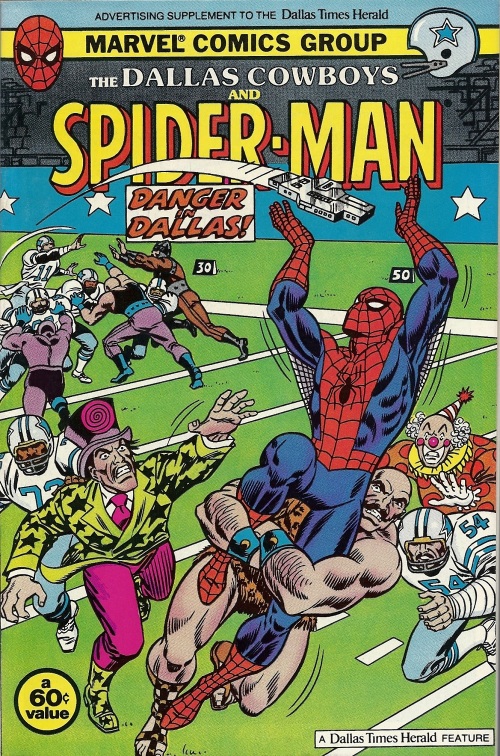
Great Moments In Comic Book History #17: Spider-Man and The Dallas Cowboys Battle The Circus of Crime


Spider-Man meets the Dallas Cowboys!

In 1983, Marvel comics teamed up with local newspapers to produce inserts that would feature heroes like the X-Men and Spider-Man visiting towns outside of New York, meeting with local celebrities, and, of course, providing ad space for local businesses.  One of the newspapers that they teamed up with the now-defunct Dallas Times Herald, which was also the original home of Texas’s own drive-in movie reviewer, Joe Bob Briggs.

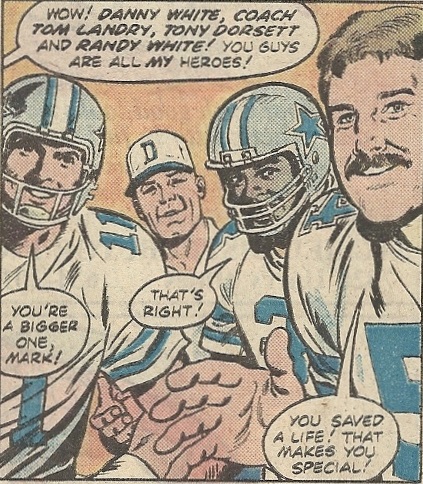
Marvel ended up doing three inserts for the Dallas Times Herald, one with the X-Men at the State Fair and then two featuring Spider-Man.  In “Danger in Dallas,” Peter Parker accompanied J. Jonah Jameson and Dr. Mudge to Dallas so that Dr. Mudge’s wheelchair-bound son could meet his heroes, the Dallas Cowboys.

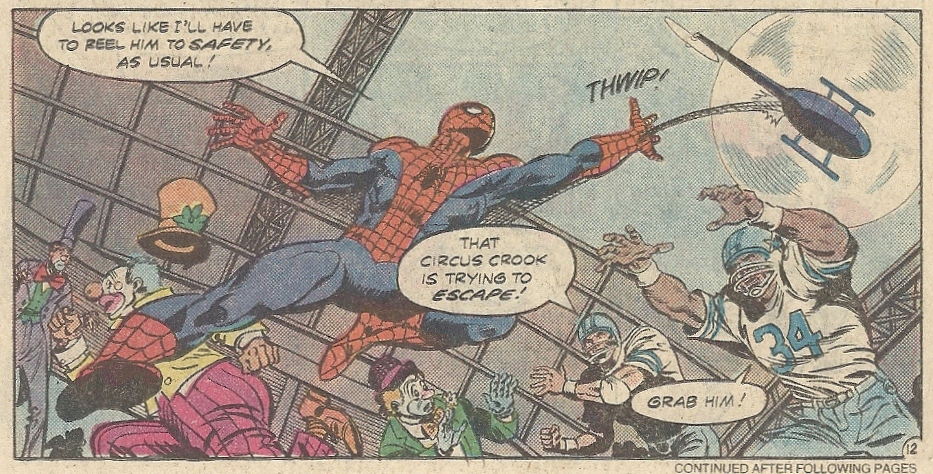
Dr. Mudge had also developed an anti-gravity device and the Circus of Crime was determined to steal it for themselves.  Spider-Man had to stop them but to fight an entire circus, he would need some help.  Good thing that Cowboys didn’t have anything to do that day!

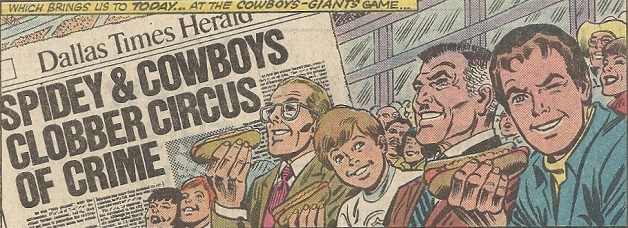
Once the Cowboys had tackled the Circus of Crime, Peter and even Jonah were able to enjoy opening day.  Peter even proved his courage by eating a Texas Stadium hot dog!

Spider-Man wished the Cowboys a good game, letting us know that even super heroes from New York were rooting for America’s Team in the 80s.

Out of curiosity, I decided to see how the Cowboys did during the 1983 season.  They went 12-4 and were second in the NFC East.  They earned a wildcard spot but lost to the Rams, 17-24.  Despite Spider-Man’s blessings, it was not the Cowboys who went to the Super Bowl but instead the team currently known as Football Team.  (Full disclosure: By default, that was my family’s team until Baltimore finally got the Ravens.)  Fortunately, Washington lost to the Raiders, 9-38.

According to the cover, this was a 60 cent value in 1983.  Currently, it sells for $18.00 online.

The Dallas Cowboys and Spider-Man #1 “Danger in Dallas” (1983)

Writer Marie Severin and David Kraft
Pencilers Marie Severin and Kerry Gammill
Inker Mike Esposito
Colorist Stan Goldberg
Letterer R. G. O’Shaw

Previous Great Moments In Comic Book History:

  1. Winchester Before Winchester: Swamp Thing Vol. 2 #45 “Ghost Dance” 
  2. The Avengers Appear on David Letterman
  3. Crisis on Campus
  4. “Even in Death”
  5. The Debut of Man-Wolf in Amazing Spider-Man
  6. Spider-Man Meets The Monster Maker
  7. Conan The Barbarian Visits Times Square
  8. Dracula Joins The Marvel Universe
  9. The Death of Dr. Druid
  10. To All A Good Night
  11. Zombie!
  12. The First Appearance of Ghost Rider
  13. The First Appearance of Werewolf By Night
  14. Captain America Punches Hitler
  15. Spider-Man No More!
  16. Alex Ross Captures Galactus

Game Review: Locked Door (2022, Cody Gaisser)


(SPOILER WARNING)

You are in a room. A wooden door leads north. That’s the only exit. But, the door is locked!

This is a puzzle that has faced many a player of Interactive Fiction. We’ve all had to deal with the locked room scenario, where you have to find the solution for how to get that door open. You can play guess the verb. You can look for things to examine. You can check your inventory to see if you have something on you that could be used in some clever way to unlock the door.

Or you could just pick up the iron key and see what it does.

To quote the game itself:

Room A
A plain white room. A wooden door leads north.

You can see an iron key here.

Can it be that simple? Why not? One side effect of playing too much interactive fiction is that you reach a point where you assume that every solution has to be complicated. Sometimes, you can just pick up the key.

There is another room, though. Be sure to go in the other room and read what you find.

Keep in mind, this is only the first Locked Door game. There are at least three other adventures, all asking if you can unlock more doors. I’ve been playing the fourth one. I’ll review it as soon as I figure out how to open up the damn door.

Play Locked Door

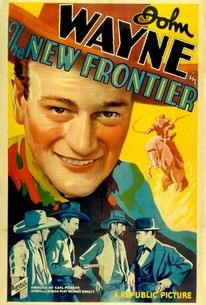
The New Frontier (1935, directed by Carl Pierson)


In 1889, wagon master Milt Dawson (Sam Flint) rides into a western town. He is planning on meeting his son John, who is also a wagon master. However, when a friend of Milt’s is killed by gambler Ace Holmes (Warner Richardson), Milt announces that he’s going to clean up the town and Ace is the first piece of trash that Milt is going to toss out. Ace responds by having his henchmen shoot Milt in the back.

After Milt’s death, his son finally arrives in town and you know that Ace is going to be in trouble because John Dawson is played by John Wayne! Seeking to avenge his father’s death, John teams up with an outlaw named Kit (Al Bridge) and declares war on Ace and his gang.

This is a typical western programmer, one that would probably be forgotten if not for the presence of John Wayne in an early starring role. This was before Stagecoach so the budget is low and the plot is simple. Even in his early 20s, John Wayne has the natural authority that would later make him a star but it’s still strange for me to see him in any film where he’s playing a young man who still has parents. There are some actors who you can’t picture as ever having been anything less than middle-aged and John Wayne is one of them. While most of the other actors are stiff and awkward, Wayne seems right at home in the dusty streets of The New Frontier. Interestingly, given Wayne’s identification with law-and-order, he plays a character here who has no problem working with outlaws and who understands that sometimes, the law can be unfair.  Ace is the most powerful man in town and John has no choice but team up with those on the outs of what was then considered to be respectability.  Another memorable scene juxtaposes a gun battle with the town’s citizens praying in church, a reminder that innocent people were often caught in the middle of the old west’s grudge matches.  These are interesting themes, though they’re not very deeply explored.  

Though the gunfights are nicely choreographed and shot, the chance to see a pre-stardom John Wayne clean up the old west is the main reason to watch The New Frontier.