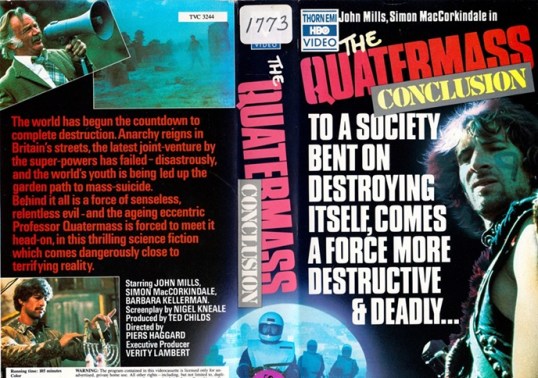
1979’s The Quatermass Conclusion opens with a narrator telling us that civilization is collapsing and no one knows why.
Though the film takes place in London and the English countryside, we are told that societal collapse a worldwide phenomenon. What we see in London is a city that has been taken over by criminal gangs, where the police stand-by helplessly and watch as battles play out. The elderly, abandoned by their government, hide out in decrepit homes and try to avoid being noticed. The future is a world that is pretty much ruled by the young and the young appear to be insane.
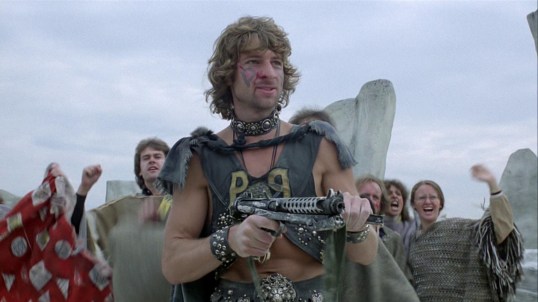
Even if one escapes the gangs, there’s still the Planet People to deal with. The Planet People are a group of hippies, who walk across the countryside and who claim that they are going to be transported to another planet. At first glance, they make seem innocent and even a bit ludicrous. But they are actually aggressive and angry, convinced that the adults have destroyed the Earth and that the young are the chosen ones who will be transported to a better world. They are led by a man who calls himself Kick Along (Ralph Arliss), an anti-Semite who smiles when he manages to find a gun and who clearly relishes getting to decide who deserves to be saved and who doesn’t.
Into all of this comes a retired scientist named Bernard Quatermass (John Mills). Elderly and suffering from heart disease, Quatermass has come to London to search for his missing granddaughter. Because Quatermass has spent the last few years living in the Scottish highlands and because the British government has covered-up the extent of the unrest, he is shocked to discover just how bad things have become. Rescued from a gang by another scientist, an astronomer named Joe Kapp (Simon MacCorkindale), Quatermass finds himself watching as humanity slowly sacrifices itself to an alien presence who is not interested in saving anyone but who instead just wants to feast.
The Quatermass Conclusion started life as a 4-episode British television simply called Quatermass, which was the last to feature the character of Prof. Bernard Quatermass. The four-hour miniseries was edited down to a 100-minute feature film that was subsequently released outside of the UK. As a result of the editing, The Quatermass Conclusion is a occasionally intriguing, frequently messy, and almost relentlessly downbeat. Having seen both the original miniseries and the subsequent film, I can tell you that tragedies that were evenly spaced out over the course of four hours come at you nonstop in the feature version. It seems like every other scene features someone either dying or giving up hope. Themes that were fully developed in the miniseries are only hinted at in the feature film. Events that were fully explained and built-up in the miniseries seem to spring out of nowhere in the movie, giving the whole thing a disjointed but nightmarish feel.
Taken on its own, the film has its flaws. I’m not really sure that the plot can truly be followed if you haven’t already watched the original miniseries. As the unfortunately-named Kick Along, Ralph Arliss gives a disturbingly plausible portrayal of a fascist who has adapted to the latest trend and John Mills is instantly sympathetic as the mentally strong but physically weak Prof. Quatermass but some of the other performances are definitely more appropriate for television than a film. And yet the film has moments that work incredibly well. A scene where the alien presence feasts on the thousands who have gathered at Wembley Stadium is undeniably well-done and brings to mind the real-life reports of political dissidents being held and executed in South American soccer stadiums. By the end of the film, the atmosphere has become so polluted with the particles of human remains that it takes on a sickly yellow hue. Even the film relentlessly bleak tone works. If you’re going to make a movie about the collapse of civilization, you should definitely go all out. There’s not much deliberate humor in The Quatermass Conclusion but, then again, there’s not much to smile about when the world’s collapsing.
Watching The Quatermass Conclusion, what struck me is just how much writer Nigel Kneale and Piers Haggard got right about the future. On the one hand, the film is anti-youth to the point of almost feeling like a parody. This is a movie that often seems to be shouting, “Get off my lawn!” Watching this, one can easily guess how Nigel Kneale felt about everyone from the hippies to the punks. However, the film’s portrayal of cities where people are scared to go out at night and of bureaucrats who would rather cover-up a problem than solve it feels rather prophetic today. (In the miniseries, there’s a youthful government official who is overjoyed at the idea of creating an entirely new civilization after destroying the current one and it’s hard to watch him without being reminded of some of the rhetoric of the COVID lockdowns.) It’s easy to laugh at the Planet People, with their face paint and their chanting, but they really don’t feel that far off from a lot of today’s wannabe activists. There’s really not that much difference between the smugly ignorant Kick Along and the people who used to throw paint on works of art.
The Quatermass Conclusion is a flawed, messy, intriguing, and prophetic. It may not be subtle but it’s a film that feel very relevant today.


Suggestions for how to watch this?
LikeLike
Both the film and the original miniseries are on YouTube.
https://www.youtube.com/watch?v=9-a2yDbjOy4
LikeLiked by 1 person
The four episode version is available at The Internet Archive.
I trust that the esteemed Lisa Marie Bowman will allow me to post the link here. I took a brief look at it, it seems like a pretty clean copy, all things considered.
LikeLiked by 1 person