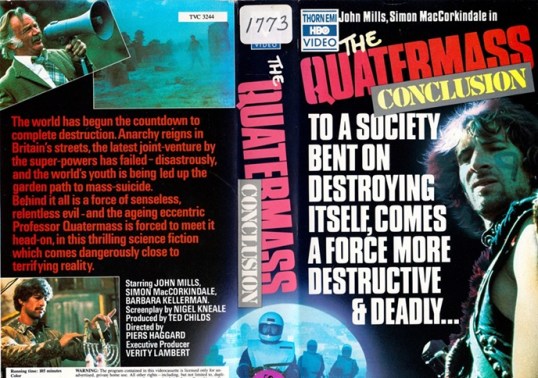
Film Review: The Quatermass Conclusion (dir by Piers Haggard)


1979’s The Quatermass Conclusion opens with a narrator telling us that civilization is collapsing and no one knows why.

Though the film takes place in London and the English countryside, we are told that societal collapse a worldwide phenomenon.  What we see in London is a city that has been taken over by criminal gangs, where the police stand-by helplessly and watch as battles play out.  The elderly, abandoned by their government, hide out in decrepit homes and try to avoid being noticed.  The future is a world that is pretty much ruled by the young and the young appear to be insane.

Even if one escapes the gangs, there’s still the Planet People to deal with.  The Planet People are a group of hippies, who walk across the countryside and who claim that they are going to be transported to another planet.  At first glance, they make seem innocent and even a bit ludicrous.  But they are actually aggressive and angry, convinced that the adults have destroyed the Earth and that the young are the chosen ones who will be transported to a better world.  They are led by a man who calls himself Kick Along (Ralph Arliss), an anti-Semite who smiles when he manages to find a gun and who clearly relishes getting to decide who deserves to be saved and who doesn’t.

Into all of this comes a retired scientist named Bernard Quatermass (John Mills).  Elderly and suffering from heart disease, Quatermass has come to London to search for his missing granddaughter.  Because Quatermass has spent the last few years living in the Scottish highlands and because the British government has covered-up the extent of the unrest, he is shocked to discover just how bad things have become.  Rescued from a gang by another scientist, an astronomer named Joe Kapp (Simon MacCorkindale), Quatermass finds himself watching as humanity slowly sacrifices itself to an alien presence who is not interested in saving anyone but who instead just wants to feast.

The Quatermass Conclusion started life as a 4-episode British television simply called Quatermass, which was the last to feature the character of Prof. Bernard Quatermass.  The four-hour miniseries was edited down to a 100-minute feature film that was subsequently released outside of the UK.  As a result of the editing, The Quatermass Conclusion is a occasionally intriguing, frequently messy, and almost relentlessly downbeat.  Having seen both the original miniseries and the subsequent film, I can tell you that tragedies that were evenly spaced out over the course of four hours come at you nonstop in the feature version.  It seems like every other scene features someone either dying or giving up hope.  Themes that were fully developed in the miniseries are only hinted at in the feature film.  Events that were fully explained and built-up in the miniseries seem to spring out of nowhere in the movie, giving the whole thing a disjointed but nightmarish feel.

Taken on its own, the film has its flaws.  I’m not really sure that the plot can truly be followed if you haven’t already watched the original miniseries. As the unfortunately-named Kick Along, Ralph Arliss gives a disturbingly plausible portrayal of a fascist who has adapted to the latest trend and John Mills is instantly sympathetic as the mentally strong but physically weak Prof. Quatermass but some of the other performances are definitely more appropriate for television than a film.  And yet the film has moments that work incredibly well.  A scene where the alien presence feasts on the thousands who have gathered at Wembley Stadium is undeniably well-done and brings to mind the real-life reports of political dissidents being held and executed in South American soccer stadiums.  By the end of the film, the atmosphere has become so polluted with the particles of human remains that it takes on a sickly yellow hue.  Even the film relentlessly bleak tone works.  If you’re going to make a movie about the collapse of civilization, you should definitely go all out.  There’s not much deliberate humor in The Quatermass Conclusion but, then again, there’s not much to smile about when the world’s collapsing.

Watching The Quatermass Conclusion, what struck me is just how much writer Nigel Kneale and Piers Haggard got right about the future.  On the one hand, the film is anti-youth to the point of almost feeling like a parody.  This is a movie that often seems to be shouting, “Get off my lawn!”  Watching this, one can easily guess how Nigel Kneale felt about everyone from the hippies to the punks.  However, the film’s portrayal of cities where people are scared to go out at night and of bureaucrats who would rather cover-up a problem than solve it feels rather prophetic today.  (In the miniseries, there’s a youthful government official who is overjoyed at the idea of creating an entirely new civilization after destroying the current one and it’s hard to watch him without being reminded of some of the rhetoric of the COVID lockdowns.)  It’s easy to laugh at the Planet People, with their face paint and their chanting, but they really don’t feel that far off from a lot of today’s wannabe activists.  There’s really not that much difference between the smugly ignorant Kick Along and the people who used to throw paint on works of art.

The Quatermass Conclusion is a flawed, messy, intriguing, and prophetic.  It may not be subtle but it’s a film that feel very relevant today.
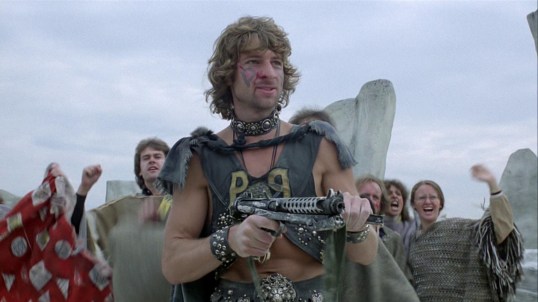
 

Doctor Who — The Ark In Space, The Sontaran Experiment, Genesis of the Daleks, Revenge of the Cybermen, Terror of the Zygons


The 12th season of Doctor Who got off to a shaky start with Robot, a serial that was ultimately distinguished only by the introduction of Tom Baker as the Fourth Doctor.  The best thing about Robot is that it ended with The Fourth Doctor peeking out of the TARDIS and inviting Sarah Jane Smith (Elisabeth Sladen) and Harry Sullivan (Ian Marter) to join him on his further adventures.  By inviting them, he was inviting the audience as well.

The remaining episodes of the 12th season not only established Tom Baker as the Doctor but it also reestablished Doctor Who as being a show about an alien who could travel through time and space.  After several seasons of The Third Doctor largely staying on Earth and in the present, the 12th Season reminded everyone that the Doctor could turn up anywhere.

The Ark In Space (1975, directed by Rodney Bennett)

The first place that the Doctor takes Sarah and Harry is to Nerva, a space station that floating above the Earth.  The time is 10,000 years into the future.  Forced to flee the Earth due to solar flares, the crew of the space station has spent a millennia in suspended animation.  During that time, the space station has been invaded by the Wirm, a space insect that has laid its eggs in some of the crewmen.  When everyone is revived, the infected crewmen are transformed into creatures that are half-human and half-insect.

The Ark in Space is a classic space opera.  When I was a kid and our PBS station first started to broadcast Doctor Who, they started with a four-hour bloc, which included Robot, The Ark In Space, and The Sontaran Experiment.  After Robot, with its basic plot and bad special effects, it was a relief to then see The Ark In Space, a serial that lived up to all of the Doctor Who hype.  Not only did Tom Baker fully step into the role of the eccentric Fourth Doctor but this serial also featured Elisabeth Sladen and Ian Marter in active roles as well.  This serial said that the days of the passive companion were (temporarily) over.

The plot of The Ark in Space does have some similarities to Alien, which came out for years later.  I think that’s probably just a coincidence.

The Sontaran Experiment (1975, directed by Rodney Bennett)

Having defeated the Wirm and saved the remaining colonists on the Ark, The Doctor, Harry, and Sarah transport down to Earth to repair a receiver terminal.  They discover that the Earth is not as deserted as they assumed.  A group of human astronauts returned to the planet earlier but they were captured by Styre (Kevin Lindsay), a Sontaran who has been sent to Earth to prepare it for an invasion so that the Sontarans can use the planet as an outpost in their never ending war with the Rutans.

This serial was only two episodes long but The Sontarans were always good villains.  They’re relentless, destructive, and very, very stupid.  This story featured one of Tom Baker’s best moments, when he convinced Styre to throw away his weapon because it made him look weak.  Styre fell for it because Sontarans will fall for anything.

Genesis of the Daleks (1975, directed by David Maloney)

This is it.  This is the first true classic of the Tom Baker era and also the best of the classic Dalek stories.  Terry Nation was invited back to Doctor Who to write about his most famous creations and he created one of the show’s most enduring villains in the process.

A Time Lord appears to the Doctor and his companions and tells them that they need The Doctor to change history.  (This goes against all Time Lord law, which is why they gave the job to a known renegade like The Doctor.)  The Daleks have been determined to be too much of a threat.  The Doctor is to go back to the time of their creation and “interfere.”

The Doctor, Harry, and Sarah Jane find themselves on Skaro, where the war between the Thals and the Kaleds have left the planet ravaged and inhospitable.  The Thals and the Kaleds each live in a domed city and spend their days shooting missiles at each other.  Terry Nation often said that the Daleks were meant to be a stand-in for the Nazis and he makes that clear in this episode with the Kaleds wearing SS-style uniforms and spouting theories about racial superiority.

In this episode, Nation introduces Davros (Michael Wisher), the horribly scarred and crippled scientist who will ultimately be responsible for transforming the Kaleds into the Daleks.  (The Kaleds who don’t want to be Daleks are wiped out by those who do.)  Davros would appear in every subsequent Dalek episode of classic era Doctor Who and his effectiveness would be diluted by repetition.  In his first appearance, though, he immediately establishes himself as a frightening and truly evil Doctor Who villain.  If their first appearance suggested that the Daleks retreated into the shells for survival in their nuclear-ravaged world, this episode shows that it more about Davros wanting to play God.

A six-episode serial, Genesis of the Daleks more than justifies its epic length.  The heart of the serial is a moment when the Doctor, on the verge of wiping out the Daleks forever, stops to wonder if he has the right to do so.  This was a key moment in the development of The Fourth Doctor.  The Fourth Doctor may have been an eccentric but he was an eccentric with a conscience who realized that even the worst creatures deserved a chance at redemption.  In the end, The Doctor does not destroy the Daleks, though he does set back their evolution by an undetermined number of years.  As the Doctor explains it, good will always rise up to counter the evil of the Daleks.

This episode features the apparent destruction of Davros but you can never keep a good villain down.  Both Davros and his creations would return.

Revenge of the Cybermen (1975, directed by Michael Briant)

After a classic Dalek story, I guess it was inevitable that Doctor Who would feature a Cyberman episode.

Following the events of Genesis of the Daleks, the Time Lords return The Doctor, Sarah Jane, and Harry to the Nerva space station.  They arrive several centuries before the events in The Ark In Space.  Without the TARDIS (it’s traveling back through time to meet them), The Doctor and his companions discover that the majority of Nerva’s crew is dead and that the remaining members are using the station as a space beacon to warn people about a drifting planetoid.  The planetoid is made of gold and the Cybermen show up at Nerva because, being uniquely vulnerable to gold dust, they want to destroy it.

If Genesis of the Daleks re-imagined the Daleks, Attack of the Cybermen proves to be just a typical Cybermen story and a disappointing one.  The best thing about this episode is that it gave Tom Baker a chance to once again prove his Doctor bonafides by defeating a classic Doctor Who villain.

Terror of the Zygons (1975, directed by Douglas Camfield)

Terror of the Zygons was the first seral of the thirteenth season but, since it’s also Harry Sullivan’s final appearance as a regular member of the TARDIS crew (though he would return in a later episode for a one-off appearance), it still feels like a twelfth season episode.

Having been reunited with the TARDIS, the Doctor, Sarah Jane, and Harry return to present-day Earth.  The Brigadier (Nicholas Courtney) and UNIT are investigating attacks on oil rigs by a giant sea creature.  Sea Devils, again?  No, this time it’s the Zygons, who are far less sympathetic.

This was a typical UNIT story, the type of thing that Jon Pertwee did regularly.  Tom Baker’s more mischievous version of the Doctor feels slightly out-of-place with UNIT but it is still a pleasure to see Nicholas Courtney and John Levene again and this episode finally explains what everyone has been seeing in Loch Ness over the years.  This episode ends with Harry returning to UNIT while Sarah Jane and the Doctor returned the TARDIS.  Harry Sullivan was a strong character and producer Philip Hinchcliffe later said it was a mistake to write him out of the series.

Ian Marter, who played Harry Sullivan, continued to be associated with Doctor Who as one of the better writers of the Doctor Who novelizations.  He also wrote two stand-alone novels featuring Harry’s adventures without the Doctor.  Ian Marter died of a heart attack when he was just 42 but Harry Sullivan lived on, frequently being mentioned in both the classic series and the revival.

That’s it for the 12th season, the season that truly made Tom Baker the Doctor and which was one of the best of the classic series.  As these were the first episodes of Doctor Who that I ever saw, I have a lot of nostalgia for them.  The Ark In Space, The Sonatarn Experiment, Genesis of the Daleks, and even Terror of the Zygons still hold up well to this day.