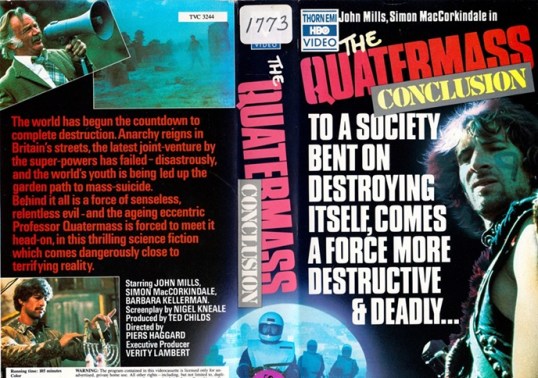
Film Review: The Quatermass Conclusion (dir by Piers Haggard)


1979’s The Quatermass Conclusion opens with a narrator telling us that civilization is collapsing and no one knows why.

Though the film takes place in London and the English countryside, we are told that societal collapse a worldwide phenomenon.  What we see in London is a city that has been taken over by criminal gangs, where the police stand-by helplessly and watch as battles play out.  The elderly, abandoned by their government, hide out in decrepit homes and try to avoid being noticed.  The future is a world that is pretty much ruled by the young and the young appear to be insane.

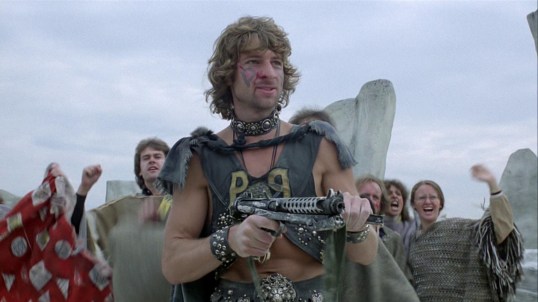
Even if one escapes the gangs, there’s still the Planet People to deal with.  The Planet People are a group of hippies, who walk across the countryside and who claim that they are going to be transported to another planet.  At first glance, they make seem innocent and even a bit ludicrous.  But they are actually aggressive and angry, convinced that the adults have destroyed the Earth and that the young are the chosen ones who will be transported to a better world.  They are led by a man who calls himself Kick Along (Ralph Arliss), an anti-Semite who smiles when he manages to find a gun and who clearly relishes getting to decide who deserves to be saved and who doesn’t.

Into all of this comes a retired scientist named Bernard Quatermass (John Mills).  Elderly and suffering from heart disease, Quatermass has come to London to search for his missing granddaughter.  Because Quatermass has spent the last few years living in the Scottish highlands and because the British government has covered-up the extent of the unrest, he is shocked to discover just how bad things have become.  Rescued from a gang by another scientist, an astronomer named Joe Kapp (Simon MacCorkindale), Quatermass finds himself watching as humanity slowly sacrifices itself to an alien presence who is not interested in saving anyone but who instead just wants to feast.

The Quatermass Conclusion started life as a 4-episode British television simply called Quatermass, which was the last to feature the character of Prof. Bernard Quatermass.  The four-hour miniseries was edited down to a 100-minute feature film that was subsequently released outside of the UK.  As a result of the editing, The Quatermass Conclusion is a occasionally intriguing, frequently messy, and almost relentlessly downbeat.  Having seen both the original miniseries and the subsequent film, I can tell you that tragedies that were evenly spaced out over the course of four hours come at you nonstop in the feature version.  It seems like every other scene features someone either dying or giving up hope.  Themes that were fully developed in the miniseries are only hinted at in the feature film.  Events that were fully explained and built-up in the miniseries seem to spring out of nowhere in the movie, giving the whole thing a disjointed but nightmarish feel.

Taken on its own, the film has its flaws.  I’m not really sure that the plot can truly be followed if you haven’t already watched the original miniseries. As the unfortunately-named Kick Along, Ralph Arliss gives a disturbingly plausible portrayal of a fascist who has adapted to the latest trend and John Mills is instantly sympathetic as the mentally strong but physically weak Prof. Quatermass but some of the other performances are definitely more appropriate for television than a film.  And yet the film has moments that work incredibly well.  A scene where the alien presence feasts on the thousands who have gathered at Wembley Stadium is undeniably well-done and brings to mind the real-life reports of political dissidents being held and executed in South American soccer stadiums.  By the end of the film, the atmosphere has become so polluted with the particles of human remains that it takes on a sickly yellow hue.  Even the film relentlessly bleak tone works.  If you’re going to make a movie about the collapse of civilization, you should definitely go all out.  There’s not much deliberate humor in The Quatermass Conclusion but, then again, there’s not much to smile about when the world’s collapsing.

Watching The Quatermass Conclusion, what struck me is just how much writer Nigel Kneale and Piers Haggard got right about the future.  On the one hand, the film is anti-youth to the point of almost feeling like a parody.  This is a movie that often seems to be shouting, “Get off my lawn!”  Watching this, one can easily guess how Nigel Kneale felt about everyone from the hippies to the punks.  However, the film’s portrayal of cities where people are scared to go out at night and of bureaucrats who would rather cover-up a problem than solve it feels rather prophetic today.  (In the miniseries, there’s a youthful government official who is overjoyed at the idea of creating an entirely new civilization after destroying the current one and it’s hard to watch him without being reminded of some of the rhetoric of the COVID lockdowns.)  It’s easy to laugh at the Planet People, with their face paint and their chanting, but they really don’t feel that far off from a lot of today’s wannabe activists.  There’s really not that much difference between the smugly ignorant Kick Along and the people who used to throw paint on works of art.

The Quatermass Conclusion is a flawed, messy, intriguing, and prophetic.  It may not be subtle but it’s a film that feel very relevant today.
 

Doctor Who — Destiny of the Daleks, City of Death, The Creature From The Pit, Nightmare of Eden, Horns of Nimon, Shada


Remember when I was writing about classic Doctor Who for Halloween?  Let’s get back to that with a look at the 17th season of the original series.  This season is a controversial one.  It featured some of the show’s worst serials but also one of its best.  Today, it’s remembered for introducing Lalla Ward as the second Romana and for featuring Douglas Adams as the script editor.

One frequent complaint about this season is that, under Adams’s influence, the season featured more comedy than before and it sometimes felt more like a version of Hitchhiker’s than Doctor Who.  There’s some truth to that but Adams’s influence also made Season 17 into a season unlike any other.  Many of Adams’s ideas didn’t work but he did give us City of Death.

Destiny of the Daleks (1979, directed by Kim Grieve)

Destiny of the Daleks will always have a place in my heart because it opens with Romana regenerating into Lalla Ward.  I will admit right now that, as a kid watching Doctor Who on PBS, I had a huge crush on Lalla Ward.  So did Tom Baker.  He ended up marrying Ward, though the marriage did not last for long.  The relationship between Baker and Ward often seemed to reflected in the relationship between The Doctor and Ward’s Romana.  Long before the Doctor Who reboot had people buzzing about the Doctor and Rose, fans of the original series knew that the Doctor and Romana were in love.

Destiny of the Daleks opens with Lalla Ward’s Romana cheerfully informing the Doctor that she’s decided to regenerate because she was bored and she’s decided to look like Princess Astra.  The Doctor points out that Princess Astra is a real person and Romana can’t just take on her appearance.  Romana then tries out several other appearances before The Doctor tells her to go with Astra.  This goes against everything that the show had established about Time Lords and regeneration but at least we end up with Lalla Ward as Romana.

It’s too bad that the rest of the serial itself isn’t that interesting, even if it does feature the first appearance by the Daleks since Genesis of the Daleks.  Davros returns as well, though he’s now more or less just another generic villain.  The Daleks have a new enemy, a group of robots called the Movellans.  The war between the Daleks and the Movellans are at a standstill because both are governed by logic.  That goes against everything we know about the Daleks.

This was Terry Nation’s final script for Doctor Who.  Reportedly, he was angered when Douglas Adams extensively rewrote the script.  Nation moved to America and later created the original MacGyver.

City of Death (1979, directed by Michael Hayes)

City of Death is a Doctor Who classic.  Romana and the Doctor visit modern-day Paris and the BBC found the money to allow the production to shoot on location.  The Doctor and Romana walk around Paris, hand-in-hand.  Count Scarlioni (Julian Glover) is actually an alien who wants to steal the Mona Lisa so that he can use it to fund his time travel experiments.  Countess Sacrlioni (Catherine Schell) is a classic femme fatale.  An American private investigator named Duggan (Tom Chabdon) wears a trench coat and solves problems by punching first and asking questions later.  John Cleese and Eleanor Bron appears as museum patrons who think the TARDIS is a work of modern art.  Douglas Adams later reworked bits of his script into Dirk Gentley’s Holistic Detective Agency.

Even people who cannot stand the rest of season 17 will agree that City of Death is one of the best of Tom Baker’s serials.  City of Death balances humor and drama and it features an excellent villain in the form of Julian Glover.  Tom Baker and Lalla Ward are at their best, the story is genuinely interesting, and — much like Jago and Lightfoot from The Talons of Weng-Chiang — Duggan deserved his own spin-off.

The Creature From The Pit (1979, directed by Christopher Barry)

This serial features the season’s first appearance by K-9, who is now voiced by David Brierley.  Though this serial was third to be aired, it was the first to be filmed.

It’s not much of a serial.  The TARDIS materializes on yet another feudal planet where Lady Adastra (Myra Frances) rules through fear.  Lady Adastra’s critics are thrown in the pit, which is said to be home to a great monster.  Instead, it’s home to a gentle blob that was sent to the planet as an ambassador.  The Doctor helps the blob gets its freedom while Romana and K-9 are briefly detained by a group of bandits.  Whatever potential the story had is short-circuited by the very unconvincing monster.

Nightmare of Eden (1979, directed by Alan Bromley and Graham Williams)

Two ships materialize in the same location and end up locked together.  Then the TARDIS materializes and the Doctor offers to find a way to unlock the two ships.  One of the ships is a luxury space liner and the passengers are soon being menaced by clawed monsters that look like stuntmen in rubber suits.  The other ship is a trade ship that the Doctor comes to suspect is involved in a drug-running operation.

Once again, the monsters were not at all convincing but the Doctor investigating the interstellar drug traffic was at least something different.  Much like City of Death, Nightmare of Eden, with its luxury spaceliner, had a few moments of satire that worked.  Unlike City of Death, the supporting characters were not that interesting and Tom Baker himself just seemed to be going through the motions.  Nightmare of Eden was better than a lot of Season 17 but it still ultimately comes across as being rather muddled.

The Horns of Nimon (1979 — 1980, directed by Kenny McBain)

The Horns of Nimon, is it terrible or is it great?  Some defend it because of its allusions to Greek mythology, its deliberate humor, and the over-the-top performance of Graham Crowden as Soldeed, the leader of the Skonnan Empire.  Others, like me, point out the turgid pacing, the bad creature effects, and the fact that the majority of the serial is just people walking around.  Based on the myth of the minotaur, The Horns of Nimon looks and feels cheap.  Crowden splits his pants at one point and I guess there was no time to stitch them back up.  The whole thing is just too slapdash.

Shada (2018, directed by Pennant Roberts and Charles Norton)

For decades, Shada was the Holy Grail of Doctor Who.  The final serial of the 17th century, Shada was in the process of filming when the BBC’s technicians went on strike.  With 50% of the serial filmed, production was suspended and eventually canceled.

Afterwards, Shada developed a legendary reputation.  It was often described as being a potential masterpiece, despite the fact that Season 17 was not one of Doctor Who‘s best.  Footage of the Doctor and Romana visiting Cambridge was widely released and even used in The Five Doctors.  The footage itself did look good but that was because it was mostly just Tom Baker and Lalla Ward relaxing and trading funny quips.  There was very little of the actual plot to be found in those scenes.

Finally, in 2017, Shada aired.  Animation was used for the unfilmed sequences and a white-haired Tom Baker even returned to shoot some new linking scenes.  Shada was finally broadcast in the U.S.  And, it wasn’t bad.  It may not have been the masterpiece that so many assumed it would be but it was certainly an improvement on The Creature From The Pit, Nightmare on Eden, and the Horns of Nimon.  

The Doctor and Romana travel to Cambridge to help out another timelord, Prof. Chronitis (Denis Carey).  After Chronitis is apparently killed, The Doctor and Romana discover that space criminal Skagra (Christopher Neame) is seeking a Time Lord named Salyavin who is somewhere on the prison planet, Shada.  Things get muddled once the Doctor actually travels to Shada but the Cambridge scenes are a definite highlight of the serial, a very British diversion for a very British show.  Much as with City of Death, the best moments are the ones where Tom Baker and Lalla Ward just get to play off of each other without having to deal with any sort of intergalactic menace.  Also, as with City of Death, Douglas Adams would borrows bits and pieces of Shada for Dirk Gentley’s Holistic Detective Agency.

Shada may not have been a masterpiece but it would have been a decent end for the seventeenth season.