Above, we see Captain America punching out Hitler on the cover of the first issue of his new comic book.
It’s an image that we’ve all seen before. It’s often held up as a perfect piece of wartime propaganda, as well as an answer to question of what should be done to anyone who wants to follow in Hitler’s footsteps. However, the most important thing about this cover is often overlooked.
It was published in December of 1940.
In 1940, America was officially neutral. Europe was at war and, while the U.S. was on the side of the Allies, the country still hadn’t entered the conflict. Due to the trauma of World War I, many American voters and politicians were still “isolationists,” saying that it was not America’s place to get involved in a conflict taking place on the other side of the world.
Joe Simon and Jack Kirby, however, disagreed. Kirby and Simon were both first-generation Americans and they understood what was happening in Europe. As Jews, they understood the evil that Hitler represented and, Simon later said, they both felt helpless whenever they heard reports about what was happening from the members of their family who were still in Europe. In one of his final interviews, Joe Simon said that he and Kirby created Captain America to serve as the antithesis of Hitler. And, with this cover, Simon and Kirby left no doubt where they and Captain America stood on the issue of neutrality. What is often forgotten today is how much courage it took to take that stand in 1940. At a time when comic books were viewed as being for kids and avoided taking a stand on anything beyond being anti-crime and also when there were any who still defended Hitler and shared his anti-Semitic views, Simon and Kirby took a stand and, to his credit, publisher Martin Goodman took that stand with them.
When this issue first came out, it sold a million copies. At the time, that was an unheard of amount. Though it would be another year before the U.S. officially entered the war after the attack on Pearl Harbor, Simon and Kirby took an early stand and created a great moment in comic book history.
Back in 2012, someone at KDOC-TV, an independent television station in Orange County, was trying to figure out a new and unique way to welcome the new year. The major networks had their own spectaculars set up for the new year, with live shots from Times Square and big-time celebrity hosts. What could a little independent station do to compete with that?
Two words: Jamie Kennedy.
Why not bring in stand-up comedian and occasional actor Jamie Kennedy to host the station’s New Year’s special and hopefully bring his own “unique” style of comedy to the proceedings?
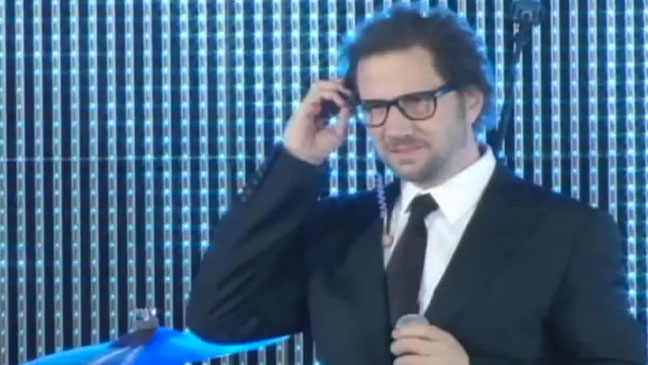
Kennedy was hired and the show that he hosted went on to become infamous far beyond Los Angeles. Featuring a myriad of technical issues, problematic humor, and even a fight that broke out on stage during the closing credits, First Night With Jamie Kennedy has since regularly been cited as one of the worst shows of all time. Patton Oswalt talks about in his stand-up. Nathan Rabin wrote an entire article about it. First Night has become a legendary disaster.
What happened during First Night that made it such a surreal disaster? Let us count the ways.
The mics often did not work when they were supposed to and the suddenly came on whenever nearby was uttering an expletive.
The crews’ walkie-talkies failed early, which meant that Kennedy was often not aware of when he was on camera and when he wasn’t. There were frequent shots of Kennedy standing on the stage, looking miserable and obviously wondering how he had gone from Scream to hosting First Night. At one point, when Stu Stone was interviewing Shannon Elizabeth, the camera lingered on an abject-looking Jamie Kennedy.
Along with making jokes about “Asian rappers,” Kennedy also appeared in comedy skit where he played a Mayan chief at a casino.
Macy Gray performed a song while appearing to be under the influence of something.
The countdown started late, so by 2013 had already arrived by the time the crowd hit zero.
Kennedy awkwardly hit on two drunk girls, one of whom resolved to “get rid of all my haters.” Kennedy told two girls (who were both black) a joke about what happens when you “go white.”
As if the night could not get bad enough, there was skit featuring puppets making lewd jokes.
And, of course, A FIGHT BROKE OUT DURING THE END CREDITS!
As the legend of First Night spread, Kennedy said that it was supposed to be bad and a parody of a typical network TV new year’s special. Sure, Jamie, we believe you.
The entirety of the show has been uploaded to YouTube. It’s not pretty and it’s not great but it is a Moment in Television History!
That is the question at the heart of A Blank Page, a work of interactive fiction that anyone with a creative spirit should be able to understand. In A Blank Page, you are the writer, sitting in front of a blank screen and trying to figure out how to begin. It seems like it should be so easy. You’re smart. You’re imaginative. You have ideas. The keyboard is right there in front of you.
So, why is it so easy to find something else to do?
You can look out the window. You can chat with your friends. You can go for a walk. You can even go through your notebook and look at all of the ideas that you’ve had, ideas that seemed good at the time but which now add up to a big pile of What Was I Thinking? Why can you do all of that but you can’t start your masterpiece?
Trust me, I’ve been there.
In fact, I’m there right now.
I have been playing and reading interactive fiction like A Blank Page for years but I’ve never actually written one. I have had ideas for a few. I’ve even started on a few. But I’ve never gotten past the first room description or the solution for the first puzzle. In October, when I was playing the entries in the 2021 Interactive Fiction Competition, I decided that 2022 was going to be the year that I was not only going to finally write a game but I was also going to let the rest of the world see it. It’s been tough getting started, though. I’ve played some good games and I’ve played some bad and really sloppy games and I would definitely rather be responsible for a good one. My hope is that I’ll have something to enter into the 2022 Interactive Fiction Competition. I don’t care if my game is ranked in top ten of the entries. I just don’t want it to be dead last.
That’s where something like A Blank Page is helpful. It’s a reminder that I’m not the only one who sometimes doesn’t know where to begin. It’s good to know that I’m not the first person to have ever struggled with this. Somewhere, someone else is also struggling to write their first game or their first story or create their first painting and they’re hoping that, whatever the final result of their efforts may be, it will be good enough to justify a second one. As A Blank Page‘s creator says in the introduction to the game, “all arts have their own version of the ‘Blank Page Syndrome.'”
A Blank Page is a short Twine game, full of details that will resonate with any artist who has struggled. It’s good and comforting to know that I’m not the only person who has ever spent more than one day looking at a blank page or screen and asking, Where to Begin?
What’s an Insomnia File? You know how some times you just can’t get any sleep and, at about three in the morning, you’ll find yourself watching whatever you can find on cable or Netflix? This feature is all about those insomnia-inspired discoveries!
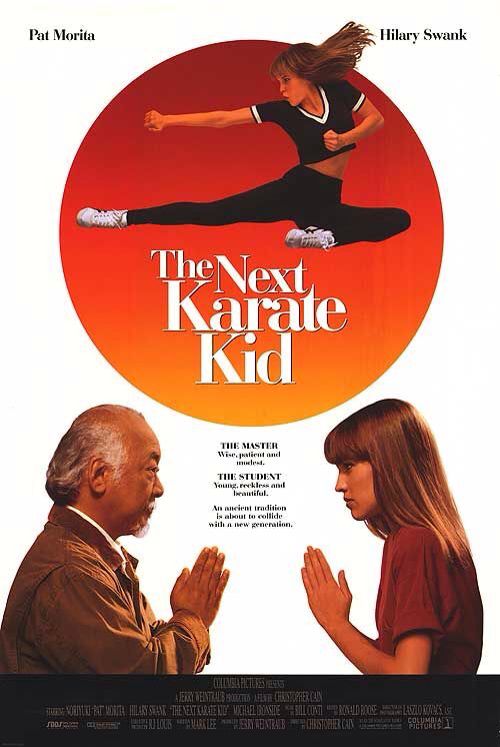
If, over the next few weeks, you find yourself having trouble getting to sleep, you might be tempted to log onto Netflix and watch the fourth season of Cobra Kai. That’s certainly what I’m planning to do over the course of the next few days. However, before you watch Cobra Kai, you should make sure that you’ve seen all of the earlier Karate Kid films because you never know who might show up on the show. I mean, if Thomas Ian Griffith is coming back, anyone could be coming back! And that includes Julie Pierce, the young karate student at the center of 1994’s The Next Karate Kid.
Julie (played by Hillary Swank) is a troubled teenager. She lives in Boston with her grandmother. She attends a high school that is run by a weirdly fascistic self-defense instructor named Colonel Dugan (Michael Ironside), who teaches all of the jocks to be tough, ruthless, and to show no mercy. When Julie’s grandmother leaves to for Los Angeles so that she can relax, Julie’s new caretaker is an old family friend who turns out to be Mr. Miyagi (Pat Morita).
At first, Julie wants nothing to do with Miyagi. She’s still angry about the death of her parents in a car crash. All she wants to do is take care of a falcon that lives on the roof of the school. She does like a boy named Eric McGowen (Chris Conrad) but Eric is also friends with the members of Colonel Dugan’s paramilitary gang, the so-called Alpha Elite. She needs someone who can understand her and her anger and, at first, Miyagi doesn’t seem like he’s capable of doing and of that. But then Miyagi discovers that Julie has a natural talent for jumping on top of cars and this leads to….
Well, you know what it leads to. It’s The Next Karate Kid! Ralph Macchio was 33 years old when this film was first released and was a bit too old to still be playing a kid so the film’s producers tried to reboot the franchise by giving Miyagi a new student. The Next Karate Kid pretty much hits all of the story beats from the first film, though it does change things up by not featuring a karate tournament. Instead, it all leads to a post-prom fight between Miyagi and Dugan. This film is your only chance to see Pat Morita face off against Michael Ironside and that’s got to be worth something.
The Next Karate Kid does not have a particularly good reputation and, watching the film, I understood why. There’s very little of the spontaneity or the wit that made the first film memorable. That said, I did appreciate Michael Ironside’s villainous turn. If Hillary Swank doesn’t necessarily give the type of performance that would make you think, “Future two-time Oscar winner!,” she still does a good job of portraying the anger that’s at the heart of the character. If nothing else, The Next Karate Kid deserves some credit for taking Julie’s anger seriously as opposed to just writing it off as being a “teen girl thing.” The Next Karate Kid wasn’t as bad as I expected but it was still hard not shake the feeling that it was largely unnecessary.
That’s said, I still look forward to Julie’s eventual visit to Cobra Kai.
Norwood Pratt (played by country singer Glenn Campbell) is a just a good old boy who has just returned home from serving in the Marines over in Vietnam. After saying goodbye to his Marine buddy, Joe William Reese (played by quarterback Joe Namath), Norwood heads to his hometown of Ralph, Texas. Norwood discovers this his sister (Leigh French) has married an idiot named Bill (Dom DeLuise!)
Norwood gets a job working at the local garage but he’s got his guitar and he’s got his dreams. All he wants to do is play his music on the Louisiana Hayride radio program. But with no money and no connections, how is he going to make it there? When a shady businessman (Pat Hingles) offers to pay him fifty bucks to drive a car and prostitute (Carol Lynley) to New York City, Norwood agrees. When Norwood discovers the car is stolen, he abandons both the vehicle and the girl but he still heads up to New York City.
Norwood has plenty of adventures and he meets plenty of people, like a hippie (Tisha Stirling) who invites him to open mike night at a coffee house in the Village. Later, she invites him to join her in a bathtub by asking him if his guitar plays underwater. “No, ma’m,” Norwood says, “but I do.” He also meets a pregnant teenager (Kim Darby, Campbell’s co-star from True Grit) and a little person (Billy Curtis) who is traveling with a super intelligent chicken.
There have been a lot of very good films made about the struggle of military veterans to transition back to civilian life after their tour of duty comes to an end. Unfortunately, Norwood is not one of those films. Both Norwood and Joe have just returned from Vietnam but neither one of them seems to carry any lingering effects from their time overseas. Neither of them shares any war stories or any thoughts on war in general. (Someone does point out that Norwood has a scar. Norwood says it’s a war wound that he got when he accidentally fell off a water truck.) There’s no hint that the war itself was not going well for the United States in 1970 or that it wasn’t a popular war and that returning veterans often felt as if they had been rejected by the same country that asked (or forced) them to serve. Even when Norwood meets the hippies in the Village, there’s no mention of protests. Instead, Norwood presents 1970 as a time with no real conflicts, which is the perfect era for someone as forgettable as Norwood Pratt to become a star.
Norwood has the same basic and episodic structure as an Elvis movie, except that Elvis could actually act when he wanted to. No one can deny Glenn Campbell’s talent as a singer but as an actor, he had very little screen presence. In True Grit and this movie, the best that he could come up with was an amiable dullness. In True Grit, it didn’t matter because John Wayne was in the movie. But in Norwood, Campbell had to carry the story and his acting limitations were much more obvious. Campbell even managed to get outacted by Joe Namath, who, as far as pro football player-turned-actors were concerned, was no Alex Karras. Wisely, Campbell didn’t further pursue a career as an actor and instead concentrated on singing. When Campbell died in 2017, he was praised for both his musical legacy and his honesty and courage while facing Alzheimer’s. He may not have made it as an actor but he still touched a lot of lives.
My aunt has always been a prodigious reader and, when I was growing up, I always enjoyed looking through the stacks of books that she had sitting in the closets of her room. A few years ago, for medical reasons, my aunt had to move out of her house. Because she wouldn’t have room for all of her books in her new place, she gave the majority of them to me. So far, I’ve only read a few but this year, I plan to read all of them and review the ones that I like. That’s one of my resolutions for 2022.
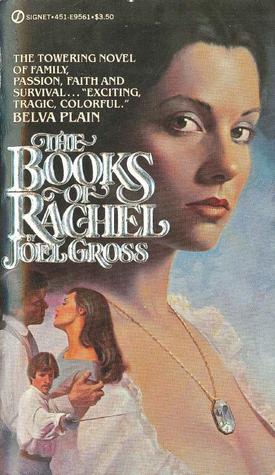
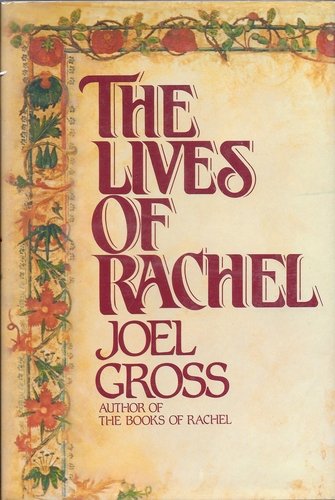
When I first got my aunt’s collection, one of the first books that I came across was a paperback called The Books of Rachel. The cover featured a beautiful woman with a lovely necklace, a man fencing, and a couple kissing. The blurb promised that Joel Gross’s The Books of Rachel was “exciting, tragic, colorful!” That’s all I needed to see! I read the book and I liked it so much that I went on Amazon to see what else Joel Gross had written. That’s when I came across the prequel to The Books of Rachel, The Lives of Rachel. Of course, I immediately ordered a copy of that book and read it as well.
The Books of Rachel was first published in 1979. The Lives of Rachel was published in 1984. Taken together, these two books tell the epic story of one family, following them from ancient Judea all the way to 1980s New York. Though the family is frequently forced to relocate and each section of the book takes place in a different country and in a different century, a few things remain the same. There is always a Rachel. Whenever a Rachel passes, the first daughter to be born after her is given the name and becomes the heiress to centuries of strength, faith, and struggle. They also, eventually, become the owner of a flawless, 60-carat diamond, the Cuheno Diamond. The other thing that remains true is that, no matter where or when the individual Rachels may live, they do so under the shadow of the oldest of all prejudices and evils. From the ancient Romans to the Spanish Inquisition to the fascists and Nazis of post-World War I Europe, anti-Semitism is the one constant that every evil in the world tends to share.
There are many different Rachels. Some are kind. Some are innocent. Some are less kind and some are definitely not innocent. But what they all have in common is that they’re willing to fight, for themselves, for their family, and ultimately for their people. For all of the sex and the melodrama (and, make no mistake, there is quite a bit and that’s definitely a good thing), The Books of Rachel and The Lives of Rachel are a tribute to survival, inner strength, and the faith and legacy of a people who would not allow themselves to be defeated. With everything going on in the world today and so many prominent people openly embracing anti-Semitic conspiracy mongering, the lessons of these books are even more needed than ever.
Finally, another reason why I loved these books is because, as I’ve mentioned many times on the site, I am a total history nerd and these books are historical fiction at their finest. The books are obviously very well-researched and the attention to detail makes them a wonderful read for those us who are interested in how life was once lived.
They’re good books. I recommend them. We can all learn from the Rachels.
The Columbus Film Critics Association have announced their nominees for the best of 2021! The winners will be announced on January 6th. That leaves you four days to see all of them. Good luck!
Here are the nominees from Columbus:
Best Film
Belfast
C’mon C’mon
Dune
Licorice Pizza
Pig
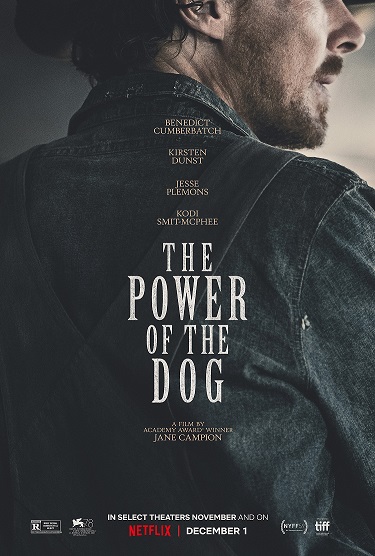
The Power of the Dog
Summer of Soul (…Or, When the Revolution Could Not Be Televised)
tick, tick…BOOM!
The Tragedy of Macbeth
West Side Story
Best Director
Paul Thomas Anderson – Licorice Pizza
Kenneth Branagh – Belfast
Jane Campion – The Power of the Dog
Steven Spielberg – West Side Story
Denis Villeneuve – Dune
Best Actor
Nicolas Cage – Pig
Benedict Cumberbatch – The Power of the Dog
Andrew Garfield – tick, tick…BOOM!
Will Smith – King Richard
Denzel Washington – The Tragedy of Macbeth
Best Actress
Jessica Chastain – The Eyes of Tammy Faye
Olivia Colman – The Lost Daughter
Alana Haim – Licorice Pizza
Taylour Paige – Zola
Tessa Thompson – Passing
Best Supporting Actor
Colman Domingo – Zola
Ciarán Hinds – Belfast
Troy Kotsur – CODA
Jesse Plemons – The Power of the Dog
Kodi Smit-McPhee – The Power of the Dog
Best Supporting Actress
Caitriona Balfe – Belfast
Jodie Comer – The Last Duel
Kirsten Dunst – The Power of the Dog
Aunjanue Ellis – King Richard
Marlee Matlin – CODA
Ruth Negga – Passing
Best Ensemble
The French Dispatch
The Harder They Fall
Licorice Pizza
The Power of the Dog
West Side Story
Actor of the Year (for an exemplary body of work)
Timothée Chalamet (Don’t Look Up, Dune, and The French Dispatch)
Bradley Cooper (Licorice Pizza and Nightmare Alley)
Benedict Cumberbatch (The Electrical Life of Louis Wain, The Mauritanian, The Power of the Dog, and Spider-Man: No Way Home)
Adam Driver (Annette, House of Gucci, and The Last Duel)
Andrew Garfield (The Eyes of Tammy Faye, Spider-Man: No Way Home, and tick, tick…BOOM!)
Breakthrough Film Artist
Janicza Bravo – Zola (for directing and screenwriting)
Maggie Gyllenhaal – The Lost Daughter (for producing, directing, and screenwriting)
Alana Haim – Licorice Pizza (for acting)
Rebecca Hall – Passing (for producing, directing, and screenwriting)
Jude Hill – Belfast (for acting)
Woody Norman – C’mon C’mon (for acting)
Best Cinematography
Bruno Delbonnel – The Tragedy of Macbeth
Andrew Droz Palermo – The Green Knight
Greig Fraser – Dune
Dan Lautsen – Nightmare Alley
Ari Wegner – The Power of the Dog
Haris Zambarloukos – Belfast
Best Film Editing
Sarah Broshar and Michael Kahn – West Side Story
Andy Jurgensen – Licorice Pizza
Peter Sciberras – The Power of the Dog
Joe Walker – Dune
Andrew Weisblum – The French Dispatch
Best Adapted Screenplay
Jane Campion – The Power of the Dog
Joel Coen – The Tragedy of Macbeth
Maggie Gyllenhaal – The Lost Daughter
Siân Heder – CODA
Tony Kushner – West Side Story
Jon Spaihts, Denis Villeneuve, and Eric Roth – Dune
Best Original Screenplay
Paul Thomas Anderson – Licorice Pizza
Zach Baylin – King Richard
Kenneth Branagh – Belfast
Julia Ducournau – Titane
Mike Mills – C’mon C’mon
Michael Sarnoski – Pig
Best Score
Alexandre Desplat – The French Dispatch
Jonny Greenwood – The Power of the Dog
Jonny Greenwood – Spencer
Nathan Johnson – Nightmare Alley
Hans Zimmer – Dune
Best Documentary
Attica
Flee
The Rescue
The Sparks Brothers
Summer of Soul (…Or, When the Revolution Could Not Be Televised)
The Velvet Underground
Best Foreign Language Film
Drive My Car
Flee
A Hero
Titane
The Worst Person in the World
Best Animated Film
Encanto
Flee
Luca
The Mitchells vs. the Machines
Raya and the Last Dragon
Best Overlooked Film
Barb and Star Go to Vista Del Mar
CODA
Cyrano
Nine Days
The Greater Western New York Film Critics Association actually announced their picks for the best of 2021 on December 31st but, with the holidays and all, I’m only now getting a chance to share them with you. The GWNFCA picked Pig for the best film of 2021 and that’s actually really cool. Both Pig and Nicolas Cage’s lead performance are probably too weird for the Academy but it’s a damn good film. One of the great things about the critics groups is that the best of them are willing to consider the films that the more mainstream Academy might overlook, films like Pig and The Green Knight.
Here are all the winners and the nominees from Western New York!
(The winners are in bold.)
BEST PICTURE
C’mon C’mon
CODA
Dune
The Green Knight
Judas and the Black Messiah
The Last Duel
Licorice Pizza Pig
The Power of the Dog
Spencer
BEST FOREIGN FILM Drive My Car (Japan)
Flee (Denmark)
Parallel Mothers (Spain)
Titane (France)
The Worst Person in the World (Norway)
BEST DOCUMENTARY
Flee
No Ordinary Man
Procession
The Sparks Brothers Summer of Soul (…Or, When the Revolution Could Not Be Televised)
BEST ANIMATED FILM
Belle
The Boss Baby 2: Family Business
Flee
Luca The Mitchells vs. the Machines
BEST LEAD ACTRESS
Olivia Colman – The Lost Daughter
Jodie Comer – The Last Duel
Emilia Jones – CODA
Renate Reinsve – The Worst Person in the World Kristen Stewart – Spencer
BEST LEAD ACTOR Nicolas Cage – Pig Benedict Cumberbatch – The Power of the Dog
Andrew Garfield – tick, tick … BOOM!
Joaquin Phoenix – C’mon C’mon
Will Smith – King Richard
BEST SUPPORTING ACTRESS
Jessie Buckley – The Lost Daughter
Ariana Debose – West Side Story
Ann Dowd – Mass
Aunjanue Ellis – King Richard Ruth Negga – Passing
BEST SUPPORTING ACTOR
Robin de Jesús – tick, tick … BOOM!
Mike Faist – West Side Story
Jason Isaacs – Mass Daniel Kaluuya – Judas and the Black Messiah Troy Kotsur – CODA
BEST DIRECTOR Jane Campion – The Power of the Dog Pablo Larraín – Spencer
Ridley Scott – The Last Duel
Michael Sarnoski – Pig
Denis Villeneuve – Dune
BEST ORIGINAL SCREENPLAY
Paul Thomas Anderson – Licorice Pizza Will Berson & Shaka King and Kenneth Lucas & Keith Lucas – Judas and the Black Messiah Julia Ducournau – Titane
Fran Kranz – Mass
Mike Mills – C’mon C’mon
BEST ADAPTED SCREENPLAY
Ben Affleck, Matt Damon & Nicole Holofcener – The Last Duel Jane Campion – The Power of the Dog Maggie Gyllenhaal – The Lost Daughter
Rebecca Hall – Passing
Tony Kushner – West Side Story
BEST CINEMATOGRAPHY
Bruno Delbonnel – The Tragedy of Macbeth Andrew Droz Palermo – The Green Knight Greig Fraser – Dune
Claire Mathon – Spencer
Ari Wegner – The Power of the Dog
BEST EDITING Peter Sciberras – The Power of the Dog Sebastián Sepúlveda – Spencer
Claire Simpson – The Last Duel
Joe Walker – Dune
Andrew Weisblum – The French Dispatch
BEST ORIGINAL SCORE
Carter Burwell – The Tragedy of Macbeth
Jonny Greenwood – The Power of the Dog Jonny Greenwood – Spencer Alberto Iglesias – Parallel Mothers
Hans Zimmer – Dune
BREAKTHROUGH PERFORMANCE
Mike Faist – West Side Story
Alana Haim – Licorice Pizza
Emilia Jones – CODA
Agathe Rousselle – Titane Rachel Sennott – Shiva Baby
BREAKTHROUGH DIRECTOR
Maggie Gyllenhaal – The Lost Daughter
Rebecca Hall – Passing
Fran Kranz – Mass Michael Sarnoski – Pig Emma Seligman – Shiva Baby
Luka (Caitlin Carmichael) is a teenage girl who lives in Florida with her Uncle Peter (George Georgiou) and her father, Theo (Alex Dimitriades). Theo has only recently reentered Luka’s life and Luka was raised by Peter and his wife, who has recently died of breast cancer. Peter and Theo both make a living diving for sea sponges but business is slow, Theo is drinking too much and still having nightmares about the things that he saw when he was growing up, and Peter is hooked on painkillers. Both Peter and Theo came to America from Cyprus but neither tells Luka much about her family’s past or why there is still so much bad blood between the two brothers.
After Luka is caught stealing for a church collection plate, she’s sentenced to do community service. Working at a retirement community, she meets an old Greek man (Burt Young) who also doesn’t like to talk about his past. Even though he’s grumpy and everyone else is scared of him, Luka bonds with him and discovers that they have something in common. Meanwhile, Theo tries to come to terms with the past with the help of his new girlfriend, Cari (Scottie Thompson).
The plot of Epiphany meanders from one incident to another and, at first, I wondered if it was all going to lead anywhere. But eventually it does, especially as Luka learns more about her Cypriot heritage and the tragedy that neither her father nor her uncle can recover from. Some of it, like the identity of the old man, was a little predictable but, overall, I enjoyed Epiphany. Caitlyn Carmichael is great as Luka and it was impossible for me not to relate to her and her coming-of-age story. It’s a sweet movie with a good message about redemption and forgiveness. I liked it.
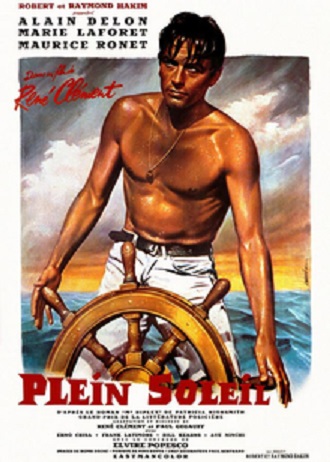
Early on in the 1960 French film, Purple Noon, there’s a scene in which a young American con artist named Tom Ripley (Alain Delon) looks at his reflection in a mirror, leans forward, and kisses it.
What are we to make of this scene? The easiest assumption would be to say that Ripley is a narcissist and certainly, there is some truth to that. Delon was 25 when he appeared in Purple Noon and the famously handsome actor was probably never better-looking than he was at that time. As well, Delon was an actor who brought, at the very least, a hint of narcissism to every role that he played. That was a part of his appeal. He looked like an angel but he moved like the devil and, when the camera focused on his face, it was easy to see that there were less than pure thoughts brewing underneath the beautiful surface.
However, in Purple Noon, there’s more to that mirror kiss than just Tom Ripley (or, for that matter, Alain Delon) admiring his own reflection. Instead, Tom has dressed up in the clothes of Philippe Greenleaf (Maurice Ronet) and, when he speaks to his reflection, he speaks in an imitation of Philippe’s voice. He addresses his words not to his reflection but to Philippe’s girlfriend, Marge Duval (Marie Lefort). When he kisses the mirror, is he kissing himself, Marg, Philippe, or himself as Philippe? Perhaps every answer is correct.
Tom Ripley is a young man who doesn’t appear to have much going on inside of him but who has definitely learned how to fake it enough to get by. He went to school with Philippe, a wealthy and casually cruel heir to a fortune. Because Philippe is currently living a rather decadent life in Europe, Tom has been hired by Philippe’s father to bring his son back to San Francisco. Tom, who were told grew up without money and who Philippe’s father used to dislike because he felt that Tom’s manners were too “common,” is happy to finally be a part of Philippe’s world and, when we first see them together, it appears as if Philippe is happy to have Tom as a part of his life as well. We watch as they give money to a blind man and then buy his cane. Though Philippe is the one who proceeds to walk around with the cane while pretending to be blind, it’s hard not to notice that Tom is the one who suggested the idea to him. For Philippe, deception is a game whereas, for Tom, it’s a way of life.
As the opening scene of the film suggests, things are not always how they seem. It quickly becomes apparent that Philippe’s charm and money hides a cruel and sadistic streak and, when he grows bored with Tom’s sycophantic ways and Tom’s constant requests for money, Philippe decides to send him away. Unfortunately, for Philippe, Tom is not ready to leave and he’s certainly not ready to abandon Marge, though it’s left to the viewer to decide if Tom is truly attracted to Marge or if he’s just attracted to the fact that she’s a part of Philippe’s world. Because Tom has no identity, it is disarmingly easy for him to slip into a new one, whether it means becoming a friend, a criminal, a loyal employee, or even Philippe himself. During one eventful afternoon, Tom and Philippe’s relationship comes to a violent conclusion while the two of them are on a yacht that’s floating in almost indescribably beautiful sea of water.
If this all sounds a bit familiar, it may be because, while Purple Noon may have been the first adaptation of Patricia Highsmith’s classic novel The Talented Mr. Ripley, it was not the last. In 1999, Matt Damon starred in The Talented Mr. Ripley, another adaptation of Highsmith’s classic thriller. Directed by Anthony Minghella, The Talented Mr. Ripley is a bit more faithful to its source material than Purple Noon and yet I have to say that, even with all of the liberties that it takes to Highsmith’s original story, I actually prefer Purple Noon. They’re both good films but Purple Noon is the one that sticks in the viewer’s mind.
While Matt Damon may be the better actor of the two, Alain Delon was the better Mr. Ripley. Delon’s natural lack of expressiveness may have often made him seem stiff and remote as a performer but it is ideal for a character like Tom Ripley, one who only exists on the surface. Whereas Damon’s Ripley is obviously unstable from the minute he makes his first appearance, Delon’s Ripley has perfected a sort of likable blandess. The viewer can believe that Philippe and Marge would want to spend time with Delon’s Ripley while also understanding why Philippe would quickly grow bored with him and his superficial ways. Damon’s Ripley realizes that his crimes have determined his future whereas Delon lives day-to-day as an existential con artist, improvising his way from one crime to another. Whereas the second adaptation was a big and glamorous production, Purple Noon takes a far grittier approach. Director Rene Clement emphasizes the shadows and the ominous atmosphere that dominates Ripley’s world.
Purple Noon does slightly alter Patricia Highsmith’s original ending, something that Highsmith was reportedly not at all happy about. Highsmith reportedly felt that Alain Delon masterfully captured Ripley’s character while complaining that the film’s ending was a concession to “public morality.” (Interestingly, when Wim Wenders made his own film about Tom Ripley, The American Friend, Highsmith had the opposite reaction, appreciating that the film retained her downbeat ending while complaining that Dennis Hopper’s performance as Ripley was not true to the character she had created.) One can understand and even agree with Highsmith’s objections while also appreciating that the Purple Noon‘s ending does actually work quite well for the story that’s been told. For all of his cleverness, not even Tom Ripley can escape the randomness of fate.




 Through the Shattered Lens