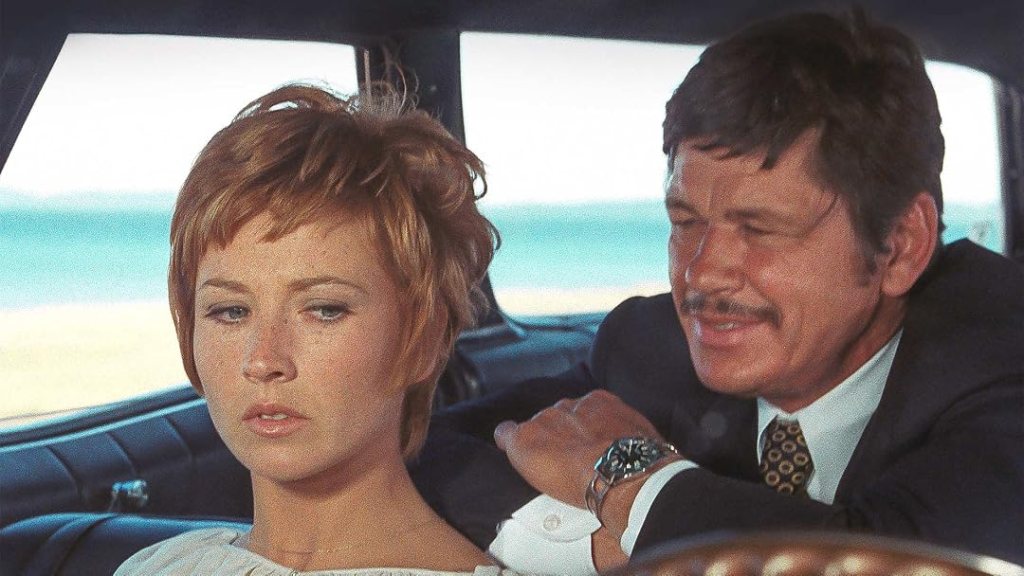
Brad reviews RIDER ON THE RAIN (1970), starring Charles Bronson and Marlène Jobert!


Charles Bronson and Marlène Jobert!

I saw RIDER ON THE RAIN early in my Bronson obsession, so this would have been sometime in the late 80s. As a young and naive teenager, I was a prime target for those folks out there selling older Bronson movies on VHS tapes whose advertising did not properly represent the film they contained. No matter what store our family went to, if they had any movies for sale, I’d always go check out the inventory. I remember this specific tape for RIDER ON THE RAIN that I bought from our local “Fred’s” discount store. It used pictures of Bronson from DEATH WISH 4, holding his high-powered rifle, to try to sell this suspenseful, character driven mystery. It was quite the education seeing how distributors shamelessly tried to sell Bronson’s older films. I do remember not liking the movie so much upon that first viewing, because I was looking for the Bronson of the 80’s, whose characters were mostly just required to blow away the scum. But it’s grown on me over the years, and I now consider it an excellent film, especially for those looking for the more charismatic Bronson before he got typecast after DEATH WISH.
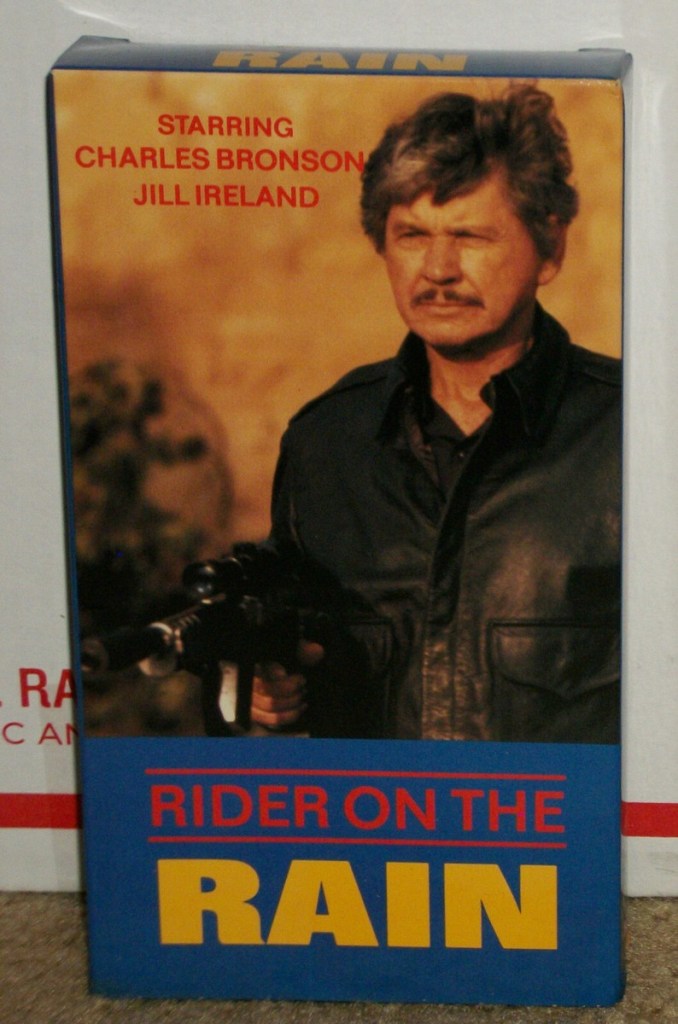
I don’t still have that VHS tape from Fred’s, but this is what it looked like.

Directed by René Clément, this French Italian production opens with Mélancolie (Marlène Jobert), a young woman living in the South of France whose relatively quiet life is interrupted when a mysterious stranger breaks into her home and sexually assaults her. When she manages to kill her attacker in self-defense, she makes the unfortunate decision to dispose of his body rather than contact the authorities. Enter Colonel Harry Dobbs (Bronson), an American investigator who arrives seemingly knowing everything about what happened. Dobbs has a rather unusual way of questioning people, and his unpredictable behavior leaves Mélancolie wondering whether he’s there to help her, expose her, or perhaps something else entirely. As the two begin an increasingly complicated game of cat and mouse, it becomes clear that there’s considerably more going on than anyone initially lets on.

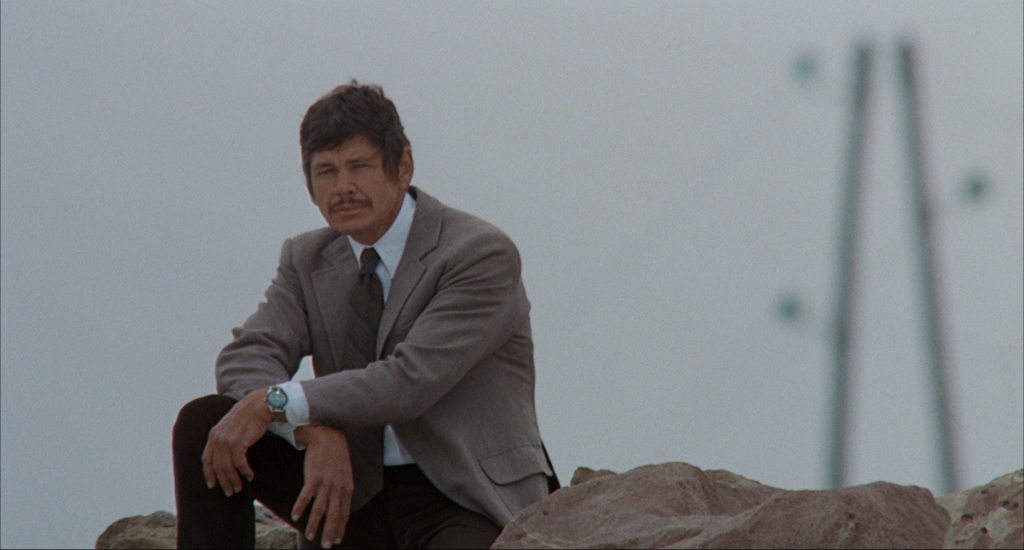
Watching the film now, one of my favorite things about RIDER ON THE RAIN is that it doesn’t play like a traditional Charles Bronson movie, or at least one that was made after DEATH WISH. Bronson only gets a couple of opportunities to kick butt throughout the entire film, and since he’s in prime physical condition, he’s an absolute badass during those times. However, what’s most intriguing about Bronson’s character here is that he’s initially mysterious and only over time are we given access to his true intentions. His Harry Dobbs can be charming one moment, bullying and intimidating the next, and he always seems to be several steps ahead of everyone else. It’s a different kind of performance, but one that demonstrates why he was such an interesting actor to watch. Bronson had recently become a worldwide phenomenon because of his performances in FAREWELL, FRIEND and ONCE UPON A TIME IN THE WEST, and RIDER ON THE RAIN was a smash hit in Europe, solidifying his status across most of the world.

Even though you wouldn’t have known it from that old VHS box I bought at Fred’s, the main character of the film is played by Marlène Jobert, who gives us a heroine who is vulnerable, resourceful, and increasingly caught up in circumstances she never could have anticipated. Yet she somehow can hold her own even though she never knows quite what Dobbs has up his sleeves. It’s an excellent performance, and the strong chemistry between her and Bronson, who doesn’t show up until over 25 minutes into the movie’s nearly two-hour running time, gives the film some real emotional punch. He sarcastically calls her “Love Love” throughout the film, and if the “walnut against the windowpane” trick is to be believed, he may even love her by the end. That trick is a fun little detail that I’ll preserve for you to discover when you watch, but it leaves me with a smile on my face as the credits roll. I always like to point out to everyone that Jobert’s daughter in real life is actress Eva Green. In supporting roles, Annie Cordy gives a solid performance as Mélancolie’s mom, Jill Ireland looks beautiful, and Marc Mazza is just plain creepy as the sexual deviant and “rider on the rain” whose much-deserved ending kicks off the story.

Clément brings his European sensibility to the proceedings, favoring atmosphere, suspense, and psychological games over the more straightforward action that would eventually become Bronson’s trademark. Looking back now, I get a sense of satisfaction seeing Bronson work with the same guy who directed classics like FORBIDDEN GAMES and PURPLE NOON. Bronson’s European phase produced some fascinating work with some equally fascinating filmmakers that I appreciate more over time. There’s also an impressive musical score from Francis Lai that adds to the film’s somewhat dreamlike, occasionally unsettling atmosphere. Interestingly, the same year he did this, he also composed LOVE STORY!

RIDER ON THE RAIN is a fascinating entry in Charles Bronson’s filmography. In my opinion, it’s one of his best films and features one of his best performances. It’s also a critically acclaimed film, having won the Golden Globe for Best Foreign Language Film. This movie is very different than his later work, as it takes its time with its intriguing premise and unpredictable characters, and gives us just enough twists and turns to keep things moving. And while we used to be stuck with bad copies on cheap VHS tapes and DVDs, a few years ago Kino Lorber restored the film on Blu Ray in all its glory, and it looks phenomenal. It’s a revelation if you haven’t revisited the film since the old days. While I’ll always make time for Charles Bronson movies in my life, I’ve grown to truly appreciate the films that give him the opportunity to do something a little different.
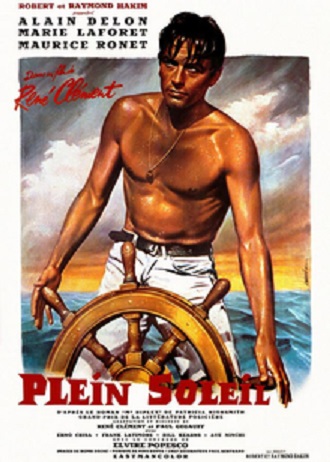
International Film Review: Purple Noon (dir by Rene Clement)


Early on in the 1960 French film, Purple Noon, there’s a scene in which a young American con artist named Tom Ripley (Alain Delon) looks at his reflection in a mirror, leans forward, and kisses it.

What are we to make of this scene?  The easiest assumption would be to say that Ripley is a narcissist and certainly, there is some truth to that.  Delon was 25 when he appeared in Purple Noon and the famously handsome actor was probably never better-looking than he was at that time.  As well, Delon was an actor who brought, at the very least, a hint of narcissism to every role that he played.  That was a part of his appeal.  He looked like an angel but he moved like the devil and, when the camera focused on his face, it was easy to see that there were less than pure thoughts brewing underneath the beautiful surface.

However, in Purple Noon, there’s more to that mirror kiss than just Tom Ripley (or, for that matter, Alain Delon) admiring his own reflection.  Instead, Tom has dressed up in the clothes of Philippe Greenleaf (Maurice Ronet) and, when he speaks to his reflection, he speaks in an imitation of Philippe’s voice.  He addresses his words not to his reflection but to Philippe’s girlfriend, Marge Duval (Marie Lefort).  When he kisses the mirror, is he kissing himself, Marg, Philippe, or himself as Philippe?  Perhaps every answer is correct.

Tom Ripley is a young man who doesn’t appear to have much going on inside of him but who has definitely learned how to fake it enough to get by.  He went to school with Philippe, a wealthy and casually cruel heir to a fortune. Because Philippe is currently living a rather decadent life in Europe, Tom has been hired by Philippe’s father to bring his son back to San Francisco.  Tom, who were told grew up without money and who Philippe’s father used to dislike because he felt that Tom’s manners were too “common,” is happy to finally be a part of Philippe’s world and, when we first see them together, it appears as if Philippe is happy to have Tom as a part of his life as well.  We watch as they give money to a blind man and then buy his cane.  Though Philippe is the one who proceeds to walk around with the cane while pretending to be blind, it’s hard not to notice that Tom is the one who suggested the idea to him.  For Philippe, deception is a game whereas, for Tom, it’s a way of life.

As the opening scene of the film suggests, things are not always how they seem.  It quickly becomes apparent that Philippe’s charm and money hides a cruel and sadistic streak and, when he grows bored with Tom’s sycophantic ways and Tom’s constant requests for money, Philippe decides to send him away.  Unfortunately, for Philippe, Tom is not ready to leave and he’s certainly not ready to abandon Marge, though it’s left to the viewer to decide if Tom is truly attracted to Marge or if he’s just attracted to the fact that she’s a part of Philippe’s world.  Because Tom has no identity, it is disarmingly easy for him to slip into a new one, whether it means becoming a friend, a criminal, a loyal employee, or even Philippe himself.  During one eventful afternoon, Tom and Philippe’s relationship comes to a violent conclusion while the two of them are on a yacht that’s floating in almost indescribably beautiful sea of water.

If this all sounds a bit familiar, it may be because, while Purple Noon may have been the first adaptation of Patricia Highsmith’s classic novel The Talented Mr. Ripley, it was not the last.  In 1999, Matt Damon starred in The Talented Mr. Ripley, another adaptation of Highsmith’s classic thriller.  Directed by Anthony Minghella, The Talented Mr. Ripley is a bit more faithful to its source material than Purple Noon and yet I have to say that, even with all of the liberties that it takes to Highsmith’s original story, I actually prefer Purple Noon.  They’re both good films but Purple Noon is the one that sticks in the viewer’s mind.

While Matt Damon may be the better actor of the two, Alain Delon was the better Mr. Ripley.  Delon’s natural lack of expressiveness may have often made him seem stiff and remote as a performer but it is ideal for a character like Tom Ripley, one who only exists on the surface.  Whereas Damon’s Ripley is obviously unstable from the minute he makes his first appearance, Delon’s Ripley has perfected a sort of likable blandess.  The viewer can believe that Philippe and Marge would want to spend time with Delon’s Ripley while also understanding why Philippe would quickly grow bored with him and his superficial ways.  Damon’s Ripley realizes that his crimes have determined his future whereas Delon lives day-to-day as an existential con artist, improvising his way from one crime to another.  Whereas the second adaptation was a big and glamorous production, Purple Noon takes a far grittier approach.  Director Rene Clement emphasizes the shadows and the ominous atmosphere that dominates Ripley’s world.

Purple Noon does slightly alter Patricia Highsmith’s original ending, something that Highsmith was reportedly not at all happy about.  Highsmith reportedly felt that Alain Delon masterfully captured Ripley’s character while complaining that the film’s ending was a concession to “public morality.”  (Interestingly, when Wim Wenders made his own film about Tom Ripley, The American Friend, Highsmith had the opposite reaction, appreciating that the film retained her downbeat ending while complaining that Dennis Hopper’s performance as Ripley was not true to the character she had created.)  One can understand and even agree with Highsmith’s objections while also appreciating that the Purple Noon‘s ending does actually work quite well for the story that’s been told.  For all of his cleverness, not even Tom Ripley can escape the randomness of fate.