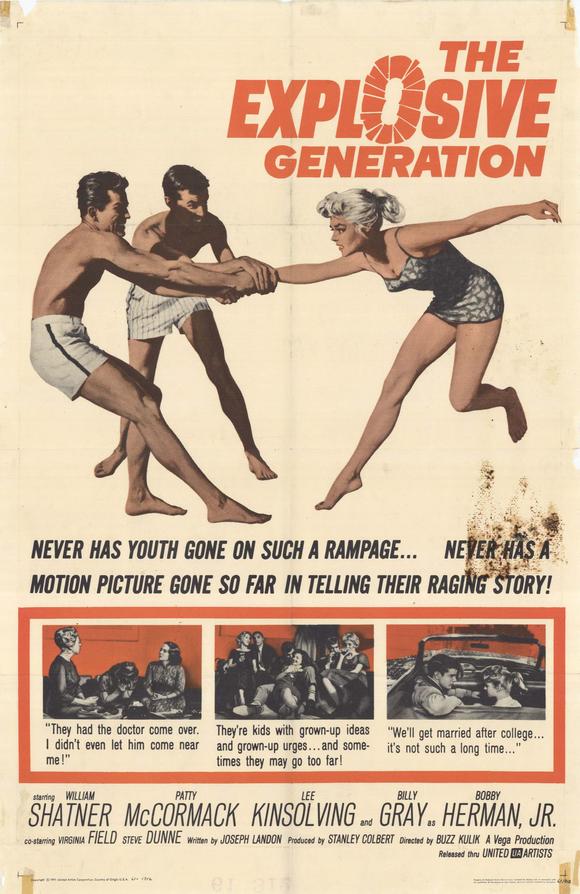
Ever since I first saw it on TCM last year, The Explosive Generation has been a favorite of mine.
This 1961 film deals with sex, peer pressure, censorship, juvenile delinquency, and civil disobedience. The Explosive Generation is one of those films that was made to try to understand the wild and crazy youth of the early 60s, with their crazy rock and roll music, hip way of talking, and their habit of occasionally showing up for high school in a coat and tie. As is typical of low-budget youth films of the period, the film is occasionally clueless and occasionally insightful. In short, it’s a lot of fun and, if you’re a history nerd like I am, it’s a valuable time capsule for the way the world used to be (or, at the very least, the way that people used to think the world was).
Even better, it stars a youngish, intense, and slim William Shatner as an idealistic high school teacher who encourages his students to have a frank and honest discussion about sex. If The Intruder(which was made roughly around the same time) is a film that proves that Shatner was capable of being an intelligent and insightful actor, The Explosive Generation is all about Shatner being Shatner. This performance is everything that you’ve probably come to expect from William Shatner and, as a result, it transcends mundane concepts like good and bad.
Below are two scenes of William Shatner dealing with the Explosive Generation. Be sure to keep an eye out because I’m sure The Explosive Generation will show up on TCM again at some point in the near future!
For today’s entry in the 44 Days of Paranoia, we take a look at one of the most underappreciated films of all time, Roger Corman’s 1962 look at race relations, The Intruder.
Despite the fact that he’s regularly cited as being one of the most important figures in the development of American cinema, Roger Corman remains an underrated director. Many critics tend to focus more on the filmmakers that got their start working for Corman than on Corman himself. When they talk about Roger Corman, they praise him for knowing how to exploit trends. They praise him as a marketer but, at the same time, they tend to dismiss him as a director.
I would suggest that those critics see The Intruder before they presume to say another word about Roger Corman.
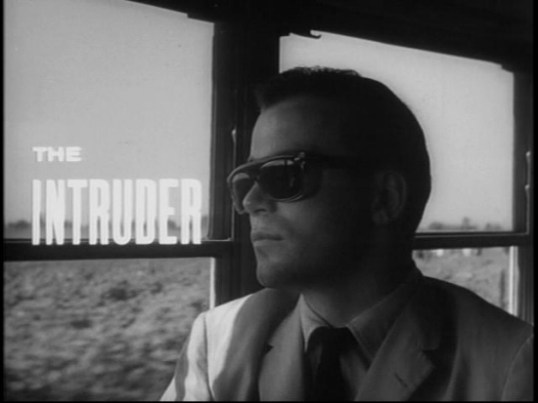
The Intruder opens with a young, handsome man named Adam Cramer sitting on a bus. The first thing that we notice about Cramer is that he’s wearing an immaculate white suit. The second thing we notice is that he’s being played by a very young (and, it must be said, rather fit) William Shatner.
I know that many people will probably be inclined to dismiss The Intruder from the minute they hear that it stars William Shatner. Based simply on Shatner’s presence, they’ll assume that this film must be very campy, very Canadian, or both. Well, they’re wrong. Shatner gives an excellent performance in this film, bringing to life one of the most evil characters ever to appear on-screen.
Adam Cramer, you see, is a representative on a Northern organization known as the Patrick Henry Society and he’s riding the bus because he’s heading to a small Southern town. The high school in that town has just recently been desegregated and Cramer’s goal is to make sure that no black students attend class. As Cramer explains it, he’s a “social worker” and his goal is to help preserve Southern society.
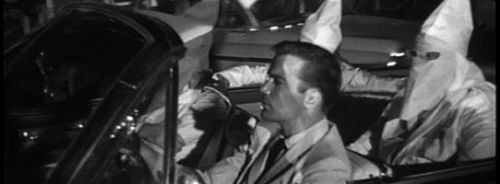
To achieve this goal, Cramer partners up with the richest man in town, Verne Shipman (who is played, rather chillingly, by Robert Emhardt). With Verne’s sponsorship, Cramer gives an inflammatory speech in the town square and then later returns with a group of Klansmen. As opposed to recent films like Django Unchained (which scored easy laughs by casting Jonah Hill as a Klansman and playing up the group’s ignorance), The Intruder presents the Klan as figures that have stepped straight out of a nightmare, making them into literal demons who appear at night and disappear during the day. In a genuinely disturbing scene, the Klansmen set a huge cross on fire. As the flames burn behind him, Cramer seduces the wife of a local salesman.
After Cramer delivers his speech, the local black church is blown up and a clergyman is killed. The editor of the town newspaper — who, before Cramer showed up, was opposed to desegregation — changes his mind and publishes an editorial strongly condemning Cramer. Cramer’s mob reacts by nearly beating the editor to death. Realizing that he’s losing the power to control the mob that he created, Cramer frames a black student for rape which leads the film to its powerful and disturbing conclusion.
Particularly when compared to other films that attempted to deal with race relations in 1962, The Intruder remains a powerful and searing indictment of intolerance and a portrait of how demagogues like Adam Cramer will always use fear, resentment, and ignorance to build their own power. Corman filmed The Intruder on location in Missouri and used a lot of locals in the cast. Judging from the disturbing authenticity of some of the performances that Corman got from some of these nonprofessionals, it’s not unreasonable to assume that quite a few of them agreed with everything that Adam Cramer was saying.
As opposed to most films made about the civil rights era in America, The Intruder doesn’t shy away from showing the ugliness of racism. The Intruder casually tosses around the N word (and yes, it is shocking to not only hear Shatner use it but to see him smile as he does so) but, unlike a lot of contemporary films, it does so not just to shock but to show us just how naturally racism comes to the film’s characters. The scene in which Verne repeatedly strikes a black teenager who failed to call him sir is also shocking, not just for the violence but because of how nobody seems to be particularly surprised by it. As a result, The Intruder is not necessarily an easy film to watch but then again, that’s the point. The hate on display in The Intruder should never be easy to watch.
The Intruder was written by Charles Beaumont, who also wrote several classic episodes of The Twilight Zone. I think it can be argued that The Intruder represents the best work of Beaumont, Corman, and Shatner. Unfortunately, but not surprisingly, The Intruder was the only film directed by Roger Corman to not be a box office success.
However, in a world where people are patting themselves on the back for sitting through The Butler, The Intruder is an important film that deserves to be seen now more than ever.
When I first decided to feature old, horror-themed television episodes this month, I knew that I had to include Nightmare At 20,000 Feet.
This is perhaps the most famous episode of Twilight Zone. William Shatner plays a man on an airplane who is both terrified of flying and who has spotted a gremlin out on the wing. As Shatner desperately tries to convince his fellow passengers that he’s not crazy, the gremlin cheerfully goes about his destructive business.
This is one of the few episodes of The Twilight Zone not to have been downloaded onto YouTube and, at first, I was worried that I wouldn’t be able to share it. Fortunately, site subscriber and frequent commenter KO tracked it down on Hulu for me and, as a result, we are very happy to present the classic fright fest Nightmare At 20,000 Feet!
This episode was written by Richard Matheson and directed by Richard Donner, who would later direct such films as The Omen, Superman, and Lethal Weapon. It originally aired on October 11th, 1963.
http://www.hulu.com/watch/440824
(Incidentally, originally an episode of Goosebumps was scheduled to be featured tonight. However, the YouTube account that was hosting that video has been suspended. The episode in question was The House of No Return, which many people believe features an early performance from Ryan Gosling. Having seen the episode before it was taken off YouTube, I can assure you that Ryan was nowhere to be seen.)
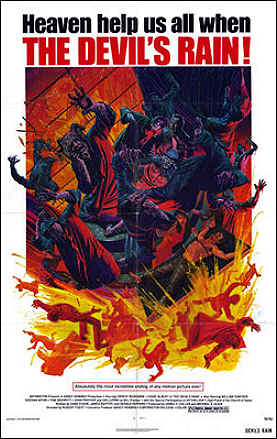
Satanic priest Jonathan Corbis (Ernest Borgnine) has spent decades pursuing the Preston family. The Prestons, it turns out, have a book of powerful Satanic magic in their possession. After Corbis causes the Preston patriarch to melt in the rain, Mark Preston (William Shatner) decides to confront Corbis and his followers…
Released in 1975, the Devil’s Rain was presumably made to capitalize on the success of films like Rosemary’s Baby and The Exorcist. The film itself is a bit incoherent but it’s worth watching just to see shameless overactors William Shatner and Ernest Borgnine acting opposite each other. The cast also includes Ida Lupino, Keenan Wynn, Tom Skerritt, and Eddie Albert, which means that there’s not a single bit of scenery that doesn’t get chewed at some point.
If watch carefully, you can spot John Travolta making his screen debut towards the end of the film.
I previously posted a review of the 1967 best picture nominee Guess Who’s Coming To Dinner that was somewhat critical of Stanley Kramer as a filmmaker. In retrospect, I feel like I may have been a bit too dismissive of Stanley Kramer. When one looks over the list of every film that has ever been nominated for best picture, one comes across the name Stanley Kramer (as a producer, a director, or both) far too many times to just blindly dismiss him for the sin of being old-fashioned. While Kramer made his share of well-intentioned misfires like Guess Who’s Coming To Dinner, he was also responsible for some films that remain important and watchable today. Judgment at Nuremberg is one of those films.
Judgment at Nuremberg opens in 1947, with one car being driven through the ruins of Nuremberg, Germany. Inside the car is Dan Haywood (Spencer Tracy), a judge from Maine who has been appointed chief of a military tribunal that will be passing judgment on four German judges who are accused of crimes against humanity for their legal rulings during the Nazi regime. As Haywood quickly learns, many people don’t feel that the Nazi judges should be held as accountable for their actions as men like Hitler, Goebbles, and Goering should have been. It’s up to Haywood to determine whether the accused were simply doing their job or if they had a responsibility to defy the laws that they had sworn to uphold.
Judgment at Nuremberg almost feels like two films. The first film is a courtroom drama, where the Nazi judges (the main one of which is played by Burt Lancaster) are prosecuted by the fiery Col. Tad Lawson (Richard Widmark) and defended by the idealistic Hans Rolfe (Maximilian Schell). While Lawson approaches the case and regards the defendants with righteous anger, Rolfe takes a more cerebral approach to defending the undefensible. Rolfe argues that the judges were following the laws of Germany and that if the tribunal finds them guilty than it will be finding the entire nation of Germany guilty. (In a rather clever twist, director Kramer and screenwriter Abby Mann initially make the German defense attorney a far more likable character than the American prosecutor.) During the trial, we also hear heart-wrenching testimony from two people (played by Montgomery Clift and Judy Garland) who were victimized by the Nazi regime and the judges who gave legal legitimacy to the regime’s crimes.
The second film deals with Haywood adjusting to working in Germany and trying to understand how the Nazis could have come to power in the first place. Haywood asks several Germans to tell him about life under the Nazis and every time, he is met with bland excuses. (“We were not political,” he is told more than once.) The film’s strongest scenes are the ones where Haywood simply walks alone through the ruins of Nuremberg. Spencer Tracy was a uniquely American actor and, much as he did in Guess Who’s Coming To Dinner, Tracy here stood in for every American who was struggling to make sense of a changing world.
In his book Pictures At A Revolution, Mark Harris correctly points out that Stanley Kramer started out as a producer and, even after he started directing, he still approached filmmaking like a producer. While that approach led to many uninspiring films, it was also the right approach for Judgment at Nuremberg. Perhaps realizing that Judgment at Nuremberg was a long and talky movie about a disturbing subject manner, Kramer made the very producer-like decision to fill Judgment at Nuremberg with recognizable faces. While this approach has proven disastrous for many films, it works quite well in Judgment at Nuremberg.
This is one of the most perfectly cast films of all time, with all of the actors bringing both their characters and the issues that they’re confronting to vivid life. As the main defendant, Burt Lancaster brings a combination of intelligence and self-loathing to his role, playing him in such a way to reveal that even he can’t believe the evil he upheld as a judge. Meanwhile, Spencer Tracy is perfectly cast as a world-weary man who is simply trying to figure out what justice means in the post-war world. Maximilian Schell plays his role with so much passion that it’s impossible not to listen to him even when you despise the argument he’s making. Marlene Dietrich has an extended cameo where she plays the widow of Nazi general who befriends Judge Haywood but still refuses to admit that she knew anything about what Adolf Hitler was doing. Even William Shatner shows up, playing a small role as Haywood’s chief military aide and yes, he does deliver his lines in that Shatner way of his.
First released in 1962, Judgment at Nuremberg won Oscars for Best Actor (Maximilian Schell) and Best Adapted Screenplay (Abby Mann) and was nominated for 9 more: Best Picture, Best Director, Best Actor (Spencer Tracy), Best Supporting Actor (Montgomery Clift), Best Supporting Actress (Judy Garland), Best Black-and-White Art Direction, Best Black-and-White Cinematography, Best Black-and-White Costume Design, and Best Film Editing. While it’s hard to argue with the victory of West Side Story in that year’s Oscar race, Judgment at Nuremberg remains a watchable and thought-provoking film.
On Thursday night, my twitter timeline briefly exploded when it was reported that legendary filmmaker Roger Corman had just passed away. I immediately jumped over to Wikipedia and I saw that Roger Corman was officially listed as being newly deceased. Quickly, I jumped back over to twitter and I tweeted, “R.I.P. to one of the most important figures in American film history — the legendary Roger Corman.” I then sent out another tweet in which I pointed out that this meant that two of the men who has played senators in The Godfather, Part II — G.D. Spradlin and Roger Corman — had died this year and within months of each other.
Immediatly, one of my twitter friends tweeted back, “If only real Senators would die as quickly.”
“Agck!” I thought to myself, “how do I respond to that? If I get all offended or humorless, I might lose a follower. If I say yes, that’s a good point, I might end up getting put on some sort of super secret government list…”
Even as I worried about my future as a subversive, I was thinking to myself that the best way I could pay tribute to the late Roger Corman was to devote my next edition of Lisa Marie’s Favorite Grindhouse and Exploitation trailers to his memory. Yes, I decided, the next edition would have be all Corman, a celebration of the man, his life, and his movies…
And then it turned out that Roger Corman wasn’t dead. Turns out that some idiot journalist named Jake Tapper tweeted that Corman was dead and that’s what set off a chain reaction of false assumptions and early tributes. However, Roger Corman is still alive but you know me. Once I get an idea in my head, I have to see it through. Letting things go is not one of my talents.
So, with that in mind, here are 6 trailers in tribute to Roger Corman, who is not dead.
1) The Trip (1967)
In 1967, Roger Corman directed this film in which Peter Fonda plays a tv director who drops acid and ends up having a really bad trip. The script was written by Jack Nicholson and Dennis Hopper plays a random guru guy. Bruce Dern is in it too. As far as drug movies go, The Trip is actually pretty good though it does indulge in some of the standard Renaissance Faire imagery that all movies seem to use whenever attempting to visualize an acid trip.
2) St. Valentine’s Day Massacre (1967)
I recently saw this movie, Roger Corman’s first “studio” film. I have to admit that I thought it was a little bit slow but it had some fun performances and Jack Nicholson gets a memorable cameo where he explains why he dips his bullets in garlic.
3) The Intruder (1962)
In 1962, Roger Corman and William Shatner teamed up to make this look at racism and the people who exploit it.
4) The Raven (1963)
This is one of Corman’s famous Poe films.
5) The Wild Angels (1966)
Peter Fonda again. In this seminal biker film, Fonda again costars with Bruce Dern. Fonda’s girlfriend is played by Nancy Sinatra who, by the way, is one of the few celebs on twitter who will not only follow back but who will also actually respond to her followers.
6) It Conquered The World (1956)
Finally, let’s end things off with some truly old school Corman — It Conquered the World! This was Corman’s 3rd film as a director and his first major success.
Here’s to you, Roger Corman! Thank you for the movies and congratulations on still being with us.
To me, this first offering actually feels more like a parody trailer (like Machete or Hobo With A Shotgun) than an actual trailer. But no, Sweet Jesus Preacherman appears to be an actual film.
This was directed by James Glickenhaus, who directed The Exterminator. According to the commentary track on one of the 42nd Street Forever DVDs, Glickenhaus felt that The Soldier would help him break into mainstream films and, though I’m not a huge fan of action movies, the trailer does look fairly exciting. Plus, if you watch the whole without blinking, you might catch a split-second appearance from Klaus Kinski. Supposedly, Kinski was offered a role in both this film and Raiders of the Lost Ark. Kinski chose to appear in The Soldier.
Speaking of Klaus Kinski, he’s also featured in our next trailer, The Great Silence. Directed by Sergio Corbucci, The Great Silence has been acclaimed as one of the greatest spaghetti westerns of all time. This film’s title refers to the fact that the nominal hero (played by Jean-Louis Trintignant) is a mute. The trailer also features Ennio Morricone’s excellent score.
There were actually two versions of this film — an explicit one and a slightly less explicit one. I’m guessing this trailer was used to advertise the slightly less explicit version.
In this film, William Shatner, Eddie Albert, Tom Skerritt, and Ida Lupino battle Satanists (and Ernest Borgnine) in New Mexico. Though he’s not mentioned in the trailer, John Travolta made his film debut here. He plays a member of Borgnine’s cult. This trailer — with its promise of the greatest ending of all time — is a drive-in classic.
Let’s end how we began, with a blaxploitation trailer. I do have to say that, as a character, Dolemite looks a bit more interesting that Sweet Jesus Preacherman. Plus, the Dolemite trailer rhymes.
Remember that Monday is Memorial Day so, if nothing else, take a few minutes to remember the men and women who have fought to allow us to live in a country where we can watch movies like Dolemite, Flesh Gordon, and Sweet Jesus Preacherman.
Last year, I gave up control to the reader of the site and you know what? I kinda liked it in a sneaky, dirty little way. So I figured, why not do it again?
Here’s how it works. Earlier today, I put on a blindfold and then I randomly groped through my DVD collection until I had managed to pull out ten movies. I then promptly stubbed my big toe on the coffee table, fell down to the floor, and spent about 15 minutes cursing and crying. Because, seriously, it hurt! Anyway, I then took off the blindfold and looked over the 10 movies I had randomly selected. Two of them — Dracula A.D. 1972 and A Blade in the Dark — were movies that I had already reviewed on this site. So I put them back and I replaced them with two movies of my own choosing — in this case, Eternal Sunshine of the Spotless Mind and The Unbearable Lightness of Being.
Between now and next Sunday (March 27th), people will hopefully vote in this poll. On Sunday, I will watch and review whichever movie has received the most votes. Even if that movie turns out to be Incubus. *shudder* (Have I mentioned how much I love Eternal Sunshine of the Spotless Mind?)
Now, of course, there’s always the possibility that no one will vote in this poll and I’ll end up looking silly. Those are the risks you take when you set up an online poll. However, I have a backup plan. If nobody votes, I will just spend every day next week shopping for purses at Northpark Mall and then blogging about it. And by that, I mean blogging every single little detail. So, it’s a win-win for me.
Anyway, here’s the list of the 10 films:
1) Barbarella— From 1968, Jane Fonda plays Barbarella who flies around space while getting molested by …. well, everyone. Directed by Roger Vadim.
2) Barry Lyndon — From 1975, this best picture nominee is director Stanley Kubrick’s legendary recreation of 18th-century Europe and the rogues who live there.
3) Caligula — Yes, that Caligula. From 1979, it’s time for decadence, blood, and nudity in the Roman Empire. Starring Malcolm McDowell, Helen Mirren, Peter O’Toole, John Gielgud, John Steiner, and Theresa Ann Savoy.
4) Eternal Sunshine of the Spotless Mind — Oh my God, I love this movie. Jim Carrey breaks up with Kate Winslet and deals with the pain by getting his mind erased by Tom Wilkinson, Mark Ruffalo, Kirsten Dunst, and an amazingly creepy Elijah Wood.
5) Incubus — From 1969, this low-budget supernatural thriller not only stars a young William Shatner but it also features the entire cast speaking in Esperanto. For. The. Entire. Movie.
6) Inland Empire — If you want to give Lisa nightmares, you can vote for David Lynch’s disturbing 3-hour film about lost identity, sexual repression, human trafficking, and talking rabbits.
7) Kiss Me Deadly — From 1955, this Robert Aldrich-directed cult classic features hard-boiled P.I. Mike Hammer and a host of others chasing after a mysterious glowing box and accidentally destroying the world in the process.
8 ) Mandingo — From 1975, this infamous little film is a look at slavery, incest, and rheumatism in the pre-Civil War South. Starring James Mason, Ken Norton, Perry King, and Susan George. Supposedly a really offensive movie, one I haven’t sat down and watched yet.
9) Sunset Boulevard — From 1950, hack screenwriter William Holden ends up the kept man of psychotic former screen goddess Gloria Swanson. Directed by Billy Wilder.
10) The Unbearable Lightness of Being — From 1988, Philip L. Kaufman’s adaptation of Milan Kundera’s classic novel (one of my favorite books, by the way) features Daniel Day-Lewis, Juliette Binoche, and Lena Olin having sex and dealing with ennui. After I first saw this movie, I insisted on wearing a hat just like Lena Olin did.
Everyone, except for me, is eligible to vote. Vote as often as you want. The poll is now open until Sunday, March 27th.
(Edit: Voting is now closed but check below for the results! — Lisa)
Earlier today, when I was talking about which trailers I was thinking of including in this edition, Jeff asked me if I had included any Sonny Chiba trailers. The way he asked the question seemed to indicate that it was the most important thing he had ever asked so, understandably, I was a little nervous when I answered, “N-no, I don’t think so.”
Well, apparently, that wasn’t the right answer because Jeff’s eyes just about popped out of his head and he’s lucky that he’s s0 cute because I might otherwise have taken his reaction personally. Instead of taking offense, I’m going to start this edition off with Sonny Chiba in The Streetfighter.
This one is from one of the great, unacknowledged directors of British cinema, Peter Walker. I think it’s always strange for Americans to hear grindhouse dialogue being delivered in an English accent.
This is a trailer for an Italian film that is also known as “House 4,” “Witchcraft,” “Ghost House,” and “Demons 5.” In Italy, it was promoted as a sequel to Sam Raimi’s Evil Dead 2. For all I know, they may have tried to sell this as an installment in the Zombi series as well. I saw this film a few years ago when I was first starting to explore the world of Italian horror and oh my God, it gave me nightmares. Seriously, don’t let the presence of David Hasselhoff fool you. This is a disturbing movie that was produced (and some day actually directed) by the infamous Joe D’Amato.
Apparently, the trailer is disturbing as well as I tried to show it to my sister Erin earlier and she asked me stop it around the time the gentleman with the weird mouth showed up.
“Even a peaceful man…can get fighting mad!” Peter Fonda looked good playing archer. This is an early film from Jonathan Demme who directed one of my favorite films ever, Rachel Getting Married.
I’m scared to death of rollercoasters so I probably won’t be seeing this film anytime soon. Still this film has a surprisingly good cast — George Segal, Richard Widmark, Henry Fonda — for a movie about a rollercoaster.
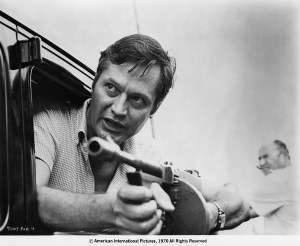
Not to be confused with Crazy Mama or Bloody Mama, Big Bad Mama features Angie Dickinson, Tom Skerritt, William Shatner, and a lot of tommy guns. It’s not a great film but it is a lot more fun than Public Enemies.
What is there to say about Dodgeball – A True Underdog Story other than it’s a no-brainer of a hilarious movie that doesn’t aspire to lofty heights. What it does do is come out firing with some of the funniest physical comedy and one-liners since The Farrelly Brothers’ Something About Mary. First time director Rawson Marshall Thurber does a good enough job to keep the laughs coming one right after the another to keep Dodgeball from becoming too repetitive.
The movie is a riff from the stock underdog sports genre with a Peter La Fleur (played by Vince Vaughn with his usual sardonic wit) having to find a way to save his Average Joe’s Gym from being foreclosed by his bank and turned by a rival hi-tech gym next door into a parking lot. Who else would be the perfect foil for Vince Vaughn’s Peter La Fleur but none other than Ben Stiller as the former-fatty turned workout fitness Nazi, White Goodman. Goodman’s Globo Gym is a state-of-the art, sterile and BALCO-like gym where insults and making its members feel ugly, fat and useless is the way to clean health and the perfect bod.
Already, within the first fifteen minutes, we know who to root for and who to boo. In one corner we have the Average Joe’s guys played with comedic timing by Justin Long, Stephen Root, Chris Williams, Alan Tudyk and Joel Moore. Stiller’s Goodman and his consigliere Me’Shell (Jamal Duff channeling Barry White) with a hand-picked ringer of a dodgeball team he calls the Purple Cobras. With the two sides set the dodgeball carnage begins as Average Joe’s must win the Las Vegas Dodgeball Invitational to earn the $50,000 needed to save the gym. To round out the Average Joe’s team will be the bank accountant who ends up sympathizing with the Joe’s, Kate Veatch (played by Stiller’s real-life wife, Christine Taylor) and Patches O’Houlihan (Rip Torn in a scene-stealing role).
Rip Torn is hilarious as the acerbic and insane former dodgeball great Patches O’Houlihan. He pretty much gets all the best one-liners in the movie the moment he appears on the screen. He coaches the Average Joe’s team by browbeating them, insulting them and, failing that, throwing wrenches at them to help them in learning the 5 D’s of dodgeball: Dodge, duck, dip, dive, dodge. In fact, I would say that if it wasn’t for Rip Torn’s character dominating the middle part of the movie, I think Dodgeball‘s constant ball to the groin shots would’ve gotten old. Instead Patches O’Houlihan constantly gave people watching a reason to laugh out loud.
Dodgeball – A True Underdog Story is a movie that the Academy voters will not go about showering with praises and awards, but I’m sure most of them will be watching it and laughing out loud like the rest of the general public. Dodgeball is one hilarious, one-liner after one-liner ball to the nuts funny and it doesn’t aspire to be anything else but that. This movie will never get old with each viewing and will continue to make people laugh out loud.


 Through the Shattered Lens