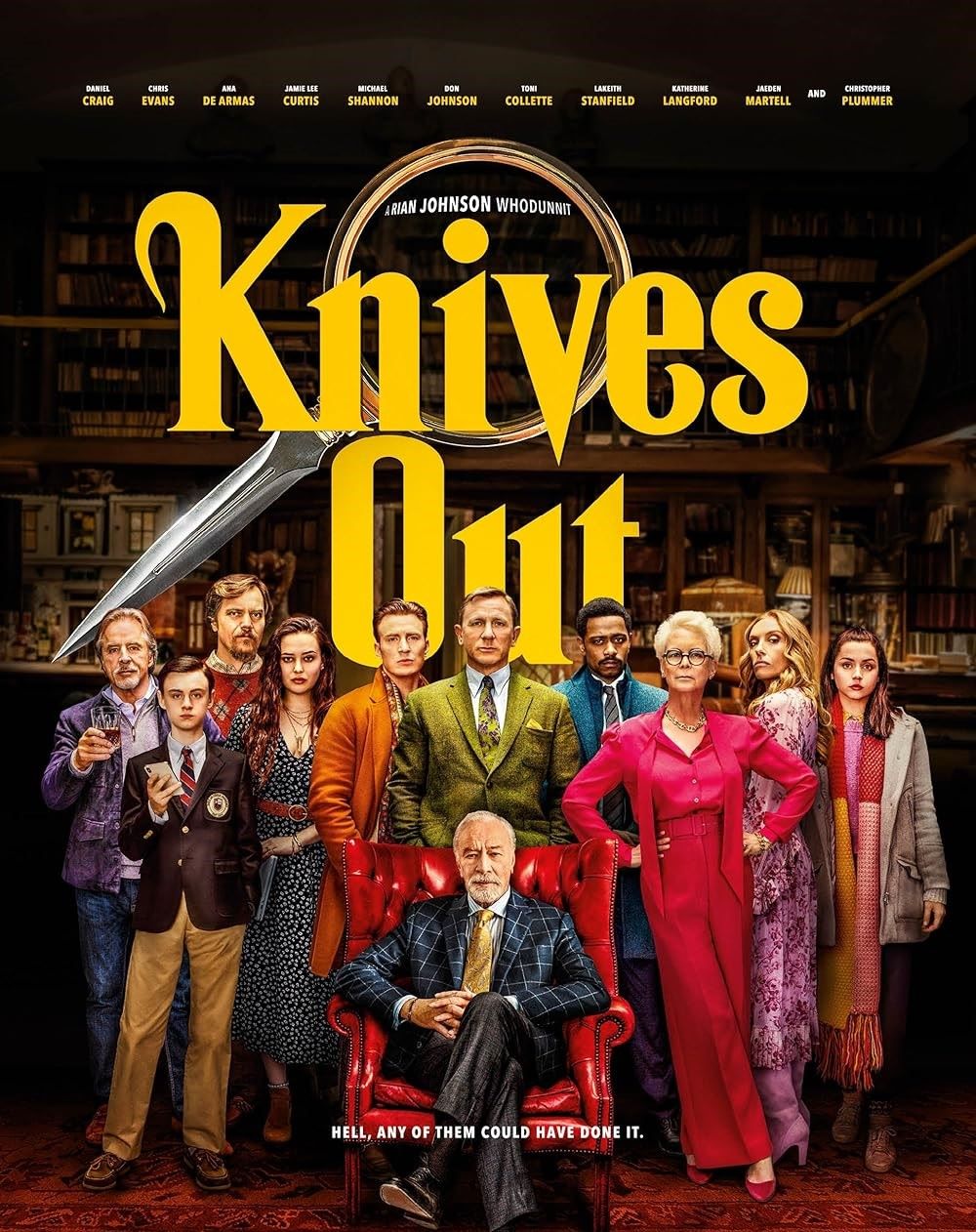
Review: Knives Out (dir. by Rian Johnson)


“The family is truly desperate. And when people get desperate, the knives come out.” — Benoit Blanc

After shaking up galaxies far, far away with Star Wars: The Last Jedi, Rian Johnson returned to solid ground in 2019 with Knives Out, a film so self-assured and inventive it practically felt like a director catching his breath while reminding the world what made him exciting in the first place. It was his first movie after that polarizing Star Wars entry, and he used the opportunity not to go bigger, but smarter—to take something intimate, character-driven, and refreshingly old-school and make it gleam again. Knives Out landed as a kind of palate cleanser for both him and the audience: a modern mystery that leaned into genre nostalgia while reinventing it with sharp humor and social bite. The result wasn’t just a change of pace—it was a confident display of craft from a filmmaker unbothered by his critics, operating with absolute control over every frame, every line, and every perfectly timed smirk.

The setup couldn’t be more classic: a wealthy family patriarch, Harlan Thrombey, turns up dead after his 85th birthday, leaving behind a tangled household of suspects, secrets, and strained smiles. His death looks like suicide, but something isn’t right. Enter Benoit Blanc, a Southern gentleman detective hired anonymously to snoop through the wreckage of lies and grievances. The scenario drips with vintage whodunit flavor, but Johnson’s genius lies in retooling that familiarity into something electrifyingly modern. The Thrombeys aren’t just eccentric millionaires—they’re avatars of American entitlement, each convinced of their own superiority while quietly dependent on the man they pretend to revere. By building his mystery around a clan that mirrors contemporary divisions of money, politics, and self-deception, Johnson injects wit and purpose into the genre without ever losing the fun of the game.

Jamie Lee Curtis plays the confident matriarch Linda, Michael Shannon the resentful son Walt, Toni Collette the spiritual grifter Joni, and Don Johnson the smirking son-in-law Richard—all of them playing heightened but recognizable shades of selfishness. Their sniping exchanges during the first act are among the film’s best sequences, packed with fast banter, political jabs, and casual hypocrisy. Johnson directs these moments like a verbal tennis match, letting personalities bounce and clash until the family’s shiny façade cracks enough for true frustrations to spill out. It’s sharp, funny, and chaotic, showing early on that no one in the Thrombey family is as self-made or self-aware as they claim to be.

Amid that colorful ensemble, the performance that most stunned audiences came from Chris Evans as Ransom Drysdale, Harlan’s playboy grandson and the family’s unapologetic black sheep. Coming off years of playing Marvel’s resolutely noble Steve Rogers, Evans dives into Ransom with visible glee, turning him into a figure of charm and mystery whose motives are never quite clear. He’s magnetic from the moment he appears—witty, cynical, a little dangerous—and Johnson clearly relishes using Evans’s clean-cut image to toy with expectations. Ransom strides into the story radiating confidence, but there’s a guarded, almost predatory intelligence behind his grin. His scenes crackle because the audience can’t quite decide where to place him: is he the rare Thrombey who sees through the family hypocrisy, or is he spinning his own kind of manipulation? That tension between self-awareness and deceit gives his every line an edge. Watching Evans in this role feels like a release for him and a thrill for viewers, a testament to both his range and Johnson’s intuitive casting.

Opposite that moral uncertainty stands Ana de Armas’s Marta Cabrera, Harlan’s kind and soft-spoken nurse who suddenly finds herself at the heart of the story. Marta grounds the entire film emotionally, her decency cutting through the Thrombeys’ arrogance like sunlight in a dusty room. She’s the migrant caretaker who everyone claims to love while casually condescending to, a detail Johnson uses to expose how often politeness masks prejudice. Marta’s inability to lie without vomiting, played initially for laughs, gradually becomes symbolic—a kind of moral honesty that makes her unique in a house ruled by deception. De Armas brings layered vulnerability to the role, balancing fear, guilt, and compassion with natural ease. Through her, Johnson turns the whodunit into something more human and emotionally resonant. She isn’t just a witness or a suspect; she’s the beating heart around which all the greed, paranoia, and privilege revolve.

Then there’s Daniel Craig’s Benoit Blanc, whose arrival shifts the film into another gear entirely. His Southern drawl—equal parts poetic and perplexing—sets the tone for what becomes one of Craig’s most playful performances. After years of portraying the stoic James Bond, he’s clearly having the time of his life as a detective who investigates with both intellect and intuition. Blanc operates less like a hard-nosed cop and more like a philosopher; he believes that solving a crime means understanding human weakness as much as evidence. His famous “donut hole” speech perfectly captures the balance Johnson strikes between earnestness and absurdity. Blanc may revel in his own melodrama, but he also brings heart to chaos, observing people’s contradictions without losing his sense of wonder. The result is a detective who’s less about revelation and more about revelation’s moral cost.

Visually, Knives Out belongs to a rare category of films that are so meticulously crafted they could be paused at any frame and still look compelling. Johnson and cinematographer Steve Yedlin transform Harlan’s mansion into a breathing character—an architectural echo chamber of secrets. The walls are lined with strange trinkets, elaborate paintings, and heavy mahogany furniture that suggest old money’s suffocating weight. There’s something both cozy and claustrophobic about the space, which mirrors the tension between family warmth and poisonous resentment. The camera glides through it with purpose, lingering on small details that gain meaning later, and the autumn-colored palette—deep reds, browns, and golds—wraps everything in an inviting melancholy. It’s as much a visual experience as it is a narrative one, and few modern mysteries feel as tactile.

Johnson’s writing keeps that sense of precision. The plot unfolds like clockwork, but the mechanics never feel mechanical. Instead, he keeps viewers off-balance by blending humor with genuine suspense. Instead of relying entirely on high-stakes twists, Johnson builds tension through empathy, giving us access to characters’ doubts and stakes rather than just their clues. The result is a mystery that keeps the audience guessing in emotional and moral dimensions, not just logical ones. Every revelation says as much about character as it does about the crime.

Underneath the quick humor and ornate mystery structure, Knives Out doubles as a satire of class and entitlement. Johnson sketches the Thrombeys as people who talk endlessly about fairness, morality, and self-reliance yet collapse into panic when their material comfort is threatened. Through them, he captures a peculiar American irony: the people most obsessed with earning their status are often those most insulated from real struggle. When the family gathers to argue over wealth and loyalty, Johnson doesn’t need to exaggerate—they expose themselves with every smug phrase and self-justified rant. It’s social commentary that’s biting but never heavy-handed because it plays out through personality instead of sermon.

Nathan Johnson’s score carries the story forward with playful precision, shifting from tension to whimsy in sync with the characters’ shifting loyalties. There’s something almost dance-like about the film’s rhythm: scenes of laughter can spiral into confession, and interrogations can dissolve into comedy without losing a beat. The editing supports that agility, cutting crisply between overlapping dialogue and close-ups that reveal just enough expression to keep us alert. Johnson’s sense of pacing feels theatrical in the best way—it’s about timing and tone rather than spectacle.

As with many of Rian Johnson’s works, contradiction fuels the story’s appeal. Knives Out is cynical about human greed but oddly hopeful about individual decency. It mocks arrogance but rewards empathy. Even when it toys with genre clichés, it does so out of affection, not scorn. Johnson clearly understands that mystery storytelling is as much about character and morality as deduction, and he uses humor and chaos as tools to explore who people become under pressure. The movie’s sophistication lies in how effortless it feels—its layers unfold smoothly, but the craft behind them is razor sharp.

The film’s ending closes with a visual that redefines power without needing words. After a story filled with deceit, pretension, and the scramble to control a legacy, it concludes on an image that says everything about perspective—who actually holds the moral high ground and how quietly dignity can win. Like the rest of the movie, it’s both playful and pointed, leaving you smiling while still turning the characters’ behavior over in your mind.

Looking back, Knives Out stands as a defining moment in Rian Johnson’s career. After the spectacle and dialogue storms of The Last Jedi, this lean, ensemble-driven mystery reaffirmed his strengths as a writer-director who thrives on structure, rhythm, and human contradictions. It’s a film that takes as much pleasure in observation as revelation, brimming with sly humor and performances that sparkle across the moral spectrum. Anchored by Ana de Armas’s poignant sincerity, Daniel Craig’s eccentric brilliance, and Chris Evans’s unpredictable charisma, it became one of the most purely enjoyable movies of its time. Witty without pretense, political without lecturing, and perfectly balanced between cynicism and heart, Knives Out remains proof that the old whodunit can still cut deep—and that Rian Johnson’s sharpest weapon is still his storytelling.
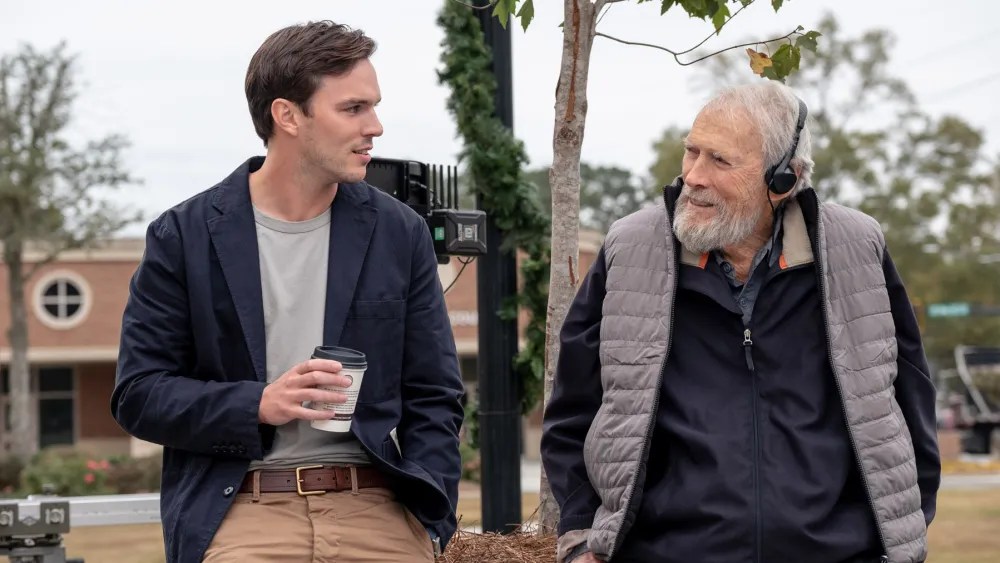
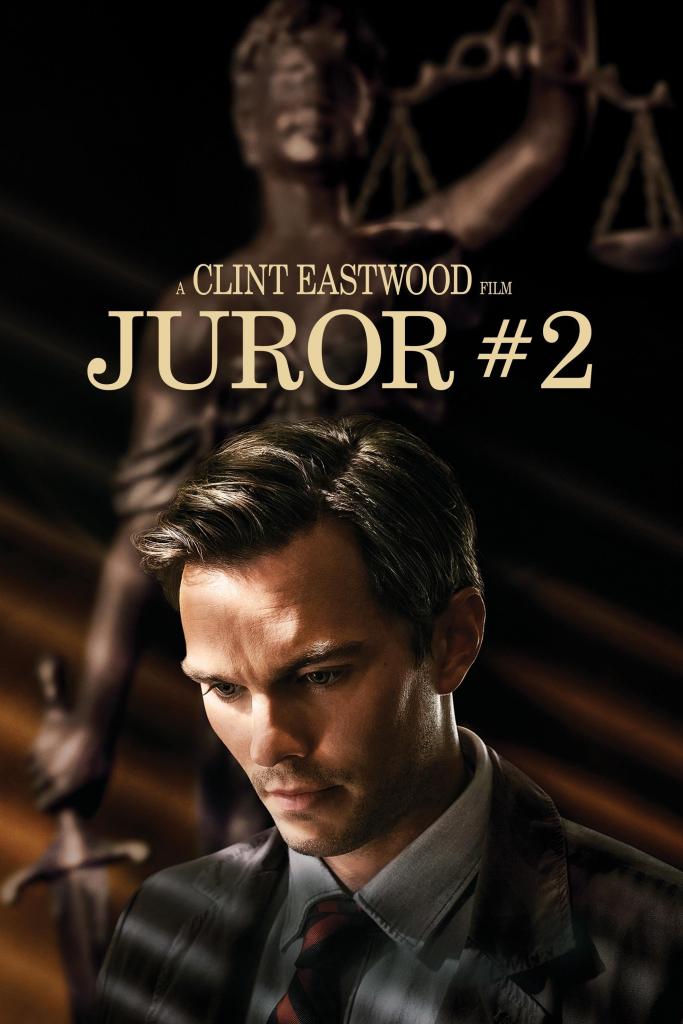
JUROR #2 (2024) – Another Gift from Clint Eastwood


I’ve really been looking forward to seeing JUROR #2, Clint Eastwood’s most recent directorial effort, since I first read about it a year or two ago. Any film from the aging icon is a gift to his fans at this point, so it seems appropriate that I watched it for the first time on Christmas Eve. I still don’t understand the release strategy for the film, considering it was released in a few theaters and then pushed out to streaming platforms a little over a month later. That seems strange for a movie with this kind of pedigree, but I guess that doesn’t really matter at this point. 

The plot revolves around Justin Kemp (Nicholas Hoult), a seemingly nice guy who’s going to be a dad any day now. I know that because his wife Allison (Zoey Deutch) looks like she could pop at any moment. He tries to use that pregnancy to get out of jury duty, but to no avail. Of course he gets selected to serve. As District Attorney Faith Killebrew (Toni Collette) begins laying out the facts of a horrific murder case against James Michael Sythe (Gabriel Basso), Justin begins to immediately realize that the wrong guy may have been arrested for the crime. How does he know they’ve got the wrong guy? Because Justin now thinks that he may be the one responsible for an accidental hit and run killing of the victim, Kendall Carter (Francesca Eastwood). The remainder of the film deals with Justin’s moral dilemma as he attempts to serve on the jury, protect his own freedom, and not send an innocent man to jail. This plot does require a pretty big suspension of disbelief, but if you’ll just go along with it, the movie does present some interesting ideas.

I’ll say right off the bat that I like JUROR #2. This was a relief to me because as much as I wanted to like Eastwood’s prior film CRY MACHO, at the end of the day it just wasn’t a very good movie. I’ve always enjoyed courtroom thrillers, and it doesn’t seem we get to see many of them anymore. Our main character Justin Kemp has a troubled past, but he’s truly turned his life around. The fact that he now finds himself in a seemingly impossible moral position is a strong hook that pulled me in. Director Eastwood takes his time here and tightens the grip on Justin, leaving him with few options, as he tries to figure out what to do. I’ve never served on a jury, and I’ve never really wanted to. I’m not sure I want the responsibility of deciding a person’s guilt or innocence. Eastwood’s film doesn’t change my mind in this area. It shows us some jurors who have made up their minds based on pre-conceived notions, regardless of the evidence. It shows us other jurors who want to convict just so the trial can be over and they can get on with their lives. It shows us witnesses who are willing to identity people just to please the prosecution. Considering what we know as the audience, these are glaring but realistic weaknesses of our nation’s system of justice. 

Eastwood assembled a good cast with Nicholas Hoult, Toni Collette, J.K. Simmons, and Kiefer Sutherland, actors that I always find worth watching. Hoult and Collette do most of the heavy lifting. JUROR #2 is set in Georgia, and I appreciate that Hoult, who’s from England, and Collette, who’s from Australia, don’t overdo the southern accents. J.K. Simmons is very impressive as an ex-cop who’s serving on the jury who is convinced of the defendant’s innocence. Unfortunately, his character exits the film fairly early, and he’s sorely missed. I’ve been a big fan of Kiefer Sutherland since I was a teenager, and I consider “24” one of my all time favorite shows. His role is pretty small here. He’s good, but from what I’ve read, he really just wanted to work with Eastwood. I also enjoyed seeing Gabriel Basso (Hillbilly Elegy) and Francesca Eastwood (Clint’s daughter) in the film. 

Clint Eastwood amazes me. In his legendary six decade career, he has been a part of some of the best films of all time. DIRTY HARRY, THE OUTLAW JOSEY WALES, and UNFORGIVEN are included in my list of all-time favorites. JUROR #2 is not in their league, and it’s certainly not a perfect film. But it is an entertaining film that tells an interesting story and even makes you think a little bit. And with that I say, thanks for another gift, Clint! 

Lisa Marie’s Early Oscar Predictions For August!


  You can check out my predictions for April by clicking hereAnd then check out my predictions for May!  And June as wellAnd July!

Best Picture

Anora

Blitz

Didi

Dune Part 2

Emilia Perez

Gladiator II

Maria

A Real Pain

Sing Sing

The Substance

Best Director

Jacques Audiard for Emilia Perez

Sean Baker for Anora

Pablo Larrain for Maria

Steve McQueen for Blitz

Denis Villeneuve for Dune Part 2

Best Actor

Jesse Eisenberg in A Real Pain

Andre Holland in The Actor

Daniel Craig in Queer

Barry Keoghan in Bird

Jesse Plemons in Kinds of Kindness

Best Actress

Ryan Destiny in The Fire Inside

Cynthia Erivo in Wicked

Angelina Jolie in Maria

Mikey Madison in Anora

Demi Moore In The Substance

Best Supporting Actor

Kieran Culkin in A Real Pain

Brian Tyree Henry in The Fire Inside

Samuel L. Jackson in The Piano Lesson

Paul Raci in Sing Sing

Denzel Washington in Gladiator II

Best Supporting Actress

Joan Chen in Didi

Toni Collette in Juror #2

Julianne Moore in The Room Next Door

Saoirse Ronan in Blitz

Zoe Saldana in Emilia Perez

Lisa Marie’s Way Too Early Oscar Predictions For July


  You can check out my predictions for April by clicking hereAnd then check out my predictions for May!  And June as well!

Best Picture

Anora

Blitz

Didi

Dune Part 2

Emilia Perez

The Fire Inside

Gladiator II

Inside Out 2

A Real Pain

Sing Sing

Best Director

Jacques Audiard for Emilia Perez

Sean Baker for Anora

Steve McQueen for Blitz

Rachel Morrison for The Fire Inside

Denis Villeneuve for Dune Part 2

Best Actor

Jesse Eisenberg in A Real Pain

Andre Holland in The Actor

Daniel Craig in Queer

Barry Keoghan in Bird

Jesse Plemons in Kinds of Kindness

Best Actress

Ryan Destiny in The Fire Inside

Cynthia Erivo in Wicked

Angelina Jolie in Maria

Mikey Madison in Anora

Demi Moore In The Substance

Best Supporting Actor

Kieran Culkin in A Real Pain

Brian Tyree Henry in The Fire Inside

Samuel L. Jackson in The Piano Lesson

Paul Raci in Sing Sing

Denzel Washington in Gladiator II

Best Supporting Actress

Joan Chen in Didi

Toni Collette in Juror #2

Julianne Moore in The Room Next Door

Saoirse Ronan in Blitz

Zoe Saldana in Emilia Perez

Lisa Marie’s Way Too Early Oscar Predictions For June


This has not been an easy month and I’ve fallen behind in my movie-watching and also my news-reading.  So, take the predictions below with many grains of salt.  That said, it is the end of the month and it’s time for my monthly Oscar predictions!

What will happen when the nominations are announced in 2025?  Who knows?  For now, let’s just have fun guessing.  You can check out my predictions for April by clicking hereAnd then check out my predictions for May!

Best Picture

Anora

Blitz

Didi

Dune Part 2

Emilia Perez

The Fire Inside

Gladiator II

Inside Out 2

A Real Pain

Sing Sing

Best Director

Jacques Audiard for Emilia Perez

Sean Baker for Anora

Steve McQueen for Blitz

Rachel Morrison for The Fire Inside

Denis Villeneuve for Dune Part 2

Best Actor

Jesse Eisenberg in A Real Pain

Andre Holland in The Actor

Daniel Craig in Queer

Barry Keoghan in Bird

Jesse Plemons in Kinds of Kindness

Best Actress

Ryan Destiny in The Fire Inside

Cynthia Erivo in Wicked

Angelina Jolie in Maria

Mikey Madison in Anora

Demi Moore In The Substance

Best Supporting Actor

Kieran Culkin in A Real Pain

Brian Tyree Henry in The Fire Inside

Samuel L. Jackson in The Piano Lesson

Paul Raci in Sing Sing

Denzel Washington in Gladiator II

Best Supporting Actress

Joan Chen in Didi

Toni Collette in Juror #2

Julianne Moore in The Room Next Door

Saoirse Ronan in Blitz

Zoe Saldana in Emilia Perez

Lisa Marie Reviews An Oscar Nominee: Nightmare Alley (dir by Guillermo del Toro)


In March, CODA won the Oscar for Best Picture.

By May, I think most people had forgotten about it.

I point this out not to be snarky about CODA (which, for the most part, I found to be a well-made and sweet-natured movie) but to just point out that occasionally, the Oscar for Best Picture Of The Year does not go to the nominee that’s necessarily going to be remembered and watched by future generations.  CODA’s victory is not a travesty, regardless of what some members of Film Twitter insisted.  This isn’t like when Green Book won.  It’s just that CODA seems to be destined to be remembered in much the same way that we remember Argo and Spotlight, i.e. a well-made and well-acted film that gets the job done but don’t necessarily stick around in your mind for long after you watch it.

In fact, looking back at all of the 2021 Best Picture nominees, the one that has really stuck with me is Guillermo del Toro’s Nightmare Alley.

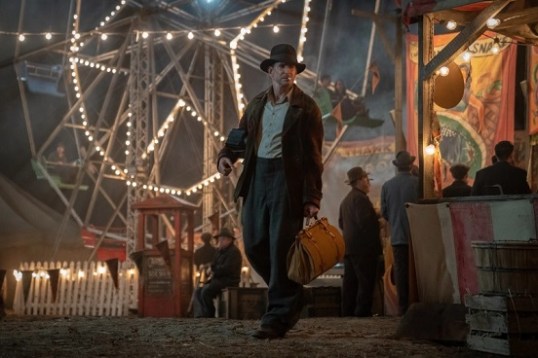
Nightmare Alley tells the story of Stan Carlisle (Bradley Cooper), a drifter who, in 1939, gets a job with a carnival.  Stan is running from his past.  He’s haunted by visions and dreams of a dying old man and a burning farm house.  When we first meet him, he avoids alcohol which is perhaps a good thing as getting drunk at the carnival just makes someone easier to exploit and, ultimately, the carnival is all about exploitation.  The carnival’s owner, Clem (Willem DaFoe), specializes in tricking alcoholics into becoming opium-addicted “geeks,” who bite the heads off of chickens for gawking country audiences.

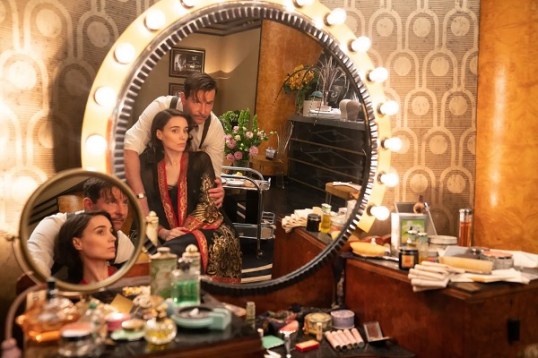
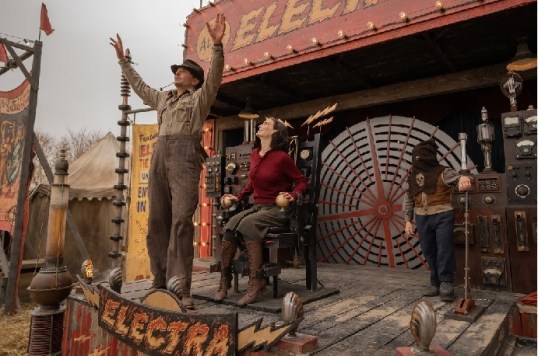
It’s not a glamorous life but it’s one that allows Stan to hide from his past.  He comes under the tutelage of Madame Zeena (Toni Collette) and her husband, Pete (David Straithairn).  They teach him how to give “cold readings,” and Stan proves to be an eager student.  Pete tells Stan to never pretend to be able to speak to the dead and, from the minute that Pete says it, we can tell that Stan is already thinking about how much money he could make by doing just that.  Stan also appears to fall in love with Molly (Rooney Mara), a performer whose act involves a fake electric chair.  When Stan eventually abandons the carnival, Molly goes with him.  When Stan finds success as a fake medium, Molly is his assistant.

Stan becomes quite a success in Buffalo, trading in his shabby clothes and his unshaven appearance for a tuxedo and suave mustache.  With success comes arrogance and Stan soon ignore what Pete told him about pretending to be able to speak to the dead.  When Stan meets a psychologist named Dr. Lillian Rith (Cate Blanchett), he gets involved in a plot to con a judge who is still mourning for his deceased son.  It also leads to Stan meeting a corrupt and murderous businessman (Richard Jenkins).  Ignoring Pete’s lesson sets off a chain of events that leads Stan right back to where he started.

There’s something wonderfully subversive about taking Bradley Cooper, a legitimate movie star who is probably one of the most personable and likable actors working today, and casting him as such a sleazy character.  This isn’t a case, as in American Hustle or even The Hangover movies, where Cooper is playing a goof who gets in over his head.  Instead, Stan is someone who uses his eager manner and his natural charm to cover up the fact that he’s hollow on the inside.  Watching the film, you’re never quite sure as to whether or not Stan truly cares about any of the people who come into his life.  Does he love Molly or is he just using her?  Does he care about his friends from the carnival or is he just manipulating them into acting as a shield to keep out his former life?  When he goes against Pete’s lessons about pretending to speak to the dead, is he motivated by greed or arrogance?  Or does he truly want to believe that he’s somehow become the all-powerful psychic that he pretends to be?  Stan becomes a success because he knows how to con everyone but eventually, he meets someone who is even emptier than he is.  Ultimately, Stan cons himself.  He tricks himself into believing that he’s more clever than he actually is and he ends up facing the fate that he secretly always knew was waiting for him.  Cooper gives an outstanding performance as Stan.  Both he and del Toro cleverly play with what audiences expect when they see Bradley Cooper onscreen.  In the end, the film suggests that not even charm can ward off karma.

Nightmare Alley is work of what Lucio Fulci called “pure cinema,” one in which the imagery and the emotions generated by that imagery is even more important than the story itself.  The sets, whether it’s the carnival or Dr. Ritter’s office or the Buffalo ballroom where Stan cons the wealthy, are large and ornate.  The cinematography is gorgeous.  The supporting performances are arch and witty.  Cate Blanchett’s and Rooney Mara’s costumes are to die for.  Nearly every shot feels as if it could have been lifted from a particularly vivid dream.  Guillermo del Toro’s love of cinema is evident in every frame of Nightmare Alley.  It’s a film that celebrates the grandeur and the power of imagination and also warns about the destructive power of hubris.  Despite the fact that del Toro has gone on the record saying that there’s nothing supernatural about Nightmare Alley, it’s still a wonderful film for the Halloween season.  The costumes are beautiful and the final third of the movie plays like an homage to the classic German expressionistic horror films, with Blanchett playing her role as a mix of Dr. Caligari and a classic noir feeme fatale.  Nightmare Alley is a big, flamboyant, and unforgettable work of pure cinema and, looking back, it’s my favorite film of 2021.

It’s a film that stays with you.

Music Video of the Day: Look Up by Toni Collette & The Finish (2007, dir by ????)


Toni Collette can sing!

On another note, my little ADD-wracked brain has been having a hard time remembering that the name of Adam McKay’s latest film is Don’t Look Up and not Don’t Look Now.  (Don’t Look Now, of course, is the classic Nicolas Roeg film about Julie Christine and Donald Sutherland taking an eventful trip to Venice and getting to know a mysterious person who wanders around while wearing a red jacket.  Seriously, if you’re missing traveling and you’re into the romance of Italy, check out Don’t Look Now!)  Fortunately, a friend sent me this video as a way to help me remember the difference between the two.  Personally, I prefer the music video to Adam McKay’s film.  It’s a lovely video and there’s no one yelling at me.

Toni Colette & The Forward released one album in 2006, Beautiful Awkward Pictures.  Two singles were released off the album, this one and the title track.  The video for the title track was directed by Nash Edgerton and I’m tempted to think that he may have done this one as well.  But I’m not sure so until I get some sort of official confirmation, we’ve got question marks.

This song was written by Toni Collette herself.

Enjoy!

Look up look up
The sky is falling
Colors changing
People laughing
In the face of danger
Look out look out
The bruise is swelling
Streets are bleeding
Angels calling
In a time of rescue
The rivers flooding
Boats are sinking
Lights are fading
An attempt to get through
To the ocean of you
All naked & blue
How do you do
Watch out watch out
The fools are fighting
There’s love that’s dying
An earth that’s crying
For the life it once knew
Trace the day
Across all space
To find a smile
Upon your face
I could never replace
The hue of these days
It’s just a phase
That we can’t sleep
We can only weep
For all we can’t keep
We live in dream
Hear this hear this
The record’s playing
There’s lovers swaying
A town that’s praying
For a laugh to see them through
The rocket’s lifting
The air is thinning
Shapes are shifting
Oh god but what a view
One for your time
Two for your words
Three for a picture of a
Four dimensional world
Five to live with each other
Six to sing the same song
Seven not to eat them
Eight to feel that you belong
Nine to let go of fear
Ten to hold your vision dear
Look up look up
The sky is falling
Colors changing
People laughing
In the face of danger
The bruise is swelling
Streets are bleeding
Angels calling
In a time of rescue
The rivers flooding
Boats are sinking
Lights are fading
An attempt to get through
The fools are fighting
There’s love that’s dying
An earth that’s crying
For the life it once knew

Here’s The Teaser for Guillermo del Toro’s Nightmare Alley!


Here’s the first teaser for one of the most anticipated movies of the year, Nightmare Alley!

Guillermo del Toro’s previous film, Shape of the Water, won the Oscar for Best Picture. Could Nightmare Alley pull off the same feat? I have no idea but the trailer looks good and I’ll watch Bradley Cooper, Willem DaFoe, and Cate Blanchett in anything. Nightmare Alley is scheduled to be released on December 17th.

Incidentally, Nightmare Alley is based on a novel, which was previously adapted into a film way back in 1947. That version, which is considered to be a noir classic, was directed by Edmund Goulding and starred Tyrone Power, Jr in the lead role.

Lisa Marie Picks The 30 Top Films of 2020


Well, it’s finally time!  It’s time for me to announce my picks for the best films of 2020.

Before we begin, there is one thing I want to make clear.  Unlike the Academy, I did not extend my eligibility window.  Films like Nomadland, Minari, and The Father (amongst others) will undoubtedly be competing for the Oscar for Best Picture of 2020.  However, as far as I’m concerned, those are all 2021 films.  And I imagine that a few of them will probably appear on my best films of 2021 list.  However, the list below are my picks for the best films of 2020.  You’ll probably agree with some of my picks and disagree with some of the others.  As always, I welcome any and all comments.

Also, be sure to check out my picks for 2010, 2011, 2012, 2013, 2014, 2015, 2016, 2017, 2018, and 2019!  Wow, I’ve been doing this for a while!

And now, in descending order, my favorites of 2020!

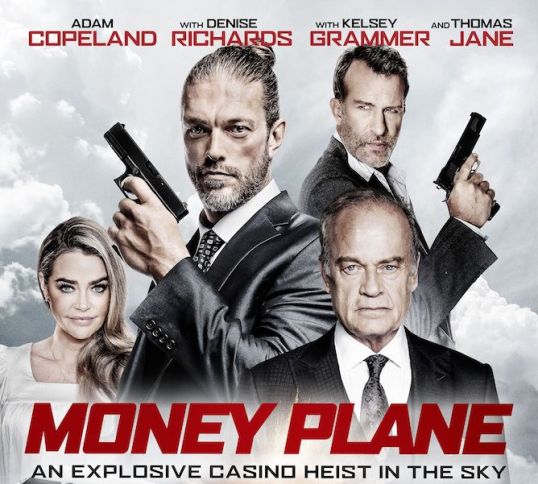
30. Money Plane (dir by Andrew Lawrence) — Okay, I can sense that you’re already rolling your eyes at my list by seriously, Money Plane is such a cheerfully absurd and self-aware little B-movie that there’s no way I couldn’t include it.  Seriously, how can you not love a film that features Kelsey Grammer always a gangster known as the Rumble?  Basically, as soon as I heard that priceless declaration of “We are going to rob the Money Plane!,” this movie had me under its spell.

29. Ma Rainey’s Black Bottom (dir by George C. Wolfe) — Though this adaptation of August Wilson’s play never quite escapes its theatrical roots, no one can deny the powerful performances of Viola Davis, Colman Domingo, Glynn Turman, and especially Chadwick Boseman.  Boseman dominates the film from the minute that he makes his first appearance, playing an ambitious, troubled, and undeniably talented trumpeter.  Viola Davis plays Ma Rainey with the self-awareness of someone who knows that the record producers need her more than she needs them.  She has the power and she’s not going to let anyone get away with forgetting it.

28. The Invisible Man (dir by Leigh Wannell) — Before the Academy announced that they would be changing their rules to considers streaming movies, many critics speculated that one of the results of the pandemic would be The Invisible Man winning all of the Oscars.  Though they may have been joking, it was not as outlandish an idea as they seemed to think.  The Invisible Man is a horror film that proves that being a genre film does not mean that film can’t also be a good and thought-provoking work of art.  The Invisible Man breathes new life into a somewhat hokey premise and Elisabeth Moss gives a great performance as a woman stalked by her abusive (and now invisble) ex.  The Invisible Man features one of the best ending scenes of 2020.

27. The Hunt (dir by Craig Zobel) — Delayed due to a manufactured controversy and released to critical bafflement, The Hunt is a clever satire of our hyper-partisan and hyper-polarized society.  The film’s final twist is a clever commentary on social media drama and Hillary Swank steals the show with an unexpected cameo.

26. One Night In Miami (dir by Regina King) — I went back and forth on this one.  Based on a stage play, this film imagines what happened the night that Malcolm X, Jim Brown, Sam Cooke, and Muhammad Ali met in a Miami motel room.  There are a few times that the film is undoubtedly a bit too stagey for its own good and, early on, some of the dialogue is a bit too on the nose.  But the film has a cumulative power and, despite a few uneven moments, it’s ultimately an intriguing look at race, celebrity, and political activism in America.  A good deal of the film’s power is due to the ensemble.  While most of the awards chatter seems to be focused on Leslie Odom, Jr. as Sam Cooke, it’s Aldis Hodge’s Jim Brown who truly anchors the film.

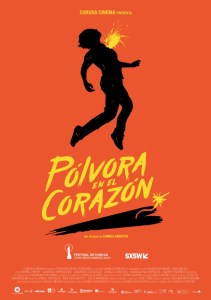
25. Gunpowder Heart (dir by Camila Urrutia) — This raw and angry film from Guatemala was one of the more powerful films to be featured at 2020’s virtual South By Southwest.  In Guatemala City, Maria and her girlfriend Claudia are assaulted by three men.  Maria wants revenge, no mater what.  Claudia, the more cautious of the two, knows that Maria’s plans are going to end in tragedy and disaster but she also knows that there’s nothing she can do to stop her.  Gunpowder Heart isn’t always easy to watch but it’s undeniably powerful.

24. The Shock of the Future (dir by Marc Collin) — Taking place in 1978, this French film follows one day in the life of a composer named Ana (Alma Jodorowsky).  It’s a typical day — Anna wakes up, a friend comes by with the latest albums, Anna tries to compose music, she goes to a party, and she hears the newest music.  It’s a simple but effective celebration of both music and the thrill of having your entire creative life ahead of you.  Alma Jodorowsky is brilliant in the role of Anna.

23. She Dies Tomorrow (dir by Amy Seimetz) — This a disturbing mood piece about a woman who is convinced that she is going to die in a day.  Everyone who she meets also becomes convinced that they’re going to die within 24 hours.  Some of them go out of their way to make sure that it happens while others just wait for death to come.  Is it a mass delusion or is it something else?  The atmospheric film may raise more questions than it answers but it will definitely stick with you.

22. Driveways (dir by Andrew Ahn) — Kathy (Hong Chau) and her young son, Cody (Lucas Jaye), move into the home that was owned by Kathy’s deceased sister.  In his final film appearance, Brian Dennehy plays the gruff but caring neighbor who befriends both Cody and his mother.  This is a low-key but emotionally resonant film, elevated by Dennehy’s heartfelt performance.

21. Figurant (dir by Jan Vejnar) — Clocking in at 14 minutes, this unsettling but powerful French/Czech co-production tells the story of a quiet man (Denis Levant) who follows a group of younger men into a warehouse and who soon finds himself in uniform and on a battlefield.  Or is he?  It’s not an easy question to answer but this intriguing short film will keep you watching, guessing, and thinking.

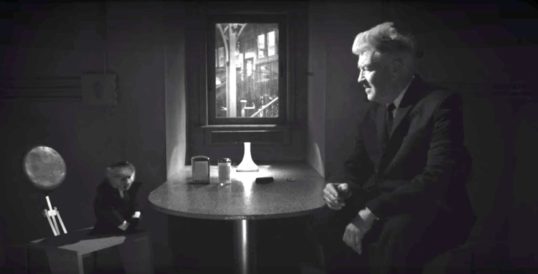
20. What Did Jack Do? (dir by David Lynch) — David Lynch interrogates a monkey in an expressionistic train station.  The monkey talks about a chicken and sings a song about true love’s flame.  “Are you now or have you ever been a member of the communist party?” Lynch asks.  It’s a brilliant short film and really, it’s the sort of thing that only David Lynch, with his mix of earnestness and eccentricity, could have pulled off.  Technically, this film was made a few years ago but it only got it’s official premiere in 2020, when Netflix released it on Lynch’s birthday.

19. Red, White, and Blue (dir by Steven McQueen) — Steve McQueen’s Small Axe was made up of five short films.  Three of them appear on this list.  There’s been a lot of debate about whether or not the Small Axe films should be considered individual features or if they should be considered a miniseries.  Obviously, I see them as being individual features but, in the end, they’re brilliant and thought-provoking regardless of whether they’re television or film.  Red, White, and Blue takes a nuanced look at institutional racism and features an excellent lead performance from John Boyega.

18. Mr. Jones (dir by Agnieszka Holland) — A film that deserved more attention than it received, Mr. Jones tells the story of Gareth Jones, the Welsh journalist who, in 1933, discovered the truth about the state-sponsored famine that was killing millions in the Ukraine.  Despite his efforts, the press refused to report on what was really happening in the Ukraine and instead, an odious propagandist named Walter Duranty was awarded a Pulitzer prize for writing pro-Stalin stories that were later determined to be full of deliberate lies.  An important and heartfelt film, Mr. Jones features a subtle but effective lead performance from James Norton and a memorable supporting turn from Peter Sarsgaard, who plays Walter Duranty as a smug snake.

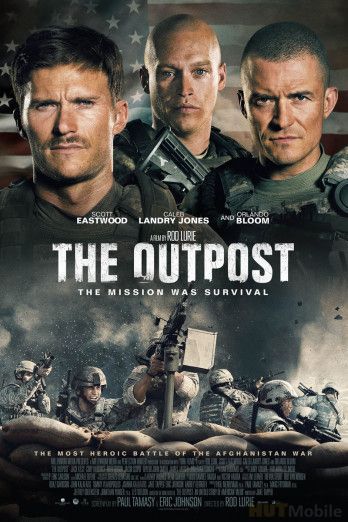
17. The Outpost (dir by Rod Lurie) — Based on a true story and directed by Rod Lurie, this film pays tribute to the men who have fought and died in America’s forgotten conflict, the War in Afghanistan.  Well-acted and doggedly unsentimental, The Outpost will literally leave you breathless.

16. Emma (dir by Autumn de Wilde) — The latest adaptation of Jane Austen’s much-adapted novel, Emma has a playful spirit that is lacking in so many other literary adaptations.  It also has a great performance from Anya Taylor-Joy, who makes the character of Emma Woodhouse her own.

15. Never Rarely Sometimes Always (dir by Eliza Hittman) — Two teenagers, Autumn (Sidney Flanigan) and her cousin Skylar (Talia Ryder), travel to New York City from Pennsylvania so that Autumn can get an abortion without having to get her parent’s consent.  Though I’m occasionally a bit skeptic of cinema verite, Never Rarely Sometimes Always makes good use of the style.  Far more than just being a film about abortion, it’s a character study of two people trying to survive in a harsh world.  The scene where the previously withdrawn Autumn is prodded to open up about her past is one of the most powerful of the year.

14. Possessor (dir by Brandon Cronenberg) — Brandon Cronenberg’s disturbing sci-fi/horror hybrid is not an easy film to explain or to even describe.  Questions of identity and betrayal are mixed with grotesque images of body horror and societal neglect.  By the end of the film, you’ll find yourself reconsidering everything that you previously assumed about the movie.  This one sticks with you, even though you may not want it to.  (How’s that for a recommendation?)

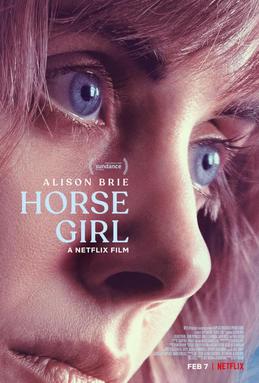
13. Horse Girl (dir by Jeff Baena) — This is a film that definitely deserved a bit more attention than it received.  Alison Brie gives a brave and sympathetic performance as someone who believes that she’s a clone who has been abducted by aliens.  Is she suffering from delusions brought on by a combination of loneliness and too much television?  Or is she right?  The film will leave you guessing.  While Brie is at the center of almost every scene, Molly Shannon also gives a good performance as one of Brie’s only friends.

12. Sound of Metal (dir by Darius Marder) — Riz Ahmed plays an occasionally obnoxious drummer who goes deaf.  Worried that Ahemd is going to relapse into drug use, his girlfriend and musical partner (Olivia Cooke) checks him into a rehab center for the deaf.  With the help of a sympathetic but no-nonsense counselor (Paul Raci), Ahmed struggles to come to accept the loss of sound and music from his life.  The three main performances elevate this film, making it one of the year’s best.  In the film’s best moments, we hear the world through Ahmed’s ears and experience what he’s experiencing.

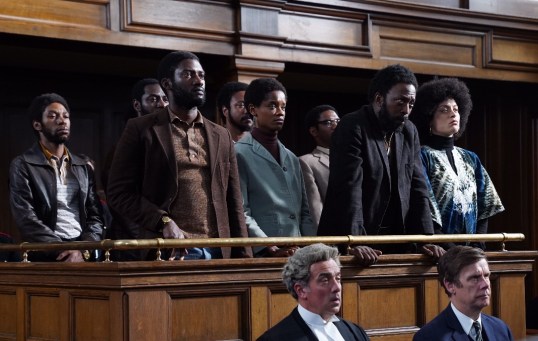
11. Mangrove (dir by Steve McQueen) — The first film in Steve McQueen’s Small Axe anthology tells the story of a true life court case.  Politically charged from beginning to end and leaving no doubt as to what the true stakes were in the case, Mangrove is the film that Trial of The Chicago 7 should have been.

10. Soul (dir by Peter Docter) — The latest from PIXAR made me cry as only a great PIXAR film can.  A music teacher named Joe (voices by Jamie Foxx) falls down a manhole shortly after winning his dream job in a jazz band.  Unwilling to die before performing on stage, Joe finds himself in the Great Before, assigned to teach an unborn soul named 22 (voiced by Tina Fey) what it means to be human …. okay, you know what?  This film has one of those plots that sounds silly if you try to explain it.  What matters is that it’s a heartfelt film that celebrates every minute of life.  Foxx and Fey both do wonderful voice work and the animation is as clever as always.  Plus, there’s a cat!

9. The Vast of Night (dir by Andrew Patterson) — This low-budget film is a wonderfully atmospheric look at what may or may not be an alien invasion taking place in the 1950s.  Featuring wonderfully naturalistic performances and an intelligent storyline, The Vast of Night is a triumph of the independent spirit.  I can’t wait to see what Andrew Patterson does next.

8. Lovers Rock (dir by Steve McQueen) — The 2nd film is Steve MQueen’s Small Axe anthology, Lovers Rock centers on one exhilarating house party.  Though the world outside of this party may be harsh and full of oppression and racism (a group of white teens shout racial slurs at one partygoer when she steps outside of the house), the world inside of the party is one of love, music, and celebration.

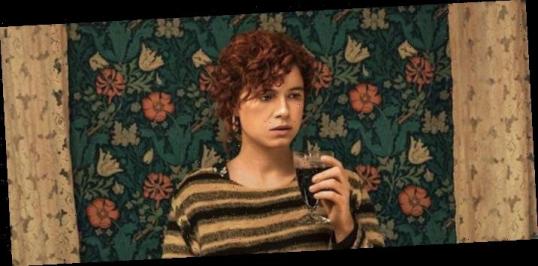
7. i’m thinking of ending things (dir by Charlie Kaufman) — A riddle wrapped in an enigma, i’m thinking of ending things features great performance from Jessie Buckley, Jesse Plemons, Toni Collette, and David Thewlis.  What starts out as an awkward drive to visit Plemons’s parents grows increasingly more and more surreal until the audience is left to wonder what is real, what is fantasy, and whether the majority of the film’s characters even exist.  This film plays out like a dream and stays with you long after it end.

6. Palm Springs (dir by Max Barbakow) — Perhaps the ultimate twist on Groundhog Day, Palm Springs is a thought-provoking comedic gem from Lonely Island Classic Pictures.  Andy Samberg, J.K. Simmons, and Cristin Milioti find themselves living the same day over and over again.  Each one reacts to their predicament in a different way.  It’ll make you laugh and then it’ll make you cry.  Revealing too much else about the plot would be a crime.  It’s on Hulu so go watch it.

5. The Assistant (dir by Kitty Green) — This infuriating and ultimately tragic film follows one day in the life of Jane (Julia Garner), a production assistant at a film company.  Though he’s never seen, Jane’s boss is clearly meant to be a fictionalized version of Harvey Weinstein.  Should Jane save her career or try to warn the actress that her boss has clearly set his eyes upon as his next victim?  The scene where the head of HR assures Jane that she needn’t worry about her boss’s behavior because “you’re not his type,” rings all too horribly true.  The Assistant was obviously designed to be a rallying call for #MeToo but sadly, today, it feels more like an obituary.

Bad Education

4. Bad Education (dir by Cory Finley) — All year, I have been lamenting the fact that Bad Education was bought by HBO and not Netflix.  If it had been released on Netflix, it would probably be an Oscar contender and Hugh Jackman would be in the hunt for his first Best Actor Oscar.  Instead, it aired on HBO and it had to settle for limited Emmy recognition.  It’s a shame because this film, which centers on embezzlement at one suburban school, was one of the best of 2020.  At a time when we’re being told not to question authority, Bad Education encourages us to question everything.  Along with being thought-provoking, it’s also occasionally laugh out loud funny.  Jackman is brilliant in the lead role.  Allison Janney is award-worthy as his partner-in-crime.  Ray Romano takes another step in proving that he’s more than just a sitcom actor.  All in all, this was a great movie.

3. First Cow (dir by Kelly Reichardt) — This melancholy tale follows two men who meet in Oregon in the 1820s and who become unlikely business partners.  Unfortunately, being partners means stealing milk from Toby Jones’s cow and thievery was even less appreciated in the 1820s than it is today. Featuring outstanding lead performances from Jon Magaro and Orion Lee, First Cow is a rewarding work of historical fiction.  Kelly Reichardt makes you feel as if you’ve woken up in the 1820s, even as she uses the past to comment upon the present.  This probably isn’t a film for everyone.  Reichardt’s style has always been more about observing than passing judgment.  But for viewers willing to stick with it, this deliberately paced film is a rewarding experience.

Finally, when it comes to the best film of the year, I’ve been going back and forth between two films.  In the end, I have to declare a tie.  In alphabetical order by title, here are the two best films of 2020:

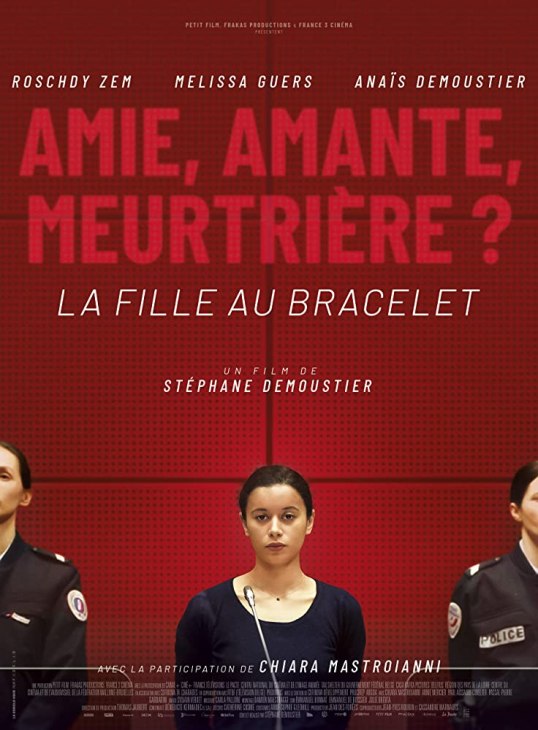
2. The Girl With A Bracelet (dir by Stéphane Demoustier) — This French film is about a teenage girl who is on trial for murdering her best friend.  Whether or not she’s guilty is ultimately less important than why everyone has been so quick to accuse her in the first place.  Featuring an outstanding ensemble and an intelligent script, The Girl With A Bracelet will leave you thinking about …. well, everything.  It can currently be viewed on Prime.

1. Promising Young Woman (dir by Emerald Fennell) — When I first started watching this film, I worried that it might be too stylized to be effective.  But it soon became apparent the director/screenwriter Emerald Fennell and star Carey Mulligan both knew exactly what they needed to do to tell this story.  Mulligan plays a med school drop-out who is seeking her own unique style of revenge against not only the men who raped her best friend in college but also the people who Mulligan feels subsequently let her friend down.  Bo Burnham plays the pediatrician who asks Mulligan out on a date and who appears to be the perfect nice guy, the adorably awkward boyfriend who you you would expect to find in a 90s rom com.  Neither character turns out to be exactly who they initially appeared to be.  Promising Young Woman mixes genres that normally don’t go together, smashing together drama and comedy, and it’s just audacious enough to be one of the best films of the year.


TSL Looks Back at 2020:

  1. 2020 In Review: The Best of Lifetime (Lisa Marie Bowman)
  2. 12 Good Things I Saw On Television in 2020 (Lisa Marie Bowman)
  3. Lisa Marie’s Top 8 Novels of 2020 (Lisa Marie Bowman)
  4. Lisa Marie’s Top 8 Non-Fiction Books of 2020 (Lisa Marie Bowman)
  5. Lisa Marie’s 20 Favorite Songs of 2020 (Lisa Marie Bowman)
  6. Lisa Marie’s 16 Worst Films of 2020 (Lisa Marie Bowman)
  7. My Top 20 Albums of 2020 (Necromoonyeti)
  8. 25 Best, Worst, and Gems That I Saw In 2020 (Valerie Troutman)
  9. Top 10 Vintage Collections (Ryan C)
  10. Top 10 Contemporary Collections (Ryan C)
  11. Top 10 Original Graphic Novels (Ryan C)
  12. Top 10 Ongoing Series (Ryan C.)
  13. Top 10 Special Mentions (Ryan C.)
  14. Top Ten Single Issues (Ryan C)