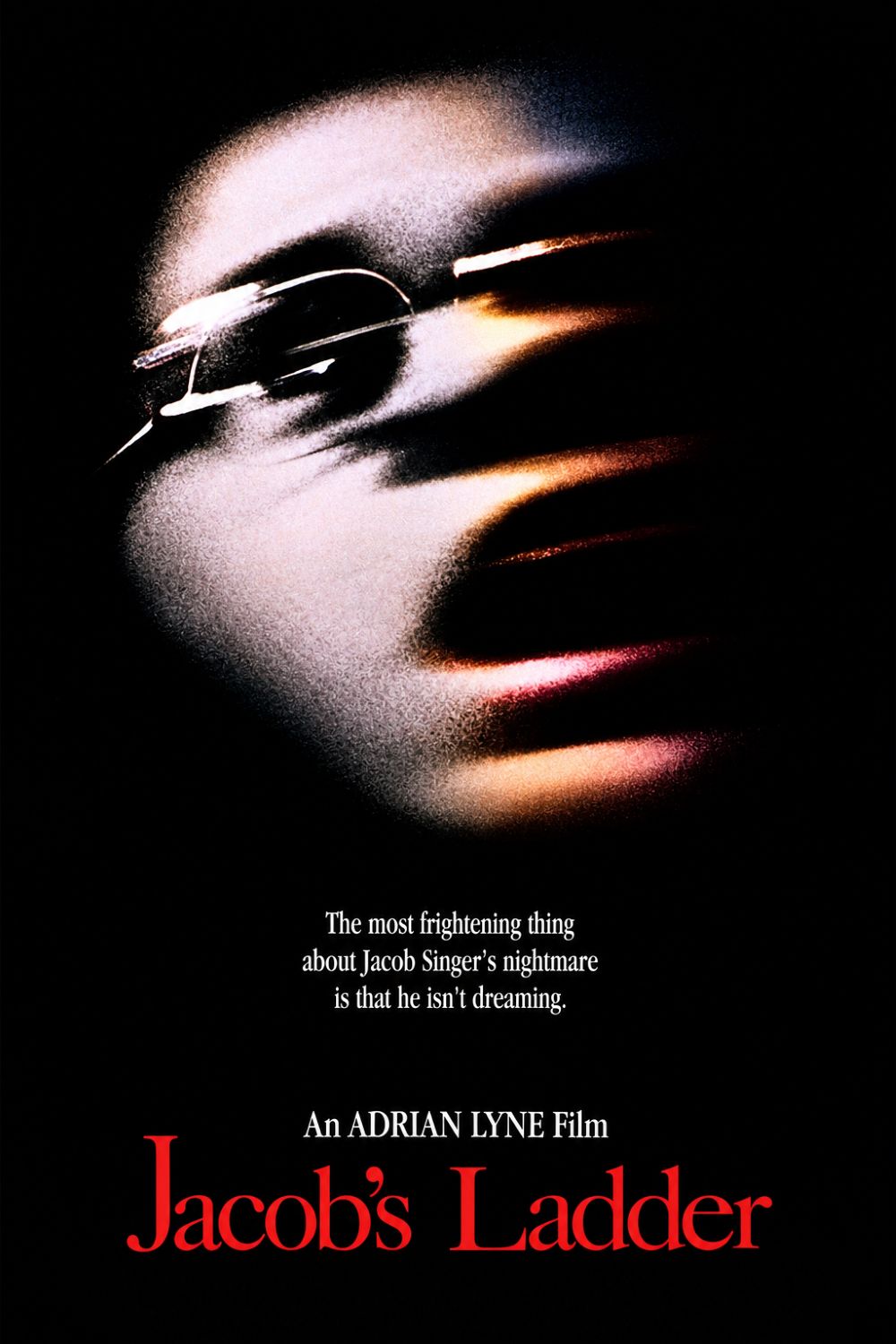
“The only thing that burns in Hell is the part of you that won’t let go of life, your memories, your attachments.” — Louis
There’s a particular kind of nightmare where nothing looks entirely impossible, but everything feels wrong. The people around you seem familiar until they speak. A room you recognize leads somewhere it shouldn’t. You keep trying to explain the situation, only to realize that nobody else thinks an explanation is necessary. Adrian Lyne’s Jacob’s Ladder captures that feeling with remarkable precision. Released in 1990, it’s a psychological horror film that makes confusion feel physical, then gives that confusion emotional weight. Its shocks are effective, but the real hook is watching someone search for reassurance in a world that keeps withdrawing it.
That someone is Jacob Singer, played by Tim Robbins, a Vietnam veteran whose life in New York is interrupted by disturbing visions and memories. He works as a postal employee, lives with his girlfriend Jezzie, and carries grief over the death of his young son. Those details establish a life beyond the central mystery, which matters because the story soon makes almost every part of that life uncertain. Jacob sees things he cannot account for, and the explanations available never remain convincing for long. The screenplay keeps us close to his perspective without guaranteeing that his perspective is reliable.
Robbins gives the film its emotional center. He plays Jacob with an openness that makes the character easy to care about without becoming overly sentimental. There’s something affecting about watching this tall, seemingly capable man become so unsure of himself. He searches other people’s faces for confirmation, tries to ask reasonable questions, and sometimes looks embarrassed by his own fear. Those small reactions do more than constant shouting would. Jacob feels like someone attempting to preserve his dignity while losing the basic confidence that he understands what is happening around him.
Lyne surrounds that performance with environments that seem to magnify Jacob’s anxiety. The New York locations have a worn, claustrophobic quality, and even crowded spaces offer little protection. People are nearby, but help feels strangely unavailable. The subway scenes make especially good use of that disconnect. A familiar public setting becomes threatening through its emptiness, strange encounters, and lack of a straightforward exit. The film understands how quickly an ordinary inconvenience can become frightening when you’re already uncertain about your surroundings. It doesn’t need a spectacular transformation to make a place feel hostile.
The more openly nightmarish imagery grows out of that atmosphere rather than replacing it. Distorted faces and violently unnatural movements appear like interruptions in the visible world. They’re frightening partly because the film rarely allows a comfortable examination of them. You see enough to register something awful, but not enough to understand it. That restraint gives the images an unpleasant afterlife in your imagination. Instead of presenting monsters as clearly defined opponents, Lyne makes them feel like evidence that Jacob’s entire experience has become unsafe. There’s no obvious distance he can put between himself and the threat.
The hospital sequence brings that idea to its most punishing extreme. Jacob cannot control where he is taken, what happens to his body, or whether anyone will answer him honestly. The sequence turns the expectation of medical care inside out. Equipment, corridors, and staff become elements in a process he cannot understand or interrupt. It’s gruesome, certainly, but the gore isn’t doing all the work. The deeper horror lies in being handled as though your fear is irrelevant. Lyne makes the loss of agency unbearable before the most disturbing images even finish registering.
What keeps the movie from becoming exhausting is its attention to Jacob’s emotional life. His memories of his son aren’t simply clues for the audience to collect. They show what he misses and why an ordinary family moment might matter more than a logically satisfying explanation. These passages soften the film without making it less unsettling. Once we understand what comfort looks like to Jacob, we understand how cruel it is when that comfort becomes uncertain. Elizabeth Peña’s vivid, sometimes disquieting presence as Jezzie and Danny Aiello’s reassuring warmth as Louis further complicate his search for someone he can trust.
Not every narrative move is equally successful. The conspiracy thread gives Jacob something tangible to investigate, but its explanatory passages feel stiff compared with the uncertainty elsewhere. Some of the spiritual dialogue also states ideas that the imagery and performances have already communicated more subtly. The fragmented structure becomes repetitive in places: Jacob encounters something frightening, finds a possible explanation, and then loses confidence in it. That pattern occasionally makes the film feel more calculated than spontaneous. It’s noticeable because the strongest scenes create dread without seeming to work nearly so hard.
In its latter stretches, Jacob’s Ladder also reveals itself as another piece of creative work whose narrative DNA reaches back to Ambrose Bierce’s excellent short story “An Occurrence at Owl Creek Bridge.” The kinship lies in the unstable relationship between subjective experience, passing time, and a reality the central character cannot comfortably confront. Without spelling out either ending, both works draw their power from making an intensely personal experience feel expansive and immediate, then asking us to reconsider its boundaries. That connection doesn’t make Lyne’s film feel redundant. Its urban nightmares, war-haunted atmosphere, and intimate grief give the familiar storytelling lineage a distinctive emotional texture.
Ultimately, Jacob’s Ladder earns its impact through compassion, not just ingenuity. Its closing movement redirects attention from solving a mystery toward understanding the cost of Jacob’s struggle, and Robbins makes that change feel earned. The film isn’t flawless; some explanations are less compelling than the questions, and a few speeches push too insistently toward meaning. But its best images remain inseparable from the vulnerable person experiencing them. You remember the nightmare hospital and the faces that won’t stay still, certainly. What gives those memories their sting is the man beneath them, still hoping that the next familiar voice or open doorway might finally lead him home.

