Retro Television Review: The Love Boat 5.11 “He’s My Brother/Zeke and Zelda/Teach Me Tonight”


Welcome to Retro Television Reviews, a feature where we review some of our favorite and least favorite shows of the past!  On Wednesdays, I will be reviewing the original Love Boat, which aired on ABC from 1977 to 1986!  The series can be streamed on Paramount Plus!
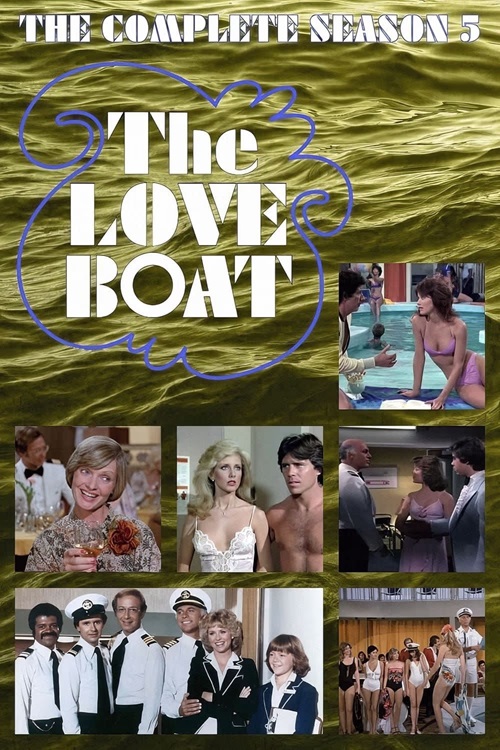
The Love Boat is back for a new year of reviews!

Episode 5.11 “He’s My Brother/Zeke and Zelda/Teach Me Tonight”

(Dir by Bruce Bilson, originally aired on December 5th, 1981)

This week, Doc Bricker’s brother boards the Love Boat and boy, does he turn out to be a jerk!  Fred Bricker (Jack Bannon) is bitter because their father paid for Doc to go to medical school while Fred had to stay behind on the farm.  Now, Fred is married to Nancy (Elaine Joyce) and worried about how he’s going to afford to send his own son to college.  Convinced that Doc is rich, Fred thinks that Doc should pay for his nephew’s college tuition.  Doc agrees.  Fred still acts like an ungrateful jackass but, when he learns that Doc has actually taken out a loan to pay the tuition, Fred realizes that Doc may not be rich but he is a good man.

The weird thing about this storyline is that Fred didn’t have enough money to send his kid to college but apparently, he did have enough money to take an expensive cruise on a luxury liner.  The other strange thing is that Fred didn’t know that Doc worked on the ship until he saw him in the lobby.  Fred just happened to buy a ticket for the same ship that his brother worked on.  Every episode of The Love Boat featured its share of implausible coincidences but this episode really pushes suspension of disbelief to its breaking point.  On a positive note, this story did allow us to see another side of Doc.  Bernie Kopell is always more believable when he gets to play Doc as being a nice guy as opposed to playing him as being an irredeemable lech.

Speaking of money, two old vaudevillians (played by Milton Berle and Martha Raye) haven’t had much of it ever since their style of performing went out of fashion.  Berle and Raye stowaway on the ship and then attempt to freeload their way through the cruise by pretending to be another set of passengers, Zeke and Zelda Van Buren (played by Herb Edelman and Elinor Donahue).  The captain is not amused when he finds out that someone is breaking the law on his boat but then Milton and Martha sing a duet of For Me And My Gal and all is forgiven.  The Captain arranges for them to get a job as entertainers on another ship.  I’ve noticed that the Captain never really seems to punish any of the many stowaways who have taken a trip on The Love Boat.  And you know what?  Good for him!  There’s a place for mercy in this cold world of ours.

Finally, romance novelist Michael Scott (Daryl Anderson) has a one night stand with teacher Emily Parker (Susan Richardson).  Michael — and yes, it’s impossible not to think of The Office whenever anyone mentions the character’s name — is stunned when Emily gets emotional after their night together.  “You’re acting like you’ve never done this before….” Michael says and, of course, it turns out that she hasn’t.  This was a pretty bleh storyline but it did lead to a funny scene where Michael attempts to have a conversation with Emily while two old ladies eavesdrop and freak out every time they hear the word “virgin.”

I enjoyed this cruise, mostly because it gave Bernie Kopell a chance to actually do some real acting for once.  I always like it when Doc turns out to be a nice guy.  Milton Berle and Martha Raye are, to put it lightly, an acquired taste but both of them give good performances in this episode and even manage to pull off their duet without making it too cringey.  As for the third storyline, it was defeated by the lack of chemistry between Daryl Anderson and Susan Richardson.  Still, two out of three is not bad.
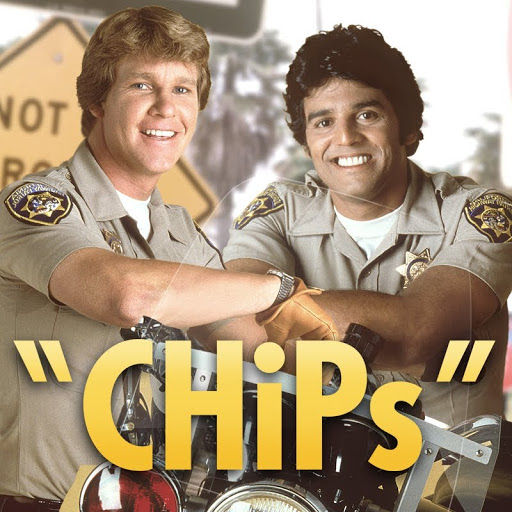
Late Night Retro Television Review: CHiPs 3.1 and 3.2 “Roller Disco”


Welcome to Late Night Retro Television Reviews, a feature where we review some of our favorite and least favorite shows of the past!  On Mondays, I will be reviewing CHiPs, which ran on NBC from 1977 to 1983.  The entire show is currently streaming on Prime!

This week, season three begins with a classic episode!

Episode 3.1 and 3.2 “Roller Disco”

(Dir by Don Weis, originally aired on September 22nd, 1979)

It’s the roller disco episode!

From the moment that I first announced that I would be watching and reviewing CHiPs for this feature, people have been telling me about the legendary roller disco episode.  Having finally reached it, I can say that it lived up to the hype.  You’re not likely to see anything more 70s than the third season premiere of CHiPs.

Now, this was a two-hour episode so there were actually quite a few subplot going on, all of which were typical CHiPs storylines.  In no particular order:

  1. A kid named Mark (Bobby Rolofson) is roller skating around the beach and idolizing three criminals.  Can Baker show him that the good guys always win?
  2. The three criminals are Lita (Helena Kallianiotes), Ty (Fred Williamson), and Romo (Jim Brown).  Lita sets up the targets.  Ty and Romo steal their purses and their wallets and then escape on roller skates.  Ty and Romo are tired of breaking the law.  Lita demands that they continue to steal.  Eventually, it falls to Baker and Ponch to arrest them.
  3. Carlin (Larry Linville) and Franco (Larry Storch) continually cause accidents on the highway.
  4. Rock star Jimmy Tyler (Leif Garrett) is so tired that he sleeps through one of those accidents.  Looking to break free from his well-meaning but overbearing manager (Bill Daily), Jimmy decides to manage his own affairs while staying at Jon Baker’s apartment.

There’s a lot going on but the main plotline is Ponch trying to find celebrities to take part in the annual highway patrol fund raiser.  Even with his big smile, Ponch struggles to charm the celebs.  He pulls over Ed McMahon at one point but fails to recognize him until McMahon drives off.  Gatraer tells Ponch that police work comes first but also tells him that he has to find celebrities.  Gatraer’s been giving Ponch a hard time ever since the first season.  Some things never change.

Fortunately, Jimmy feels guilty for overstaying his welcome at Baker’s apartment and he makes it up to Baker and Ponch by asking his celebrity friends to take part in the fund raiser.  It’s time for a roller disco with the stars!

It all leads to this classic scene:

I recognized a few of the stars, though certainly not all of them.  I recognized Victor French because I’ve been reviewing Highway to Heaven.  I’ve also seen enough old sitcoms that I immediately recognized Robert Mandan, who was apparently the best roller skater in Hollywood.  Melissa Sue Anderson, I knew from Happy Birthday To Me.  Cindy Williams, who got two shout-outs, I knew from American Graffiti.  Is it just me or did Nancy Kulp look kind of lost?  Neither Melissa Sue Anderson nor Cindy Williams seemed to want to talk to her.

The roller disco actually goes on for fifteen minutes, which I appreciated.  The show promised a roller disco and it delivered.  It was like stepping into a time machine and traveling to the 70s.  It was a great way to start season three!

Because of the holidays, this is going to be my final CHiPs review of 2024.  My reviews of this show will return on January 6th!

Retro Television Review: Fantasy Island 5.12 “The Magic Camera/Mata Hari/Valerie”


Welcome to Retro Television Reviews, a feature where we review some of our favorite and least favorite shows of the past!  On Tuesdays, I will be reviewing the original Fantasy Island, which ran on ABC from 1977 to 1984.  Unfortunately, the show has been removed from most streaming sites.  Fortunately, I’ve got nearly every episode on my DVR.

This week’s episode presents your erstwhile reviewer with a bit of an ethical quandary.

Episode 5.12 “The Magic Camera/Mata Hari/Valerie”

(Dir by Don Chaffey and Don Weis, originally aired on January 16th, 1982)

I don’t feel completely comfortable about reviewing this episode of Fantasy Island and I’ll tell you why.

Occasionally, Fantasy Island would broadcast an extra-long episode.  These episodes would typically feature three fantasies as opposed to the usual two.  Unfortunately, when these long episodes were syndicated, one of the fantasies would be edited out so the episode would fit into an hour-long slot.  Usually, the editing was not particularly smooth, either.  The end result would usually be an episode that seemed oddly paced and the performances of Ricardo Montalban and Herve Villechaize would often seem uneven as well.  As such, it’s neither easy nor particularly fair to review those edited episodes.  When it comes to reviewing, I always want to see the complete episode.

And yet, now that the original Fantasy Island is no longer streaming anywhere (seriously, what the Hell, Tubi?), I’m stuck using the episodes that I have on my DVR.  And that means reviewing the edited, syndicated versions of these episodes.

As you can probably guess, this is one of those edited episodes.  The Valerie fantasy was removed for syndication.  That’s a shame because Valerie featured the final televised performance of actor Christopher George, a charismatic B-movie veteran who is pretty popular around the Shattered Lens offices.  It also featured Michelle Phillips, though apparently she did not return as the mermaid who she played earlier on the show.  I’d love to review Valerie but I can’t.  And that sucks,

As for the other two fantasies, one is basically a remake of the Lillian Russell fantasy, except this time Martha Harris (Phyllis Davis) goes into the past and finds herself transformed into her great-grandmother, Mata Hari.  She gets to dance.  She gets to spy.  She gets thrown in prison and sentenced to death but, fortunately, her life is spared when the firing squad’s rifles are filled with blanks and she’s given a drug by one of the men who is in love with that makes her appear to be dead.  This was a enjoyable fantasy, mostly because of the costumes and the melodrama.

The other fantasy features Bob Denver, coming to the Island for the second week in a row.  This time, he’s a photographer who wants to take the type of pictures that the world’s greatest photographers couldn’t.  Because of the awkward way the fantasy was stated, the photographer ends up with a camera that takes pictures of the future.  At first, the photographer is really happy and uses his camera to commit a little insider trading.  But then he takes a picture of a newspaper and sees a headline announcing his death in a fiery auto accident.  Uh-oh!

Again, neither of the two fantasies is bad (though the second one does require a certain tolerance for Bob Denver that some people may not have) but it was hard for me to enjoy them knowing that I was missing out on a third fantasy.  For that reason, I assigning this episode a grade of incomplete.  If I ever get a chance to watch the complete episode, uncut, I’ll revisit this review but until then, I really can’t give an overall grade to this episode.

Finally, for those keeping track, both Julie and Tattoo join Roarke when it’s time to greet the guests.  That’s only second time that’s happened this season.

Insomnia File #24: A Star is Born (dir by Frank Pierson)


What’s an Insomnia File? You know how some times you just can’t get any sleep and, at about three in the morning, you’ll find yourself watching whatever you can find on cable? This feature is all about those insomnia-inspired discoveries!

If you found yourself awake and unable to sleep at 2:30 this morning, you could have always turned over to TCM and watched the 1976 film, A Star is Born. 

A Star is Born gets off to a good start by having Gary Busey give Kris Kristofferson a hit of cocaine.  As I pointed out on twitter, no movie that starts with Gary Busey offering cocaine to Kris Kristofferson can be all bad.

Anyway, Kris is playing John Norman Howard.  John Norman Howard is a big 70s rock star, which means that he has a beard and a bad case of ennui.  Despite all of the cocaine and whiskey, his career is on a downward spiral.  Part of the problem appears to be that he only sings one song and, half the time, he still can’t bring himself to remember all of the lyrics.  The song opens with John growling, “Are you a figment of my imagination or am I one of yours?” and John always ends up storming off stage before we can hear the rest of it.

Anyway, John ends up at this club in Hollywood that looks a lot like the place that Ryan Gosling opened up at the end of La La Land.  While at the club, John gets into a fight with Robert Englund (who I assume was playing a young Freddy Krueger) and totally interrupts the performance of the Oreos.

Who are the Oreos?   They’re a folk-singin’ power trio.  There’s One (Venetta Fields) and Two (Clydie King).  (According to the credits, that’s actually their names.)  And then there’s Esther Hoffman, who has a truly horrid perm and who is played by Barbra Streisand.  One and Two are black.  Esther, who stands right in the middle whenever they perform, is white.  And they’re called The Oreos!

Uhmmm, yeah…

Anyway, we really don’t learn anything about One or Two, beyond the fact that they are totally and completely devoted to Esther.  When Esther gets them fired from recording a cat food jingle, they just smile and laugh.  Sure, why not!?  After all, it’s not like struggling musicians need money or anything.  When Esther interrupts a performance to yell at John, One and Two smile and laugh.  When Esther, under John’s tutelage, becomes a big star and basically abandons the Oreos, One and Two show up at a recording session and smile and laugh.

Last night was my first time to actually see A Star is Born, though I had heard and read quite a bit about it.  Of all the versions of A Star is Born, this one made the most money at the box office but it also got the worst reviews.  Reportedly, the film’s production was a trainwreck with Barbra Streisand and then-boyfriend Jon Peters fighting with … well, everyone.

And yet, like so many cinematic trainwrecks, you simply cannot look away from it.  This version of A Star is Born gets so many things wrong that it becomes rather fascinating to watch.  Perhaps the scene that epitomizes A Star is Born comes when John refuses to perform his one song at a benefit concert and instead, brings out Esther and has her perform her songs.  First off, John’s hard rock band suddenly transforms into a Broadway orchestra and John’s audience — who presumably had paid money to hear that growling song about imagination — is overjoyed to instead have to listen to Esther’s style of lite pop/rock.  (Actually, to even call it rock is to needlessly stretch the definition of rock to its breaking point.)  Making the scene even more bizarre is that 1) John is basically exploiting a benefit concert to launch Esther’s career and 2) since the concert was being performed to support the American Indian Movement, the disembodied head of a Native American woman keeps appearing over Esther’s shoulder while she’s performing songs that have absolutely nothing to do with the cause that the concert is supposedly supporting.  It’s kind of the cinematic equivalent of that Kendall Jenner Pepsi commercial.

Anyway, things get even better when John buys an empty field and, in a ten minute montage, John and Esther literally build a house.  Seriously, I’m not kidding.  At no point do we see anyone other than John and Esther working on that house and yet, within a matter of minutes, they have an adobe mansion to live in.  I had no idea it was so easy to build a house.  It makes me wonder why people waste money buying houses when they can just buy an empty field and build their own.

(Maybe they’re scared of the poltergeists.  Imagine how different this version of A Star Is Born would have been if it ended with Esther grabbing John and screaming, “YOU MOVED THE HEADSTONES BUT YOU LEFT THE BODIES, DIDN’T YOU!?  YOU LEFT THE BODIES!”)

Kris Kristofferson is well-cast as John Norman Howard but the film is pretty much centered around Barbra.  That, in itself, wouldn’t be a problem if not for the fact that Barbra is completely miscast.  She’s a great singer but she’s not a rock singer.  You never believe that the same people who want to hear John sing his one song would also want to hear any of Esther’s songs.  The fact that the film is basically 140 minutes of everyone insisting that Esther is the future of music only reminds us of the fact that she’s not.  Her style is throwback to the past, which is one reason why everyone’s grandmother loves Barbra Streisand.

This wouldn’t be such a big deal if Barbra and Kris actually had any chemistry but they really don’t.  There’s a scene where Barbra and Kris take a bath together and Barbra puts makeup on Kris’s face.  Between two people who have chemistry, that would be sexy and sweet.  Between Kris and Barbra, it’s just kind of icky and you find yourself wondering who took the time to light the hundreds of candles surrounding them.  Whenever Barbra and Kris kissed, I worried for her just because all I could think of was the stubble burn that Esther would have to deal with later.

Yet, in the end, the film makes so many mistakes that it becomes one of the most watchable movies ever made.  It may not be good but it sure is entertaining.

Previous Insomnia Files:

  1. Story of Mankind
  2. Stag
  3. Love Is A Gun
  4. Nina Takes A Lover
  5. Black Ice
  6. Frogs For Snakes
  7. Fair Game
  8. From The Hip
  9. Born Killers
  10. Eye For An Eye
  11. Summer Catch
  12. Beyond the Law
  13. Spring Broke
  14. Promise
  15. George Wallace
  16. Kill The Messenger
  17. The Suburbans
  18. Only The Strong
  19. Great Expectations
  20. Casual Sex?
  21. Truth
  22. Insomina
  23. Death Do Us Part

Back to School #13: American Graffiti (dir by George Lucas)


Well, this is certainly intimidating.  I know I’ve said this many time before but it deserves to be repeated: it’s often a hundred times more difficult to review a great film than it is to review a merely mediocre one.  When a film fails, it’s usually easy to say why.  The acting was bad.  The directing was uninspired.  The plot didn’t make any sense.  Or maybe the film has been so overpraised that you, as a reviewer, are almost obligated to be tougher on it than you would be with any other film.  However, it’s never as easy to put into words just what exactlyit is that makes a movie great.

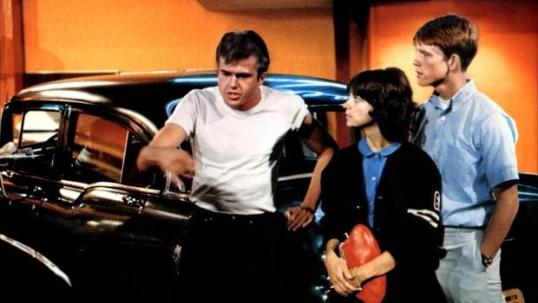
Take the 1973 Best Picture nominee American Graffiti for instance.  I could tell you that this is a very well-acted film and that it features an ensemble of very likable performers, many of whom subsequently went on to become stars and celebrated character actors.  Then again, you can say the same thing about countless other films.

american-graffiti-1973-03-g

I could say that director George Lucas does such a good job putting this film together that it’s hard to believe that he’s the same man who would later be responsible for all three of the Star Wars prequels.  Then again, I could also say the same thing about how odd it is that the same man who directed the entertaining Final Destination 5 was also responsible for the far less enthralling Into The Storm.

i007737

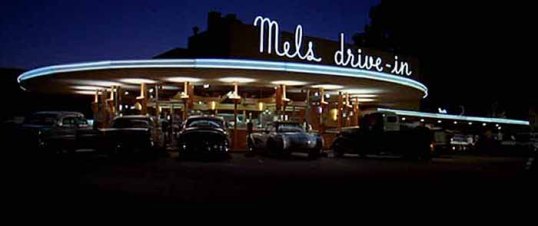
I could tell you that the film serves as a valuable time capsule in that not only does it feature a loving recreation of small town America in the early 60s but that it’s also a chance to see what Richard Dreyfuss, Ron Howard, and Charles Martin Smith all looked like when they still had hair.  But then again, I also praised The Young Graduates for being a time capsule as well.

MelsGraffiti

Let’s face it — it’s difficult to define the intangible qualities that make a film great.  Often times, it’s a case of simply knowing it when you see it.  I’ve seen American Graffiti a few times.  The last time I saw it was at a special Sunday showing at the Alamo Drafthouse.  And, on that early Sunday afternoon, the theater was packed with people who had paid for the chance to see the 40 year-old film on the big screen.  I’m 28 years old and it’s significant that, while the majority of the audience was older than me, there were quite a few people who were younger.  American Graffiti is one of those films that obviously spoke to audiences when it was first released and continues to speak to audiences today.

As I mentioned in my review of Rebel Without A Cause, films about teens tend to age quickly and, often times, one generation’s masterpiece will turn out to be a later generation’s joke.  When a film like Rebel or American Graffiti survives the test of time, it’s because the film has managed to capture a universal truth about what it means to be young and to have your entire life ahead of you.

American Graffiti takes place over the course of one long night in Modesto, California in 1962.  The film follows several different characters, the majority of whom have just graduated from high school.  What these characters all have in common is that one phase of their life has ended and a new one is about to begin.  Over the course of that one night, all of them are forced to say goodbye to their past identities and, in some instances, are forced to face their future.

Curt and the Pharoahs

For instance, there’s Curt (an amazingly young Richard Dreyfuss), a neurotic intellectual who spends the night trying to decide whether or not he actually wants to leave for college in the morning.  Complicating Curt’s decision is a mysterious blonde who mouths “I love you” at him before driving away.  While searching for her, Curt finds himself unwillingly recruited into the Pharoahs, a somewhat ludicrous small town gang that’s led by Joe (played, in hilariously clueless fashion, by Bo Hopkins.)  Curt, incidentally, is my favorite character in the film.  He’s just adorable, which admittedly is not a reaction that one often has to Richard Dreyfuss.

(Curt is also featured in one of my favorite scenes, in which he smokes a cigarette with a lecherous teacher named Mr. Wolf.)

Cindy Williams, Ron Howard, and Charles Martin Smith

Curt’s sister (Cindy Williams) is dating Steve Bolander (Ron Howard).  Steve is the former class president and, unlike Curt, he’s very excited about leaving home.  Ron Howard gives such a likable performance that it actually takes a few viewing to realize just how big of a jerk Steve really is.

Terry and Debbie


And then there Terry (Charles Martin Smith) who wears big glasses and has bad skin.  Terry gets to spend the night driving around in Steve’s car and manages to pick up a girl named Debbie (Candy Clark).  For Terry, this is his night to actually be somebody and what makes it all the more poignant is just how obvious it is that Terry will probably never get another chance.  Though he may not realize it, those of us watching understand that this is literally going to the be the best night of Terry’s life.

(Incidentally, much like Ron Howard, Charles Martin Smith would go on to become a film director and gave the world the amazingly sweet Dolphin Tale.)

John Milner

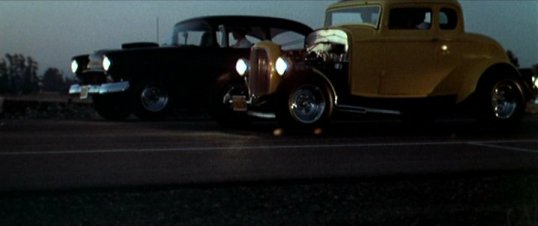
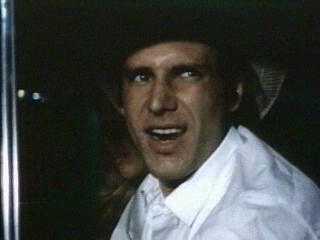
And finally, there’s John Milner (Paul Le Mat).  John is a little older than the other main characters.  He spends most of his time in his car, driving around and getting challenged to race.  He’s the epitome of late 50s/early 60s cool, with an attitude and a look that he obviously borrowed from James Dean and Marlon Brando.  Over the course of the night, he is forced to deal with a bratty 13 year-old stowaway (MacKenzie Phillips) and a mysterious challenger named Bob Falfa (played by a youngish Harrison Ford, who wears a cowboy hat and speaks with a country twang).

Harrison Ford in American Graffiti

The film follows these characters through the night and then, at the end of it, we get the famous epilogue where we discover that all of the male characters have pretty much ended up exactly how we thought they would.  In some cases, that’s a good thing.  And in other cases, it’s not.  It’s a good ending that’s kept from being great by the fact that none of the film’s female characters rate so much as even a mention.

So, what else can be said about American Graffiti?

It’s a great film.

Isn’t that enough?

American Graffiti